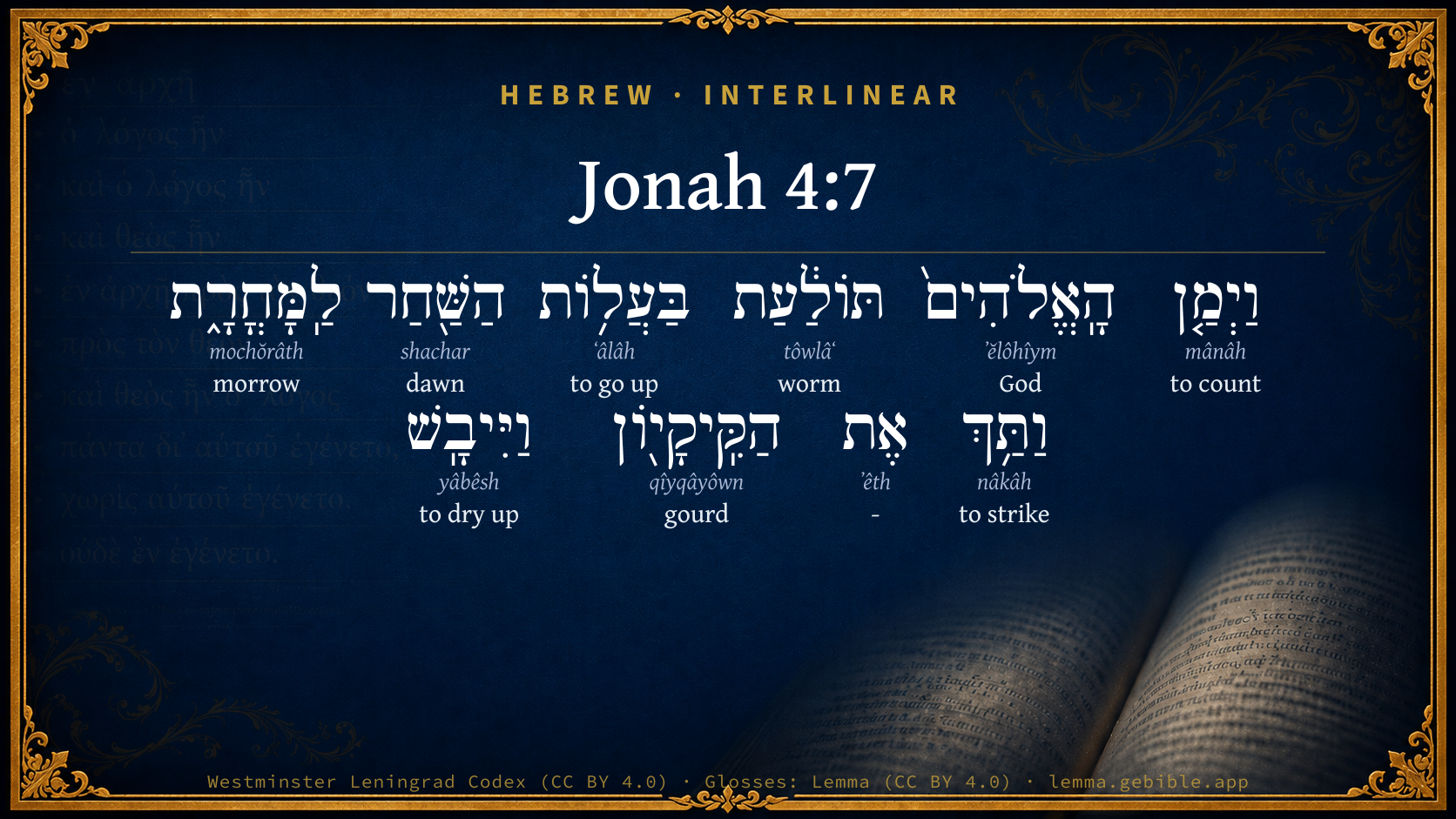
Jonah 4:7

Hebrew (Westminster Leningrad Codex) Jonah 4:7 appears in the Hebrew Old Testament. The text above is from the Westminster Leningrad Codex. Each word links to its Strong’s number, a concise gloss, and parsing drawn from the Open Scriptures Hebrew Bible morphology. Click any word for its full Brown-Driver-Briggs (BDB) entry.
Download image
Cite this verse

Jonah 4:7 (World English Bible). Public Domain. Lemma interlinear Bible study tool, https://lemma.gebible.app/v/jonah/4/7.

Show BibTeX & RIS
BibTeX
RIS
English Translation
But God prepared a worm at dawn the next day, and it chewed on the vine, so that it withered.
World English Bible · Public Domain
Download a study sheet

One document with this verse’s original text, its word-by-word gloss line, the meaning frame, cross-references with their text, attributed commentary, and full source and license credits — printable, and it pastes into notes with its structure intact.

This verse Autodidact and up

Study sheet (.html) Plain text (.txt)

A passage Seminary Student

Up to 50 verses in one chapter. A passage sheet keeps up to 6 commentary sources and 12 cross-references per verse, in the order this page ranks them, and says so on the sheet whenever that leaves anything out. Ask for a single verse and you get the Autodidact verse sheet above.

Everything on this page stays free to read, with no account — the sheet is a download of what is already on screen, not access to it.

Want to remove ads? Support Godless Engineer
Compare translations 3

The same verse in 3 English versions, stacked beneath the original-language interlinear above. Click any original word for its lexicon entry.

Each is an independent rendering of the whole verse — the interlinear is not word-aligned to these translations.

Highlighted words mark where these versions differ — a whole-verse word diff, not a word-by-word alignment.

  • World English Bible Public Domain
    But God prepared a worm at dawn the next day, and it chewed on the vine, so that it withered.
  • King James Version Public Domain
    But God prepared a worm when the morning rose the next day, and it smote the gourd that it withered.
  • unfoldingWord Literal Text CC BY-SA 4.0
    Then God appointed a worm at the rising of the dawn of the next day; and it attacked the plant, and it withered.

unfoldingWord Literal Text — © unfoldingWord, licensed CC BY-SA 4.0. Word-aligned USFM3 via Door43 (git.door43.org/unfoldingWord/en_ult).

Versions to compare (up to 4)

3 of 4 selected

Show all 18 translations

Every available English version of this verse, each an independent rendering of the whole verse.

  • World English Bible Public Domain
    But God prepared a worm at dawn the next day, and it chewed on the vine, so that it withered.
  • Berean Standard Bible Public Domain
    When dawn came the next day, God appointed a worm that attacked the plant so that it withered.
  • Majority Standard Bible Public Domain
    When dawn came the next day, God appointed a worm that attacked the plant so that it withered.
  • King James Version Public Domain
    But God prepared a worm when the morning rose the next day, and it smote the gourd that it withered.
  • American Standard Version (1901) Public Domain
    But God prepared a worm when the morning rose the next day, and it smote the gourd, that it withered.
  • Revised Version (1885) Public Domain
    But God prepared a worm when the morning rose the next day, and it smote the gourd, that it withered.
  • Geneva Bible (1599) Public Domain
    But God prepared a worme when the morning rose the next day, and it smote the gourd, that it withered.
  • Douay-Rheims (1899) Public Domain
    But God prepared a worm, when the morning arose on the following day: and it struck the ivy and it withered.
  • Young's Literal Translation Public Domain
    And God appointeth a worm at the going up of the dawn on the morrow, and it smiteth the gourd, and it drieth up.
  • Literal Standard Version CC BY-SA 4.0
    And God appoints a worm at the going up of the dawn on the next day, and it strikes the gourd, and it dries up.
  • Unlocked Literal Bible CC BY-SA 4.0
    But God prepared a worm at sunrise the next morning. It attacked the plant and the plant withered.
  • unfoldingWord Literal Text CC BY-SA 4.0
    Then God appointed a worm at the rising of the dawn of the next day; and it attacked the plant, and it withered.
  • Darby Bible Public Domain
    But God prepared a worm when the morning rose the next day, and it smote the gourd, that it withered.
  • World Messianic Bible Public Domain
    But God prepared a worm at dawn the next day, and it chewed on the vine so that it withered.
  • Webster's Bible Public Domain
    But God prepared a worm when the morning rose the next day, and it smote the gourd that it withered.
  • Free Bible Version CC BY-SA 4.0
    The next day at dawn the Lord had a maggot attack the plant and it withered.
  • Bible in Basic English Public Domain
    But early on the morning after, God made ready a worm for the destruction of the vine, and it became dry and dead.
  • JPS Tanakh (1917) Public Domain
    But God prepared a worm when the morning rose the next day, and it smote the gourd, that it withered.

Literal Standard Version (2020), Covenant Press — licensed CC BY-SA 4.0. Text via the HelloAO Bible API (eBible.org). Unlocked Literal Bible (unfoldingWord) — licensed CC BY-SA 4.0. Text via the HelloAO Bible API (eBible.org). unfoldingWord Literal Text — © unfoldingWord, licensed CC BY-SA 4.0. Word-aligned USFM3 via Door43 (git.door43.org/unfoldingWord/en_ult). Free Bible Version, Dr. Jonathan Gallagher — licensed CC BY-SA 4.0. Text via the HelloAO Bible API (eBible.org).

Word by word

More ways to search: Search by grammar → Find every occurrence → Compare this word →

Practice this passage: Drill this verse → Learn its vocabulary →

הַקִּֽיקָי֖וֹן
qîyqâyôwn
H7021
“the · gourd”
Particle, Definite Article + Noun, Common, Masculine, Singular, Absolute
Part of Speech
Particle + Noun
Type
Common
Gender
Masculine
Number
Singular
State
Absolute
Full BDB Definition

Origin: perhaps from H7006

TWOT: 2021

a plant - perhaps a gourd, castor-oil plant, bottle-gourd
  1. וַיְמַ֤ן mânâh H4487 “and · to count” Conjunction + Verb, Piel, Sequential Imperfect, 3rd Person, Masculine, Singular
  2. הָֽאֱלֹהִים֙ ʼĕlôhîym H430 “the · God(s)” Particle, Definite Article + Noun, Common, Masculine, Plural, Absolute
  3. תּוֹלַ֔עַת tôwlâʻ H8438 “worm” Noun, Common, Feminine, Singular, Absolute
  4. בַּעֲל֥וֹת ʻâlâh H5927 “in/at · to go up” Preposition + Verb, Qal, Infinitive Construct
  5. הַשַּׁ֖חַר shachar H7837 “the · dawn” Particle, Definite Article + Noun, Common, Masculine, Singular, Absolute
  6. לַֽמָּחֳרָ֑ת mochŏrâth H4283 “to/for the · morrow” Preposition, Determined + Noun, Common, Feminine, Singular, Absolute
  7. וַתַּ֥ךְ nâkâh H5221 “and · to strike” Conjunction + Verb, Hiphil, Sequential Imperfect, 3rd Person, Feminine, Singular
  8. אֶת ʼêth H853 “-” Particle, Direct Object
  9. וַיִּיבָֽשׁ yâbêsh H3001 “and · to dry up” Conjunction + Verb, Qal, Sequential Imperfect, 3rd Person, Masculine, Singular

About this verse

These counts appear in no published source. They are computed here, from the morphology-tagged text and Lemma’s own curated glosses. What Lemma adds →

10
words
10
distinct lemmas
Prophets
section

Notable vocabulary

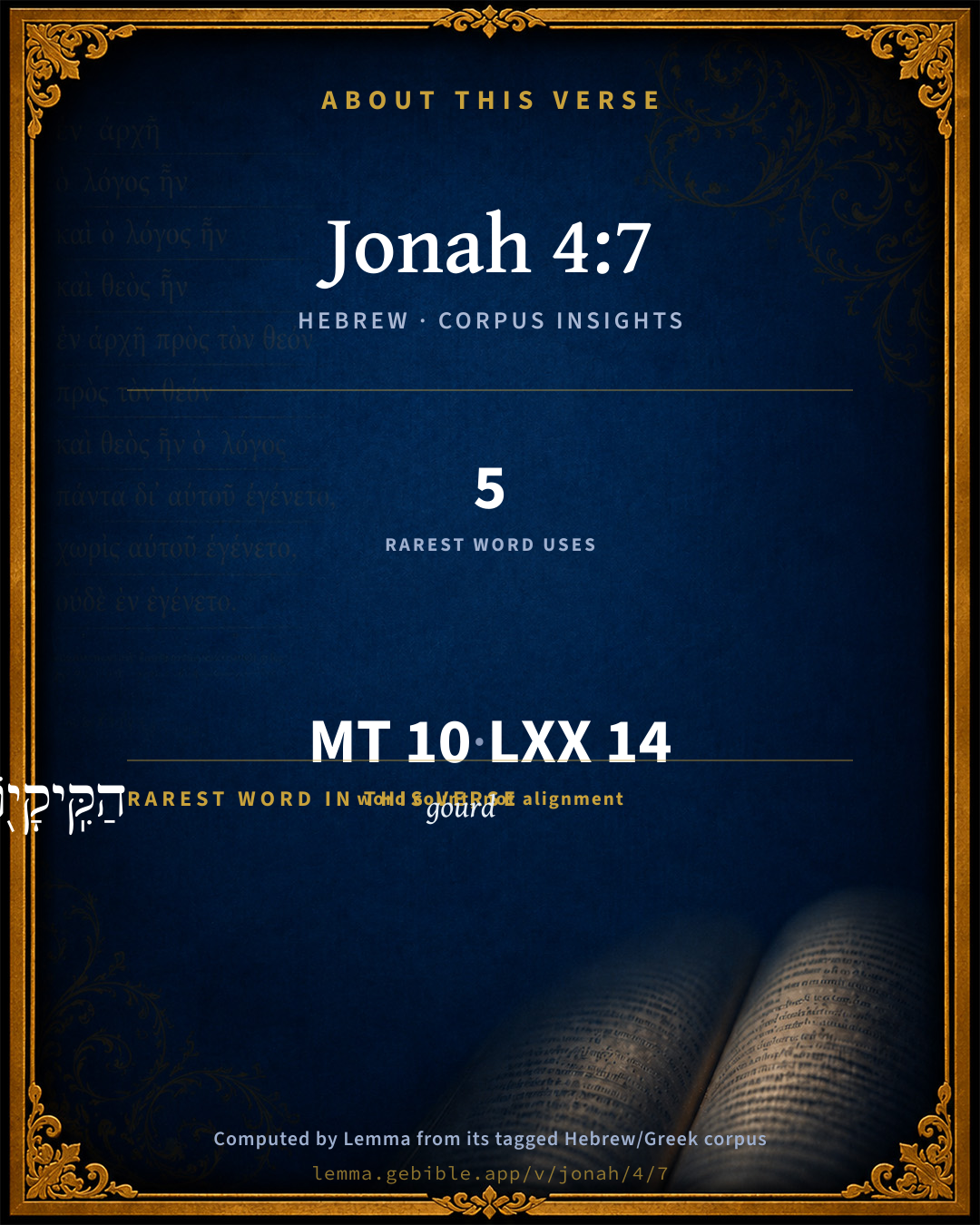
The rarest word here is הַקִּֽיקָי֖וֹן gourd H7021 — appearing just 5 times in the whole Hebrew Bible.

Shared distinctive vocabulary

הַקִּֽיקָי֖וֹן gourd H7021 occurs in 4 verses of the Hebrew Bible. Also found in:

Grammatical profile

  • 4 verbs
  • 5 nouns
  • 1 particle

Verb forms

  • וַיְמַ֤ן Piel · Sequential Imperfect
  • בַּעֲל֥וֹת Qal · Infinitive Construct
  • וַתַּ֥ךְ Hiphil · Sequential Imperfect
  • וַיִּיבָֽשׁ Qal · Sequential Imperfect

Hebrew & Septuagint length

In English translation the verse runs 20 words from the Hebrew and 17 from the Septuagint (LXX English) — closely comparable.

A rough comparison of the two English renderings, which tokenize alike — not a word-level alignment.

Word counts can differ between the Hebrew and the Greek without any difference in meaning — e.g. the Hebrew direct-object marker אֵת has no separate Greek word, and Greek often adds the article ὁ.

In the original languages it is 10 Hebrew tokens and 14 Greek tokens — but the two are counted differently (Hebrew bundles its prefixes and suffixes into one token; the Greek is in lemma form), so that isn’t a like-for-like length.

Cross-references

6

Topical passages linked to Jonah 4:7 in the Treasury of Scripture Knowledge — connected by theme and wording, ordered by reader-vote popularity; previews shown in the World English Bible.

  • Joel 1:12 The vine has dried up, and the fig tree withered; the pomegranate tree, the palm tree also, and the apple tree, Even all of the trees of the field are withered; For joy has withered away from the sons of men.
  • Psalms 90:5–6 You sweep them away as they sleep. In the morning they sprout like new grass.
  • Job 1:21 He said, "Naked I came out of my mother's womb, and naked shall I return there. Yahweh gave, and Yahweh has taken away. Blessed be the name of Yahweh."
  • Psalms 30:6–7 As for me, I said in my prosperity, "I shall never be moved."
  • Psalms 102:10 Because of your indignation and your wrath, For you have taken me up, and thrown me away.
  • Isaiah 40:6–8 The voice of one saying, Cry. One said, What shall I cry? All flesh is grass, and all the glory of it is as the flower of the field.

Cross-references courtesy of OpenBible.info (CC BY 4.0).

Hebrew and Greek witnesses Masoretic Hebrew ↔ Greek Septuagint

The same verse in the two great witnesses to the Old Testament, shown verse-for-verse.

These are two independent witnesses, not word-aligned to each other, and the Septuagint is shown in lemma (dictionary) form.

Hebrew Jonah 4:7 Masoretic · Westminster Leningrad Codex

וַיְמַ֤ן הָֽאֱלֹהִים֙ תּוֹלַ֔עַת בַּעֲל֥וֹת הַשַּׁ֖חַר לַֽמָּחֳרָ֑ת וַתַּ֥ךְ אֶת הַקִּֽיקָי֖וֹן וַיִּיבָֽשׁ

But God prepared a worm at dawn the next day, and it chewed on the vine, so that it withered.

World English Bible · Public Domain

Greek LXX Jonah 4:7 Septuagint · lemma form

καί προςτάσσω ὁ θεός σκώληξ ἑωθινός ὁ ἐπαύριον καί πατάσσω ὁ κολόκυνθα καί ἀποξηραίνω

And God commanded a worm the next morning, and it struck the gourd, and it withered away.

LXX2012 (modern English Septuagint) · Public Domain

Hebrew: Westminster Leningrad Codex (CC BY 4.0). Greek: Septuagint (public domain); English from LXX2012 (modern English Septuagint) (Public Domain). How the Septuagint differs from the Hebrew →

Targum (Aramaic paraphrase)

1

The Targum is the ancient Jewish Aramaic paraphrase of the Hebrew Scriptures — an interpretive translation, not the Hebrew text itself. Onkelos (literal) and Pseudo-Jonathan (expansive) render the Torah, and Jonathan the Prophets. Coverage is partial: where no permissively-licensed English translation exists for a verse, only the Aramaic is shown. This is verse-level text, not a word-by-word alignment to the Hebrew.

  1. Targum Jonathan Prophets (Joshua–Malachi)
    וְזַמֵין יְיָ יַת תּוֹלַעְתָּא בְּמֵיסַק צַפְרָא בְּיוֹמָא דְבַתְרוֹהִי וּמְחָא יַת קִיקָיוֹן וִיבָשׁ:

    And the LORD invited a worm as the sun rose on the net day, and it struck the gourd and it wilted.

    Targum Jonathan — Aramaic: “Mikraot Gedolot” (public domain). English: “Sefaria Community Translation” (CC0 1.0 (public-domain dedication)); “London "Chaldee Paraphrase," 1871” (public domain). Text via Sefaria.

Commentary

Notes on Jonah 4:7 from classic Christian and Jewish commentators (each source and its license shown beneath its notes). The classic Christian expositions comment on the surrounding passage and are grouped to its opening verse, so a note may address several verses; the Jewish commentaries on the Tanakh (Rashi and others) are per-verse, so they appear only where the commentator wrote on this verse.

Lemma curates 59 commentaries, every one of them public domain or Creative Commons licensed, each selected and text-cleaned for this edition rather than reprinted as found. About our sources →

Trapp's Complete Commentary

John Trapp

Jon 4:7 But God prepared a worm when the morning rose the next day, and it smote the gourd that it withered.

Ver. 7. But God prepared a worm] All occurrences are to be ascribed not to nature, fate, or fortune, but to God, who, as he is great in great things, so is he not little in the least, maximus in magnis, nec parvus in minimis. He prepared first the gourd, and then the worm, and then the wind. He was the great doer in all. He so attempereth all that his people shall have their times and their turns of joy and sorrow. These two are tied together, said the heathen, with chains of adamant; hence also Ageronia’s altar in the temple of Volupia (Plut.). See the circle God usually goes in with his, Psa 30:5-7, &c., to teach them that all outward comforts are but as grass or flower of the field, which he can soon blast or corrode by some worm of his providing. Moneo te iterumque iterumque monebo, saith Lactantius, I warn thee, therefore, and will do it again and again, that thou look not upon those earthly delights as either great or true to those that trust them; but as things that are not only deceitful, because doubtful, but also deadly, because delicious. There is a worm lies couchant in every gourd to smite it, a worm to waste it, besides the worm of conscience bred in that froth and filth, for a perpetual torment.

And it smote the gourd that it withered] Plants have also their wounds, diseases, and death, saith Pliny (lib. 17, cap. 14). The gourd being gnawed at the root, and robbed of its moistness, withered. Sic transit gloria mundi. So fleeting is the glory of the world. But "the righteous shall flourish like a palm tree" (not like this palm crist), Psa 92:12. Now the palm tree, though it have many weights at the top and many snakes or worms at the root, yet it still says, Nec premor nec perimor, I am neither borne down nor dried up; but as Noah’s olive drowned, kept its verdure; and as Moses’ bush fired but not consumed; so fareth it with the righteous, "persecuted, but not forsaken," &c., 2Co 4:8-9, and at death a crown of life awaits him, quanta perennis erit, an imperishable crown, an inheritance undefiled, and that withereth not, 1Pe 5:4, that suffereth no wasting away but is reserved fresh and green for you in heaven; like the palm tree, which Pliny saith never loseth his leaf nor fruit; or like that Persian tree, whereof Theophrastus saith, that at the same time it doth bud, blossom, and bear fruit.

John Trapp, A Commentary or Exposition upon All the Books of the Old and New Testament (1647–1656) — public domain. Text from a community e-Sword module.

The Biblical Illustrator

Joseph S. Exell

Jon_4:7

But God prepared a worm when the morning rose the next day.

The prepared worm

Just when Jonah had felt the delight of the shadowing foliage, and had begun to promise himself a most comfortable retreat against an Assyrian sun, the broad-leaved gourd withered. What caused this calamity? A worm. No, that is not all. God prepared the worm. But He also prepared the gourd. Does He, then, build up in order to destroy? Does He give comfort to His creatures in order to torment them by its removal?

I. God is the author of affliction. God asserts in His Word, that all the losses in the world are sent by Him. By evil is often meant calamity, not wickedness. God is the Author equally of prosperity and adversity to His creatures. He uses agents, but we must not forget that He is behind them. He is the Author of affliction, whatever may be the agencies He uses in the course of His providence.

II. He uses the natural laws of the world as his agents in afflicting. The worm merely followed the impulses of its nature. That is all science can say. But God has made all things, however great, however small, for Himself. The things which we call laws are only the methods of His activity, Nature is a forlorn object to study unless we find it a mirror to reflect God.

IV. God is just in afflicting us. Simply as the Maker and Owner of His creatures, God has a right to afflict. But He has entered into a covenant with us. He has said, Do ye according to My commandments, and ye shall live. What is the record of our race since? Have we obeyed, or have we disobeyed? Surely we have come into the need of affliction. If God would be just in casting us down to hell for our disobedience, surely He is just in laying upon us disciplinary afflictions.

IV. God afflicts us in his love. With all Jonahs sins against God, it was not to punish him that God prepared a worm. Gods aim in affliction is our restoration, our improvement. There are uses of adversity. However harsh the voice of God may seem to us, it is yet a Fathers voice, with a Fathers heart behind it. Inferences--

1. If God afflicts, how foolish it is to go to the world for relief.

2. Gods worms for us prove an interesting study.

3. When our gourds wither it is proof that God is near. (Howard Crosby, D. D.)

A worm-smitten gourd

I. God has a right to recall His gifts.

II. God may recall at any time. He has placed Himself under no obligation.

III. God may recall the gift when it is apparently most needed. When the morning rose the gourd was smitten.

IV. God may recall the gift when we are beginning to appreciate it most. When Jonah was exceeding glad because of the gourd, it withered.

V. God may recall the gift by any instrumentality He may choose. A worm smote the gourd. Some apparently insignificant thing may be Gods agent for our deprivation.

VI. God, after recalling the gift, can comfort the sorrowing, and can compensate for the loss. (Homiletic Review.)

The lesson of the gourd

Jonahs gourd teaches us that the Lord mercifully cares for the comfort of His creatures, and that He is kind even to the unthankful and to the evil. Perhaps Jonah was a little too glad of the temporal refreshment of the gourd. This is the mistake we are all tempted to commit with regard to our temporal comforts and conveniences. We are so glad of them that we pillow our hearts upon them. But are our earthly comforts incorruptible and undecaying? There is a worm at the root of all our earthly comforts. The fashion of this world passeth away. But let a man, through grace, enjoy his comforts soberly, habitually regarding them as transient things; let him look up through the gift unto the Giver, and then, when his gourd is withered, he will still bless and magnify the Hand that withered it. (A. Roberts, M. A.)

Creature comforts withered

A very awful proof of human depravity, in Gods own people, is recorded in the case of Jonah. If Jonahs corruption is very conspicuous, the mercy of God is yet more so, both as it respects Jonah and the Ninevites. See what absolute obedience God requires of all His prophets and people in general This prophecy teaches us that Gods dispensations may vary, and be different from His threatening, without any change taking place in His nature or purpose. God so wisely governs His kingdom that even in His very punishment of the rebellions of His people He investeth them with honour, so little is His goodness dependent on human worthiness. Here we find Jonah exceedingly displeased, very angry indeed, at Gods merciful conduct towards Nineveh. He reasons with God against His merciful conduct towards that great city. In the heat of his angry impatience he wants to die. God rebukes Jonahs impatience in gentle terms, and the prophet seems to have conceived some hope that God for his sake might yet destroy the city; therefore he fled from it and waited the issue in painful suspense. He made a booth, and rested under its shade, and to make it more comfortable God covered it with a gourd. But as Jonahs grief had been carnal and rebellious, so now his joy was merely sensual, the excess of which it behoved the Almighty to curb. Therefore God suddenly destroyed the gourd. Doctrine--That as mankind in general are apt, like Jonah, to delight to sit under the shadow of a gourd, God hath very wisely, and in great love, ordained a worm at the root of every gourd of creature delight and comfort; by which means He drives His people to a more excellent dwelling-place, and more certain dependence.

1. Point out some things in which people are apt to promise themselves great pleasure and satisfaction, but which in the event evidently appear to be no better than Jonahs withered gourd. Such as riches, self-indulgence in food, children, human esteem, connections in social life. Trust in mere outward ordinances. Too high expectations even from relation to a gospel church.

2. At the root of every gourd there is a canker worm, whose envenomed bite smiteth it that it withereth. Apply to the above-mentioned human pleasures. God will by no means have creatures dignified with any dignity besides that with which He Himself is pleased to invest them. Now point out a certain antidote against the poison of this canker-worm which is the thing to be attended to.

(1) The vanity, emptiness, and uncertainty of worldly riches.

(2) All temporal honours vanish in the grave, where distinctions are no longer known.

(3) Children are certain cares, but very uncertain comforts. Cease, then, O believer, cease from temporary gourds. Call back thy wandering affections from transitory objects, and sit down under the shadow of thy only Lord and Saviour. (John Macgowan.)

The God of the worm

This writer does not, as many foolishly do, banish God from His universe to watch in idle unconcern its workings from afar. This book says, God answered, God commanded, God saved, God bethought, God excited the wind, God made the great fish, God caused a gourd to grow, God made a worm, God repented and God spared. It is God, God, God. He is the explanation of all things, and His existence gives purpose and meaning to all things. Or think again of the character of God as it is here explicitly set forth in words. He is the gracious God and merciful, long-suffering, abundant in kindness, and repentant of the evil. This is one of the most evangelical writings in the Old Testament. What an expression it gives of the Divine love to all mankind, and how it forespeaks like the first gleam of the dawn that universal brotherhood of men so bound up with the Fatherhood of God as it is proclaimed by Christ. How nobly, too, the doctrine of repentance and its value are stated. Assuredly this is a great book with a great message and high teaching on the nature, character, and purpose of God. And now, keeping all that in view, and distinctly remembering that the God of this book is the merciful and is a God of purpose, let us think of the statement of the text, And the Lord prepared a worm. That is a truth before which many people stagger. There are people, some who may be said never to have thought at all, and some who have thought much but mistakenly, who cannot understand the character of a holy God who in any way sends pain, suffering, loss, who, in short, prepares a worm. They can understand the God of the gourd, who provides protection and safety, but they cannot understand a God of discipline and rebuke and chastisement. At such a thought they rebel and stagger, or sulk in unbelief. They are prepared readily and gladly to believe in the God of the gourd, but not in the God of the worm; in the God of the rose, but not in the God of the thorn. Happiness, gifts, and love, these are all marked by His hand, but loss and suffering and sorrow, too, may be His instruments of good. Through the chastisement of His love men may find the best He has to give. And yet we must be careful here to differentiate. Is it not true that a great deal of the sorrow and evil that are in the world are wrongly blamed on God? There is nothing plainer than that a large proportion of the evil that afflicts man and burdens life is a direct outcome of the breach of Gods laws of truth and justice and love. They are clearly the fruit of sin, and sin is in mans will. But sin is against Gods purpose, and He is ever seeking to destroy it. Ah! Its mans inhumanity to man that makes countless thousands mourn; it is the selfishness and the pitilessness, the unscrupulousness and injustice of the human heart, the ignorance and superstition of the human mind that have caused the very creation to groan and travail in pain; it is no will or act of Gods. To-day, as then, there is the tendency for people, by ignorance and injustice and moral laziness, to bring upon themselves and their neighbours the ravages of disease, the miseries of unholy social relationships, the shame that crushes the heart with unhealable sorrow, and to blame God for it all, and to preach resignation in the midst of it, when it is our plain duty to rise up and to deal with the causes of such things--to slay the evil, to tear up its roots, to fight against the wrong that needs resistance and for the cause that needs assistance, and to bring in the Kingdom of God, which is life and health and peace. But after all that has been said, there still remain suffering and evil in the world, and we can do nothing to explain it, and still less to remove it. It is oftentimes a great mystery, and it burdens many hearts with heavy perplexity. The only explanation that can be given of it is that God permits it; yea, that He sends it, and that tie has got a great purpose in it. Neither did this man sin, nor his parents; but he was born blind in order that he might manifest the works of God. The man suffered not only for himself but for others; yea, in his suffering there was a Divine purpose. He illustrated that great principle everywhere present in nature and in life, and which found its sublimest expression in the Cress itself, the deep and precious truth that much suffering is vicarious. Now towards such pain, suffering, sorrow--and which cannot be removed and but little explained--two attitudes may be assumed. In the midst of it men may forget God, or ignore Him altogether, or rebel against Him. There are many people who are not able to see God for their trouble; they are afflicted with the rebellious heart. All this, of course, in no way mitigates the evil or helps them in the day of their suffering; it only twists their nature and warps and stunts their inner life. It is evil added to evil, and no gain anywhere, for the trouble still remains. Rebellion only aggravates the trouble. To have done with God and religion makes matters worse instead of better. The other attitude is that of humble submission and recognition of the truth that God has prepared a worm, and that He, the merciful and the holy, has a purpose in it. Before anyone can have any light on the great mysteries of suffering and sorrow he must first learn and distinctly recognise that the end of life is not happiness, but character; that discipline is necessary to character, that submission and a spirit of devout resignation are the only way to get good by seeking even through pain and suffering--character, holiness, Christ-likeness. It is a truth which all the great teachers of the world have declared. It was taught by Buddhist as it was by the Greek dramatist, by the Stoic as it is by the Christian; but the Christian looks at it from a loftier height than any other, and recognises in it the fatherly purpose of the Eternal God, who maketh all things work together for good to them that love Him, and causeth our light affliction, which is but for a moment, to work for us a far more exceeding and eternal weight of glory. Resignation is the attitude of the wise. The distinct recognition of the fact that God made the worm is the wisdom of the holy. But how many mistake what is meant by resignation! Mr. Gladstone, whom Lord Salisbury described as a great Christian, in writing to his wife, said that resignation is too often conceived to be merely a submission, not unattended by complaint, to what we have no power to avoid. But that is less than the whole work of a Christian. Our full triumph will be found when we not merely repress inward tendencies to murmur, but when we would not even, though we could, alter what in any matter, God has willed. Here is the great work of religion, here is the test from which sanctity is attained. And surely sanctity is Gods greatest gift to men. How many of the saintliest characters that the world has known have been those who have learned this great lesson in the school of God, when they met pain without murmuring, and sorrow with resignation; when through loss they found gain, and so treasured up in themselves that enduring wealth. The greatest instrument that the world has ever known for the shaping of human character is the will of God, and the glad acceptance of it as wisdom and love and life. I read somewhere not long ago an illustration that may help us to understand this truth and seal it on our hearts. The end is not clear, not yet; some day it will become plain, when the tuning is over and the discipline is done. Meanwhile we can trust Him who is the God of the worm as He is of the gourd, the God at once of the rose and thorn. (D. L. Ritchie.)

The Biblical Illustrator, edited by Joseph S. Exell (c. 1880s–1900s) — public domain. Text from a community e-Sword module.

Jamieson, Fausset & Brown

Robert Jamieson, A. R. Fausset & David Brown

a worm--of a particular kind, deadly to the ricinus. A small worm at the root destroys a large gourd. So it takes but little to make our creature comforts wither. It should silence discontent to remember, that when our gourd is gone, our God is not gone.

the next day--after Jonah was so "exceeding glad" (compare ).

Jamieson, Fausset & Brown — Commentary Critical and Explanatory on the Whole Bible (1871) — public domain (CC PDM 1.0). Text via the HelloAO Bible API.

Adam Clarke's Commentary

Verse 7. But God prepared a worm] By being eaten through the root, the plant, losing its nourishment, would soon wither; and this was the case in the present instance.

Adam Clarke's Commentary on the Bible (1810–1826) — public domain. Text from a community e-Sword/MySword module.

John Calvin's Commentaries

But it is said afterwards that a worm was prepared. We see here also, that what seemed to happen by chance was yet directed by the hidden providence of God. Should any one say, that what is here narrated does not commonly happen, but what once happened; to this I answer, — that though God then designed to exhibit a wonderful example, worthy of being remembered, it is yet ever true that the gnawing even of worms are directed by the counsel of God, so that neither a herb nor a tree withers independently of his purpose. The same truth is declared by Christ when he says, that without the Father’s appointment the sparrows fall not on the ground, (Matthew 10:29.) Thus much as to the worm.

John Calvin's Commentaries (1540-1563) — public domain. Text from the Calvin Translation Society English edition (1840s-50s) via the Christian Classics Ethereal Library (ccel.org). Calvin's coverage is partial (roughly two-thirds of the Bible); uncommented books and verses are honest gaps, never fabricated. The 19th-century editor's footnotes and remarks are omitted so the notes are faithfully Calvin's own voice.

Ellicott's Commentary for English Readers

(7) A worm.—Possibly to be taken collectively, as in Isa_14:11, for a swarm of caterpillars.

A Bible Commentary for English Readers, edited by Charles John Ellicott (1878–1897) — public domain. Text from a community e-Sword module.

The Cambridge Bible for Schools and Colleges

gen. ed. J. J. S. Perowne

7. a worm] This of course may mean a single worm which either by attacking the root or gnawing the stem, still young and tender and not yet hardened by maturity, suddenly destroyed the palmchrist. It is better, however, to take the word in its collective sense, worms, as in Deu_28:39; Isa_14:11, and other passages. Thus the special intervention of Almighty God again accommodates itself to nature. “The destruction may have been altogether in the way of nature, except that it happened at that precise moment, when it was to be a lesson to Jonah. ‘On warm days, when a small rain falls, black caterpillars are generated in great numbers on this plant, which, in one night, so often and so suddenly cut off its leaves, that only their bare ribs remain, which I have often observed with much wonder, as though it were a copy of that destruction of old at Nineveh.’ ”—Pusey.

The Cambridge Bible for Schools and Colleges (gen. ed. J. J. S. Perowne; Cambridge University Press, 1878–1918) — public domain. Text from a community e-Sword module.

John Gill's Exposition

But God prepared a worm when the morning rose the next day,.... That God that prepared this plant to rise so suddenly, almost as soon prepared a worm to destroy it; for it rose up one night, continued one whole day, to the great delight of Jonah; and by the morning of the following day this worm or grub was prepared in, it, or sent to it, to the root of it: this shows that God is the Creator of the least as well as the largest of creatures, of worms as well as whales, contrary to the notion of Valentinus, Marcion, and Apelles; who, as Jerom (s) says, introduce another creator of ants, worms, fleas, locusts, &c. and another of the heavens, earth, sea, and angels: but it is much that. Arnobius (t), an orthodox ancient Christian father, should deny such creatures to be the work of God, and profess his ignorance of the Maker of them. His words are,

"should we deny flies, beetles, worms, mice, weasels, and moths, to be the work of the King Omnipotent, it does not follow that it should be required of us to say who made and formed them; for we may without blame be ignorant who gave them their original;''

whereas, in the miracle of the lice, the magicians of Egypt themselves owned that the finger of God was there, and were out of their power to effect; and to the Prophet Amos the great God was represented in a vision as making locusts or grasshoppers, Amo 7:1; and indeed the smallest insect or reptile is a display of the wisdom and power of God, and not at all below his dignity and greatness to produce; and for which there are wise reasons in nature and providence, as here for the production of this worm: the same God that prepared a great fish to swallow Jonah, and a gourd to shadow him, and an east wind to blow upon him, prepared this worm to destroy his shade, and try his patience:

and it smote the gourd, that it withered; it bit its root, and its moisture dried up, and it withered away at once, and became useless: that same hand that gives mercies can take them away, and that very suddenly, in a trice, in a few hours, as in the case of Job; and sometimes very secretly and invisibly, that men are not aware of; their substance wastes, and they fall to decay, and they can scarcely tell the reason of it; there is a worm at the root of their enjoyments, which kills them; God is as a moth and rottenness unto them; and he does this sometimes by small means, by little instruments, as he plagued Pharaoh and the Egyptians with lice and flies.

(s) Prooem. in Philemon. ad Paulam & Eustochium. (t) Adv. Gentes, l. 2. p. 95.

John Gill's Exposition of the Whole Bible (1746–1763) — public domain (CC PDM 1.0). Text via the HelloAO Bible API.

Albert Barnes' Notes on the Bible

When the morning rose - , i. e., in the earliest dawn, before the actual sunrise. For one day Jonah enjoyed the refreshment of the palm-christ. In early dawn, it still promised the shadow; just ere it was most needed, at God’s command, it withered.

Albert Barnes' Notes on the Bible (1834–1885) — public domain. Text from a community e-Sword/MySword module.

Matthew Poole's English Annotations

But God, by the same power which caused the gourd suddenly, and to Jonah’s great joy, to spring, grow, and spread itself as a canopy,

prepared also a

worm, what, is not said, some contemptible grub that was not seen by Jonah; which early next morning, i.e. by break of day, bit the root, so that the whole gourd suddenly withered.

Matthew Poole's English Annotations on the Holy Bible (1683–1685) — public domain. Text from a community e-Sword/MySword module.

Whedon's Commentary on the Bible

Daniel D. Whedon

7. The joy was short-lived. At the divine command a worm came which gnawed the roots of the “gourd,” so that it perished.

Smote — As in Jon_4:8, to indicate the suddenness of the effect. Concerning the suddenness with which the castor-oil plant perishes Dr. Pusey says: “On warm days when a small rain falls, black caterpillars are generated in great numbers on this plant, which in one night so suddenly and so often cut off its leaves that only their bare ribs remain; which I have often observed with much wonder, as if it were a copy of that destruction of old at Nineveh.” 8. With the “gourd” dead, the hot rays of the sun could again beat mercilessly upon the head of Jonah.

Vehement [“sultry”] east wind — See on Hos_12:1. When these east winds are blowing the temperature rises very rapidly (G.A. Smith, Historical Geography, p. 67). The exact meaning of the word translated “vehement” or “sultry” is not known; but it is clear that the author intends to describe the wind as extraordinarily intense and disagreeable. Jonah soon became aware of the change.

He fainted — Not necessarily, “he became unconscious,” for he retained his senses sufficiently to wish for death; but, “he became completely exhausted” (Amo_8:13). The old despondency returned, increased by the intense heat, and once more he prayed for death (Jon_4:3).

Daniel D. Whedon (gen. ed.), Commentary on the Old and New Testaments (1874–1909) — public domain. Text from a community e-Sword module.

The Pulpit Commentary

Prepared (see note on ver. 6). A worm. Either a single worm which punctured the stem and caused the plant to wither, or the word is used collectively, as in Deu_28:39, for "worms." A single warm night, with a moist atmosphere, will suffice to produce a host of caterpillars, which in an incredibly short time strip a plant of all its leaves. When the morning rose. At the very earliest dawn, before the actual rising of the sun. (comp. Jud_1:9:33) Jonah seems to have enjoyed the shelter of the gourd one whole day. The withering of the plant came about in a natural way, but was ordered by God at a certain time in order to give Jonah the intended lesson.

The withering of earthly consolation.

If Jonah"s vexation and anger were due first to the sparing of Nineveh, and the mortification of his self-importance, similar emotion was excited within him by the deprivation of personal comfort which was appointed by Divine providence.

I IN TIMES OF TROUBLE GOD APPOINTS DIVINE CONSOLATIONS FOR HIS PEOPLE. The gourd, or palmcrist, which the Author of nature caused to grow up over Jonah"s booth, was "for a shadow over his head, to deliver him from his grief." Such a refuge, shelter, shadow, Providence often appoints for those who are in distress. Some unexpected provision for want, some gracious alleviation of suffering, some marvellous deliverance from impending danger, reveals the thoughtful and loving care of the Most High.

II GOD IN HIS MERCY THUS TURNS SORROW INTO GLADNESS. "Jonah was exceeding glad of the gourd." It was itself beautiful to behold, and its cool shelter was refreshing, and it was a pleasant and welcome emblem of Divine care and kindness. Many have been made glad according to the days in which they have been afflicted, to the years in which they have seen evil. Of many once storm-tossed and imperilled it may be said, "They are glad because they be quiet." It is right to rejoice when Eternal Mercy rescues and delivers those who are in trouble and distress.

III CONSOLATIONS ARE OFTEN SHORT-LIVED AND DISAPPOINTING. The caterpillars which smote the palmcrist in a few hours robbed Jonah of his comfort, so that his new, dawning joy was overcast with clouds of gloom. And this withering was an emblem of the transitory nature of all earthly happiness and prosperity. The comforts which God sends he takes away, lest we should set our hearts upon created good. Health fails, property is lost, friends die, bright prospects are clouded, hopes perish- Nothing continueth in one stay. "This world is all a fleeting show, For man"s illusion given; The smiles of joy, the tears of woe, Deceitful shine, deceitful flow: There"s nothing true but heaven.

IV THE PRIVATION OF EARTHLY COMFORTS IS INTENDED TO LEAD MEN TO SEEK THEIR HIGHEST GOOD IN GOD. Such discipline does not, indeed, produce this effect upon all men; many are hardened, some are driven to despair, by adversity. But with regard to the truly pious, it may be said that, when the gourd withers, the Giver is as firmly trusted and as warmly loved as when the shelter was thick and green. "Though vine nor fig tree neither Their wonted fruit should bear; Though all the field should wither, Nor flock nor herd be there; Yet God the same abiding, His praise shall tune my voice; For while in him confiding, I cannot but rejoice.

The Pulpit Commentary (1880–1919), ed. H.D.M. Spence-Jones & Joseph S. Exell — public domain. Text from a community e-Sword module.

John Wesley's Explanatory Notes

Prepared - By the same power which caused the gourd suddenly to spring, and spread itself. It smote - Which early next morning, bit the root, so that the whole gourd withered.

John Wesley, Explanatory Notes Upon the Whole Bible (1754–1765) — public domain. Text via the GEBible commentary corpus.

Rashi

Rabbi Shlomo Yitzchaki (Rashi)

attacked Heb. וַתַּךְ. The worm attacked the kikayon. Where one would say for masculine וַיַךְ, he struck, he says for feminine וַתַּךְ, she struck.

Rashi on the Tanakh — English translations: “The Judaica Press complete Tanach with Rashi, translated by A. J. Rosenberg” (CC BY 4.0); “Pentateuch with Rashi's commentary by M. Rosenbaum and A.M. Silbermann, 1929-1934” (public domain); “The Metsudah Tanach series, Lakewood, N.J” (CC BY 4.0); and “The Book of Joshua, Metsudah Publications, 1997” (CC BY 4.0). Text via Sefaria.

Lesson kit

Teaching starters — assembled from the data on this page, not authored interpretation. Every prompt links to the verse data it draws on. Edit before teaching.

Jonah, in the Prophets, opens this verse with 10 words (10 distinct Hebrew lemmas). Its most distinctive word is qîyqâyôwn (“gourd”). A historical commentator’s framing appears above. Read the whole chapter for the surrounding context.

Discussion questions

  1. What does “gourd” (qîyqâyôwn) contribute to the verse as a whole?
  2. How does Jonah 4:6, which shares the word «gourd», read alongside this verse?
  3. These translations render this verse differently. What is at stake in choosing one wording over another?
  4. «וַיְמַ֤ן» is a Piel Sequential Imperfect verb. How does that grammatical form shape the action described?
  5. Compare how Trapp's Complete Commentary and The Biblical Illustrator read this verse. Where do they agree or differ?

Things to notice

Reading settings

Reading text

Shown beneath each verse's original-language words.

Old Testament
Old Testament edition

Read the OT as the Masoretic Hebrew (MT) or the Greek Septuagint (LXX).

English shown for the Greek Septuagint (in the Hebrew ↔ Greek comparison).

Comparing translations? Open the Compare panel on any verse page to stack up to four side by side.