
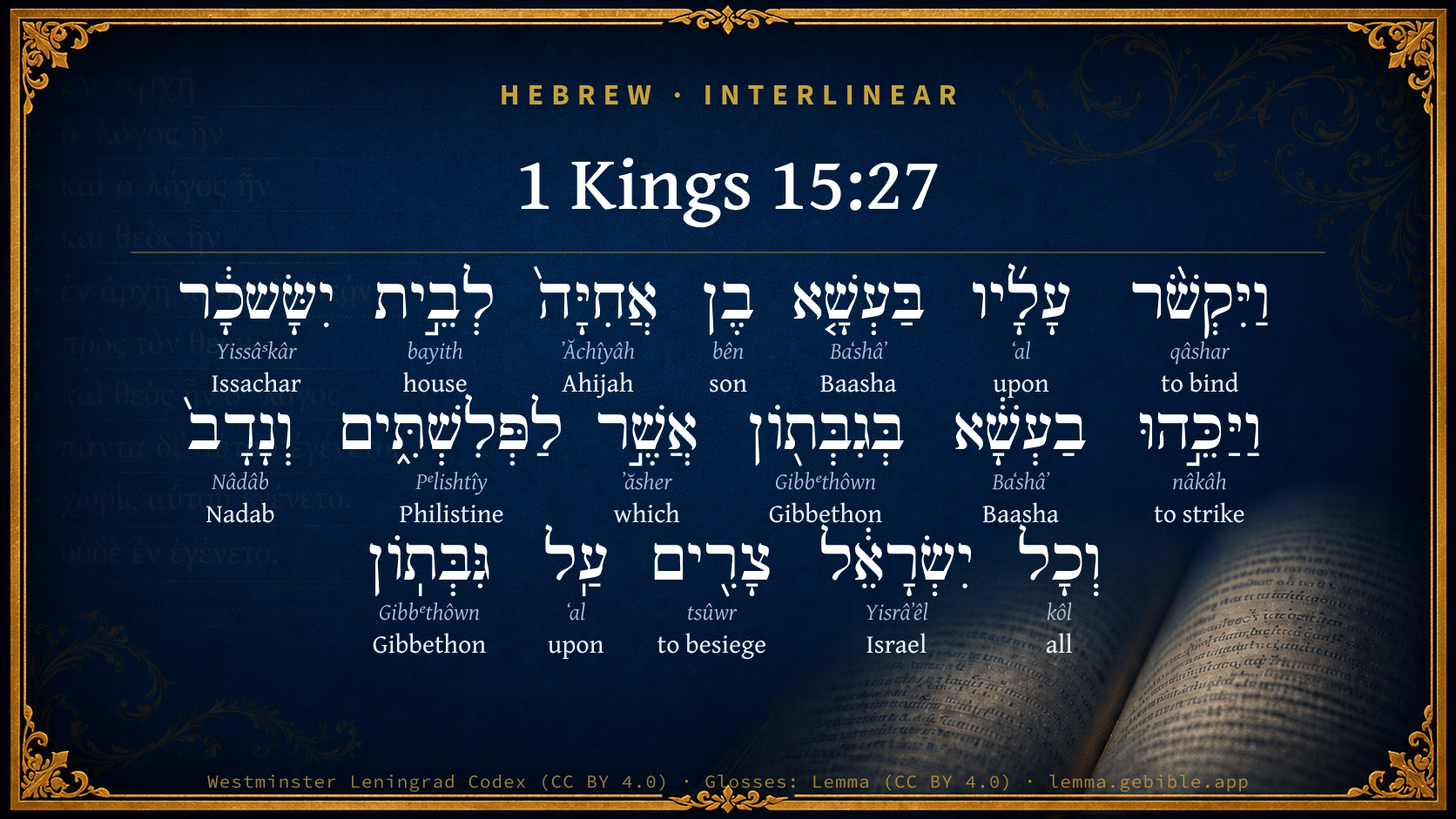
1 Kings 15:27

Hebrew (Westminster Leningrad Codex) 1 Kings 15:27 appears in the Hebrew Old Testament. The text above is from the Westminster Leningrad Codex. Each word links to its Strong’s number, a concise gloss, and parsing drawn from the Open Scriptures Hebrew Bible morphology. Click any word for its full Brown-Driver-Briggs (BDB) entry.
Download image
Cite this verse

1 Kings 15:27 (World English Bible). Public Domain. Lemma interlinear Bible study tool, https://lemma.gebible.app/v/1-kings/15/27.

Show BibTeX & RIS
BibTeX
RIS
English Translation
Baasha the son of Ahijah, of the house of Issachar, conspired against him; and Baasha struck him at Gibbethon, which belonged to the Philistines; for Nadab and all Israel were laying siege to Gibbethon.
World English Bible · Public Domain
Download a study sheet

One document with this verse’s original text, its word-by-word gloss line, the meaning frame, cross-references with their text, attributed commentary, and full source and license credits — printable, and it pastes into notes with its structure intact.

This verse Autodidact and up

Study sheet (.html) Plain text (.txt)

A passage Seminary Student

Up to 50 verses in one chapter. A passage sheet keeps up to 6 commentary sources and 12 cross-references per verse, in the order this page ranks them, and says so on the sheet whenever that leaves anything out. Ask for a single verse and you get the Autodidact verse sheet above.

Everything on this page stays free to read, with no account — the sheet is a download of what is already on screen, not access to it.

Want to remove ads? Support Godless Engineer
Compare translations 3

The same verse in 3 English versions, stacked beneath the original-language interlinear above. Click any original word for its lexicon entry.

Each is an independent rendering of the whole verse — the interlinear is not word-aligned to these translations.

Highlighted words mark where these versions differ — a whole-verse word diff, not a word-by-word alignment.

  • World English Bible Public Domain
    Baasha the son of Ahijah, of the house of Issachar, conspired against him; and Baasha struck him at Gibbethon, which belonged to the Philistines; for Nadab and all Israel were laying siege to Gibbethon.
  • King James Version Public Domain
    And Baasha the son of Ahijah, of the house of Issachar, conspired against him; and Baasha smote him at Gibbethon, which belonged to the Philistines; for Nadab and all Israel laid siege to Gibbethon.
  • unfoldingWord Literal Text CC BY-SA 4.0
    And Baasha, the son of Ahijah, from the house of Issachar, conspired against him, and Baasha struck him at Gibbethon, which to the Philistines. Now Nadab and all of Israel were besieging against Gibbethon.

unfoldingWord Literal Text — © unfoldingWord, licensed CC BY-SA 4.0. Word-aligned USFM3 via Door43 (git.door43.org/unfoldingWord/en_ult).

Versions to compare (up to 4)

3 of 4 selected

Show all 18 translations

Every available English version of this verse, each an independent rendering of the whole verse.

  • World English Bible Public Domain
    Baasha the son of Ahijah, of the house of Issachar, conspired against him; and Baasha struck him at Gibbethon, which belonged to the Philistines; for Nadab and all Israel were laying siege to Gibbethon.
  • Berean Standard Bible Public Domain
    Then Baasha son of Ahijah of the house of Issachar conspired against Nadab, and Baasha struck him down at Gibbethon of the Philistines while Nadab and all Israel were besieging the city.
  • Majority Standard Bible Public Domain
    Then Baasha son of Ahijah of the house of Issachar conspired against Nadab, and Baasha struck him down at Gibbethon of the Philistines while Nadab and all Israel were besieging the city.
  • King James Version Public Domain
    And Baasha the son of Ahijah, of the house of Issachar, conspired against him; and Baasha smote him at Gibbethon, which belonged to the Philistines; for Nadab and all Israel laid siege to Gibbethon.
  • American Standard Version (1901) Public Domain
    And Baasha the son of Ahijah, of the house of Issachar, conspired against him; and Baasha smote him at Gibbethon, which belonged to the Philistines; for Nadab and all Israel were laying siege to Gibbethon.
  • Revised Version (1885) Public Domain
    And Baasha the son of Ahijah, of the house of Issachar, conspired against him; and Baasha smote him at Gibbethon, which belonged to the Philistines; for Nadab and all Israel were laying siege to Gibbethon.
  • Geneva Bible (1599) Public Domain
    And Baasha the sonne of Ahijah of ye house of Issachar conspired against him, and Baasha slue him at Gibbethon, which belonged to the Philistims: for Nadab and all Israel layde siege to Gibbethon.
  • Douay-Rheims (1899) Public Domain
    And Baasa the son of Ahias of the house of Issachar, conspired against him, and slew him in Gebbethon, which is a city of the Philistines: for Nadab and all Israel besieged Gebbethon.
  • Young's Literal Translation Public Domain
    And conspire against him doth Baasha son of Ahijah, of the house of Issachar, and Baasha smiteth him in Gibbethon, which `is' to the Philistines -- and Nadab and all Israel are laying siege against Gibbethon --
  • Literal Standard Version CC BY-SA 4.0
    And Baasha son of Ahijah, of the house of Issachar, conspires against him, and Baasha strikes him in Gibbethon, which [belonged] to the Philistines—and Nadab and all Israel are laying siege against Gibbethon—
  • Unlocked Literal Bible CC BY-SA 4.0
    Baasha son of Ahijah, of the family of Issachar, conspired against Nadab; Baasha killed him down at Gibbethon, which belonged to the Philistines, for Nadab and all Israel were laying siege to Gibbethon.
  • unfoldingWord Literal Text CC BY-SA 4.0
    And Baasha, the son of Ahijah, from the house of Issachar, conspired against him, and Baasha struck him at Gibbethon, which to the Philistines. Now Nadab and all of Israel were besieging against Gibbethon.
  • Darby Bible Public Domain
    And Baasha the son of Ahijah, of the house of Issachar, conspired against him; and Baasha smote him at Gibbethon, which [belonged] to the Philistines, when Nadab and all Israel were besieging Gibbethon.
  • World Messianic Bible Public Domain
    Baasha the son of Ahijah, of the house of Issachar, conspired against him; and Baasha struck him at Gibbethon, which belonged to the Philistines; for Nadab and all Israel were besieging Gibbethon.
  • Webster's Bible Public Domain
    And Baasha the son of Ahijah, of the house of Issachar, conspired against him; and Baasha smote him at Gibbethon, which belonged to the Philistines; for Nadab and all Israel laid siege to Gibbethon.
  • Free Bible Version CC BY-SA 4.0
    Baasha, son of Ahijah of the tribe of Issachar, plotted a rebellion against him. Baasha murdered Nadab at the Philistine town of Gibbethon while Nadab and the whole Israelite army were besieging it.
  • Bible in Basic English Public Domain
    And Baasha, the son of Ahijah, of the family of Issachar, made a secret design against him, attacking him at Gibbethon, a town of the Philistines; for Nadab and the armies of Israel were making war on Gibbethon.
  • JPS Tanakh (1917) Public Domain
    And Baasa the son of Ahijah, of the house of Issachar, conspired against him; and Baasa smote him at Gibbethon, which belonged to the Philistines; for Nadab and all Israel were laying siege to Gibbethon.

Literal Standard Version (2020), Covenant Press — licensed CC BY-SA 4.0. Text via the HelloAO Bible API (eBible.org). Unlocked Literal Bible (unfoldingWord) — licensed CC BY-SA 4.0. Text via the HelloAO Bible API (eBible.org). unfoldingWord Literal Text — © unfoldingWord, licensed CC BY-SA 4.0. Word-aligned USFM3 via Door43 (git.door43.org/unfoldingWord/en_ult). Free Bible Version, Dr. Jonathan Gallagher — licensed CC BY-SA 4.0. Text via the HelloAO Bible API (eBible.org).

Word by word

More ways to search: Search by grammar → Find every occurrence → Compare this word →

Practice this passage: Drill this verse → Learn its vocabulary →

בְּגִבְּת֖וֹן
Gibbᵉthôwn
H1405
“in/at · Gibbethon”
Preposition + Noun, Proper
Part of Speech
Preposition + Noun
Type
Proper
Full BDB Definition

Origin: intensive from H1389

TWOT: None

Gibbethon = "mound" - a Philistine town in Dan allocated to the Kohathite Levites
  1. וַיִּקְשֹׁ֨ר qâshar H7194 “and · to bind” Conjunction + Verb, Qal, Sequential Imperfect, 3rd Person, Masculine, Singular
  2. עָלָ֜יו ʻal H5921 “upon · him” Preposition + Suffix, Personal, 3rd Person, Masculine, Singular
  3. בַּעְשָׁ֤א Baʻshâʼ H1201 “Baasha” Noun, Proper
  4. בֶן bên H1121 “son of” Noun, Common, Masculine, Singular, Construct
  5. אֲחִיָּה֙ ʼĂchîyâh H281 “Ahijah” Noun, Proper
  6. לְבֵ֣ית bayith H1004 “to/for · house of” Preposition + Noun, Common, Masculine, Singular, Construct
  7. יִשָּׂשכָ֔ר Yissâˢkâr H3485 “Issachar” Noun, Proper
  8. וַיַּכֵּ֣הוּ nâkâh H5221 “and · to strike · him” Conjunction + Verb, Hiphil, Sequential Imperfect, 3rd Person, Masculine, Singular + Suffix, Personal, 3rd Person, Masculine, Singular
  9. בַעְשָׁ֔א Baʻshâʼ H1201 “Baasha” Noun, Proper
  10. אֲשֶׁ֣ר ʼăsher H834 “which” Particle, Relative
  11. לַפְּלִשְׁתִּ֑ים Pᵉlishtîy H6430 “to/for the · Philistines” Preposition, Determined + Noun, Gentilic, Masculine, Plural, Absolute
  12. וְנָדָב֙ Nâdâb H5070 “and · Nadab” Conjunction + Noun, Proper
  13. וְכָל kôl H3605 “and · all of” Conjunction + Noun, Common, Masculine, Singular, Construct
  14. יִשְׂרָאֵ֔ל Yisrâʼêl H3478 “Israel” Noun, Proper
  15. צָרִ֖ים tsûwr H6696 “besieging” Verb, Qal, Participle Active, Masculine, Plural, Absolute
  16. עַֽל ʻal H5921 “upon” Preposition
  17. גִּבְּתֽוֹן Gibbᵉthôwn H1405 “Gibbethon” Noun, Proper

About this verse

These counts appear in no published source. They are computed here, from the morphology-tagged text and Lemma’s own curated glosses. What Lemma adds →

18
words
15
distinct lemmas
Historical
section

Notable vocabulary

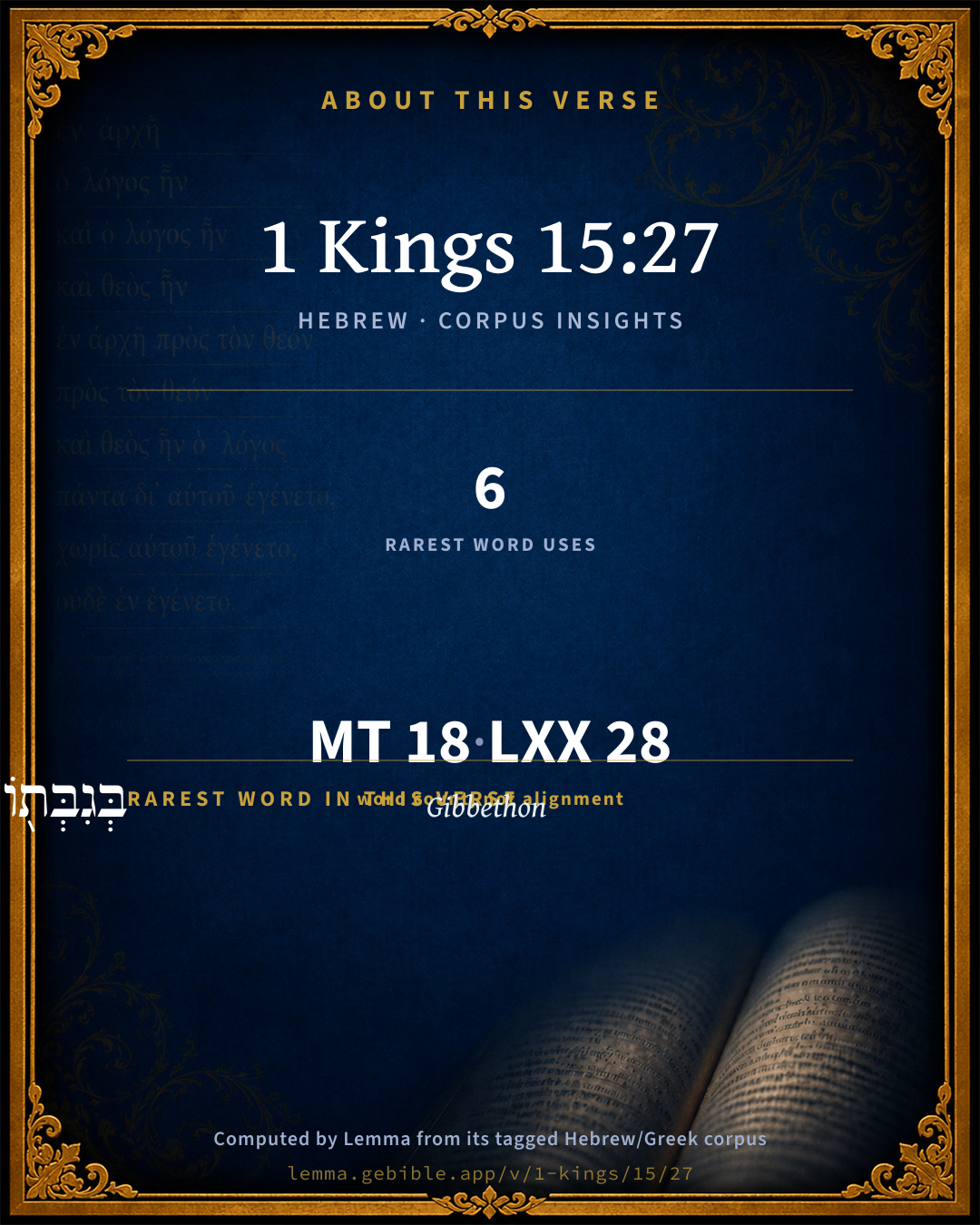
The rarest word here is בְּגִבְּת֖וֹן Gibbethon H1405 — appearing just 6 times in the whole Hebrew Bible.

Shared distinctive vocabulary

בְּגִבְּת֖וֹן Gibbethon H1405 occurs in 5 verses of the Hebrew Bible. Also found in:

Grammatical profile

  • 3 verbs
  • 12 nouns
  • 2 prepositions
  • 1 particle

Verb forms

  • וַיִּקְשֹׁ֨ר Qal · Sequential Imperfect
  • וַיַּכֵּ֣הוּ Hiphil · Sequential Imperfect
  • צָרִ֖ים Qal · Participle Active

Repetition

Words recur within this verse — often emphatic in Hebrew:

  • עָלָ֜יו upon H5921 ×2
  • בַּעְשָׁ֤א Baasha H1201 ×2
  • בְּגִבְּת֖וֹן Gibbethon H1405 ×2

Hebrew & Septuagint length

In English translation the verse runs 34 words from the Hebrew and 34 from the Septuagint (LXX English) — the same length.

A rough comparison of the two English renderings, which tokenize alike — not a word-level alignment.

Word counts can differ between the Hebrew and the Greek without any difference in meaning — e.g. the Hebrew direct-object marker אֵת has no separate Greek word, and Greek often adds the article ὁ.

In the original languages it is 18 Hebrew tokens and 28 Greek tokens — but the two are counted differently (Hebrew bundles its prefixes and suffixes into one token; the Greek is in lemma form), so that isn’t a like-for-like length.

Cross-references

8

Topical passages linked to 1 Kings 15:27 in the Treasury of Scripture Knowledge — connected by theme and wording, ordered by reader-vote popularity; previews shown in the World English Bible.

  • Joshua 19:44 and Eltekeh, and Gibbethon, and Baalath,
  • Joshua 21:23 Out of the tribe of Dan, Elteke with its suburbs, Gibbethon with its suburbs,
  • 1 Kings 14:14 Moreover Yahweh will raise him up a king over Israel, who shall cut off the house of Jeroboam that day: but what? even now.
  • 1 Kings 16:15 In the twenty-seventh year of Asa king of Judah did Zimri reign seven days in Tirzah. Now the people were encamped against Gibbethon, which belonged to the Philistines.
  • 1 Kings 15:16–17 There was war between Asa and Baasha king of Israel all their days.
  • 1 Kings 16:9 His servant Zimri, captain of half his chariots, conspired against him. Now he was in Tirzah, drinking himself drunk in the house of Arza, who was over the household in Tirzah:
  • 1 Kings 16:17 Omri went up from Gibbethon, and all Israel with him, and they besieged Tirzah.
  • 2 Kings 12:20 His servants arose, and made a conspiracy, and struck Joash at the house of Millo, [on the way] that goes down to Silla.

Cross-references courtesy of OpenBible.info (CC BY 4.0).

Hebrew and Greek witnesses Masoretic Hebrew ↔ Greek Septuagint

The same verse in the two great witnesses to the Old Testament, shown verse-for-verse.

These are two independent witnesses, not word-aligned to each other, and the Septuagint is shown in lemma (dictionary) form.

Hebrew 1 Kings 15:27 Masoretic · Westminster Leningrad Codex

וַיִּקְשֹׁ֨ר עָלָ֜יו בַּעְשָׁ֤א בֶן אֲחִיָּה֙ לְבֵ֣ית יִשָּׂשכָ֔ר וַיַּכֵּ֣הוּ בַעְשָׁ֔א בְּגִבְּת֖וֹן אֲשֶׁ֣ר לַפְּלִשְׁתִּ֑ים וְנָדָב֙ וְכָל יִשְׂרָאֵ֔ל צָרִ֖ים עַֽל גִּבְּתֽוֹן

Baasha the son of Ahijah, of the house of Issachar, conspired against him; and Baasha struck him at Gibbethon, which belonged to the Philistines; for Nadab and all Israel were laying siege to Gibbethon.

World English Bible · Public Domain

Greek LXX 1 Kings 15:27 Septuagint · lemma form

καί περι καταἵζω αὐτός βαασα υἱός αχια ἐπί ὁ οἶκος βελααν καί πατάσσω αὐτός ἐν γαβαθων ὁ ὁ ἀλλόφυλος καί ναδαβ καί πᾶς ἰσραήλ περι καταἧμαι ἐπί γαβαθων

And Baasa son of Achia, who was over the house of Belaan son of Achia, conspired against him, and struck him in Gabathon of the Philistines; for Nabat and all Israel were besieging Gabathon.

LXX2012 (modern English Septuagint) · Public Domain

Hebrew: Westminster Leningrad Codex (CC BY 4.0). Greek: Septuagint (public domain); English from LXX2012 (modern English Septuagint) (Public Domain). How the Septuagint differs from the Hebrew →

Targum (Aramaic paraphrase)

1

The Targum is the ancient Jewish Aramaic paraphrase of the Hebrew Scriptures — an interpretive translation, not the Hebrew text itself. Onkelos (literal) and Pseudo-Jonathan (expansive) render the Torah, and Jonathan the Prophets. Coverage is partial: where no permissively-licensed English translation exists for a verse, only the Aramaic is shown. This is verse-level text, not a word-by-word alignment to the Hebrew.

  1. Targum Jonathan Prophets (Joshua–Malachi)
    וּמְרַד עֲלוֹהִי בַּעְשָׁא בַר אֲחִיָה מִשִׁבְטָא דְבֵית יִשָׂשׂכָר וּמְחָהִי בַּעְשָׁא בְּגִבְּתוֹן דִי לִפְלִשְׁתָּאֵי וְנָדָב וְכָל יִשְׂרָאֵל צַיְרִין עַל גִבְּתוֹן:

    (no public-domain English translation for this verse)

    Targum Jonathan — Aramaic: “Mikraot Gedolot” (public domain). English: “Sefaria Community Translation” (CC0 1.0 (public-domain dedication)); “London "Chaldee Paraphrase," 1871” (public domain). Text via Sefaria.

Commentary

Notes on 1 Kings 15:27 from classic Christian and Jewish commentators (each source and its license shown beneath its notes). The classic Christian expositions comment on the surrounding passage and are grouped to its opening verse, so a note may address several verses; the Jewish commentaries on the Tanakh (Rashi and others) are per-verse, so they appear only where the commentator wrote on this verse.

Lemma curates 59 commentaries, every one of them public domain or Creative Commons licensed, each selected and text-cleaned for this edition rather than reprinted as found. About our sources →

Trapp's Complete Commentary

John Trapp

1Ki 15:27 And Baasha the son of Ahijah, of the house of Issachar, conspired against him; and Baasha smote him at Gibbethon, which [belonged] to the Philistines; for Nadab and all Israel laid siege to Gibbethon.

Ver. 27. Which belonged to the Philistines.] Sed quo iure? They had gotten it; but the right of it was in Israel. {Jos 21:23}

John Trapp, A Commentary or Exposition upon All the Books of the Old and New Testament (1647–1656) — public domain. Text from a community e-Sword module.

Joseph Benson's Commentary

1Ki 15:27-28. Baasha smote him at Gibbethon, which belonged to the Philistines — This was a city in the tribe of Dan, given to the Levites, (Jos 19:44; Jos 21:23,) who quitted it, as they did the rest of their cities, when Jeroboam would not suffer them to execute their office, 2Ch 11:14; and the Philistines, it is likely, seized upon it, being adjoining to their country. But it appears, Nadab was now endeavouring to recover it out of their hands, as of right belonging to him; and here, in the midst of his army, did Baasha, with others, conspire against him, and kill him: and so little interest had he in the affections of his people, that his army not only did not avenge his death, but chose his murderer his successor. Whether Baasha did this upon a personal pique against Nadab, or to be revenged on the house of Jeroboam for some affront received from them; or whether under pretence of freeing his country from the tyranny of an ill prince; or whether purely from a principle of ambition, to make way for himself to the throne, doth not appear; but having slain him, he reigned in his stead.

Joseph Benson's Commentary on the Old and New Testaments (1811–1818) — public domain. Text from a community e-Sword module.

Whedon's Commentary on the Bible

Daniel D. Whedon

BAASHA’S REIGN, Ki_15:27 to 1Ki_16:7.

27. Baasha… house of Issachar — That is, a descendant of the fifth son of Jacob by Leah, (Gen_30:18,) whose lot in the tribe-division of the land is described Jos_19:17-23.

Conspired against him — Baasha was probably commander, or chief captain, in Nadab’s army, and wickedly laid his schemes to assassinate the king, and use the army now at his command to establish himself upon the throne.

Gibbethon — A city belonging to the territory of Dan. Jos_19:44. It was assigned, with its suburbs, to “the Levites which remained of the children of Kohath,”

(Jos_21:23,) but at the time of Nadab it was held by the Philistines, and probably they had always held it. It has not been identified with any modern town.

Laid siege to Gibbethon — What led Nadab to turn his forces against this city does not appear. We learn from chapter 1Ki_16:15 that the siege was continued in the time of Zimri.

Daniel D. Whedon (gen. ed.), Commentary on the Old and New Testaments (1874–1909) — public domain. Text from a community e-Sword module.

Tyndale Open Study Notes

Tyndale Open Resources

15:27-29 Baasha . . . assassinated . . . Nadab and slaughtered all the descendants of . . . Jeroboam, thus terminating Israel’s first dynasty. Baasha’s father was named Ahijah, who is not to be confused with the prophet who predicted the demise of Jeroboam’s dynasty (11:29-39). Baasha’s coup d’etat was the first of several in Israel’s history (e.g., 16:9-10).

Tyndale Open Study Notes — © Tyndale Open Resources, licensed CC BY-SA 4.0. Text via the HelloAO Bible API.

Jamieson, Fausset & Brown

Robert Jamieson, A. R. Fausset & David Brown

Baasha smote him at Gibbethon--This town, within the tribe of Dan, was given to the Levites (Jos 19:44). It lay on the Philistine borders, and having been seized by that people, Nadab laid siege to recover it.

Jamieson, Fausset & Brown — Commentary Critical and Explanatory on the Whole Bible (1871) — public domain (CC PDM 1.0). Text via the HelloAO Bible API.

Adam Clarke's Commentary

Verse 27. Smote him at Gabbethon] This was a city in the tribe of Dan, and generally in the possession of the Philistines.

Adam Clarke's Commentary on the Bible (1810–1826) — public domain. Text from a community e-Sword/MySword module.

Ellicott's Commentary for English Readers

(27) Baasha, sprung from an obscure tribe, hardly at any time distinguished in the history, and himself, as it would seem (1Ki_16:2), of low origin in it, is the first of the many military chiefs who by violence or assassination seized upon the throne of Israel. The constant succession of ephemeral dynasties stands in striking contrast with the unchanged royalty of the house of David, resting on the promise of God.

Gibbethon—a Levitical town in the territory of Dan (Jos_19:44; Jos_21:23), probably, like other places in that region, still held by the Philistines till their subjugation by David. The text here implies a revolt of the Philistines against the enfeebled power of Israel, and the occupation of Gibbethon, commanding a pass from the plain of Sharon to the interior. The siege must have been fruitless, at least of any permanent result; for twenty-six years after we find Gibbethon still in the hands of the enemy. (See 1Ki_16:15.)

A Bible Commentary for English Readers, edited by Charles John Ellicott (1878–1897) — public domain. Text from a community e-Sword module.

The Cambridge Bible for Schools and Colleges

gen. ed. J. J. S. Perowne

27. of the house of Issachar] Jeroboam’s family was of the tribe of Ephraim (1Ki_11:26), and it may have been some tribal jealousy which led a man of Issachar to exterminate the whole family of Jeroboam, and to found a new dynasty. From the message of the prophet Jehu to Baasha (1Ki_14:1-2) it would appear as if Baasha’s attempt had been sanctioned by some divine message. But none the more did Baasha improve upon the conduct of the two kings of the previous house.

at Gibbethon, which belongeth [R.V. belonged] to the Philistines] Scrivener’s edition of 1611 reads belongeth. This was a town allotted originally to the tribe of Dan (Jos_19:44), and was given as a Levitical city to the Kohathites (Jos_21:23), but it had been by this time taken by the Philistines, and Nadab was endeavouring to drive them out. The verb belongeth is only indicated by the preposition which is prefixed to the word Philistines, and we need not understand more by it than occupation such as conquerors take.

all Israel laid siege] R.V. were laying siege. The work was still in progress, and was not completed even in Baasha’s reign. Cf. 1Ki_16:15.

The Cambridge Bible for Schools and Colleges (gen. ed. J. J. S. Perowne; Cambridge University Press, 1878–1918) — public domain. Text from a community e-Sword module.

Albert Barnes' Notes on the Bible

Baasha ... of the house of Issachar - It is curious to find Issachar furnishing a king. Tola, its one very undistinguished Judge Jdg 10:1, on obtaining office had at once settled himself in the territory of Ephraim. The tribe was as little famous as any that could be named. The “ass crouching between two burthens” was a true symbol of the patient, plodding cultivators of the plain of Esdraelon Gen 49:14-15. Baasha probably owed his rise neither to his tribe nor to his social position, but simply to his audacity, and his known valor and skill as a soldier 1Ki 16:2.

Albert Barnes' Notes on the Bible (1834–1885) — public domain. Text from a community e-Sword/MySword module.

Haydock's Catholic Bible Commentary

Gebbethon, of the tribe of Dan, occupied by the Philistines. It was often attacked, chap. xvi. 15. (Calmet) --- The occasion of this war is not known. (Menochius)

George Leo Haydock (1774–1849), Haydock's Catholic Family Bible and Commentary, 1859 edition — public domain. Excludes Psalms (Douay-Rheims chapter numbering differs from Protestant) and Deuterocanonical books (Catholic canon only).

Matthew Poole's English Annotations

Of the house of Issachar, i.e. of the tribe, which is oft called a house, as Jdg 10:9; Psa 135:20; Hos 1:7. Which belonged to the Philistines; who, taking advantage of the division between Israel and Judah, had retaken this town, which belonged to the tribe of Dan, Jos 19:44, and belonged to the Levites, Jos 21:23; upon whose departure to Judah, 2Ch 11:14, the kings of Israel seized their towns and lands to their own use, as was noted before; which made them so much concerned for this town, to besiege it both now and many years after this time, 1Ki 16:15.

Matthew Poole's English Annotations on the Holy Bible (1683–1685) — public domain. Text from a community e-Sword/MySword module.

The Pulpit Commentary

And Baasha the son of Ahijah not the prophet of that name, (1Ki_14:2) who was an Ephraimite, whereas this Ahijah was, of the house of Issachar This fact is perhaps mentioned to distinguish the father of Baasha from the prophet. Or it may owe its insertion to the insignificance of this tribe (Gen_49:14, Gen_49:15) up to this date. This change of dynasty, unlike the last, was in no way connected with tribal jealousies. Baasha owed his elevation to his own abilities or to his unscrupulous daring, conspired The word implies associates. There was a plot formed fur Nadab"s assassination against him: and Baasha smote him at Gibbethon = eminence . In the tribe of Dan (Jos_19:44) and aLevitical city: one of the four assigned to the Levites in the territory of that tribe (ib., 21:23). It has not been identified. Evidently it was on the border of Philistia. Some would connect it with the modern Mejdel, a little to the north of Ascalon. The reader will observe how large a number of the names of towns indicate their elevation. The cities of those days were set on a hill. It was dangerous to build in the plain, which belonged to the Philistines Blunt suggests ("Coincidences," p. 181) that it was because the place had been deserted by the Levites, in the general exodus to Judah, that the Philistines availed themselves of the opportunity to seize and fortify it. But the divided and consequently weakened state of the kingdom would of itself have encouraged them to throw off the yoke of Israel (Ewald); for Nadab and all Israel laid siege to Gibbethon.

The Pulpit Commentary (1880–1919), ed. H.D.M. Spence-Jones & Joseph S. Exell — public domain. Text from a community e-Sword module.

unfoldingWord translationNotes

Door43 World Missions Community

conspired against Nadab

"secretly plotted to kill King Nadab"

Gibbethon

This is the name of a city. (See: How to Translate Names)

Nadab and all Israel

"The phrase "all Israel" is a generalization that represents the many soldiers of Israel. AT: "Nadab and the many soldiers of Israel" or "Nadab and the army of Israel" (See: Synecdoche and Hyperbole and Generalization)

were laying siege to Gibbethon

"were surrounding Gibbethon, so that the people of Gibbethon would surrender to them"

became king in his place

The phrase "in his place" is a metaphor meaning "instead of him." AT: "became king instead of Nadab" (See: Metaphor)

translationWords

Baasha

Ahijah

Issachar

Philistines

unfoldingWord translationNotes — © Distant Shores Media and the Door43 World Missions Community, licensed CC BY-SA 4.0. Source: git.door43.org/Door43/en_tn.

Lesson kit

Teaching starters — assembled from the data on this page, not authored interpretation. Every prompt links to the verse data it draws on. Edit before teaching.

1 Kings, in the Historical, opens this verse with 18 words (15 distinct Hebrew lemmas). Its most distinctive word is Gibbᵉthôwn (“Gibbethon”). A historical commentator’s framing appears above. Read the whole chapter for the surrounding context.

Discussion questions

  1. The word Gibbᵉthôwn carries the sense “Gibbethon.” How does it shape the verse?
  2. Joshua 19:44 shares the word «Gibbethon» with this verse. How do the two illuminate each other?
  3. “upon” occurs 2× in this one verse. What is the effect of the repetition?
  4. The translations on this page render this verse differently — a whole-verse word diff, not a word-by-word alignment. What might account for the different wordings?
  5. The verb «וַיִּקְשֹׁ֨ר» is Qal Sequential Imperfect. How does its form color the action?
  6. Reading how Trapp's Complete Commentary and Joseph Benson's Commentary read this verse, where do the two commentators agree and where do they part?

Things to notice

Reading settings

Reading text

Shown beneath each verse's original-language words.

Old Testament
Old Testament edition

Read the OT as the Masoretic Hebrew (MT) or the Greek Septuagint (LXX).

English shown for the Greek Septuagint (in the Hebrew ↔ Greek comparison).

Comparing translations? Open the Compare panel on any verse page to stack up to four side by side.