
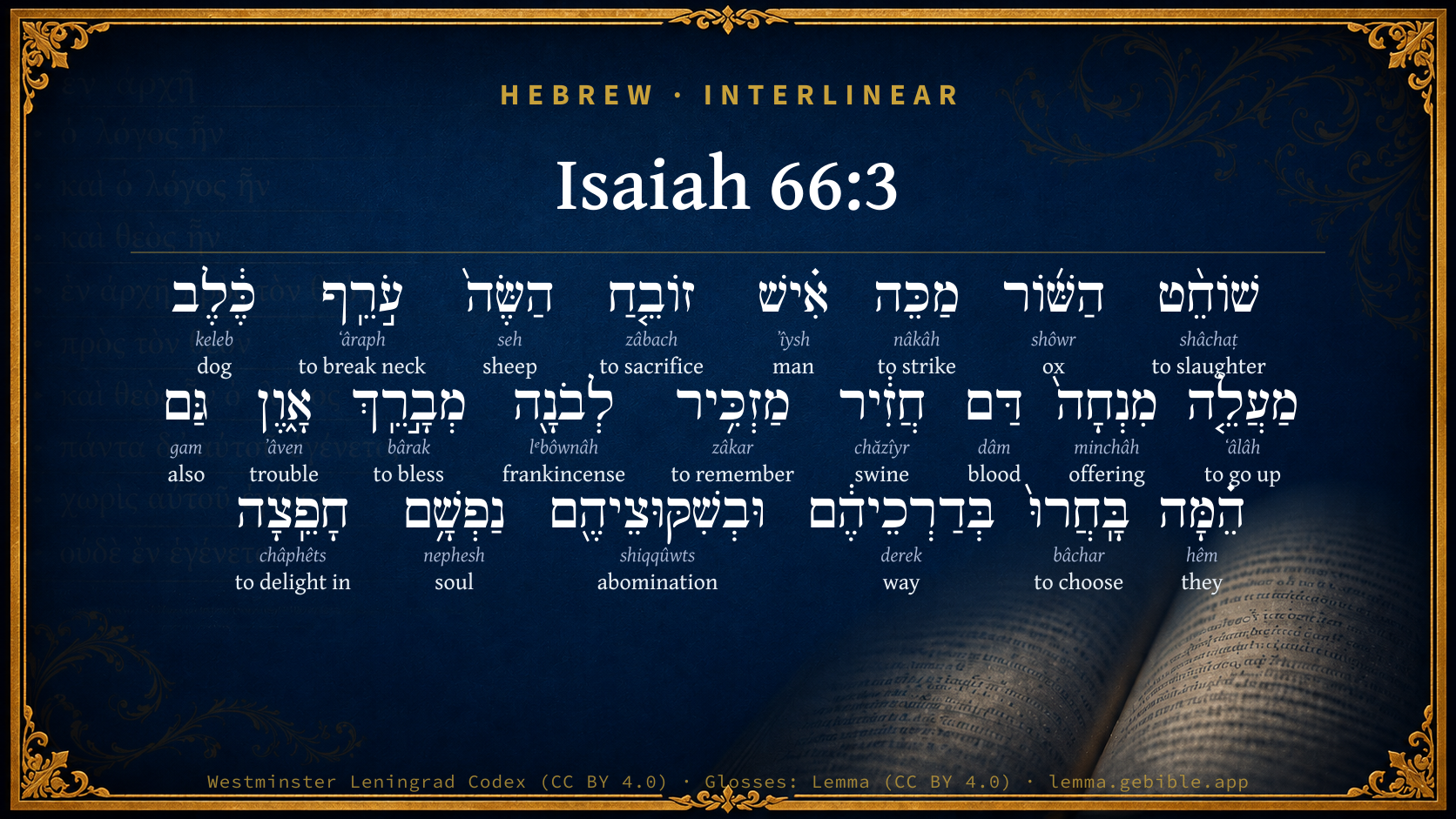
Isaiah 66:3

Hebrew (Westminster Leningrad Codex) Isaiah 66:3 appears in the Hebrew Old Testament. The text above is from the Westminster Leningrad Codex. Each word links to its Strong’s number, a concise gloss, and parsing drawn from the Open Scriptures Hebrew Bible morphology. Click any word for its full Brown-Driver-Briggs (BDB) entry.
Download image
Cite this verse

Isaiah 66:3 (World English Bible). Public Domain. Lemma interlinear Bible study tool, https://lemma.gebible.app/v/isaiah/66/3.

Show BibTeX & RIS
BibTeX
RIS
English Translation
He who kills an ox is as he who kills a man; he who sacrifices a lamb, as he who breaks a dog's neck; he who offers an offering, [as he who offers] pig's blood; he who burns frankincense, as he who blesses an idol. Yes, they have chosen their own ways, and their soul delights in their abominations:
World English Bible · Public Domain
Download a study sheet

One document with this verse’s original text, its word-by-word gloss line, the meaning frame, cross-references with their text, attributed commentary, and full source and license credits — printable, and it pastes into notes with its structure intact.

This verse Autodidact and up

Study sheet (.html) Plain text (.txt)

A passage Seminary Student

Up to 50 verses in one chapter. A passage sheet keeps up to 6 commentary sources and 12 cross-references per verse, in the order this page ranks them, and says so on the sheet whenever that leaves anything out. Ask for a single verse and you get the Autodidact verse sheet above.

Everything on this page stays free to read, with no account — the sheet is a download of what is already on screen, not access to it.

Want to remove ads? Support Godless Engineer
Compare translations 3

The same verse in 3 English versions, stacked beneath the original-language interlinear above. Click any original word for its lexicon entry.

Each is an independent rendering of the whole verse — the interlinear is not word-aligned to these translations.

Highlighted words mark where these versions differ — a whole-verse word diff, not a word-by-word alignment.

  • World English Bible Public Domain
    He who kills an ox is as he who kills a man; he who sacrifices a lamb, as he who breaks a dog's neck; he who offers an offering, [as he who offers] pig's blood; he who burns frankincense, as he who blesses an idol. Yes, they have chosen their own ways, and their soul delights in their abominations:
  • King James Version Public Domain
    He that killeth an ox is as if he slew a man; he that sacrificeth a lamb, as if he cut off a dog's neck; he that offereth an oblation, as if he offered swine's blood; he that burneth incense, as if he blessed an idol. Yea, they have chosen their own ways, and their soul delighteth in their abominations.
  • unfoldingWord Literal Text CC BY-SA 4.0
    The one slaughtering an ox is striking a man; the one sacrificing a lamb is breaking the neck a dog; the one bringing up a grain offering, the blood of a pig; the one making remember incense is blessing nothingness. As they, they have chosen their ways, and their soul delights in their abominations,

unfoldingWord Literal Text — © unfoldingWord, licensed CC BY-SA 4.0. Word-aligned USFM3 via Door43 (git.door43.org/unfoldingWord/en_ult).

Versions to compare (up to 4)

3 of 4 selected

Show all 18 translations

Every available English version of this verse, each an independent rendering of the whole verse.

  • World English Bible Public Domain
    He who kills an ox is as he who kills a man; he who sacrifices a lamb, as he who breaks a dog's neck; he who offers an offering, [as he who offers] pig's blood; he who burns frankincense, as he who blesses an idol. Yes, they have chosen their own ways, and their soul delights in their abominations:
  • Berean Standard Bible Public Domain
    Whoever slaughters an ox is like one who slays a man; whoever sacrifices a lamb is like one who breaks a dog’s neck; whoever presents a grain offering is like one who offers pig’s blood; whoever offers frankincense is like one who blesses an idol. Indeed, they have chosen their own ways and delighted in their abominations.
  • Majority Standard Bible Public Domain
    Whoever slaughters an ox is like one who slays a man; whoever sacrifices a lamb is like one who breaks a dog’s neck; whoever presents a grain offering is like one who offers pig’s blood; whoever offers frankincense is like one who blesses an idol. Indeed, they have chosen their own ways and delighted in their abominations.
  • King James Version Public Domain
    He that killeth an ox is as if he slew a man; he that sacrificeth a lamb, as if he cut off a dog's neck; he that offereth an oblation, as if he offered swine's blood; he that burneth incense, as if he blessed an idol. Yea, they have chosen their own ways, and their soul delighteth in their abominations.
  • American Standard Version (1901) Public Domain
    He that killeth an ox is as he that slayeth a man; he that sacrificeth a lamb, as he that breaketh a dog's neck; he that offereth an oblation, `as he that offereth' swine's blood; he that burneth frankincense, as he that blesseth an idol. Yea, they have chosen their own ways, and their soul delighteth in their abominations:
  • Revised Version (1885) Public Domain
    He that killeth an ox is as he that slayeth a man; he that sacrificeth a lamb, as he that breaketh a dog’s neck; he that offereth an oblation, as he that offereth swine’s blood; he that burneth frankincense, as he that blesseth an idol: yea, they have chosen their own ways, and their soul delighteth in their abominations;
  • Geneva Bible (1599) Public Domain
    He that killeth a bullocke, is as if he slewe a man: he that sacrificeth a sheepe, as if he cut off a dogges necke: he that offereth an oblation, as if he offered swines blood: he that remembreth incense, as if he blessed an idole: yea, they haue chosen their owne wayes, and their soule deliteth in their abominations.
  • Douay-Rheims (1899) Public Domain
    He that sacrificeth an ox, is as if he slew a man: he that killeth a sheep in sacrifice, as if he should brain a dog: he that offereth an oblation, as if he should offer swine's blood; he that remembereth incense, as if he should bless an idol. All these things have they chosen in their ways, and their soul is delighted in their abominations.
  • Young's Literal Translation Public Domain
    Whoso slaughtereth the ox smiteth a man, Whoso sacrificeth the lamb beheadeth a dog, Whoso is bringing up a present -- The blood of a sow, Whoso is making mention of frankincense, Is blessing iniquity. Yea, they have fixed on their own ways, And in their abominations their soul hath delighted.
  • Literal Standard Version CC BY-SA 4.0
    Whoever slaughters the ox strikes a man, || Whoever sacrifices the lamb beheads a dog, || Whoever is bringing up a present—The blood of a sow, || Whoever is making mention of frankincense, || Is blessing iniquity. Indeed, they have fixed on their own ways, || And their soul has delighted in their abominations.
  • Unlocked Literal Bible CC BY-SA 4.0
    He who slaughters an ox also murders a man; he who sacrifices a lamb also breaks a dog's neck; he who offers a grain offering offers swine's blood; he who offers a memorial of incense also blesses wickedness. They have chosen their own ways, and they take pleasure in their abominations.
  • unfoldingWord Literal Text CC BY-SA 4.0
    The one slaughtering an ox is striking a man; the one sacrificing a lamb is breaking the neck a dog; the one bringing up a grain offering, the blood of a pig; the one making remember incense is blessing nothingness. As they, they have chosen their ways, and their soul delights in their abominations,
  • Darby Bible Public Domain
    He that slaughtereth an ox, smiteth a man; he that sacrificeth a lamb, breaketh a dog's neck; he that offereth an oblation, [it is as] swine's blood; he that presenteth a memorial of incense, [is as] he that blesseth an idol. As they have chosen their own ways, and their soul delighteth in their abominations,
  • World Messianic Bible Public Domain
    He who kills an ox is as he who kills a man; he who sacrifices a lamb, as he who breaks a dog’s neck; he who offers an offering, as he who offers pig’s blood; he who burns frankincense, as he who blesses an idol. Yes, they have chosen their own ways, and their soul delights in their abominations.
  • Webster's Bible Public Domain
    He that killeth an ox is as if he slew a man; he that sacrificeth a lamb, as if he cut off a dog's neck; he that offereth an oblation, as if he offered swine's blood; he that burneth incense, as if he blessed an idol. Yes, they have chosen their own ways, and their soul delighteth in their abominations.
  • Free Bible Version CC BY-SA 4.0
    When someone sacrifices a bull it's like human sacrifice, and when someone sacrifices a lamb, it's like breaking the neck of a dog. When they present a grain offering it's like presenting pig's blood, and when they burn incense it's like worshiping an idol. Since they have chosen to act like this and to love such disgusting things,
  • Bible in Basic English Public Domain
    He who puts an ox to death puts a man to death; he who makes an offering of a lamb puts a dog to death; he who makes a meal offering makes an offering of pig's blood; he who makes an offering of perfumes for a sign gives worship to an image: as they have gone after their desires, and their soul takes pleasure in their disgusting things;
  • JPS Tanakh (1917) Public Domain
    He that killeth an ox is as if he slew a man; he that sacrificeth a lamb, as if he broke a dog's neck; he that offereth a meal-offering, as if he offered swine's blood; he that maketh a memorial-offering of frankincense, as if he blessed an idol; according as they have chosen their own ways, and their soul delighteth in their abominations;

Literal Standard Version (2020), Covenant Press — licensed CC BY-SA 4.0. Text via the HelloAO Bible API (eBible.org). Unlocked Literal Bible (unfoldingWord) — licensed CC BY-SA 4.0. Text via the HelloAO Bible API (eBible.org). unfoldingWord Literal Text — © unfoldingWord, licensed CC BY-SA 4.0. Word-aligned USFM3 via Door43 (git.door43.org/unfoldingWord/en_ult). Free Bible Version, Dr. Jonathan Gallagher — licensed CC BY-SA 4.0. Text via the HelloAO Bible API (eBible.org).

Word by word

More ways to search: Search by grammar → Find every occurrence → Compare this word →

Practice this passage: Drill this verse → Learn its vocabulary →

עֹ֣רֵֽף
ʻâraph
H6202
“breaking neck”
Verb, Qal, Participle Active, Masculine, Singular, Absolute
Part of Speech
Verb
Stem
Qal
Form
Participle Active
Gender
Masculine
Number
Singular
State
Absolute
Full BDB Definition

Origin: a primitive root [identical with H6201 through the idea of sloping]

TWOT: 1700

(Qal) to break the neck (of an animal)
  1. שׁוֹחֵ֨ט shâchaṭ H7819 “slaughtering” Verb, Qal, Participle Active, Masculine, Singular, Absolute
  2. הַשּׁ֜וֹר shôwr H7794 “the · ox” Particle, Definite Article + Noun, Common, Masculine, Singular, Absolute
  3. מַכֵּה nâkâh H5221 “striking” Verb, Hiphil, Participle Active, Masculine, Singular, Construct
  4. אִ֗ישׁ ʼîysh H376 “man” Noun, Common, Masculine, Singular, Absolute
  5. זוֹבֵ֤חַ zâbach H2076 “sacrificing” Verb, Qal, Participle Active, Masculine, Singular, Absolute
  6. הַשֶּׂה֙ seh H7716 “the · sheep” Particle, Definite Article + Noun, Common, Both, Singular, Absolute
  7. כֶּ֔לֶב keleb H3611 “dog” Noun, Common, Masculine, Singular, Absolute
  8. מַעֲלֵ֤ה ʻâlâh H5927 “going up” Verb, Hiphil, Participle Active, Masculine, Singular, Construct
  9. מִנְחָה֙ minchâh H4503 “offering” Noun, Common, Feminine, Singular, Absolute
  10. דַּם dâm H1818 “blood of” Noun, Common, Masculine, Singular, Construct
  11. חֲזִ֔יר chăzîyr H2386 “swine” Noun, Common, Masculine, Singular, Absolute
  12. מַזְכִּ֥יר zâkar H2142 “remembering” Verb, Hiphil, Participle Active, Masculine, Singular, Absolute
  13. לְבֹנָ֖ה lᵉbôwnâh H3828 “frankincense” Noun, Common, Feminine, Singular, Absolute
  14. מְבָ֣רֵֽךְ bârak H1288 “blessing” Verb, Piel, Participle Active, Masculine, Singular, Absolute
  15. אָ֑וֶן ʼâven H205 “trouble” Noun, Common, Masculine, Singular, Absolute
  16. גַּם gam H1571 “also” Particle, Accusative
  17. הֵ֗מָּה hêm H1992 “they” Pronoun, Personal, 3rd Person, Masculine, Plural
  18. בָּֽחֲרוּ֙ bâchar H977 “to choose” Verb, Qal, Perfect, 3rd Person, Common, Plural
  19. בְּדַרְכֵיהֶ֔ם derek H1870 “in/at · ways · their” Preposition + Noun, Common, Both, Plural, Construct + Suffix, Personal, 3rd Person, Masculine, Plural
  20. וּבְשִׁקּוּצֵיהֶ֖ם shiqqûwts H8251 “and · in/at · abominations · their” Conjunction + Preposition + Noun, Common, Masculine, Plural, Construct + Suffix, Personal, 3rd Person, Masculine, Plural
  21. נַפְשָׁ֥ם nephesh H5315 “soul · their” Noun, Common, Both, Singular, Construct + Suffix, Personal, 3rd Person, Masculine, Plural
  22. חָפֵֽצָה châphêts H2654 “to delight in” Verb, Qal, Perfect, 3rd Person, Feminine, Singular

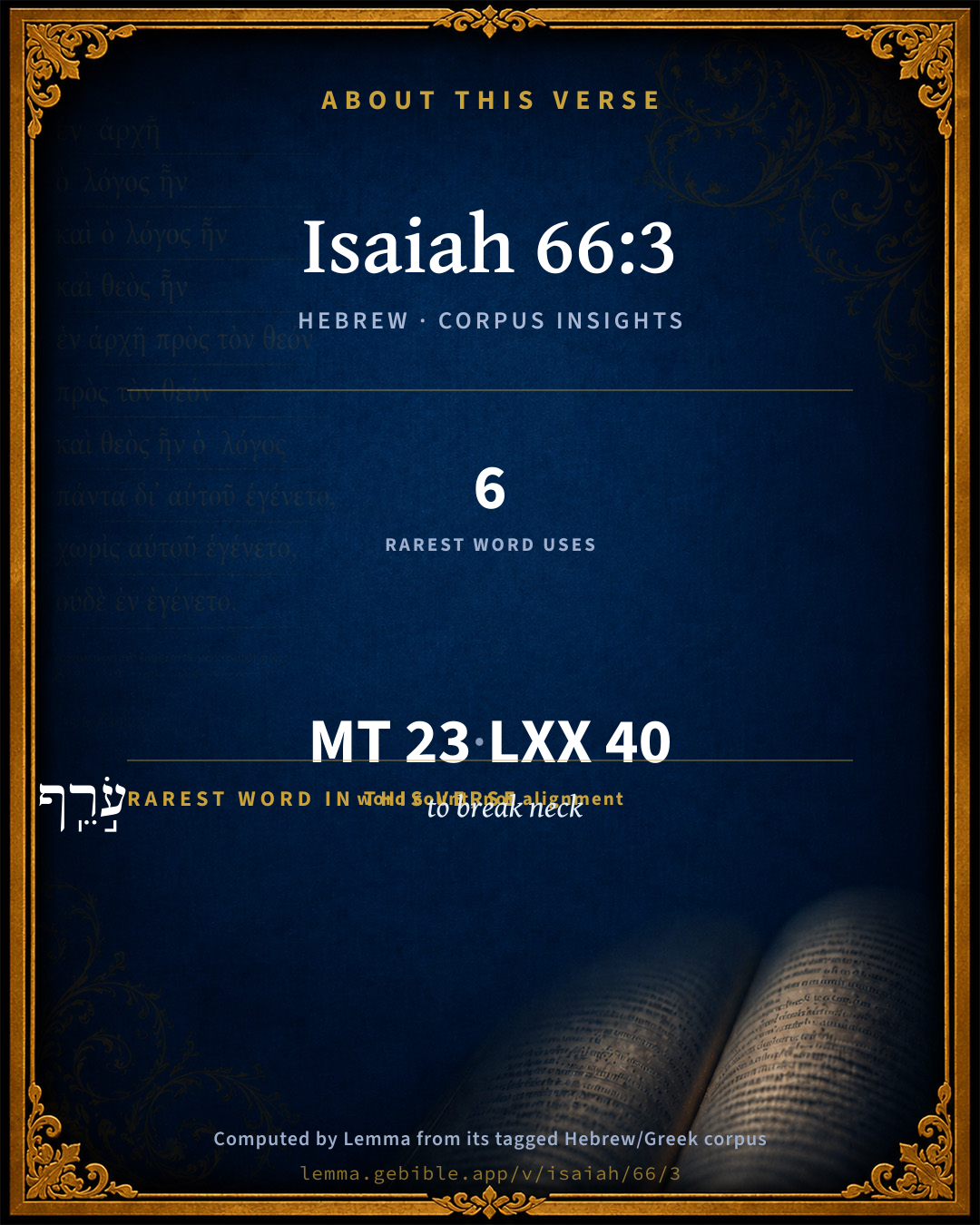
About this verse

These counts appear in no published source. They are computed here, from the morphology-tagged text and Lemma’s own curated glosses. What Lemma adds →

23
words
23
distinct lemmas
Prophets
section

Notable vocabulary

The rarest word here is עֹ֣רֵֽף to break neck H6202 — appearing just 6 times in the whole Hebrew Bible.

Shared distinctive vocabulary

עֹ֣רֵֽף to break neck H6202 occurs in 6 verses of the Hebrew Bible. Also found in:

Grammatical profile

  • 9 verbs
  • 12 nouns
  • 1 pronoun
  • 1 particle

Verb forms

  • שׁוֹחֵ֨ט Qal · Participle Active
  • מַכֵּה Hiphil · Participle Active
  • זוֹבֵ֤חַ Qal · Participle Active
  • עֹ֣רֵֽף Qal · Participle Active
  • מַעֲלֵ֤ה Hiphil · Participle Active
  • מַזְכִּ֥יר Hiphil · Participle Active
  • מְבָ֣רֵֽךְ Piel · Participle Active
  • בָּֽחֲרוּ֙ Qal · Perfect
  • חָפֵֽצָה Qal · Perfect

Hebrew & Septuagint length

In English translation the verse runs 59 words from the Hebrew and 54 from the Septuagint (LXX English) — closely comparable.

A rough comparison of the two English renderings, which tokenize alike — not a word-level alignment.

Word counts can differ between the Hebrew and the Greek without any difference in meaning — e.g. the Hebrew direct-object marker אֵת has no separate Greek word, and Greek often adds the article ὁ.

In the original languages it is 23 Hebrew tokens and 40 Greek tokens — but the two are counted differently (Hebrew bundles its prefixes and suffixes into one token; the Greek is in lemma form), so that isn’t a like-for-like length.

Cross-references

13

Topical passages linked to Isaiah 66:3 in the Treasury of Scripture Knowledge — connected by theme and wording, ordered by reader-vote popularity; previews shown in the World English Bible.

  • Proverbs 15:8 The sacrifice made by the wicked is an abomination to Yahweh, But the prayer of the upright is his delight.
  • Isaiah 1:11–15 "What are the multitude of your sacrifices to me?," says Yahweh. "I have had enough of the burnt offerings of rams, And the fat of fed animals. I don't delight in the blood of bulls, Or of lambs, Or of male goats.
  • Amos 5:21–22 I hate, I despise your feasts, And I can't stand your solemn assemblies.
  • Leviticus 2:2 He shall bring it to Aaron's sons the priests; and he shall take his handful of its fine flour, and of its oil, with all its frankincense; and the priest shall burn the memorial of it on the altar, an offering made by fire, of a sweet savor to Yahweh.
  • Isaiah 65:12 I will destine you to the sword, and you shall all bow down to the slaughter; because when I called, you did not answer; when I spoke, you did not hear; but you did that which was evil in my eyes, and chose that in which I didn't delight.
  • Isaiah 66:17 Those who sanctify themselves and purify themselves [to go] to the gardens, behind one in the midst, eating pig's flesh, and the abomination, and the mouse, they shall come to an end together, says Yahweh.
  • Deuteronomy 14:8 The pig, because it has a split hoof but doesn't chew the cud, is unclean to you: of their flesh you shall not eat, and their carcasses you shall not touch.
  • Deuteronomy 23:18 You shall not bring the hire of a prostitute, or the wages of a dog, into the house of Yahweh your God for any vow: for even both these are an abomination to Yahweh your God.
  • Proverbs 21:27 The sacrifice of the wicked is an abomination: How much more, when he brings it with a wicked mind!
  • Isaiah 65:3–4 a people who provoke me to my face continually, sacrificing in gardens, and burning incense on bricks;
  • Judges 10:14 Go and cry to the gods which you have chosen; let them save you in the time of your distress.
  • Judges 5:8 They chose new gods; Then was war in the gates: Was there a shield or spear seen Among forty thousand in Israel?
  • Isaiah 57:17 For the iniquity of his covetousness was I angry, and struck him; I hid [my face] and was angry; and he went on backsliding in the way of his heart.

Cross-references courtesy of OpenBible.info (CC BY 4.0).

Hebrew and Greek witnesses Masoretic Hebrew ↔ Greek Septuagint

The same verse in the two great witnesses to the Old Testament, shown verse-for-verse.

These are two independent witnesses, not word-aligned to each other, and the Septuagint is shown in lemma (dictionary) form.

Hebrew Isaiah 66:3 Masoretic · Westminster Leningrad Codex

שׁוֹחֵ֨ט הַשּׁ֜וֹר מַכֵּה אִ֗ישׁ זוֹבֵ֤חַ הַשֶּׂה֙ עֹ֣רֵֽף כֶּ֔לֶב מַעֲלֵ֤ה מִנְחָה֙ דַּם חֲזִ֔יר מַזְכִּ֥יר לְבֹנָ֖ה מְבָ֣רֵֽךְ אָ֑וֶן גַּם הֵ֗מָּה בָּֽחֲרוּ֙ בְּדַרְכֵיהֶ֔ם וּבְשִׁקּוּצֵיהֶ֖ם נַפְשָׁ֥ם חָפֵֽצָה

He who kills an ox is as he who kills a man; he who sacrifices a lamb, as he who breaks a dog's neck; he who offers an offering, [as he who offers] pig's blood; he who burns frankincense, as he who blesses an idol. Yes, they have chosen their own ways, and their soul delights in their abominations:

World English Bible · Public Domain

Greek LXX Isaiah 66:3 Septuagint · lemma form

ὁ δέ ἄνομος ὁ θύω ἐγώ μόσχος ὡς ὁ ἀποκτείνω κύων ὁ δέ ἀναφέρω σεμίδαλις ὡς αἷμα ὕειος ὁ δίδωμι λίβανος εἰς μνημόσυνον ὡς βλάσφημος καί οὗτος ἐκλέγω ὁ ὁδός αὐτός καί ὁ βδέλυγμα αὐτός ὅς ὁ ψυχή αὐτός θέλω

But the transgressor that sacrifices a calf to me, is as he that kills a dog; and he that offers fine flour, as one that offers swine's blood; he that gives frankincense for a memorial, is as a blasphemer. Yet they have chosen their own ways, and their soul has delighted in their abominations.

LXX2012 (modern English Septuagint) · Public Domain

On this verse, Adam Clarke's Commentary discusses the Septuagint’s reading. Read the note in Commentary ↓

Hebrew: Westminster Leningrad Codex (CC BY 4.0). Greek: Septuagint (public domain); English from LXX2012 (modern English Septuagint) (Public Domain). How the Septuagint differs from the Hebrew →

Targum (Aramaic paraphrase)

1

The Targum is the ancient Jewish Aramaic paraphrase of the Hebrew Scriptures — an interpretive translation, not the Hebrew text itself. Onkelos (literal) and Pseudo-Jonathan (expansive) render the Torah, and Jonathan the Prophets. Coverage is partial: where no permissively-licensed English translation exists for a verse, only the Aramaic is shown. This is verse-level text, not a word-by-word alignment to the Hebrew.

  1. Targum Jonathan Prophets (Joshua–Malachi)
    נָכֵיס תּוֹרָא כְּקָטִיל גְבַר דָבַח אִימַר כְּנָקֵיף כְּלֵב מַסְקֵי קוּרְבַּן דַם חֲזִירָא קוּרְבַּן מַתְּנַתְהוֹן מַתְּנַת אוֹנָס אַף אִינוּן אִתְרְעִיאוּ בְּאוֹרְחַתְהוֹן וּבְשִׁיקוּצֵיהוֹן נַפְשֵׁהוֹן אִתְרְעִיאַת:

    He that killeth an ox is as if he slew a man; he that sacrificeth a lamb, as if he cut off a dog's neck; he that offereth an oblation,”as if he offered swine's blood; the offering of their gifts is the gift of violence. Yea, they delight in their paths, and their soul findeth pleasure in their abominations.

    Targum Jonathan — Aramaic: “Mikraot Gedolot” (public domain). English: “Sefaria Community Translation” (CC0 1.0 (public-domain dedication)); “London "Chaldee Paraphrase," 1871” (public domain). Text via Sefaria.

Commentary

Notes on Isaiah 66:3 from classic Christian and Jewish commentators (each source and its license shown beneath its notes). The classic Christian expositions comment on the surrounding passage and are grouped to its opening verse, so a note may address several verses; the Jewish commentaries on the Tanakh (Rashi and others) are per-verse, so they appear only where the commentator wrote on this verse.

Lemma curates 59 commentaries, every one of them public domain or Creative Commons licensed, each selected and text-cleaned for this edition rather than reprinted as found. About our sources →

The Cambridge Bible for Schools and Colleges

gen. ed. J. J. S. Perowne

3. The first part of the verse runs literally thus: “The slaughterer of the ox, a slayer of a man; the sacrificer of the sheep, a breaker of a dog’s neck; the offerer of an oblation,—swine’s blood; the maker of a memorial of incense, one that blesseth vanity (i.e. an idol)”;—four legitimate sacrificial acts being bracketed with four detestable idolatrous rites. The first member of each pair is probably to be taken as subj., the second as pred., of a sentence. But this leaves open a choice between two interpretations. (a) That the legal sacrificial action is as hateful in the sight of God as the idolatrous rite, so long as it is performed by unspiritual worshippers. (b) That he who does the first series of actions does also the second, i.e. combines the service of Jehovah with the most hateful idolatries. It is extremely difficult to decide which is the true sense. The words “as if” in E.V. are of course supplied by the translators, but the rendering is a perfectly fair one. The one fact that favours the second explanation (b) is that the latter part of the verse speaks of those who “delight in their abominations.” Unless there be a complete break in the middle of the verse, which is unlikely, this would seem to imply that the abominations enumerated were actually practised by certain persons, who at the same time claimed to be worshippers of Jehovah. Cf. Isa_66:17, Isa_65:3-5, Isa_57:3-9.

as if he slew a man] The reference may be either to murder merely or to human sacrifice; most probably the latter, since every other member of the sentence expresses a religious act. That human sacrifice was actually perpetrated by those spoken of may be safely inferred from ch. Isa_57:5.

breaketh a dog’s neck] “This sacrifice … seems … to be alluded to as a Punic rite in Justin xviii. 1. 10, where we read that Darius sent a message to the Carthaginians forbidding them to sacrifice human victims and to eat the flesh of dogs: in the connexion a religious meal must be understood.” (W. R. Smith, Rel. of the Semites2, p. 291.) The whole paragraph should be consulted for other important references to the sacredness of the dog amongst the Semites. See also the note in Cheyne’s Commentary.

he that offereth an oblation (see on ch. Isa_1:13) (offereth) swine’s blood] See on ch. Isa_65:4.

burneth incense] R.V. marg. maketh a memorial of incense. The Hebr. verb (hizkîr) is connected with ’azkârâh, the technical name of the part of the meal offering which had to be burned with incense on the altar (cf. Lev_2:2; Lev_24:7).

blesseth an idol] Lit. “vanity,” but the rendering rightly expresses the sense; cf. ch. Isa_41:29.

Yea, they have chosen &c.] These clauses form the protasis to (Isa_66:4. Render: As they have chosen … (Isa_66:4) so will I choose &c.

I also will choose] with the same shade of meaning as in Isa_66:3 (“will find satisfaction in”). “The Orientals are fond of such antitheses” (Gesenius).

The Cambridge Bible for Schools and Colleges (gen. ed. J. J. S. Perowne; Cambridge University Press, 1878–1918) — public domain. Text from a community e-Sword module.

Trapp's Complete Commentary

John Trapp

Isa 66:3 He that killeth an ox [is as if] he slew a man; he that sacrificeth a lamb, [as if] he cut off a dog’s neck; he that offereth an oblation, [as if he offered] swine’s blood; he that burneth incense, [as if] he blessed an idol. Yea, they have chosen their own ways, and their soul delighteth in their abominations.

Ver. 3. He that killeth an ox is as if he slew a man.] Unless, together with his ox, he kill his corruptions, and lay fast hold upon Christ (who himself was sacrificed for us, 1Co 5:7) by a lively faith. Heathens sacrificed men to Saturn; dogs also, and swine, and other unclean creatures, to their other dunghill deities. Mass priests do the like by their cruelty, hypocrisy, idolatry, impudence, luxury: their prayers, therefore, fastings, penances, pilgrimages, &c., are not accepted.

He that sacrificeth a lamb.] Unless with it he sacrifice his lusts, and look to "the Lamb of God, slain from the beginning of the world."

As if he cut off a dog’s neck.] Heb., As if he necked a dog, {a} that is, decolled him, beheaded him for sacrifice: this was absolutely forbidden. {Deu 23:18} The Athenians also suffered not a dog to enter into their tower dedicated to Minerva, for his heat in venery and ill savour, saith Plutarch. {b}

He that offereth an oblation.] Unless with it he present his body for a sacrifice holy and acceptable unto God. {as Rom 12:1}

Is as if he offered swine’s blood.] Blood was not to be offered at all in an oblation or meat offering, but meal, oil, wine; {Lev 2:1-16} much less swine’s blood. See Lev 11:7.

He that burneth incense.] In honour of me, unless his heart ascend up withal in those pillars of sweet smoke, as Manoah’s angel did in the smoke of the sacrifice.

Is as if he blessed an idol,] i.e., Gave thanks to an idol (called here by a name that signifieth vanity or vexation) as if he were a god: in doing whereof God holdeth himself less dishonoured than by their hypocritical services performed to himself. {Eze 20:39}

Yea, they have chosen their own ways.] Which must needs be naught: Nemo sibi de suo palpet. {c} Are ye not carnal and walk as men, saith Paul that is, as naughty men. Horreo quicquid de meo est, ut meus sim.

{a} Excerebraret. - Vulg.

{b} Plut., Eλληνικ.

{c} Bernard.

John Trapp, A Commentary or Exposition upon All the Books of the Old and New Testament (1647–1656) — public domain. Text from a community e-Sword module.

The Biblical Illustrator

Joseph S. Exell

Isa_66:3

He that killeth an ox

Worship and wickedness

Our prophet affirms, that the sacrifices offered by the wicked and hypocritical among the Jews, being attended with enormous crimes and profane rites, and not presented with pure hearts, according to the Divine appointment, were an abomination to the Lord.

They intermixed impious ceremonies and odious superstitions with the sacrifices which they offered to the Most High. (R. Macculloch.)

Hateful sacrifices

The first part of the verse runs literally thus: The slaughterer of the ox, a slayer of a man; the sacrificer of the sheep, a breaker of a dogs neck; the offerer of an oblation, swines blood; the maker of a memorial of incense, one that blesseth vanity (i.e an idol); four legitimate sacrificial acts being bracketed with four detestable idolatrous rites. The first member of each pair is probably to be taken as subject, the second as predicate, of a sentence. But this leaves open a choice between two interpretations.

1. That the legal sacrificial action is as hateful in the sight of God as the idolatrous rite, so long as it is performed by unspiritual worshippers.

2. That he who does the first series of actions does also the second, i.e combines the service of Jehovah with the most hateful idolatries. It is extremely difficult to decide which is the true sense. The words as if in

E.V. are, of course, supplied by the translators, but the rendering is aperfectly fair one. The one fact that favours the second explanation is that the latter part of the verse speaks of those who delight in their abominations. Unless there be a complete break in the middle of the verse, which is unlikely, this would seem to imply that the abominations enumerated were actually practised by certain persons, who at the same time claimed to be worshippers of Jehovah (cf Isa_66:17, Isa_65:3-5; Isa_57:3-9). (Prof. J. Skinner, D. D.)

Unacceptable sacrifices

I regard Vitringas exposition as the most exact, profound and satisfactory. He agrees with Gesenius in making the text the general doctrine that sacrifice is hateful in the sight of God if offered in a wicked spirit, but with a special reference to those who still adhered to the old sacrifices after the great Sacrifice for sin was come and had been offered once for all. Thus understood, this verse extends to sacrifices that which the foregoing verse said of the temple, after the change of dispensation. (J. A. Alexander.)

As if he slew a man

The reference may be either to murder merely or to human sacrifice; most probably the latter, since every other member of the sentence expresses a religious act. That human sacrifice was actually perpetrated by those spoken of may be safely inferred from Isa_57:5.(Prof. J. Skinner, D. D.)

As if he cut off (breaketh) a dogs neck

This sacrifice . . . seems . . . to be alluded to as a Punic rite in Justin 18. I. 10, where we read that Darius sent a message to the Carthaginians forbidding them to sacrifice human victims and to eat the flesh of dogs. In the connection a religious meal must be understood. (W. Robertson Smith.)

Formal worship

I. ITS FEATURES.

II. ITS OFFENSIVENESS TO GOD.

III. ITS UTTER WORTHLESSNESS. (Homiletic Commentary.)

The Biblical Illustrator, edited by Joseph S. Exell (c. 1880s–1900s) — public domain. Text from a community e-Sword module.

Joseph Benson's Commentary

Isa 66:3. He that killeth an ox is as if he slew a man — Without this humble and devout temper of mind, killing an ox for a burnt-offering is no more acceptable to God than if a man offered his son in sacrifice to Moloch. “God here shows that the external ritual worship, offered to him by hypocrites and wicked persons, void of faith and virtue, was no more estimable in his sight than the material temple above spoken of; but that he was as much offended by the ritual worship of the impure, as by the most grievous crimes perpetrated against the immediate commands of the law, and particularly under the new economy, after the promulgation of the law of liberty, and the perfect and true sacrifice offered by Christ to expiate the sins of the world. The declaration is most important, but will not be understood unless by those who are well acquainted with the interior part of religion.” See Vitringa. Solomon, it may be observed, gives (Pro 15:8) a short but full commentary on the whole verse: The sacrifice of the wicked is an abomination to the Lord. He that sacrificeth a lamb as if he cut off a dog’s neck — Namely, in order to sacrifice it. This animal was held in the greatest abhorrence by the Jews, insomuch that the very price of a dog was forbidden to be brought into the house of the Lord, Deu 23:18. The comparison shows God’s detestation of ceremonial performances from persons destitute of true piety. He that offereth, &c., as if he offered swine’s blood — Which, being one of the principal sacrifices which the heathen offered to their idols, was in a particular manner abominable to God. He that burneth incense as if he blessed an idol — As if he honoured an idol with gifts and presents. From hence it is plain that the prophet is not here reflecting upon idolatrous worship, but formal worship; for to say, He that burneth incense to an idol is as he that blesseth an idol, would be only to say, He that blesseth an idol, blesseth an idol; that is, it would be saying nothing. But he is reflecting upon those who, in a formal way, and not in spirit and in truth, worshipped the true God, and by acts which he had appointed. God, by the prophet, declares that these men’s services were no more acceptable to him than murder, idolatry, or the most horrid profanation of his name. Yea, they have chosen their own ways — They live as they list; they persist in their wicked practices, and yet expect to recommend themselves to my favour by their ceremonial observances. And their soul delighteth in their abominations — Taking pleasure in their sins, and showing their contempt of my authority and enmity to my holiness, as much as their fathers did when they were mad upon their idols.

Joseph Benson's Commentary on the Old and New Testaments (1811–1818) — public domain. Text from a community e-Sword module.

Tyndale Open Study Notes

Tyndale Open Resources

66:3 delighting in their detestable sins: Literally delighting in abominations, which refers to pagan worship practices. • sacrifice a bull . . . blessed an idol: Wicked people brought sacrifices as prescribed by the law, but their sin rendered those sacrifices equivalent to pagan offerings (see 1:11-17).

Tyndale Open Study Notes — © Tyndale Open Resources, licensed CC BY-SA 4.0. Text via the HelloAO Bible API.

Geneva Bible (1599)

Geneva Bible translators

Because the Jews thought themselves holy by offering of their sacrifices, and in the mean season had neither faith nor repentance, God showeth that he doth no less detest these ceremonies than he doth the sacrifices of the heathen, who offered men, dogs, and swine to their idols, which things were expressly forbidden in the Law.

Geneva Bible (1599) marginal notes — public domain. Text via Bolls.life.

Jamieson, Fausset & Brown

Robert Jamieson, A. R. Fausset & David Brown

God loathes even the sacrifices of the wicked (Isa 1:11; Pro 15:8; Pro 28:9).

is as if--LOWTH not so well omits these words: "He that killeth an ox (presently after) murders a man" (as in Eze 23:39). But the omission in the Hebrew of "is as if"--increases the force of the comparison. Human victims were often offered by the heathen.

dog's neck--an abomination according to the Jewish law (Deu 23:18); perhaps made so, because dogs were venerated in Egypt. He does not honor this abomination by using the word "sacrifice," but uses the degrading term, "cut off a dog's neck" (Exo 13:13; Exo 34:20). Dogs as unclean are associated with swine (Mat 7:6; Pe2 2:22).

oblation--unbloody: in antithesis to "swine's blood" (Isa 65:4).

burneth--Hebrew, "he who offereth as a memorial oblation" (Lev 2:2).

they have chosen--opposed to the two first clauses of Isa 66:4 : "as they have chosen their own ways, &c., so I will choose their delusions.

Jamieson, Fausset & Brown — Commentary Critical and Explanatory on the Whole Bible (1871) — public domain (CC PDM 1.0). Text via the HelloAO Bible API.

Adam Clarke's Commentary

Verse 3. He that killeth an ox is as if he slew a man - "He that slayeth an ox killeth a man"] These are instances of wickedness joined with hypocrisy; of the most flagitious crimes committed by those who at the same time affected great strictness in the performance of all the external services of religion. God, by the Prophet Ezekiel, upbraids the Jews with the same practices: "When they had slain their children to their idols, then they came the same day into my sanctuary to profane it," Eze 23:39. Of the same kind was the hypocrisy of the Pharisees in our Saviour's time: "who devoured widows' houses, and for a pretence made long prayers," Mt 23:14.

The generality of interpreters, by departing from the literal rendering of the text, have totally lost the true sense of it, and have substituted in its place what makes no good sense at all; for it is not easy to show how, in any circumstances, sacrifice and murder, the presenting of legal offerings and idolatrous worship, can possibly be of the same account in the sight of God.

He that offereth an oblation, as if he offered swine's blood - "That maketh an oblation offereth swine's blood"] A word here likewise, necessary to complete the sense, is perhaps irrecoverably lost out of the text. The Vulgate and Chaldee add the word offereth, to make out the sense; not, as I imagine, from any different reading, (for the word wanted seems to have been lost before the time of the oldest of them, as the Septuagint had it not in their copy,) but from mere necessity.

Le Clerc thinks that מעלה maaleh is to be repeated from the beginning of this member; but that is not the case in the parallel members, which have another and a different verb in the second place, "דם dam, sic Versiones; putarem tamen legendum participium aliquod, et quidem זבח zabach, cum sequatur ח cheth, nisi jam praecesserat." - SECKER. Houbigant supplies אכל achal, eateth. After all, I think the most probable word is that which the Chaldee and Vulgate seem to have designed to represent; that is, מקריב makrib, offereth.

In their abominations.] ובשקוציהם ubeshikkutseyhem, "and in their abominations;" two copies of the Machazor, and one of Kennicott's MSS. have ובגלוליהם ubegilluleyhem, "and in their idols." So the Vulgate and Syriac.

Adam Clarke's Commentary on the Bible (1810–1826) — public domain. Text from a community e-Sword/MySword module.

Ellicott's Commentary for English Readers

(3) He that killeth an ox . . .—The truth of the previous verse is emphasised by iteration, each clause presenting a distinct illustration of it. Chapter Isa_65:3-11 had pointed to tendencies, not yet extinct, which led to open apostasy. Now the prophet declares that there may be as real an apostasy beneath an orthodox creed and an irreproachable ritual. Each act of the hypocrite’s worship is as an idolatrous abomination.

A Bible Commentary for English Readers, edited by Charles John Ellicott (1878–1897) — public domain. Text from a community e-Sword module.

John Gill's Exposition

He that killeth an ox, is as if he slew a man,.... Not that killed the ox of his neighbour, which, according to law, he was to pay for; or that killed one for food, which was lawful to be done; but that slew one, and offered it as a sacrifice; not blamed because blind or lame, or had any blemish in it, and so unfit for sacrifice; or because not rightly offered, under a due sense of sin, and with repentance for it, and faith in Christ; but because all sacrifices of this kind are now abolished in Gospel times, to which this prophecy belongs; Christ the great sacrifice being offered up; and therefore to offer sacrifice, which, notwithstanding the unbelieving Jews continued daily, till it was made to cease by the destruction of their temple, was a great offence to God; it was as grievous to him as offering their children to Moloch; or as the murder of a man; and was indeed a trampling under foot the Son of God, and accounting his blood and sacrifice as nothing, which was highly displeasing to God:

he that sacrificeth a lamb, as if he cut off a dog's neck; the lamb for the daily sacrifice, morning and evening, or the passover lamb, or any other: this now is no more acceptable to God, than if a dog, a very impure creature, was slain, his head cut off, and offered on the altar; which was so abominable to the Lord, that the price of one might not be brought into his house, Deu 23:18,

he that offereth an oblation, as if he offered swine's blood; the meat offering, made of fine flour, on which oil was poured, and frankincense put, Lev 2:1, however rightly composed it might be, and offered according to law, yet now of no more esteem with God than blood, which was forbidden by the same law; nay, than the blood of swine, which creature itself, according to the ceremonial law, was unclean, and might not be eaten, and much less be offered up, and still less its blood, Lev 11:7,

and he that burneth incense, as if he blessed an idol; or that "remembers incense" (p); that offers it as a memorial of mercies, and by way of thankfulness for them, as if he gave thanks to an idol, which is nothing, and vanity and vexation in the world; sacrifices of such kind, be they what they will, are reckoned no other than as idolatry and will worship:

yea, they have chosen their own ways: which were evil, and opposite to the ways of God, especially to the way of salvation by Christ; they gave heed to the traditions of the elders; continued the service of the ceremonial law; and set up their own righteousness, in opposition to the doctrines, ordinances, sacrifice, and righteousness of Christ:

and their soul delighteth in their abominations: things which were abominable unto God; as were their traditions, which were preferred to the word of God, and by which they made it void; and their sacrifices being offered up contrary to his will, and with a wicked mind; and their righteousness being imperfect, and trusted in, to the neglect and contempt of the righteousness of his Son.

(p) , , Sept.; "qui recordatur thuris", V. L. Calvin, Vatablus; "memorans thus", Montanus.

John Gill's Exposition of the Whole Bible (1746–1763) — public domain (CC PDM 1.0). Text via the HelloAO Bible API.

Albert Barnes' Notes on the Bible

He that killeth an ox is as if he slew a man - Lowth and Noyes render this, ‘He that slayeth an ox, killeth a man.’ This is a literal translation of the Hebrew. Jerome renders it, ‘He who sacrifices an ox is as if (quasi) he slew a man.’ The Septuagint, in a very free translation - such as is common in their version of Isaiah - render it, ‘The wicked man who sacrifices a calf, is as he who kills a dog; and he who offers to me fine flour, it is as the blood of swine.’ Lowth supposes the sense to be, that the most flagitious crimes were united with hypocrisy, and that they who were guilty of the most extreme acts of wickedness at the same time affected great strictness in the performance of all the external duties of religion. An instance of this, he says, is referred to by Ezekiel, where he says, ‘When they had slain their children to their idols, then they came the same day into my sanctuary to profane it’ Eze 23:39.

There can be no doubt that such offences were often committed by those who were very strict and zealous in their religious services (compare Isa 1:11-14, with Isa 66:21-23. But the generality of interpreters have supposed that a different sense was to be affixed to this passage. According to their views, the particles as if are to be supplied; and the sense is, not that the mere killing of an ox is as sinful in the sight of God as deliberate murder, but that he who did it in the circumstances, and with the spirit referred to, evinced a spirit as odious in his sight as though he had slain a man. So the Septuagint, Vulgate, Chaldee, Symmachus, and Theodotion, Junius, and Tremellius, Grotius, and Rosenmuller, understand it. There is probably an allusion to the fact that human victims were offered by the pagan; and the sense is, that the sacrifices here referred to were no more acceptable in the sight of God than they were.

The prophet here refers, probably, first, to the spirit with which this was done. Their sacrifices were offered with a temper of mind as offensive to God as if a man had been slain, and they had been guilty of murder. They were proud, vain, and hypocritical. ‘They had forgotten the true nature and design of sacrifice, and such worship could not but be an abhorrence in the sight of God. Secondly, It may also be implied here, that the period was coming when all sacrifices would be unacceptable to God. When the Messiah should have come; when he should have made by one offering a sufficent atonement for the sins of the whole world; then all bloody sacrifices would be needless, and would be offensive in the sight of God. The sacrifice of an ox would be no more acceptable than the sacrifice of a man; and all offerings with a view to propitiate the divine favor, or that implied that there was a deficiency in the merit of the one great atoning sacrifice, would be odious to God.

He that sacrificeth a lamb - Margin, ‘Kid’ The Hebrew word (שׂה s'eh) may refer to one of a flock, either of sheep or goats Gen 22:7-8; Gen 30:32. Where the species is to be distinguished, it is usually specified, as, e. g., Deu 14:4, כשׂבים שׂה עזים ושׂה ves'ēh ‛ı̂zzym s'ēh kı̂s'âbı̂ym (one of the sheep and one of the goats). Both were used in sacrifice.

As if he cut off a dog’s neck - That is, as if he had cut off a dog’s neck for sacrifice. To offer a dog in sacrifice would have been abominable in the view of a Jew. Even the price for which he was sold was not permitted to be brought into the house of God for a vow (Deu 23:18; compare 1Sa 17:43; 1Sa 24:14). The dog was held in veneration by many of the pagan, and was even offered in sacrifice; and it was, doubtless, partly in view of this fact, and especially of the fact that such veneration was shown for it in Egypt, that it was an object of such detestation among the Jews. Thus Juvenal, Sat. xiv. says:

Oppida tota canem venerantur, nemo Dianam.

‘Every city worships the dog; none worship Diana.’ Diodorus (B. i.) says, ‘Certain animals the Egyptians greatly venerate (σέβονται sebontai), not only when alive, but when they are dead, as cats, ichneumons, mice, and dogs.’ Herodotus says also of the Egyptians, ‘In some cities, when a cat dies all the inhabitants cut off their eyebrows; when a dog dies, they shave the whole body and the head.’ In Samothracia there was a cave in which dogs were sacrificed to Hecate. Plutarch says, that all the Greeks sacrificed the dog. The fact that dogs were offered in sacrifice by the pagan is abundantly proved by Bochart (Hieroz. i. 2. 56). No kind of sacrifice could have been regarded with higher detestation by a pious Jew. But God here says, that the spirit with which they sacrificed a goat or a lamb was as hateful in his sight as would be the sacrifice of a dog: or that the time would come when, the great sacrifice for sin having been made, and the necessity for all other sacrifice having ceased, the offering of a lamb or a goat for the expiation of sin would be as offensive to him as would be the sacrifice of a dog.

He that offereth an oblation - On the word rendered here ‘oblation’ (מנחה minchāh). See the notes at Isa 1:13.

As if he offered swine’s blood - The sacrifice of a hog was an abomination in the sight of the Hebrews (see the notes at Isa 65:4). Yet here it is said that the offering of the מנחה minchāh, in the spirit in which they would do it, was as offensive to God as would be the pouring out of the blood of the swine on the altar, Nothing could more emphatically express the detestation of God for the spirit with which they would make their offerings, or the fact that the time would come when all such modes of worship would be offensive in his sight.

He that burneth incense - See the word ‘incense’ explained in the notes at Isa 1:13. The margin here is, ‘Maketh a memorial of.’ Such is the usual meaning of the word used here (זכר zâkar), meaning to remember, and in Hiphil to cause to remember, or to make a memorial. Such is its meaning here. incense was burned as a memorial or a remembrance-offering; that is, to keep up the remembrance of God on the earth by public worship (see the notes at Isa 62:6).

As if he blessed an idol - The spirit with which incense would be offered would be as offensive as idolatry. The sentiment in all this is, that the most regular and formal acts of worship where the heart is lacking, may be as offensive to God as the worst forms of crime, or the most gross and debasing idolatry. Such a spirit often characterized the Jewish people, and eminently prevailed at the time when the temple of Herod was nearly completed, and when the Saviour was about to appear.

Albert Barnes' Notes on the Bible (1834–1885) — public domain. Text from a community e-Sword/MySword module.

Haydock's Catholic Bible Commentary

He. Septuagint, "the wicked who." (Haydock) --- Ox. This is a prophecy, that the sacrifices which were offered in the old law, should be abolished in the new; and that he offering of them should be a crime. (Challoner) --- Without the proper dispositions, sacrifice only displeases God. (Calmet) --- Brain, or slay. (Haydock) --- Incense. To offer it in the way of a sacrifice; (Challoner) or to remind God of his people. The expression is popular, but energetic, Leviticus ii. 2, 9., and vi. 15. --- Ways, to please themselves, and to bind me. But I will not have a divided heart, chap. i. 11., and lviii. 3. (Calmet)

George Leo Haydock (1774–1849), Haydock's Catholic Family Bible and Commentary, 1859 edition — public domain. Excludes Psalms (Douay-Rheims chapter numbering differs from Protestant) and Deuterocanonical books (Catholic canon only).

Matthew Poole's English Annotations

Solomon, Pro 15:8, gives us a short but full commentary on the whole verse, The sacrifice of the wicked is an abomination to the Lord. He that killeth an ox, that is, for sacrifice, as it is expounded by the next words, he that sacrificeth a lamb. The comparisons show God’s detestation of ceremonial performances from men of wicked hearts and lives. He that burneth incense, as if he blessed an idol: from hence it is plain that the prophet is not here reflecting upon idolatrous worship, but formal worship; for to say, he that burneth incense to an idol is as he that blesseth an idol, is but to say, he that blesseth an idol blesseth an idol; but upon those who in a formality worshipped the true God, and by acts which he had appointed, such were offering sacrifices, oblation, incense. God by the prophet declares that these men’s services were no more acceptable to him than murder, idolatry, or the most horrid profanation of his name. Such would cutting off a dog’s neck for sacrifice have been, or offering swine’s blood; so little do ritual performances, though instituted by God himself, please God, when they are but mere formalities, as they always are when those that perform them live as they list, lewd and loose lives, and think to save themselves by their prayers, like the whore, Pro 7:14,15; not only sinning by human frailty, but taking pleasure in their sins, Pro 15:26. To offer a sacrifice with a heart resolved (when it is offered) to go on in sinful courses, is to offer it with an evil mind. This is a dreadful text to those persons who will murder, and steal, and swear, and curse, and lie, and commit adultery, and then come and stand before God in his house, which is called by his name, that is, come to serve him in acts of worship, Lev 10:3; see Psa 50:16-18; Isa 1:11-14; Jer 7:9,10; Mt 7:21-23; Joh 4:24; 1Ti 4:8.

Matthew Poole's English Annotations on the Holy Bible (1683–1685) — public domain. Text from a community e-Sword/MySword module.

Whedon's Commentary on the Bible

Daniel D. Whedon

3. But as to men of undevout character, who do not seek God with broken hearts — hearts crushed under a sense of sin — their sacrifices are an offence to Jehovah and a curse to themselves.

He that killeth an ox is as if he slew a man — Here follow three other similar propositions, having for their subjects things required in religious offerings under the ritual law: all together, they are the ox, the lamb, the oblation, and offering of incense. Things offset against these are utterly forbidden by the law, being in themselves abominable. They are the human sacrifice, the blood of swine, the breaking the neck of a dog, and blessing an idol — all of which call for what in themselves raise the divine horror, instead of the divine compassion. And they of the undevout Jews are herein said to sacrifice what is equivalent to these abominations when they formally attempt to sacrifice at all. In spirit they are gross idolaters, (see Isa_1:11-14,) and the conclusion seems to be, that it is time a ritual institution, abused like this, should be abolished for ever. It has ever helped the humble and penitent worshipper of Jehovah, though he needs it no more since the world’s Great Sacrifice has come, and covers all his sins. But the undevout ones worship only in the letter — the spirit of the law they trample under foot, and thereby they profane the Almighty Saviour.

Daniel D. Whedon (gen. ed.), Commentary on the Old and New Testaments (1874–1909) — public domain. Text from a community e-Sword module.

The Pulpit Commentary

He that killeth an ox is as if he slew a man; literally, is a manslayer. The full meaning seems to be, "He that, not being of a poor and contrite spirit, would offer me an ox in sacrifice, is as little pleasing to me as a murderer." Sacrifice, without the true spirit of sacrifice, is an abomination. (comp. Isa_1:11, "To what purpose is the multitude of your sacrifices unto me? saith the Lord," etc.) There, however, the sacrifices are actually offered; here they are hypothetical. The ungodly exiles design to offer sacrifice to God in his temple, when they have rebuilt it (ver. 1). God rejects their offerings by anticipation. As if he out off a dog"s neck; i.e. " would no more please me by the sacrifice than if he were to make an offering of the unclean dog." (On the uncleanness of the dog, see Deu_23:18) He that offereth an oblation; or, a meat offering. (see Lev_2:1-15) He that burneth incense. With his meat offering, as directed in Lev_2:1, Lev_2:2. Such a one is no better than he that blesseth (i.e. worships) an idol. It may be suspected that the ritual acts selected for comparison with those of the Levitical law are practices to which the exiles were given. (comp. Isa_65:3, Isa_65:4) Yea, they have chosen, etc.; rather, as they haw chosen. The clause stands over against the first clause of ver. 4, "As they (gain hemmah) have chosen their ways, so I (gain ani) have chosen their delusions.

Vers. 3, 4. The rebuke of unrighteousness.

We have

I FOUR OFFENCES SPECIALLY HATEFUL TO THE HOLY ONE.

1. Insincerity. These worshippers who brought their bullocks, their lambs, their prescribed oblations, were as guilty in the judgment of God as if they brought to his altar that which was an abomination in his sight. Their guilt lay in their insincerity; their heart was far from God when their feet were nigh his house.

2. Heedlessness. When God calls and we pay no heed to his voice, we commit an aggravated offence against him.

3. Wilfulness. The "choosing of our own ways," instead of submitting to the Divine will, is a perpetual disobedience, a sustained disloyalty.

4. Arrogance. "Doing evil before mine eyes," though conscious of the presence and the observation of God.

II GOD"S GRAVE REBUKE OF THIS UNRIGHTEOUSNESS.

1. He will make the fears of the guilty to be fulfilled will "bring their fears upon them." The apprehensions of guilt may safely be taken as prophecies of evil. Sin is at least as mischievous as it seems to the sinner. If men who are living in obdurate rebellion against God have impressions or intimations of evil consequences, they may be sure that ruin is on the road, and will before long confront them.

2. He will visit with unexpected sorrow. "I will choose their delusions calamities." Not that God ever arbitrarily punishes his children, but that he does often bring down upon the guilty sorrows and calamities which they did not apprehend from which, indeed, they imagined themselves to be secure. No man can possibly foresee where a sinful course will lead him, and in what it will land him. C.

The Pulpit Commentary (1880–1919), ed. H.D.M. Spence-Jones & Joseph S. Exell — public domain. Text from a community e-Sword module.

John Wesley's Explanatory Notes

He that, &c. - Solomon, Prov. xv, 8, gives a full commentary on the whole verse; The sacrifice of the wicked is an abomination to the Lord. As if - From hence it is plain, that the prophet is not here reflecting upon idolatrous worship, but formal worship: upon those who in a formality worshipped the true God, and by acts which he had appointed. God by the prophet declares, that these mens services were no more acceptable to him than murder, idolatry, or the most horrid profanation of his name. Own ways - They live as they lust. Delight - They take pleasure in their sins.

John Wesley, Explanatory Notes Upon the Whole Bible (1754–1765) — public domain. Text via the GEBible commentary corpus.

J. A. Alexander on Isaiah

Joseph Addison Alexander

“Slaying the ox, smiting a man-sacrificing the sheep, breaking a dog’s neck-offering an oblation, blood of swine-making a memorial of incense, blessing vanity-also they have chosen their ways, and in their abominations has their soul delighted.” This translation, although scarcely English, will convey some idea of the singular form of the original, and render intelligible what is said as to the different constructions of the sentence. The first clause consists of four similar members, in each of which are coupled a form of sacrifice under the Mosaic law and an offering which according to that law was inadmissible and even revolting. The ox and the sheep represent the animal sacrifices, the minchah or meal-offering and the incense those of an unbloody nature. The verbs connected with these nouns are likewise all selected from the technical vocabulary of the law. ‘Memorial’ is the technical name of a certain kind of offering, especially of incense (Lev 24:7) with or without other vegetable substances (Num 5:26), so called perhaps because the fumes of the incense were conceived of as ascending into heaven and reminding God of the worshipper. The same figure was then transferred to prayers and other spiritual offerings. (See Act 10:4). ‘Smiting’ has here, as often elsewhere, the emphatic sense of wounding mortally or killing (Gen 4:15; Exo 2:12; Jos 20:5; 1Sa 17:26). The dog has ever been regarded in the east as peculiarly unclean, and in that light is coupled with the swine, not only in the Bible (Mat 7:6; 2Pe 2:22) but by Horace, who twice names dog and swine together as the vilest animals. Swine’s blood alone is without a verb to govern it. The simplest course is to repeat the leading verb of the same member. Awen is commonly supposed to mean an idol, as it does in a few places; but it is better to retain its generic sense, as more expressive. This is by some understood to be vanity, nonentity, or worthlessness, as attributes of idols; by others, injustice or iniquity in general. The whole phrase is commonly explained to mean blessing (i.e., praising or worshipping) an idol, or saluting it by kissing (1Ki 19:18; Job 31:27). The simplest syntax is to supply the verb of existence, and thus produce a series of short propositions: ‘He that slays an ox smites a man, etc.’ The ancient versions all supply a particle of likeness, ‘he that slays an ox is like one that murders a man, etc.’ This is adopted by most of the modern writers, but of late without supplying anything, the words being taken to assert not mere resemblance but identity, which is the strongest form of comparison. It is certainly more expressive to say that an offerer of cattle is a murderer, than to say that he is like one, though the latter may be after all the real meaning. ‘He is a murderer,’ (i.e., God so esteems him). The common interpretation is that the passage relates not to the actual practice of the abominations mentioned, but to the practice of iniquity in general, which renders the most regular and costly offerings as hateful to Jehovah as the most abominable rites of idolatry. The general doctrine of the text is that sacrifice is hateful in the sight of God if offered in a wicked spirit, but with a special reference to those who still adhere to the old sacrifices after the great sacrifice for sin was come and had been offered once for all. Thus understood this verse extends to sacrifices that which the foregoing verses said of the temple, after the change of dispensations.

Joseph Addison Alexander, The Prophecies of Isaiah (1846–1847; New York: Scribner, 1870–1878) — public domain. Text from a community e-Sword module.

unfoldingWord translationNotes

Door43 World Missions Community

General Information:

Yahweh continues speaking.

He who slaughters ... also blesses wickedness

These four clauses all describe different ways evil people act and come to the same meaning for emphasis. (See: Parallelism)

They have chosen their own ways

"They have chosen to do evil things that violate the ways of Yahweh"

translationWords

slaughter

cow

sacrifice

lamb

grain offering

pig

blood

memorial

incense

bless

evil

abomination

unfoldingWord translationNotes — © Distant Shores Media and the Door43 World Missions Community, licensed CC BY-SA 4.0. Source: git.door43.org/Door43/en_tn.

Rashi

Rabbi Shlomo Yitzchaki (Rashi)

brings a gift of violence Heb. מְבָרֵךְ, blesses Me with a gift of violence, brings a gift of violence. This is its explanation, and the expression of בְּרָכָה applies to a gift that is for a reception. Comp. (Gen. 33: 11) “Please take my gift (בִּרְכָתִי).” Also (supra 36:16), “Make peace (בְרָכָה) with me and come out to me.”

they, too, chose their ways They desire these evil ways, and I, too, will choose and desire their mockeries. Now if you ask the meaning of גַּם, too, so is the style of the Hebrew language to say twice גַּם one next to the other. Comp. (Deut. 32:25) “Both a young man and a virgin (גַּם בָּחוּר גַּם בְּתוּלָה)”; (I Kings 3:26) “neither mine nor yours (גַּם לִי גַּם לָךְ)”; (Ecc. 9:1) “neither love nor hate (גַּם אַהֲבָה גַּם שִׂנְאָה)”; (Num. 18:3) “and neither they nor you shall die (גַּם הֵם גַּם אַתֶּם).” Here, too, both they chose and I will choose.

Rashi on the Tanakh — English translations: “The Judaica Press complete Tanach with Rashi, translated by A. J. Rosenberg” (CC BY 4.0); “Pentateuch with Rashi's commentary by M. Rosenbaum and A.M. Silbermann, 1929-1934” (public domain); “The Metsudah Tanach series, Lakewood, N.J” (CC BY 4.0); and “The Book of Joshua, Metsudah Publications, 1997” (CC BY 4.0). Text via Sefaria.

Ibn Ezra

Rabbi Abraham ibn Ezra

He that killeth an ox, etc. I look to him that trembleth at my word, not to those that sacrifice burnt offerings, and at the same time act badly; for he that killeth an ox, מכה איש is as guilty as if he slew a man; it is considered as murder on his part, because the offering is not brought properly; or is guilty as if he struck a man, not killing, but hurting and wounding him;

He that sacrificeth a lamb before me, is guilty, ערף כלב as if he killed a dog;

עֹרֵף֭ with the accent on the last syllable is participle Kal of ערף to cut off the neck; comp. וערפו and they shall strike off the neck (Deut. 21:4); when it has the accent on the last syllable but one (עׁ֭רֶף neck) it is a noun;

he that offereth an oblation is guilty דם חזיר as if he offered the swine’s blood;

מזכיר לבונה he that burneth incense—comp. אזכרה incense (Lev. 2:2)—isguilty, מברך און as if he blessed iniquity.

גם המה Even they, namely, your forefathers; the word אבותיכם is to be supplied. chosen, etc.

Ibn Ezra on the Tanakh — English translations: “Sefaria Community Translation” (CC0 1.0 (public-domain dedication)); “Yalkut, Sifsei Chachomim Chumash, Metsudah Publications, 2009” (CC BY 4.0); and “Commentary of Ibn Ezra on Isaiah - trans. by M. Friedlander, 1873” (public domain). Text via Sefaria.

Lesson kit

Teaching starters — assembled from the data on this page, not authored interpretation. Every prompt links to the verse data it draws on. Edit before teaching.

Isaiah, in the Prophets, opens this verse with 23 words (23 distinct Hebrew lemmas). Its most distinctive word is ʻâraph (“to break neck”). A historical commentator’s framing appears above. Read the whole chapter for the surrounding context.

Discussion questions

  1. How does “to break neck” (ʻâraph) shape what this verse is saying?
  2. Exodus 13:13 shares the word «to break neck» with this verse. How do the two illuminate each other?
  3. These translations render this verse differently. What is at stake in choosing one wording over another?
  4. The verb «שׁוֹחֵ֨ט» is Qal Participle Active. How does its form color the action?
  5. Reading how The Cambridge Bible for Schools and Colleges and Trapp's Complete Commentary read this verse, where do the two commentators agree and where do they part?

Things to notice

Reading settings

Reading text

Shown beneath each verse's original-language words.

Old Testament
Old Testament edition

Read the OT as the Masoretic Hebrew (MT) or the Greek Septuagint (LXX).

English shown for the Greek Septuagint (in the Hebrew ↔ Greek comparison).

Comparing translations? Open the Compare panel on any verse page to stack up to four side by side.