
1 Chronicles 10:2

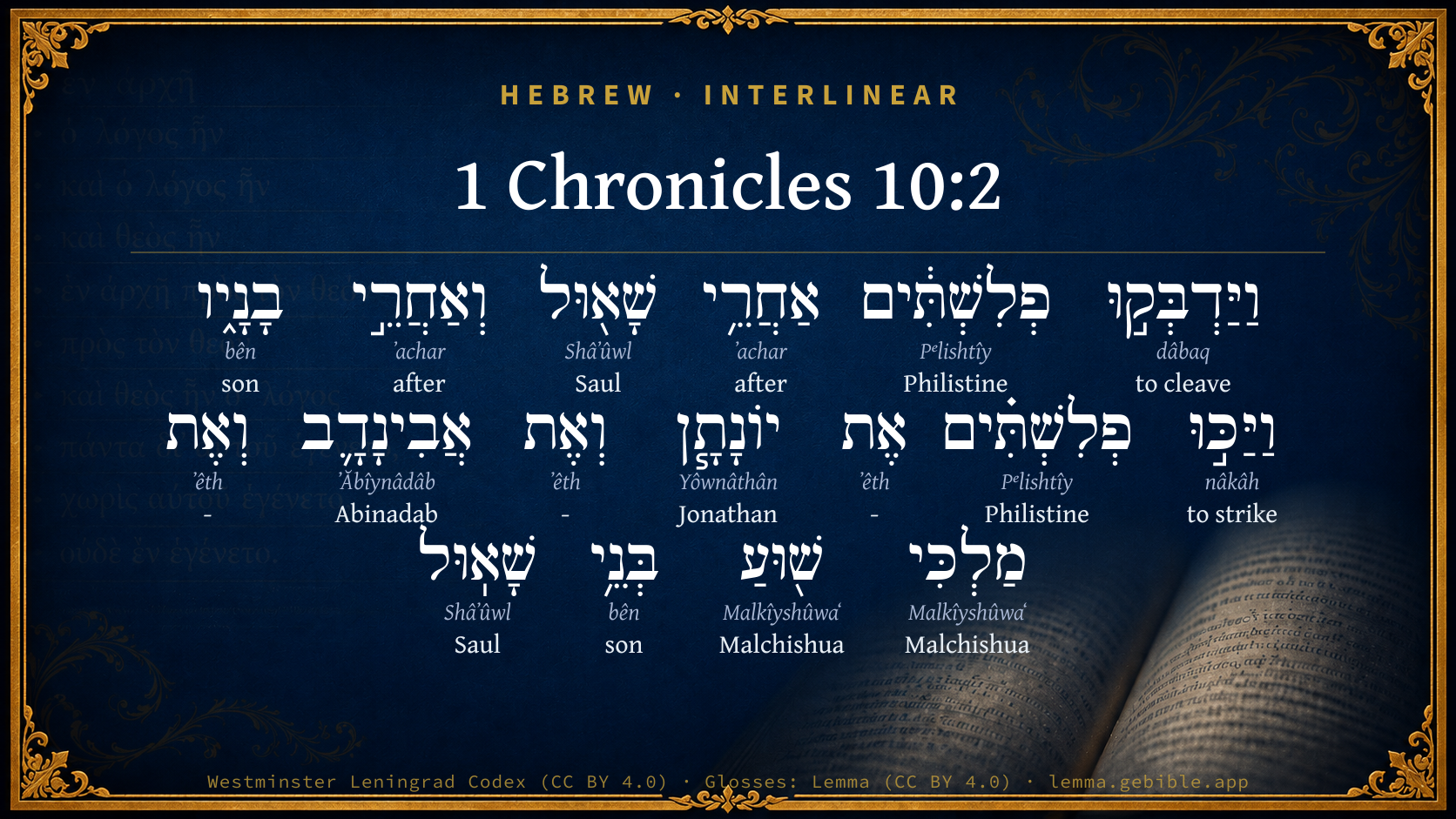
Hebrew (Westminster Leningrad Codex) 1 Chronicles 10:2 appears in the Hebrew Old Testament. The text above is from the Westminster Leningrad Codex. Each word links to its Strong’s number, a concise gloss, and parsing drawn from the Open Scriptures Hebrew Bible morphology. Click any word for its full Brown-Driver-Briggs (BDB) entry.
Download image
Cite this verse

1 Chronicles 10:2 (World English Bible). Public Domain. Lemma interlinear Bible study tool, https://lemma.gebible.app/v/1-chronicles/10/2.

Show BibTeX & RIS
BibTeX
RIS
English Translation
The Philistines followed hard after Saul and after his sons; and the Philistines killed Jonathan, and Abinadab, and Malchishua, the sons of Saul.
World English Bible · Public Domain
Download a study sheet

One document with this verse’s original text, its word-by-word gloss line, the meaning frame, cross-references with their text, attributed commentary, and full source and license credits — printable, and it pastes into notes with its structure intact.

This verse Autodidact and up

Study sheet (.html) Plain text (.txt)

A passage Seminary Student

Up to 50 verses in one chapter. A passage sheet keeps up to 6 commentary sources and 12 cross-references per verse, in the order this page ranks them, and says so on the sheet whenever that leaves anything out. Ask for a single verse and you get the Autodidact verse sheet above.

Everything on this page stays free to read, with no account — the sheet is a download of what is already on screen, not access to it.

Want to remove ads? Support Godless Engineer
Compare translations 3

The same verse in 3 English versions, stacked beneath the original-language interlinear above. Click any original word for its lexicon entry.

Each is an independent rendering of the whole verse — the interlinear is not word-aligned to these translations.

Highlighted words mark where these versions differ — a whole-verse word diff, not a word-by-word alignment.

  • World English Bible Public Domain
    The Philistines followed hard after Saul and after his sons; and the Philistines killed Jonathan, and Abinadab, and Malchishua, the sons of Saul.
  • King James Version Public Domain
    And the Philistines followed hard after Saul, and after his sons; and the Philistines slew Jonathan, and Abinadab, and Malchishua, the sons of Saul.
  • unfoldingWord Literal Text CC BY-SA 4.0
    And the Philistines pursued after Saul and after his sons. And the Philistines struck Jonathan and Abinadab and Malchi Shua, the sons of Saul.

unfoldingWord Literal Text — © unfoldingWord, licensed CC BY-SA 4.0. Word-aligned USFM3 via Door43 (git.door43.org/unfoldingWord/en_ult).

Versions to compare (up to 4)

3 of 4 selected

Show all 18 translations

Every available English version of this verse, each an independent rendering of the whole verse.

  • World English Bible Public Domain
    The Philistines followed hard after Saul and after his sons; and the Philistines killed Jonathan, and Abinadab, and Malchishua, the sons of Saul.
  • Berean Standard Bible Public Domain
    The Philistines followed hard after Saul and his sons, and they killed Saul’s sons Jonathan, Abinadab, and Malchishua.
  • Majority Standard Bible Public Domain
    The Philistines followed hard after Saul and his sons, and they killed Saul’s sons Jonathan, Abinadab, and Malchishua.
  • King James Version Public Domain
    And the Philistines followed hard after Saul, and after his sons; and the Philistines slew Jonathan, and Abinadab, and Malchishua, the sons of Saul.
  • American Standard Version (1901) Public Domain
    And the Philistines followed hard after Saul and after his sons; and the Philistines slew Jonathan, and Abinadab, and Malchi-shua, the sons of Saul.
  • Revised Version (1885) Public Domain
    And the Philistines followed hard after Saul and after his sons; and the Philistines slew Jonathan, and Abinadab, and Malchi-shua, the sons of Saul.
  • Geneva Bible (1599) Public Domain
    And the Philistims pursued after Saul and after his sonnes, and the Philistims smote Ionathan, and Abinadab, and Malchishua the sonnes of Saul.
  • Douay-Rheims (1899) Public Domain
    And the Philistines drew near pursuing after Saul, and his sons, and they killed Jonathan, and Abinadab, and Melchisua the sons of Saul.
  • Young's Literal Translation Public Domain
    and the Philistines pursue after Saul, and after his sons, and the Philistines smite Jonathan, and Abinadab, and Malchi-Shua, sons of Saul.
  • Literal Standard Version CC BY-SA 4.0
    and the Philistines pursue after Saul, and after his sons, and the Philistines strike Jonathan, and Abinadab, and Malchi-Shua, sons of Saul.
  • Unlocked Literal Bible CC BY-SA 4.0
    The Philistines closely pursued Saul and his son. The Philistines killed Jonathan, Abinadab, and Malki-Shua, his sons.
  • unfoldingWord Literal Text CC BY-SA 4.0
    And the Philistines pursued after Saul and after his sons. And the Philistines struck Jonathan and Abinadab and Malchi Shua, the sons of Saul.
  • Darby Bible Public Domain
    And the Philistines followed hard after Saul and after his sons; and the Philistines smote Jonathan, and Abinadab, and Malchi-shua, Saul's sons.
  • World Messianic Bible Public Domain
    The Philistines followed hard after Saul and after his sons; and the Philistines killed Jonathan, Abinadab, and Malchishua, the sons of Saul.
  • Webster's Bible Public Domain
    And the Philistines followed hard after Saul, and after his sons; and the Philistines slew Jonathan, and Abinadab, and Malchi-shua, the sons of Saul.
  • Free Bible Version CC BY-SA 4.0
    The Philistines chased down Saul and his sons. They killed Saul's sons Jonathan, Abinadab, and Malchishua.
  • Bible in Basic English Public Domain
    And the Philistines went hard after Saul and his sons, and put to death Jonathan and Abinadab and Malchi-shua, the sons of Saul.
  • JPS Tanakh (1917) Public Domain
    And the Philistines followed hard after Saul and after his sons; and the Philistines slew Jonathan, and Abinadab, and Malchi-shua, the sons of Saul.

Literal Standard Version (2020), Covenant Press — licensed CC BY-SA 4.0. Text via the HelloAO Bible API (eBible.org). Unlocked Literal Bible (unfoldingWord) — licensed CC BY-SA 4.0. Text via the HelloAO Bible API (eBible.org). unfoldingWord Literal Text — © unfoldingWord, licensed CC BY-SA 4.0. Word-aligned USFM3 via Door43 (git.door43.org/unfoldingWord/en_ult). Free Bible Version, Dr. Jonathan Gallagher — licensed CC BY-SA 4.0. Text via the HelloAO Bible API (eBible.org).

Word by word

More ways to search: Search by grammar → Find every occurrence → Compare this word →

Practice this passage: Drill this verse → Learn its vocabulary →

מַלְכִּי
Malkîyshûwaʻ
H4444
“Malchishua”
Noun, Proper
Part of Speech
Noun
Type
Proper
Full BDB Definition

Origin: from H4428 and H7769

TWOT: None

Malchishua = "my king is wealth" - a son of king Saul of Israel
  1. וַיַּדְבְּק֣וּ dâbaq H1692 “and · to cleave” Conjunction + Verb, Hiphil, Sequential Imperfect, 3rd Person, Masculine, Plural
  2. פְלִשְׁתִּ֔ים Pᵉlishtîy H6430 “Philistines” Noun, Gentilic, Masculine, Plural, Absolute
  3. אַחֲרֵ֥י ʼachar H310 “after” Preposition
  4. שָׁא֖וּל Shâʼûwl H7586 “Saul” Noun, Proper
  5. וְאַחֲרֵ֣י ʼachar H310 “and · after” Conjunction + Preposition
  6. בָנָ֑יו bên H1121 “sons · his” Noun, Common, Masculine, Plural, Construct + Suffix, Personal, 3rd Person, Masculine, Singular
  7. וַיַּכּ֣וּ nâkâh H5221 “and · to strike” Conjunction + Verb, Hiphil, Sequential Imperfect, 3rd Person, Masculine, Plural
  8. פְלִשְׁתִּ֗ים Pᵉlishtîy H6430 “Philistines” Noun, Gentilic, Masculine, Plural, Absolute
  9. אֶת ʼêth H853 “-” Particle, Direct Object
  10. יוֹנָתָ֧ן Yôwnâthân H3129 “Jonathan” Noun, Proper
  11. וְאֶת ʼêth H853 “and · -” Conjunction + Particle, Direct Object
  12. אֲבִינָדָ֛ב ʼĂbîynâdâb H41 “Abinadab” Noun, Proper
  13. וְאֶת ʼêth H853 “and · -” Conjunction + Particle, Direct Object
  14. שׁ֖וּעַ Malkîyshûwaʻ H4444 “Malchishua” Noun, Proper
  15. בְּנֵ֥י bên H1121 “sons of” Noun, Common, Masculine, Plural, Construct
  16. שָׁאֽוּל Shâʼûwl H7586 “Saul” Noun, Proper

About this verse

These counts appear in no published source. They are computed here, from the morphology-tagged text and Lemma’s own curated glosses. What Lemma adds →

17
words
10
distinct lemmas
Historical
section

Notable vocabulary

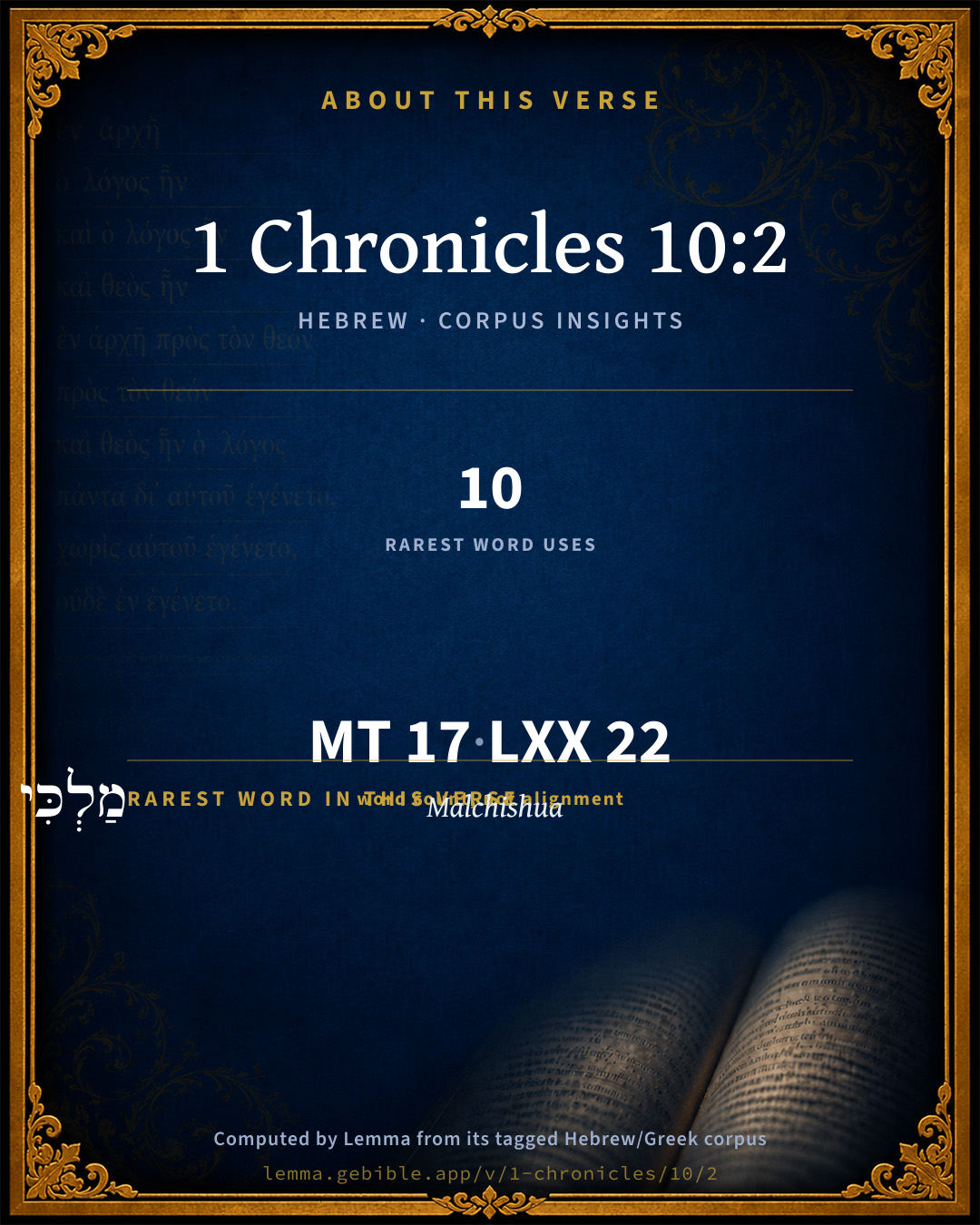
The rarest word here is מַלְכִּי Malchishua H4444 — appearing just 10 times in the whole Hebrew Bible.

Shared distinctive vocabulary

מַלְכִּי Malchishua H4444 occurs in 5 verses of the Hebrew Bible. Also found in:

Grammatical profile

  • 2 verbs
  • 10 nouns
  • 2 prepositions
  • 3 particles

Verb forms

  • וַיַּדְבְּק֣וּ Hiphil · Sequential Imperfect
  • וַיַּכּ֣וּ Hiphil · Sequential Imperfect

Repetition

Words recur within this verse — often emphatic in Hebrew:

  • פְלִשְׁתִּ֔ים Philistine H6430 ×2
  • אַחֲרֵ֥י after H310 ×2
  • שָׁא֖וּל Saul H7586 ×2
  • בָנָ֑יו son H1121 ×2
  • מַלְכִּי Malchishua H4444 ×2

Hebrew & Septuagint length

In English translation the verse runs 23 words from the Hebrew and 22 from the Septuagint (LXX English) — closely comparable.

A rough comparison of the two English renderings, which tokenize alike — not a word-level alignment.

Word counts can differ between the Hebrew and the Greek without any difference in meaning — e.g. the Hebrew direct-object marker אֵת has no separate Greek word, and Greek often adds the article ὁ.

In the original languages it is 17 Hebrew tokens and 22 Greek tokens — but the two are counted differently (Hebrew bundles its prefixes and suffixes into one token; the Greek is in lemma form), so that isn’t a like-for-like length.

Cross-references

9

Topical passages linked to 1 Chronicles 10:2 in the Treasury of Scripture Knowledge — connected by theme and wording, ordered by reader-vote popularity; previews shown in the World English Bible.

  • 1 Chronicles 9:39 Ner became the father of Kish; and Kish became the father of Saul; and Saul became the father of Jonathan, and Malchishua, and Abinadab, and Eshbaal.
  • Isaiah 57:1–2 The righteous perishes, and no man lays it to heart; and merciful men are taken away, none considering that the righteous is taken away from the evil [to come].
  • Exodus 20:5 you shall not bow yourself down to them, nor serve them, for I, Yahweh your God, am a jealous God, visiting the iniquity of the fathers on the children, on the third and on the fourth generation of those who hate me,
  • 1 Samuel 14:6 Jonathan said to the young man who bore his armor, Come, and let us go over to the garrison of these uncircumcised: it may be that Yahweh will work for us; for there is no restraint to Yahweh to save by many or by few.
  • 1 Samuel 14:39–40 For, as Yahweh lives, who saves Israel, though it be in Jonathan my son, he shall surely die. But there was not a man among all the people who answered him.
  • 1 Samuel 14:49 Now the sons of Saul were Jonathan, and Ishvi, and Malchishua; and the names of his two daughters were these: the name of the firstborn Merab, and the name of the younger Michal:
  • 2 Kings 23:29 In his days Pharaoh Necoh king of Egypt went up against the king of Assyria to the river Euphrates: and king Josiah went against him; and [Pharaoh Necoh] killed him at Megiddo, when he had seen him.
  • 2 Kings 25:7 They killed the sons of Zedekiah before his eyes, and put out the eyes of Zedekiah, and bound him in fetters, and carried him to Babylon.
  • 1 Chronicles 8:33 Ner became the father of Kish; and Kish became the father of Saul; and Saul became the father of Jonathan, and Malchishua, and Abinadab, and Eshbaal.

Cross-references courtesy of OpenBible.info (CC BY 4.0).

Hebrew and Greek witnesses Masoretic Hebrew ↔ Greek Septuagint

The same verse in the two great witnesses to the Old Testament, shown verse-for-verse.

These are two independent witnesses, not word-aligned to each other, and the Septuagint is shown in lemma (dictionary) form.

Hebrew 1 Chronicles 10:2 Masoretic · Westminster Leningrad Codex

וַיַּדְבְּק֣וּ פְלִשְׁתִּ֔ים אַחֲרֵ֥י שָׁא֖וּל וְאַחֲרֵ֣י בָנָ֑יו וַיַּכּ֣וּ פְלִשְׁתִּ֗ים אֶת יוֹנָתָ֧ן וְאֶת אֲבִינָדָ֛ב וְאֶת מַלְכִּי שׁ֖וּעַ בְּנֵ֥י שָׁאֽוּל

The Philistines followed hard after Saul and after his sons; and the Philistines killed Jonathan, and Abinadab, and Malchishua, the sons of Saul.

World English Bible · Public Domain

Greek LXX 1 Chronicles 10:2 Septuagint · lemma form

καί καταδιώκω ἀλλόφυλος ὀπίσω σαούλ καί ὀπίσω υἱός αὐτός καί πατάσσω ἀλλόφυλος ὁ ιωναθαν καί ὁ αμιναδαβ καί ὁ μελχισουε υἱός σαούλ

And the Philistines pursued after Saul, and after his sons; and the Philistines struck Jonathan, and Aminadab, and Melchisue, sons of Saul.

LXX2012 (modern English Septuagint) · Public Domain

Hebrew: Westminster Leningrad Codex (CC BY 4.0). Greek: Septuagint (public domain); English from LXX2012 (modern English Septuagint) (Public Domain). How the Septuagint differs from the Hebrew →

Commentary

Notes on 1 Chronicles 10:2 from classic Christian and Jewish commentators (each source and its license shown beneath its notes). The classic Christian expositions comment on the surrounding passage and are grouped to its opening verse, so a note may address several verses; the Jewish commentaries on the Tanakh (Rashi and others) are per-verse, so they appear only where the commentator wrote on this verse.

Lemma curates 59 commentaries, every one of them public domain or Creative Commons licensed, each selected and text-cleaned for this edition rather than reprinted as found. About our sources →

Trapp's Complete Commentary

John Trapp

1Ch 10:2 And the Philistines followed hard after Saul, and after his sons; and the Philistines slew Jonathan, and Abinadab, and Malchishua, the sons of Saul.

Ver. 2. And the Philistines slew Jonathan.] Though a pious and valiant prince.

“ Non te tua plurima, Pentheu,

Labentem texit pietas. ” - Ovid.

“ Cadit et Ripheus iustissimus unus,

Qui fuit in Teucris, et servantissimus aequi. ” - Virg.

John Trapp, A Commentary or Exposition upon All the Books of the Old and New Testament (1647–1656) — public domain. Text from a community e-Sword module.

Ellicott's Commentary for English Readers

(2) The Philistines followed hard after Saul.—Literally, clave to Saul, that is, hotly pursued him. (Comp. 1 Kings 22, 31.) The destruction of the king and his sons would make their triumph complete.

The sons of Saul.—Omit the. Eshbaal, Saul’s fourth son, was not in the battle (2Sa_2:8. Comp. 1Ch_8:33). Like Zedekiah, the last king of Judah, Saul may have witnessed the death of his sons (2Ki_25:7). Jonathan, at least, would not be far from him in the last struggle. “In their deaths they were not divided.”

A Bible Commentary for English Readers, edited by Charles John Ellicott (1878–1897) — public domain. Text from a community e-Sword module.

The Cambridge Bible for Schools and Colleges

gen. ed. J. J. S. Perowne

2. Malchi-shua] This is the correct spelling, not Melchi-shua.

The Cambridge Bible for Schools and Colleges (gen. ed. J. J. S. Perowne; Cambridge University Press, 1878–1918) — public domain. Text from a community e-Sword module.

The Pulpit Commentary

Followed hard after. The Hebrew verb implies all this and rather more, viz. that they made the pursuit of Saul and his sons their one special object. Luther"s "Hingen sich au Saul" expresses this forcibly. Abinadab ; or Ishui (see 1Ch_8:33; 1Sa_14:49) The sons of Saul. Omit the article, which is not present in the Hebrew text. The fourth son, not withstanding our ver. 6, survived. (2Sa_2:8-15)

HOMILIES BY F. WHITFIELD Vers. 2, 14.

Saul and David.

The portion of the Book of Chronicles referring more particularly to the genealogy of Israel ends with the thirty-fourth verse of the ninth chapter. With the following verse commences the real history of the people. The history of a nation is the history of its head or king; and we commence that history with the history of Saul and David. They both appear on the scene in the following verses. We must not forget, in reading this history, that these two personages are representative characters. They are eminently typical. In Saul we must not omit to see the head of the great world-power, or that which is antagonistic to the kingdom of the Son of God. In David, likewise, we must see One greater than David, even the true David, the Lord Jesus Christ. Saul and David are from beginning to end in opposition, Saul"s history comes first. He is the people"s choice, the man of the world. His entire course is enmity against David. Hatred, opposition, and bitter persecution are the results of this enmity. The end of the world-power, as represented in him, is defeat and failure, ruin and death. Thus will this world"s rule end also. Nevertheless, all this opposition and enmity are most needful to David and his few faithful followers. It disciplined and trained him for the kingdom for which he had been anointed of God. So this world"s misrule and enmity are most needful for the Lord"s anointed ones. David and his followers under Saul were strangers and pilgrims indeed. So Christ and his people are now. But their time is at hand when the weeds of sorrow shall be exchanged for the laurels of victory. I said Saul"s history comes first. It is always so. Whether in the history of individuals or nations, whether in nature or in grace, in everything the dark background comes first, and then the lines of the picture of grace can be seen. The tenth chapter of this book is man at his best estate. It is the dark background. One chapter is enough for it. The eleventh chapter begins with the God-man, David, who is the type in it of a "Greater than David." It goes on unfolding chapter after chapter. It has not ended yet, for in the history of David"s Son the Lord Jesus Christ it is still going on. The chapters are still unfolding him, and will throughout eternity, for he is "the everlasting God," the "I am that I am, which is, and which was, and which is to come, the Almighty. W.

HOMILIES BY R. TUCK Ver. 2.

Innocent sharing in calamity.

The judgment that came upon King Saul could not be limited to him; it included his sons, his family, his dynasty. Saul"s sin was distinctly personal. He committed acts of wilfulness; he failed in the completeness of his obedience. (1Sa_13:8-14 1Sa_15:8, 1Sa_15:9) And yet his sin could not be personal only no man can secure that his sin shall be, while he comes into relations with others. Saul"s sin must also be official the iniquity of the representative person, the king; and relational the iniquity of the father, the head of a family. So far as a man"s sin starts a train of consequences, he cannot limit the disabilities to his own suffering, and he may not wonder if the resultant calamities should strike him through the suffering of those most dear to him. To our feeling the exceeding bitterness of the consequences of wilful sin lies in the fact of their involving others, and those whom we would most anxiously spare.

I THE INNOCENT DO NOT SHARE IN THE GUILT. Distinguish between the guilt and the calamity that follows on it. The guilt can rest only on the man who does the wilful and guilty act, because an action is only guilty action when it is wilfully done against light and knowledge. So, depending on the will, it belongs exclusively to the individual. King Saul was guilty before God, but his sons were not, save as they may have personally accepted and approved their father"s acts, and so made themselves individually responsible. This way of becoming sharers in guilt is taught by St. Paul in Rom_1:22. He comes under the Divine judgment who has pleasure in them that do evil things, as well as those who actually do the evil.

II THE INNOCENT MAY SHARE IN THE CALAMITY THAT FOLLOWS ON SIN. This may be illustrated from the family sphere a father"s wrong-doing breaks up the home, etc.; or from the social spheres neglect of sanitary laws on the part of local governments involve theinnocent citizens in disease and plague; or from the national spheres a king"s wrong-doing brings war, and battle and siege are calamities for women and children as well as for soldiers.

III THE INNOCENT MUST SHARE IN THE CALAMITY THAT FOLLOWS ON SIN. For this is precisely the condition under which God has set mankind. It follows, of necessity, upon that fact of the "solidarity of the race," which modern writers are now setting in prominence, but which St. Paul taught as one of the basis-principles of Christianity long years ago. See his speech at Athens and the Epistle to the Romans. Illustrate by the figure of "many members in one body." One limb or organ, diseased, gives vain and weakness in other organs that are not diseased. Men are, in actual life, as vitally related as parts of the body, and if one member sins the other members suffer with it.

IV THE INNOCENT SHARING IN CALAMITY HAS A MORAL MISSION. It is one of warning. We only feel the real evil of sin through the pressure of the troubles that follow upon it. But it becomes an effective warning that we must drag others down with our sin; and we can never be sure who will be the chief sufferer it may possibly be our dearest and best.

V THE INNOCENT SHARING IN CALAMITY HAS A RECOVERING AND REDEMPTIVE POWER. It awakens to a sense of sin, recovering us from the delusions of self-will. It binds men together in a brotherhood of helpfulness; seeking to relieve from burdens of suffering, they are led to see that suffering must be dealt with at its root, which is sin.

Lead up to the fact of the Lord Jesus Christ, the innocent member of the human race, the spotless and perfectly obedient Son of God, suffering in, with, and for a guilty world. It is precisely this which is the fullest and most effective revelation of the guilt of mankind. Yet it is precisely this which is the great recovering and redemptive power. "He was wounded for our transgressions," and "by his stripes we are healed. R.T.

The Pulpit Commentary (1880–1919), ed. H.D.M. Spence-Jones & Joseph S. Exell — public domain. Text from a community e-Sword module.

Lesson kit

Teaching starters — assembled from the data on this page, not authored interpretation. Every prompt links to the verse data it draws on. Edit before teaching.

1 Chronicles, in the Historical, opens this verse with 17 words (10 distinct Hebrew lemmas). Its most distinctive word is Malkîyshûwaʻ (“Malchishua”). A historical commentator’s framing appears above. Read the whole chapter for the surrounding context.

Discussion questions

  1. What does “Malchishua” (Malkîyshûwaʻ) contribute to the verse as a whole?
  2. 1 Samuel 14:49 shares the word «Malchishua» with this verse. How do the two illuminate each other?
  3. “Philistine” occurs 2× in this one verse. What is the effect of the repetition?
  4. The translations on this page render this verse differently — a whole-verse word diff, not a word-by-word alignment. What might account for the different wordings?
  5. The verb «וַיַּדְבְּק֣וּ» is Hiphil Sequential Imperfect. How does its form color the action?
  6. Reading how Trapp's Complete Commentary and Ellicott's Commentary for English Readers read this verse, where do the two commentators agree and where do they part?

Things to notice

Reading settings

Reading text

Shown beneath each verse's original-language words.

Old Testament
Old Testament edition

Read the OT as the Masoretic Hebrew (MT) or the Greek Septuagint (LXX).

English shown for the Greek Septuagint (in the Hebrew ↔ Greek comparison).

Comparing translations? Open the Compare panel on any verse page to stack up to four side by side.