
2 Chronicles 28:5

Hebrew (Westminster Leningrad Codex) 2 Chronicles 28:5 appears in the Hebrew Old Testament. The text above is from the Westminster Leningrad Codex. Each word links to its Strong’s number, a concise gloss, and parsing drawn from the Open Scriptures Hebrew Bible morphology. Click any word for its full Brown-Driver-Briggs (BDB) entry.
Download image
Cite this verse

2 Chronicles 28:5 (World English Bible). Public Domain. Lemma interlinear Bible study tool, https://lemma.gebible.app/v/2-chronicles/28/5.

Show BibTeX & RIS
BibTeX
RIS
English Translation
Therefore Yahweh his God delivered him into the hand of the king of Syria; and they struck him, and carried away of his a great multitude of captives, and brought them to Damascus. He was also delivered into the hand of the king of Israel, who struck him with a great slaughter.
World English Bible · Public Domain
Download a study sheet

One document with this verse’s original text, its word-by-word gloss line, the meaning frame, cross-references with their text, attributed commentary, and full source and license credits — printable, and it pastes into notes with its structure intact.

This verse Autodidact and up

Study sheet (.html) Plain text (.txt)

A passage Seminary Student

Up to 50 verses in one chapter. A passage sheet keeps up to 6 commentary sources and 12 cross-references per verse, in the order this page ranks them, and says so on the sheet whenever that leaves anything out. Ask for a single verse and you get the Autodidact verse sheet above.

Everything on this page stays free to read, with no account — the sheet is a download of what is already on screen, not access to it.

Want to remove ads? Support Godless Engineer
Compare translations 3

The same verse in 3 English versions, stacked beneath the original-language interlinear above. Click any original word for its lexicon entry.

Each is an independent rendering of the whole verse — the interlinear is not word-aligned to these translations.

Highlighted words mark where these versions differ — a whole-verse word diff, not a word-by-word alignment.

  • World English Bible Public Domain
    Therefore Yahweh his God delivered him into the hand of the king of Syria; and they struck him, and carried away of his a great multitude of captives, and brought them to Damascus. He was also delivered into the hand of the king of Israel, who struck him with a great slaughter.
  • King James Version Public Domain
    Wherefore the LORD his God delivered him into the hand of the king of Syria; and they smote him, and carried away a great multitude of them captives, and brought them to Damascus. And he was also delivered into the hand of the king of Israel, who smote him with a great slaughter.
  • unfoldingWord Literal Text CC BY-SA 4.0
    And Yahweh his God gave him into the hand of the king of Aram. And he struck him, and they took captive from him many captives. And they brought to Damascus. And also into the hand of the king of Israel he gave, and he struck him a great striking.

unfoldingWord Literal Text — © unfoldingWord, licensed CC BY-SA 4.0. Word-aligned USFM3 via Door43 (git.door43.org/unfoldingWord/en_ult).

Versions to compare (up to 4)

3 of 4 selected

Show all 18 translations

Every available English version of this verse, each an independent rendering of the whole verse.

  • World English Bible Public Domain
    Therefore Yahweh his God delivered him into the hand of the king of Syria; and they struck him, and carried away of his a great multitude of captives, and brought them to Damascus. He was also delivered into the hand of the king of Israel, who struck him with a great slaughter.
  • Berean Standard Bible Public Domain
    So the LORD his God delivered Ahaz into the hand of the king of Aram, who attacked him and took many captives to Damascus. Ahaz was also delivered into the hand of the king of Israel, who struck him with great force.
  • Majority Standard Bible Public Domain
    So the LORD his God delivered Ahaz into the hand of the king of Aram, who attacked him and took many captives to Damascus. Ahaz was also delivered into the hand of the king of Israel, who struck him with great force.
  • King James Version Public Domain
    Wherefore the LORD his God delivered him into the hand of the king of Syria; and they smote him, and carried away a great multitude of them captives, and brought them to Damascus. And he was also delivered into the hand of the king of Israel, who smote him with a great slaughter.
  • American Standard Version (1901) Public Domain
    Wherefore Jehovah his God delivered him into the hand of the king of Syria; and they smote him, and carried away of his a great multitude of captives, and brought them to Damascus. And he was also delivered into the hand of the king of Israel, who smote him with a great slaughter.
  • Revised Version (1885) Public Domain
    Wherefore the LORD his God delivered him into the hand of the king of Syria; and they smote him, and carried away of his a great multitude of captives, and brought them to Damascus. And he was also delivered into the hand of the king of Israel, who smote him with a great slaughter.
  • Geneva Bible (1599) Public Domain
    Wherefore the Lord his God deliuered him into the hand of the King of the Aramites, and they smote him, and tooke of his, many prisoners, and brought them to Damascus: and he was also deliuered into the hande of the King of Israel, which smote him with a great slaughter.
  • Douay-Rheims (1899) Public Domain
    And the Lord his God delivered him into the hands of the king of Syria, who defeated him, and took a great booty out of his kingdom, and carried it to Damascus: he was also delivered into the hands of the king of Israel, who overthrew him with a great slaughter.
  • Young's Literal Translation Public Domain
    And Jehovah his God giveth him into the hand of the king of Aram, and they smite him, and take captive from him a great captivity, and bring `them' in to Damascus, and also into the hand of the king of Israel he hath been given, and he smiteth him -- a great smiting.
  • Literal Standard Version CC BY-SA 4.0
    And his God YHWH gives him into the hand of the king of Aram, and they strike him, and take captive a great captivity from him, and bring [them] to Damascus, and he has also been given into the hand of the king of Israel, and he strikes him [with] a great striking.
  • Unlocked Literal Bible CC BY-SA 4.0
    Therefore Yahweh the God of Ahaz gave him into the hand of the king of Aram. The Arameans defeated him and carried away from him a great crowd of prisoners, bringing them to Damascus. Ahaz was also given into the hand of the king of Israel who defeated him in a great slaughter.
  • unfoldingWord Literal Text CC BY-SA 4.0
    And Yahweh his God gave him into the hand of the king of Aram. And he struck him, and they took captive from him many captives. And they brought to Damascus. And also into the hand of the king of Israel he gave, and he struck him a great striking.
  • Darby Bible Public Domain
    Therefore Jehovah his God gave him into the hand of the king of Syria; and they smote him, and carried away a great multitude of them captives, and brought them to Damascus. And he was also given into the hand of the king of Israel, who smote him with a great slaughter.
  • World Messianic Bible Public Domain
    Therefore the LORD his God delivered him into the hand of the king of Syria. They struck him, and carried away from him a great multitude of captives, and brought them to Damascus. He was also delivered into the hand of the king of Israel, who struck him with a great slaughter.
  • Webster's Bible Public Domain
    Wherefore the LORD his God delivered him into the hand of the king of Syria; and they smote him, and carried away a great multitude of them captives, and brought them to Damascus. And he was also delivered into the hand of the king of Israel, who smote him with a great slaughter.
  • Free Bible Version CC BY-SA 4.0
    As a result, the Lord his God let the king of Aram conquer Ahaz. The Arameans attacked him and captured many of his people, taking them to Damascus. Ahaz was also defeated by the king of Israel in a massive attack.
  • Bible in Basic English Public Domain
    So the Lord his God gave him up into the hands of the king of Aram; and they overcame him, and took away a great number of his people as prisoners to Damascus. Then he was given into the hands of the king of Israel, who sent great destruction on him.
  • JPS Tanakh (1917) Public Domain
    Wherefore the LORD his God delivered him into the hand of the king of Aram; and they smote him, and carried away of his a great multitude of captives, and brought them to Damascus. And he was also delivered into the hand of the king of Israel, who smote him with a great slaughter.

Literal Standard Version (2020), Covenant Press — licensed CC BY-SA 4.0. Text via the HelloAO Bible API (eBible.org). Unlocked Literal Bible (unfoldingWord) — licensed CC BY-SA 4.0. Text via the HelloAO Bible API (eBible.org). unfoldingWord Literal Text — © unfoldingWord, licensed CC BY-SA 4.0. Word-aligned USFM3 via Door43 (git.door43.org/unfoldingWord/en_ult). Free Bible Version, Dr. Jonathan Gallagher — licensed CC BY-SA 4.0. Text via the HelloAO Bible API (eBible.org).

Word by word

More ways to search: Search by grammar → Find every occurrence → Compare this word →

Practice this passage: Drill this verse → Learn its vocabulary →

שִׁבְיָ֣ה
shibyâh
H7633
“captivity”
Noun, Common, Both, Singular, Absolute
Part of Speech
Noun
Type
Common
Gender
Both
Number
Singular
State
Absolute
Full BDB Definition

Origin: from H7628

TWOT: 2311c

captivity, captives - (state of) captivity - captives
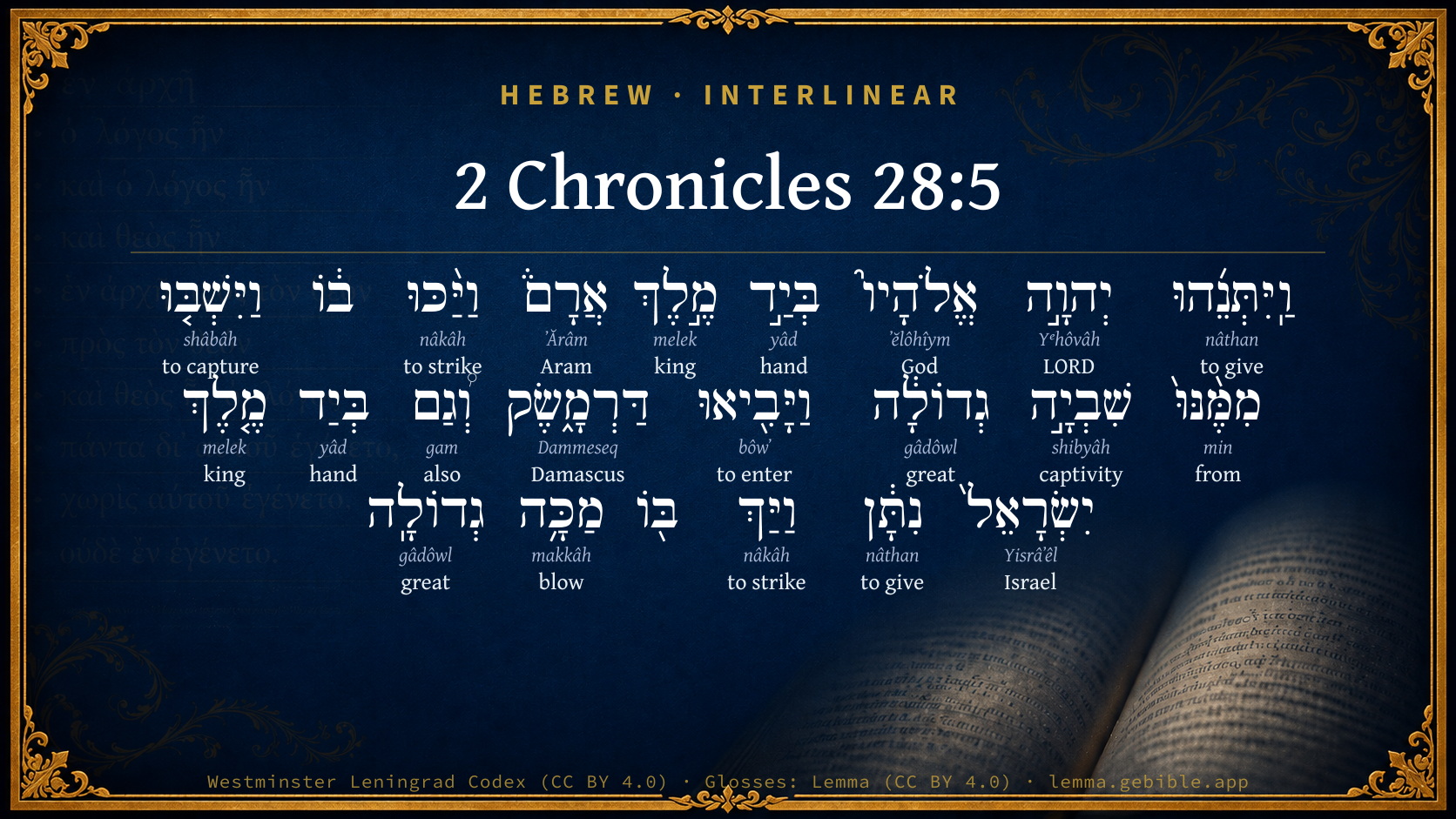
  1. וַֽיִּתְּנֵ֜הוּ nâthan H5414 “and · to give · him” Conjunction + Verb, Qal, Sequential Imperfect, 3rd Person, Masculine, Singular + Suffix, Personal, 3rd Person, Masculine, Singular
  2. יְהוָ֣ה Yᵉhôvâh H3068 “LORD” Noun, Proper
  3. אֱלֹהָיו֮ ʼĕlôhîym H430 “God(s) · his” Noun, Common, Masculine, Plural, Construct + Suffix, Personal, 3rd Person, Masculine, Singular
  4. בְּיַ֣ד yâd H3027 “in/at · hand of” Preposition + Noun, Common, Both, Singular, Construct
  5. מֶ֣לֶךְ melek H4428 “king of” Noun, Common, Masculine, Singular, Construct
  6. אֲרָם֒ ʼĂrâm H758 “Aram” Noun, Proper
  7. וַיַּ֨כּוּ nâkâh H5221 “and · to strike” Conjunction + Verb, Hiphil, Sequential Imperfect, 3rd Person, Masculine, Plural
  8. וַיִּשְׁבּ֤וּ shâbâh H7617 “and · to capture” Conjunction + Verb, Qal, Sequential Imperfect, 3rd Person, Masculine, Plural
  9. מִמֶּ֨נּוּ֙ min H4480 “from · us” Preposition + Suffix, Personal, 1st Person, Common, Plural
  10. גְדוֹלָ֔ה gâdôwl H1419 “great” Adjective, Adjective, Feminine, Singular, Absolute
  11. וַיָּבִ֖יאוּ bôwʼ H935 “and · to enter” Conjunction + Verb, Hiphil, Sequential Imperfect, 3rd Person, Masculine, Plural
  12. דַּרְמָ֑שֶׂק Dammeseq H1834 “Damascus” Noun, Proper
  13. וְ֠גַם gam H1571 “and · also” Conjunction + Particle, Accusative
  14. בְּיַד yâd H3027 “in/at · hand of” Preposition + Noun, Common, Both, Singular, Construct
  15. מֶ֤לֶךְ melek H4428 “king of” Noun, Common, Masculine, Singular, Construct
  16. יִשְׂרָאֵל֙ Yisrâʼêl H3478 “Israel” Noun, Proper
  17. נִתָּ֔ן nâthan H5414 “giving” Verb, Niphal, Participle Active, Masculine, Singular, Absolute
  18. וַיַּךְ nâkâh H5221 “and · to strike” Conjunction + Verb, Hiphil, Sequential Imperfect, 3rd Person, Masculine, Singular
  19. מַכָּ֥ה makkâh H4347 “blow” Noun, Common, Feminine, Singular, Absolute
  20. גְדוֹלָֽה gâdôwl H1419 “great” Adjective, Adjective, Feminine, Singular, Absolute

About this verse

These counts appear in no published source. They are computed here, from the morphology-tagged text and Lemma’s own curated glosses. What Lemma adds →

23
words
16
distinct lemmas
Historical
section

Notable vocabulary

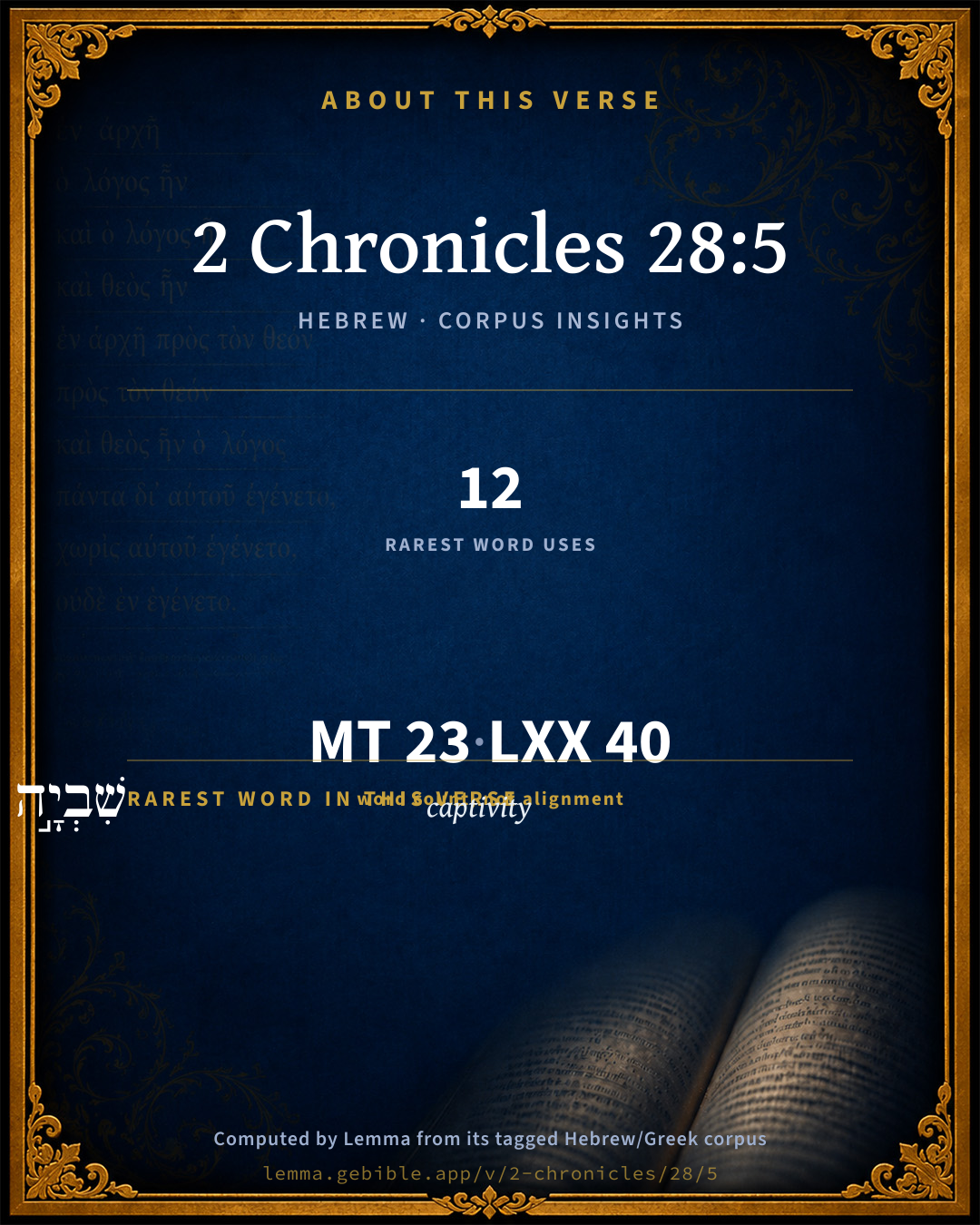
The rarest word here is שִׁבְיָ֣ה captivity H7633 — appearing just 12 times in the whole Hebrew Bible.

Shared distinctive vocabulary

שִׁבְיָ֣ה captivity H7633 occurs in 12 verses of the Hebrew Bible. Also found in:

Grammatical profile

  • 6 verbs
  • 11 nouns
  • 2 adjectives
  • 3 prepositions
  • 1 particle

Verb forms

  • וַֽיִּתְּנֵ֜הוּ Qal · Sequential Imperfect
  • וַיַּ֨כּוּ Hiphil · Sequential Imperfect
  • וַיִּשְׁבּ֤וּ Qal · Sequential Imperfect
  • וַיָּבִ֖יאוּ Hiphil · Sequential Imperfect
  • נִתָּ֔ן Niphal · Participle Active
  • וַיַּךְ Hiphil · Sequential Imperfect

Repetition

Words recur within this verse — often emphatic in Hebrew:

  • וַֽיִּתְּנֵ֜הוּ to give H5414 ×2
  • בְּיַ֣ד hand H3027 ×2
  • מֶ֣לֶךְ king H4428 ×2
  • וַיַּ֨כּוּ to strike H5221 ×2
  • גְדוֹלָ֔ה great H1419 ×2

Hebrew & Septuagint length

In English translation the verse runs 52 words from the Hebrew and 53 from the Septuagint (LXX English) — closely comparable.

A rough comparison of the two English renderings, which tokenize alike — not a word-level alignment.

Word counts can differ between the Hebrew and the Greek without any difference in meaning — e.g. the Hebrew direct-object marker אֵת has no separate Greek word, and Greek often adds the article ὁ.

In the original languages it is 23 Hebrew tokens and 40 Greek tokens — but the two are counted differently (Hebrew bundles its prefixes and suffixes into one token; the Greek is in lemma form), so that isn’t a like-for-like length.

Cross-references

9

Topical passages linked to 2 Chronicles 28:5 in the Treasury of Scripture Knowledge — connected by theme and wording, ordered by reader-vote popularity; previews shown in the World English Bible.

  • Isaiah 7:1 It happened in the days of Ahaz the son of Jotham, the son of Uzziah, king of Judah, that Rezin the king of Syria, and Pekah the son of Remaliah, king of Israel, went up to Jerusalem to war against it, but could not prevail against it.
  • 2 Kings 16:5–6 Then Rezin king of Syria and Pekah son of Remaliah king of Israel came up to Jerusalem to war: and they besieged Ahaz, but could not overcome him.
  • 2 Chronicles 24:24 For the army of the Syrians came with a small company of men; and Yahweh delivered a very great host into their hand, because they had forsaken Yahweh, the God of their fathers. So they executed judgment on Joash.
  • Exodus 20:2–3 "I am Yahweh your God, who brought you out of the land of Egypt, out of the house of bondage.
  • Judges 2:14 The anger of Yahweh was kindled against Israel, and he delivered them into the hands of spoilers who despoiled them; and he sold them into the hands of their enemies round about, so that they could not any longer stand before their enemies.
  • 2 Chronicles 33:11 Therefore Yahweh brought on them the captains of the host of the king of Assyria, who took Manasseh in chains, and bound him with fetters, and carried him to Babylon.
  • 2 Chronicles 36:5 Jehoiakim was Twenty-five years old when he began to reign; and he reigned eleven years in Jerusalem: and he did that which was evil in the sight of Yahweh his God.
  • 2 Chronicles 36:17 Therefore he brought on them the king of the Chaldeans, who killed their young men with the sword in the house of their sanctuary, and had no compassion on young man or virgin, old man or gray-headed: he gave them all into his hand.
  • Isaiah 7:6 "Let's go up against Judah, and tear it apart, and let's divide it among ourselves, and set up a king in the midst of it, even the son of Tabeel."

Cross-references courtesy of OpenBible.info (CC BY 4.0).

Hebrew and Greek witnesses Masoretic Hebrew ↔ Greek Septuagint

The same verse in the two great witnesses to the Old Testament, shown verse-for-verse.

These are two independent witnesses, not word-aligned to each other, and the Septuagint is shown in lemma (dictionary) form.

Hebrew 2 Chronicles 28:5 Masoretic · Westminster Leningrad Codex

וַֽיִּתְּנֵ֜הוּ יְהוָ֣ה אֱלֹהָיו֮ בְּיַ֣ד מֶ֣לֶךְ אֲרָם֒ וַיַּ֨כּוּ ב֔וֹ וַיִּשְׁבּ֤וּ מִמֶּ֨נּוּ֙ שִׁבְיָ֣ה גְדוֹלָ֔ה וַיָּבִ֖יאוּ דַּרְמָ֑שֶׂק וְ֠גַם בְּיַד מֶ֤לֶךְ יִשְׂרָאֵל֙ נִתָּ֔ן וַיַּךְ בּ֖וֹ מַכָּ֥ה גְדוֹלָֽה

Therefore Yahweh his God delivered him into the hand of the king of Syria; and they struck him, and carried away of his a great multitude of captives, and brought them to Damascus. He was also delivered into the hand of the king of Israel, who struck him with a great slaughter.

World English Bible · Public Domain

Greek LXX 2 Chronicles 28:5 Septuagint · lemma form

καί παραδίδωμι αὐτός κύριος ὁ θεός αὐτός διά χείρ βασιλεύς συρία καί πατάσσω ἐν αὐτός καί αἰχμαλωτεύω ἐκ αὐτός αἰχμαλωσία πολύς καί ἄγω εἰς δαμασκός καί γάρ εἰς ὁ χείρ βασιλεύς ἰσραήλ παραδίδωμι αὐτός καί πατάσσω ἐν αὐτός πληγή μέγας

And the Lord his God delivered him into the hand of the king of Syria; and he struck him, and took captive of them a great band of prisoners, and carried him to Damascus. Also God delivered him into the hands of the king of Israel, who struck him with a great slaughter.

LXX2012 (modern English Septuagint) · Public Domain

Hebrew: Westminster Leningrad Codex (CC BY 4.0). Greek: Septuagint (public domain); English from LXX2012 (modern English Septuagint) (Public Domain). How the Septuagint differs from the Hebrew →

Commentary

Notes on 2 Chronicles 28:5 from classic Christian and Jewish commentators (each source and its license shown beneath its notes). The classic Christian expositions comment on the surrounding passage and are grouped to its opening verse, so a note may address several verses; the Jewish commentaries on the Tanakh (Rashi and others) are per-verse, so they appear only where the commentator wrote on this verse.

Lemma curates 59 commentaries, every one of them public domain or Creative Commons licensed, each selected and text-cleaned for this edition rather than reprinted as found. About our sources →

Ellicott's Commentary for English Readers

THE WAR WITH REZIN OF SYRIA AND PEKAH OF ISRAEL; OR, THE SYRO-EPHRAITE CAMPAIGN (2Ch_28:5-9). (Comp. 2Ki_16:5; Isa_7:1.)

(5) Wherefore (and) the Lord his God delivered him.—These opening words help us to understand the ground of the variations of the present account from that of 2 Kings 16. The chronicler purposes, not so much to describe a campaign, as to select those events of it which most conspicuously illustrate God’s chastisements of the apostate Ahaz. Accordingly, throughout the description, the historical is subordinated to the didactic motive. (Comp. the account of the Syrian invasion, 2Ch_24:23-24.) Not history for its own sake, but history teaching by example, is what the writer desires to present. At the same time, the events here recorded are above critical suspicion. Thenius characterises the whole section (2Ch_28:5-15) as “thoroughly historical.”

Into the hand of the king of Syria.—Rezin of Damascus. (Comp. 2Ki_16:5.) Instead of relating the joint attempt against Jerusalem, and the seizure of Elath by Rezin, the chronicler prefers to record two severe defeats suffered by Ahaz in the open field, before his retreat behind the walls of Jerusalem. (See Note on 2Ch_17:17; 2Ch_22:1.) After these successes the confederates converged upon the capital, and the panic inspired by the news of their coming is finely depicted in Isa_7:2. Their attempt proved ineffectual, as the prophet had foretold.

Smote him.—Literally, smote in him, i.e., in his army; defeated him. (A similar remark applies in the next sentence.)

Carried away . . . captives.—Literally, and led captive from him a great captivity (Deu_21:11).

And he was also delivered.—A second terrible reverse, which took place, perhaps, while Rezin was absent in Idumæa. “At that time Rezin king of Syria recovered Elath to Syria, and drove the Jews out of Elath: and the Arameans (or Edomites) came to Elath, and dwelt there unto this day” (2Ki_16:6).

A Bible Commentary for English Readers, edited by Charles John Ellicott (1878–1897) — public domain. Text from a community e-Sword module.

Trapp's Complete Commentary

John Trapp

2Ch 28:5 Wherefore the LORD his God delivered him into the hand of the king of Syria; and they smote him, and carried away a great multitude of them captives, and brought [them] to Damascus. And he was also delivered into the hand of the king of Israel, who smote him with a great slaughter.

Ver. 5. Wherefore the Lord his God,] i.e., That should have been his God, and would have been too, had he been oughts [as he ought].

Into the hand of the king of Syria,] i.e., Of Rezin, whom God raised up to be a scourge to Judah, to chastise them for their idolatry and other impieties.

And they smote him,] viz., When they took Elah. See 2Ki 16:6.

John Trapp, A Commentary or Exposition upon All the Books of the Old and New Testament (1647–1656) — public domain. Text from a community e-Sword module.

Joseph Benson's Commentary

2Ch 28:5. Wherefore the Lord his God delivered him, &c. — Jehovah was his God, though not by special relation, which Ahaz had renounced, yet by his sovereign dominion over him: for God did not forfeit his right by Ahaz’s denying it. Into the hand of the king of Syria — Who insulted him, triumphed over him, beat him in the field, and carried away a great many of his people into captivity. He was also delivered into the hand of the king of Israel — Who, though an idolater as well as Ahaz, was made a terrible scourge to him and his people, shedding their blood, wasting their country, and ruining their families. When they had a good king, and acted wickedly, his goodness in some sort sheltered them; but now they had a bad one, all their defence was departed from them, and an inundation of judgments broke in upon them. And they that knew not their happiness in the foregoing reign, were taught to value it by the miseries of this.

Joseph Benson's Commentary on the Old and New Testaments (1811–1818) — public domain. Text from a community e-Sword module.

Geneva Bible (1599)

Geneva Bible translators

Hebrew, a great captivity.

Geneva Bible (1599) marginal notes — public domain. Text via Bolls.life.

Jamieson, Fausset & Brown

Robert Jamieson, A. R. Fausset & David Brown

the Lord . . . delivered him into the hand of the king of Syria . . . he was also delivered into the hand of the King of Israel--These verses, without alluding to the formation of a confederacy between the Syrian and Israelitish kings to invade the kingdom of Judah, or relating the commencement of the war in the close of Jotham's reign (Kg2 15:37), give the issue only of some battles that were fought in the early part of the campaign.

delivered him . . . smote him . . . he was also delivered--that is, his army, for Ahaz was not personally included in the number either of the slain or the captives. The slaughter of one hundred twenty thousand in one day was a terrible calamity, which, it is (Ch2 28:6) expressly said, was inflicted as a judgment on Judah, "because they had forsaken the Lord God of their fathers." Among the slain were some persons of distinction:

Jamieson, Fausset & Brown — Commentary Critical and Explanatory on the Whole Bible (1871) — public domain (CC PDM 1.0). Text via the HelloAO Bible API.

Adam Clarke's Commentary

Verse 5. Delivered him into the hand of the king of Syria] For the better understanding of these passages, the reader is requested to refer to what has been advanced in the notes on the sixteenth chapter of 2Kg 16:5, &c.

Adam Clarke's Commentary on the Bible (1810–1826) — public domain. Text from a community e-Sword/MySword module.

The Cambridge Bible for Schools and Colleges

gen. ed. J. J. S. Perowne

5. smote him] From 2 Kin. it appears that the Syrian king, (1) helped to shut up Ahaz in Jerusalem, (2) seized the port of Elath (Eloth) on the Red Sea which had belonged to Judah. Some of the “captives” taken to Damascus were no doubt brought from Elath.

carried away a great multitude of them captives] R.V. carried away of his a great multitude of captives.

5–7 (cp. 2Ki_16:5-9; Isa_7:1-9). The Syro-Ephraimite War

The Chronicler describes the war from a different point of view from that taken in 2 Kin. In the latter the failure of the allies to take Jerusalem is the chief feature in the account, while in Chron. the damage and loss inflicted on Judah takes the first place. Thus far the two accounts supplement each other.

The Cambridge Bible for Schools and Colleges (gen. ed. J. J. S. Perowne; Cambridge University Press, 1878–1918) — public domain. Text from a community e-Sword module.

John Gill's Exposition

Wherefore the Lord his God delivered him into the hand of the king of Syria,.... Whose name was Rezin, Kg2 16:5, though that is an after expedition to this, which is there related. The Lord is called the God of Ahaz, because he was so of right; he had dominion over him, and ought to have been worshipped by him; and, besides, he was so by virtue of the national covenant between God and the people Ahaz was king of; and moreover, Ahaz professed he was his God, though in an hypocritical manner, and he forsook the true worship of him:

and they smote him, and carried away a great multitude of them captives, and brought them to Damascus; whereas in a later expedition, related in Kg2 16:5, they did not succeed:

and he was also delivered into the hand of the king of Israel; whose name was Pekah:

who smote him with a great slaughter; as is next related.

John Gill's Exposition of the Whole Bible (1746–1763) — public domain (CC PDM 1.0). Text via the HelloAO Bible API.

Albert Barnes' Notes on the Bible

The two battles here mentioned, one with Rezin (king of Syria), and the other with Pekah (king of Israel) are additions to the narrative of the writer of Kings (marginal reference “g”). The events of the Syro-Israelite war were probably spread over several years.

Albert Barnes' Notes on the Bible (1834–1885) — public domain. Text from a community e-Sword/MySword module.

Haydock's Catholic Bible Commentary

Booty. Heb. "number of captives." H. --- The two kings had besieged Jerusalem without success: (4 K.) but now their forces were divided. M. --- The motives of this war were unjust, (Micheas ii. 8.)

George Leo Haydock (1774–1849), Haydock's Catholic Family Bible and Commentary, 1859 edition — public domain. Excludes Psalms (Douay-Rheims chapter numbering differs from Protestant) and Deuterocanonical books (Catholic canon only).

Matthew Poole's English Annotations

The Lord his God: God was his God, though not by covenant and grace, and special relation, which Ahaz had renounced, yet by his sovereign dominion over him; for God did not forfeit his right by Ahaz’s denying it.

Matthew Poole's English Annotations on the Holy Bible (1683–1685) — public domain. Text from a community e-Sword/MySword module.

The Pulpit Commentary

The King of Syria. The name of this king (Rezin) does not appear in this chapter, but it does in the parallel, vers. 5, 6, 9. They smote him. A previous unsuccessful attempt of Rezin and Pekah is apparently passed over in our chapter, (2Ki_16:5) while the contents of our present yeas must be understood to have its place just before the last clause of ver. 5 in the parallel, and to be significantly confirmed by the contents of its following verse. They smote carried away brought. These plurals strongly indicate the dialocation of sentences in compiled matter. They probably came from original sources, where the conjoined names of Rezin and Pekah had been the antecedents (see on this history, Isa 7:, Isa 8:, Isa_8:9). Brought them to Damascus. The mode of the first introduction of the name of Ahaz in connection with Damascus in the parallel (ver. 10) is a suggestive illustration of how these parallel but very various narratives proffer to piece themselves, and in a wonderful manner clear their, whole subject of any possible taint of the "cunningly devised fable." A great multitude of Judah"s people had been carried captives and "brought to Damascus." When the King of Assyria (parallel, ver. 9) came to the help of Ahaz, he struck a fierce and evidently decisive blow against Damascus and Rezin, and to Damascus," to meat" Assyria"s king, Tiglath-Pileser, the very next verso tells us, Ahaz. went little doubt to pay his bills, over which a decent veil of silence is thrown. He was also delivered into the hand, etc. The form of this sentence, with its "also," and with its evidently tacked-on appearance, coupled with the conjunction "for" with which the following verso is dragged in, seems to give great probability to the idea, first, that the latter half of ver. 5 and all of ver. 6 find their real place before (say) the word "Damascus;" and secondly, that they are strictly and conterminously paralleled by the former part of ver. 5 parallel.

The Pulpit Commentary (1880–1919), ed. H.D.M. Spence-Jones & Joseph S. Exell — public domain. Text from a community e-Sword module.

John Wesley's Explanatory Notes

His God - God was his God, tho' not by special relation, (which Ahaz had renounced) yet by his sovereign dominion over him: for God did not forfeit his right by Ahaz's denying it.

John Wesley, Explanatory Notes Upon the Whole Bible (1754–1765) — public domain. Text via the GEBible commentary corpus.

Keil & Delitzsch

C. F. Keil & F. Delitzsch

The war with the Kings Rezin of Syria and Pekah of Israel. - On the events of this war, so far as they can be ascertained by uniting the statements of our chapter with the summary account in 2 Kings 16, see the commentary on Kg2 16:5. The author of the Chronicle brings the two main battles prominently forward as illustrations of the way in which Jahve gave Ahaz into the power of his enemies because of his defection from Him. Into the power of the king of Aram. They (ויּכּוּ, and they, the Arameans) smote בו, in him, i.e., they inflicted on his army a great defeat. Just so also ממּנוּ signifies of his army. גּדולה שׁביה, a great imprisonment, i.e., a great number of prisoners. And into the power of the king of Israel, Pekah, who inflicted on him a still greater defeat. He slew in (among) Judah 120,000 men "in one day," i.e., in a great decisive battle. Judah suffered these defeats because they (the men of Judah) had forsaken Jahve the God of their fathers. Judah's defection from the Lord is not, indeed, expressly mentioned in the first verses of the chapter, but may be inferred as a matter of course from the remark as to the people under Jotham, Ch2 27:2. If under that king, who did that which was right in the eyes of Jahve, and stedfastly walked before the Lord (Ch2 27:6), they did corruptly, they must naturally have departed much further from the God of the fathers, and been sunk much deeper in the worship of idols, and the worship on high places, under Ahaz, who served the Baals and other idols.

Keil & Delitzsch — Biblical Commentary on the Old Testament (1861–1891) — public domain (CC PDM 1.0). Text via the HelloAO Bible API. (Old Testament only.)

unfoldingWord translationNotes

Door43 World Missions Community

Yahweh the God of Ahaz gave him into the hand of the king of Aram

Here the metonym "hand" represents power. God enabling the army of the king of Aram to defeat Ahaz and his army is spoken of as if God had put Ahaz in the hand of the king of Aram. AT: "Yahweh the God of Ahaz enabled the king of Aram to defeat Ahaz" (See: Metonymy and Metaphor)

carried away from him

"carried away from Ahaz." Here "him" represents Ahaz's army. AT: "carried away from Ahaz's army" (See: Metonymy)

Ahaz was also given into the hand of the king of Israel who defeated him

Here the metonym "hand" represents power. God enabling the army of the king of Israel to defeat Ahaz and his army is spoken of as if God had put Ahaz in the hand of the king of Israel. This can be stated in active form. AT: "Yahweh also enabled the king of Israel to defeat Ahaz" (See: Metonymy and Metaphor and Active or Passive)

Pekah son of Remaliah

This was the king of Israel. Both "Pekah" and "Remaliah" are the names of men. (See: How to Translate Names)

120,000 soldiers

"one hundred twenty thousand soldiers" (See: Numbers)

translationWords

Ahaz

hand

Aram

prison

Damascus

slaughter

Judah

forsake

unfoldingWord translationNotes — © Distant Shores Media and the Door43 World Missions Community, licensed CC BY-SA 4.0. Source: git.door43.org/Door43/en_tn.

Lesson kit

Teaching starters — assembled from the data on this page, not authored interpretation. Every prompt links to the verse data it draws on. Edit before teaching.

2 Chronicles, in the Historical, opens this verse with 23 words (16 distinct Hebrew lemmas). Its most distinctive word is shibyâh (“captivity”). A historical commentator’s framing appears above. Read the whole chapter for the surrounding context.

Discussion questions

  1. What does “captivity” (shibyâh) contribute to the verse as a whole?
  2. How does Deuteronomy 21:11, which shares the word «captivity», read alongside this verse?
  3. What does the repetition of “to give” (2× in this one verse) do in this verse?
  4. The translations on this page render this verse differently — a whole-verse word diff, not a word-by-word alignment. What might account for the different wordings?
  5. «וַֽיִּתְּנֵ֜הוּ» is a Qal Sequential Imperfect verb. How does that grammatical form shape the action described?
  6. Compare how Ellicott's Commentary for English Readers and Trapp's Complete Commentary read this verse. Where do they agree or differ?

Things to notice

Reading settings

Reading text

Shown beneath each verse's original-language words.

Old Testament
Old Testament edition

Read the OT as the Masoretic Hebrew (MT) or the Greek Septuagint (LXX).

English shown for the Greek Septuagint (in the Hebrew ↔ Greek comparison).

Comparing translations? Open the Compare panel on any verse page to stack up to four side by side.