
Judges 11:33

Hebrew (Westminster Leningrad Codex) Judges 11:33 appears in the Hebrew Old Testament. The text above is from the Westminster Leningrad Codex. Each word links to its Strong’s number, a concise gloss, and parsing drawn from the Open Scriptures Hebrew Bible morphology. Click any word for its full Brown-Driver-Briggs (BDB) entry.
Download image
Cite this verse

Judges 11:33 (World English Bible). Public Domain. Lemma interlinear Bible study tool, https://lemma.gebible.app/v/judges/11/33.

Show BibTeX & RIS
BibTeX
RIS
English Translation
He struck them from Aroer until you come to Minnith, even twenty cities, and to Abelcheramim, with a very great slaughter. So the children of Ammon were subdued before the children of Israel.
World English Bible · Public Domain
Highlights
  • 2 first appearances in the Hebrew Bible
Full analysis ↓
Download a study sheet

One document with this verse’s original text, its word-by-word gloss line, the meaning frame, cross-references with their text, attributed commentary, and full source and license credits — printable, and it pastes into notes with its structure intact.

This verse Autodidact and up

Study sheet (.html) Plain text (.txt)

A passage Seminary Student

Up to 50 verses in one chapter. A passage sheet keeps up to 6 commentary sources and 12 cross-references per verse, in the order this page ranks them, and says so on the sheet whenever that leaves anything out. Ask for a single verse and you get the Autodidact verse sheet above.

Everything on this page stays free to read, with no account — the sheet is a download of what is already on screen, not access to it.

Want to remove ads? Support Godless Engineer
Compare translations 3

The same verse in 3 English versions, stacked beneath the original-language interlinear above. Click any original word for its lexicon entry.

Each is an independent rendering of the whole verse — the interlinear is not word-aligned to these translations.

Highlighted words mark where these versions differ — a whole-verse word diff, not a word-by-word alignment.

  • World English Bible Public Domain
    He struck them from Aroer until you come to Minnith, even twenty cities, and to Abelcheramim, with a very great slaughter. So the children of Ammon were subdued before the children of Israel.
  • King James Version Public Domain
    And he smote them from Aroer, even till thou come to Minnith, even twenty cities, and unto the plain of the vineyards, with a very great slaughter. Thus the children of Ammon were subdued before the children of Israel.
  • unfoldingWord Literal Text CC BY-SA 4.0
    And he struck them from Aroer and to your coming Minnith, twenty cities, and to Abel Keramim, a very great slaughter. So the sons of Ammon were subdued from the face of the sons of Israel.

unfoldingWord Literal Text — © unfoldingWord, licensed CC BY-SA 4.0. Word-aligned USFM3 via Door43 (git.door43.org/unfoldingWord/en_ult).

Versions to compare (up to 4)

3 of 4 selected

Show all 18 translations

Every available English version of this verse, each an independent rendering of the whole verse.

  • World English Bible Public Domain
    He struck them from Aroer until you come to Minnith, even twenty cities, and to Abelcheramim, with a very great slaughter. So the children of Ammon were subdued before the children of Israel.
  • Berean Standard Bible Public Domain
    With a great blow he devastated twenty cities from Aroer to the vicinity of Minnith, as far as Abel-keramim. So the Ammonites were subdued before the Israelites.
  • Majority Standard Bible Public Domain
    With a great blow he devastated twenty cities from Aroer to the vicinity of Minnith, as far as Abel-keramim. So the Ammonites were subdued before the Israelites.
  • King James Version Public Domain
    And he smote them from Aroer, even till thou come to Minnith, even twenty cities, and unto the plain of the vineyards, with a very great slaughter. Thus the children of Ammon were subdued before the children of Israel.
  • American Standard Version (1901) Public Domain
    And he smote them from Aroer until thou come to Minnith, even twenty cities, and unto Abelcheramim, with a very great slaughter. So the children of Ammon were subdued before the children of Israel.
  • Revised Version (1885) Public Domain
    And he smote them from Aroer until thou come to Minnith, even twenty cities, and unto Abel-cheramim, with a very great slaughter. So the children of Ammon were subdued before the children of Israel.
  • Geneva Bible (1599) Public Domain
    And he smote them from Aroer euen till thou come to Minnith, twentie cities, and so foorth to Abel of the vineyardes, with an exceeding great slaughter. Thus the children of Ammon were humbled before the children of Israel.
  • Douay-Rheims (1899) Public Domain
    And he smote them from Aroer till you come to Mennith, twenty cities, and as far as Abel, which is set with vineyards, with a very great slaughter: and the children of Ammon were humbled by the children of Israel.
  • Young's Literal Translation Public Domain
    and he smiteth them from Aroer, and unto thy going in to Minnith, twenty cities, and unto the meadow of the vineyards -- a very great smiting; and the Bene-Ammon are humbled at the presence of the sons of Israel.
  • Literal Standard Version CC BY-SA 4.0
    and he strikes them from Aroer, and to [where] you are going in to Minnith—twenty cities—and to the meadow of the vineyards, [with] a very great striking; and the sons of Ammon are humbled at the presence of the sons of Israel.
  • Unlocked Literal Bible CC BY-SA 4.0
    He attacked them and caused a great slaughter from Aroer as far as Minnith—twenty cities—and to Abel Keramim. So the people of Ammon were put under the control of the people of Israel.
  • unfoldingWord Literal Text CC BY-SA 4.0
    And he struck them from Aroer and to your coming Minnith, twenty cities, and to Abel Keramim, a very great slaughter. So the sons of Ammon were subdued from the face of the sons of Israel.
  • Darby Bible Public Domain
    And he smote them from Aro'er to the neighborhood of Minnith, twenty cities, and as far as Abel-keramim, with a very great slaughter. So the Ammonites were subdued before the people of Israel.
  • World Messianic Bible Public Domain
    He struck them from Aroer until you come to Minnith, even twenty cities, and to Abelcheramim, with a very great slaughter. So the children of Ammon were subdued before the children of Israel.
  • Webster's Bible Public Domain
    And he smote them from Aroer even till thou comest to Minnith, even twenty cities, and to the plain of the vineyards, with a very great slaughter. Thus the children of Ammon were subdued before the children of Israel.
  • Free Bible Version CC BY-SA 4.0
    He soundly defeated them, capturing twenty cities from Aroer to the area around Minnith, up as far as Abel-keramim. This is how the Ammonites were conquered by the Israelites.
  • Bible in Basic English Public Domain
    And he made an attack on them from Aroer all the way to Minnith, overrunning twenty towns, as far as Abel-cheramim, and put great numbers to the sword. So the children of Ammon were crushed before the children of Israel.
  • JPS Tanakh (1917) Public Domain
    And he smote them from Aroer until thou come to Minnith, even twenty cities, and unto Abel-cheramim, with a very great slaughter. So the children of Ammon were subdued before the children of Israel.

Literal Standard Version (2020), Covenant Press — licensed CC BY-SA 4.0. Text via the HelloAO Bible API (eBible.org). Unlocked Literal Bible (unfoldingWord) — licensed CC BY-SA 4.0. Text via the HelloAO Bible API (eBible.org). unfoldingWord Literal Text — © unfoldingWord, licensed CC BY-SA 4.0. Word-aligned USFM3 via Door43 (git.door43.org/unfoldingWord/en_ult). Free Bible Version, Dr. Jonathan Gallagher — licensed CC BY-SA 4.0. Text via the HelloAO Bible API (eBible.org).

Word by word

More ways to search: Search by grammar → Find every occurrence → Compare this word →

Practice this passage: Drill this verse → Learn its vocabulary →

מִנִּ֜ית
Minnîyth
H4511
“Minnith”
Noun, Proper
Part of Speech
Noun
Type
Proper
Full BDB Definition

Origin: from the same as H4482

TWOT: None

Minnith = "distribution" - a place east of the Jordan in Ammonite territory; site unknown
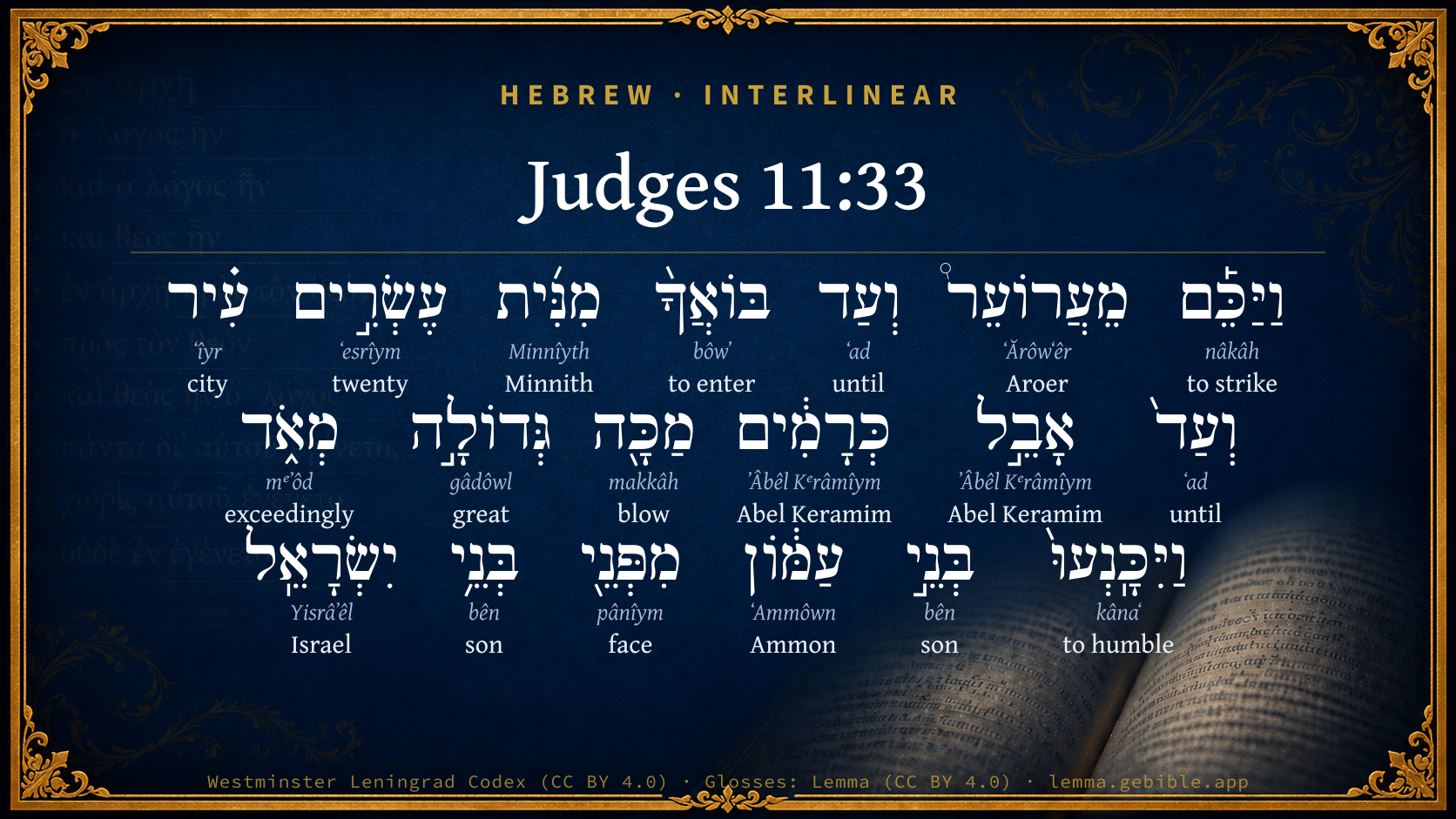
  1. וַיַּכֵּ֡ם nâkâh H5221 “and · to strike · them” Conjunction + Verb, Hiphil, Sequential Imperfect, 3rd Person, Masculine, Singular + Suffix, Personal, 3rd Person, Masculine, Plural
  2. מֵעֲרוֹעֵר֩ ʻĂrôwʻêr H6177 “from · Aroer” Preposition + Noun, Proper
  3. וְעַד ʻad H5704 “and · until” Conjunction + Preposition
  4. בּוֹאֲךָ֨ bôwʼ H935 “to enter · you” Verb, Qal, Infinitive Construct + Suffix, Personal, 2nd Person, Masculine, Singular
  5. עֶשְׂרִ֣ים ʻesrîym H6242 “twenty” Adjective, Cardinal number, Both, Plural, Absolute
  6. עִ֗יר ʻîyr H5892 “city” Noun, Common, Feminine, Singular, Absolute
  7. וְעַד֙ ʻad H5704 “and · until” Conjunction + Preposition
  8. אָבֵ֣ל ʼÂbêl Kᵉrâmîym H64 “Abel Keramim” Noun, Proper
  9. כְּרָמִ֔ים ʼÂbêl Kᵉrâmîym H64 “Abel Keramim” Noun, Proper
  10. מַכָּ֖ה makkâh H4347 “blow” Noun, Common, Feminine, Singular, Absolute
  11. גְּדוֹלָ֣ה gâdôwl H1419 “great” Adjective, Adjective, Feminine, Singular, Absolute
  12. מְאֹ֑ד mᵉʼôd H3966 “exceedingly” Adverb
  13. וַיִּכָּֽנְעוּ֙ kânaʻ H3665 “and · to humble” Conjunction + Verb, Niphal, Sequential Imperfect, 3rd Person, Masculine, Plural
  14. בְּנֵ֣י bên H1121 “sons of” Noun, Common, Masculine, Plural, Construct
  15. עַמּ֔וֹן ʻAmmôwn H5983 “Ammon” Noun, Proper
  16. מִפְּנֵ֖י pânîym H6440 “from · face(s) of” Preposition + Noun, Common, Both, Plural, Construct
  17. בְּנֵ֥י bên H1121 “sons of” Noun, Common, Masculine, Plural, Construct
  18. יִשְׂרָאֵֽל Yisrâʼêl H3478 “Israel” Noun, Proper

About this verse

These counts appear in no published source. They are computed here, from the morphology-tagged text and Lemma’s own curated glosses. What Lemma adds →

19
words
16
distinct lemmas
Historical
section

Notable vocabulary

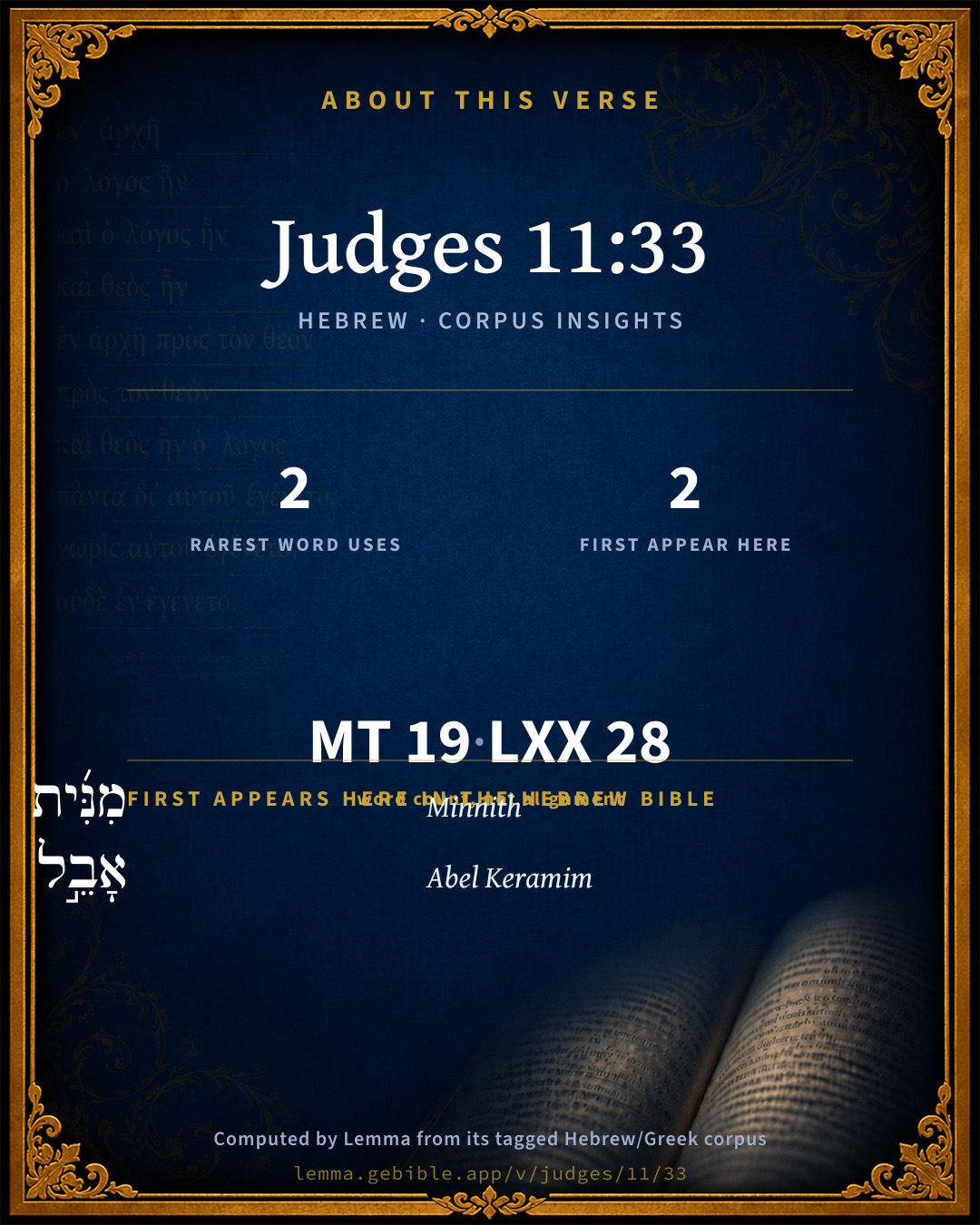
The rarest word here is מִנִּ֜ית Minnith H4511 — appearing just 2 times in the whole Hebrew Bible.

First appearance in Scripture

These words make their first canonical appearance in the Hebrew Bible here:

  • מִנִּ֜ית Minnith H4511
  • אָבֵ֣ל Abel Keramim H64

Shared distinctive vocabulary

מִנִּ֜ית Minnith H4511 occurs in 2 verses of the Hebrew Bible. Also found in:

Grammatical profile

  • 3 verbs
  • 11 nouns
  • 2 adjectives
  • 2 prepositions
  • 1 adverb

Verb forms

  • וַיַּכֵּ֡ם Hiphil · Sequential Imperfect
  • בּוֹאֲךָ֨ Qal · Infinitive Construct
  • וַיִּכָּֽנְעוּ֙ Niphal · Sequential Imperfect

Repetition

Words recur within this verse — often emphatic in Hebrew:

  • וְעַד until H5704 ×2
  • אָבֵ֣ל Abel Keramim H64 ×2
  • בְּנֵ֣י son H1121 ×2

Hebrew & Septuagint length

In English translation the verse runs 33 words from the Hebrew and 37 from the Septuagint (LXX English) — closely comparable.

A rough comparison of the two English renderings, which tokenize alike — not a word-level alignment.

Word counts can differ between the Hebrew and the Greek without any difference in meaning — e.g. the Hebrew direct-object marker אֵת has no separate Greek word, and Greek often adds the article ὁ.

In the original languages it is 19 Hebrew tokens and 28 Greek tokens — but the two are counted differently (Hebrew bundles its prefixes and suffixes into one token; the Greek is in lemma form), so that isn’t a like-for-like length.

Cross-references

2

Topical passages linked to Judges 11:33 in the Treasury of Scripture Knowledge — connected by theme and wording, ordered by reader-vote popularity; previews shown in the World English Bible.

  • Ezekiel 27:17 Judah, and the land of Israel, they were your traffickers: they traded for your merchandise wheat of Minnith, and confections, and honey, and oil, and balm.
  • Deuteronomy 2:36 From Aroer, which is on the edge of the valley of the Arnon, and [from] the city that is in the valley, even to Gilead, there was not a city too high for us; Yahweh our God delivered up all before us:

Cross-references courtesy of OpenBible.info (CC BY 4.0).

Hebrew and Greek witnesses Masoretic Hebrew ↔ Greek Septuagint

The same verse in the two great witnesses to the Old Testament, shown verse-for-verse.

These are two independent witnesses, not word-aligned to each other, and the Septuagint is shown in lemma (dictionary) form.

Hebrew Judges 11:33 Masoretic · Westminster Leningrad Codex

וַיַּכֵּ֡ם מֵעֲרוֹעֵר֩ וְעַד בּוֹאֲךָ֨ מִנִּ֜ית עֶשְׂרִ֣ים עִ֗יר וְעַד֙ אָבֵ֣ל כְּרָמִ֔ים מַכָּ֖ה גְּדוֹלָ֣ה מְאֹ֑ד וַיִּכָּֽנְעוּ֙ בְּנֵ֣י עַמּ֔וֹן מִפְּנֵ֖י בְּנֵ֥י יִשְׂרָאֵֽל

He struck them from Aroer until you come to Minnith, even twenty cities, and to Abelcheramim, with a very great slaughter. So the children of Ammon were subdued before the children of Israel.

World English Bible · Public Domain

Greek LXX Judges 11:33 Septuagint · lemma form

καί πατάσσω αὐτός ἀπό αροηρ ἕως ἔρχομαι ἄχρι αρνων ἐν ἀριθμός εἴκοσι πόλις καί ἕως εβελχαρμιν πληγή μέγας σφόδρα καί συνστέλλω ὁ υἱός αμμων ἀπό πρόσωπον υἱός ἰσραήλ

And he struck them from Aroer till one comes to Arnon, in number twenty cities, and as far as Ebelcharmim, with a very great destruction: and the children of Ammon were straitened before the children of Israel.

LXX2012 (modern English Septuagint) · Public Domain

Hebrew: Westminster Leningrad Codex (CC BY 4.0). Greek: Septuagint (public domain); English from LXX2012 (modern English Septuagint) (Public Domain). How the Septuagint differs from the Hebrew →

Targum (Aramaic paraphrase)

1

The Targum is the ancient Jewish Aramaic paraphrase of the Hebrew Scriptures — an interpretive translation, not the Hebrew text itself. Onkelos (literal) and Pseudo-Jonathan (expansive) render the Torah, and Jonathan the Prophets. Coverage is partial: where no permissively-licensed English translation exists for a verse, only the Aramaic is shown. This is verse-level text, not a word-by-word alignment to the Hebrew.

  1. Targum Jonathan Prophets (Joshua–Malachi)
    וּמְחָנוּן מֵעֲרוֹעֵר עַד מַעֲלָנָא דְמִנִית עַשְׂרִין קִרְוִין וְעַד מֵישַׁר כְּרָמַיָא מַחֲתָא רַבְּתָא לַחֲדָא וְאִתְבָּרוּ בְּנֵי עַמוֹן מִן קֳדָם בְּנֵי יִשְׂרָאֵל:

    (no public-domain English translation for this verse)

    Targum Jonathan — Aramaic: “Mikraot Gedolot” (public domain). English: “Sefaria Community Translation” (CC0 1.0 (public-domain dedication)); “London "Chaldee Paraphrase," 1871” (public domain). Text via Sefaria.

Commentary

Notes on Judges 11:33 from classic Christian and Jewish commentators (each source and its license shown beneath its notes). The classic Christian expositions comment on the surrounding passage and are grouped to its opening verse, so a note may address several verses; the Jewish commentaries on the Tanakh (Rashi and others) are per-verse, so they appear only where the commentator wrote on this verse.

Lemma curates 59 commentaries, every one of them public domain or Creative Commons licensed, each selected and text-cleaned for this edition rather than reprinted as found. About our sources →

Trapp's Complete Commentary

John Trapp

Jdg 11:33 And he smote them from Aroer, even till thou come to Minnith, [even] twenty cities, and unto the plain of the vineyards, with a very great slaughter. Thus the children of Ammon were subdued before the children of Israel.

Ver. 33. And he smote them from Aroer.] The Ammonites had better have kept home, content with their own country, a great part whereof they now lose by reaching after more, like the dog in the fable, and are so beaten that they cannot recruit.

John Trapp, A Commentary or Exposition upon All the Books of the Old and New Testament (1647–1656) — public domain. Text from a community e-Sword module.

Joseph Benson's Commentary

Jdg 11:33. Till thou come to Minnith — A place not far from Rabbah, the chief city of the Ammonites. The children of Ammon were subdued before Israel — It does not appear that Jephthah offered to take possession of their country. Though the attempt of others to wrong us will justify us in the defence of our own right, yet it will not authorize us to do them wrong.

Joseph Benson's Commentary on the Old and New Testaments (1811–1818) — public domain. Text from a community e-Sword module.

Geneva Bible (1599)

Geneva Bible translators

Or, the plain.

Geneva Bible (1599) marginal notes — public domain. Text via Bolls.life.

Adam Clarke's Commentary

Verse 33. Twenty cities] That is, he either took or destroyed twenty cities of the Ammonites, and completely routed their whole army.

Adam Clarke's Commentary on the Bible (1810–1826) — public domain. Text from a community e-Sword/MySword module.

Ellicott's Commentary for English Readers

(33) To Minnith.—According to Eusebius and Jerome, this is Maanith, four miles from Heshbon (Eze_27:17).

Unto the plain of the vineyards.—Rather, unto Abel-ceramim. The place is either Abela, a few miles beyond Maanith, or another Abela, twelve miles from Gadara (Euseb., Jer.).

Were subdued before.—Jdg_3:30; Jdg_8:28.

A Bible Commentary for English Readers, edited by Charles John Ellicott (1878–1897) — public domain. Text from a community e-Sword module.

The Cambridge Bible for Schools and Colleges

gen. ed. J. J. S. Perowne

33. Aroer] Probably not the Aroer of Jdg_11:16, but another place of the same name E. of Rabbath-ammon, Jos_13:25, on the Ammonite border. Minnith is identified by Eusebius (Onom. Sacr. 280, 44; 140, 3) with Maanith, 4 rom. miles from Heshbon, on the way to Philadelphia (Rabbath-ammon). Abel-cherâmim according to Onom. Sacr. 225, 5; 96, 10 = Abel, 6 or 7 miles from Philadelphia. The two last identifications are uncertain. The direction of the campaign is twice mentioned (until thou come … and unto); the twenty cities come in awkwardly between the two places; probably the text has received additions.

were subdued] See Jdg_3:30 n.

The Cambridge Bible for Schools and Colleges (gen. ed. J. J. S. Perowne; Cambridge University Press, 1878–1918) — public domain. Text from a community e-Sword module.

John Gill's Exposition

And it came to pass, when he saw her,.... She being the first person that presented to his view, as she was at the head of the virgins with their timbrels and dances:

that he rent his clothes; as was the usual manner, when anything calamitous and distressing happened; see Gen 37:34.

and said, alas, my daughter, thou hast brought me very low; damped his spirits, sunk him very low, so that he was ready to drop into the earth, as we say; he that was now returning in triumph, amidst the acclamations of the people, in the height of his glory, and extolled to the skies, and perhaps elated in his own mind; on a sudden, at the sight of his daughter, was so depressed in his spirits, that he could not bear up; but was ready to sink and die away, all his honour being as it were laid in the dust, and nothing to him:

and thou art one of them that trouble me: or among his troublers, and the greatest he ever met with; he had been in trouble from his brethren, when they drove him from his father's house, and he had had trouble with the children of Ammon to subdue them; but this was the greatest trouble of all, that his daughter should be the first that should meet him; of whom, according to his vow, he was to be deprived, and so all his future comforts, hopes, and expectations from her gone; and therefore ranks her among, and at the head of, his troublers:

for I have opened my mouth unto the Lord; in a vow; not only had purposed it in his heart, but had expressed it with his lips:

and I cannot go back; or retract it; looking upon himself under an indispensable obligation to perform it; of which, be it as it may, he seems to have had mistaken notions and apprehensions; for if his vow was to sacrifice her, as some think, he was not obliged to do it, since it was contrary to the law of God, and abominable in his sight; and besides, what was vowed to be the Lord's, or devoted to him, might be redeemed according to the law, a female for thirty pieces of silver, Lev 27:2 and if the vow was to separate his daughter from the company of men, and oblige her never to marry, such a power as this parents had not allowed them over their children, according to the laws of God or of men, in the Jewish nation; and therefore, be it which it will, what he had to do was to repent of this rash vow, and humble himself before God for making it, and not add sin to sin by performing it.

John Gill's Exposition of the Whole Bible (1746–1763) — public domain (CC PDM 1.0). Text via the HelloAO Bible API.

Albert Barnes' Notes on the Bible

As in the conflicts with the Moabites, Canaanites, and Midianites Judg. 3; 4; 7, the battle was on Israelite territory, in self-defense, not in aggressive warfare.

The plain of the vineyards - Rather, “Abel-Ceramim” (compare Abel-Meholah), identified with an “Abel” situated among vineyards, 7 miles from Robbah. “Minnith” is “Maanith,” 4 miles from Heshbon, on the road to Rab-bah.

Albert Barnes' Notes on the Bible (1834–1885) — public domain. Text from a community e-Sword/MySword module.

Haydock's Catholic Bible Commentary

Aroer, upon the Arnon, belonged to the tribe of Gad. Menith was four miles from Hesebon, towards Rabbath. --- Abel was noted for its vineyards, 12 miles east of Gadara, so that Jephte pursued the enemy, as they fled towards the north for about 60 miles, and during the course of the war destroyed 20 of their cities, (Calmet) to punish them for their unjust revenges and usurpation of another’s property. (Haydock)

George Leo Haydock (1774–1849), Haydock's Catholic Family Bible and Commentary, 1859 edition — public domain. Excludes Psalms (Douay-Rheims chapter numbering differs from Protestant) and Deuterocanonical books (Catholic canon only).

Matthew Poole's English Annotations

Minnith; a place not far from Rabbah, the chief city of; the Ammonites.

Matthew Poole's English Annotations on the Holy Bible (1683–1685) — public domain. Text from a community e-Sword/MySword module.

Whedon's Commentary on the Bible

Daniel D. Whedon

33. Aroer — See at Jos_13:25.

Minnith — A place that was noted for its wheat, (Eze_27:17;) but its exact site is unknown.

Plain of the vineyards — This is a literal translation of a Hebrew proper name — Abel-keramim — so called, probably, because of its vineyards. The place is mentioned by Eusebius as lying six miles from Rabbah, and was still rich in vineyards in his day.

For want of precise details of the battle, and from uncertainty as to the exact sites of Aroer and Minnith, we find it impossible to trace the course of Jephthah’s victory. We most naturally suppose that from the height of Mount Gilead he marched southward and encountered the Ammonites near Aroer, somewhere between Jordan and Rabbah, probably at Ayra on the Wady Nimrin. Here he put them to flight, and chased them towards the south and east, probably capturing Rabbah, their capital, among the twenty cities which fell into his hands by this great victory. See the map of Gilead, page 234.

Daniel D. Whedon (gen. ed.), Commentary on the Old and New Testaments (1874–1909) — public domain. Text from a community e-Sword module.

The Pulpit Commentary

From Aroer... to Minnith. The Aroer here mentioned seems to be that in the tribe of Gad, (Num_32:34 Jos_13:25) now Nahr Amman. Minnith is thought to have been situated four Roman miles from Heshbon, on the road to Rabbah of the children of Ammon, afterwards called Philadelphia. It was called Manith in the time of Eusebius. The plain of the vineyards, better taken as a proper name, Abel-ceramim. The site is not certainly known. Eusebius speaks of two Abels, both fertile in vineyards, one seven Roman miles from Rabbah, which is probably the one here meant.

The Pulpit Commentary (1880–1919), ed. H.D.M. Spence-Jones & Joseph S. Exell — public domain. Text from a community e-Sword module.

John Wesley's Explanatory Notes

Minnith - A place not far from Rabbah, the chief city of the Ammonites. Subdued before Israel - It does not appear, that he offered to take possession of the country. Tho' the attempt of others to wrong us, will justify us in the defense of our own right, yet it will not authorize us to do them wrong.

John Wesley, Explanatory Notes Upon the Whole Bible (1754–1765) — public domain. Text via the GEBible commentary corpus.

Rashi

Rabbi Shlomo Yitzchaki (Rashi)

The Vineyard plains. The plain of the vineyards.

Rashi on the Tanakh — English translations: “The Judaica Press complete Tanach with Rashi, translated by A. J. Rosenberg” (CC BY 4.0); “Pentateuch with Rashi's commentary by M. Rosenbaum and A.M. Silbermann, 1929-1934” (public domain); “The Metsudah Tanach series, Lakewood, N.J” (CC BY 4.0); and “The Book of Joshua, Metsudah Publications, 1997” (CC BY 4.0). Text via Sefaria.

Lesson kit

Teaching starters — assembled from the data on this page, not authored interpretation. Every prompt links to the verse data it draws on. Edit before teaching.

Judges, in the Historical, opens this verse with 19 words (16 distinct Hebrew lemmas). Its most distinctive word is Minnîyth (“Minnith”). A historical commentator’s framing appears above. Read the whole chapter for the surrounding context.

Discussion questions

  1. What does “Minnith” (Minnîyth) contribute to the verse as a whole?
  2. 2 words here appear for the first time in Scripture. What is being introduced at this debut?
  3. Ezekiel 27:17 shares the word «Minnith» with this verse. How do the two illuminate each other?
  4. “until” occurs 2× in this one verse. What is the effect of the repetition?
  5. The translations on this page render this verse differently — a whole-verse word diff, not a word-by-word alignment. What might account for the different wordings?
  6. The verb «וַיַּכֵּ֡ם» is Hiphil Sequential Imperfect. How does its form color the action?
  7. Reading how Trapp's Complete Commentary and Joseph Benson's Commentary read this verse, where do the two commentators agree and where do they part?

Things to notice

Reading settings

Reading text

Shown beneath each verse's original-language words.

Old Testament
Old Testament edition

Read the OT as the Masoretic Hebrew (MT) or the Greek Septuagint (LXX).

English shown for the Greek Septuagint (in the Hebrew ↔ Greek comparison).

Comparing translations? Open the Compare panel on any verse page to stack up to four side by side.