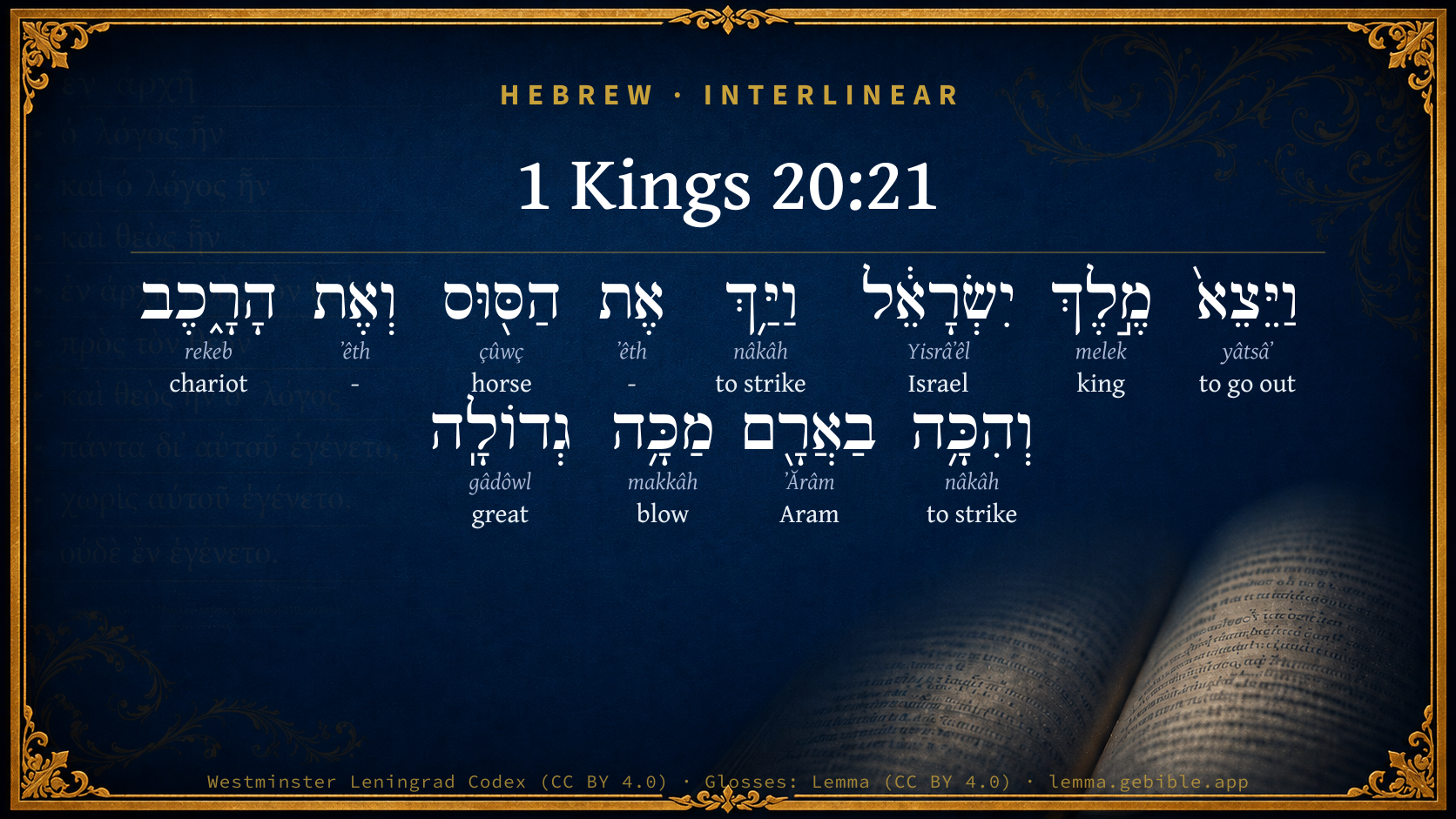
1 Kings 20:21

Hebrew (Westminster Leningrad Codex) 1 Kings 20:21 appears in the Hebrew Old Testament. The text above is from the Westminster Leningrad Codex. Each word links to its Strong’s number, a concise gloss, and parsing drawn from the Open Scriptures Hebrew Bible morphology. Click any word for its full Brown-Driver-Briggs (BDB) entry.
Download image
Cite this verse

1 Kings 20:21 (World English Bible). Public Domain. Lemma interlinear Bible study tool, https://lemma.gebible.app/v/1-kings/20/21.

Show BibTeX & RIS
BibTeX
RIS
English Translation
The king of Israel went out, and struck the horses and chariots, and killed the Syrians with a great slaughter.
World English Bible · Public Domain
Download a study sheet

One document with this verse’s original text, its word-by-word gloss line, the meaning frame, cross-references with their text, attributed commentary, and full source and license credits — printable, and it pastes into notes with its structure intact.

This verse Autodidact and up

Study sheet (.html) Plain text (.txt)

A passage Seminary Student

Up to 50 verses in one chapter. A passage sheet keeps up to 6 commentary sources and 12 cross-references per verse, in the order this page ranks them, and says so on the sheet whenever that leaves anything out. Ask for a single verse and you get the Autodidact verse sheet above.

Everything on this page stays free to read, with no account — the sheet is a download of what is already on screen, not access to it.

Want to remove ads? Support Godless Engineer
Compare translations 3

The same verse in 3 English versions, stacked beneath the original-language interlinear above. Click any original word for its lexicon entry.

Each is an independent rendering of the whole verse — the interlinear is not word-aligned to these translations.

Highlighted words mark where these versions differ — a whole-verse word diff, not a word-by-word alignment.

  • World English Bible Public Domain
    The king of Israel went out, and struck the horses and chariots, and killed the Syrians with a great slaughter.
  • King James Version Public Domain
    And the king of Israel went out, and smote the horses and chariots, and slew the Syrians with a great slaughter.
  • unfoldingWord Literal Text CC BY-SA 4.0
    And the king of Israel went out, and he struck the horse and the chariot. And he struck Aram a great striking.

unfoldingWord Literal Text — © unfoldingWord, licensed CC BY-SA 4.0. Word-aligned USFM3 via Door43 (git.door43.org/unfoldingWord/en_ult).

Versions to compare (up to 4)

3 of 4 selected

Show all 18 translations

Every available English version of this verse, each an independent rendering of the whole verse.

  • World English Bible Public Domain
    The king of Israel went out, and struck the horses and chariots, and killed the Syrians with a great slaughter.
  • Berean Standard Bible Public Domain
    Then the king of Israel marched out and attacked the horses and chariots, inflicting a great slaughter on the Arameans.
  • Majority Standard Bible Public Domain
    Then the king of Israel marched out and attacked the horses and chariots, inflicting a great slaughter on the Arameans.
  • King James Version Public Domain
    And the king of Israel went out, and smote the horses and chariots, and slew the Syrians with a great slaughter.
  • American Standard Version (1901) Public Domain
    And the king of Israel went out, and smote the horses and chariots, and slew the Syrians with a great slaughter.
  • Revised Version (1885) Public Domain
    And the king of Israel went out, and smote the horses and chariots, and slew the Syrians with a great slaughter.
  • Geneva Bible (1599) Public Domain
    And the King of Israel went out, and smote the horses and charets, and with a great slaughter slew he the Aramites.
  • Douay-Rheims (1899) Public Domain
    But the king of Israel going out overthrew the horses and chariots, and slew the Syrians with a great slaughter.
  • Young's Literal Translation Public Domain
    and the king of Israel goeth out, and smiteth the horses, and the charioteers, and hath smitten among the Aramaeans a great smiting.
  • Literal Standard Version CC BY-SA 4.0
    and the king of Israel goes out, and strikes the horses, and the charioteers, and has struck among the Arameans a great striking.
  • Unlocked Literal Bible CC BY-SA 4.0
    Then the king of Israel went out and attacked the horses and chariots, and killed the Arameans in a great slaughter.
  • unfoldingWord Literal Text CC BY-SA 4.0
    And the king of Israel went out, and he struck the horse and the chariot. And he struck Aram a great striking.
  • Darby Bible Public Domain
    And the king of Israel went out, and smote the horses and chariots, and slew the Syrians with a great slaughter.
  • World Messianic Bible Public Domain
    The king of Israel went out and struck the horses and chariots, and killed the Syrians with a great slaughter.
  • Webster's Bible Public Domain
    And the king of Israel went out, and smote the horses and chariots, and slew the Syrians with a great slaughter.
  • Free Bible Version CC BY-SA 4.0
    Then the king of Israel came out and attacked the horses and chariots. He inflicted a great defeat on the Arameans.
  • Bible in Basic English Public Domain
    And the king of Israel went out and took the horses and the war-carriages, and made great destruction among the Aramaeans.
  • JPS Tanakh (1917) Public Domain
    And the king of Israel went out, and smote the horses and chariots, and slew the Arameans with a great slaughter.

Literal Standard Version (2020), Covenant Press — licensed CC BY-SA 4.0. Text via the HelloAO Bible API (eBible.org). Unlocked Literal Bible (unfoldingWord) — licensed CC BY-SA 4.0. Text via the HelloAO Bible API (eBible.org). unfoldingWord Literal Text — © unfoldingWord, licensed CC BY-SA 4.0. Word-aligned USFM3 via Door43 (git.door43.org/unfoldingWord/en_ult). Free Bible Version, Dr. Jonathan Gallagher — licensed CC BY-SA 4.0. Text via the HelloAO Bible API (eBible.org).

Word by word

More ways to search: Search by grammar → Find every occurrence → Compare this word →

Practice this passage: Drill this verse → Learn its vocabulary →

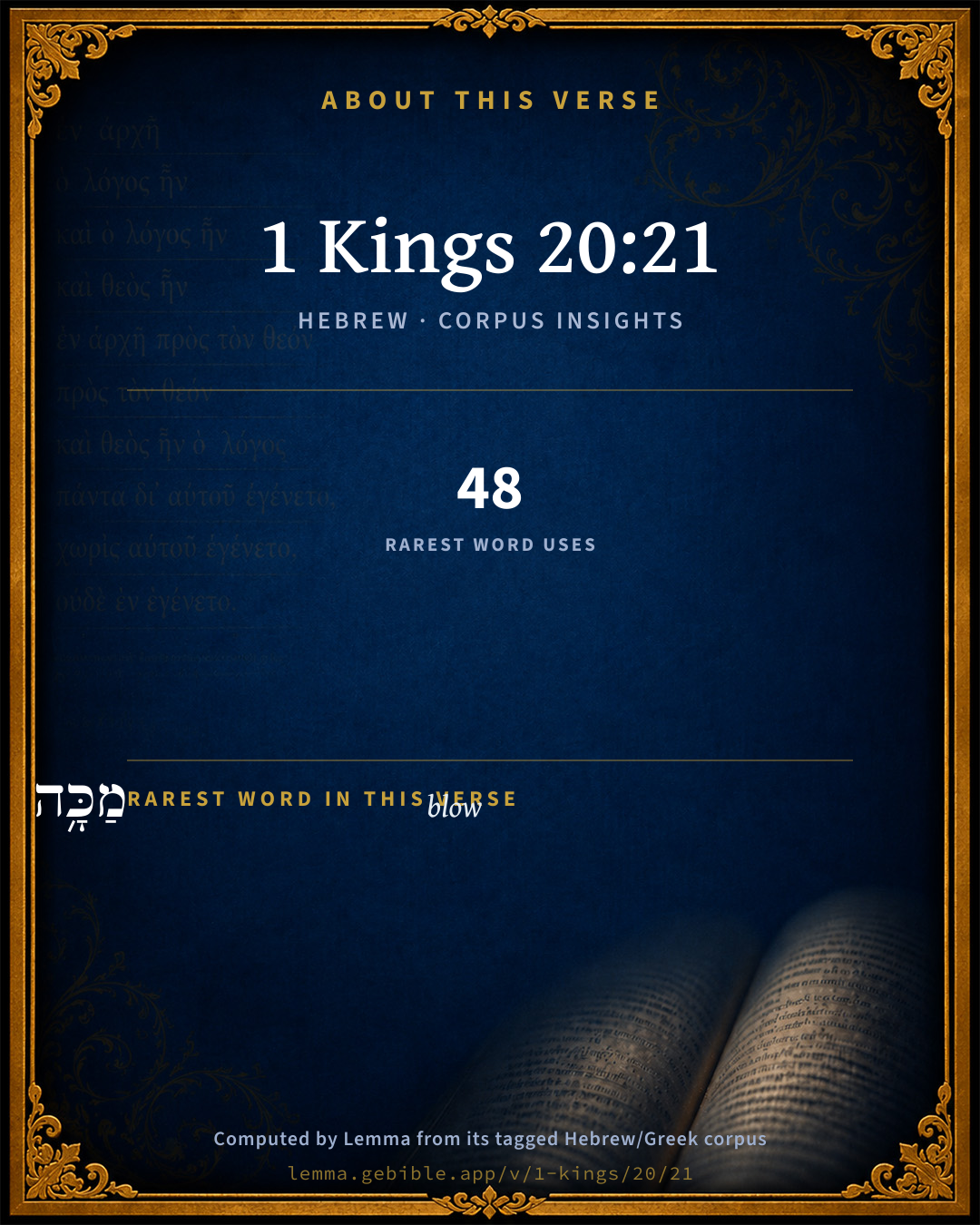
מַכָּ֥ה
makkâh
H4347
“blow”
Noun, Common, Feminine, Singular, Absolute
Part of Speech
Noun
Type
Common
Gender
Feminine
Number
Singular
State
Absolute
Full BDB Definition

Origin: from H5221

TWOT: 1364d

blow, wound, slaughter - blow, stripe - beating, scourging - wound - slaughter - defeat, conquest - plague
  1. וַיֵּצֵא֙ yâtsâʼ H3318 “and · to go out” Conjunction + Verb, Qal, Sequential Imperfect, 3rd Person, Masculine, Singular
  2. מֶ֣לֶךְ melek H4428 “king of” Noun, Common, Masculine, Singular, Construct
  3. יִשְׂרָאֵ֔ל Yisrâʼêl H3478 “Israel” Noun, Proper
  4. וַיַּ֥ךְ nâkâh H5221 “and · to strike” Conjunction + Verb, Hiphil, Sequential Imperfect, 3rd Person, Masculine, Singular
  5. אֶת ʼêth H853 “-” Particle, Direct Object
  6. הַסּ֖וּס çûwç H5483 “the · horse” Particle, Definite Article + Noun, Common, Masculine, Singular, Absolute
  7. וְאֶת ʼêth H853 “and · -” Conjunction + Particle, Direct Object
  8. הָרָ֑כֶב rekeb H7393 “the · chariot” Particle, Definite Article + Noun, Common, Masculine, Singular, Absolute
  9. וְהִכָּ֥ה nâkâh H5221 “and · to strike” Conjunction + Verb, Hiphil, Perfect, 3rd Person, Masculine, Singular
  10. בַאֲרָ֖ם ʼĂrâm H758 “in/at · Aram” Preposition + Noun, Proper
  11. גְדוֹלָֽה gâdôwl H1419 “great” Adjective, Adjective, Feminine, Singular, Absolute

About this verse

These counts appear in no published source. They are computed here, from the morphology-tagged text and Lemma’s own curated glosses. What Lemma adds →

12
words
10
distinct lemmas
Historical
section

Shared distinctive vocabulary

מַכָּ֥ה blow H4347 occurs in 46 verses of the Hebrew Bible. Also found in:

Grammatical profile

  • 3 verbs
  • 6 nouns
  • 1 adjective
  • 2 particles

Verb forms

  • וַיֵּצֵא֙ Qal · Sequential Imperfect
  • וַיַּ֥ךְ Hiphil · Sequential Imperfect
  • וְהִכָּ֥ה Hiphil · Perfect

Repetition

A word recurs within this verse — often emphatic in Hebrew:

  • וַיַּ֥ךְ to strike H5221 ×2

Hebrew & Septuagint length

In English translation the verse runs 20 words from the Hebrew and 36 from the Septuagint (LXX English) — the Septuagint runs noticeably longer here. See the side-by-side →

A rough comparison of the two English renderings, which tokenize alike — not a word-level alignment.

Word counts can differ between the Hebrew and the Greek without any difference in meaning — e.g. the Hebrew direct-object marker אֵת has no separate Greek word, and Greek often adds the article ὁ.

Cross-references

6

Topical passages linked to 1 Kings 20:21 in the Treasury of Scripture Knowledge — connected by theme and wording, ordered by reader-vote popularity; previews shown in the World English Bible.

  • Judges 3:28 He said to them, Follow after me; for Yahweh has delivered your enemies the Moabites into your hand. They went down after him, and took the fords of the Jordan against the Moabites, and didn't allow a man to pass over.
  • Judges 7:23–25 The men of Israel were gathered together out of Naphtali, and out of Asher, and out of all Manasseh, and pursued after Midian.
  • 1 Samuel 14:20–22 Saul and all the people who were with him were gathered together, and came to the battle: and, behold, every man's sword was against his fellow, [and there was] a very great confusion.
  • 1 Samuel 17:52 The men of Israel and of Judah arose, and shouted, and pursued the Philistines, until you come to Gai, and to the gates of Ekron. The wounded of the Philistines fell down by the way to Shaaraim, even to Gath, and to Ekron.
  • 2 Kings 3:18 This is but a light thing in the sight of Yahweh: he will also deliver the Moabites into your hand.
  • 2 Kings 3:24 When they came to the camp of Israel, the Israelites rose up and struck the Moabites, so that they fled before them; and they went forward into the land smiting the Moabites.

Cross-references courtesy of OpenBible.info (CC BY 4.0).

Hebrew and Greek witnesses Masoretic Hebrew ↔ Greek Septuagint

The same verse in the two great witnesses to the Old Testament, shown verse-for-verse.

Here the Septuagint runs noticeably longer than the Hebrew — LXX2012 (modern English Septuagint) 36 words vs World English Bible 20. A rough length comparison of the two English translations, not a word-level alignment — read both below.

These are two independent witnesses, not word-aligned to each other, and the Septuagint is shown in lemma (dictionary) form.

Hebrew 1 Kings 20:21 Masoretic · Westminster Leningrad Codex

וַיֵּצֵא֙ מֶ֣לֶךְ יִשְׂרָאֵ֔ל וַיַּ֥ךְ אֶת הַסּ֖וּס וְאֶת הָרָ֑כֶב וְהִכָּ֥ה בַאֲרָ֖ם מַכָּ֥ה גְדוֹלָֽה

The king of Israel went out, and struck the horses and chariots, and killed the Syrians with a great slaughter.

World English Bible · Public Domain

Greek LXX 1 Kings 20:21 Septuagint · lemma form

ὅδε λέγω κύριος ἰδού ἐγώ ἐπιἄγω ἐπί σύ κακός καί ἐκκαίω ὀπίσω σύ καί ἐκὀλεθρεύω ὁ αχααβ οὐρέω πρός τοῖχος καί συνἔχω καί ἐν καταλείπω ἐν ἰσραήλ

behold, I bring evil upon you: and I will kindle a fire after you, and I will utterly destroy every male of Achaab, and him that is shut up and him that is left in Israel.

LXX2012 (modern English Septuagint) · Public Domain

On this verse, The Pulpit Commentary discusses the Septuagint’s reading. Read the note in Commentary ↓

Hebrew: Westminster Leningrad Codex (CC BY 4.0). Greek: Septuagint (public domain); English from LXX2012 (modern English Septuagint) (Public Domain). How the Septuagint differs from the Hebrew →

Targum (Aramaic paraphrase)

1

The Targum is the ancient Jewish Aramaic paraphrase of the Hebrew Scriptures — an interpretive translation, not the Hebrew text itself. Onkelos (literal) and Pseudo-Jonathan (expansive) render the Torah, and Jonathan the Prophets. Coverage is partial: where no permissively-licensed English translation exists for a verse, only the Aramaic is shown. This is verse-level text, not a word-by-word alignment to the Hebrew.

  1. Targum Jonathan Prophets (Joshua–Malachi)
    וּנְפַק מַלְכָּא דְיִשְׂרָאֵל וּמְחָא יַת סוּסְוָתָא וּמַגֵיר יַת רְתִיכַיָא וּמְחָא בֶּאֱנַשׁ אֲרָם מָחָא סַגִיאָה:

    (no public-domain English translation for this verse)

    Targum Jonathan — Aramaic: “Mikraot Gedolot” (public domain). English: “Sefaria Community Translation” (CC0 1.0 (public-domain dedication)); “London "Chaldee Paraphrase," 1871” (public domain). Text via Sefaria.

Commentary

Notes on 1 Kings 20:21 from classic Christian and Jewish commentators (each source and its license shown beneath its notes). The classic Christian expositions comment on the surrounding passage and are grouped to its opening verse, so a note may address several verses; the Jewish commentaries on the Tanakh (Rashi and others) are per-verse, so they appear only where the commentator wrote on this verse.

Lemma curates 59 commentaries, every one of them public domain or Creative Commons licensed, each selected and text-cleaned for this edition rather than reprinted as found. About our sources →

Trapp's Complete Commentary

John Trapp

1Ki 20:21 And the king of Israel went out, and smote the horses and chariots, and slew the Syrians with a great slaughter.

Ver. 21. And slew the Syrians.] Whom God had smitten with fear, that cowardly passion, which betrayeth many, and exposeth them to more danger than those that stand it out to the utmost, the battle at Edgehill, for instance.

John Trapp, A Commentary or Exposition upon All the Books of the Old and New Testament (1647–1656) — public domain. Text from a community e-Sword module.

The Cambridge Bible for Schools and Colleges

gen. ed. J. J. S. Perowne

21. And the king of Israel went out] Ahab’s part appears to have been a small one. He seems to have given directions to the young men, and to those that followed them, but himself to have tarried in Samaria, until the rout was seen to have begun.

The Cambridge Bible for Schools and Colleges (gen. ed. J. J. S. Perowne; Cambridge University Press, 1878–1918) — public domain. Text from a community e-Sword module.

John Gill's Exposition

And the king of Israel went out,.... Of Samaria; when he saw the Syrians fleeing, and his army pursuing, he went forth, perhaps, with more forces, who were now willing to join with him; Josephus (c) says, Ahab had another army within the walls:

and smote the horses and chariots; that is, the men that rode on horses; and in chariots, the Syrian cavalry:

and slew the Syrians with a great slaughter; how many were slain is not said; but the Jewish historian (d) says they plundered the camp, in which were much riches, and great plenty of gold and silver, and took their chariots and horses, and returned to the city of Samaria.

(c) Antiqu. l. 8. c. 14. sect. 2. (d) Ibid.

John Gill's Exposition of the Whole Bible (1746–1763) — public domain (CC PDM 1.0). Text via the HelloAO Bible API.

Haydock's Catholic Bible Commentary

CHAPTER XX.

George Leo Haydock (1774–1849), Haydock's Catholic Family Bible and Commentary, 1859 edition — public domain. Excludes Psalms (Douay-Rheims chapter numbering differs from Protestant) and Deuterocanonical books (Catholic canon only).

Matthew Poole's English Annotations

Went out, i.e. proceeded further in his march, and fought against them.

The horses and chariots, i.e. the men that fought from them, or belonged to them; for so horses and chariots are sometimes taken. See Poole "1Sa 13:5".

Matthew Poole's English Annotations on the Holy Bible (1683–1685) — public domain. Text from a community e-Sword/MySword module.

The Pulpit Commentary

And the king of Israel went out It looks as if Ahab had remained within the city until the defeat of the Syrians was assured, and smote LXX kai ejlabe, and captured the horses and chariots i.e. , the cavalry and chariotry; cf. ver. 1, and slew the Syrians with a great slaughter. Heb. in Syria a great, etc.

The Pulpit Commentary (1880–1919), ed. H.D.M. Spence-Jones & Joseph S. Exell — public domain. Text from a community e-Sword module.

John Wesley's Explanatory Notes

The king went - Proceeded further in his march. Smote the chariots - The men that fought from them.

John Wesley, Explanatory Notes Upon the Whole Bible (1754–1765) — public domain. Text via the GEBible commentary corpus.

Lesson kit

Teaching starters — assembled from the data on this page, not authored interpretation. Every prompt links to the verse data it draws on. Edit before teaching.

1 Kings, in the Historical, opens this verse with 12 words (10 distinct Hebrew lemmas). Its most distinctive word is makkâh (“blow”). The Greek Septuagint runs longer here. A historical commentator’s framing appears above. Read the whole chapter for the surrounding context.

Discussion questions

  1. How does “blow” (makkâh) shape what this verse is saying?
  2. Leviticus 26:21 shares the word «blow» with this verse. How do the two illuminate each other?
  3. “to strike” occurs 2× in this one verse. What is the effect of the repetition?
  4. Compared with the Hebrew, the Septuagint runs longer here. What questions does that raise?
  5. These translations render this verse differently; the difference is in the English rendering, not the original. What questions does that raise?
  6. The verb «וַיֵּצֵא֙» is Qal Sequential Imperfect. How does its form color the action?
  7. Reading how Trapp's Complete Commentary and The Cambridge Bible for Schools and Colleges read this verse, where do the two commentators agree and where do they part?

Things to notice

Reading settings

Reading text

Shown beneath each verse's original-language words.

Old Testament
Old Testament edition

Read the OT as the Masoretic Hebrew (MT) or the Greek Septuagint (LXX).

English shown for the Greek Septuagint (in the Hebrew ↔ Greek comparison).

Comparing translations? Open the Compare panel on any verse page to stack up to four side by side.