
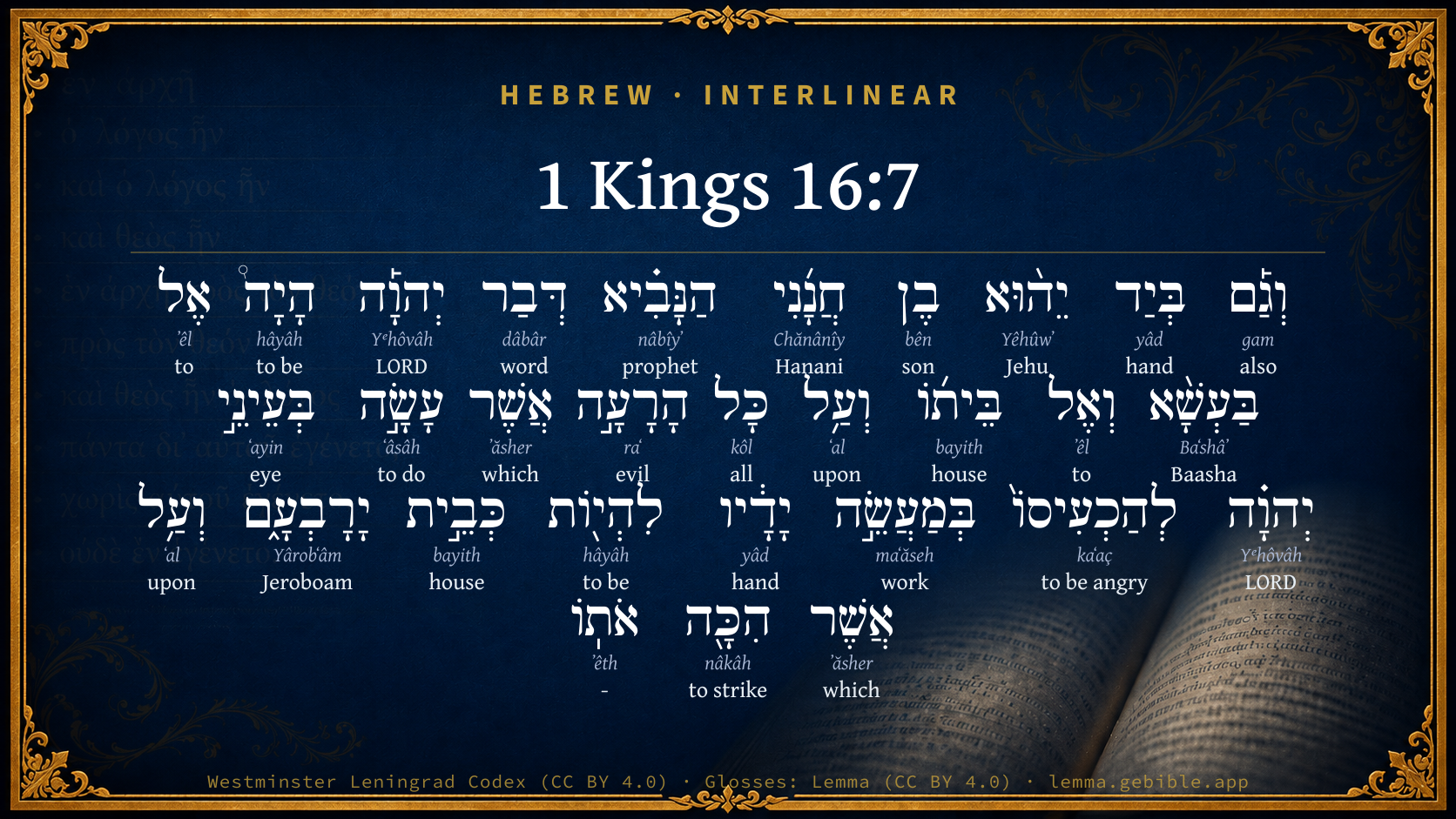
1 Kings 16:7

Hebrew (Westminster Leningrad Codex) 1 Kings 16:7 appears in the Hebrew Old Testament. The text above is from the Westminster Leningrad Codex. Each word links to its Strong’s number, a concise gloss, and parsing drawn from the Open Scriptures Hebrew Bible morphology. Click any word for its full Brown-Driver-Briggs (BDB) entry.
Download image
Cite this verse

1 Kings 16:7 (World English Bible). Public Domain. Lemma interlinear Bible study tool, https://lemma.gebible.app/v/1-kings/16/7.

Show BibTeX & RIS
BibTeX
RIS
English Translation
Moreover by the prophet Jehu the son of Hanani came the word of Yahweh against Baasha, and against his house, both because of all the evil that he did in the sight of Yahweh, to provoke him to anger with the work of his hands, in being like the house of Jeroboam, and because he struck him.
World English Bible · Public Domain
Download a study sheet

One document with this verse’s original text, its word-by-word gloss line, the meaning frame, cross-references with their text, attributed commentary, and full source and license credits — printable, and it pastes into notes with its structure intact.

This verse Autodidact and up

Study sheet (.html) Plain text (.txt)

A passage Seminary Student

Up to 50 verses in one chapter. A passage sheet keeps up to 6 commentary sources and 12 cross-references per verse, in the order this page ranks them, and says so on the sheet whenever that leaves anything out. Ask for a single verse and you get the Autodidact verse sheet above.

Everything on this page stays free to read, with no account — the sheet is a download of what is already on screen, not access to it.

Want to remove ads? Support Godless Engineer
Compare translations 3

The same verse in 3 English versions, stacked beneath the original-language interlinear above. Click any original word for its lexicon entry.

Each is an independent rendering of the whole verse — the interlinear is not word-aligned to these translations.

Highlighted words mark where these versions differ — a whole-verse word diff, not a word-by-word alignment.

  • World English Bible Public Domain
    Moreover by the prophet Jehu the son of Hanani came the word of Yahweh against Baasha, and against his house, both because of all the evil that he did in the sight of Yahweh, to provoke him to anger with the work of his hands, in being like the house of Jeroboam, and because he struck him.
  • King James Version Public Domain
    And also by the hand of the prophet Jehu the son of Hanani came the word of the LORD against Baasha, and against his house, even for all the evil that he did in the sight of the LORD, in provoking him to anger with the work of his hands, in being like the house of Jeroboam; and because he killed him.
  • unfoldingWord Literal Text CC BY-SA 4.0
    And also by the hand of Jehu, the son of Hanani, the prophet, the word of Yahweh was to Baasha and to his house and against all of the evil that he had done in the eyes of Yahweh, provoking him with the work of his hands, by being like the house of Jeroboam and because he had struck him.

unfoldingWord Literal Text — © unfoldingWord, licensed CC BY-SA 4.0. Word-aligned USFM3 via Door43 (git.door43.org/unfoldingWord/en_ult).

Versions to compare (up to 4)

3 of 4 selected

Show all 18 translations

Every available English version of this verse, each an independent rendering of the whole verse.

  • World English Bible Public Domain
    Moreover by the prophet Jehu the son of Hanani came the word of Yahweh against Baasha, and against his house, both because of all the evil that he did in the sight of Yahweh, to provoke him to anger with the work of his hands, in being like the house of Jeroboam, and because he struck him.
  • Berean Standard Bible Public Domain
    Moreover, the word of the LORD came through the prophet Jehu son of Hanani against Baasha and his house, because of all the evil he had done in the sight of the LORD, provoking Him to anger with the work of his hands and becoming like the house of Jeroboam, and also because Baasha had struck down the house of Jeroboam.
  • Majority Standard Bible Public Domain
    Moreover, the word of the LORD came through the prophet Jehu son of Hanani against Baasha and his house, because of all the evil he had done in the sight of the LORD, provoking Him to anger with the work of his hands and becoming like the house of Jeroboam, and also because Baasha had struck down the house of Jeroboam.
  • King James Version Public Domain
    And also by the hand of the prophet Jehu the son of Hanani came the word of the LORD against Baasha, and against his house, even for all the evil that he did in the sight of the LORD, in provoking him to anger with the work of his hands, in being like the house of Jeroboam; and because he killed him.
  • American Standard Version (1901) Public Domain
    And moreover by the prophet Jehu the son of Hanani came the word of Jehovah against Baasha, and against his house, both because of all the evil that he did in the sight of Jehovah, to provoke him to anger with the work of his hands, in being like the house of Jeroboam, and because he smote him.
  • Revised Version (1885) Public Domain
    And moreover by the hand of the prophet Jehu the son of Hanani came the word of the LORD against Baasha, and against his house, both because of all the evil that he did in the sight of the LORD, to provoke him to anger with the work of his hands, in being like the house of Jeroboam, and because he smote him.
  • Geneva Bible (1599) Public Domain
    And also by the hande of Iehu the sonne of Hanani the Prophet, came the worde of the Lord to Baasha, and to his house, that he shoulde be like the house of Ieroboam, euen for all the wickednes that he did in the sight of the Lord, in prouoking him with the worke of his hands, and because he killed him.
  • Douay-Rheims (1899) Public Domain
    And when the word of the Lord came in the hand of Jehu the son of Hanani the prophet, against Baasa, and against his house, and against all the evil that he had done before the Lord, to provoke him to anger by the works of his hands, to become as the house of Jeroboam: for this cause he slew him, that is to say, Jehu the son of Hanani, the prophet.
  • Young's Literal Translation Public Domain
    And also by the hand of Jehu son of Hanani the prophet a word of Jehovah hath been concerning Baasha, and concerning his house, and concerning all the evil that he did in the eyes of Jehovah to provoke Him to anger with the work of his hands, to be like the house of Jeroboam, and concerning that for which he smote him.
  • Literal Standard Version CC BY-SA 4.0
    And also by the hand of Jehu son of Hanani the prophet a word of YHWH has been concerning Baasha, and concerning his house, and concerning all the evil that he did in the eyes of YHWH to provoke Him to anger with the work of his hands, to be like the house of Jeroboam, and concerning that for which he struck him.
  • Unlocked Literal Bible CC BY-SA 4.0
    So by the prophet Jehu son of Hanani the word of Yahweh came against Baasha and his family, both because of all the evil that he did in the sight of Yahweh, so as to provoke him to anger with the work of his hands, like the family of Jeroboam, and also because he had killed all of Jeroboam's family.
  • unfoldingWord Literal Text CC BY-SA 4.0
    And also by the hand of Jehu, the son of Hanani, the prophet, the word of Yahweh was to Baasha and to his house and against all of the evil that he had done in the eyes of Yahweh, provoking him with the work of his hands, by being like the house of Jeroboam and because he had struck him.
  • Darby Bible Public Domain
    And also through the prophet Jehu the son of Hanani the word of Jehovah came against Baasha, and against his house, even for all the evil that he did in the sight of Jehovah, provoking him to anger with the work of his hands, in being like the house of Jeroboam; and because he had smitten him.
  • World Messianic Bible Public Domain
    Moreover the LORD’s word came by the prophet Jehu the son of Hanani against Baasha and against his house, both because of all the evil that he did in the LORD’s sight, to provoke him to anger with the work of his hands, in being like the house of Jeroboam, and because he struck him.
  • Webster's Bible Public Domain
    And also by the hand of the prophet Jehu the son of Hanani came the word of the LORD against Baasha, and against his house, even for all the evil that he did in the sight of the LORD, in provoking him to anger with the work of his hands, in being like the house of Jeroboam; and because he killed him.
  • Free Bible Version CC BY-SA 4.0
    The message from the Lord condemning Baasha and his family came to the prophet Jehu, son of Hanani. It came because Baasha had done what was evil in the Lord's sight, in the same way as the family of Jeroboam had done, and also because Baasha had killed Jeroboam's family. The Lord was angry because of Baasha's sins.
  • Bible in Basic English Public Domain
    And the Lord sent his word against Baasha and his family by the mouth of the prophet Jehu, the son of Hanani, because of all the evil he did in the eyes of the Lord, moving him to wrath by the work of his hands, because he was like the family of Jeroboam, and because he put it to death.
  • JPS Tanakh (1917) Public Domain
    And moreover by the hand of the prophet Jehu the son of Hanani came the word of the LORD against Baasa, and against his house, both because of all the evil that he did in the sight of the LORD, to provoke Him with the work of his hands, in being like the house of Jeroboam, and because he smote him.

Literal Standard Version (2020), Covenant Press — licensed CC BY-SA 4.0. Text via the HelloAO Bible API (eBible.org). Unlocked Literal Bible (unfoldingWord) — licensed CC BY-SA 4.0. Text via the HelloAO Bible API (eBible.org). unfoldingWord Literal Text — © unfoldingWord, licensed CC BY-SA 4.0. Word-aligned USFM3 via Door43 (git.door43.org/unfoldingWord/en_ult). Free Bible Version, Dr. Jonathan Gallagher — licensed CC BY-SA 4.0. Text via the HelloAO Bible API (eBible.org).

Word by word

More ways to search: Search by grammar → Find every occurrence → Compare this word →

Practice this passage: Drill this verse → Learn its vocabulary →

חֲנָ֜נִי
Chănânîy
H2607
“Hanani”
Noun, Proper
Part of Speech
Noun
Type
Proper
Full BDB Definition

Origin: from H2603

TWOT: None

Hanani = "gracious" - one of the sons of Heman, a chief musician of David, and head of the 18th course of the service - a seer who rebuked Asa, king of Judah, and was imprisoned - maybe, father of Jehu the seer who testified against Baasha - one of the priests who in the time of Ezra took a foreign wife - brother of Nehemiah whom Nehemiah appointed governor of Jerusalem - another priest who was the chief musician under Nehemiah
  1. וְגַ֡ם gam H1571 “and · also” Conjunction + Particle, Accusative
  2. בְּיַד yâd H3027 “in/at · hand of” Preposition + Noun, Common, Both, Singular, Construct
  3. יֵה֨וּא Yêhûwʼ H3058 “Jehu” Noun, Proper
  4. בֶן bên H1121 “son of” Noun, Common, Masculine, Singular, Construct
  5. הַנָּבִ֗יא nâbîyʼ H5030 “the · prophet” Particle, Definite Article + Noun, Common, Masculine, Singular, Absolute
  6. דְּבַר dâbâr H1697 “word of” Noun, Common, Masculine, Singular, Construct
  7. יְהוָ֡ה Yᵉhôvâh H3068 “LORD” Noun, Proper
  8. הָיָה֩ hâyâh H1961 “to be” Verb, Qal, Perfect, 3rd Person, Masculine, Singular
  9. אֶל ʼêl H413 “to” Preposition
  10. בַּעְשָׁ֨א Baʻshâʼ H1201 “Baasha” Noun, Proper
  11. וְאֶל ʼêl H413 “and · to” Conjunction + Preposition
  12. בֵּית֜וֹ bayith H1004 “house · his” Noun, Common, Masculine, Singular, Construct + Suffix, Personal, 3rd Person, Masculine, Singular
  13. וְעַ֥ל ʻal H5921 “and · upon” Conjunction + Preposition
  14. כָּל kôl H3605 “all of” Noun, Common, Masculine, Singular, Construct
  15. הָרָעָ֣ה raʻ H7451 “the · evil” Particle, Definite Article + Noun, Common, Feminine, Singular, Absolute
  16. אֲשֶׁר ʼăsher H834 “which” Particle, Relative
  17. עָשָׂ֣ה ʻâsâh H6213 “to do” Verb, Qal, Perfect, 3rd Person, Masculine, Singular
  18. בְּעֵינֵ֣י ʻayin H5869 “in/at · eyes of” Preposition + Noun, Common, Both, Dual, Construct
  19. יְהוָ֗ה Yᵉhôvâh H3068 “LORD” Noun, Proper
  20. לְהַכְעִיסוֹ֙ kaʻaç H3707 “to be angry · him” Preposition + Verb, Hiphil, Infinitive Construct + Suffix, Personal, 3rd Person, Masculine, Singular
  21. בְּמַעֲשֵׂ֣ה maʻăseh H4639 “in/at · work of” Preposition + Noun, Common, Masculine, Singular, Construct
  22. יָדָ֔יו yâd H3027 “hands · his” Noun, Common, Both, Dual, Construct + Suffix, Personal, 3rd Person, Masculine, Singular
  23. לִהְי֖וֹת hâyâh H1961 “to be” Preposition + Verb, Qal, Infinitive Construct
  24. כְּבֵ֣ית bayith H1004 “like/as · house of” Preposition + Noun, Common, Masculine, Singular, Construct
  25. יָרָבְעָ֑ם Yârobʻâm H3379 “Jeroboam” Noun, Proper
  26. וְעַ֥ל ʻal H5921 “and · upon” Conjunction + Preposition
  27. אֲשֶׁר ʼăsher H834 “which” Particle, Relative
  28. הִכָּ֖ה nâkâh H5221 “to strike” Verb, Hiphil, Perfect, 3rd Person, Masculine, Singular
  29. אֹתֽוֹ ʼêth H853 “- · him” Particle, Direct Object + Suffix, Personal, 3rd Person, Masculine, Singular

About this verse

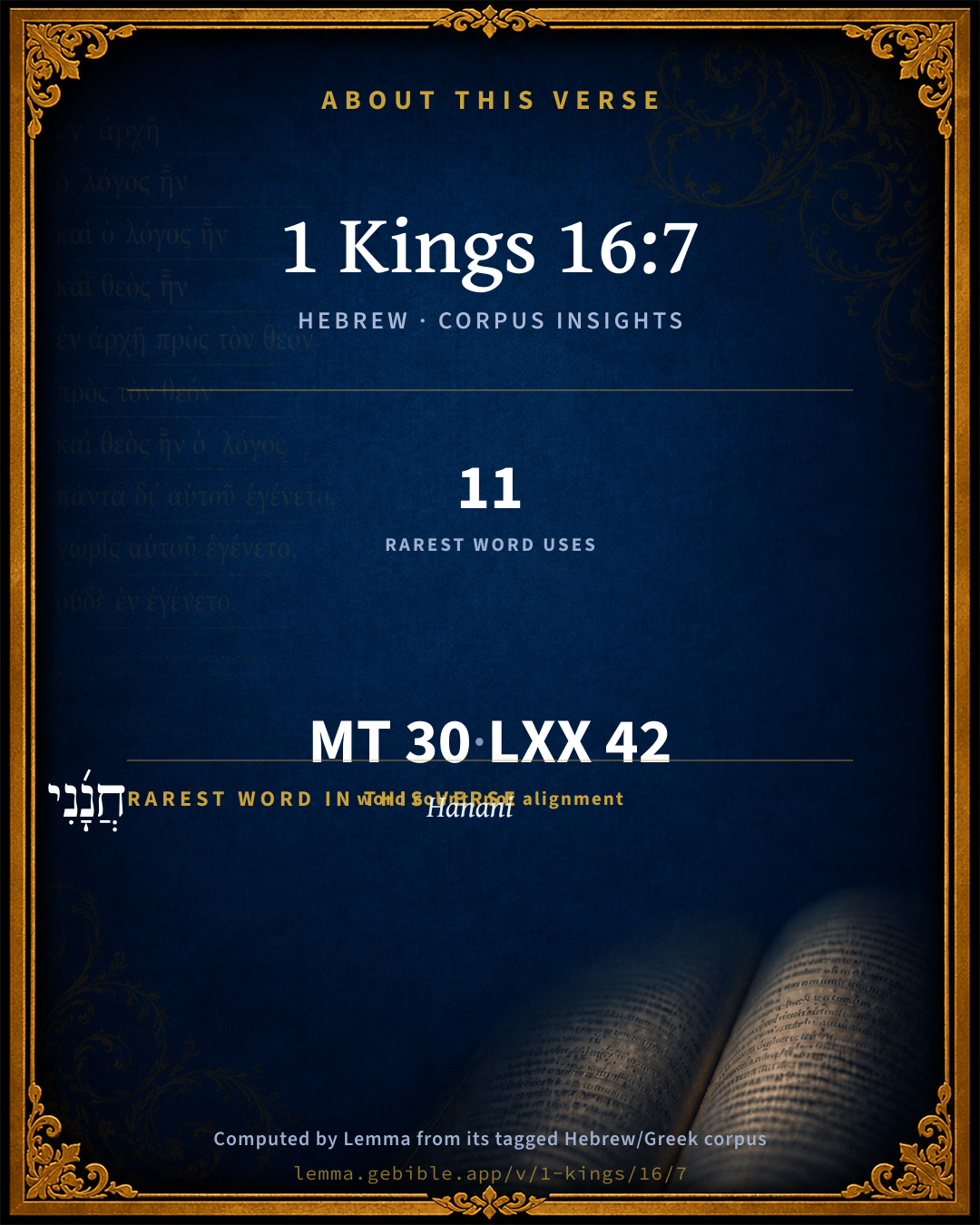
These counts appear in no published source. They are computed here, from the morphology-tagged text and Lemma’s own curated glosses. What Lemma adds →

30
words
23
distinct lemmas
Historical
section

Notable vocabulary

The rarest word here is חֲנָ֜נִי Hanani H2607 — appearing just 11 times in the whole Hebrew Bible.

Shared distinctive vocabulary

חֲנָ֜נִי Hanani H2607 occurs in 11 verses of the Hebrew Bible. Also found in:

Grammatical profile

  • 5 verbs
  • 17 nouns
  • 4 prepositions
  • 4 particles

Verb forms

  • הָיָה֩ Qal · Perfect
  • עָשָׂ֣ה Qal · Perfect
  • לְהַכְעִיסוֹ֙ Hiphil · Infinitive Construct
  • לִהְי֖וֹת Qal · Infinitive Construct
  • הִכָּ֖ה Hiphil · Perfect

Repetition

Words recur within this verse — often emphatic in Hebrew:

  • בְּיַד hand H3027 ×2
  • יְהוָ֡ה LORD H3068 ×2
  • הָיָה֩ to be H1961 ×2
  • בֵּית֜וֹ house H1004 ×2
  • וְעַ֥ל upon H5921 ×2
  • אֶל to H413 ×2
  • אֲשֶׁר which H834 ×2

Hebrew & Septuagint length

In English translation the verse runs 57 words from the Hebrew and 49 from the Septuagint (LXX English) — closely comparable.

A rough comparison of the two English renderings, which tokenize alike — not a word-level alignment.

Word counts can differ between the Hebrew and the Greek without any difference in meaning — e.g. the Hebrew direct-object marker אֵת has no separate Greek word, and Greek often adds the article ὁ.

In the original languages it is 30 Hebrew tokens and 42 Greek tokens — but the two are counted differently (Hebrew bundles its prefixes and suffixes into one token; the Greek is in lemma form), so that isn’t a like-for-like length.

Cross-references

12

Topical passages linked to 1 Kings 16:7 in the Treasury of Scripture Knowledge — connected by theme and wording, ordered by reader-vote popularity; previews shown in the World English Bible.

  • 1 Kings 14:14 Moreover Yahweh will raise him up a king over Israel, who shall cut off the house of Jeroboam that day: but what? even now.
  • Psalms 115:4 Their idols are silver and gold, The work of men's hands.
  • Isaiah 2:8 Their land also is full of idols. They worship the work of their own hands, That which their own fingers have made.
  • Hosea 1:4 Yahweh said to him, "Call his name Jezreel; for yet a little while, and I will avenge the blood of Jezreel on the house of Jehu, and will cause the kingdom of the house of Israel to cease.
  • Exodus 20:5 you shall not bow yourself down to them, nor serve them, for I, Yahweh your God, am a jealous God, visiting the iniquity of the fathers on the children, on the third and on the fourth generation of those who hate me,
  • 1 Kings 15:27–29 Baasha the son of Ahijah, of the house of Issachar, conspired against him; and Baasha struck him at Gibbethon, which belonged to the Philistines; for Nadab and all Israel were laying siege to Gibbethon.
  • 1 Kings 16:1–2 The word of Yahweh came to Jehu the son of Hanani against Baasha, saying,
  • 2 Kings 10:30–31 Yahweh said to Jehu, Because you have done well in executing that which is right in my eyes, [and] have done to the house of Ahab according to all that was in my heart, your sons of the fourth generation shall sit on the throne of Israel.
  • Isaiah 10:6–7 I will send him against a profane nation, and against the people of my wrath will I give him a charge, to take the spoil, and to take the prey, and to tread them down like the mire of the streets.
  • Isaiah 44:9–20 Those who fashion an engraved image are all of them vanity; and the things that they delight in shall not profit; and their own witnesses don't see, nor know: that they may be disappointed.
  • Acts 2:23 him, being delivered up by the determined counsel and foreknowledge of God, you have taken by the hand of lawless men, crucified and killed;
  • Acts 4:27–28 For truly, in this city against your holy servant, Jesus, whom you anointed, both Herod and Pontius Pilate, with the Gentiles and the people of Israel, were gathered together

Cross-references courtesy of OpenBible.info (CC BY 4.0).

Hebrew and Greek witnesses Masoretic Hebrew ↔ Greek Septuagint

The same verse in the two great witnesses to the Old Testament, shown verse-for-verse.

These are two independent witnesses, not word-aligned to each other, and the Septuagint is shown in lemma (dictionary) form.

Hebrew 1 Kings 16:7 Masoretic · Westminster Leningrad Codex

וְגַ֡ם בְּיַד יֵה֨וּא בֶן חֲנָ֜נִי הַנָּבִ֗יא דְּבַר יְהוָ֡ה הָיָה֩ אֶל בַּעְשָׁ֨א וְאֶל בֵּית֜וֹ וְעַ֥ל כָּל הָרָעָ֣ה אֲשֶׁר עָשָׂ֣ה בְּעֵינֵ֣י יְהוָ֗ה לְהַכְעִיסוֹ֙ בְּמַעֲשֵׂ֣ה יָדָ֔יו לִהְי֖וֹת כְּבֵ֣ית יָרָבְעָ֑ם וְעַ֥ל אֲשֶׁר הִכָּ֖ה אֹתֽוֹ

Moreover by the prophet Jehu the son of Hanani came the word of Yahweh against Baasha, and against his house, both because of all the evil that he did in the sight of Yahweh, to provoke him to anger with the work of his hands, in being like the house of Jeroboam, and because he struck him.

World English Bible · Public Domain

Greek LXX 1 Kings 16:7 Septuagint · lemma form

καί ἐν χείρ ιου υἱός ανανι λαλέω κύριος ἐπί βαασα καί ἐπί ὁ οἶκος αὐτός πᾶς ὁ κακία ὅς ποιέω ἐνώπιον κύριος ὁ παραὀργίζω αὐτός ἐν ὁ ἔργον ὁ χείρ αὐτός ὁ εἰμί κατά ὁ οἶκος ιεροβοαμ καί ὑπέρ ὁ πατάσσω αὐτός

And the Lord spoke by Ju the son of Anani against Baasa, and against his house, even all the evil which he wrought before the Lord to provoke him to anger by the works of his hands, in being like the house of Jeroboam; and because he struck him.

LXX2012 (modern English Septuagint) · Public Domain

On this verse, The Cambridge Bible for Schools and Colleges discusses the Septuagint’s reading. Read the note in Commentary ↓

Hebrew: Westminster Leningrad Codex (CC BY 4.0). Greek: Septuagint (public domain); English from LXX2012 (modern English Septuagint) (Public Domain). How the Septuagint differs from the Hebrew →

Targum (Aramaic paraphrase)

1

The Targum is the ancient Jewish Aramaic paraphrase of the Hebrew Scriptures — an interpretive translation, not the Hebrew text itself. Onkelos (literal) and Pseudo-Jonathan (expansive) render the Torah, and Jonathan the Prophets. Coverage is partial: where no permissively-licensed English translation exists for a verse, only the Aramaic is shown. This is verse-level text, not a word-by-word alignment to the Hebrew.

  1. Targum Jonathan Prophets (Joshua–Malachi)
    וְאַף עִם יֵהוּא בַּר חֲנָנִי נָבִיא פִּתְגַם נְבוּאָה מִן קֳדָם יְיָ הֲוָה עַל בַּעְשָׁא וְעַל בֵּיתֵיהּ וְעַל כָּל בִּישְׁתָּא דַעֲבַד קֳדָם יְיָ לְאַרְגָזָא קֳדָמוֹהִי בְּעוֹבָדֵי יְדוֹהִי לְמֶהֱוֵי כְּבֵית יָרָבְעָם וְעַל דִקְטַל יָתֵיהּ:

    (no public-domain English translation for this verse)

    Targum Jonathan — Aramaic: “Mikraot Gedolot” (public domain). English: “Sefaria Community Translation” (CC0 1.0 (public-domain dedication)); “London "Chaldee Paraphrase," 1871” (public domain). Text via Sefaria.

Commentary

Notes on 1 Kings 16:7 from classic Christian and Jewish commentators (each source and its license shown beneath its notes). The classic Christian expositions comment on the surrounding passage and are grouped to its opening verse, so a note may address several verses; the Jewish commentaries on the Tanakh (Rashi and others) are per-verse, so they appear only where the commentator wrote on this verse.

Lemma curates 59 commentaries, every one of them public domain or Creative Commons licensed, each selected and text-cleaned for this edition rather than reprinted as found. About our sources →

Trapp's Complete Commentary

John Trapp

1Ki 16:7 And also by the hand of the prophet Jehu the son of Hanani came the word of the LORD against Baasha, and against his house, even for all the evil that he did in the sight of the LORD, in provoking him to anger with the work of his hands, in being like the house of Jeroboam; and because he killed him.

Ver. 7. And because he killed him.] Him, that is, his lord Nadab, the son of Jeroboam; not Jehu the prophet, as the Latin translator doateth, and with him A. Lapide and others.

John Trapp, A Commentary or Exposition upon All the Books of the Old and New Testament (1647–1656) — public domain. Text from a community e-Sword module.

Joseph Benson's Commentary

1Ki 16:7. And also by the hand of the Prophet Jehu — The order of the narrative seems to be here much confused, to restore which Houbigant places this seventh verse before the fifth and sixth. Came the word of the Lord against Baasha — The meaning is, the message which came from the Lord to Jehu, (1Ki 16:1-4,) was here delivered by the hand, that is, the ministry of Jehu unto Baasha. Jehu did what God commanded in this matter, though it was not without apparent hazard to himself. And because he killed him — That is, Nadab; who though he be not expressed, is sufficiently understood. But why is he punished for doing God’s work? Because, 1st, Though God appointed that Jeroboam’s family should be cut off, yet he did not give Baasha commission to do it. 2d, Baasha did this not to fulfil God’s will, but his own lusts. See on 1Ki 16:2.

Joseph Benson's Commentary on the Old and New Testaments (1811–1818) — public domain. Text from a community e-Sword module.

Geneva Bible (1599)

Geneva Bible translators

That is, the Prophet did his message.

Meaning, Nadab Jeroboam’s son.

Geneva Bible (1599) marginal notes — public domain. Text via Bolls.life.

Jamieson, Fausset & Brown

Robert Jamieson, A. R. Fausset & David Brown

also by the hand of the prophet Jehu--This is not another prophecy, but merely an addition by the sacred historian, explanatory of the death of Baasha and the extinction of his family. The doom pronounced against Jeroboam (Kg1 14:9), did not entitle him to take the execution of the sentence into his own hands; but from his following the same calf-worship, he had evidently plotted the conspiracy and murder of that king in furtherance of his own ambitious designs; and hence, in his own assassination, he met the just reward of his deeds. The similitude to Jeroboam extends to their deaths as well as their lives--the reign of their sons, and the ruin of their families.

Jamieson, Fausset & Brown — Commentary Critical and Explanatory on the Whole Bible (1871) — public domain (CC PDM 1.0). Text via the HelloAO Bible API.

Adam Clarke's Commentary

Verse 7. And because he killed him.] This the Vulgate understands of Jehu the prophet, put to death by Baasha: Ob hanc causam occidit eum, hoe est. Jehu filium Hanani prophetam; "On this account he killed him, that is, Jehu the prophet, the son of Hanani." Some think Baasha is intended, others Jeroboam, and others Nadab the son of Jeroboam. This last is the sentiment of Rab. Sol. Jarchi, and of some good critics. The order is here confused; and the seventh verse should probably be placed between the 4th and 5th.

Adam Clarke's Commentary on the Bible (1810–1826) — public domain. Text from a community e-Sword/MySword module.

Ellicott's Commentary for English Readers

(7) And also.—This second reference to the prophecy of Jehu seems to be a note of the historian—perhaps added chiefly for the sake of the last clause, which shows that Baasha’s act, though foretold, was not thereby justified.

A Bible Commentary for English Readers, edited by Charles John Ellicott (1878–1897) — public domain. Text from a community e-Sword module.

The Cambridge Bible for Schools and Colleges

gen. ed. J. J. S. Perowne

7. And also [R.V. moreover] by the hand of the prophet Jehu] ‘Moreover’ connects the two prophetic messages more directly than the ‘also’ of A. V. The LXX. omits the words ‘the prophet.’

even for (R.V. both because of] all the evil] There are two reasons given for the divine message sent to Baasha. They are both prefaced by the same preposition in the original = because, and it makes the verse clearer if the same word be used in both clauses in the translation.

and because he killed [R.V. smote] him] The R.V. gives on the margin ‘it’ for ‘him.’ The reference must be to Jeroboam and his house. God had raised up Baasha, and sent him against Jeroboam, but it is clear from this verse that the manner in which punishment had been inflicted by Baasha was not such as God approved of. We may compare with this the language of Isaiah (Isa_47:6) where God by the mouth of His prophet declares His wrath against His people, and how He delivered them into the hand of the king of Babylon, but at the same time shews His anger with the conqueror for the way in which he had exercised cruelty; “Thou didst shew them no mercy.”

The R.V. has rendered the verb ‘smote’ because it is so rendered in 1Ki_15:27; 1Ki_15:29, about the destruction of Jeroboam and of his house.

The Cambridge Bible for Schools and Colleges (gen. ed. J. J. S. Perowne; Cambridge University Press, 1878–1918) — public domain. Text from a community e-Sword module.

John Gill's Exposition

In the twenty sixth year of Asa king of Judah began Elah the son of Baasha to reign over Israel in Tirzah, two years. Not complete, for he died in the twenty seventh of Asa, Kg1 16:10 he reigned just the time that Nadab the son of Jeroboam did, Kg1 15:25.

.

1 Kings 16:9

kg1 16:9

kg1 16:9

kg1 16:9And his servant Zimri, captain of half his chariots,.... His military chariots; there were two captains of them, and this was one of them; so the Targum,

"one of the two masters or captains of the chariots:''

conspired against him, as he was in Tirzah drinking himself drunk in the house of Arza, steward of his house in Tirzah; who had the charge of his wine and other liquors, to which he was addicted beyond measure; and this was a fit opportunity for Zimri to fall upon him, and slay him, when he was drunk, and off his guard, and his army at the same time was besieging Gibbethon, Kg1 16:15 so that there was a very great likeness in what befell the family of Baasha, to that of the family of Jeroboam; for as the son of the one, and of the other, reigned but two years, so they were both slain by their servants, and both at a time when Gibbethon was besieged; the Targum takes this Arza to be the temple of an idol so called, near the royal palace.

John Gill's Exposition of the Whole Bible (1746–1763) — public domain (CC PDM 1.0). Text via the HelloAO Bible API.

Albert Barnes' Notes on the Bible

The natural position of this verse would be after 1Ki 16:4 and before 1Ki 16:5. But it may be regarded as added by the writer, somewhat irregularly, as an afterthought; its special force being to point out that the sentence on Baasha was intended to punish, not only his calf-worship, but emphatically his murder of Jeroboam and his family. Though the destruction of Jeroboam had been foretold, and though Baasha may be rightly regarded as God’s instrument to punish Jeroboam’s sins, yet, as he received no command to execute God’s wrath on the offender, and was instigated solely by ambition and self-interest, his guilt was just as great as if no prophecy had been uttered. Even Jehu’s commission 2Ki 9:5-10 was not held to justify, altogether, his murder of Jehoram and Jezebel.

Albert Barnes' Notes on the Bible (1834–1885) — public domain. Text from a community e-Sword/MySword module.

Haydock's Catholic Bible Commentary

The evil, to punish it. (Menochius) --- He, God, slew him, Baasa, (Calmet) or "because the latter slew" Nadab, &c. (Grotius) --- God punished his usurpation and murders. (Calmet) --- That is, &c., is not found in Hebrew, Chaldean, Septuagint, nor in some Latin copies. (Estius) --- Hence Jehu might survive to admonish Josaphat, ver. 1. (Calmet)

George Leo Haydock (1774–1849), Haydock's Catholic Family Bible and Commentary, 1859 edition — public domain. Excludes Psalms (Douay-Rheims chapter numbering differs from Protestant) and Deuterocanonical books (Catholic canon only).

Matthew Poole's English Annotations

By the hand of the prophet Jehu came the word of the Lord: the meaning is, the message which came from the Lord to Jehu, 1Ki 16:1, &c., was here delivered by the hand, i.e. the ministry, of Jehu, unto Baasha. Jehu did what God commanded him in this matter, though it was not without apparent hazard to himself.

And because he killed him, i.e. Nadab; who, though he be not expressed, yet is sufficiently understood:

1. By the manifest reference which these words have to the murder committed by Baasha, which was done upon Nadab only, 1Ki 15:28.

2. By the foregoing words,

the house of Jeroboam, i.e. his posterity, which was Nadab.

Quest. Why doth God punish him for doing God’s work?

Answ. 1. Though God appointed that Jeroboam’s family should be cut off, yet he did not give Baasha commission to do it, nor had declared how or by whom he would do it.

2. Baasha did this not to fulfil God’s will, but his own lusts. See Poole "1Ki 16:2".

Matthew Poole's English Annotations on the Holy Bible (1683–1685) — public domain. Text from a community e-Sword/MySword module.

Whedon's Commentary on the Bible

Daniel D. Whedon

7. Also — Further reason why the word of the Lord came to Baasha by Jehu.

And because he killed him — That is, killed Jeroboam. That assassination (1Ki_15:27) was a dark and bloody crime, which, though foreseen and foretold by Jehovah, was still wrought by wicked hands. God’s prescience of his act took not from the daring Baasha the guilt of murder; and therefore, besides the oracles of judgment which Jehu uttered in 1Ki_16:2-4. he also uttered other words of the Lord against Baasha, because he had killed Jeroboam.

Daniel D. Whedon (gen. ed.), Commentary on the Old and New Testaments (1874–1909) — public domain. Text from a community e-Sword module.

The Pulpit Commentary

And also by the hand of the prophet Jehu, the son of Hanani, came the word of the Lord against Baasha This does not refer, as some have thought, to a second prophecy on Jehu"s part, but is rather explicative of ver. 2. Rawlinson thinks the object of the historian herein was to point out that Baasha was punished for the "murder of Jeroboam? and his family," as well as for the calf worship. Keil and Bahr hold that it is designed to guard against a perversion of ver. 2, "I made thee prince," etc., from which it might be inferred that he was commissioned of God to murder Nadab. But it is simpler to suppose that his primary idea was to convey, by this repetition, which no doubt is derived from a different source from the statement of ver. 2, that Baasha was visited by God for his various sins. It was no chance that happened to him. The excision of his house, like that of Jeroboam, was distinctly foretold, and against his house, even for all the evil that he did in the sight of the Lord, in provoking him to anger with the work of his hands ver. 2; note the coincidence with 1Ki_15:30, in connexion with the next words. Bahr explains "the works of his hands "as idols, Dii factitii, after, Deu_4:28, but this appears somewhat far fetched in being like the house of Jeroboam, and because he killed him i.e., Nadab.

The Pulpit Commentary (1880–1919), ed. H.D.M. Spence-Jones & Joseph S. Exell — public domain. Text from a community e-Sword module.

John Wesley's Explanatory Notes

Came, &c. - The meaning is, the message which came from the Lord to Jehu, ver. 1, &c. was here delivered by the hand, the ministry of Jehu, unto Baasha. Jehu did what God commanded him in this matter, tho' it was not without apparent hazard to himself.

John Wesley, Explanatory Notes Upon the Whole Bible (1754–1765) — public domain. Text via the GEBible commentary corpus.

unfoldingWord translationNotes

Door43 World Missions Community

the word of Yahweh came

This is an idiom that is used to introduce something that God told his prophets or his people. See how you translated this in 1 Kings 6:11. AT: "Yahweh spoke this message" or "Yahweh spoke these words" (See: Idiom)

all the evil that he did in the sight of Yahweh

The sight of Yahweh represents Yahweh's judgment. AT: "all the things that Baasha that are evil in Yahweh's judgment" or "all the things that Baaha did that Yahweh considers to be evil" (See: Metaphor)

so as to provoke him to anger

The abstract noun "anger" can be expressed with the adjective "angry." AT: "so as to make Yahweh very angry" or "that made God very angry" (See: Abstract Nouns)

with the work of his hands

Here Basha is represented by his "hands." This speaks of all of his actions as his "work." AT: "by the things Baasha had done" (See: Synecdoche)

translationWords

prophet

Jehu

son

word of God

Baasha

family

evil

anger

works

hand

Jeroboam

unfoldingWord translationNotes — © Distant Shores Media and the Door43 World Missions Community, licensed CC BY-SA 4.0. Source: git.door43.org/Door43/en_tn.

Rashi

Rabbi Shlomo Yitzchaki (Rashi)

Also, in the hand of Yeihu the son of Chanoni the prophet, there was a word of Adonoy concerning Bashah. I.e., behold Eilah son of Bashah reigned, nevertheless, the word of Adonoy through Yeihu was that his kingdom would not last.

And because he had killed him [Nodov]. Since he too, committed the same sins, consequently he should not have killed him, therefore he was punished for his murder. And similarly we find, “And I will avenge the blood of Yizre’el upon the house of Yeihu,” because they did not turn away from Achov’s ways, they were punished for his murder.

Rashi on the Tanakh — English translations: “The Judaica Press complete Tanach with Rashi, translated by A. J. Rosenberg” (CC BY 4.0); “Pentateuch with Rashi's commentary by M. Rosenbaum and A.M. Silbermann, 1929-1934” (public domain); “The Metsudah Tanach series, Lakewood, N.J” (CC BY 4.0); and “The Book of Joshua, Metsudah Publications, 1997” (CC BY 4.0). Text via Sefaria.

Lesson kit

Teaching starters — assembled from the data on this page, not authored interpretation. Every prompt links to the verse data it draws on. Edit before teaching.

1 Kings, in the Historical, opens this verse with 30 words (23 distinct Hebrew lemmas). Its most distinctive word is Chănânîy (“Hanani”). A historical commentator’s framing appears above. Read the whole chapter for the surrounding context.

Discussion questions

  1. The word Chănânîy carries the sense “Hanani.” How does it shape the verse?
  2. How does 1 Kings 16:1, which shares the word «Hanani», read alongside this verse?
  3. What does the repetition of “hand” (2× in this one verse) do in this verse?
  4. The translations on this page render this verse differently — a whole-verse word diff, not a word-by-word alignment. What might account for the different wordings?
  5. «הָיָה֩» is a Qal Perfect verb. How does that grammatical form shape the action described?
  6. Compare how Trapp's Complete Commentary and Joseph Benson's Commentary read this verse. Where do they agree or differ?

Things to notice

Reading settings

Reading text

Shown beneath each verse's original-language words.

Old Testament
Old Testament edition

Read the OT as the Masoretic Hebrew (MT) or the Greek Septuagint (LXX).

English shown for the Greek Septuagint (in the Hebrew ↔ Greek comparison).

Comparing translations? Open the Compare panel on any verse page to stack up to four side by side.