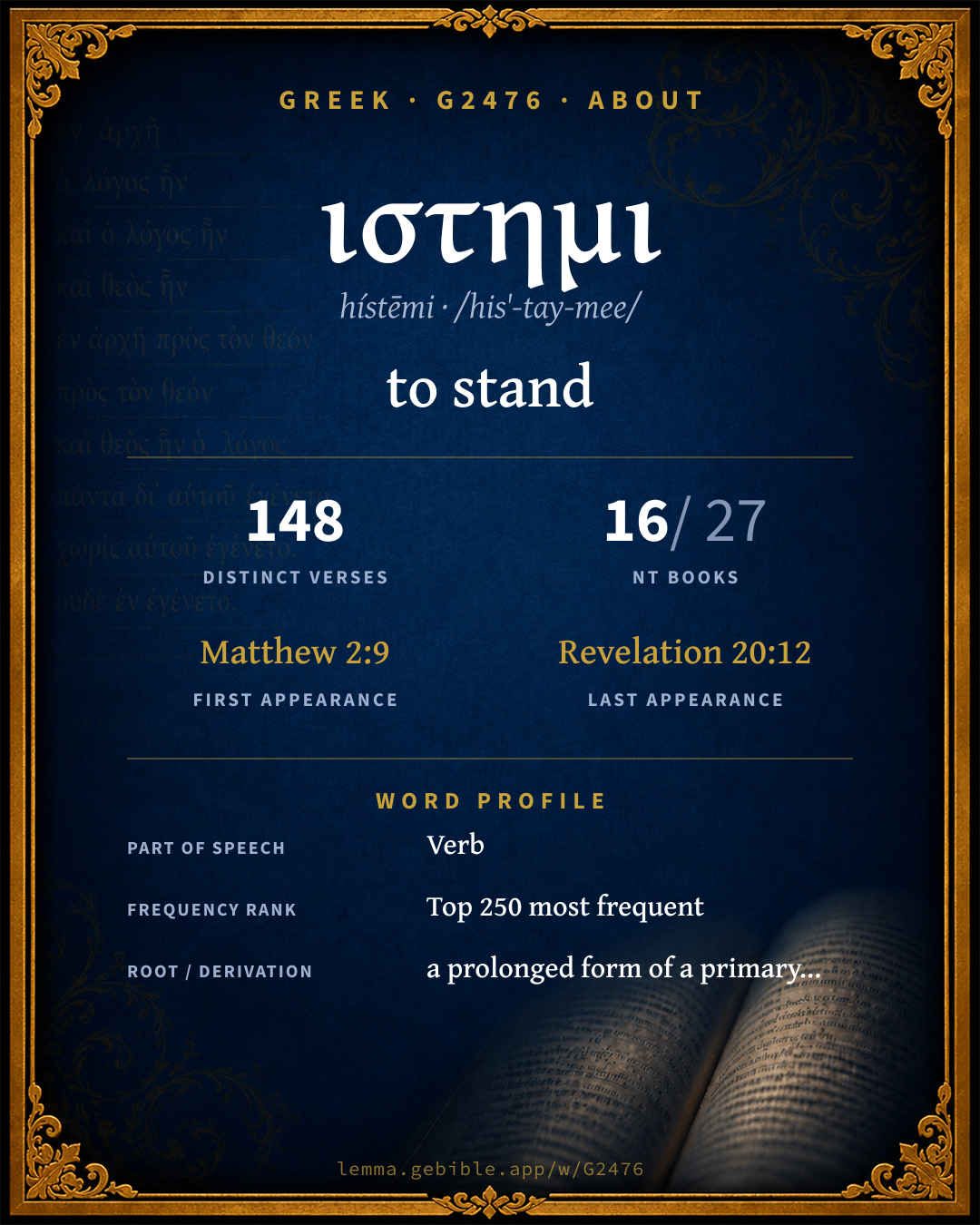
ἵστημι
to stand
‘to stand’ is one of 5 main senses fuller range ↓
Full lexicon entry — Thayer's Greek Lexicon
From Thayer's Greek Lexicon
Where this word appears
See every Aorist-tense verb in the Greek New Testament →
Grammar key — what these labels mean
Part of speech
- Verb
- An action or state-of-being word.
Tense
- Perfect
- A completed past action with continuing present results.
- Aorist
- Action viewed as a simple whole, without regard to duration — often past (perfective aspect).
- Pluperfect
- A past action completed before another past point (“had written”).
- Future
- Action expected in future time.
- Present
- Ongoing or general action in present time (imperfective aspect).
Voice
- Active
- The subject performs the action.
- Passive
- The subject receives the action.
- Middle deponent
- Middle in form but active in meaning.
Mood
- Participle
- A verbal adjective (“writing,” “having written”).
- Indicative
- States a fact or asks a factual question (the mood of reality).
- Infinitive
- A verbal noun (“to write”), unmarked for person or number.
- Imperative
- Expresses a command or request.
- Subjunctive
- Expresses probability, purpose, or possibility (the mood of contingency).
Case
- Nominative
- The case of the subject (and the predicate nominative).
- Accusative
- The case of the direct object and of extent.
- Genitive
- The case of source, possession, or “of” — answers “whose / from what.”
Person
- 3rd person
- The one spoken about (“he / she / it / they”).
- 2nd person
- The one addressed (“you”).
- 1st person
- The speaker (“I / we”).
Gender
- Masculine
- Grammatically masculine.
- Feminine
- Grammatically feminine.
- Neuter
- Grammatically neuter.
Number
- Singular
- One.
- Plural
- More than one.
64 distinct verses where G2476 appears in the Aorist tense, across 13 books. Filtered view — show all forms. Click any verse to open its interlinear word-by-word view. Verse text shown in the World English Bible for context — . Each verse’s Greek form is shown with its reference; the English is not keyword-highlighted, since the data carries no word-level English alignment. Use “Compare translations” on any verse to read it across multiple English versions. This concordance covers the Greek New Testament; Septuagint (Greek Old Testament) occurrences of this word are not indexed here.
Matthew 7 verses
- Matthew 2:9 ἐστάθη aor pass ind 3sg They, having heard the king, went their way; and behold, the star, which they saw in the east, went before them, until it came and stood over where the young child was.
- Matthew 4:5 ἔστησεν aor act ind 3sg Then the devil took him into the holy city. He set him on the pinnacle of the temple,
- Matthew 18:2 ἔστησεν aor act ind 3sg Jesus called a little child to himself, and set him in the midst of them,
- Matthew 18:16 σταθῇ aor pass subj 3sg But if he doesn't listen, take one or two more with you, that at the mouth of two or three witnesses every word may be established.
- Matthew 20:32 στὰς aor act ptcp nom sg masc Jesus stood still, and called them, and asked, "What do you want me to do for you?"
- Matthew 26:15 ἔστησαν aor act ind 3pl and said, "What are you willing to give me, that I should deliver him to you?" They weighed out for him thirty pieces of silver.
- Matthew 27:11 ἐστάθη aor pass ind 3sg Now Jesus stood before the governor: and the governor asked him, saying, "Are you the King of the Jews?" Jesus said to him, "So you say."
Mark 5 verses
- Mark 3:24 σταθῆναι aor pass inf If a kingdom is divided against itself, that kingdom cannot stand.
- Mark 3:25 σταθῆναι aor pass inf If a house is divided against itself, that house cannot stand.
- Mark 3:26 στῆναι aor act inf If Satan has risen up against himself, and is divided, he can't stand, but has an end.
- Mark 9:36 ἔστησεν aor act ind 3sg He took a little child, and set him in the midst of them. Taking him in his arms, he said to them,
- Mark 10:49 στὰς aor act ptcp nom sg masc Jesus stood still, and said, "Call him." They called the blind man, saying to him, "Cheer up! Get up. He is calling you!"
Luke 14 verses
- Luke 4:9 ἔστησεν aor act ind 3sg He led him to Jerusalem, and set him on the pinnacle of the temple, and said to him, "If you are the Son of God, cast yourself down from here,
- Luke 6:8 στῆθι ἔστη aor act impv 2sg aor act ind 3sg But he knew their thoughts; and he said to the man who had the withered hand, "Rise up, and stand in the middle." He arose and stood.
- Luke 6:17 ἔστη aor act ind 3sg He came down with them, and stood on a level place, with a crowd of his disciples, and a great number of the people from all Judea and Jerusalem, and the sea coast of Tyre and Sidon, who came to hear him and to be healed of their diseases;
- Luke 7:14 ἔστησαν aor act ind 3pl He came near and touched the coffin, and the bearers stood still. He said, "Young man, I tell you, arise!"
- Luke 7:38 στᾶσα aor act ptcp nom sg fem Standing behind at his feet weeping, she began to wet his feet with her tears, and she wiped them with the hair of her head, kissed his feet, and anointed them with the ointment.
- Luke 8:44 ἔστη aor act ind 3sg came behind him, and touched the fringe of his cloak, and immediately the flow of her blood stopped.
- Luke 9:47 ἔστησεν aor act ind 3sg Jesus, perceiving the reasoning of their hearts, took a little child, and set him by his side,
- Luke 17:12 ἔστησαν aor act ind 3pl As he entered into a certain village, ten men who were lepers met him, who stood at a distance.
- Luke 18:11 σταθεὶς aor pass ptcp nom sg masc The Pharisee stood and prayed to himself like this: 'God, I thank you, that I am not like the rest of men, extortioners, unrighteous, adulterers, or even like this tax collector.
- Luke 18:40 σταθεὶς aor pass ptcp nom sg masc Standing still, Jesus commanded him to be brought to him. When he had come near, he asked him,
- Luke 19:8 σταθεὶς aor pass ptcp nom sg masc Zacchaeus stood and said to the Lord, "Behold, Lord, half of my goods I give to the poor. If I have wrongfully exacted anything of anyone, I restore four times as much."
- Luke 21:36 σταθῆναι aor pass inf Therefore be watchful all the time, asking that you may be counted worthy to escape all these things that will happen, and to stand before the Son of Man."
- Luke 24:17 ἐστάθησαν aor pass ind 3pl He said to them, "What are you talking about as you walk, and are sad?"
- Luke 24:36 ἔστη aor act ind 3sg As they said these things, Jesus himself stood among them, and said to them, "Peace be to you."
John 4 verses
- John 8:3 στήσαντες aor act ptcp nom pl masc The scribes and the Pharisees brought a woman taken in adultery. Having set her in the midst,
- John 20:19 ἔστη aor act ind 3sg When therefore it was evening, on that day, the first day of the week, and when the doors were locked where the disciples were assembled, for fear of the Jews, Jesus came and stood in the midst, and said to them, "Peace be to you."
- John 20:26 ἔστη aor act ind 3sg After eight days again his disciples were inside, and Thomas was with them. Jesus came, the doors being locked, and stood in the midst, and said, "Peace be to you."
- John 21:4 ἔστη aor act ind 3sg But when day had already come, Jesus stood on the beach, yet the disciples didn't know that it was Jesus.
Acts 19 verses
- Acts 1:23 ἔστησαν aor act ind 3pl They put forward two, Joseph called Barsabbas, who was surnamed Justus, and Matthias.
- Acts 2:14 Σταθεὶς aor pass ptcp nom sg masc But Peter, standing up with the eleven, lifted up his voice, and spoke out to them, "You men of Judea, and all you who dwell at Jerusalem, let this be known to you, and listen to my words.
- Acts 3:8 ἔστη aor act ind 3sg Leaping up, he stood, and began to walk. He entered with them into the temple, walking, leaping, and praising God.
- Acts 4:7 στήσαντες aor act ptcp nom pl masc When they had stood them in the middle of them, they inquired, "By what power, or in what name, have you done this?"
- Acts 5:20 σταθέντες aor pass ptcp nom pl masc "Go stand and speak in the temple to the people all the words of this life."
- Acts 5:27 ἔστησαν aor act ind 3pl When they had brought them, they set them before the council. The high priest questioned them,
- Acts 6:6 ἔστησαν aor act ind 3pl whom they set before the apostles. When they had prayed, they laid their hands on them.
- Acts 6:13 ἔστησάν aor act ind 3pl and set up false witnesses who said, "This man never stops speaking blasphemous words against this holy place and the law.
- Acts 7:60 στήσῃς aor act subj 2sg He kneeled down, and cried with a loud voice, "Lord, don't hold this sin against them!" When he had said this, he fell asleep.
- Acts 8:38 στῆναι aor act inf He commanded the chariot to stand still, and they both went down into the water, both Philip and the eunuch, and he baptized him.
- Acts 10:30 ἔστη aor act ind 3sg Cornelius said, "Four days ago, I was fasting until this hour, and at the ninth hour, I prayed in my house, and behold, a man stood before me in bright clothing,
- Acts 11:13 σταθέντα aor pass ptcp acc sg masc He told us how he had seen the angel standing in his house, and saying to him, 'Send to Joppa, and get Simon, whose surname is Peter,
- Acts 17:22 Σταθεὶς aor pass ptcp nom sg masc Paul stood in the middle of the Areopagus, and said, "You men of Athens, I perceive that you are very religious in all things.
- Acts 17:31 ἔστησεν aor act ind 3sg because he has appointed a day in which he will judge the world in righteousness by the man whom he has ordained; of which he has given assurance to all men, in that he has raised him from the dead."
- Acts 22:30 ἔστησεν aor act ind 3sg But on the next day, desiring to know the truth about why he was accused by the Jews, he freed him from the bonds, and commanded the chief priests and all the council to come together, and brought Paul down and set him before them.
- Acts 24:20 στάντος aor act ptcp gen sg masc Or else let these men themselves say what injustice they found in me when I stood before the council,
- Acts 25:18 σταθέντες aor pass ptcp nom pl masc Concerning whom, when the accusers stood up, they brought no charge of such things as I supposed;
- Acts 26:16 στῆθι aor act impv 2sg But arise, and stand on your feet, for I have appeared to you for this purpose: to appoint you a servant and a witness both of the things which you have seen, and of the things which I will reveal to you;
- Acts 27:21 σταθεὶς aor pass ptcp nom sg masc When they had been long without food, Paul stood up in the middle of them, and said, "Sirs, you should have listened to me, and not have set sail from Crete, and have gotten this injury and loss.
Romans 2 verses
- Romans 10:3 στῆσαι aor act inf For being ignorant of God's righteousness, and seeking to establish their own righteousness, they didn't subject themselves to the righteousness of God.
- Romans 14:4 σταθήσεται στῆσαι fut pass ind 3sg aor act inf Who are you who judge another's servant? To his own lord he stands or falls. Yes, he will be made to stand, for God has power to make him stand.
Ephesians 3 verses
- Ephesians 6:11 στῆναι aor act inf Put on the whole armor of God, that you may be able to stand against the wiles of the devil.
- Ephesians 6:13 στῆναι aor act inf Therefore, put on the whole armor of God, that you may be able to withstand in the evil day, and, having done all, to stand.
- Ephesians 6:14 στῆτε aor act impv 2pl Stand therefore, having the utility belt of truth buckled around your waist, and having put on the breastplate of righteousness,
Colossians 1 verse
Hebrews 1 verse
James 1 verse
1 Peter 1 verse
Jude 1 verse
Revelation 5 verses
- Revelation 6:17 σταθῆναι aor pass inf for the great day of his wrath has come; and who is able to stand?"
- Revelation 8:3 ἐστάθη aor pass ind 3sg Another angel came and stood over the altar, having a golden censer. Much incense was given to him, that he should add it to the prayers of all the saints on the golden altar which was before the throne.
- Revelation 11:11 ἔστησαν aor act ind 3pl After the three and a half days, the breath of life from God entered into them, and they stood on their feet. Great fear fell on those who saw them.
- Revelation 12:18 ἐστάθην aor pass ind 1sg
- Revelation 18:17 ἔστησαν aor act ind 3pl For in an hour such great riches are made desolate.' Every shipmaster, and everyone who sails anywhere, and mariners, and as many as gain their living by sea, stood far away,
About this entry
At a glance — auto-summarized from this page’s data, not written by a person. Every figure links to its source below. This summary describes the numbers; it doesn’t interpret them.
The Greek verb ιστημι centers on the idea of “to stand.” Older and newer Bibles part ways — “stood” in the King James Version, “standing” (Berean Standard Bible) in modern versions. See the renderings breakdown. It turns up in 148 verses across 16 books, a common footprint. Its earliest occurrence is Matthew 2:9. Thayer's distinguishes 5 senses for it. For the data behind this summary, explore the sense tree and the renderings breakdown below.
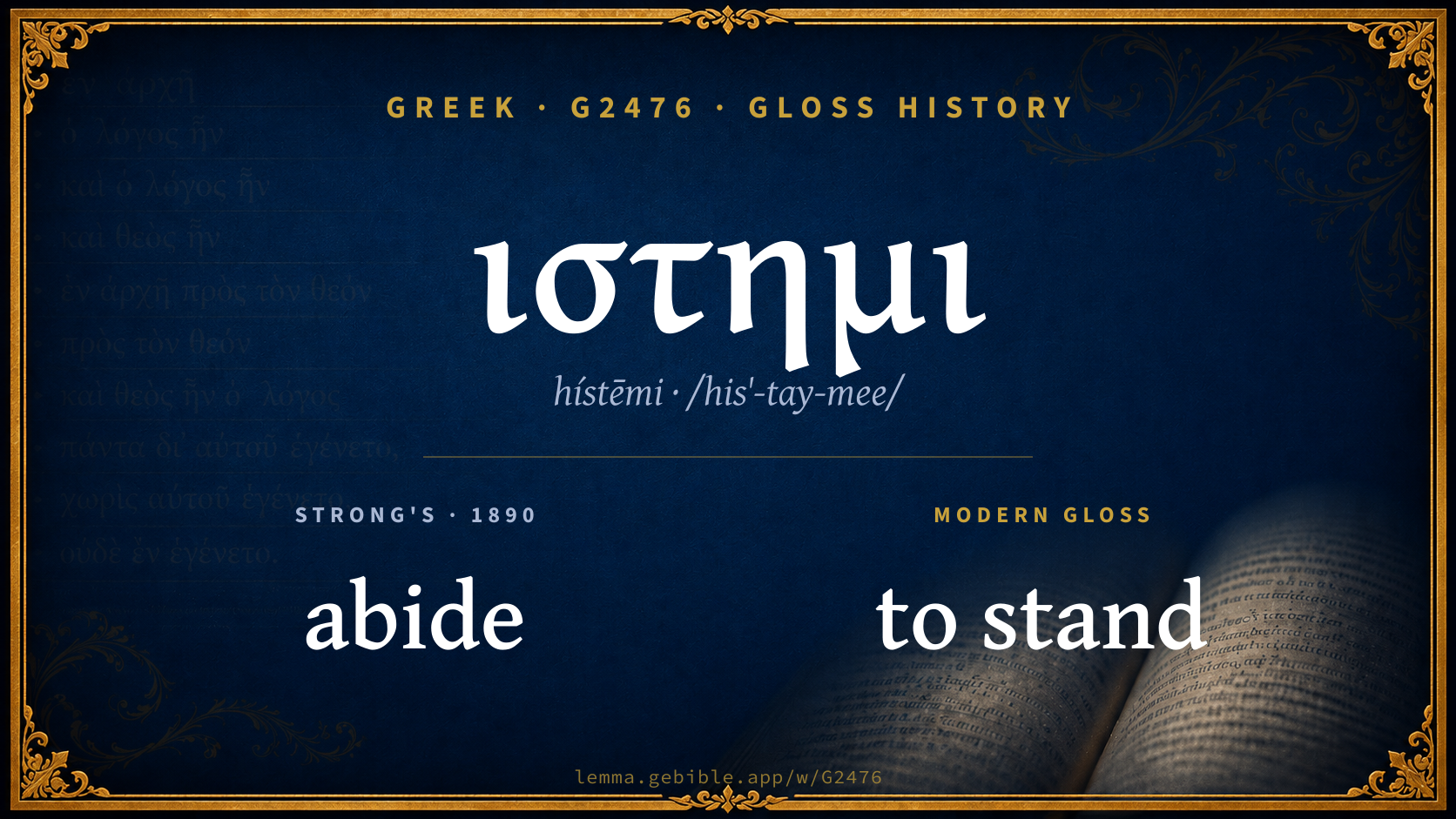
Gloss history
Strong's 1890 vs modern scholarship
About this word
Strong's G2476 catalogs a Greek word from the Greek New Testament.
These counts are not copied from any lexicon or concordance. They are computed here, from the morphology-tagged Greek New Testament. What Lemma adds →
- 148
- distinct verses
- The word appears in 148 distinct verses.
- 16 / 27
- NT books
- The word appears in 16 of 27 New Testament books.
- #107
- by frequency
- Top 250 most frequent Greek words (rank 107 of 5,347 Greek words by occurrence).
View all 148 occurrences in the concordance →
By section of the New Testament
By traditional corpus
Conventional, traditional groupings — biblical authorship is debated, so this is a traditional corpus grouping, not an authorship claim. Some books belong to more than one corpus (Luke is in both the Gospels and the Lukan corpus, and so on), so these shares overlap and need not total 100%. Each figure is a share of the word’s 148 distinct verses.
- Gospels 72 verses · 49%
- Lukan (Luke–Acts) 60 verses · 41%
- Johannine 38 verses · 26%
- Revelation 20 verses · 14%
- Pauline corpus 15 verses · 10%
- General (Catholic) Epistles 4 verses · 3%
- Hebrews 2 verses · 1%
How translations render this word
Counts come from each version’s own published word-to-Strong’s tagging or interlinear alignment — an approximate guide to how each version renders this word, not a word-level alignment the data otherwise carries. Because each total is that version’s own tagged count, the per-version totals vary from one another and need not match the appearance or distinct-verse counts above. These counts may also differ from a printed concordance because Lemma counts each distinctly tagged rendering and does not collapse phrase taggings into a single head-word total. This is a fixed set of word-tagged versions (KJV, ASV, BSB, ULT) and does not change with the reading translation you choose elsewhere. Each version’s license is shown beside its name below (and on Sources).
- King James Version: Stood 43×, Stand 23×, Standing 22×
- American Standard Version: Standing 30×, Stood 27×, Stand 21×
- Berean Standard Bible: Standing 31×, Stood 26×, Stand 15×
- unfoldingWord Literal Text: Standing 38×, Stand 20×, Stood 16×
King James Version Public Domain
Renders G2476 across 156 tagged occurrences — most commonly:
Plus other, less common renderings. Plus 33 renderings that appear only once — usually multi-word phrases or single function words the recovered tagging swept in, not distinct renderings. Not rendered by a distinct English word in 7 further occurrences.
American Standard Version Public Domain
Renders G2476 across 166 tagged occurrences — most commonly:
Plus other, less common renderings. Plus 49 renderings that appear only once — usually multi-word phrases or single function words the recovered tagging swept in, not distinct renderings.
Berean Standard Bible Public Domain
Renders G2476 across 152 tagged occurrences — most commonly:
Plus other, less common renderings. Plus 44 renderings that appear only once — usually multi-word phrases or single function words the recovered tagging swept in, not distinct renderings.
unfoldingWord Literal Text CC BY-SA 4.0
Renders G2476 across 169 tagged occurrences — most commonly:
Plus other, less common renderings. Plus 47 renderings that appear only once — usually multi-word phrases or single function words the recovered tagging swept in, not distinct renderings.
Senses in Thayer's
The 5 senses Thayer's distinguishes for this word, in lexicon order (not ranked by frequency or importance). The full entry — with sub-senses — is in the Lexicon Entry tab.
- to cause or make to stand, to place, put, set
- to uphold or sustain the authority or force of anything
- to stand by or near
- of the foundation of a building
- to stand
Word origin
Origin: a prolonged form of a primary stao stah'-o (of the same meaning, and used for it in certain tenses)
A prolonged form of a primary word στάω staō (of the same meaning and used for it in certain tenses); to stand (transitively or intransitively) used in various applications (literally or figuratively): - abide appoint bring continue covenant establish hold up lay present set (up) stanch stand (by forth still up). Compare G5087 .
— Strong’s Exhaustive Concordance (1890), public domain.
Forms in the corpus
The 50 distinct written forms G2476 takes in the Greek New Testament, most frequent first — each parse links to that tense’s occurrences in the concordance.
Same root — word family
Other Thayer's entries built from the same root as G2476, grouped by Strong’s listed origin. These share a root / origin per the lexicon — not necessarily a shared meaning. Each links to that word’s own entry.
Derived from this word
- σθενοω sthenóō G4599 to strengthen
- σταδιον stádion G4712 furlong
- σταμνος stámnos G4713 jar
- στασις stásis G4714 insurrection
- σταυρος staurós G4716 cross
- σταχυς stáchys G4719 ear of grain
- στελλω stéllō G4724 to set
- στενος stenós G4728 narrow
- στερεος stereós G4731 strong
- στηθος stēthos G4738 breast
- στηκω stḗkō G4739 to stand firm
- στηριζω stērízō G4741 to establish
- στοα stoá G4745 portico
- στυλος stŷlos G4769 pillar
Compare all same-root words → Showing 4 of 15 — not the complete family. They share a root, not necessarily a meaning.
Septuagint usage
The same Greek word ιστημι appears 592 times in the Greek Old Testament (Septuagint), across 555 verses in 33 books.
- 592
- LXX occurrences
- Tagged occurrences of this Greek word in the Septuagint.
- 555
- verses
- Distinct Septuagint verses containing this word.
- 33 / 39
- OT books
- The word appears in 33 of the 39 Old Testament books.
Sample Septuagint occurrences
- Genesis 6:18 ἵστημι
- Exodus 3:5 ἵστημι
- Leviticus 9:5 ἵστημι
- Numbers 3:6 ἵστημι
- Deuteronomy 4:10 ἵστημι
- Joshua 2:11 ἵστημι
- Judges 4:20 ἵστημι
- Ruth 2:7 ἵστημι
- 1 Samuel 1:23 ἵστημι
- 2 Samuel 1:9 ἵστημι
- 1 Kings 1:28 ἵστημι
- 2 Kings 2:7 ἵστημι
Septuagint occurrences (same lexeme)
Every verse where the same Strong’s number (G2476) appears in the Greek Septuagint — showing the first 50 of 555. Verse text shown in the World English Bible for context; the Greek form is the matched word — the English is not keyword-highlighted.
- Genesis 6:18 ἵστημι But I will establish my covenant with you. You shall come into the ark, you, your sons, your wife, and your sons' wives with you.
- Genesis 9:11 ἵστημι I will establish my covenant with you; neither will all flesh be cut off any more by the waters of the flood; neither will there any more be a flood to destroy the earth."
- Genesis 12:8 ἵστημι He left from there to the mountain on the east of Bethel, and pitched his tent, having Bethel on the west, and Ai on the east. There he built an altar to Yahweh, and called on the name of Yahweh.
- Genesis 17:7 ἵστημι I will establish my covenant between me and you and your seed after you throughout their generations for an everlasting covenant, to be a God to you and to your seed after you.
- Genesis 17:19 ἵστημι God said, "No, but Sarah, your wife, will bear you a son. You shall call his name Isaac. I will establish my covenant with him for an everlasting covenant for his seed after him.
- Genesis 17:21 ἵστημι But my covenant I establish with Isaac, whom Sarah will bear to you at this set time in the next year."
- Genesis 18:2 ἵστημι He lifted up his eyes and looked, and saw that three men stood opposite him. When he saw them, he ran to meet them from the tent door, and bowed himself to the earth,
- Genesis 18:22 ἵστημι The men turned from there, and went toward Sodom, but Abraham stood yet before Yahweh.
- Genesis 19:17 ἵστημι It came to pass, when they had taken them out, that he said, "Escape for your life! Don't look behind you, neither stay anywhere in the plain. Escape to the mountain, lest you be consumed!"
- Genesis 19:27 ἵστημι Abraham got up early in the morning to the place where he had stood before Yahweh.
- Genesis 21:28 ἵστημι Abraham set seven ewe lambs of the flock by themselves.
- Genesis 21:29 ἵστημι Abimelech said to Abraham, "What do these seven ewe lambs which you have set by themselves mean?"
- Genesis 23:17 ἵστημι So the field of Ephron, which was in Machpelah, which was before Mamre, the field, the cave which was therein, and all the trees that were in the field, that were in all the border of it round about, were made sure
- Genesis 24:13 ἵστημι Behold, I am standing by the spring of water. The daughters of the men of the city are coming out to draw water.
- Genesis 24:30 ἵστημι It happened, when he saw the ring, and the bracelets on his sister's hands, and when he heard the words of Rebekah his sister, saying, "This is what the man said to me," that he came to the man. Behold, he was standing by the camels at the spring.
- Genesis 24:31 ἵστημι He said, "Come in, you blessed of Yahweh. Why do you stand outside? For I have prepared the house, and room for the camels."
- Genesis 26:3 ἵστημι Sojourn in this land, and I will be with you, and will bless you. For to you, and to your seed, I will give all these lands, and I will establish the oath which I swore to Abraham your father.
- Genesis 28:18 ἵστημι Jacob rose up early in the morning, and took the stone that he had put under his head, and set it up for a pillar, and poured oil on the top of it.
- Genesis 28:22 ἵστημι then this stone, which I have set up for a pillar, will be God's house. Of all that you will give me I will surely give the tenth to you."
- Genesis 29:35 ἵστημι She conceived again, and bare a son. She said, "This time will I praise Yahweh." Therefore she named him Judah. Then she stopped bearing.
- Genesis 30:9 ἵστημι When Leah saw that she had finished bearing, she took Zilpah, her handmaid, and gave her to Jacob as a wife.
- Genesis 30:40 ἵστημι Jacob separated the lambs, and set the faces of the flocks toward the streaked and all the black in the flock of Laban: and he put his own droves apart, and didn't put them into Laban's flock.
- Genesis 31:25 ἵστημι Laban caught up with Jacob. Now Jacob had pitched his tent in the mountain, and Laban with his relatives encamped in the mountain of Gilead.
- Genesis 31:45 ἵστημι Jacob took a stone, and set it up for a pillar.
- Genesis 31:48 ἵστημι Laban said, "This heap is witness between me and you this day." Therefore it was named Galeed
- Genesis 33:19 ἵστημι He bought the parcel of ground, where he had spread his tent, at the hand of the children of Hamor, Shechem's father, for one hundred pieces of money.
- Genesis 33:20 ἵστημι He erected an altar there, and called it El Elohe Israel.
- Genesis 35:14 ἵστημι Jacob set up a pillar in the place where he spoke with him, a pillar of stone. He poured out a drink-offering on it, and poured oil on it.
- Genesis 35:20 ἵστημι Jacob set up a pillar on her grave. The same is the Pillar of Rachel's grave to this day.
- Genesis 41:1 ἵστημι It happened at the end of two full years, that Pharaoh dreamed: and, behold, he stood by the river.
- Genesis 41:17 ἵστημι Pharaoh spoke to Joseph, "In my dream, behold, I stood on the brink of the river:
- Genesis 41:46 ἵστημι Joseph was thirty years old when he stood before Pharaoh king of Egypt. Joseph went out from the presence of Pharaoh, and went throughout all the land of Egypt.
- Genesis 43:9 ἵστημι I will be collateral for him. From my hand will you require him. If I don't bring him to you, and set him before you, then let me bear the blame forever,
- Genesis 43:15 ἵστημι The men took that present, and they took double money in their hand, and Benjamin; and rose up, went down to Egypt, and stood before Joseph.
- Genesis 44:32 ἵστημι For your servant became collateral for the boy to my father, saying, 'If I don't bring him to you, then I will bear the blame to my father forever.'
- Genesis 47:2 ἵστημι From among his brothers he took five men, and presented them to Pharaoh.
- Genesis 47:7 ἵστημι Joseph brought in Jacob, his father, and set him before Pharaoh, and Jacob blessed Pharaoh.
- Exodus 3:5 ἵστημι He said, "Don't come close. Take off your sandals from off your feet, for the place you are standing on is holy ground."
- Exodus 4:25 ἵστημι Then Zipporah took a flint, and cut off the foreskin of her son, and cast it at his feet; and she said, "Surely you are a bridegroom of blood to me."
- Exodus 4:26 ἵστημι So he let him alone. Then she said, "You are a bridegroom of blood," because of the circumcision.
- Exodus 6:4 ἵστημι I have also established my covenant with them, to give them the land of Canaan, the land of their travels, in which they lived as aliens.
- Exodus 7:15 ἵστημι Go to Pharaoh in the morning. Behold, he goes out to the water; and you shall stand by the river's bank to meet him; and the rod which was turned to a serpent you shall take in your hand.
- Exodus 8:16 ἵστημι Yahweh said to Moses, "Tell Aaron, 'Stretch out your rod, and strike the dust of the earth, that it may become lice throughout all the land of Egypt.'"
- Exodus 9:11 ἵστημι The magicians couldn't stand before Moses because of the boils; for the boils were on the magicians, and on all the Egyptians.
- Exodus 9:13 ἵστημι Yahweh said to Moses, "Rise up early in the morning, and stand before Pharaoh, and tell him, 'This is what Yahweh, the God of the Hebrews, says: "Let my people go, that they may serve me.
- Exodus 14:13 ἵστημι Moses said to the people, "Don't be afraid. Stand still, and see the salvation of Yahweh, which he will work for you today: for the Egyptians whom you have seen today, you shall never see them again.
- Exodus 14:19 ἵστημι The angel of God, who went before the camp of Israel, moved and went behind them; and the pillar of cloud moved from before them, and stood behind them.
- Exodus 14:20 ἵστημι It came between the camp of Egypt and the camp of Israel; and there was the cloud and the darkness, yet gave it light by night: and the one didn't come near the other all the night.
- Exodus 17:6 ἵστημι Behold, I will stand before you there on the rock in Horeb. You shall strike the rock, and water will come out of it, that the people may drink." Moses did so in the sight of the elders of Israel.
- Exodus 17:9 ἵστημι Moses said to Joshua, "Choose men for us, and go out, fight with Amalek. Tomorrow I will stand on the top of the hill with God's rod in my hand."
These are occurrences of the same Greek lexeme (G2476) in the Septuagint — not a translation of any one Hebrew word. The store carries no word-level Hebrew↔Greek alignment, so no Hebrew original is asserted here. Counts come from the recovered LXX Strong's tagging — high-frequency vocabulary is well covered, while rare or late forms may be untagged — so they reflect tagged occurrences and may slightly undercount.