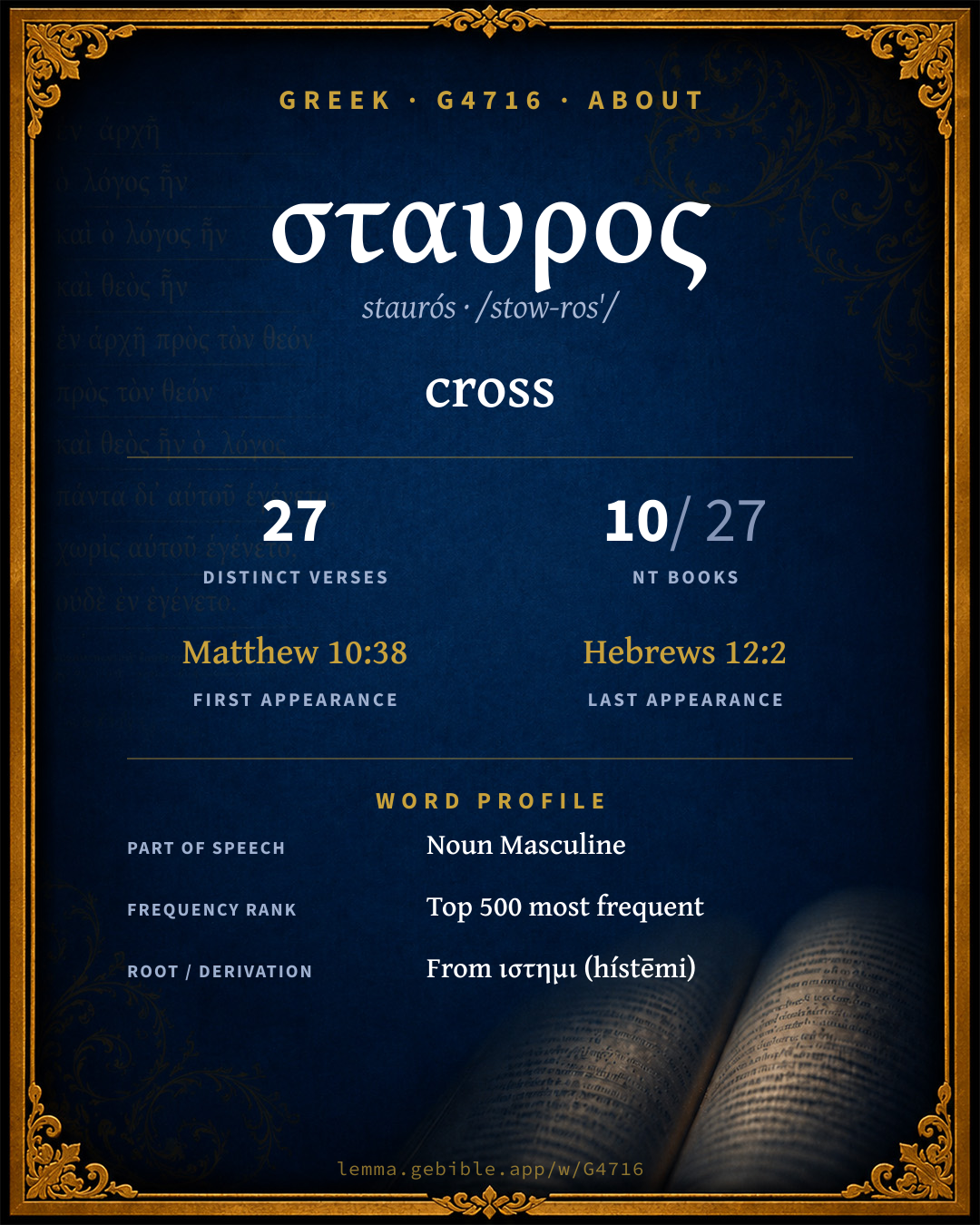
σταυρός
cross
‘cross’ is one of 3 main senses fuller range ↓
Full lexicon entry — Thayer's Greek Lexicon
From Thayer's Greek Lexicon
Where this word appears
See every Genitive-case word in the Greek New Testament →
Grammar key — what these labels mean
Part of speech
- Noun
- A naming word — a person, place, thing, or idea.
Case
- Genitive
- The case of source, possession, or “of” — answers “whose / from what.”
- Accusative
- The case of the direct object and of extent.
- Dative
- The case of the indirect object, means, or location — “to / for / with / in.”
- Nominative
- The case of the subject (and the predicate nominative).
Gender
- Masculine
- Grammatically masculine.
Number
- Singular
- One.
Grammatical forms
- Noun, Genitive, Singular, Masculine 12 times (44%)
- Noun, Accusative, Singular, Masculine 10 times (37%)
- Noun, Dative, Singular, Masculine 4 times (15%)
- Noun, Nominative, Singular, Masculine 1 time (4%)
Parsed forms decoded from the imported morphology (Robinson–Tischendorf, public domain), counted across 27 parsed occurrences — not distinct verses.
Every verse where G4716 appears — 27 distinct verses across 10 books. Click any verse to open its interlinear word-by-word view. Verse text shown in the World English Bible for context — . Each verse’s Greek form is shown with its reference; the English is not keyword-highlighted, since the data carries no word-level English alignment. Use “Compare translations” on any verse to read it across multiple English versions. This concordance covers the Greek New Testament; Septuagint (Greek Old Testament) occurrences of this word are not indexed here.
Matthew 5 verses
- Matthew 10:38 σταυρὸν n acc sg masc He who doesn't take his cross and follow after me, isn't worthy of me.
- Matthew 16:24 σταυρὸν n acc sg masc Then Jesus said to his disciples, "If anyone desires to come after me, let him deny himself, and take up his cross, and follow me.
- Matthew 27:32 σταυρὸν n acc sg masc As they came out, they found a man of Cyrene, Simon by name, and they compelled him to go with them, that he might carry his cross.
- Matthew 27:40 σταυροῦ n gen sg masc and saying, "You who destroy the temple, and build it in three days, save yourself! If you are the Son of God, come down from the cross!"
- Matthew 27:42 σταυροῦ n gen sg masc "He saved others, but he can't save himself. If he is the King of Israel, let him come down from the cross now, and we will believe in him.
Mark 4 verses
- Mark 8:34 σταυρὸν n acc sg masc He called the multitude to himself with his disciples, and said to them, "Whoever wants to come after me, let him deny himself, and take up his cross, and follow me.
- Mark 15:21 σταυρὸν n acc sg masc They compelled one passing by, coming from the country, Simon of Cyrene, the father of Alexander and Rufus, to go with them, that he might bear his cross.
- Mark 15:30 σταυροῦ n gen sg masc save yourself, and come down from the cross!"
- Mark 15:32 σταυροῦ n gen sg masc Let the Christ, the King of Israel, now come down from the cross, that we may see and believe him." Those who were crucified with him insulted him.
Luke 3 verses
- Luke 9:23 σταυρὸν n acc sg masc He said to all, "If anyone desires to come after me, let him deny himself, take up his cross, and follow me.
- Luke 14:27 σταυρὸν n acc sg masc Whoever doesn't bear his own cross, and come after me, can't be my disciple.
- Luke 23:26 σταυρὸν n acc sg masc When they led him away, they grabbed one Simon of Cyrene, coming from the country, and laid on him the cross, to carry it after Jesus.
John 4 verses
- John 19:17 σταυρὸν n acc sg masc He went out, bearing his cross, to the place called "The Place of a Skull," which is called in Hebrew, "Golgotha,"
- John 19:19 σταυροῦ n gen sg masc Pilate wrote a title also, and put it on the cross. There was written, "JESUS OF NAZARETH, THE KING OF THE JEWS."
- John 19:25 σταυρῷ n dat sg masc But there were standing by the cross of Jesus his mother, and his mother's sister, Mary the wife of Clopas, and Mary Magdalene.
- John 19:31 σταυροῦ n gen sg masc Therefore the Jews, because it was the Preparation Day, so that the bodies wouldn't remain on the cross on the Sabbath (for that Sabbath was a special one), asked of Pilate that their legs might be broken, and that they might be taken away.
1 Corinthians 2 verses
- 1 Corinthians 1:17 σταυρὸς n nom sg masc For Christ sent me not to baptize, but to preach the Gospel--not in wisdom of words, so that the cross of Christ wouldn't be made void.
- 1 Corinthians 1:18 σταυροῦ n gen sg masc For the word of the cross is foolishness to those who are dying, but to us who are saved it is the power of God.
Galatians 3 verses
- Galatians 5:11 σταυροῦ n gen sg masc But I, brothers, if I still preach circumcision, why am I still persecuted? Then the stumbling-block of the cross has been removed.
- Galatians 6:12 σταυρῷ n dat sg masc As many as desire to look good in the flesh, they compel you to be circumcised; only that they may not be persecuted for the cross of Christ.
- Galatians 6:14 σταυρῷ n dat sg masc But far be it from me to boast, except in the cross of our Lord Jesus Christ, through which the world has been crucified to me, and I to the world.
Ephesians 1 verse
Philippians 2 verses
Colossians 2 verses
- Colossians 1:20 σταυροῦ n gen sg masc and through him to reconcile all things to himself, by him, whether things on the earth, or things in the heavens, having made peace through the blood of his cross.
- Colossians 2:14 σταυρῷ n dat sg masc wiping out the handwriting in ordinances which was against us; and he has taken it out of the way, nailing it to the cross;
Hebrews 1 verse
About this entry
At a glance — auto-summarized from this page’s data, not written by a person. Every figure links to its source below. This summary describes the numbers; it doesn’t interpret them.
The Greek noun σταυρος centers on the idea of “cross.” Its earliest occurrence is Matthew 10:38. Spanning 27 verses in 10 books, it ranks among the moderately common words of the Greek New Testament. Lexicons map it across 3 senses. Related forms include ιστημι, σθενοω and σταδιον. Dig into 27-verse concordance and the renderings breakdown below.
Gloss history
Strong's 1890 vs modern scholarship
About this word
Strong's G4716 catalogs a Greek word from the Greek New Testament.
These counts are not copied from any lexicon or concordance. They are computed here, from the morphology-tagged Greek New Testament. What Lemma adds →
- 27
- distinct verses
- The word appears in 27 distinct verses.
- 10 / 27
- NT books
- The word appears in 10 of 27 New Testament books.
- #500
- by frequency
- Top 500 most frequent Greek words (rank 500 of 5,347 Greek words by occurrence).
View all 27 occurrences in the concordance →
By section of the New Testament
By traditional corpus
Conventional, traditional groupings — biblical authorship is debated, so this is a traditional corpus grouping, not an authorship claim. Some books belong to more than one corpus (Luke is in both the Gospels and the Lukan corpus, and so on), so these shares overlap and need not total 100%. Each figure is a share of the word’s 27 distinct verses.
- Gospels 16 verses · 59%
- Pauline corpus 10 verses · 37%
- Johannine 4 verses · 15%
- Lukan (Luke–Acts) 3 verses · 11%
- Hebrews 1 verse · 4%
How translations render this word
Counts come from each version’s own published word-to-Strong’s tagging or interlinear alignment — an approximate guide to how each version renders this word, not a word-level alignment the data otherwise carries. Because each total is that version’s own tagged count, the per-version totals vary from one another and need not match the appearance or distinct-verse counts above. These counts may also differ from a printed concordance because Lemma counts each distinctly tagged rendering and does not collapse phrase taggings into a single head-word total. This is a fixed set of word-tagged versions (KJV, ASV, BSB, ULT) and does not change with the reading translation you choose elsewhere. Each version’s license is shown beside its name below (and on Sources).
- King James Version: Cross 28×
- American Standard Version: Cross 23×
- Berean Standard Bible: Cross 27×
- unfoldingWord Literal Text: Cross 27×
King James Version Public Domain
Renders G4716 across 28 tagged occurrences — most commonly:
American Standard Version Public Domain
Renders G4716 across 26 tagged occurrences — most commonly:
Plus 3 renderings that appear only once — usually multi-word phrases or single function words the recovered tagging swept in, not distinct renderings.
Berean Standard Bible Public Domain
Renders G4716 across 27 tagged occurrences — most commonly:
unfoldingWord Literal Text CC BY-SA 4.0
Renders G4716 across 28 tagged occurrences — most commonly:
Plus 1 rendering that appears only once — usually multi-word phrases or single function words the recovered tagging swept in, not distinct renderings.
Senses in Thayer's
The 3 senses Thayer's distinguishes for this word, in lexicon order (not ranked by frequency or importance). The full entry — with sub-senses — is in the Lexicon Entry tab.
- an upright stake, esp. a pointed one
- a well known instrument of most cruel and ignominious punishment…
- the crucifixion which Christ underwent
Word origin
Derived from ιστημι (hístēmi) (G2476) — to stand.
From the base of G2476 ; a stake or post (as set upright) that is (specifically) a pole or cross (as an instrument of capital punishment); figuratively exposure to death that is self denial ; by implication the atonement of christ : - cross.
— Strong’s Exhaustive Concordance (1890), public domain.
Forms in the corpus
The 4 distinct written forms G4716 takes in the Greek New Testament, most frequent first — each parse links to that case’s occurrences in the concordance.
| Form | Parsing | Example | Uses |
|---|---|---|---|
| σταυροῦ stauroû | Noun, Genitive, Singular, Masculine | Matthew 27:40 | 12 |
| σταυρὸν stauròn | Noun, Accusative, Singular, Masculine | Matthew 10:38 | 10 |
| σταυρῷ staurō̂ | Noun, Dative, Singular, Masculine | John 19:25 | 4 |
| σταυρὸς stauròs | Noun, Nominative, Singular, Masculine | 1 Corinthians 1:17 | 1 |
Same root — word family
Other Thayer's entries built from the same root as G4716, grouped by Strong’s listed origin. These share a root / origin per the lexicon — not necessarily a shared meaning. Each links to that word’s own entry.
Derives from
Shares the same root
- σθενοω sthenóō G4599 to strengthen
- σταδιον stádion G4712 furlong
- σταμνος stámnos G4713 jar
- στασις stásis G4714 insurrection
- σταχυς stáchys G4719 ear of grain
- στελλω stéllō G4724 to set
- στενος stenós G4728 narrow
- στερεος stereós G4731 strong
- στηθος stēthos G4738 breast
- στηκω stḗkō G4739 to stand firm
- στηριζω stērízō G4741 to establish
- στοα stoá G4745 portico
- στυλος stŷlos G4769 pillar
Derived from this word
Compare all same-root words → Showing 4 of 16 — not the complete family. They share a root, not necessarily a meaning.