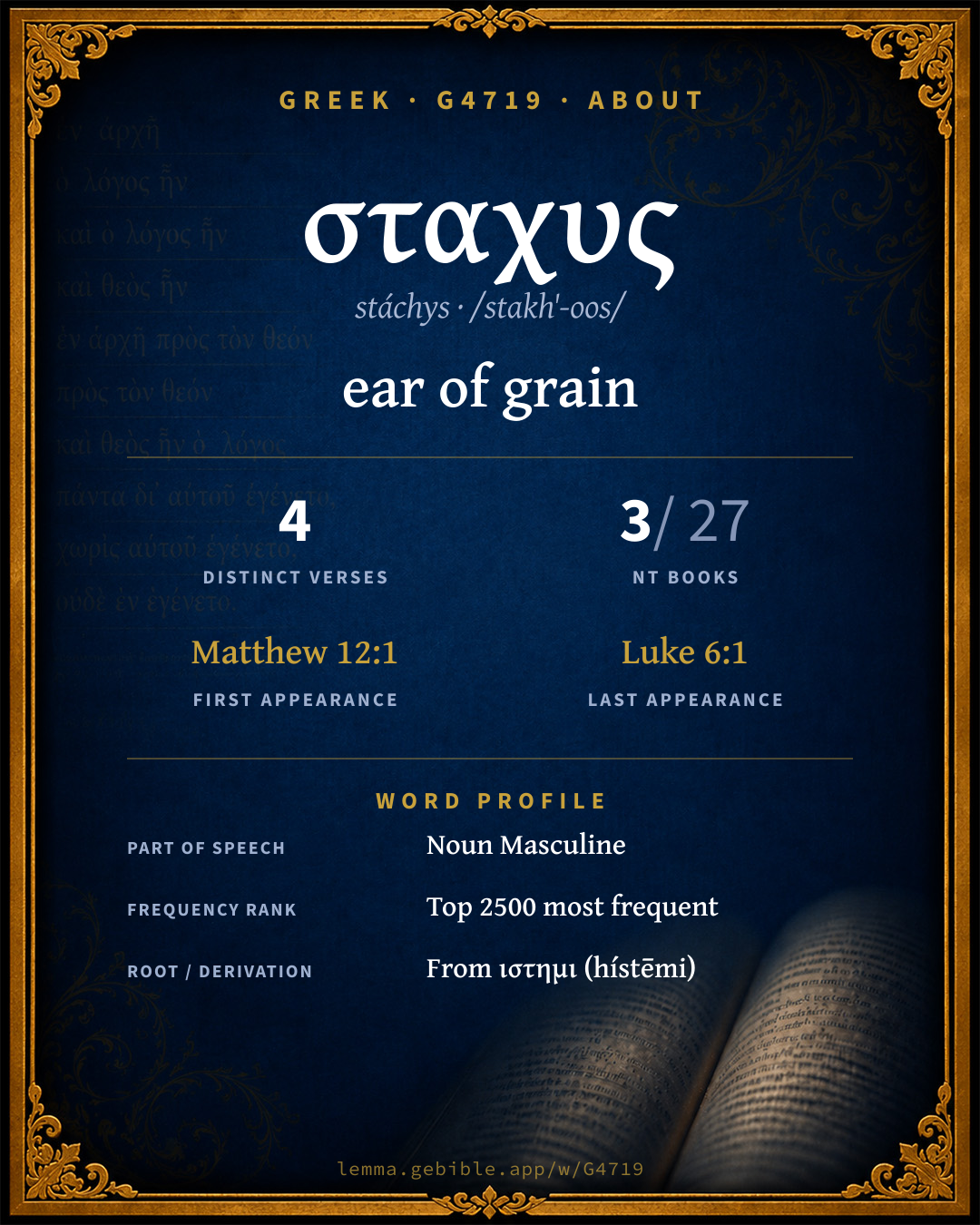
στάχυς
ear of grain
Full lexicon entry — Thayer's Greek Lexicon
From Thayer's Greek Lexicon
Where this word appears
See every Accusative-case word in the Greek New Testament →
Grammar key — what these labels mean
Part of speech
- Noun
- A naming word — a person, place, thing, or idea.
Case
- Accusative
- The case of the direct object and of extent.
- Dative
- The case of the indirect object, means, or location — “to / for / with / in.”
Gender
- Masculine
- Grammatically masculine.
Number
- Plural
- More than one.
- Singular
- One.
Grammatical forms
- Noun, Accusative, Plural, Masculine 3 times (60%)
- Noun, Accusative, Singular, Masculine 1 time (20%)
- Noun, Dative, Singular, Masculine 1 time (20%)
Parsed forms decoded from the imported morphology (Robinson–Tischendorf, public domain), counted across 5 parsed occurrences — not distinct verses.
Every verse where G4719 appears — 4 distinct verses across 3 books. Click any verse to open its interlinear word-by-word view. Verse text shown in the World English Bible for context — . Each verse’s Greek form is shown with its reference; the English is not keyword-highlighted, since the data carries no word-level English alignment. Use “Compare translations” on any verse to read it across multiple English versions. This concordance covers the Greek New Testament; Septuagint (Greek Old Testament) occurrences of this word are not indexed here.
Matthew 1 verse
Mark 2 verses
- Mark 2:23 στάχυας n acc pl masc It happened that he was going on the Sabbath day through the grain fields, and his disciples began, as they went, to pluck the ears of grain.
- Mark 4:28 στάχυν στάχυϊ n acc sg masc n dat sg masc For the earth bears fruit: first the blade, then the ear, then the full grain in the ear.
Luke 1 verse
About this entry
At a glance — auto-summarized from this page’s data, not written by a person. Every figure links to its source below. This summary describes the numbers; it doesn’t interpret them.
The Greek noun σταχυς centers on the idea of “ear of grain.” It is rare — just 4 verses in the entire Greek New Testament. The word gravitates to Mark (50%), then Matthew and Luke. First canonically at Matthew 12:1, it enters the text early. It clusters with ιστημι, σθενοω and σταδιον under a shared root. For the data behind this summary, explore the sense tree and the renderings breakdown below.
Gloss history
Strong's 1890 vs modern scholarship
About this word
Strong's G4719 catalogs a Greek word from the Greek New Testament.
These counts are not copied from any lexicon or concordance. They are computed here, from the morphology-tagged Greek New Testament. What Lemma adds →
- 4
- distinct verses
- The word appears in 4 distinct verses.
- 3 / 27
- NT books
- The word appears in 3 of 27 New Testament books.
- #1,648
- by frequency
- Top 2500 most frequent Greek words (rank 1,648 of 5,347 Greek words by occurrence).
View all 4 occurrences in the concordance →
By section of the New Testament
By traditional corpus
Conventional, traditional groupings — biblical authorship is debated, so this is a traditional corpus grouping, not an authorship claim. Some books belong to more than one corpus (Luke is in both the Gospels and the Lukan corpus, and so on), so these shares overlap and need not total 100%. Each figure is a share of the word’s 4 distinct verses.
- Gospels 4 verses · 100%
- Lukan (Luke–Acts) 1 verse · 25%
How translations render this word
Counts come from each version’s own published word-to-Strong’s tagging or interlinear alignment — an approximate guide to how each version renders this word, not a word-level alignment the data otherwise carries. Because each total is that version’s own tagged count, the per-version totals vary from one another and need not match the appearance or distinct-verse counts above. These counts may also differ from a printed concordance because Lemma counts each distinctly tagged rendering and does not collapse phrase taggings into a single head-word total. This is a fixed set of word-tagged versions (KJV, ASV, BSB, ULT) and does not change with the reading translation you choose elsewhere. Each version’s license is shown beside its name below (and on Sources).
- King James Version: Ears of corn 3×, Ear 2×
- American Standard Version: Ears 3×, Ear 2×
- Berean Standard Bible: Heads of grain 3×
- unfoldingWord Literal Text: Heads of grain 3×, Head 2×
King James Version Public Domain
Renders G4719 across 5 tagged occurrences — most commonly:
American Standard Version Public Domain
Renders G4719 across 6 tagged occurrences — most commonly:
Plus 1 rendering that appears only once — usually multi-word phrases or single function words the recovered tagging swept in, not distinct renderings.
Berean Standard Bible Public Domain
Renders G4719 across 4 tagged occurrences — most commonly:
Plus 1 rendering that appears only once — usually multi-word phrases or single function words the recovered tagging swept in, not distinct renderings. Not rendered by a distinct English word in 1 further occurrence.
unfoldingWord Literal Text CC BY-SA 4.0
Renders G4719 across 5 tagged occurrences — most commonly:
Senses in Thayer's
The 1 sense Thayer's distinguishes for this word, in lexicon order (not ranked by frequency or importance). The full entry — with sub-senses — is in the Lexicon Entry tab.
- an ear of corn or of growing grain
Word origin
Derived from ιστημι (hístēmi) (G2476) — to stand.
From the base of G2476 ; a head of grain (as standing out from the stalk): - ear (of corn).
— Strong’s Exhaustive Concordance (1890), public domain.
Forms in the corpus
The 3 distinct written forms G4719 takes in the Greek New Testament, most frequent first — each parse links to that case’s occurrences in the concordance.
| Form | Parsing | Example | Uses |
|---|---|---|---|
| στάχυας stáchyas | Noun, Accusative, Plural, Masculine | Matthew 12:1 | 3 |
| στάχυν stáchyn | Noun, Accusative, Singular, Masculine | Mark 4:28 | 1 |
| στάχυϊ stáchyï | Noun, Dative, Singular, Masculine | Mark 4:28 | 1 |
Same root — word family
Other Thayer's entries built from the same root as G4719, grouped by Strong’s listed origin. These share a root / origin per the lexicon — not necessarily a shared meaning. Each links to that word’s own entry.
Derives from
Shares the same root
- σθενοω sthenóō G4599 to strengthen
- σταδιον stádion G4712 furlong
- σταμνος stámnos G4713 jar
- στασις stásis G4714 insurrection
- σταυρος staurós G4716 cross
- στελλω stéllō G4724 to set
- στενος stenós G4728 narrow
- στερεος stereós G4731 strong
- στηθος stēthos G4738 breast
- στηκω stḗkō G4739 to stand firm
- στηριζω stērízō G4741 to establish
- στοα stoá G4745 portico
- στυλος stŷlos G4769 pillar
Proper names from this root
People and places named from this root — a name, not an additional meaning of the word.
Compare all same-root words → Showing 4 of 16 — not the complete family. 1 of the same-root words is a proper name (a person or place). They share a root, not necessarily a meaning.
Septuagint usage
The same Greek word σταχυς appears 19 times in the Greek Old Testament (Septuagint), across 15 verses in 7 books.
- 19
- LXX occurrences
- Tagged occurrences of this Greek word in the Septuagint.
- 15
- verses
- Distinct Septuagint verses containing this word.
- 7 / 39
- OT books
- The word appears in 7 of the 39 Old Testament books.
Sample Septuagint occurrences
- Genesis 41:5 στάχυς
- Exodus 22:5 στάχυς
- Deuteronomy 23:25 στάχυς
- Judges 12:6 στάχυς
- Ruth 2:2 στάχυς
- Job 24:24 στάχυς
- Isaiah 17:5 στάχυς
Septuagint occurrences (same lexeme)
Every verse where the same Strong’s number (G4719) appears in the Greek Septuagint. Verse text shown in the World English Bible for context; the Greek form is the matched word — the English is not keyword-highlighted.
- Genesis 41:5 στάχυς He slept and dreamed a second time: and, behold, seven heads of grain came up on one stalk, healthy and good.
- Genesis 41:6 στάχυς Behold, seven heads of grain, thin and blasted with the east wind, sprung up after them.
- Genesis 41:7 στάχυς The thin heads of grain swallowed up the seven healthy and full ears. Pharaoh awoke, and, behold, it was a dream.
- Genesis 41:22 στάχυς I saw in my dream, and, behold, seven heads of grain came up on one stalk, full and good:
- Genesis 41:23 στάχυς and, behold, seven heads of grain, withered, thin, and blasted with the east wind, sprung up after them.
- Genesis 41:24 στάχυς The thin heads of grain swallowed up the seven good heads of grain. I told it to the magicians; but there was no one who could explain it to me."
- Genesis 41:26 στάχυς The seven good cattle are seven years; and the seven good heads of grain are seven years. The dream is one.
- Genesis 41:27 στάχυς The seven lean and ill-favored cattle that came up after them are seven years, and also the seven empty heads of grain blasted with the east wind; they will be seven years of famine.
- Exodus 22:5 στάχυς "If a man causes a field or vineyard to be eaten, and lets his animal loose, and it grazes in another man's field, he shall make restitution from the best of his own field, and from the best of his own vineyard.
- Deuteronomy 23:25 στάχυς When you come into your neighbor's standing grain, then you may pluck the ears with your hand; but you shall not move a sickle to your neighbor's standing grain.
- Judges 12:6 στάχυς then said they to him, Say now Shibboleth; and he said Sibboleth; for he couldn't manage to pronounce it right: then they laid hold on him, and killed him at the fords of the Jordan. There fell at that time of Ephraim forty-two thousand.
- Judges 15:5 στάχυς When he had set the brands on fire, he let them go into the standing grain of the Philistines, and burnt up both the shocks and the standing grain, and also the olive groves.
- Ruth 2:2 στάχυς Ruth the Moabitess said to Naomi, Let me now go to the field, and glean among the ears of grain after him in whose sight I shall find favor. She said to her, Go, my daughter.
- Job 24:24 στάχυς They are exalted; yet a little while, and they are gone. Yes, they are brought low, they are taken out of the way as all others, And are cut off as the tops of the ears of grain.
- Isaiah 17:5 στάχυς It shall be as when the harvester gathers the standing grain, and his arm reaps the ears; yes, it shall be as when one gleans ears in the valley of Rephaim.
These are occurrences of the same Greek lexeme (G4719) in the Septuagint — not a translation of any one Hebrew word. The store carries no word-level Hebrew↔Greek alignment, so no Hebrew original is asserted here. Counts come from the recovered LXX Strong's tagging — high-frequency vocabulary is well covered, while rare or late forms may be untagged — so they reflect tagged occurrences and may slightly undercount.