Revelation 12:18

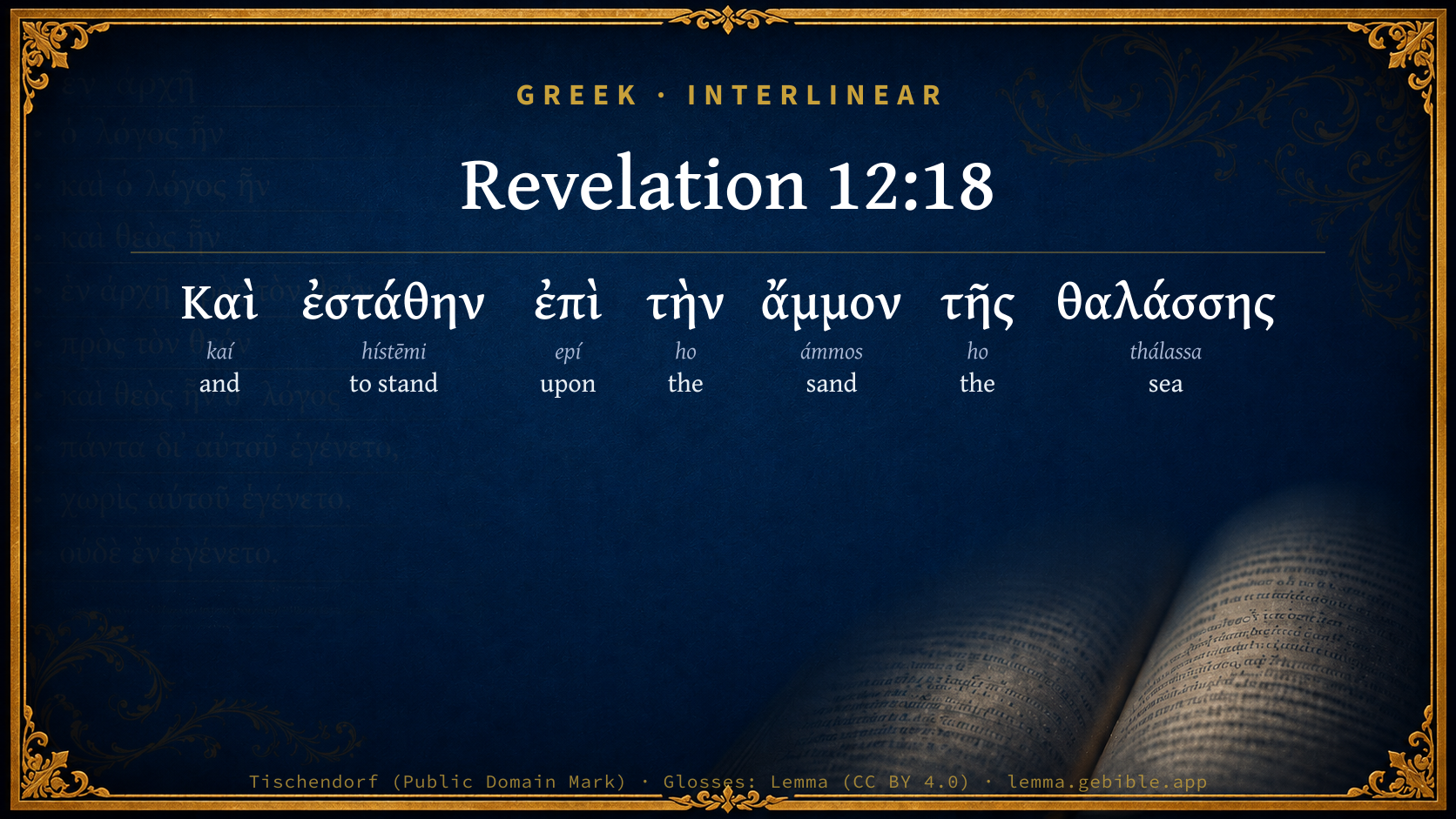
Greek (Tischendorf 8th ed.) Revelation 12:18 appears in the Greek New Testament. The text above is from the Tischendorf 8th edition. Each word links to its Strong’s number and a concise gloss. Click any word for its full Thayer’s Greek Lexicon entry.
Download image
Cite this verse

Revelation 12:18. Public Domain. Lemma interlinear Bible study tool, https://lemma.gebible.app/v/revelation/12/18.

Show BibTeX & RIS
BibTeX
RIS
Download a study sheet

One document with this verse’s original text, its word-by-word gloss line, the meaning frame, cross-references with their text, attributed commentary, and full source and license credits — printable, and it pastes into notes with its structure intact.

This verse Autodidact and up

Study sheet (.html) Plain text (.txt)

A passage Seminary Student

Up to 50 verses in one chapter. A passage sheet keeps up to 6 commentary sources and 12 cross-references per verse, in the order this page ranks them, and says so on the sheet whenever that leaves anything out. Ask for a single verse and you get the Autodidact verse sheet above.

Everything on this page stays free to read, with no account — the sheet is a download of what is already on screen, not access to it.

Want to remove ads? Support Godless Engineer
Compare translations 3

The same verse in 3 English versions, stacked beneath the original-language interlinear above. Click any original word for its lexicon entry.

Each is an independent rendering of the whole verse — the interlinear is not word-aligned to these translations.

  • World English Bible Public Domain

    (No text available for this verse in this version)

  • King James Version Public Domain

    (No text available for this verse in this version)

  • unfoldingWord Literal Text CC BY-SA 4.0
    And he stood on the sand of the sea.

unfoldingWord Literal Text — © unfoldingWord, licensed CC BY-SA 4.0. Word-aligned USFM3 via Door43 (git.door43.org/unfoldingWord/en_ult).

Versions to compare (up to 4)

3 of 4 selected

Show all 6 translations

Every available English version of this verse, each an independent rendering of the whole verse.

  • Geneva Bible (1599) Public Domain
    And I stood on the sea sand.
  • Douay-Rheims (1899) Public Domain
    And he stood upon the sand of the sea.
  • Literal Standard Version CC BY-SA 4.0
    -
  • Unlocked Literal Bible CC BY-SA 4.0
    Then the dragon stood on the sand of the seashore.
  • unfoldingWord Literal Text CC BY-SA 4.0
    And he stood on the sand of the sea.
  • Webster's Bible Public Domain
    \\13:1\\And I stood upon the sand of the sea,\\

Literal Standard Version (2020), Covenant Press — licensed CC BY-SA 4.0. Text via the HelloAO Bible API (eBible.org). Unlocked Literal Bible (unfoldingWord) — licensed CC BY-SA 4.0. Text via the HelloAO Bible API (eBible.org). unfoldingWord Literal Text — © unfoldingWord, licensed CC BY-SA 4.0. Word-aligned USFM3 via Door43 (git.door43.org/unfoldingWord/en_ult).

Word by word

More ways to search: Search by grammar → Find every occurrence → Compare this word →

Practice this passage: Drill this verse → Learn its vocabulary →

About this verse

These counts appear in no published source. They are computed here, from the morphology-tagged text and Lemma’s own curated glosses. What Lemma adds →

7
words
6
distinct lemmas
Revelation
section

Notable vocabulary

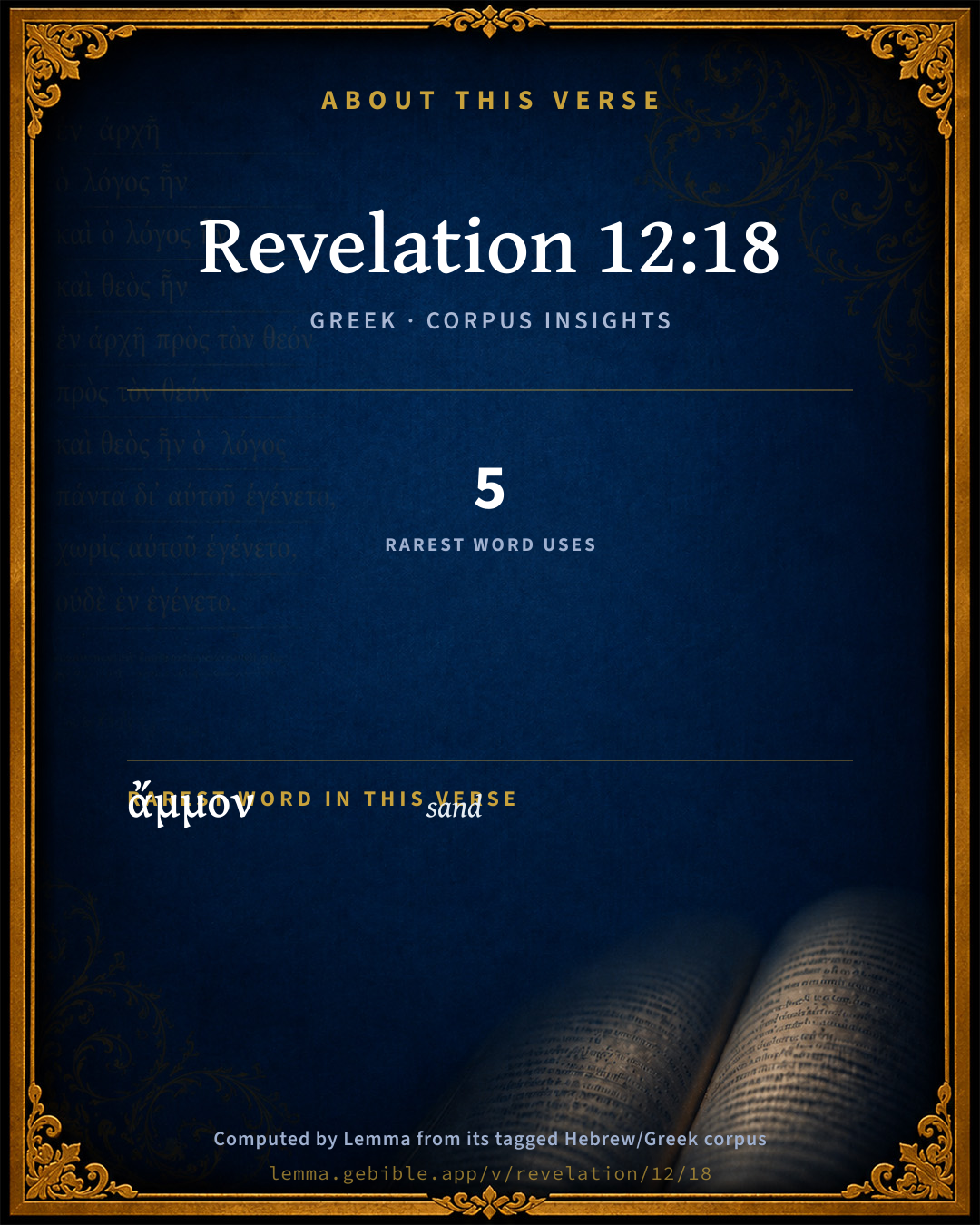
The rarest word here is ἄμμον sand G285 — appearing just 5 times in the whole Greek New Testament.

Shared distinctive vocabulary

ἄμμον sand G285 occurs in 5 verses of the Greek New Testament. Also found in:

Repetition

A word recurs within this verse:

Commentary

Notes on Revelation 12:18 from classic Christian and Jewish commentators (each source and its license shown beneath its notes). The classic Christian expositions comment on the surrounding passage and are grouped to its opening verse, so a note may address several verses; the Jewish commentaries on the Tanakh (Rashi and others) are per-verse, so they appear only where the commentator wrote on this verse.

Lemma curates 59 commentaries, every one of them public domain or Creative Commons licensed, each selected and text-cleaned for this edition rather than reprinted as found. About our sources →

Tyndale Open Study Notes

Tyndale Open Resources

12:18–13:18 John portrays the dragon conducting its war (12:17) through two beasts who with Satan form an evil trinity.

12:18 on the shore beside the sea: By contrast, the Lamb stands on the rock of Zion (14:1).

Tyndale Open Study Notes — © Tyndale Open Resources, licensed CC BY-SA 4.0. Text via the HelloAO Bible API.

Alford’s Greek Testament

Henry Alford

12:18-13:10.] The vision of the Beast that came up out of the sea. See Dan 7:7, Dan 7:8, Dan 7:19-27, to which continual reference will be made in the Commentary. And he (the dragon) stood upon the sand of the sea (see Dan 7:2, where the four winds of heaven are striving upon the great sea); and I saw out of the sea a wild-beast coming up, having ten horns (now put first, because they are crowned. The ten horns are found also in the fourth beast of Dan 7:7) and seven heads, and upon his horns ten diadems, and upon his heads (notice the gen. ἐπὶ τῶν κεράτων and the accus. ἐπὶ τὰς κεφαλάς: the reason being probably, that the crowns are simply spoken of as in position on the horns, whereas the names were inscribed on the heads, and the preposition takes the tinge of motion belonging to the act of inscription) a name of blasphemy (whether (see digest) we read plural or singular, the meaning will be the same—on each head a name. The heads are (see for the interpretation ch. 17:9, 10, where it is given by the angel) Kings, in the widest acceptation of the word; Kings, as representing their kingdoms; not necessarily individual Kings (see as above):—the name or names of blasphemy, the divine titles given to those Kings, “Lord of the whole earth,” and the like: in the Roman form, “Deus” or “Divus.” Hereafter, when the great harlot succeeds to the character and symbolic details of the beast, this is carried yet further). And the beast which I saw was like to a leopard, and its feet as of a bear, and its mouth as the mouth of a lion (thus uniting in itself the three previous kingdoms of Dan 7:4 ff., the first of which was like a lion, the second like a bear, the third like a leopard; and in consequence representing, not the Roman Empire merely, but the aggregate of the Empires of this world as opposed to Christ and His kingdom). And the dragon gave to it his might and his throne and great power (i. e. this beast, this earthly persecuting power, was the vicegerent and instrument of the devil, the prince of this world, and used by him for his purposes of hostility against the remnant of the seed of the woman). And (I saw) one from among his heads as it were wounded unto death (this seems to represent the Roman pagan Empire, which having long been a head of the beast, was crushed and to all appearance exterminated), and the stroke of its death was healed (in the establishment of the Christian Roman Empire. The period now treated of is the same, introduced here by anticipation, but hereafter to be described in detail, as that during which the woman sits on the beast and guides it. Very many Commentators have explained these seven heads as individual kings, and supposed the one who was wounded to death to be Nero, and these last words to allude to the idea that Nero would return from the dead and become antichrist. But this idea was certainly not prevalent in this form at the time when the Apocalypse was written. Tacitus merely relates, that there were many rumours about Nero’s death, “eoque pluribus vivere eum fingentibus credentibusque,” Hist. ii. 8, and that on the strength of this, a Pseudo-Nero arose in the East, Hist. 1. ii, “mota etiam prope Parthorum arma falsi Neronis ludibrio.” See also the citations from the Sibylline oracles, Lactantius, and Sulpicius Severus, in Düst.’s note. The first who mentions the idea of Nero returning from the dead, is Augustine, Civ. Dei xx. 19. 3, vol. vii. p. 686, in explaining 2Th 2:3 ff.: “quidam putant hoc (ver. 7) de imperio dictum fuisse Romano—ut hoc quod dixit, jam enim mysterium iniquitatis operatur, Neronem voluerit intelligi, cujus jam facta velut Antichristi videbantur. Unde non-nulli ipsum resurrecturum et futurum Antichristum suspicantur.” But it is observable that does not connect the idea with the Apocalypse. This is first done by Sulp. Severus, and completed by Victorinus, whose very words (“unum autem de capitibus occisum in morte et plaga mortis ejus curata est, Neronem dicit. Constat enim, dum insequeretur eum equitatus missus a senatu, ipsam sibi gulam succidisse. Hunc ergo suscitatum Deus mittet regem dignum dignis, et Christum qualem meruerint Judæi”) betray the origin of the idea having been from this passage itself). And the whole earth wondered after (pregnant construction for wondered at, as they followed, or gazed, after) the beast, and worshipped the dragon, because he gave the (or, his) power to the beast, and worshipped the beast, saying, Who is like to the beast? And who is able to war with him (these words are a sort of parody, in their blasphemy, on ascriptions of praise to God: cf. besides reff., Psa 112:5; Isa 40:18, Isa 40:25, 46:5; Jer 29:20 (49:19); Mic 7:18: they represent to us the relapse into all the substantial blasphemies of paganism under the resuscitated Empire of Rome, and the retention of pagan titles and forms. I may remark, that nothing in those words finds any representative in the history of the times of the Pagan Empire)? And there was given to it a mouth speaking great and blasphemous things (so we read of the little horn in Dan 7:8): and there was given to it power to work (more probably, as in former reff., than “to spend” merely: this meaning is indeed found in latter reff., but the places in Daniel seem to decide for us) forty-two months (the well-known period of the agency of antichrist = 3½ years = 1260 days: see Prolegomena, § v. 29 f.), and he opened his mouth (spoken, see reff., of the commencement of a series of discourses. These vv. 6, 7, in fact expand into detail that which ver. 5 gave compendiously) for blasphemies against God, to blaspheme His name and His tabernacle, which dwell in heaven (the apposition is strange, but if the καί must be omitted, the meaning is to enhance the enormity of the blasphemy by bringing out the lofty nature of God’s holy Name and dwelling-place. With the καί, the last clause would mean that he blasphemes them that dwell in heaven, i. e. the holy angels of God. To take this as still the meaning without the καί, is to introduce into the apocalyptic style an asyndeton which is not found in it). And there was given to it to make war with the saints (see Dan 7:21) and to conquer them (see ch. 11:7, of which this is a wider statement): and there was given to it power over every tribe and people and tongue and nation (viz. universal empire). And all shall worship it (αὐτόν, though masculine, must be referred to the θηρίον, which has been now for some time spoken of as an agent, and not to an impersonation of it by a living king) who dwell upon the earth, (every one) whose (the change into the singular arises from resolving πάντες into its component individuals) name (οὗ … αὐτοῦ, the usual Hellenistic redundance: see reff.) is not written in the book of life of the Lamb which is slain from the foundation of the world (these last words are ambiguously placed. They may belong either to γέγραπται, or to ἐσφαγμένου. The former connexion is taken by Hammond, Bengel, Heinr., Ewald, Züllig, De Wette, Hengstb., Düsterd. But the other is far more obvious and natural: and had it not been for the apparent difficulty of the sense thus conveyed, the going so far back as to γέγραπται for a connexion would never have been thought of. See this remarkably shewn in the Catena: ὧν γέγραπται, ἀπὸ καταβολῆς κόσμου γέγραπται· οὕτω γὰρ δεῖ νοεῖν, οὐχ ὡς ἡ γραφὴ ἔχει· ὅτι μηδὲ ἀπὸ καταβολῆς κόσμου ἡ τοῦ ἀρνίου σφαγή. The difficulty however is but apparent: 1Pe 1:19, 1Pe 1:20 says more fully the same thing. That death of Christ which was foreordained from the foundation of the world, is said to have taken place in the counsels of Him with whom the end and the beginning are one. Ch. 17:8, which is cited by De W. as decisive for his view, is irrelevant. Of course where simply the writing in the book of life from the foundation of the world is expressed, no other element is to be introduced: but it does not therefore follow, that where, as here, other elements are by the construction introduced, that, and that alone is to be understood).

9,

Henry Alford, The Greek Testament (1849–1861) — public domain. Text from a community e-Sword module.

Geneva Bible (1599)

Geneva Bible translators

That is, a most mighty tempest, that he rushed upon the whole world (whose prince he is) to raise the floods and provoke the nations, that they might with their furious bellows toss up and down, drive here and there, and finally destroy the Church of Christ with the holy members of the same. But the providence of God resisted his attempt, that he might favor the Church of the Gentiles, yet tender and as it were green. The rest of the story of the Dragon is excellently prosecuted by the Apostle S. John hereafter in the twentieth chapter. For here the Dragon endeavoring to do mischief, was by God cast into prison.

Geneva Bible (1599) marginal notes — public domain. Text via Bolls.life.

Haydock's Catholic Bible Commentary

And he stood upon the sand of the sea;[1] i.e. the dragon seemed to be at a stand, to rest a while, not being able to raise any more persecutions. Now as to the time that these things should come to pass, many by seven heads and ten horns understand many powerful wicked kings, who should persecute the good, especially about antichrist’s time, when the faithful at different times should be oppressed, and forced to fly as it were into the wilderness to worship God in private. And when the end of the world seems to draw near, the devil with greater malice will persecute God’s servants, his time being short. Others apply these predictions to the particular persecutions in the Church by the Jews, and by the heathen emperors in the first three Christian ages [centuries] before Constantine’s time, when idolatry was destroyed, when the face of the Church was changed, and when she became victorious, and publicly triumphed over her former enemies, the heathens; and by the man child, whom God took under his special protection, they will have to be understood Constantine himself. (Witham)

===============================

[BIBLIOGRAPHY]

Et stetit super arenam maris. The ordinary Greek copies, Greek: estathen, steti, which the Protestant translators followed, beginning chapter xiii. with these words, and I stood upon the sand of the sea, as if St. John spoke of himself. But Dr. Wells, in his amendments, has corrected the Protestant translation, and restored the reading Greek: estathe, stetit, as we find it in the Latin Vulgate. I have reckoned near upon a hundred places in the Apocalypse only, wherein Dr. Wells has preferred those readings in the Greek manuscripts which are conformable to our Latin Vulgate.

====================

George Leo Haydock (1774–1849), Haydock's Catholic Family Bible and Commentary, 1859 edition — public domain. Excludes Psalms (Douay-Rheims chapter numbering differs from Protestant) and Deuterocanonical books (Catholic canon only).

Lesson kit

Teaching starters — assembled from the data on this page, not authored interpretation. Every prompt links to the verse data it draws on. Edit before teaching.

Revelation, in the Revelation, opens this verse with 7 words (6 distinct Greek lemmas). Its most distinctive word is ámmos (“sand”). A historical commentator’s framing appears above. Read the whole chapter for the surrounding context.

Discussion questions

  1. How does “sand” (ámmos) shape what this verse is saying?
  2. How does Matthew 7:26, which shares the word «sand», read alongside this verse?
  3. What does the repetition of “the” (2× in this one verse) do in this verse?
  4. Compare how Tyndale Open Study Notes and Alford’s Greek Testament read this verse. Where do they agree or differ?

Things to notice

Reading settings

Reading text

Shown beneath each verse's original-language words.

Old Testament
Old Testament edition

Read the OT as the Masoretic Hebrew (MT) or the Greek Septuagint (LXX).

English shown for the Greek Septuagint (in the Hebrew ↔ Greek comparison).

Comparing translations? Open the Compare panel on any verse page to stack up to four side by side.