Revelation 18:17

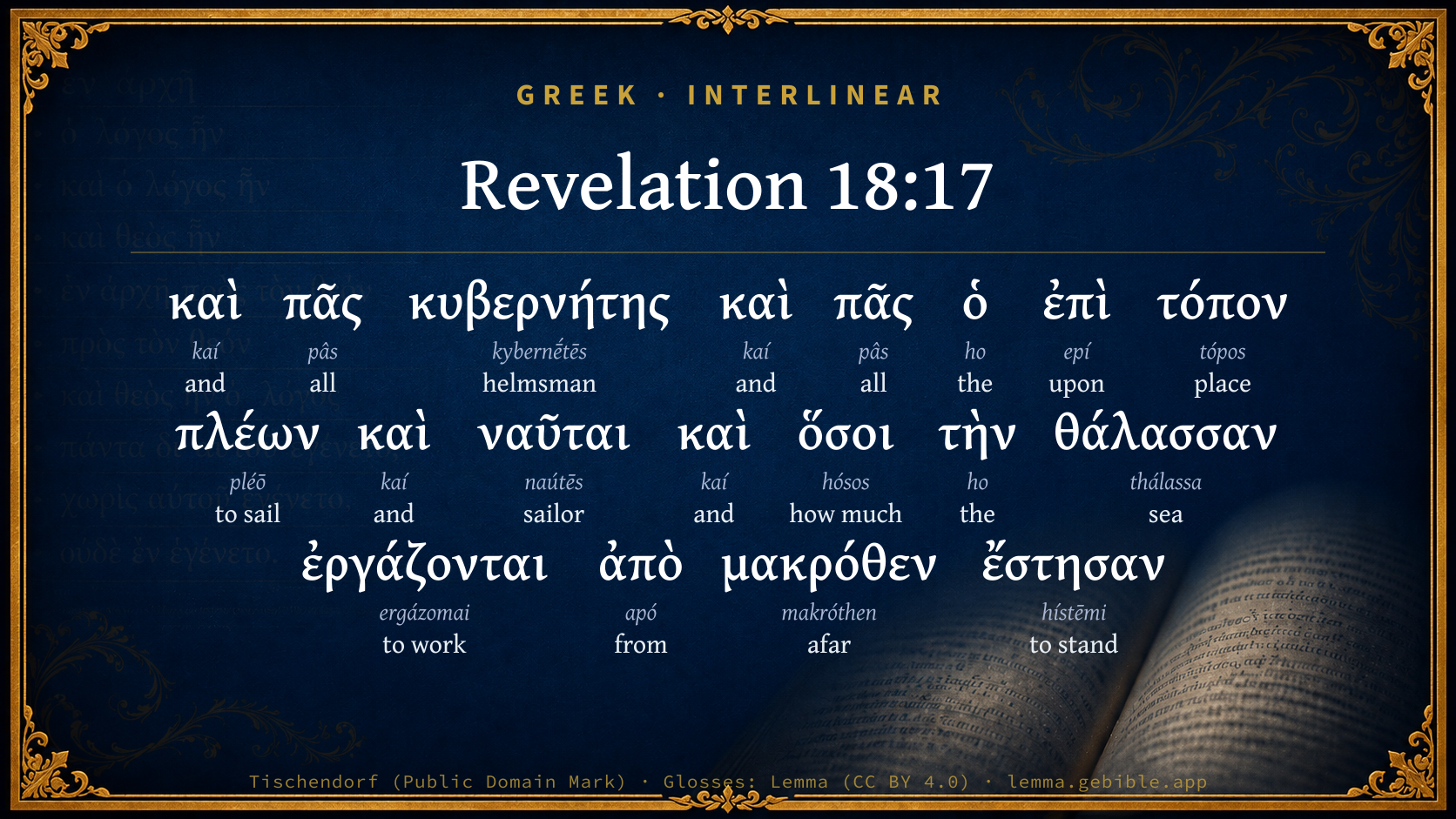
Greek (Tischendorf 8th ed.) Revelation 18:17 appears in the Greek New Testament. The text above is from the Tischendorf 8th edition. Each word links to its Strong’s number and a concise gloss. Click any word for its full Thayer’s Greek Lexicon entry.
Download image
Cite this verse

Revelation 18:17 (World English Bible). Public Domain. Lemma interlinear Bible study tool, https://lemma.gebible.app/v/revelation/18/17.

Show BibTeX & RIS
BibTeX
RIS
English Translation
For in an hour such great riches are made desolate.' Every shipmaster, and everyone who sails anywhere, and mariners, and as many as gain their living by sea, stood far away,
World English Bible · Public Domain
Download a study sheet

One document with this verse’s original text, its word-by-word gloss line, the meaning frame, cross-references with their text, attributed commentary, and full source and license credits — printable, and it pastes into notes with its structure intact.

This verse Autodidact and up

Study sheet (.html) Plain text (.txt)

A passage Seminary Student

Up to 50 verses in one chapter. A passage sheet keeps up to 6 commentary sources and 12 cross-references per verse, in the order this page ranks them, and says so on the sheet whenever that leaves anything out. Ask for a single verse and you get the Autodidact verse sheet above.

Everything on this page stays free to read, with no account — the sheet is a download of what is already on screen, not access to it.

Want to remove ads? Support Godless Engineer
Compare translations 3

The same verse in 3 English versions, stacked beneath the original-language interlinear above. Click any original word for its lexicon entry.

Each is an independent rendering of the whole verse — the interlinear is not word-aligned to these translations.

Highlighted words mark where these versions differ — a whole-verse word diff, not a word-by-word alignment.

  • World English Bible Public Domain
    For in an hour such great riches are made desolate.' Every shipmaster, and everyone who sails anywhere, and mariners, and as many as gain their living by sea, stood far away,
  • King James Version Public Domain
    For in one hour so great riches is come to nought. And every shipmaster, and all the company in ships, and sailors, and as many as trade by sea, stood afar off,
  • unfoldingWord Literal Text CC BY-SA 4.0
    for in one hour so much wealth has been destroyed.” And every shipmaster and every one sailing to a place and sailors and as many as work the sea stood from afar

unfoldingWord Literal Text — © unfoldingWord, licensed CC BY-SA 4.0. Word-aligned USFM3 via Door43 (git.door43.org/unfoldingWord/en_ult).

Versions to compare (up to 4)

3 of 4 selected

Show all 19 translations

Every available English version of this verse, each an independent rendering of the whole verse.

  • World English Bible Public Domain
    For in an hour such great riches are made desolate.' Every shipmaster, and everyone who sails anywhere, and mariners, and as many as gain their living by sea, stood far away,
  • Berean Standard Bible Public Domain
    For in a single hour such fabulous wealth has been destroyed!” Every shipmaster, passenger, and sailor, and all who make their living from the sea, will stand at a distance
  • Majority Standard Bible Public Domain
    For in a single hour such fabulous wealth has been destroyed!” Every shipmaster, passenger, and sailor, and all who make their living from the sea, will stand at a distance
  • King James Version Public Domain
    For in one hour so great riches is come to nought. And every shipmaster, and all the company in ships, and sailors, and as many as trade by sea, stood afar off,
  • American Standard Version (1901) Public Domain
    for in an hour so great riches is made desolate. And every shipmaster, and every one that saileth any wither, and mariners, and as many as gain their living by sea, stood afar off,
  • Revised Version (1885) Public Domain
    for in one hour so great riches is made desolate. And every shipmaster, and every one that saileth any whither, and mariners, and as many as gain their living by sea, stood afar off,
  • Geneva Bible (1599) Public Domain
    For in one houre so great riches are come to desolation. And euery shipmaster, and all the people that occupie shippes, and shipmen, and whosoeuer traffike on the sea, shall stand a farre off,
  • Douay-Rheims (1899) Public Domain
    For in one hour are so great riches come to nought; and every shipmaster, and all that sail into the lake, and mariners, and as many as work in the sea, stood afar off.
  • Young's Literal Translation Public Domain
    `And every shipmaster, and all the company upon the ships, and sailors, and as many as work the sea, far off stood,
  • Literal Standard Version CC BY-SA 4.0
    because in one hour so much riches were made desolate! And every shipmaster, and all the company on the ships, and sailors, and as many as work the sea, stood far off,
  • Unlocked Literal Bible CC BY-SA 4.0
    In a single hour all that wealth has been wasted.” Every ship's captain, every seafaring man, sailors, and all whose living is made from the sea, stood off at a distance.
  • unfoldingWord Literal Text CC BY-SA 4.0
    for in one hour so much wealth has been destroyed.” And every shipmaster and every one sailing to a place and sailors and as many as work the sea stood from afar
  • Darby Bible Public Domain
    for in one hour so great riches has been made desolate. And every steersman, and every one who sailed to any place, and sailors, and all who exercise their calling on the sea, stood afar off,
  • World Messianic Bible Public Domain
    For in an hour such great riches are made desolate.’ Every ship master, and everyone who sails anywhere, and mariners, and as many as gain their living by sea, stood far away,
  • Webster's Bible Public Domain
    For in one hour so great riches is come to naught. And every ship-master, and all the company in ships, and sailors, and as many as trade by sea, stood afar off,
  • Free Bible Version CC BY-SA 4.0
    In just one hour all this wealth was destroyed!’ Every sea captain and everyone who travels by sea and every sailor and everyone who earns their living from the sea stood at a distance.
  • Bible in Basic English Public Domain
    For in one hour such great wealth has come to nothing. And every shipmaster, and all who are sailing on the sea, and sailors and all who get their living by the sea, were watching from far away,
  • Text-Critical English NT CC BY 4.0
    For in a single hour such great wealth has been laid waste!” And every shipmaster and seafaring man, sailors and all whose trade is on the sea, stood at a distance
  • Tyndale New Testament (1534) Public Domain
    for at one houre so great ryches ys come to nought. And every shippe governer and all they that occupied shippes and shippmen which worke in the see stode a farre of

Literal Standard Version (2020), Covenant Press — licensed CC BY-SA 4.0. Text via the HelloAO Bible API (eBible.org). Unlocked Literal Bible (unfoldingWord) — licensed CC BY-SA 4.0. Text via the HelloAO Bible API (eBible.org). unfoldingWord Literal Text — © unfoldingWord, licensed CC BY-SA 4.0. Word-aligned USFM3 via Door43 (git.door43.org/unfoldingWord/en_ult). Free Bible Version, Dr. Jonathan Gallagher — licensed CC BY-SA 4.0. Text via the HelloAO Bible API (eBible.org).

Word by word

More ways to search: Search by grammar → Find every occurrence → Compare this word →

Practice this passage: Drill this verse → Learn its vocabulary →

κυβερνήτης
kybernḗtēs
G2942
“helmsman”
Noun, Nominative, Singular, Masculine
Part of Speech
Noun
Case
Nominative
Number
Singular
Gender
Masculine
Full Thayer's Definition

Origin: from the same as G2941

TDNT: None

1. steersman, helmsman, sailing master
  1. καὶ kaí G2532 “and” Conjunction
  2. πᾶς pâs G3956 “all” Adjective, Nominative, Singular, Masculine
  3. καὶ kaí G2532 “and” Conjunction
  4. πᾶς pâs G3956 “all” Adjective, Nominative, Singular, Masculine
  5. ὁ ho G3588 “the” Article, Nominative, Singular, Masculine
  6. ἐπὶ epí G1909 “upon” Preposition
  7. τόπον tópos G5117 “place” Noun, Accusative, Singular, Masculine
  8. πλέων pléō G4126 “to sail” Verb, Present, Active, Participle, Nominative, Singular, Masculine
  9. καὶ kaí G2532 “and” Conjunction
  10. ναῦται naútēs G3492 “sailor” Noun, Nominative, Plural, Masculine
  11. καὶ kaí G2532 “and” Conjunction
  12. ὅσοι hósos G3745 “how much” Correlative pronoun, Nominative, Plural, Masculine
  13. τὴν ho G3588 “the” Article, Accusative, Singular, Feminine
  14. θάλασσαν thálassa G2281 “sea” Noun, Accusative, Singular, Feminine
  15. ἐργάζονται ergázomai G2038 “to work” Verb, Present, Middle or Passive deponent, Indicative, 3rd person, Plural
  16. ἀπὸ apó G575 “from” Preposition
  17. μακρόθεν makróthen G3113 “afar” Adverb
  18. ἔστησαν hístēmi G2476 “to stand” Verb, Aorist, Active, Indicative, 3rd person, Plural

About this verse

These counts appear in no published source. They are computed here, from the morphology-tagged text and Lemma’s own curated glosses. What Lemma adds →

19
words
14
distinct lemmas
Revelation
section

Notable vocabulary

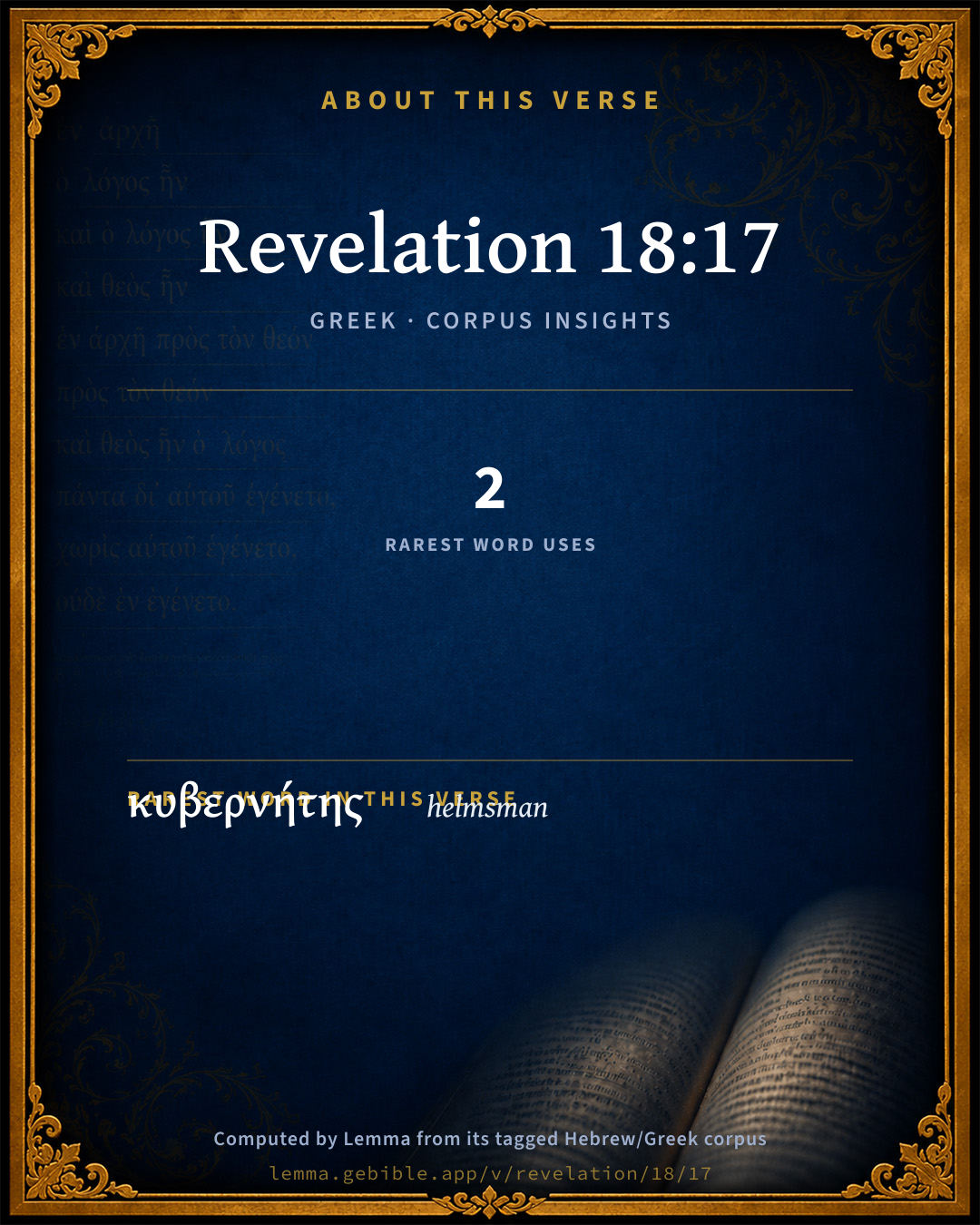
The rarest word here is κυβερνήτης helmsman G2942 — appearing just 2 times in the whole Greek New Testament.

Shared distinctive vocabulary

κυβερνήτης helmsman G2942 occurs in 2 verses of the Greek New Testament. Also found in:

Repetition

Words recur within this verse:

Cross-references

9

Topical passages linked to Revelation 18:17 in the Treasury of Scripture Knowledge — connected by theme and wording, ordered by reader-vote popularity; previews shown in the World English Bible.

  • Isaiah 23:14 Howl, you ships of Tarshish; for your stronghold is laid waste.
  • Ezekiel 27:27–36 Your riches, and your wares, your merchandise, your mariners, and your pilots, your repairers of ship seams, and the dealers in your merchandise, and all your men of war, who are in you, with all your company which is in the midst of you, shall fall into the heart of the seas in the day of your ruin.
  • Revelation 17:16 The ten horns which you saw, and the beast, these will hate the prostitute, and will make her desolate, and will make her naked, and will eat her flesh, and will burn her utterly with fire.
  • Jeremiah 51:8 Babylon is suddenly fallen and destroyed: wail for her; take balm for her pain, if so be she may be healed.
  • Jonah 1:6 So the shipmaster came to him, and said to him, "What do you mean, sleeper? Arise, call on your gods! Maybe the gods will notice us, so that we won't perish."
  • Revelation 18:10–11 standing far away for the fear of her torment, saying, 'Woe, woe, the great city, Babylon, the strong city! For your judgment has come in one hour.'
  • Revelation 18:19 They cast dust on their heads, and cried, weeping and mourning, saying, 'Woe, woe, the great city, in which all who had their ships in the sea were made rich by reason of her great wealth!' For in one hour is she made desolate.
  • Isaiah 47:9 but these two things shall come to you in a moment in one day, the loss of children, and widowhood; in their full measure shall they come on you, in the multitude of your sorceries, and the great abundance of your enchantments.
  • Lamentations 4:6 For the iniquity of the daughter of my people is greater than the sin of Sodom, That was overthrown as in a moment, and no hands were laid on her.

Cross-references courtesy of OpenBible.info (CC BY 4.0).

Where the printed editions differ

2 variants

Places in this verse where the major printed Greek editions disagree on the wording in a way that affects the translation — a comparison of editions, not a manuscript-by-manuscript collation. The editions are the modern critical texts (Nestlé-Aland 28/27, SBL, Westcott-Hort, Tregelles, Tyndale House) and the traditional texts behind the KJV (the Textus Receptus and the Byzantine/Majority text). It is not a claim about which reading is original.

  1. Extra text
    τόπον

    “a place”

    In NA28NA27TynSBLWHTregByz Not in TR

    τόπον (topon) 'a place' is only in older manuscripts (NA28+NA27+Tyn+SBL+WH+Treg+Byz)

  2. Extra text
    ὁ ὅμιλος

    “the multitudes”

    In TR Not in NA28NA27TynSBLWHTregByz

    ὁ ὅμιλος (ho homilos) 'the multitudes' is only in traditional manuscripts (TR)

Textual data: Translators Amalgamated Greek New Testament (STEPBible TAGNT) · CC BY 4.0.

Commentary

Notes on Revelation 18:17 from classic Christian and Jewish commentators (each source and its license shown beneath its notes). The classic Christian expositions comment on the surrounding passage and are grouped to its opening verse, so a note may address several verses; the Jewish commentaries on the Tanakh (Rashi and others) are per-verse, so they appear only where the commentator wrote on this verse.

Lemma curates 59 commentaries, every one of them public domain or Creative Commons licensed, each selected and text-cleaned for this edition rather than reprinted as found. About our sources →

Ellicott's Commentary for English Readers

THE LAMENT OF THE SHIPMASTERS (Rev_18:17-19).—On the whole passage read Eze_27:32, &c.

(17, 18) And every shipmaster. . . .—Or, better, And every shipmaster, and every one who sails for a place, and sailors, and all who work the sea, stood afar off, and cried when they saw the smoke of her burning, saying, Who is like the great city? With this expression compare the similar one applied to the beast (Rev_13:4). It is the outcry of those who call to mind, with pain, a glory that was great, but now is gone. It is not to be taken as meaning “what city has suffered as she has?” but rather is it the recollection of her former splendour—“how great she was.” This lingering of the mind over delights now vanished is one subtle element of misery. So the hapless Francesca thought—

“There is no greater woe,

Than to remember days of happiness

Amid affliction.” Inf. v. 121-3.

A Bible Commentary for English Readers, edited by Charles John Ellicott (1878–1897) — public domain. Text from a community e-Sword module.

Tyndale Open Study Notes

Tyndale Open Resources

18:17-19 all the captains: Seafarers sing the third lament (see study note on 18:9-19). Their mourning focuses on the breakdown of communication and transportation. During the reign of Julius Caesar, the Mediterranean was cleared of pirates and trade blossomed under the region’s Roman law enforcement. The swift loss of Roman authority would upset the system of trade.

Tyndale Open Study Notes — © Tyndale Open Resources, licensed CC BY-SA 4.0. Text via the HelloAO Bible API.

Bengel's Gnomon

Johann Albrecht Bengel

Rev 18:17. Πᾶς ὁ ἐπὶ τόπον πλέων) I was not right, I think, in disparaging this reading in my Apparatus.[204] It is supported by the best copies, and denotes indeed a class of men differing from pilots, to whom however it is subjoined, and from sailors, and from all, who trade by sea. Therefore ὁ ἐπὶ τόπον πλέων must be he, who repeatedly directs his ship to one place, mart, or country. Others read, Πᾶς Ὁ ἘΠῚ ΤῶΝ ΠΛΟΊΩΝ ΠΛΈΩΝ; others, Πᾶς ἘΠῚ ΤῶΝ ΠΛΟΊΩΝ Ὁ ὍΜΙΛΟς. The former reading arose from haste, as it seems; the latter from a paraphrase of the genuine reading.—ΚΑῚ ὍΣΟΙ ΤῊΝ ΘΆΛΑΣΣΑΝ ἘΡΓΆΖΟΝΤΑΙ) ἘΡΓΆΖΕΣΘΑΙ is not only to effect anything by labour, but also, which is the meaning here, to be engaged upon, to have to do with. Thus LXX., ἐργάζεσθαι γῆν, παράδεισον, ἀμπελῶνα, πόλιν, χρυσίον, κ.τ.λ.

[204] Therefore it is preferred in the margin of Ed. II. and in Vers. Germ.—E. B.

ABCh Vulg. read ὁ ἐπὶ (τὸν, B) τόπον πλέων. Rec. Text, without good authority, ἐπὶ τῶν πλοίων ὁ ὅμιλος.—E.

Bengel's Gnomon of the New Testament — English translation (T&T Clark, Edinburgh, 1860) — public domain. Text from a community e-Sword module.

Meyer's Critical & Exegetical Commentary

Heinrich August Wilhelm Meyer

Rev_18:17-19. The lament of the shipmasters, which likewise contains the three points of Rev_18:9 sq. and Rev_18:11-16 : the standing afar off of those lamenting, the remembrance of the citys former glory, and the cry of woe over its destruction.

On the preterite forms of statement (ἔστησαν, Rev_18:17, ἔκραζον, Rev_18:18-19), from which, however, according to the plan of the entire description, ch. 18. it is not to be inferred that John actually beheld the fall of the city, cf. on Rev_18:11, and the preliminary note on ch. 18.

All classes of mariners are mentioned, just as, Rev_18:11 sqq., all classes of merchants were indicated: pilots, and πᾶς ὁ ἑπὶ τόπον πλέων, i.e., not exactly the coasters,[3990] but those who regularly sailed to a definite harbor;[3991] and ναῦται, i.e., mariners in general; and, as it is finally said, as many as work the sea, i.e., all those for whom the sea is the sphere of their calling and the source of livelihood; fishermen also belong to this category. On the expression common in the classics, τὴν θάλ. ἐργάζεσθαι, to work the sea, cf. many examples in Wetst.

καπνὸν τ. πυρ. Cf. Rev_18:9.

The question of lamentation, τίς ὁμοία τῇ πόλει τῇ μεγάλῃ; is likewise a sarcastic allusion to the former self-deification of the metropolis of the empire.[3992]

ἔβαλον χοῦν, κ.τ.λ. Cf. Eze_27:30. Concerning this sign of grief, cf. Winer, Rwb., on the word.

ἐν ᾖ ἐπλούτησαν, κ.τ.λ. The city was the place where all mariners with their manifold wares had found a rich and productive market; for, because of its precious treasures,[3993] the city was able to become the source of wealth to all dealers. (ἐπλούτ.

ἐκ τῆς τιμιότητος αὐτ. Cf. Rev_18:3.

ἠρημώθη.) Cf. Rev_17:3. [See Note LXXXIII., p. 449.]

[3990] De Wette.

[3991] Beng., Hengstenb., etc. Cf. Act_27:2.

[3992] Cf. Rev_13:4.

[3993] Cf. Rev_18:16.

Meyer — Critical and Exegetical Commentary on the New Testament — English translation by Peter Christie, edited by Frederick Crombie (T&T Clark, 1880) — public domain. Text from a community e-Sword module.

Expositor's Greek Testament

ed. W. Robertson Nicoll

Rev 18:17 . ἐργάζονται κ . τ . λ . = “whose business is on the sea”. The passage reflects the importance of Rome especially for the trade of the Levant. Pliny ( H. N. vi. 101, xii. 84) gives the large figures of Oriental imports and their cost, adding sarcastically tanti nobis deliciae et feminae constant (Friedländer, iii. 48 51). The regret of the mariners for the grandeur that was Rome passes rapidly into a sense of commercial loss.

The Expositor's Greek Testament, edited by W. Robertson Nicoll (1897–1910) — public domain. Text from a community e-Sword module.

Geneva Bible (1599)

Geneva Bible translators

The manner of mourning used by them that trade by sea.

Geneva Bible (1599) marginal notes — public domain. Text via Bolls.life.

Jamieson, Fausset & Brown

Robert Jamieson, A. R. Fausset & David Brown

is come to naught--Greek, "is desolated."

shipmaster--Greek, "steersman," or "pilot."

all the company in ships--A, C, Vulgate, and Syriac read, "Every one who saileth to a place" (B has ". . . to the place"), every voyager. Vessels were freighted with pilgrims to various shrines, so that in one month (A.D. 1300) two hundred thousand pilgrims were counted in Rome [D'AAUBIGNE, Histoire de la Reformation]: a source of gain, not only to the Papal see, but to shipmasters, merchants, pilots, &c. These latter, however, are not restricted to those literally "shipmasters," &c., but mainly refer, in the mystical sense, to all who share in the spiritual traffic of apostate Christendom.

Jamieson, Fausset & Brown — Commentary Critical and Explanatory on the Whole Bible (1871) — public domain (CC PDM 1.0). Text via the HelloAO Bible API.

Adam Clarke's Commentary

Verse 17. Every shipmaster] Captains of vessels; some think pilots are meant, and this is most likely to be the meaning of the original word κυβερνητης. This description appears to be at least partly taken from Eze 27:26-28.

And all the company in ships] Και πας επι των πλοιων ὁ ὁμιλος· The crowd or passengers aboard. But the best MSS, and versions have και πας ὁ επι τοπον πλεων, those who sail from place to place, or such as stop at particular places on the coast, without performing the whole voyage. This sufficiently marks the traffic on the coast of the Mediterranean Sea. Some might debark (in sailing from Rome) at the island of Sicily, others at different ports in Greece; some at Corinth, others at Crete, or the various islands of the AEgean Sea; some at Rhodes, Pamphylia, c., &c. as in those times in which the compass was unknown, every voyage was performed coastwise, always keeping, if possible, within sight of the land.

Adam Clarke's Commentary on the Bible (1810–1826) — public domain. Text from a community e-Sword/MySword module.

The Cambridge Bible for Schools and Colleges

gen. ed. J. J. S. Perowne

17. is come to nought] Lit., is made desolate.

all the company in ships] Read with R. V., and everyone that saileth any whither. The words will probably stand for the merchants travelling in ships with their own goods, which they intend to sell on arriving at their destination—Lat. vectores.

sailors] Cf. Eze_27:29 sqq.

trade by sea] Lit., work the sea. The sense is more general than the A. V.: it will include all three classes, shipmasters, sailing merchants, and sailors.

The Cambridge Bible for Schools and Colleges (gen. ed. J. J. S. Perowne; Cambridge University Press, 1878–1918) — public domain. Text from a community e-Sword module.

John Gill's Exposition

And cried when they saw the smoke of her burning,.... See Gill on Rev 18:9.

saying, what city is like unto this great city? as before for magnificence and grandeur, so now for sorrow, desolation, and ruin; nor was any city like it for power and authority, for pride and luxury, for idolatry and superstition, blasphemy and impenitence; the like the sailors say of Tyre, Eze 27:30 from whence this and other expressions are borrowed in this lamentation.

John Gill's Exposition of the Whole Bible (1746–1763) — public domain (CC PDM 1.0). Text via the HelloAO Bible API.

Trapp's Complete Commentary

John Trapp

17 For in one hour so great riches is come to nought. And every shipmaster, and all the company in ships, and sailors, and as many as trade by sea, stood afar off,

Ver. 17. So great riches come to nought] Gr. ηρημωθη, is desolated, or become a wilderness. Petrarch writeth, that in the treasury of Pope John XXII were found by his heirs two hundred and fifty tons of gold. And of Boniface VIII it is recorded that he was able to show more money than all the kings in Christendom.

And every ship master] i.e. Cardinal, patriarch, archbishop, though but titular and imaginary, without jurisdiction, as are the patriarchs of Constantinople, Antioch, Jerusalem, and Alexandria, which the pope successively consecrates, ever since the Holy Land and the provinces about it were in the hands of Christian princes, A.D. 1100, so loth is the pope to lose the remembrance of any superiority or title that he hath once compassed. (Spec. Europ.)

And all the company] The cardinals and archbishops’ train and retinue, those in office especially. What a pompous family kept Wolsey, consisting of one earl, nine barons, very many knights and esquires, and others, to the number of four hundred. (Rex Platen., p. 26.)

And sailors] Bishops, abbots, priors, &c. In a parliament holden here at Leicester, A.D. 1413, in the reign of Henry V, a complaint was exhibited against the Popish clergy’s excess. This bill (saith E. Hall the chronicler) made the fat abbots to sweat, the proud priors to frown, the poor friars to curse, the silly nuns to weep, and all her merchants to fear that Babel would then down. But God’s time was not yet.

And as many as trade by the sea] All the clergy, the Jesuits especially, without whose lusty help (saith Mr Brightman) St Peter’s fishing boat had stuck in the sand, and had rushed against the rocks long since.

John Trapp, A Commentary or Exposition upon All the Books of the Old and New Testament (1647–1656) — public domain. Text from a community e-Sword module.

Albert Barnes' Notes on the Bible

For in one hour - In a very brief period - so short, that it seemed to them to be but one hour. In the prediction Rev 18:8, it is said that it would be “in one day” (see the notes on that place); here it is said that, to the on-lookers, it seemed to be but an hour. There is no inconsistency, therefore, between the two statements.

So great riches is come to nought - All the accumulated wealth of so great and rich a city. This should have been united with Rev 18:16, as it is a part of the lamentation of the merchants, and as the lamentation of the mariners commences in the other part of the verse. It is so divided in the Greek Testaments.

And every ship-master - This introduces the lamentation of the mariners, who would, of course, be deeply interested in the destruction of a city with which they had been accustomed to trade, and by carrying merchandise to which they had been enriched. The word “ship-master” - κυβερνήτης kubernētēs - means, properly, a “governor”; then a governor of a ship - the “steersman” or “pilot,” Act 27:11.

And all the company in ships - Prof. Stuart renders this “coasters.” There is here, however, an important difference in the reading of the text. The commonly received text is, πᾶς ἐπὶ τῶν πλοίων ὁ ὅμιλος pas epi tōn ploiōn ho homilos - “the whole company in ships,” as in our common version; the reading which is now commonly adopted, and which is found in Griesbach, Hahn, and Tittmann, is ὁ ἐπὶ τόπον πλέων ho epi topon pleōn - “he who sails to a place”; that is, he who sails from one place to another along the coast, or who does not venture out far to sea; and thus the phrase would denote a secondary class of sea-captains or officers - those less venturesome, or experienced, or bold than others. There can be little doubt that this is the correct reading (compare Wetatein, in loco); and hence the class of seamen here referred to is “coasters.” Such seamen would naturally be employed where there was a great and luxurious maritime city, and would have a deep interest in its fall.

And sailors - Common seamen.

And as many as trade by sea - In any kind of craft, whether employed in a near or a remote trade.

Stood afar off - notes on Rev 18:10.

Albert Barnes' Notes on the Bible (1834–1885) — public domain. Text from a community e-Sword/MySword module.

Matthew Poole's English Annotations

In one hour; that is, suddenly. The term denotes rather the surprisal of this judgment, than the short space of time within which it should be effected.

Matthew Poole's English Annotations on the Holy Bible (1683–1685) — public domain. Text from a community e-Sword/MySword module.

Whedon's Commentary on the Bible

Daniel D. Whedon

17. Enumeration of the various marine mourners.

Shipmaster—The helmsman who steered, and was, generally, also the ship captain.

Company in ships—Literal Greek, every one sailing to a place; rendered by Alford, “Who saileth any whither.” Stuart renders the phrase, “Every coaster,” understanding those who do not put out to broad sea, but ply from place to place on the coast. They gathered, perhaps, the commodities to be shipped in larger craft to the metropolitan market.

Trade by sea— Literal Greek, whoever work the sea; as if taking care, comprehensively, that all should be included.

Daniel D. Whedon (gen. ed.), Commentary on the Old and New Testaments (1874–1909) — public domain. Text from a community e-Sword module.

The Pulpit Commentary

For in one hour so great riches is come to nought; because (oti) in one hour was made desolate that so great wealth. This is given as the reason of the "Woe, woe!" of ver. 16, and is to be connected with the preceding clauses. (On "one hour," see ver. 10, where the same reason is given as in this verse) And every shipmaster; pilot; found only here and in Act_27:11. And all the company in ships; and every one who saileth to a place. Such is probably the correct text, though there are several small variations. The Authorized Version has little support. The Revised Version renders, And every one that saileth anywhither. And sailors, and as many as trade by sea; as many as work the sea; i.e. gain their living by means of the sea. Thus are enumerated all who are connected with the sea in any capacity. (cf. Eze_27:27) Stood afar off. Like the kings (ver. 10) and the merchants (ver. 15), and doubtless for the same reason; viz. to avoid being overwhelmed in the destruction of the city.

The Pulpit Commentary (1880–1919), ed. H.D.M. Spence-Jones & Joseph S. Exell — public domain. Text from a community e-Sword module.

Burkitt's Expository Notes on the New Testament

William Burkitt

The last sort of mourners for Babylon’s ruin are sailors and seamen; all spiritual seamen that have an oar in St. Peter’s boat shall lament greatly, whose life and livelihood did depend upon the merchant trade of that great city; these, though they stuck close to her, and trafficked with her in the day of her prosperity, yet now with the rest they stand afar off from her, lamenting her ruin, and their own loss, in the day when her desolation cometh.

And, as an evidence of the greatness of their sorrow and mourning, they are here said to cast dust on their heads; which amongst the ancients was used as a special token of extraordinary grief and sorrow, Job 2:13. In a time of deep affliction we may express our outward sorrows by our outward gestures: those mourners for Babylon express their sorrow for her and themselves, by casting dust upon their heads.

William Burkitt's Expository Notes on the New Testament (1700–1703) — public domain. Text from a community e-Sword module.

Cambridge Greek Testament for Schools and Colleges

17. ἐπὶ τόπον πλέων. B2 has ἐπὶ τὸν τ. πλ.; P ἐπὶ τῶν πλοίων πλέων. Text. Rec[670] ἐπὶ τῶν πλοίων ὁ ὄμιλος with 1 Hipp[671] An[672][673].

[670] Rec. Textus Receptus as printed by Scrivener.

[671] St Hippolytus. The readings not given by Tischendorf are from the newly published 4th book of his commentary on Daniel.

[672] Andreas’ Augsburg MS. 12th century.

[673] Andreas’ Augsburg MS. 12th century.

17. πᾶς ὁ ἐπὶ τόπον πλέων. Vulg. renders ac omnes qui in locum navigant, which would mean “every one who saileth to the place,” a more natural sense than that of R. V[690], “who saileth any whither.” There is no known parallel in Biblical or other Greek for the curious phrase ἐπὶ τόπον: the nearest is σεισμοὶ κατὰ τόπους, St Mat 24:7. The Old Latin, and most probably the Coptic, read πόντον in some form. If the text be right the words probably stand for the merchants travelling in ships with their own goods, which they intend to sell on arriving at their destination—Lat. vectores.

[690] Revised Version.

ναῦται. Cf. Eze 27:29 sqq.

ὅσοι τὴν θάλασσαν ἐργάζονται. The sense is general and includes all the three classes named, shipmasters, sailing merchants, and sailors. “Trade” in A. V[691] is defensible, as neither noun nor verb had any exclusive reference to commerce in the seventeenth century.

[691] Authorised Version.

ἀπὸ μακρόθεν ἔστησαν. At this point, as in Rev 11:11, vision may be supposed to take the place of prediction, and so the seer narrates what has been shewn him. The pleonasm ἀπὸ μακρόθεν is characteristic of St Mark who has it five times, St Matthew has it twice (Mat 26:58 = Mar 14:54, Mat 27:58 = Mar 15:40), St Luke twice (Luk 16:23; Luk 23:49 = Mar 15:40) with an added reminiscence of Psa 37:12 LXX. Kings, merchants, and shipmen when they land would all naturally go up to the great city, but they see the smoke of her torment and stand afar off.

Cambridge Greek Testament for Schools and Colleges (Cambridge University Press, 1896; 21 vols, various authors incl. Carr, Maclear, Plummer, Farrar, Lumby, Moule, M. R. James, Simcox) — public domain. Text from a community e-Sword module.

Alford’s Greek Testament

Henry Alford

17-19.] The lamentation of the shipmasters, &c. And every pilot and every one who saileth any whither (the same expression, without the preposition, is found in Act 27:2. The words here import, all sailors from place to place), and sailors and as many as make traffic of the sea (τ. θάλασσαν ἐργάζεσθαι, ‘mare exercere,’ to live by seafaring, is abundantly illustrated by Wetst, from the classics and later writers), stood afar off, and cried out when they saw the smoke of her burning, saying, Who is like to the great city? And they cast [on] earth upon their heads (see besides ref. Eze 27:30: also 1Sa 4:12; 2Sa 1:2, 2Sa 1:13:19, 2Sa 1:15:32; Job 2:12; Lam 2:10; and the numerous references in Winer, art. Trauer), and cried out weeping and mourning, saying, Woe, woe, the great city, in (ἐν is ambiguous at first appearance: but from what follows it cannot be merely local, as E. V. “wherein,” but must be of the conditional element in which: “whereby” would more nearly give it in our idiom) which all who have their ships in the sea became rich out of her costliness (her costly treasures: concrete meaning for the abstract term): for in one hour she hath been laid waste.

Henry Alford, The Greek Testament (1849–1861) — public domain. Text from a community e-Sword module.

Vincent's Word Studies in the New Testament

Marvin R. Vincent

Shipmaster [κυβερνητης] . From kubernaw to govern. Strictly, steersman. Only here and Act 27:11.

All the company in ships [πας επι των πλοιων ο ομιλος] . The best texts substitute oJ ejpi topon plewn, that saileth anywhere, lit., saileth to a place. So Rev.

Trade by sea [την θαλασσαν εργαζονται] . Lit., work the sea, like the Latin mare exercent, live by seafaring. Rev., gain their living by sea.

Marvin R. Vincent, Word Studies in the New Testament (1887–1900) — public domain. Text from a community e-Sword/MySword module.

Lesson kit

Teaching starters — assembled from the data on this page, not authored interpretation. Every prompt links to the verse data it draws on. Edit before teaching.

Revelation, in the Revelation, opens this verse with 19 words (14 distinct Greek lemmas). Its most distinctive word is kybernḗtēs (“helmsman”). A historical commentator’s framing appears above. Read the whole chapter for the surrounding context.

Discussion questions

  1. How does “helmsman” (kybernḗtēs) shape what this verse is saying?
  2. Acts 27:11 shares the word «helmsman» with this verse. How do the two illuminate each other?
  3. “all” occurs 2× in this one verse. What is the effect of the repetition?
  4. The translations on this page render this verse differently — a whole-verse word diff, not a word-by-word alignment. What might account for the different wordings?
  5. Reading how Ellicott's Commentary for English Readers and Tyndale Open Study Notes read this verse, where do the two commentators agree and where do they part?

Things to notice

Reading settings

Reading text

Shown beneath each verse's original-language words.

Old Testament
Old Testament edition

Read the OT as the Masoretic Hebrew (MT) or the Greek Septuagint (LXX).

English shown for the Greek Septuagint (in the Hebrew ↔ Greek comparison).

Comparing translations? Open the Compare panel on any verse page to stack up to four side by side.