
Luke 7:38

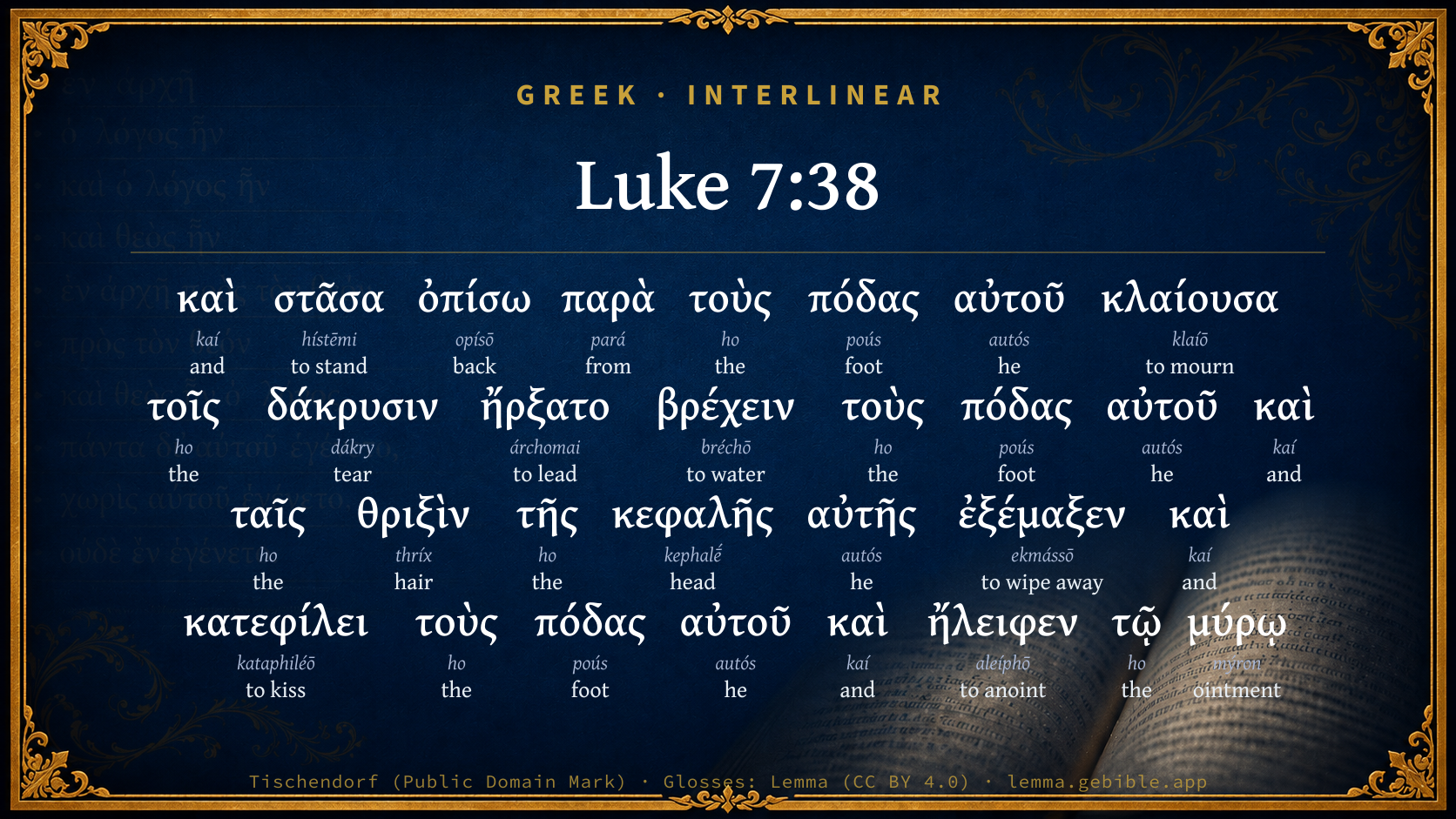
Greek (Tischendorf 8th ed.) Luke 7:38 appears in the Greek New Testament. The text above is from the Tischendorf 8th edition. Each word links to its Strong’s number and a concise gloss. Click any word for its full Thayer’s Greek Lexicon entry.
Download image
Cite this verse

Luke 7:38 (World English Bible). Public Domain. Lemma interlinear Bible study tool, https://lemma.gebible.app/v/luke/7/38.

Show BibTeX & RIS
BibTeX
RIS
English Translation
Standing behind at his feet weeping, she began to wet his feet with her tears, and she wiped them with the hair of her head, kissed his feet, and anointed them with the ointment.
World English Bible · Public Domain
Highlights
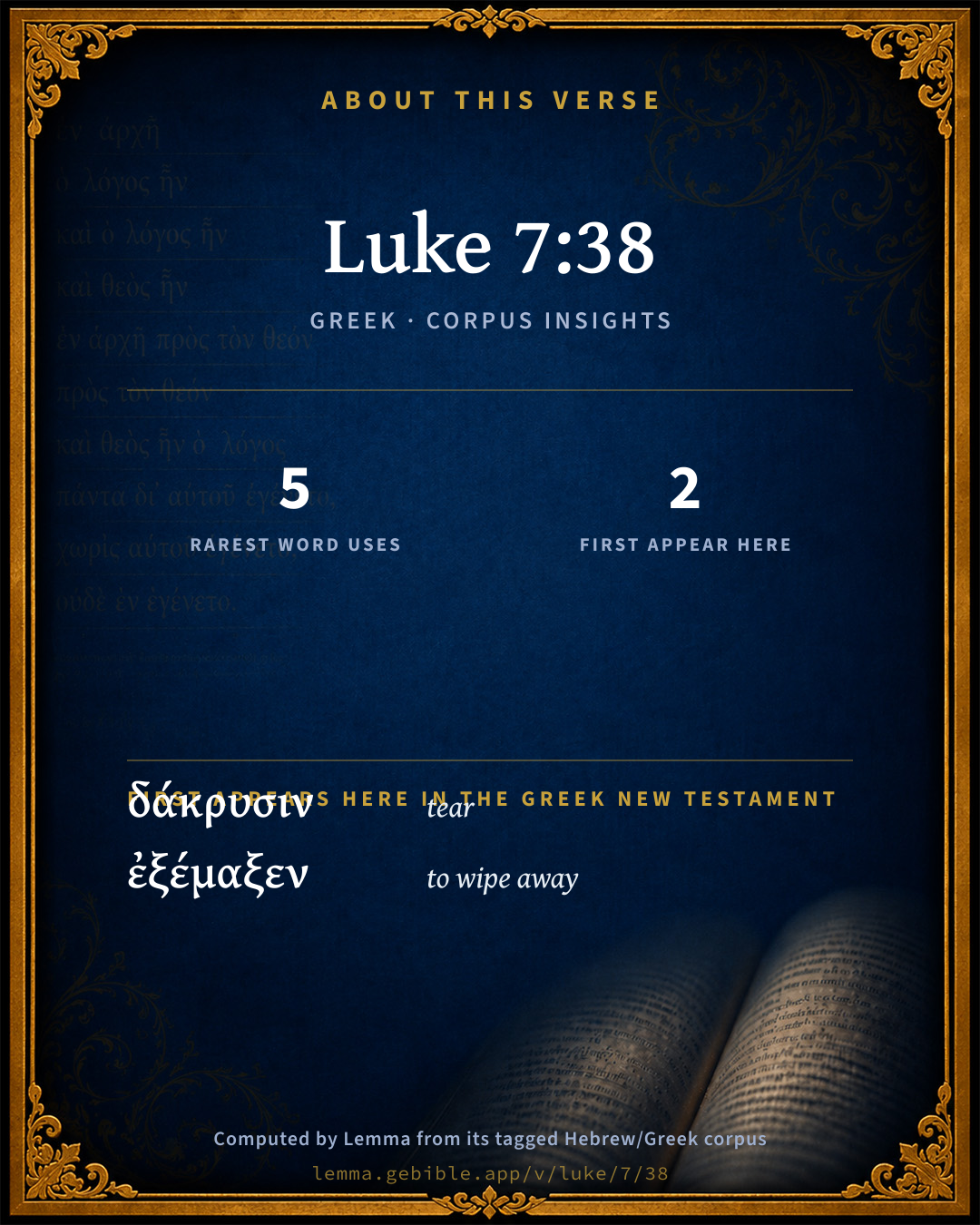
  • 2 first appearances in the Greek New Testament
Full analysis ↓
Download a study sheet

One document with this verse’s original text, its word-by-word gloss line, the meaning frame, cross-references with their text, attributed commentary, and full source and license credits — printable, and it pastes into notes with its structure intact.

This verse Autodidact and up

Study sheet (.html) Plain text (.txt)

A passage Seminary Student

Up to 50 verses in one chapter. A passage sheet keeps up to 6 commentary sources and 12 cross-references per verse, in the order this page ranks them, and says so on the sheet whenever that leaves anything out. Ask for a single verse and you get the Autodidact verse sheet above.

Everything on this page stays free to read, with no account — the sheet is a download of what is already on screen, not access to it.

Want to remove ads? Support Godless Engineer
Compare translations 3

The same verse in 3 English versions, stacked beneath the original-language interlinear above. Click any original word for its lexicon entry.

Each is an independent rendering of the whole verse — the interlinear is not word-aligned to these translations.

Highlighted words mark where these versions differ — a whole-verse word diff, not a word-by-word alignment.

  • World English Bible Public Domain
    Standing behind at his feet weeping, she began to wet his feet with her tears, and she wiped them with the hair of her head, kissed his feet, and anointed them with the ointment.
  • King James Version Public Domain
    And stood at his feet behind him weeping, and began to wash his feet with tears, and did wipe them with the hairs of her head, and kissed his feet, and anointed them with the ointment.
  • unfoldingWord Literal Text CC BY-SA 4.0
    and stood behind him near his feet, weeping. She began to wet his feet with her tears, and she was wiping them with the hair of her head and kissing his feet and anointing with the perfumed oil.

unfoldingWord Literal Text — © unfoldingWord, licensed CC BY-SA 4.0. Word-aligned USFM3 via Door43 (git.door43.org/unfoldingWord/en_ult).

Versions to compare (up to 4)

3 of 4 selected

Show all 19 translations

Every available English version of this verse, each an independent rendering of the whole verse.

  • World English Bible Public Domain
    Standing behind at his feet weeping, she began to wet his feet with her tears, and she wiped them with the hair of her head, kissed his feet, and anointed them with the ointment.
  • Berean Standard Bible Public Domain
    As she stood behind Him at His feet weeping, she began to wet His feet with her tears and wipe them with her hair. Then she kissed His feet and anointed them with the perfume.
  • Majority Standard Bible Public Domain
    As she stood behind Him at His feet weeping, she began to wet His feet with her tears and wipe them with her hair. Then she kissed His feet and anointed them with the perfume.
  • King James Version Public Domain
    And stood at his feet behind him weeping, and began to wash his feet with tears, and did wipe them with the hairs of her head, and kissed his feet, and anointed them with the ointment.
  • American Standard Version (1901) Public Domain
    and standing behind at his feet, weeping, she began to wet his feet with her tears, and wiped them with the hair of her head, and kissed his feet, and anointed them with the ointment.
  • Revised Version (1885) Public Domain
    and standing behind at his feet, weeping, she began to wet his feet with her tears, and wiped them with the hair of her head, and kissed his feet, and anointed them with the ointment.
  • Geneva Bible (1599) Public Domain
    And shee stoode at his feete behinde him weeping, and began to wash his feete with teares, and did wipe them with the heares of her head, and kissed his feete, and anoynted them with the oyntment.
  • Douay-Rheims (1899) Public Domain
    And standing behind at his feet, she began to wash his feet, with tears, and wiped them with the hairs of her head, and kissed his feet, and anointed them with the ointment.
  • Young's Literal Translation Public Domain
    and having stood behind, beside his feet, weeping, she began to wet his feet with the tears, and with the hairs of her head she was wiping, and was kissing his feet, and was anointing with the ointment.
  • Literal Standard Version CC BY-SA 4.0
    and having stood behind, beside His feet, weeping, she began to wet His feet with the tears, and with the hairs of her head she was wiping, and was kissing His feet, and was anointing with the ointment.
  • Unlocked Literal Bible CC BY-SA 4.0
    As she stood behind him near his feet, weeping, she began to wet his feet with her tears, and she wiped them with the hair of her head and kissed his feet and anointed them with perfumed oil.
  • unfoldingWord Literal Text CC BY-SA 4.0
    and stood behind him near his feet, weeping. She began to wet his feet with her tears, and she was wiping them with the hair of her head and kissing his feet and anointing with the perfumed oil.
  • Darby Bible Public Domain
    and standing at his feet behind [him] weeping, began to wash his feet with tears; and she wiped them with the hairs of her head, and kissed his feet, and anointed [them] with the myrrh.
  • World Messianic Bible Public Domain
    Standing behind at his feet weeping, she began to wet his feet with her tears, and she wiped them with the hair of her head, kissed his feet, and anointed them with the ointment.
  • Webster's Bible Public Domain
    And stood at his feet behind him weeping, and began to wash his feet with tears, and wiped them with the hairs of her head, and kissed his feet, and anointed them with the ointment.
  • Free Bible Version CC BY-SA 4.0
    She kneeled beside Jesus and with her tears wet his feet, and dried them with her hair. She kissed his feet, and then she poured the perfume over them.
  • Bible in Basic English Public Domain
    And went in and took her place at the back of him, near his feet, weeping, so that his feet were washed with the drops from her eyes, and with her hair she made them dry, and kissing his feet she put the perfume on them.
  • Text-Critical English NT CC BY 4.0
    As she stood behind him at his feet, weeping, she began to wet his feet with her tears. Then she wiped them with the hair of her head, kissed his feet, and anointed them with the ointment.
  • Tyndale New Testament (1534) Public Domain
    and she stode at his fete behynde him wepynge and beganne to wesshe his fete with teares and dyd wipe the with the heares of her heed and kyssed his fete and anoynted them with oyntment.

Literal Standard Version (2020), Covenant Press — licensed CC BY-SA 4.0. Text via the HelloAO Bible API (eBible.org). Unlocked Literal Bible (unfoldingWord) — licensed CC BY-SA 4.0. Text via the HelloAO Bible API (eBible.org). unfoldingWord Literal Text — © unfoldingWord, licensed CC BY-SA 4.0. Word-aligned USFM3 via Door43 (git.door43.org/unfoldingWord/en_ult). Free Bible Version, Dr. Jonathan Gallagher — licensed CC BY-SA 4.0. Text via the HelloAO Bible API (eBible.org).

Word by word

More ways to search: Search by grammar → Find every occurrence → Compare this word →

Practice this passage: Drill this verse → Learn its vocabulary →

ἐξέμαξεν
ekmássō
G1591
“to wipe away”
Verb, Aorist, Active, Indicative, 3rd person, Singular
Part of Speech
Verb
Tense
Aorist
Voice
Active
Mood
Indicative
Person
3rd person
Number
Singular
Full Thayer's Definition

Origin: from G1537 and the base of G3145

TDNT: None

1. to wipe off, to wipe away
  1. καὶ kaí G2532 “and” Conjunction
  2. στᾶσα hístēmi G2476 “to stand” Verb, Aorist, Active, Participle, Nominative, Singular, Feminine
  3. ὀπίσω opísō G3694 “back” Adverb
  4. παρὰ pará G3844 “from” Preposition
  5. τοὺς ho G3588 “the” Article, Accusative, Plural, Masculine
  6. πόδας poús G4228 “foot” Noun, Accusative, Plural, Masculine
  7. αὐτοῦ autós G846 “he” Personal pronoun, Genitive, Singular, Masculine
  8. κλαίουσα klaíō G2799 “to mourn” Verb, Present, Active, Participle, Nominative, Singular, Feminine
  9. τοῖς ho G3588 “the” Article, Dative, Plural, Neuter
  10. δάκρυσιν dákry G1144 “tear” Noun, Dative, Plural, Neuter
  11. ἤρξατο árchomai G756 “to lead” Verb, Aorist, Middle deponent, Indicative, 3rd person, Singular
  12. βρέχειν bréchō G1026 “to water” Verb, Present, Active, Infinitive
  13. τοὺς ho G3588 “the” Article, Accusative, Plural, Masculine
  14. πόδας poús G4228 “foot” Noun, Accusative, Plural, Masculine
  15. αὐτοῦ autós G846 “he” Personal pronoun, Genitive, Singular, Masculine
  16. καὶ kaí G2532 “and” Conjunction
  17. ταῖς ho G3588 “the” Article, Dative, Plural, Feminine
  18. θριξὶν thríx G2359 “hair” Noun, Dative, Plural, Feminine
  19. τῆς ho G3588 “the” Article, Genitive, Singular, Feminine
  20. κεφαλῆς kephalḗ G2776 “head” Noun, Genitive, Singular, Feminine
  21. αὐτῆς autós G846 “he” Personal pronoun, Genitive, Singular, Feminine
  22. καὶ kaí G2532 “and” Conjunction
  23. κατεφίλει kataphiléō G2705 “to kiss” Verb, Imperfect, Active, Indicative, 3rd person, Singular
  24. τοὺς ho G3588 “the” Article, Accusative, Plural, Masculine
  25. πόδας poús G4228 “foot” Noun, Accusative, Plural, Masculine
  26. αὐτοῦ autós G846 “he” Personal pronoun, Genitive, Singular, Masculine
  27. καὶ kaí G2532 “and” Conjunction
  28. ἤλειφεν aleíphō G218 “to anoint” Verb, Imperfect, Active, Indicative, 3rd person, Singular
  29. τῷ ho G3588 “the” Article, Dative, Singular, Neuter
  30. μύρῳ mýron G3464 “ointment” Noun, Dative, Singular, Neuter

About this verse

These counts appear in no published source. They are computed here, from the morphology-tagged text and Lemma’s own curated glosses. What Lemma adds →

31
words
17
distinct lemmas
Gospels
section

Notable vocabulary

The rarest word here is ἐξέμαξεν to wipe away G1591 — appearing just 5 times in the whole Greek New Testament.

First appearance in Scripture

These words make their first canonical appearance in the Greek New Testament here:

  • δάκρυσιν tear G1144
  • ἐξέμαξεν to wipe away G1591

Shared distinctive vocabulary

ἐξέμαξεν to wipe away G1591 occurs in 5 verses of the Greek New Testament. Also found in:
Repetition

Words recur within this verse:

  • πόδας foot G4228 ×3
  • τοὺς the G3588 ×7
  • καὶ and G2532 ×4
  • αὐτοῦ he G846 ×4

Cross-references

19

Topical passages linked to Luke 7:38 in the Treasury of Scripture Knowledge — connected by theme and wording, ordered by reader-vote popularity; previews shown in the World English Bible.

  • Psalms 126:5–6 Those who sow in tears will reap in joy.
  • Psalms 51:17 The sacrifices of God are a broken spirit. A broken and contrite heart, O God, you will not despise.
  • Genesis 18:4 Now let a little water be fetched, wash your feet, and rest yourselves under the tree.
  • Psalms 6:6–8 I am weary with my groaning; Every night I flood my bed; I drench my couch with my tears.
  • Ecclesiastes 9:8 Let your garments be always white, and don't let your head lack oil.
  • Isaiah 61:3 to appoint to those who mourn in Zion, to give to them a garland for ashes, the oil of joy for mourning, the garment of praise for the spirit of heaviness; that they may be called trees of righteousness, the planting of Yahweh, that he may be glorified.
  • Luke 7:44–46 Turning to the woman, he said to Simon, "Do you see this woman? I entered into your house, and you gave me no water for my feet, but she has wet my feet with her tears, and wiped them with the hair of her head.
  • Psalms 38:18 For I will declare my iniquity. I will be sorry for my sin.
  • Jeremiah 31:9 They shall come with weeping; and with petitions will I lead them: I will cause them to walk by rivers of waters, in a straight way in which they shall not stumble; for I am a father to Israel, and Ephraim is my firstborn.
  • John 13:4–5 arose from supper, and laid aside his outer garments. He took a towel, and wrapped a towel around his waist.
  • 2 Corinthians 7:10–11 For godly sorrow works repentance to salvation, which brings no regret. But the sorrow of the world works death.
  • Ezra 10:1 Now while Ezra prayed and made confession, weeping and casting himself down before the house of God, there was gathered together to him out of Israel a very great assembly of men and women and children; for the people wept very sore.
  • Joel 2:12 "Yet even now," says Yahweh, "turn to me with all your heart, And with fasting, and with weeping, and with mourning."
  • Matthew 5:4 Blessed are those who mourn, For they shall be comforted.
  • Judges 2:4–5 It happened, when the angel of Yahweh spoke these words to all the children of Israel, that the people lifted up their voice, and wept.
  • Isaiah 57:9 You went to the king with oil, and did increase your perfumes, and did send your ambassadors far off, and did debase yourself even to Sheol.
  • Jeremiah 31:18–20 I have surely heard Ephraim bemoaning himself [thus], You have chastised me, and I was chastised, as a calf unaccustomed [to the yoke]: turn you me, and I shall be turned; for you are Yahweh my God.
  • Zechariah 12:10 I will pour on the house of David, and on the inhabitants of Jerusalem, the spirit of grace and of supplication; and they will look to me whom they have pierced; and they shall mourn for him, as one mourns for his only son, and will grieve bitterly for him, as one grieves for his firstborn.
  • James 4:9 Lament, mourn, and weep. Let your laughter be turned to mourning, and your joy to gloom.

Cross-references courtesy of OpenBible.info (CC BY 4.0).

Commentary

Notes on Luke 7:38 from classic Christian and Jewish commentators (each source and its license shown beneath its notes). The classic Christian expositions comment on the surrounding passage and are grouped to its opening verse, so a note may address several verses; the Jewish commentaries on the Tanakh (Rashi and others) are per-verse, so they appear only where the commentator wrote on this verse.

Lemma curates 59 commentaries, every one of them public domain or Creative Commons licensed, each selected and text-cleaned for this edition rather than reprinted as found. About our sources →

Tyndale Open Study Notes

Tyndale Open Resources

7:38 she knelt behind him at his feet: At a banquet, guests reclined around a low table with their feet extended outward. The woman could not reach Jesus’ head to anoint him, so she poured the perfume on his feet. • wiped them off with her hair: Letting down her hair in public was scandalous and could have constituted grounds for her husband to divorce her; kissing his feet connoted reverence. She discarded propriety due to her gratitude.

Tyndale Open Study Notes — © Tyndale Open Resources, licensed CC BY-SA 4.0. Text via the HelloAO Bible API.

Bengel's Gnomon

Johann Albrecht Bengel

Luk 7:38. Ὀπίσω, behind) As being one who wished to make no ostentatious display of what she was doing. Love taught her to do that which, to one who loves not, would seem out of place [inept], and which no one would require his servant (slave) to do: and so love taught her without human instruction. Similar instances occur, ch. Luk 17:15, Luk 19:37.—θριξὶ) with the hairs, dishevelled, as in mourning. Most exquisite [refinement in her] reverence!

Bengel's Gnomon of the New Testament — English translation (T&T Clark, Edinburgh, 1860) — public domain. Text from a community e-Sword module.

Expositor's Greek Testament

ed. W. Robertson Nicoll

Luk 7:38 . στᾶσα ὀπίσω , standing behind, at His feet. The guests reclined on couches with their feet turned outwards, a posture learned by the Jews from their various masters: Persians, Greeks, Romans. In delicacy Jesus would not look round or take any notice, but let her do what she would. κλαίουσα : excitement, tumultuous emotions, would make a burst of weeping inevitable. ἤρξατο applies formally to βρέχειν , but really to all the descriptive verbs following. She did not wet Christ’s feet with tears of set purpose; the act was involuntary. βρέχειν , to moisten, as rain moistens the ground: her tears fell like a thunder shower on Christ’s feet. Cf. Mat 5:45 . ἐξέμασσε , she continued wiping. Might have been infinitive depending on ἤρξατο , but more forcible as an imperfect. Of late use in this sense. To have her hair flowing would be deemed immodest. Extremes met in that act. κατεφίλει , kissed fervently, again and again. Judas also kissed fervently. Vide Mat 26:49 and remarks there. ἤλειφε : this was the one act she had come of set purpose to do; all the rest was done impulsively under the rush of feeling.

The Expositor's Greek Testament, edited by W. Robertson Nicoll (1897–1910) — public domain. Text from a community e-Sword module.

Jamieson, Fausset & Brown

Robert Jamieson, A. R. Fausset & David Brown

at his feet behind him--the posture at meals being a reclining one, with the feet out behind.

began to wash, &c.--to "water with a shower." The tears, which were quite involuntary, poured down in a flood upon His naked feet, as she bent down to kiss them; and deeming them rather fouled than washed by this, she hastened to wipe them off with the only towel she had, the long tresses of her own hair, "with which slaves were wont to wash their masters' feet" [STIER].

kissed--The word signifies "to kiss fondly, to caress," or to "kiss again and again," which Luk 7:45 shows is meant here. What prompted this? Much love, springing from a sense of much forgiveness. So says He who knew her heart (Luk 7:47). Where she had met with Christ before, or what words of His had brought life to her dead heart and a sense of divine pardon to her guilty soul, we know not. But probably she was of the crowd of "publicans and sinners" whom Incarnate Compassion drew so often around Him, and heard from His lips some of those words such as never man spake, "Come unto Me, all ye that labour," &c. No personal interview had up to this time taken place between them; but she could keep her feelings no longer to herself, and having found her way to Him (and entered along with him, Luk 7:45), they burst forth in this surpassing yet most artless style, as if her whole soul would go out to Him.

Jamieson, Fausset & Brown — Commentary Critical and Explanatory on the Whole Bible (1871) — public domain (CC PDM 1.0). Text via the HelloAO Bible API.

Adam Clarke's Commentary

Verse 38. Stood at his feet behind him] In taking their meals, the eastern people reclined on one side; the loins and knees being bent to make the more room, the feet of each person were turned outwards behind him. This is the meaning of standing BEHIND at his FEET.

Began to wash his feet with tears] Ηρξατο βρεχειν - τοις δακρυσι, She began to water his feet - to let a shower of tears fall on them. As the Jews wore nothing like our shoes, (theirs being a mere sole, bound about the foot and ancle with thongs,) their feet being so much exposed had frequent need of washing, and this they ordinarily did before taking their meals.

Kissed his feet] With affectionate tenderness, κατεφιλει, or kissed them again and again. See Clarke on Mt 26:49.

The kiss was used in ancient times as the emblem of love, religious reverence, subjection, and supplication. It has the meaning of supplication, in the way of adoration, accompanied with subjection, in 1Kg 19:18, Whose mouths have not kissed Baal; and in Job 31:27, My mouth hath not kissed my hand; I have paid no sort of adoration to false gods; and in Ps 2:12, Kiss the Son lest he be angry,-close in with him, embrace affectionately, the offers of mercy made unto you through Christ Jesus, lest he (the Lord) be angry with you, and ye perish: which commandment this woman seems to have obeyed, both in the literal and spiritual sense. Kissing the feet was practised also among the heathens, to express subjection of spirit, and earnest supplication. See a long example in Raphelius, produced from Polybius, concerning the Carthaginian ambassadors when supplicating the Romans for peace. With an humble and abject mind, πεσοντες επι την γην, they fell down on the earth, τους ποδας καταφιλοιεν τῳ συνεδριῳ, and kissed the feet of the council. See also several examples in Kypke. Kissing the feet is a farther proof that this person had been educated a heathen. This was no part of a Jew's practice.

Adam Clarke's Commentary on the Bible (1810–1826) — public domain. Text from a community e-Sword/MySword module.

Ellicott's Commentary for English Readers

(38) And stood at his feet behind him.—The common usage of the East left the court-yard of the house open while such a feast as that described was going on, and there was nothing to hinder one who had not been invited from coming even into the guest-chamber. It is possible, indeed, that the feast may have been intentionally open to all comers. Our Lord’s position has to be remembered as we read the narrative.

To wash his feet with tears.—Many different emotions may have mingled in the woman’s soul. Shame, penitence, gratitude, joy, love, all find the same natural relief. The word for “wash” should be noted as implying a “shower” of tears. It may be noted that while the tenses for this and the “wiping” imply a momentary act, those that follow for the kissing and anointing involve the idea of continuance. The act, the sobs, the fragrance of the ointment, of course attracted notice.

A Bible Commentary for English Readers, edited by Charles John Ellicott (1878–1897) — public domain. Text from a community e-Sword module.

The Cambridge Bible for Schools and Colleges

gen. ed. J. J. S. Perowne

38. stood at his feet behind him] This is explained by the arrangement of the triclinia, by which the guest reposed on his elbow at the table, with his unsandalled feet outstretched on the couch. Each guest left his sandals beside the door on entering. Literally the verse is, “And standing behind beside His feet weeping, with her tears she began to bedew His feet, and with the hairs of her head she wiped them off, and was eagerly kissing His feet, and anointing them with the perfume.” As she bent over His feet her tears began to fall on them, perhaps accidentally at first, and she wiped them off with the long dishevelled hair (1Co_11:15) which shewed her shame and anguish, and then in her joy and gratitude at finding herself unrepulsed, she poured the unguent over them. The scene and its moral are beautifully expressed in the sonnet of Hartley Coleridge.

“She sat and wept beside His feet. The weight

Of sin oppressed her heart; for all the blame

And the poor malice, of the worldly shame

To her were past, extinct, and out of date:

Only the sin remained—the leprous state.

She would be melted by the heat of love,

By fires far fiercer than are blown to prove

And purge the silver ore adulterate.

She sat and wept, and with her untressed hair

Still wiped the feet she was so blest to touch;

And He wiped off the soiling of despair

From her sweet soul, because she loved so much.”

No one but a woman in the very depths of anguish would have violated all custom by appearing in public with uncovered head (1Co_11:10).

weeping] Doubtless at the contrast of His sinlessness and her own stained life. She could not have done thus to the Pharisee, who would have repelled her with execration as bringing pollution by her touch. The deepest sympathy is caused by the most perfect sinlessness. It is not impossible that on that very day she may have heard the “Come unto me” of Mat_11:28.

kissed] The word means ‘was earnestly’ or ‘tenderly-kissing,’ as in Act_20:37.

The Cambridge Bible for Schools and Colleges (gen. ed. J. J. S. Perowne; Cambridge University Press, 1878–1918) — public domain. Text from a community e-Sword module.

John Gill's Exposition

And when they had nothing to pay,.... Neither the lesser nor greater debtor; for though not alike in debt, yet both insolvent: man has run out his whole stock, which the God of nature gave him, in his original creation and primitive state; and is become a bankrupt and a beggar, is poor, wretched, and miserable; he has no money, he has nothing to offer for a composition, much less for payment; he has no righteousness, and if he had, it would be nothing to pay with; since that itself, even in perfection, is due to God, and cannot discharge a former debt: sin being committed against an infinite being, is in some sense an infinite debt, and requires an infinite satisfaction, which a finite creature can never give; and he is therefore liable to a prison, and that for ever: but behold the wonderful grace of God, the creditor!

he frankly forgave them both: their whole debts, without regard to any merits of theirs, which they could not have, or any motives in them, or any conditions to be performed by them, but purely of his sovereign will, free grace, and rich mercy, though not without regard to the satisfaction of his Son; which by no means hinders the frankness of the pardon, or obscures the grace of it, but increases and illustrates it; seeing this satisfaction is of God's own finding out, providing, and accepting; and is at his own expense, and without money and price, to the debtors:

tell me therefore, which of them will love him most; or "ought to love him most", as the Ethiopic version. The Vulgate Latin, and all the Oriental versions, leave out the first part of this clause, "tell me".

John Gill's Exposition of the Whole Bible (1746–1763) — public domain (CC PDM 1.0). Text via the HelloAO Bible API.

Trapp's Complete Commentary

John Trapp

38 And stood at his feet behind him weeping, and began to wash his feet with tears, and did wipe them with the hairs of her head, and kissed his feet, and anointed them with the ointment.

Ver. 38. To wash his feet] They that make their eyes a fountain to wash Christ’s feet in, shall have his side for a fountain to wash their souls in.

Kissed his feet] But how many now refuse those kisses of his mouth, Son 1:2, by despising the word preached, that sweet pledge of his love!

John Trapp, A Commentary or Exposition upon All the Books of the Old and New Testament (1647–1656) — public domain. Text from a community e-Sword module.

Albert Barnes' Notes on the Bible

Stood at his feet behind him - They reclined, at their meals, on their left side, and their feet, therefore, were extended from the table, so that persons could easily approach them. See the notes at Mat 23:6.

Began to wash his feet - The Jews wore sandals. These were taken off when they entered a house. It was an act of hospitality and kindness to wash the feet of a guest. “She” therefore began to show her love for the Saviour, and at the same time her humility and penitence, by pouring forth a flood of tears, and washing his feet in the manner of a servant.

Kissed his feet - The kiss was an emblem of love and affection. In this manner she testified her love for the Lord Jesus, and at the same time her humility and sense of sin by kissing his feet. There could be few expressions of penitence more deep and tender than were these. A sense of all her sins rushed over her mind; her heart burst at the remembrance of them, and at the presence of the pure Redeemer; with deep sorrow she humbled herself and sought forgiveness. She showed her love for him by a kiss of affection; her humility, by bathing his feet; her veneration, by breaking a costly box - perhaps procured by a guilty life - and anointing his feet. In this way we should all come, embracing him as the loved Redeemer, humbled at his feet, and offering all we have - all that we have gained in lives of sin, in our professions, by merchandise and toil, while we were sinners - offering “all” to his service. Thus shall we show the sincerity of our repentance, and thus shall we hear his gracious voice pronounce our sins forgiven.

Albert Barnes' Notes on the Bible (1834–1885) — public domain. Text from a community e-Sword/MySword module.

Haydock's Catholic Bible Commentary

Jesus Christ was then at table, after the manner of the Orientals, reclined at length on a couch, a little raised from the ground, having his face turned towards the table, and his feet extended. He had quitted his sandals, according to the custom of the country, before he had laid himself on the couch. (Bible de Vence)

George Leo Haydock (1774–1849), Haydock's Catholic Family Bible and Commentary, 1859 edition — public domain. Excludes Psalms (Douay-Rheims chapter numbering differs from Protestant) and Deuterocanonical books (Catholic canon only).

Whedon's Commentary on the Bible

Daniel D. Whedon

38. Stood at his feet—Reclining at table, after the oriental fashion; his sandals, according to custom, having been taken off upon entering the house. The feet of Jesus would be extended, so that the woman could stand behind and wash them. The word βρεχειν in the Greek signifies not to wash, but to moisten by the natural dripping of the tears as she profusely shed them. As they dropped, with her loosened hair she wiped his feet and then anointed them. This custom of cleansing and anointing the feet prevails not only in the Oriental sections, but is the subject of many allusions in the classics, as taking place among the Greeks and Romans. Thus Aristophanes, the Greek dramatic poet, makes an Athenian say that upon going home at night “My daughter shall grasp me, anoint my two feet, and, stooping down, kiss them.”

Daniel D. Whedon (gen. ed.), Commentary on the Old and New Testaments (1874–1909) — public domain. Text from a community e-Sword module.

The Pulpit Commentary

And stood at his feet behind him weeping, and began to wash his feet with tears, and did wipe them with the hairs of her head, and kissed his feet, and anointed them with the ointment. It had been, no doubt, with her a settled purpose for days, this presenting herself to the pitiful Master. She had been one of his listeners, without doubt, for some time previously, and that morning probably she made up her mind to approach him. He was a great public Teacher, and his movements would be well known in the city. She heard he was to be present at a feast in the house of the rich Pharisee Simon. It would be easier, she thought, to get close to him there than in the crowd in the marketplace or in the synagogue; so taking with her a flask of perfumed ointment, she passed into the courtyard with others, and so made her way unnoticed into the guest-chamber. As she stood behind him, and the sweet words of forgiveness and reconciliation, the pleading invitation to all heavy-laden, sin-burdened ones to come to him for peace, which she in the past days bad listened to so eagerly, came into her mind, unbidden tears rose into her eyes and fell on the Master"s feet as he lay on his couch; and, after the manner of slaves with their masters, she wiped the tear-wet feet with her long hair, which she evidently loosed for this loving purpose, and then quietly poured the fragrant ointment on the feet where her tears had fallen. It was the perfume of the ointment which called the host"s attention to this scene of sorrow and heartfelt penitence.

The Pulpit Commentary (1880–1919), ed. H.D.M. Spence-Jones & Joseph S. Exell — public domain. Text from a community e-Sword module.

The People's New Testament

B. W. Johnson

38. Stood at his feet behind him. The Jews reclined at table, leaning upon the left elbow, with the feet stretched out behind. With tears. Heart-broken, with a sense of sin and a hope of mercy, her tears fell upon his feet.

B. W. Johnson's The People's New Testament with Notes (1889–1891) — public domain. Electronic text from the Christian Classics Ethereal Library (CCEL) ThML edition.

Cambridge Greek Testament for Schools and Colleges

38. ὀπίσω παρὰ τοὺς πόδας αὐτοῦ. This is explained by the arrangement of the triclinia. The guests reposed on their elbows at the table, with their unsandalled feet outstretched on the couch. Each guest left his sandals beside the door on entering. Literally the verse is, ‘And standing behind beside His feet weeping, with her tears she began to bedew His feet, and with the hairs of her head she wiped them off, and was eagerly kissing His feet, and anointing them with the perfume.’ As she bent over His feet her tears began to fall on them, perhaps accidentally at first, and she wiped them off with the long dishevelled hair (1Co 11:15) which shewed her shame and anguish; then in her joy and gratitude at finding herself unrepulsed, she poured the unguent over them. The scene and its moral are beautifully expressed in the sonnet of Hartley Coleridge.

“She sat and wept beside His feet. The weight

Of sin oppressed her heart; for all the blame

And the poor malice, of the worldly shame

To her were past, extinct, and out of date:

Only the sin remained—the leprous state.

She would be melted by the heat of love,

By fires far fiercer than are blown to prove

And purge the silver ore adulterate.

She sat and wept, and with her untressed hair

Still wiped the feet she was so blest to touch;

And He wiped off the soiling of despair

From her sweet soul, because she loved so much.”

No one but a woman in the very depths of anguish would have violated all custom by appearing in public with uncovered head (1Co 11:10).

κλαίουσα. Doubtless at the contrast of His sinlessness and her own stained life. She could not have done thus to the Pharisee, who would have repelled her with execration as bringing pollution by her touch. The deepest sympathy is caused by the most perfect sinlessness. It is not impossible that on that very day she may have heard the “Come unto me” of Mat 11:28.

βρέχειν τοὺς πόδας αὐτοῦ. To sprinkle or bedew (rather than “to wash,” which is derived by the A. V[163] from Tyndale). The Vulg[164] has rigare, and Wiclif, to moist (comp. Mat 5:45, βρέχει, ‘He sends His rain’).

[163] A. V. Authorised Version.

[164] Vulg. Vulgate.

κατεφίλει. ‘Was earnestly’ or ‘tenderly kissing,’ as in Act 20:37.

Cambridge Greek Testament for Schools and Colleges (Cambridge University Press, 1896; 21 vols, various authors incl. Carr, Maclear, Plummer, Farrar, Lumby, Moule, M. R. James, Simcox) — public domain. Text from a community e-Sword module.

International Critical Commentary

38. στᾶσα ὀπίσω παρὰ τοὺς πόδας αὐτοῦ. The sandals were removed at meals, and people reclined with their feet behind them ; she could therefore easily approach the feet. While Lk. writes παρὰ τοὺς πόδας (8:35, 41, 10:39?, 17:16, Act 4:35, Act 4:37, Act 4:5:2, Act 4:7:58, Act 4:22:3), Mk. has πρὸς τοὺς πόδας (5:22, 7:25), and Jn. πρὸς τοὺς πόδας (11:32). Mt. has παρὰ τοὺς πόδας (15:30).

τοῖς δάκρυσιν ἥρξατο βρέχειν τοὺς πόδας αὐτοῦ καὶ ταῖς θριξίν, κ.τ.λ. This was no part of her original plan. She came to anoint His feet, and was overcome by her feelings; hence the ἤρξατο. The βρέχειν led to the ἐξέμασσεν, which was also unpremeditated. Among the Jews it was a shameful thing for a woman to let down her hair in public; but she makes this sacrifice. For βρέχειν comp. Psa 6:7: it is probably a vernacular word (Kennedy, Sources of N.T. Grk. p. 39).

καὶκατεφίλει. Note the compound verb and the change of tense: “She continued to kiss affectionately.” The word is used of the kiss of the traitor (Mat 26:49; Mar 14:45), which was demonstrative, of the prodigal’s father (Luk 15:20), and of the Ephesian elders in their last farewell (Act 20:37), and nowhere else in N.T. Comp. Xen. Mem. ii. 6, 33. Kissing the feet was a common mark of deep reverence, especially to leading Rabbis (Xen. Cyr. vii. 5. 32; Polyb. xv. I. 7; Aristoph. Vesp. 608).

International Critical Commentary — older volumes (1896–1929), various authors — public domain. Text from a community e-Sword module.

Vincent's Word Studies in the New Testament

Marvin R. Vincent

At his feet behind. The body of the guest rested on the couch; the feet were turned from the table toward the walls, and the left elbow rested on the table.

Wash [βρεχειν] . More literally and better, as Rev., wet, as with rain. Wiped [εξεμασσεν] . See on ch. Luk 5:2.

Marvin R. Vincent, Word Studies in the New Testament (1887–1900) — public domain. Text from a community e-Sword/MySword module.

Lesson kit

Teaching starters — assembled from the data on this page, not authored interpretation. Every prompt links to the verse data it draws on. Edit before teaching.

Luke, in the Gospels, opens this verse with 31 words (17 distinct Greek lemmas). Its most distinctive word is ekmássō (“to wipe away”). A historical commentator’s framing appears above. Read the whole chapter for the surrounding context.

Discussion questions

  1. The word ekmássō carries the sense “to wipe away.” How does it shape the verse?
  2. 2 words make their first appearance in Scripture here. What does this debut establish?
  3. How does Luke 7:44, which shares the word «to wipe away», read alongside this verse?
  4. What does the repetition of “foot” (3× in this one verse) do in this verse?
  5. The translations on this page render this verse differently — a whole-verse word diff, not a word-by-word alignment. What might account for the different wordings?
  6. Compare how Tyndale Open Study Notes and Bengel's Gnomon read this verse. Where do they agree or differ?

Things to notice

  • 2 words make their first canonical appearance in Scripture here.
  • These translations choose different wording for 19 words in this verse.
  • “foot” occurs 3× in this single verse.
  • 17 distinct Greek lemmas span 31 words in this verse.

Reading settings

Reading text

Shown beneath each verse's original-language words.

Old Testament
Old Testament edition

Read the OT as the Masoretic Hebrew (MT) or the Greek Septuagint (LXX).

English shown for the Greek Septuagint (in the Hebrew ↔ Greek comparison).

Comparing translations? Open the Compare panel on any verse page to stack up to four side by side.