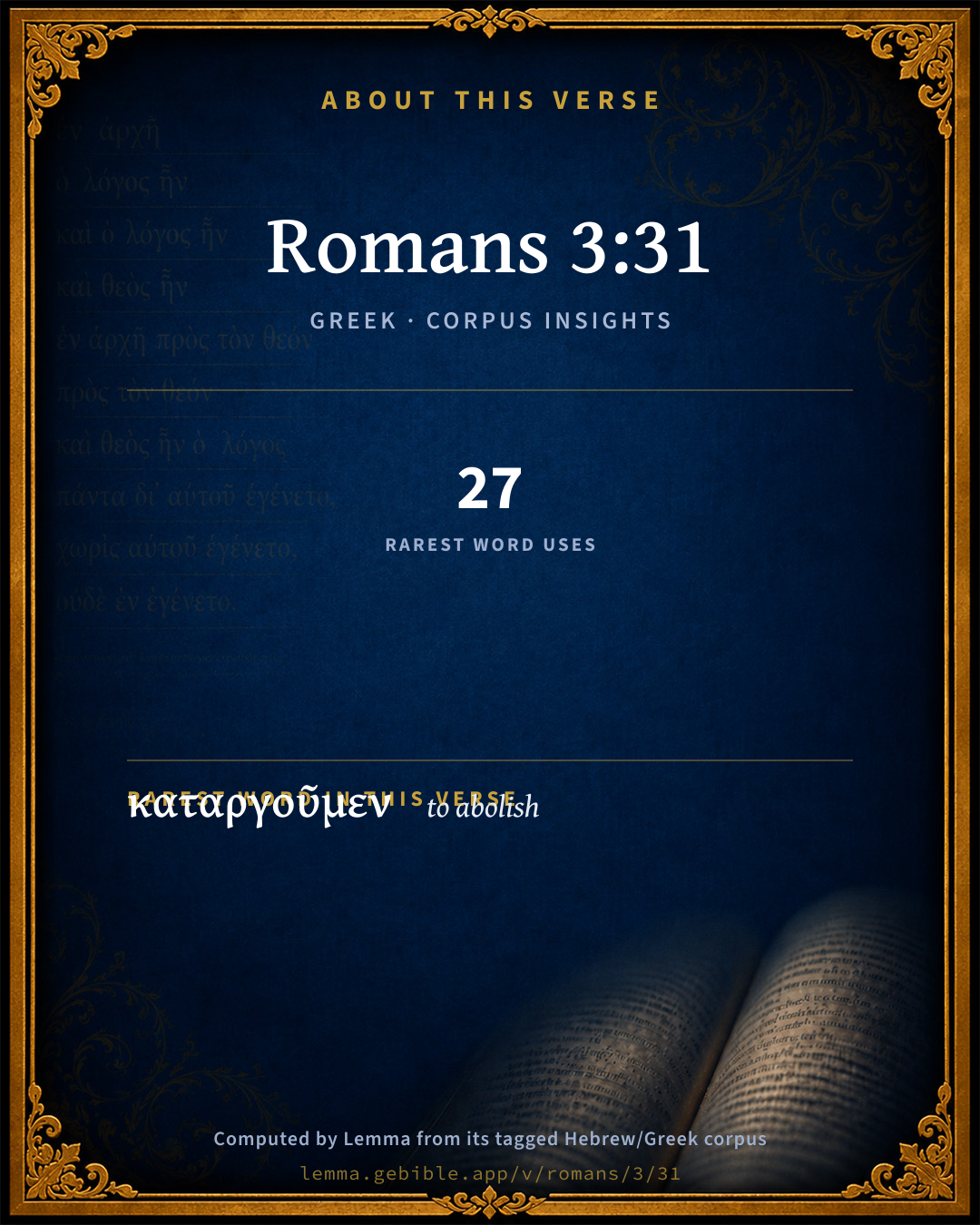
Romans 3:31

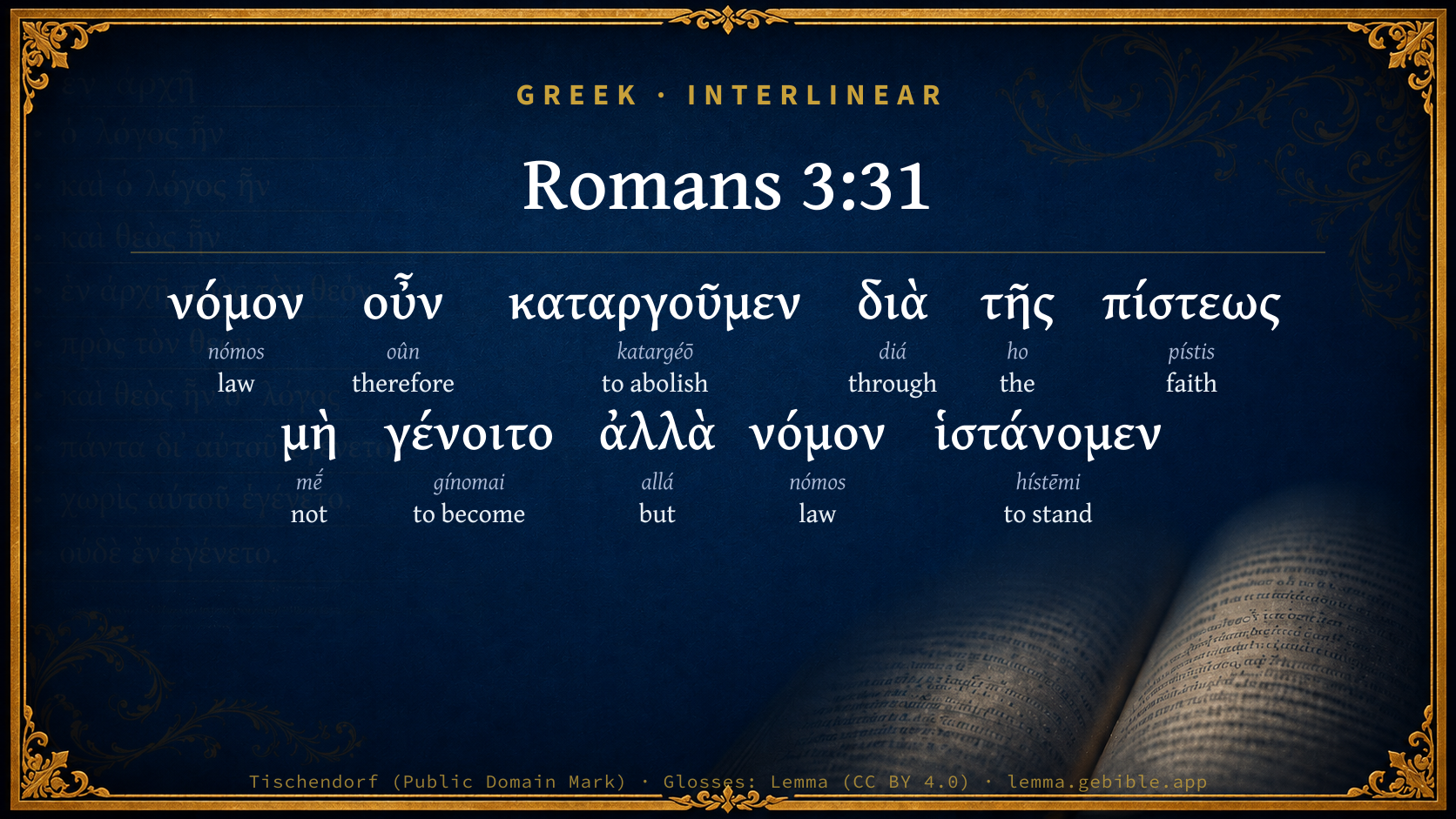
Greek (Tischendorf 8th ed.) Romans 3:31 appears in the Greek New Testament. The text above is from the Tischendorf 8th edition. Each word links to its Strong’s number and a concise gloss. Click any word for its full Thayer’s Greek Lexicon entry.
Download image
Cite this verse

Romans 3:31 (World English Bible). Public Domain. Lemma interlinear Bible study tool, https://lemma.gebible.app/v/romans/3/31.

Show BibTeX & RIS
BibTeX
RIS
English Translation
Do we then nullify the law through faith? May it never be! No, we establish the law.
World English Bible · Public Domain
Download a study sheet

One document with this verse’s original text, its word-by-word gloss line, the meaning frame, cross-references with their text, attributed commentary, and full source and license credits — printable, and it pastes into notes with its structure intact.

This verse Autodidact and up

Study sheet (.html) Plain text (.txt)

A passage Seminary Student

Up to 50 verses in one chapter. A passage sheet keeps up to 6 commentary sources and 12 cross-references per verse, in the order this page ranks them, and says so on the sheet whenever that leaves anything out. Ask for a single verse and you get the Autodidact verse sheet above.

Everything on this page stays free to read, with no account — the sheet is a download of what is already on screen, not access to it.

Want to remove ads? Support Godless Engineer
Compare translations 3

The same verse in 3 English versions, stacked beneath the original-language interlinear above. Click any original word for its lexicon entry.

Each is an independent rendering of the whole verse — the interlinear is not word-aligned to these translations.

Highlighted words mark where these versions differ — a whole-verse word diff, not a word-by-word alignment.

  • World English Bible Public Domain
    Do we then nullify the law through faith? May it never be! No, we establish the law.
  • King James Version Public Domain
    Do we then make void the law through faith? God forbid: yea, we establish the law.
  • unfoldingWord Literal Text CC BY-SA 4.0
    Do we then nullify the law through the faith? May it never be! Instead, we uphold the law.

unfoldingWord Literal Text — © unfoldingWord, licensed CC BY-SA 4.0. Word-aligned USFM3 via Door43 (git.door43.org/unfoldingWord/en_ult).

Versions to compare (up to 4)

3 of 4 selected

Show all 19 translations

Every available English version of this verse, each an independent rendering of the whole verse.

  • World English Bible Public Domain
    Do we then nullify the law through faith? May it never be! No, we establish the law.
  • Berean Standard Bible Public Domain
    Do we, then, nullify the law by this faith? Certainly not! Instead, we uphold the law.
  • Majority Standard Bible Public Domain
    Do we, then, nullify the law by this faith? Certainly not! Instead, we uphold the law.
  • King James Version Public Domain
    Do we then make void the law through faith? God forbid: yea, we establish the law.
  • American Standard Version (1901) Public Domain
    Do we then make the law of none effect through faith? God forbid: nay, we establish the law.
  • Revised Version (1885) Public Domain
    Do we then make the law of none effect through faith? God forbid: nay, we establish the law.
  • Geneva Bible (1599) Public Domain
    Doe we then make the Lawe of none effect through faith? God forbid: yea, we establish the Lawe.
  • Douay-Rheims (1899) Public Domain
    Do we, then, destroy the law through faith? God forbid: but we establish the law.
  • Young's Literal Translation Public Domain
    Law then do we make useless through the faith? let it not be! yea, we do establish law.
  • Literal Standard Version CC BY-SA 4.0
    Do we then make law useless through faith? Let it not be! Indeed, we establish law.
  • Unlocked Literal Bible CC BY-SA 4.0
    Do we then nullify the law through faith? May it never be! Instead, we uphold the law.
  • unfoldingWord Literal Text CC BY-SA 4.0
    Do we then nullify the law through the faith? May it never be! Instead, we uphold the law.
  • Darby Bible Public Domain
    Do we then make void law by faith? Far be the thought: [no,] but we establish law.
  • World Messianic Bible Public Domain
    Do we then nullify the law through faith? May it never be! No, we establish the law.
  • Webster's Bible Public Domain
    Do we then make void the law through faith? By no means: but we establish the law.
  • Free Bible Version CC BY-SA 4.0
    Does that mean that by trusting in God we do away with the law? Of course not! In fact we affirm the importance of the law.
  • Bible in Basic English Public Domain
    Do we, then, through faith make the law of no effect? in no way: but we make it clear that the law is important.
  • Text-Critical English NT CC BY 4.0
    Do we then nullify the law through faith? Certainly not! On the contrary, we uphold the law.
  • Tyndale New Testament (1534) Public Domain
    Do we then destroye the lawe thorow fayth? God forbid. But we rather mayntayne the lawe.

Literal Standard Version (2020), Covenant Press — licensed CC BY-SA 4.0. Text via the HelloAO Bible API (eBible.org). Unlocked Literal Bible (unfoldingWord) — licensed CC BY-SA 4.0. Text via the HelloAO Bible API (eBible.org). unfoldingWord Literal Text — © unfoldingWord, licensed CC BY-SA 4.0. Word-aligned USFM3 via Door43 (git.door43.org/unfoldingWord/en_ult). Free Bible Version, Dr. Jonathan Gallagher — licensed CC BY-SA 4.0. Text via the HelloAO Bible API (eBible.org).

Word by word

More ways to search: Search by grammar → Find every occurrence → Compare this word →

Practice this passage: Drill this verse → Learn its vocabulary →

καταργοῦμεν
katargéō
G2673
“to abolish”
Verb, Present, Active, Indicative, 1st person, Plural
Part of Speech
Verb
Tense
Present
Voice
Active
Mood
Indicative
Person
1st person
Number
Plural
Full Thayer's Definition

Origin: from G2596 and G691

TDNT: 08:32,8

1. to render idle, unemployed, inactivate, inoperative a. to cause a person or thing to have no further efficiency b. to deprive of force, influence, power 2. to cause to cease, put an end to, do away with, annul, abolish a. to cease, to pass away, be done away b. to be severed from, separated from, discharged from, loosed from any one c. to terminate all intercourse with one
  1. νόμον nómos G3551 “law” Noun, Accusative, Singular, Masculine
  2. οὖν oûn G3767 “therefore” Conjunction
  3. διὰ diá G1223 “through” Preposition
  4. τῆς ho G3588 “the” Article, Genitive, Singular, Feminine
  5. πίστεως pístis G4102 “faith” Noun, Genitive, Singular, Feminine
  6. μὴ mḗ G3361 “not” Particle, Negative
  7. γένοιτο gínomai G1096 “to become” Verb, Aorist, Middle deponent, Optative, 3rd person, Singular
  8. ἀλλὰ allá G235 “but” Conjunction
  9. νόμον nómos G3551 “law” Noun, Accusative, Singular, Masculine
  10. ἱστάνομεν hístēmi G2476 “to stand” Verb, Present, Active, Indicative, 1st person, Plural

About this verse

These counts appear in no published source. They are computed here, from the morphology-tagged text and Lemma’s own curated glosses. What Lemma adds →

11
words
10
distinct lemmas
Pauline Epistles
section

Shared distinctive vocabulary

καταργοῦμεν to abolish G2673 occurs in 26 verses of the Greek New Testament. Also found in:

Repetition

A word recurs within this verse:

  • νόμον law G3551 ×2

Cross-references

24

Topical passages linked to Romans 3:31 in the Treasury of Scripture Knowledge — connected by theme and wording, ordered by reader-vote popularity; previews shown in the World English Bible.

  • Galatians 2:21 I don't make void the grace of God. For if righteousness is through the law, then Christ died for nothing!"
  • Matthew 5:17 "Don't think that I came to destroy the law or the prophets. I didn't come to destroy, but to fulfill.
  • Romans 10:4 For Christ is the fulfillment of the law for righteousness to everyone who believes.
  • Romans 13:8–10 Owe no one anything, except to love one another; for he who loves his neighbor has fulfilled the law.
  • Romans 8:4 that the ordinance of the law might be fulfilled in us, who walk not after the flesh, but after the Spirit.
  • 1 Corinthians 9:21 to those who are without law, as without law (not being without law toward God, but under law toward Christ), that I might win those who are without law.
  • Romans 7:7–14 What shall we say then? Is the law sin? May it never be! However, I wouldn't have known sin, except through the law. For I wouldn't have known coveting, unless the law had said, "You shall not covet."
  • Jeremiah 8:8–9 How do you say, We are wise, and the law of Yahweh is with us? But, behold, the false pen of the scribes has worked falsely.
  • Galatians 3:17–19 Now I say this. A covenant confirmed beforehand by God in Christ, the law, which came four hundred thirty years after, does not annul, so as to make the promise of no effect.
  • Romans 4:14 For if those who are of the law are heirs, faith is made void, and the promise is made of no effect.
  • James 2:8–12 However, if you fulfill the royal law, according to the Scripture, "You shall love your neighbor as yourself," you do well.
  • Psalms 40:8 I delight to do your will, my God. Yes, your law is within my heart."
  • Psalms 119:126 It is time to act, Yahweh, For they break your law.
  • Isaiah 42:21 It pleased Yahweh, for his righteousness' sake, to magnify the law, and make it honorable.
  • Jeremiah 31:33–34 But this is the covenant that I will make with the house of Israel after those days, says Yahweh: I will put my law in their inward parts, and in their heart will I write it; and I will be their God, and they shall be my people:
  • Matthew 3:15 But Jesus, answering, said to him, "Allow it now, for this is the fitting way for us to fulfill all righteousness." Then he allowed him.
  • Matthew 5:20 For I tell you that unless your righteousness exceeds that of the scribes and Pharisees, there is no way you will enter into the Kingdom of Heaven.
  • Matthew 15:6 he shall not honor his father or mother.' You have made the commandment of God void because of your tradition.
  • Romans 3:4 May it never be! Yes, let God be found true, but every man a liar. As it is written, "That you might be justified in your words, And might prevail when you come into judgment."
  • Romans 7:22 For I delight in God's law after the inward man,
  • Romans 7:25 I thank God through Jesus Christ, our Lord! So then with the mind, I myself serve God's law, but with the flesh, the sin's law.
  • Galatians 2:19 For I, through the law, died to the law, that I might live to God.
  • Galatians 5:18–23 But if you are led by the Spirit, you are not under the law.
  • Hebrews 10:15–16 The Holy Spirit also testifies to us, for after saying,

Cross-references courtesy of OpenBible.info (CC BY 4.0).

Commentary

Notes on Romans 3:31 from classic Christian and Jewish commentators (each source and its license shown beneath its notes). The classic Christian expositions comment on the surrounding passage and are grouped to its opening verse, so a note may address several verses; the Jewish commentaries on the Tanakh (Rashi and others) are per-verse, so they appear only where the commentator wrote on this verse.

Lemma curates 59 commentaries, every one of them public domain or Creative Commons licensed, each selected and text-cleaned for this edition rather than reprinted as found. About our sources →

Tyndale Open Study Notes

Tyndale Open Resources

3:31 we truly fulfill the law: Paul knows that some people will object to his insistence on faith apart from the law because it seems to dismiss the demands of the law. However, faith actually enables people to fulfill the law. The Holy Spirit is given to those who have faith, and he makes it possible for people to do as they should.

Tyndale Open Study Notes — © Tyndale Open Resources, licensed CC BY-SA 4.0. Text via the HelloAO Bible API.

Bengel's Gnomon

Johann Albrecht Bengel

Rom 3:31. Νόμον, the law) This declaration is similar to the declaration of our Lord, Mat 5:17.—ἱστῶμεν, we establish) while we defend [uphold] that which the law witnesseth to, Rom 3:20-21, and while we show, how satisfaction is truly made to the law through Christ.

Bengel's Gnomon of the New Testament — English translation (T&T Clark, Edinburgh, 1860) — public domain. Text from a community e-Sword module.

Meyer's Critical & Exegetical Commentary

Heinrich August Wilhelm Meyer

Rom_3:31. Οὖν] The Apostle infers for himself from his doctrine of justification ἐκ πίστεως.… χωρὶς ἔργων νόμουjust discusseda possible objection and reproach: Do we then make away with the law (render it invalid) through faith?

νόμον] emphatically put first, and here also to be understood neither of the moral law, nor of every law in general, nor of the entire O. T., but, as is proved by the antithesis between νόμον and πίστις and the reference as bearing on Rom_3:28, of the Mosaic law. Comp Act_21:28, Gal_4:21 f.

ΔΙᾺ Τῆς ΠΊΣΤ.] i.e. thereby, that we assert faith as the condition of justification.

νόμον ἱστῶμεν] Not: we let the law stand (Matthias), but: we make it stand, we produce the result that it, so far from being ready to fall, in reality stands upright (βεβαιοῦμεν, Theodoret) in its authority, force, and obligation. Comp 1Ma_14:29; 1Ma_2:27; Sir_44:20-22. This ἹΣΤΆΝΕΙΝ of the law, whereby there is secured to it stability and authority instead of the ΚΑΤΑΡΓΕῖΣΘΑΙ, takes place by means of (see ch. 4) the Pauline doctrine demonstrating and making good the fact that, and the mode in which, justification by the grace of God through faith is already taught in the law, so that Paul and his fellow teachers do not come into antagonism with the law, as if they desired to abolish and invalidate it by a new teaching, but, on the contrary, by their agreement with it, and by proving their doctrine from it, secure and confirm it in its position and essential character.[936]

The νόμον ἱστῶμεν, however, is so little at variance with the abrogation of the law as an institute of works obligatory in order to the becoming righteous, which has taken place through Christianity (Rom_10:4; 2Co_3:7; Galatians 3; Rom_7:4; Gal_2:19; Col_2:14), that, on the contrary, the law had to fall in this aspect, in order that, in another aspect, the same law, so far as it teaches faith as the condition of the δικαιοσύνη, might be by the gospel imperishably confirmed in its authority, and even, according to Mat_5:17, fulfilled. For in respect of this assertion of the value of faith the law and the gospel appear one.

If the νόμον ἱστῶμεν and its relation to the abrogation of the law be defined to mean that from faith proceeds the new obedience, and the love develops itself, which is the πλήρωμα νόμου, Rom_13:10 (Philippi; comp Rückert, Krehl, Umbreit, Morison), as Augustine, Melancthon, who nevertheless mixes up with it very various elements, Luther, Calvin, Beza, Vatablus, Calovius, and others assumed (comp also Apol. C. A. p. 83, 223), the further detailed illustration of ch. 4 is quite as much opposed to this view, as it is to the interpretations which conceive the law as pedagogically leading to Christ (Grotius, Olshausen), or as fulfilled in respect of its object, which is justification by faith (Chrysostom, Oecumenius, Theophylact, and others[939]). In the case of the two latter views, faith appears as something added to the law, which is just what Paul combats in ch. 4. On the form ἱστῶμεν, from ἱστάω, see Matthiae, p. 482, Winer, p. 75 [E. T. 93]. Still the ἱστάνομεν, recommended by Griesbach and adopted by Lachmann and Tischendorf, has preponderant attestation (so also א*; but א** has ἱστῶμεν), which is here decisive (in opposition to Fritzsche), especially when we take into account the multitude of other forms in MSS. (στάνομεν, ἵσταμεν, συνιστῶμεν, συνιστάνομεν et al[940]).

[936] Comp. Weiss, Bibl. Theol. p. 333.

[939] Ὃ γὰρ ἢθελεν ὁ νόμος, τουτέστι τὸ δικαιῶσαι ἂνθρωπον, οὐκ ἴσχυσε δὲ ποιῆσαι, τοῦτο ἡ πίστις τελειοῖ· ὁμοῦ γὰρ τῷ πιστεῦσαι τίνα δικαιοῦται, Theophylact.

[940] t al. and others; and other passages; and other editions.

Rom_3:31 to Rom_4:24. The harmony of the doctrine of justification by faith with the law, illustrated by what is said in the law regarding the justification of Abraham.

The new chapter should have begun with Rom_3:31, since that verse contains the theme of the following discussion. If we should, with Augustine, Beza, Calvin, Melancthon, Bengel, and many others, including Flatt, Tholuck, Köllner, Rückert, Philippi, van Hengel, Umbreit, and Mehring, assume that at Rom_4:1 there is again introduced something new, so that Paul does not carry further the νόμον ἱστῶμεν, v. 31, but in Rom_4:1 ff. treats of a new objection that has occurred to him at the moment, we should then have the extraordinary phenomenon of Paul as it were dictatorially dismissing an objection so extremely important and in fact so very naturally suggesting itself, as νόμον οῦν καταργοῦμεν κ.τ.λ[932], merely by an opposite assertion, and then immediately, like one who has not a clear case, leaping away to something else. The more paradoxical in fact after the foregoing, and especially after the apparently antinomistic concluding idea in Rom_3:30, the assertion νόμον ἱστῶμεν must have sounded, the more difficult becomes the assumption that it is merely an anticipatory declaration abruptly interposed (see especially Philippi, who thinks that it is enlarged on at Rom_8:1 ff.); and the less can Rom_3:20, διὰ γ. νόμου ἐπίγνωσις ἁμαρτ. be urged as analogous, since that proposition had really its justification there in what preceded. According to Th. Schott, νόμος is not meant to apply to the Mosaic law at all, but to the fact that, according to Rom_3:27, faith is a νόμος, in accordance with which therefore Paul, when making faith a condition of righteousness, ascribes to himself not abrogation of the law, but rather an establishment of it, setting up merely what God Himself had appointed as the method of salvation. The discourse would thus certainly have a conclusion, but by a jugglery[933] with a word (ΝΌΜΟς) which no reader could, after Rom_3:28, understand in any other sense than as the Mosaic law. Hofmann explains substantially in the same way as Schott. He thinks that Paul conceives to himself the objection that in the doctrine of faith there might be found a doing away generally of all law, and now in opposition thereto declares that that doctrine does not exclude, but includes, the fact that there is a divine order of human life (?).

[932] .τ.λ. καὶ τὰ λοιπά.

[933] This objection in no way affects the question διὰ ποίου νόμου, ver. 27 (in opposition to Hofmanns objection) where the very ποίου placed along with it requires the general notion of νόμου.

Meyer — Critical and Exegetical Commentary on the New Testament — English translation by Peter Christie, edited by Frederick Crombie (T&T Clark, 1880) — public domain. Text from a community e-Sword module.

Expositor's Greek Testament

ed. W. Robertson Nicoll

Rom 3:31 . νόμον οὖν καταργοῦμεν διὰ τῆς πίστεως ; Do we then annul “law” through the faith we have been discussing? Perhaps if Law were written with a capital letter, it would suggest the true meaning. The Apostle speaks as from the consciousness of a Jewish objector: is all that we have ever called Law the whole Jewish religion that divinely established order, and everything of the same nature made void by faith? God forbid, he answers: on the contrary, Law is set upon a secure footing; for the first time it gets its rights. To prove this was one of the main tasks lying upon the Apostle of the New Covenant. One species of proof is given in chap 4, where he shows that representative saints under the Old Dispensation, like Abraham, were justified by faith. That is the Divine order still, and it is securer than ever under the Gospel. Another kind of proof is given in chaps. 6 8, where the new life of the Christian is unfolded, and we are shown that “the just demands of the law” are fulfilled in believers, and in believers only. The claim which the Apostle makes here, and establishes in these two passages, is the same as that in our Lord’s words: I came not to destroy (the law or the prophets), but to fulfil.

The Expositor's Greek Testament, edited by W. Robertson Nicoll (1897–1910) — public domain. Text from a community e-Sword module.

Godet's Commentaries

Frédéric Louis Godet

Vv. 31. “Do we then make void the law through faith? That be far from us! Much rather we establish the law.”

This verse has been misunderstood by most commentators. Some (Aug., Luth., Mel., Calv., Philip., Rück.) apply it to the sanctification which springs from faith, and by which the gospel finally realizes the fulfilment of the law. This is the thesis which will be developed in chaps. 6-8. We do not deny that the apostle might defer the full development of a maxim thrown out beforehand, and, as it were, by the way; comp. the sayings, Rom 3:3; Rom 3:20 b. But yet he must have been logically led to such sentences by their necessary connection with the context. Now this is not the case here. What is there at this point to lead the apostle to concern himself with the sanctifying power of faith? Let us remark, further, that Rom 3:31 is connected by then with what precedes, and can only express an inference from the passage, Rom 3:27-30. Finally, how are we to explain the then at the beginning of chap. 4? How does the mode of Abraham’s justification follow from the idea that faith leads to the fulfilment of the law? Hofmann offers substantially the same explanation, only giving to the word law the meaning of moral law in general (instead of the Mosaic law). But the difficulties remain absolutely the same.

Meyer and some others regard Rom 3:31 as the beginning, and, in a manner, the theme of the following chapter. The term law, on this view, refers to the passage of Genesis which the apostle is about to quote, Rom 4:3 : “The harmony of justification by faith with the law is about to be explained by what the law says of Abraham’s justification.” But it is difficult to believe that Paul, without the slightest indication, would call an isolated passage of the Pentateuch the law. Then, if the relation between Rom 3:31 and Rom 4:1 were as Meyer thinks, it should be expressed logically by for, not by then. Holsten, if we understand him rightly, tries to get rid of these difficulties by applying the term law in our verse to the law of faith (Rom 3:27), in which he sees an absolute rule of righteousness holding good for all men, and consequently for Abraham. One could not imagine a more forced interpretation. Our explanation is already indicated; it follows naturally from the interpretation which we have given of the preceding verses. Paul’s gospel was accused of making void the law by setting aside legal works as a means of justification; and he has just proved to his adversaries that it is his teaching, on the contrary, which harmonizes with the true meaning of the law, while the opposite teaching overturns it, by keeping up the vainglory of man, which the law was meant to destroy, and by violating Monotheism on which it is based. Is it surprising that he concludes such a demonstration with the triumphant affirmation: “Do we then overturn the law, as we are accused of doing? On the contrary, we establish it.” The true reading is probably ἱστάνομεν; the most ancient form, which has been replaced by the later form ἱστῶμεν. The verb signifies, not to preserve, maintain, but to cause to stand, to establish. This is what Paul does with regard to the law; he establishes it as it were anew by the righteousness of faith; which, instead of overturning it, as it was accused of doing, faithfully maintains its spirit in the new dispensation, the fact which he had just proved.

This verse forms a true period to the whole passage, Rom 3:21-30. The law had been called to give witness on the subject of the doctrine of universal condemnation; it had borne witness, Rom 3:7-19. It has just been cited again, and now in favor of the new righteousness; its testimony has not been less favorable, Rom 3:27-31.

After demonstrating in a general way the harmony of his teaching with Old Testament revelation, the apostle had only one thing left to desire in the discussion: that was to succeed in finding in the Old Testament itself a saying or an illustrious example which, in the estimation of the Jews, would give the sanction of divine authority to his argument. There was such a saying, and he was fortunate enough to find it. It was written by the hand of the legislator himself, and related to what was in a manner the typical example of justification with the Jews. It therefore combined all the conditions fitted to settle the present question conclusively. Thus it is that Gen 15:6 becomes the text of the admirable development contained in chap. 4. This piece is the counterpart of the scriptural demonstration which had closed the delineation of universal condemnation, Rom 3:9-20. It belongs, therefore, to the exposition of the thesis of Rom 3:21: the righteousness of faith witnessed by the law and the prophets.

Frédéric Louis Godet — Commentaries on Luke, John, Romans, and 1 Corinthians — English translation (T&T Clark, Edinburgh, 1870s–1890s) — public domain. Text from a community e-Sword module.

Hodge's Commentary on Romans, Ephesians & First Corinthians

Charles Hodge

Rom_3:31

Do we then make void the law through faith? God forbid: yea, we establish the law. This verse states the third result of this method of salvation; instead of invalidating, it establishes the law. As Paul uses the word law in so many senses, it is doubtful which one of them is here principally intended. In every sense, however, the declaration is true. If the law means the Old Testament generally, then it is true; for the gospel method of justification contradicts no one of its statements, is inconsistent with no one of its doctrines, and invalidates no one of its promises, but is harmonious with all, and confirmatory of the whole. If it means the Mosaic institutions specially, these were shadows of which Christ is the substance. That law is abolished, not by being pronounced spurious or invalid, but by having met its accomplishment, and answered its design in the gospel. What it taught and promised, the gospel also teaches and promises, only in clearer and fuller measure. If it means the moral law, which no doubt was prominently intended, still it is not invalidated, but established. No moral obligation is weakened, no penal sanction disregarded. The precepts are enforced by new and stronger motives, and the penalty is answered in Him who bore our sins in his own body on the tree. Ubi vero ad Christum ventum est, says Calvin, primum in eo invenitur exacta Legis justitia, quae per imputationem etiam nostra fit. Deinde sanctificatio, qua formantur corda nostra ad Legis observationem, imperfectam quidem illam, sed ad scopum collimat. Instead of making Rom_3:31 the close of the third chapter, many commentators regard it as more properly the beginning of the fourth. The proposition that the gospel, instead of invalidating, establishes the law, they say is too important to be dismissed with a mere categorical assertion. This, however, is Pauls method. After showing that the law cannot save, that both justification and sanctification are by the gospel, he is wont to state in a sentence what is the true end of the law, or that the law and the gospel being both from God, but designed for different ends, are not in conflict. See above, Rom_3:20; Gal_3:19, Gal_3:20. If this verse, however, be made the beginning of the exhibition contained in the following chapter, then by law must be understood the Old Testament, and the confirmation of the law by the gospel consists in the fact that the latter teaches the same doctrine as the former. Do we make void the law by teaching that justification is by faith? By no means: we establish the law; for the Old Testament itself teaches that Abraham and David were justified gratuitously by faith, and without works. Although the sense is thus good, there does not appear to be any sufficient reason for departing from the common division of the chapters. The next chapter is not connected with this verse by γάρ, which the sense would demand if the connection was what Meyer, De Wette, and others would make it: We establish the law when we teach faith, for Abraham was justified by faith. The connecting particle is simply οὖν, then, and gives a very different sense. Besides it is a very subordinate object with the apostle to prove that the law and the gospel agree. His design is to teach the true method of justification. The cases of Abraham and David are referred to, to prove his doctrine on that point, and not merely the agreement between the old dispensation and the new.

Doctrine

1. The evangelical doctrine of justification by faith is the doctrine of the Old, no less than of the New Testament, Rom_3:21.

2. Justification is pronouncing one to be just, and treating him accordingly, on the ground that the demands of the law have been satisfied concerning him, Rom_3:24-26.

3. The ground of justification is not our own merit, nor faith, nor evangelical obedience; not the work of Christ in us, but his work for us, i.e. his obedience unto death, Rom_3:25.

4. An act may be perfectly gratuitous as regards its object, and at the same time proceed on the ground of a complete satisfaction to the demands of the law. Thus justification is gratuitous, not because those demands are unsatisfied, but because it is granted to those who have no personal ground of recommendation, Rom_3:24, Rom_3:26.

5. God is the ultimate end of all his own acts. To declare his glory is the highest and best end which he can propose for himself or his creatures, Rom_3:25.

6. The atonement does not consist in a display to others of the divine justice. This is one of its designs and results; but it is such a display only by being a satisfaction to the justice of God. It is not a symbol or illustration, but a satisfaction, Rom_3:26.

7. All true doctrine tends to humble men, and to exalt God; and all true religion is characterized by humility and reverence, Rom_3:27.

8. God is a universal Father, and all men are brethren, Rom_3:29, Rom_3:30.

9. The law of God is immutable. Its precepts are always binding, and its penalty must be inflicted either on the sinner or his substitute. When, however, it is said that the penalty of the law is inflicted on the Redeemer, as the sinners substitute, or, in the language of Scripture, that he was made a curse for us, it cannot be imagined that he suffered the same kind of evils (as remorse, etc.) which the sinner would have suffered. The law threatens no specific kind of evil as its penalty. The term death, in Scripture, designates any or all of the evils inflicted in punishment of sin. And the penalty, or curse of the law, (in the language of the Bible,) is any evil judicially inflicted in satisfaction of the demands of justice. To say, therefore, that Christ suffered to satisfy the law, to declare the righteousness of God, or that he might be just in justifying him that believes in Jesus, and to say that he bore the penalty of the law, are equivalent expressions, Rom_3:31.

Remarks

1. As the cardinal doctrine of the Bible is justification by faith, so the turning point in the souls history, the saving act, is the reception of Jesus Christ as the propitiation for our sins, Rom_3:25.

2. All modes of preaching must be erroneous, which do not lead sinners to feel that the great thing to be done, and done first, is to receive the Lord Jesus Christ, and to turn unto God through him. And all religious experience must be defective, which does not embrace distinctly a sense of the justice of our condemnation, and a conviction of the sufficiency of the work of Christ, and an exclusive reliance upon it as such, Rom_3:25.

3. As God purposes his own glory as the end of all that he does, so ought we to have that glory as the constant and commanding object of pursuit, Rom_3:25.

4. The doctrine of atonement produces in us its proper effect, when it leads us to see and feel that God is just; that he is infinitely gracious; that we are deprived of all ground of boasting; that the way of salvation, which is open for us, is open for all men; and that the motives to all duty, instead of being weakened, are enforced and multiplied, Rom_3:25-31.

5. In the gospel all is harmonious: justice and mercy, as it regards God; freedom from the law, and the strongest obligations to obedience, as it regards men, Rom_3:25, Rom_3:31.

Charles Hodge — Commentary on Romans (1835), First Corinthians (1857), and Ephesians (1856) — public domain. Text from a community e-Sword module.

Geneva Bible (1599)

Geneva Bible translators

We make it effectual and strong.

Vain, void, to no purpose, and of no force.

The taking away of an objection: yet it is not the Law taken away therefore, but is rather established, as it shall be declared in [its] proper place.

Geneva Bible (1599) marginal notes — public domain. Text via Bolls.life.

Jamieson, Fausset & Brown

Robert Jamieson, A. R. Fausset & David Brown

Do we then make void the law through faith?--"Does this doctrine of justification by faith, then, dissolve the obligation of the law? If so, it cannot be of God. But away with such a thought, for it does just the reverse."

God forbid: yea, we establish the law--It will be observed here, that, important as was this objection, and opening up as it did so noble a field for the illustration of the peculiar glory of the Gospel, the apostle does no more here than indignantly repel it, intending at a subsequent stage of his argument (Rom. 6:1-23) to resume and discuss it at length.

Note, (1) It is a fundamental requisite of all true religion that it tend to humble the sinner and exalt God; and every system which breeds self-righteousness, or cherishes boasting, bears falsehood on its face (Rom 3:27-28). (2) The fitness of the Gospel to be a universal religion, beneath which the guilty of every name and degree are invited and warranted to take shelter and repose, is a glorious evidence of its truth (Rom 3:29-30). (3) The glory of God's law, in its eternal and immutable obligations, is then only fully apprehended by the sinner, and then only is it enthroned in the depths of his soul, when, believing that "He was made sin for him who knew no sin," he sees himself "made the righteousness of God in Him" (Co2 5:21). Thus do we not make void the law through faith: yea, we establish the law. (4) This chapter, and particularly the latter part of it, "is the proper seat of the Pauline doctrine of Justification, and the grand proof-passage of the Protestant doctrine of the Imputation of Christ's righteousness and of Justification not on account of, but through faith alone" [PHILIPPI]. To make good this doctrine, and reseat it in the faith and affection of the Church, was worth all the bloody struggles that it cost our fathers, and it will be the wisdom and safety, the life and vigor of the churches, to "stand fast in this liberty wherewith Christ hath made them free, and not be again entangled"--in the very least degree--"with the yoke of bondage" (Gal 5:1).

Next: Romans Chapter 4

Jamieson, Fausset & Brown — Commentary Critical and Explanatory on the Whole Bible (1871) — public domain (CC PDM 1.0). Text via the HelloAO Bible API.

Adam Clarke's Commentary

Verse 31. Do we then make void the law through faith?] 1. By law here we may understand the whole of the Mosaic law, in its rites and ceremonies; of which Jesus Christ was the subject and the end. All that law had respect to him; and the doctrine of faith in Christ Jesus, which the Christian religion proclaimed, established the very claims and demands of that law, by showing that all was accomplished in the passion and death of Christ, for, without shedding of blood, the law would allow of no remission; and Jesus was that Lamb of God which was slain from the foundation of the world, in whose blood we have redemption, even the remission of sins. 2. We may understand, also, the moral law, that which relates to the regulation of the manners or conduct of men. This law also was established by the doctrine of salvation by faith; because this faith works by love, and love is the principle of obedience: and whosoever receives salvation through faith in Christ, receives power to live in holy obedience to every moral precept; for such are God's workmanship, created anew in Christ Jesus, unto good works; in which they find it their duty and their interest incessantly to live.

1. IN the notes on the preceding chapter, I have, in general, followed the plan of Dr. Taylor, and especially in regard to its dialogue form, but I have often differed much from that very learned and judicious man, in the application of many words and doctrines. He cannot allow that the death of Christ should be considered as a price paid down for the salvation of men and, I confess, I cannot understand the apostle in any other way. Nor can I see the weight of many of his observations, nor the force of his conclusions, on any other ground than this, that the passion and death of Christ were an atonement made to Divine justice in the behalf of man; and that it is through the merit of that great sacrifice that God forgives sin. Nor can I see any reason why such great stress should be laid on faith, but as that lays hold on and takes up the sacrifice of Christ as a ransom price for the redemption of the soul from the thraldom and misery of sin and Satan.

2. This chapter contains a fine and striking synopsis of the whole Christian system. The wretched state of man is awfully exhibited, from the 10th to the 18th verse; Ro 3:10-18 and the plan of salvation, in the 24th, 25th, and 26th verses. Ro 3:24-26 A pious writer calls these the Catechism of Christian Righteousness. The following points in this catechism are worthy of high consideration - viz. How is God glorified in us, and we in him? - By his GRACE. What does his grace work in us? - True holiness. Upon what motive? - Because it is pleasing to him. By whom does he give us salvation? - By Jesus Christ. How has Christ obtained this for us? - By redeeming us. What price did he give? - His BLOOD. What does his blood effect? - It reconciles us to God. How is it applied? - By FAITH. Who has given this victim of reconciliation? - God the Father. Why did he choose these means? - To confound the false righteousness of the Gentiles; to abolish the FIGURATIVE righteousness of the Jews; and to establish his own. What does this grace of God perform? - It pardons sin and purifies the heart. For whom is this designed? - For all mankind, both Jews and Gentiles. To whom are these blessings actually communicated? - To all who repent, turn from their sin, and believe on the Lord Jesus. Why did not God make known this grand method of salvation sooner?

(1) To make it the more valued:

(2) To show his fidelity in the performance of his promises: and,

(3) To make known the virtue and efficacy of the blood of Christ, which sanctifies the present, extends its influence to the past, and continues the availing sacrifice and way of salvation to all future ages.

3. On considering this glorious scheme of salvation, there is great danger, lest, while we stand amazed at what was done FOR us, we neglect what must be done IN us. Guilt in the conscience and sin in the heart ruin the man. Pardon in the conscience and Christ in the heart save the soul. Christ has done much to save us, and the way of salvation is made plain; but, unless he justify our conscience from dead works, and purify our hearts from all sin, his passion and death will profit us nothing. While we boast in Christ Jesus, let us see that our rejoicing, καυχησις, our boasting, be this, the testimony of our conscience, that in simplicity and godly sincerity, not with fleshly wisdom, but by the grace of God, we have our conversation in the world, 2Co 1:12.

4. We must beware of Antinomianism; that is, of supposing that, because Christ has been obedient unto death, there is no necessity for our obedience to his righteous commandments. If this were so, the grace of Christ would tend to the destruction of the law, and not to its establishment. He only is saved from his sins who has the law of God written in his heart; and he alone has the law written in his heart who lives an innocent, holy, and useful life. Wherever Christ lives he works: and his work of righteousness will appear to his servants, and its effect will be quietness and assurance for ever. The life of God in the soul of man is the principle which saves and preserves eternally.

Adam Clarke's Commentary on the Bible (1810–1826) — public domain. Text from a community e-Sword/MySword module.

John Calvin's Commentaries

31. Do we then make, etc. When the law is opposed to faith, the flesh immediately suspects that there is some contrariety, as though the one were adverse to the other: and this false notion prevails, especially among those who are imbued with wrong ideas as to the law, and leaving the promises, seek nothing else through it but the righteousness of works. And on this account, not only Paul, but our Lord himself, was evil spoken of by the Jews, as though in all his preaching he aimed at the abrogation of the law. Hence it was that he made this protest, —

“I came not to undo, but to fulfill the law.” (Matthew 5:17.)

And this suspicion regards the moral as well as the ceremonial law; for as the gospel has put an end to the Mosaic ceremonies, it is supposed to have a tendency to destroy the whole dispensation of Moses. And further, as it sweeps away all the righteousness of works, it is believed to be opposed to all those testimonies of the law, by which the Lord has declared, that he has thereby prescribed the way of righteousness and salvation. I therefore take this defense of Paul, not only as to ceremonies, nor as to the commandments which are called moral, but with regard to the whole law universally.

For the moral law is in reality confirmed and established through faith in Christ, inasmuch as it was given for this end — to lead man to Christ by showing him his iniquity; and without this it cannot be fulfilled, and in vain will it require what ought to be done; nor can it do anything but irritate lust more and more, and thus finally increase man’s condemnation; but where there is a coming to Christ, there is first found in him the perfect righteousness of the law, which becomes ours by imputation, and then there is sanctification, by which our hearts are prepared to keep the law; it is indeed imperfectly done, but there is an aiming at the work. Similar is the case with ceremonies, which indeed cease and vanish away when Christ comes, but they are in reality confirmed by him; for when they are viewed in themselves they are vain and shadowy images, and then only do they attain anything real and solid, when their end is regarded. In this then consists their chief confirmation, when they have obtained their accomplishment in Christ. Let us then also bear in mind, so to dispense the gospel that by our mode of teaching the law may be confirmed; but let it be sustained by no other strength than that of faith in Christ.

John Calvin's Commentaries (1540-1563) — public domain. Text from the Calvin Translation Society English edition (1840s-50s) via the Christian Classics Ethereal Library (ccel.org). Calvin's coverage is partial (roughly two-thirds of the Bible); uncommented books and verses are honest gaps, never fabricated. The 19th-century editor's footnotes and remarks are omitted so the notes are faithfully Calvin's own voice.

Ellicott's Commentary for English Readers

(31) Do we then make void the law.—In opposition to many commentators it seems right to take this as an isolated statement to be worked out afterwards (Rom_6:1 et seq.) more fully. It cannot, without straining, be connected directly with what follows. The Apostle deals with two objections to his theory of justification by faith: (1) that there ought to be a different rule for the Jew and for the Gentile; (2) that if not, the law is practically abolished. He meets this latter by a contradiction, saying that it is not abolished, but confirmed. This is, however, drawing upon the stock of conclusions in his own mind to which he had come by process of meditation; the detailed proof is reserved.

A Bible Commentary for English Readers, edited by Charles John Ellicott (1878–1897) — public domain. Text from a community e-Sword module.

The Cambridge Bible for Schools and Colleges

gen. ed. J. J. S. Perowne

31. Do we then] This verse stands very much by itself, a sort of brief paragraph. A serious objection (on the part of the Jew) is anticipated and strongly negatived; but the discussion of it is postponed. It springs out of what has gone before, but is not connected closely with the next passage.

make void] annul, cancel. Same word as Rom_3:3.

the law] It has been much doubted what exact reference the word bears here. But the previous context seems to fix it to the moral law, and primarily as embodied in the O. T. (See on Rom_3:20.) For we have been just occupied with the contrast between “faith” and “works of the law;” and what St Paul intended by the latter (viz. moral, not ceremonial, obedience) is fully shewn by e.g. Rom_4:4-8. Here in fact is suggested and dismissed the objection which is discussed at length in ch. 6; that Justification by Faith not only annuls Jewish privileges, but seems to repeal the moral law. Alford takes this verse in close connexion with ch. 4; but ch. 4 is not at all occupied with the “establishment of the law,” in any usual sense of the word “law.”

The Cambridge Bible for Schools and Colleges (gen. ed. J. J. S. Perowne; Cambridge University Press, 1878–1918) — public domain. Text from a community e-Sword module.

Trapp's Complete Commentary

John Trapp

31 Do we then make void the law through faith? God forbid: yea, we establish the law.

Ver. 31. We establish the law] Which yet the Antinomians cry down, calling repentance a legal grace, humiliation a backdoor to heaven; grieving that they have grieved so much for their sins, &c., that they have prayed so often, and done other holy duties. Islebius Agricola (the first Antinomian that ever was) and his followers held these unsound opinions; That the law and works belong only to the court of Rome; that as soon as a man begins to think how to live godlily and modestly, he presently wandereth from the gospel; that a man was never truly mortified till he had put out all sense of conscience for sin; that if his conscience troubled him, that was his imperfection, he was not mortified enough; that St Peter understood not Christian liberty when he wrote those words, "Make your calling and election sure;" that good works were perniciosa ad salutatem, destructive to men’s souls; with a deal of such trash. All which, this Islebius afterwards condemned and recanted in a public auditory, and printed his revocation. Yet when Luther was dead, he relapsed into the same error, and hath to this day among us too many disciples. We have need, therefore, to take St Paul’s part, to establish the law, to settle it, now that it is falling (as the Greek word, ιστωμεν, signifies), to make it valid, ικανωμεν (as some copies have it), sufficient and effectual to those ends for which it was given, viz. to discover transgression and to restrain it, Gal 3:19; to humble men for sin, Rom 3:19-20; to be a schoolmaster to Christ, and a rule of life, that, according to his royal law, Jas 2:8, we may live royally above the rank of men, in obedience; while by the gospel, we obtain grace in some measure to fulfil the law; having a counterpart of it in our hearts, and a disposition answerable to it in all things, Heb 8:8-10 cf. 2Co 3:2-3; as the lead answers to the mould, as tally answers tally, indenture indenture. That was a good saying of Luther’s, Walk in the heaven of the promise, but in the earth of the law; that in respect of believing, this of obeying. Another of his sayings was, That in the justification of a sinner, Christ and faith were alone tanquam sponsus cum sponsa in thalamo, as the bridegroom and bride in the bed; howbeit it is such a faith as works by love. A third golden saying of his was, He that can rightly distinguish between law and gospel, let him praise God for his skill, and know himself to be a good divine.

John Trapp, A Commentary or Exposition upon All the Books of the Old and New Testament (1647–1656) — public domain. Text from a community e-Sword module.

Albert Barnes' Notes on the Bible

Do we then make void the law - Do we render it vain and useless; do we destroy its moral obligation; and do we prevent obedience to it, by the doctrine of justification by faith? This was an objection which would naturally be made; and which has thousands of times been since made, that the doctrine of justification by faith tends to licentiousness. The word “law” here, I understand as referring to the moral law, and not merely to the Old Testament. This is evident from Rom 3:20-21, where the apostle shows that no man could be justified by deeds of law, by conformity with the moral law. See the note.

God forbid - By no means. Note, Rom 3:4. This is an explicit denial of any such tendency.

Yea, we establish the law - That is, by the doctrine of justification by faith; by this scheme of treating people as righteous, the moral law is confirmed, its obligation is enforced, obedience to it is secured. This is done in the following manner:

(1) God showed respect to it, in being unwilling to pardon sinners without an atonement. He showed that it could not be violated with impunity; that he was resolved to fulfil its threatenings.

(2) Jesus Christ came to magnify it, and to make it honorable. He showed respect to it in his life; and he died to show that God was determined to inflict its penalty.

(3) The plan of justification by faith leads to an observance of the Law. The sinner sees the evil of transgression. He sees the respect which God has shown to the Law. He gives his heart to God, and yields himself to obey his Law. All the sentiments that arise from the conviction of sin; that flow from gratitude for mercies; that spring from love to God; all his views of the sacredness of the Law, prompt him to yield obedience to it. The fact that Christ endured such sufferings to show the evil of violating the Law, is one of the strongest motives prompting to obedience. We do not easily and readily repeat what overwhelms our best friends in calamity; and we are brought to hate what inflicted such woes on the Saviour’s soul. The sentiment recorded by Watts is as true as it is beautiful:

“’Twas for my sins my dearest Lord.

Hung on the cursed tree.

And groan’d away his dying life,

For thee, my soul, for thee.

“O how I hate those lusts of mine.

That crucified my Lord;

Those sins that pierc’d and nail’d his flesh.

Fast to the fatal wood.

“Yes, my Redeemer, they shall die,

My heart hath so decreed;

Nor will I spare the guilty things.

That made my Saviour bleed.”

This is an advantage in moral influence which no cold, abstract law always has over the human mind. And one of the chief glories of the plan of salvation is, that while it justifies the sinner, it brings a new set of influences from heaven, more tender and mighty than can be drawn from any other source, to produce obedience to the Law of God.

(This is indeed a beautiful and just view of the moral influence of the gospel, and especially of the doctrine of justification by faith alone. It may be questioned, however, whether the apostle in this place refers chiefly, or even at all, to the sanctifying tendency of his doctrine. This he does very fully in the 6th Rom.; and therefore, if another and consistent sense can be found, we need not resort to the supposition that he now anticipates what he intended, in a subsequent part of his epistle, more fully to discuss. In what other way, then, does the apostle’s doctrine establish the Law? How does he vindicate himself from the charge of making it void? In the preceding chapter he had pointed out the true ground of pardon in the “righteousness of God.” He had explained that none could be justified but they who had by faith received it. “Do we then,” he asks in conclusion,” make void the Law by maintaining thus, that no sinner can be accepted who does not receive a righteousness commensurate with all its demands?.” “Yea, we establish the law,” is the obvious answer. Jesus has died to satisfy its claims, and lives to honor its precepts. Thus, he hath brought in “righteousness,” which, being imputed to them that believe, forms such a ground of pardon and acceptance, as the Law cannot challenge.

Calvin, in his commentary on the passage, though he does not exclude the idea of sanctification, yet gives prominence to the view now stated. “When,” says he, “we come to Christ, the exact righteousness of the Law is first found in him, which also becomes ours by imputation; in the next place sanctification is acquired,” etc.)

Albert Barnes' Notes on the Bible (1834–1885) — public domain. Text from a community e-Sword/MySword module.

Haydock's Catholic Bible Commentary

Do we then destroy the law through faith? No: but we establish the law. See the words of Christ: (Matthew v. 17.) 1. Because the figures and types of the law of Moses, and the predictions of the prophets, are fulfilled. 2. Because Christians are now taught to fulfil the moral precepts, and the chief part of the law, with greater perfection, in the spirit of faith, charity, &c. (Witham)

George Leo Haydock (1774–1849), Haydock's Catholic Family Bible and Commentary, 1859 edition — public domain. Excludes Psalms (Douay-Rheims chapter numbering differs from Protestant) and Deuterocanonical books (Catholic canon only).

Matthew Poole's English Annotations

Do we then make void the law through faith? A very material objection is here to be anticipated and answered, viz. that by establishing justification by faith alone the law is rendered useless, and the obligation thereto destroyed.

God forbid: yea, we establish the law: having rejected this objection, by his usual note of abhorrency, he proceeds to show, that nothing more establishs the law, inasmuch as by faith we attain a perfect righteousness, we are interested in the most complete obedience of Christ to the moral law; and that hereby every type, promise, and prophecy is fulfilled; see Mat 5:17; Luk 16:17; and we ourselves also being enabled thereunto by a gospel spirit, have a more exact conformity to the law, though we cannot reach to a fulfilling of it.

Matthew Poole's English Annotations on the Holy Bible (1683–1685) — public domain. Text from a community e-Sword/MySword module.

Whedon's Commentary on the Bible

Daniel D. Whedon

31. Make void the law?—From the fact that the apostle next proceeds to ground the doctrine of faith in the Old Testament, Alford and others by main force make the word law here to mean, as it means not anywhere else, the Old Testament history. But Paul is here asserting, what he fully maintains in chap. 7, that the doctrine of faith neither abrogates nor dishonours the eternal law. On the contrary, it assumes the absoluteness of that law, which so discloses sin as to make the atonement necessary. It establishes that law as the perfect standard to which the scheme of redemption aspires to raise fallen man.

The apostle has now with complete explicitness stated the Remedy for the Ruin. He will next find that remedy to have been propounded in the Old Testament.

Daniel D. Whedon (gen. ed.), Commentary on the Old and New Testaments (1874–1909) — public domain. Text from a community e-Sword module.

The Pulpit Commentary

Do we then make law void through faith? God forbid: nay, we establish law. The question naturally arises after what has been said about justification being cwrimou . Do we then make out our revealed Law, which we have accounted so holy and Divine, to be valueless? Or. rather, as the question is more generally put (nomon being without the article, and therefore translated as above), "Do we make of none effect the whole principle of law, embodied to us in our Divine Law? Regarded erroneously as a principle of justification, the apostle might have answered. "Yes, we do." But any disparagement of it, regarded in its true light and as answering its real purpose, he meets with an indignant mh genoito . On the contrary, he says, we establish it. Law means the declaration of righteousness, and requirement of conformity to it on the part of man. We establish this principle by our doctrine of the necessity of atonement for man"s defect. We put law on its true base, and so make it the more to stand (istanomen) by showing its office to be, not to justify a position untenable but to convince of sin, and so lead up to Christ. (cf. Rom_7:12, etc.; Gal_3:24) In pursuance of this thought, the apostle, in the next chapter, shows that in the Old Testament itself it is faith, and not law, which is regarded as justifying; as, in the first place and notably, in the case of Abraham; thus proving the previous assertion in Rom_3:21, Marturoumenh upo tou nomou kai twn profhtwn . In Ro 7 he treats the subject subjectively, analyzing the operation of law in the human soul, and so bringing out still more clearly its true meaning and purpose.

The harmony of Law and faith. God"s dispensations cannot possibly disagree; they may not have the same immediate purport, but they must harmonize. This verse is a triumphant challenge at the close of a conclusive argument. The harmony of Law and faith.

I LAW. The great aim of the dispensation of Law was to teach man his sin and helplessness.

1. "Through the Law cometh the knowledge, of sin" (ver. 20). The Law within man fades in proportion as his disregard of it increases, and only by an objective Law can he then be taught his guilt. So did God, by a presentation of righteousness in the demands of the Law, bring home to man"s conscience his condemnation.

2. This objective holiness, by its claims upon man"s endeavours, not merely wrought condemnation in the conscience, but was designed to produce an intensest consciousness of incapacity. This not so directly intended by the apostle"s words now, but falls legitimately within their scope. We see, we desire; we cannot attain.

II FAITH. When the dispensation of Law has done its disciplinary work, the dispensation of faith shall take its place.

1. A universal condemnation prepares for the reception of the gift of grace. The world is brought to its knees before God, stricken with guilt; and now he may speak words of pardon, to be received by faith. God the Giver, man the recipient at his hands; this the relation now. Faith annulling the Law? Nay, supplementing it, and justifying its work.

2. And so the new life of faith faith in the forgiving love of God, a faith which brings hope and inspiration does but supplement, in no wise contradicts, the state of helplessness realized through the Law. We are at one with God; the chasm is bridged; and by his own loving help we can do his will.

To us Christians? Christ"s perfect life serves for Law. How great our guilt! how utter our impotence! But he stoops to die for us, and we receive forgiveness by faith; and, being in trustful and loving fellowship with him, we now can live by him. The "Law" of his life is established, not annulled, by faith. T.F.L.

The Pulpit Commentary (1880–1919), ed. H.D.M. Spence-Jones & Joseph S. Exell — public domain. Text from a community e-Sword module.

John Wesley's Explanatory Notes

We establish the law - Both the authority, purity, and the end of it; by defending that which the law attests; by pointing out Christ, the end of it; and by showing how it may be fulfilled in its purity.

John Wesley, Explanatory Notes Upon the Whole Bible (1754–1765) — public domain. Text via the GEBible commentary corpus.

Scofield Reference Notes

C. I. Scofield

Do we then

The sinner establishes the law in its right use and honour by confessing his guilt, and acknowledging that by it he is justly condemned. Christ, on the sinner’s behalf, establishes the law by enduring its penalty, death. Cf. Mat 5:17; Mat 5:18.

The Scofield Reference Bible (1917 edition), notes by C. I. Scofield — public domain. Text from a community e-Sword module.

Burkitt's Expository Notes on the New Testament

William Burkitt

Observe here, The wise and holy caution which our apostle uses to take away the calumny and reproach cast upon him, by the adversaries of the doctrine of free justification by faith; as if this would render the law of God void and altogether useless: Do we then make void the law of God? As if he had said, "There may be those that will say so, but untruly; for we establish the law; because we acknowledge, that without exact obedience and conformity to the law, both in our natures and in our lives, as a rule of living, there can be no salvation."

Learn hence, That the doctrine of justification by faith alone, doth not overthrow but establish the law.

Here note, That it is the moral, not ceremonial law, which the apostle speaks of. The ceremonial law is utterly abolished by the gospel; but the moral law is not abolished, but established by the gospel; or, if abolished, it is only as a covenant, not as a rule. Christ has relaxed the law in point of danger, but not in point of duty; for the law is holy, and just, and good, and is not disannulled, but established by the gospel: Because by the gospel we obtain grace, in some measure, to fulfill the law, and yield a sincere obedience to it; which, for the sake of Christ’s perfect and spotless obedience, shall find a gracious acceptance with God.

Therefore, with the highest elevation of soul, let us bless God for Jesus Christ, and for the gospel revelation, which has so fully discovered, and clearly revealed to us the only way of justification by faith in the Son of God, who hath loved us, and washed us from our sins in his own blood. To whom be glory and dominion forever and ever Amen.

William Burkitt's Expository Notes on the New Testament (1700–1703) — public domain. Text from a community e-Sword module.

Godbey's Commentary on the New Testament

William B. Godbey

31. “Then do we make void the law through faith? It could not be so, but we establish the law.” Here Paul answers the silly objections which I have often heard abused by Satan’s preachers; i. e., that we who preach the utter non-essentiality of all legal obedience in order to justification, are making void the law, i. e., setting it aside and treating it with contempt. This is simply the bogus pleading of spiritually ignorant people. If we had to be justified by the law we would all be sent to hell, for the simple fact that we are all law-breakers. Hunting in the Bible for justification through legal obedience is like the criminal ransacking the statute book to find his pardon. It is not there, but on the contrary he finds his condemnation boldly written on every page. Not we, but unfallen beings, such as Adam in Eden and the angels in heaven, can possibly be justified by the law. Transgressors can receive nothing but condign punishment. Well does Paul say that instead of nullifying we establish the law, boldly affirming the impossibility of its nullification under the hypothesis of our justification by faith alone without works, from the simple fact that our faith receives and appropriates Christ, who alone in all this world has kept and verified the law, not only by His active obedience to all of its mandates, but by His passive obedience, satisfying the violated law in the vicarious atonement which He made by His substitutionary death in our room and stead. When you seek justification by works, you are depending on your own obedience, which is“filthy rags in the sight of God” — a miserable and irretrievable breakdown. When we are justified by faith we lay hold of Christ, our glorious substitute, who has perfectly satisfied the law both actively and passively in every respect. Consequently we have victory over the world, the flesh, and the devil, in time and in eternity.

William B. Godbey, Commentary on the New Testament (1896–1900) — public domain. Text from a community e-Sword module.

McGarvey & Pendleton's Commentaries

J. W. McGarvey

Do we then make the law of none effect through faith? God forbid: nay, we establish the law . [Does the conclusion, proved by my argument, make the law of none effect? God forbid: on the contrary, it establishes the law by clearing it of misunderstanding. It was given to show that no man could attain salvation by self-righteousness, and we establish it by showing that it accomplished the end for which it was framed. We have shown that it was of no service to justify men; but of great service to convict them of sin, and thus lead them to Christ for justification.]

J. W. McGarvey (with Philip Y. Pendleton), Commentaries on the New Testament (The Fourfold Gospel, 1914; Acts; and the epistles) — public domain. Text from a community e-Sword/MySword module.

The People's New Testament

B. W. Johnson

31. Do we then make void the law? Do we make it useless through the faith; i. e., through the Gospel? (the article is found before faith in the Greek). We establish the law. Rather, law (the article is not found in the Greek). Law is confirmed and rendered sacred, when its just demands are met by the suffering of the Son of God himself.

B. W. Johnson's The People's New Testament with Notes (1889–1891) — public domain. Electronic text from the Christian Classics Ethereal Library (CCEL) ThML edition.

unfoldingWord translationNotes

Door43 World Missions Community

Connecting Statement:

Paul confirms the law though faith.

Do we then nullify the law through faith?

Paul asks a question that one of his readers might have. AT: "Someone might say that we can ignore the law because we have faith." (See: Rhetorical Question)

May it never be

This expression gives the strongest possible negative answer to the preceding rhetorical question. You may have a similar express in your language that you could use here. AT: "This is certainly not true" or "Certainly not" (See: Rhetorical Question)

we uphold the law

"we obey the law"

we

This pronoun refers to Paul, other believers, and the readers. (See: Inclusive "We")

translationWords

law

faith

unfoldingWord translationNotes — © Distant Shores Media and the Door43 World Missions Community, licensed CC BY-SA 4.0. Source: git.door43.org/Door43/en_tn.

Cambridge Greek Testament for Schools and Colleges

31. νόμον οὖν κ.τ.λ. An anticipatory caution, worked out in ch. 6. The Gospel does not abolish law by insisting on faith as man’s sole contribution; it represents law as fulfilled in Christ, and in man if he has faith in Christ; see above on νόμου πίστεως. Practically a summary of the treatment of law in Matthew 5 νόμος here is not limited to, though it includes, the Mosaic law.

ἱστάνομεν. A later form of ἵστημι; cf. Thackeray, p. 247; Moulton, p. 55. Only here simpl.; cf. Act 17:15 (καθ.); 1Co 13:2 (μεθ.). συνιστάνω, 2Co 3:1; 2Co 4:2; 2Co 5:12; 2Co 6:4; 2Co 10:12; Gal 2:18.

The difficulty of this passage lies in its condensation; the clue is found when we see in it a return to Rom 1:17, and amplification of that passage, with a view to fuller exposition in chh. 5 ff.; in fact it restates the subject of the Epistle. In interpreting, we must bear in mind, as we saw on Rom 1:17, that Christ Jesus is throughout the concrete righteousness of GOD.

Cambridge Greek Testament for Schools and Colleges (Cambridge University Press, 1896; 21 vols, various authors incl. Carr, Maclear, Plummer, Farrar, Lumby, Moule, M. R. James, Simcox) — public domain. Text from a community e-Sword module.

Alford’s Greek Testament

Henry Alford

31.] But again the Jew may object, if this is the case, if Faith be the ground, and Faith the medium, of justification for all, circumcised or uncircumcised, surely the law is set aside and made void. That this is not so, the Apostle both here asserts, and is prepared to shew by working out the proposition of ver. 29, that the law itself belonged to a covenant whose original recipient was justified by faith, and whose main promise was, the reception and blessing of the Gentiles.

νόμον, not ‘law,’ but the law, as every where in the Epistle. We may safely say that the Apostle never argues of law, abstract, in the sense of a system of precepts,—its attributes or its effects,—but always of the law, concrete,—the law of God given by Moses, when speaking of the Jews, as here: the law of God, in as far as written in their consciences, when speaking of the Gentiles: and when including both, the law of God generally, His written as well as His unwritten will.

Many Commentators have taken this verse (being misled in some cases by its place at the end of the chapter) as standing by itself, and have gone into the abstract grounds why faith does not make void the law (or moral obedience); which, however true, have no place here: the design being to shew that the law itself contained this very doctrine, and was founded in the promise to Abraham on a covenant embracing Jews and Gentiles,—and therefore was not degraded from its dignity by the doctrine, but rather established as a part of God’s dealings,—consistent with, explaining, and explained by, the Gospel.

Henry Alford, The Greek Testament (1849–1861) — public domain. Text from a community e-Sword module.

International Critical Commentary

31. καταργοῦμεν: see on ver. 3 above.

νόμον ἱστῶμεν. If, as we must needs think, ch. 4 contains the proof of the proposition laid down in this verse, νόμον must = ultimately and virtually the Pentateuch. But it = the Pentateuch not as an isolated Book but as the most conspicuous and representative expression of that great system of Law which prevailed everywhere until the coming of Christ.

The Jew looked at the O. T., and he saw there Law, Obedience to Law or Works, Circumcision, Descent from Abraham. St. Paul said, Look again and look deeper, and you will see—not Law but Promise, not works but Faith—of which Circumcision is only the seal, not literal descent from Abraham but spiritual descent. All these things are realized in Christianity.

And then further, whereas Law (all Law and any kind of Law) was only an elaborate machinery for producing right action, there too Christianity stepped in and accomplished, as if with the stroke of a wand, all that the Law strove to do without success (Rom 13:10 πλήρωμα οὖν νόμου ἡ ἀγάπη compared with Gal 5:6 πίστις διʼ ἀγάπης ἐνεργουμένη).

B Cod. Vaticanus

D Cod. Claromontanus

E Cod. Sangermanensis

G Cod. Boernerianus

pauc. pauci.

plur. plures.

Chrys. Chrysostom.

Orig.-lat. Latin Version of Origen

al. alii, alibi.

WH. Westcott and Hort.

Mey.-W. Meyer-Weisa.

Eus. Eusebius.

Mey. Meyer.

Gif. Gifford.

Lid. Liddon.

Oltr. Oltramare.

Go. Godet.

De W. De Wette.

Lips. Lipsius.

Va. Vaughan.

Lft. Lightfoot.

בԠCod. Patiriensis

&c. always qualify the word which precedes, not that which follows:

K Cod. Mosquensis

L Cod. Angelicus

אԠCod. Sinaiticus

A Cod. Alexandrinus

Vulg. Vulgate.

Ell. Ellicott.

Boh. Bohairic.

Tisch. Tischendorf.

RV. Revised Version.

P Cod. Porphyrianus

Syrr. Syriac.

Euthym.-Zig. Euthymius Zigabenus.

Theoph. Theophylact.

Ambrstr. Ambrosiaster.

Win. Winer’s Grammar.

אԠCod. Sinaiticus, corrector c

a Cod. Sinaiticus, corrector a

Hieron. Jerome.

Latt. Latin.

C Cod. Ephraemi Rescriptus

Fri. Fritzsche (C. F. A.).

Cypr. Cyprian.

AV. Authorized Version.

Tert. Tertullian.

Aeth. Ethiopic.

Arm. Armenian.

Clem.-Alex. Clement of Alexandria.

Orig. Origen.

Cyr.-Alex. Cyril of Alexandria.

Aug. Augustine.

F Cod. Augiensis

codd. codices.

Pesh. Peshitto.

* Some MSS. read here διὰ ̣ ̣ ̣ τοῦ ἱλαστηρίου τοῦ θανάτου αὐτῶν(O. F. Fritzsche ad loc.).

Trench, Trench on Synonyms.

Theodrt. Theodoret.

International Critical Commentary — older volumes (1896–1929), various authors — public domain. Text from a community e-Sword module.

Lesson kit

Teaching starters — assembled from the data on this page, not authored interpretation. Every prompt links to the verse data it draws on. Edit before teaching.

Romans, in the Pauline Epistles, opens this verse with 11 words (10 distinct Greek lemmas). Its most distinctive word is katargéō (“to abolish”). A historical commentator’s framing appears above. Read the whole chapter for the surrounding context.

Discussion questions

  1. How does “to abolish” (katargéō) shape what this verse is saying?
  2. How does Luke 13:7, which shares the word «to abolish», read alongside this verse?
  3. What does the repetition of “law” (2× in this one verse) do in this verse?
  4. These translations render this verse differently. What is at stake in choosing one wording over another?
  5. Compare how Tyndale Open Study Notes and Bengel's Gnomon read this verse. Where do they agree or differ?

Things to notice

Reading settings

Reading text

Shown beneath each verse's original-language words.

Old Testament
Old Testament edition

Read the OT as the Masoretic Hebrew (MT) or the Greek Septuagint (LXX).

English shown for the Greek Septuagint (in the Hebrew ↔ Greek comparison).

Comparing translations? Open the Compare panel on any verse page to stack up to four side by side.