
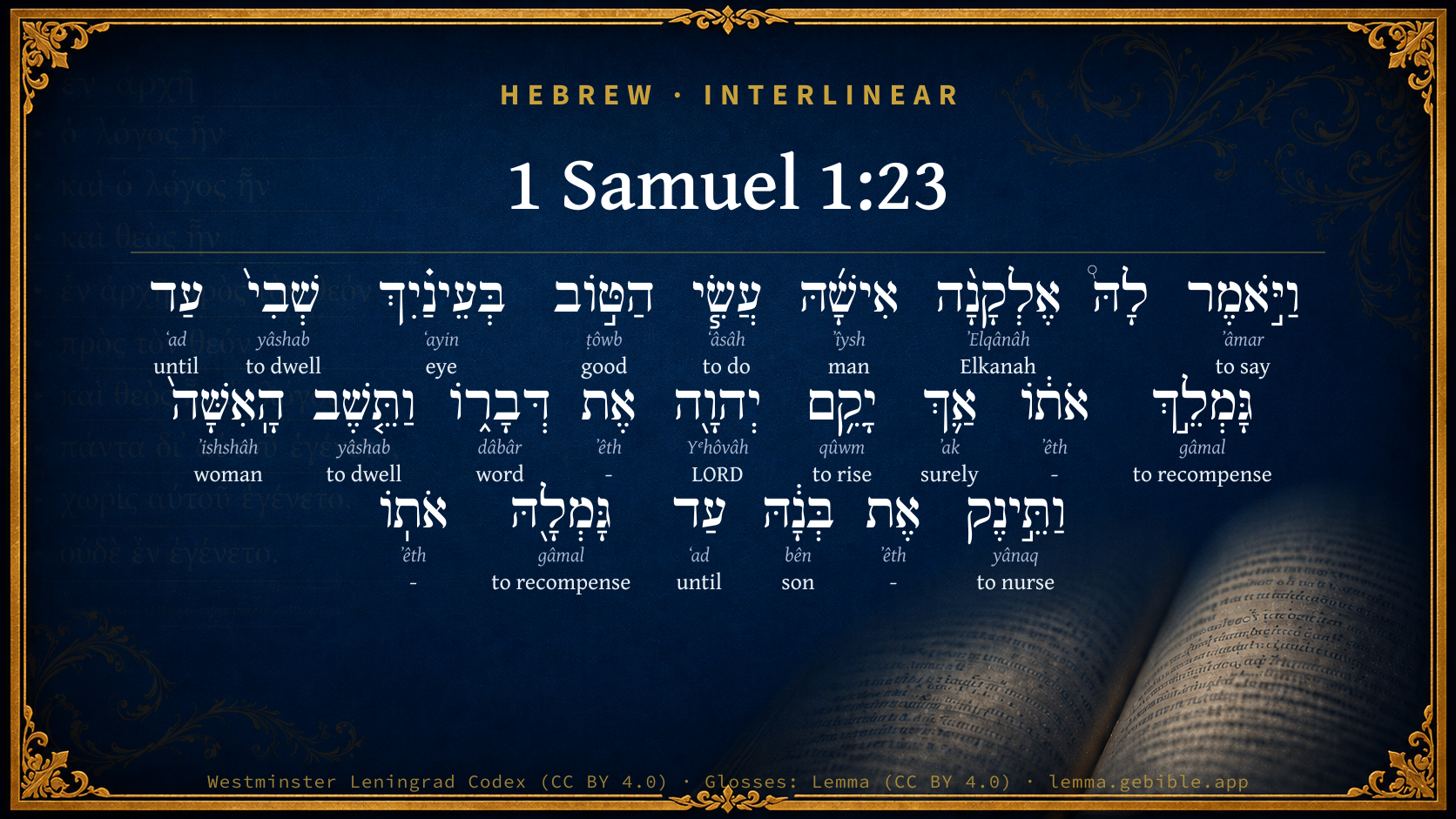
1 Samuel 1:23

Hebrew (Westminster Leningrad Codex) 1 Samuel 1:23 appears in the Hebrew Old Testament. The text above is from the Westminster Leningrad Codex. Each word links to its Strong’s number, a concise gloss, and parsing drawn from the Open Scriptures Hebrew Bible morphology. Click any word for its full Brown-Driver-Briggs (BDB) entry.
Download image
Cite this verse

1 Samuel 1:23 (World English Bible). Public Domain. Lemma interlinear Bible study tool, https://lemma.gebible.app/v/1-samuel/1/23.

Show BibTeX & RIS
BibTeX
RIS
English Translation
Elkanah her husband said to her, Do what seems you good; wait until you have weaned him; only Yahweh establish his word. So the woman waited and nursed her son, until she weaned him.
World English Bible · Public Domain
Download a study sheet

One document with this verse’s original text, its word-by-word gloss line, the meaning frame, cross-references with their text, attributed commentary, and full source and license credits — printable, and it pastes into notes with its structure intact.

This verse Autodidact and up

Study sheet (.html) Plain text (.txt)

A passage Seminary Student

Up to 50 verses in one chapter. A passage sheet keeps up to 6 commentary sources and 12 cross-references per verse, in the order this page ranks them, and says so on the sheet whenever that leaves anything out. Ask for a single verse and you get the Autodidact verse sheet above.

Everything on this page stays free to read, with no account — the sheet is a download of what is already on screen, not access to it.

Want to remove ads? Support Godless Engineer
Compare translations 3

The same verse in 3 English versions, stacked beneath the original-language interlinear above. Click any original word for its lexicon entry.

Each is an independent rendering of the whole verse — the interlinear is not word-aligned to these translations.

Highlighted words mark where these versions differ — a whole-verse word diff, not a word-by-word alignment.

  • World English Bible Public Domain
    Elkanah her husband said to her, Do what seems you good; wait until you have weaned him; only Yahweh establish his word. So the woman waited and nursed her son, until she weaned him.
  • King James Version Public Domain
    And Elkanah her husband said unto her, Do what seemeth thee good; tarry until thou have weaned him; only the LORD establish his word. So the woman abode, and gave her son suck until she weaned him.
  • unfoldingWord Literal Text CC BY-SA 4.0
    And Elkanah her husband said to her, “Do the good in your eyes. Stay until you have weaned him. Only may Yahweh raise up his word.” And the woman stayed and nursed her son until she had weaned him.

unfoldingWord Literal Text — © unfoldingWord, licensed CC BY-SA 4.0. Word-aligned USFM3 via Door43 (git.door43.org/unfoldingWord/en_ult).

Versions to compare (up to 4)

3 of 4 selected

Show all 18 translations

Every available English version of this verse, each an independent rendering of the whole verse.

  • World English Bible Public Domain
    Elkanah her husband said to her, Do what seems you good; wait until you have weaned him; only Yahweh establish his word. So the woman waited and nursed her son, until she weaned him.
  • Berean Standard Bible Public Domain
    “Do what you think is best,” her husband Elkanah replied, “and stay here until you have weaned him. Only may the LORD confirm His word.” So Hannah stayed and nursed her son until she had weaned him.
  • Majority Standard Bible Public Domain
    “Do what you think is best,” her husband Elkanah replied, “and stay here until you have weaned him. Only may the LORD confirm His word.” So Hannah stayed and nursed her son until she had weaned him.
  • King James Version Public Domain
    And Elkanah her husband said unto her, Do what seemeth thee good; tarry until thou have weaned him; only the LORD establish his word. So the woman abode, and gave her son suck until she weaned him.
  • American Standard Version (1901) Public Domain
    And Elkanah her husband said unto her, Do what seemeth thee good; tarry until thou have weaned him; only Jehovah establish his word. So the woman tarried and gave her son suck, until she weaned him.
  • Revised Version (1885) Public Domain
    And Elkanah her husband said unto her, Do what seemeth thee good; tarry until thou have weaned him; only the LORD establish his word. So the woman tarried and gave her son suck, until she weaned him.
  • Geneva Bible (1599) Public Domain
    And Elkanah her husband sayd vnto her, Do what seemeth thee best: tarie vntill thou hast weined him: only the Lord accomplish his word. So the woman abode, and gaue her sonne sucke vntill she weined him.
  • Douay-Rheims (1899) Public Domain
    And Elcana her husband said to her: Do what seemeth good to thee, and stay till thou wean him: and I pray that the Lord may fulfil his word. So the woman stayed at home, and gave her son suck, till she weaned him.
  • Young's Literal Translation Public Domain
    And Elkanah her husband saith to her, `Do that which is good in thine eyes; abide till thy weaning him; only, Jehovah establish His word;' and the woman abideth and suckleth her son till she hath weaned him,
  • Literal Standard Version CC BY-SA 4.0
    And her husband Elkanah says to her, “Do that which is good in your eyes; abide until your weaning him; only, let YHWH establish His word”; and the woman abides and suckles her son until she has weaned him,
  • Unlocked Literal Bible CC BY-SA 4.0
    Elkanah her husband said to her, “Do what seems good to you. Wait until you have weaned him; only, may Yahweh confirm his word.” So the woman stayed and nursed her son until she weaned him.
  • unfoldingWord Literal Text CC BY-SA 4.0
    And Elkanah her husband said to her, “Do the good in your eyes. Stay until you have weaned him. Only may Yahweh raise up his word.” And the woman stayed and nursed her son until she had weaned him.
  • Darby Bible Public Domain
    And Elkanah her husband said to her, Do what is good in thy sight: abide until thou hast weaned him; only, may Jehovah fulfil his word. And the woman abode, and gave her son suck until she weaned him.
  • World Messianic Bible Public Domain
    Elkanah her husband said to her, “Do what seems good to you. Wait until you have weaned him; only may the LORD establish his word.” So the woman waited and nursed her son until she weaned him.
  • Webster's Bible Public Domain
    And Elkanah her husband said to her, Do what seemeth to thee good; tarry until thou hast weaned him; only the LORD establish his word. So the woman abode, and nursed her son until she weaned him.
  • Free Bible Version CC BY-SA 4.0
    “Do as you see fit,” her husband Elkanah replied. “Stay here until you have weaned him. May the Lord fulfill what he has said.” So Hannah stayed behind and nursed her son until she had weaned him.
  • Bible in Basic English Public Domain
    And her husband Elkanah said to her, Do whatever seems right to you, but not till you have taken him from the breast; only may the Lord do as he has said. So the woman, waiting there, gave her son milk till he was old enough to be taken from the breast.
  • JPS Tanakh (1917) Public Domain
    And Elkanah her husband said unto her: 'Do what seemeth thee good; tarry until thou have weaned him; only the LORD establish His word.' So the woman tarried and gave her son suck, until she weaned him.

Literal Standard Version (2020), Covenant Press — licensed CC BY-SA 4.0. Text via the HelloAO Bible API (eBible.org). Unlocked Literal Bible (unfoldingWord) — licensed CC BY-SA 4.0. Text via the HelloAO Bible API (eBible.org). unfoldingWord Literal Text — © unfoldingWord, licensed CC BY-SA 4.0. Word-aligned USFM3 via Door43 (git.door43.org/unfoldingWord/en_ult). Free Bible Version, Dr. Jonathan Gallagher — licensed CC BY-SA 4.0. Text via the HelloAO Bible API (eBible.org).

Word by word

More ways to search: Search by grammar → Find every occurrence → Compare this word →

Practice this passage: Drill this verse → Learn its vocabulary →

אֶלְקָנָ֨ה
ʼElqânâh
H511
“Elkanah”
Noun, Proper
Part of Speech
Noun
Type
Proper
Full BDB Definition

Origin: from H410 and H7069

TWOT: None

Elkanah = "God has possessed" or " God has created" - Samuel's father - a ruler in Jerusalem in the time of king Ahaz - one of David's mighty warriors - son of Korah - several Levites
  1. וַיֹּ֣אמֶר ʼâmar H559 “and · to say” Conjunction + Verb, Qal, Sequential Imperfect, 3rd Person, Masculine, Singular
  2. אִישָׁ֜הּ ʼîysh H376 “man · her” Noun, Common, Masculine, Singular, Construct + Suffix, Personal, 3rd Person, Feminine, Singular
  3. עֲשִׂ֧י ʻâsâh H6213 “do” Verb, Qal, Imperative, 2nd Person, Feminine, Singular
  4. הַטּ֣וֹב ṭôwb H2896 “the · good” Particle, Definite Article + Adjective, Adjective, Masculine, Singular, Absolute
  5. בְּעֵינַ֗יִךְ ʻayin H5869 “in/at · eyes · your” Preposition + Noun, Common, Both, Dual, Construct + Suffix, Personal, 2nd Person, Feminine, Singular
  6. שְׁבִי֙ yâshab H3427 “dwell” Verb, Qal, Imperative, 2nd Person, Feminine, Singular
  7. עַד ʻad H5704 “until” Preposition
  8. גָּמְלֵ֣ךְ gâmal H1580 “to recompense · you” Verb, Qal, Infinitive Construct + Suffix, Personal, 2nd Person, Feminine, Singular
  9. אֹת֔וֹ ʼêth H853 “- · him” Particle, Direct Object + Suffix, Personal, 3rd Person, Masculine, Singular
  10. אַ֛ךְ ʼak H389 “surely” Particle, Accusative
  11. יָקֵ֥ם qûwm H6965 “to rise” Verb, Hiphil, Jussive, 3rd Person, Masculine, Singular
  12. יְהוָ֖ה Yᵉhôvâh H3068 “LORD” Noun, Proper
  13. אֶת ʼêth H853 “-” Particle, Direct Object
  14. דְּבָר֑וֹ dâbâr H1697 “word · his” Noun, Common, Masculine, Singular, Construct + Suffix, Personal, 3rd Person, Masculine, Singular
  15. וַתֵּ֤שֶׁב yâshab H3427 “and · to dwell” Conjunction + Verb, Qal, Sequential Imperfect, 3rd Person, Feminine, Singular
  16. הָֽאִשָּׁה֙ ʼishshâh H802 “the · woman” Particle, Definite Article + Noun, Common, Feminine, Singular, Absolute
  17. וַתֵּ֣ינֶק yânaq H3243 “and · to nurse” Conjunction + Verb, Hiphil, Sequential Imperfect, 3rd Person, Feminine, Singular
  18. אֶת ʼêth H853 “-” Particle, Direct Object
  19. בְּנָ֔הּ bên H1121 “son · her” Noun, Common, Masculine, Singular, Construct + Suffix, Personal, 3rd Person, Feminine, Singular
  20. עַד ʻad H5704 “until” Preposition
  21. גָּמְלָ֖הּ gâmal H1580 “to recompense · her” Verb, Qal, Infinitive Construct + Suffix, Personal, 3rd Person, Feminine, Singular
  22. אֹתֽוֹ ʼêth H853 “- · him” Particle, Direct Object + Suffix, Personal, 3rd Person, Masculine, Singular

About this verse

These counts appear in no published source. They are computed here, from the morphology-tagged text and Lemma’s own curated glosses. What Lemma adds →

24
words
17
distinct lemmas
Historical
section

Notable vocabulary

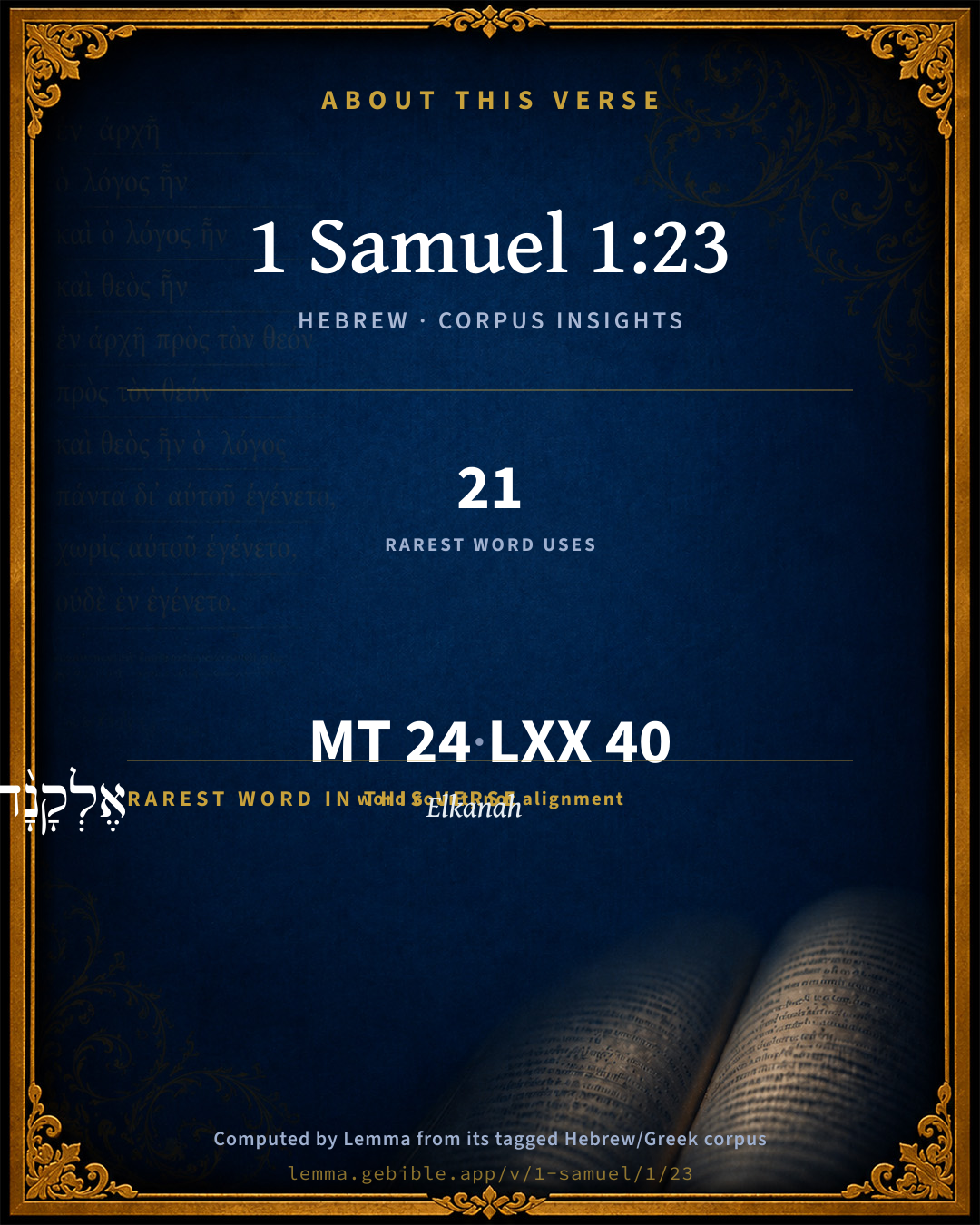
The rarest word here is אֶלְקָנָ֨ה Elkanah H511 — appearing just 21 times in the whole Hebrew Bible.

Shared distinctive vocabulary

אֶלְקָנָ֨ה Elkanah H511 occurs in 20 verses of the Hebrew Bible. Also found in:

Grammatical profile

  • 8 verbs
  • 7 nouns
  • 1 adjective
  • 3 prepositions
  • 5 particles

Verb forms

  • וַיֹּ֣אמֶר Qal · Sequential Imperfect
  • עֲשִׂ֧י Qal · Imperative
  • שְׁבִי֙ Qal · Imperative
  • גָּמְלֵ֣ךְ Qal · Infinitive Construct
  • יָקֵ֥ם Hiphil · Jussive
  • וַתֵּ֤שֶׁב Qal · Sequential Imperfect
  • וַתֵּ֣ינֶק Hiphil · Sequential Imperfect
  • גָּמְלָ֖הּ Qal · Infinitive Construct

Repetition

Words recur within this verse — often emphatic in Hebrew:

  • שְׁבִי֙ to dwell H3427 ×2
  • עַד until H5704 ×2
  • גָּמְלֵ֣ךְ to recompense H1580 ×2

Hebrew & Septuagint length

In English translation the verse runs 34 words from the Hebrew and 48 from the Septuagint (LXX English) — the Septuagint runs noticeably longer here. See the side-by-side →

A rough comparison of the two English renderings, which tokenize alike — not a word-level alignment.

Word counts can differ between the Hebrew and the Greek without any difference in meaning — e.g. the Hebrew direct-object marker אֵת has no separate Greek word, and Greek often adds the article ὁ.

In the original languages it is 24 Hebrew tokens and 40 Greek tokens — but the two are counted differently (Hebrew bundles its prefixes and suffixes into one token; the Greek is in lemma form), so that isn’t a like-for-like length.

Cross-references

8

Topical passages linked to 1 Samuel 1:23 in the Treasury of Scripture Knowledge — connected by theme and wording, ordered by reader-vote popularity; previews shown in the World English Bible.

  • 2 Samuel 7:25 Now, Yahweh God, the word that you have spoken concerning your servant, and concerning his house, confirm you it forever, and do as you have spoken.
  • Genesis 21:7–8 She said, "Who would have said to Abraham, that Sarah would nurse children? For I have borne him a son in his old age."
  • Numbers 30:7–11 and her husband hear it, and hold his peace at her in the day that he hears it; then her vows shall stand, and her bonds with which she has bound her soul shall stand.
  • 1 Samuel 1:17 Then Eli answered, Go in peace; and the God of Israel grant your petition that you have asked of him.
  • Psalms 22:9 But you brought me out of the womb. You made me trust at my mother's breasts.
  • Isaiah 44:26 who confirms the word of his servant, and performs the counsel of his messengers; who says of Jerusalem, She shall be inhabited; and of the cities of Judah, They shall be built, and I will raise up the waste places of it;
  • Matthew 24:19 But woe to those who are with child and to nursing mothers in those days!
  • Luke 11:27 It came to pass, as he said these things, a certain woman out of the multitude lifted up her voice, and said to him, "Blessed is the womb that bore you, and the breasts which nursed you!"

Cross-references courtesy of OpenBible.info (CC BY 4.0).

Hebrew and Greek witnesses Masoretic Hebrew ↔ Greek Septuagint

The same verse in the two great witnesses to the Old Testament, shown verse-for-verse.

Here the Septuagint runs noticeably longer than the Hebrew — LXX2012 (modern English Septuagint) 48 words vs World English Bible 34. A rough length comparison of the two English translations, not a word-level alignment — read both below.

These are two independent witnesses, not word-aligned to each other, and the Septuagint is shown in lemma (dictionary) form.

Hebrew 1 Samuel 1:23 Masoretic · Westminster Leningrad Codex

וַיֹּ֣אמֶר לָהּ֩ אֶלְקָנָ֨ה אִישָׁ֜הּ עֲשִׂ֧י הַטּ֣וֹב בְּעֵינַ֗יִךְ שְׁבִי֙ עַד גָּמְלֵ֣ךְ אֹת֔וֹ אַ֛ךְ יָקֵ֥ם יְהוָ֖ה אֶת דְּבָר֑וֹ וַתֵּ֤שֶׁב הָֽאִשָּׁה֙ וַתֵּ֣ינֶק אֶת בְּנָ֔הּ עַד גָּמְלָ֖הּ אֹתֽוֹ

Elkanah her husband said to her, Do what seems you good; wait until you have weaned him; only Yahweh establish his word. So the woman waited and nursed her son, until she weaned him.

World English Bible · Public Domain

Greek LXX 1 Samuel 1:23 Septuagint · lemma form

καί εἶπον αὐτός ελκανα ὁ ἀνήρ αὐτός ποιέω ὁ ἀγαθός ἐν ὀφθαλμός σύ καταἧμαι ἕως ἄν ἀπογαλακτίζω αὐτός ἀλλά ἵστημι κύριος ὁ ἐκἔρχομαι ἐκ ὁ στόμα σύ καί καταἵζω ὁ γυνή καί θηλάζω ὁ υἱός αὐτός ἕως ἄν ἀπογαλακτίζω αὐτός

And Helkana her husband said to her, Do that which is good in your eyes, abide still until you shall have weaned him; but may the Lord establish that which comes out of your mouth: and the woman tarried, and suckled her son until she had weaned him.

LXX2012 (modern English Septuagint) · Public Domain

On this verse, Keil & Delitzsch discusses the Septuagint’s reading. Read the note in Commentary ↓

Hebrew: Westminster Leningrad Codex (CC BY 4.0). Greek: Septuagint (public domain); English from LXX2012 (modern English Septuagint) (Public Domain). How the Septuagint differs from the Hebrew →

Targum (Aramaic paraphrase)

1

The Targum is the ancient Jewish Aramaic paraphrase of the Hebrew Scriptures — an interpretive translation, not the Hebrew text itself. Onkelos (literal) and Pseudo-Jonathan (expansive) render the Torah, and Jonathan the Prophets. Coverage is partial: where no permissively-licensed English translation exists for a verse, only the Aramaic is shown. This is verse-level text, not a word-by-word alignment to the Hebrew.

  1. Targum Jonathan Prophets (Joshua–Malachi)
    וַאֲמַר לָהּ אֶלְקָנָה בַעֲלָהּ עֶבִידִי כִּדְתַקִין בְּעֵינַיְכִי אוֹרִיכִי עַד דְתַחְסְלִין יָתֵיהּ בְּרַם יְקַיֵם יְיָ יַת פִּתְגָמוֹהִי וְאוֹרִיכַת אִתְּתָא וְאוֹנִיקַת יַת בְּרָהּ עַד דַחֲסִילַת יָתֵיהּ:

    (no public-domain English translation for this verse)

    Targum Jonathan — Aramaic: “Mikraot Gedolot” (public domain). English: “Sefaria Community Translation” (CC0 1.0 (public-domain dedication)); “London "Chaldee Paraphrase," 1871” (public domain). Text via Sefaria.

Commentary

Notes on 1 Samuel 1:23 from classic Christian and Jewish commentators (each source and its license shown beneath its notes). The classic Christian expositions comment on the surrounding passage and are grouped to its opening verse, so a note may address several verses; the Jewish commentaries on the Tanakh (Rashi and others) are per-verse, so they appear only where the commentator wrote on this verse.

Lemma curates 59 commentaries, every one of them public domain or Creative Commons licensed, each selected and text-cleaned for this edition rather than reprinted as found. About our sources →

Trapp's Complete Commentary

John Trapp

1Sa 1:23 And Elkanah her husband said unto her, Do what seemeth thee good; tarry until thou have weaned him; only the LORD establish his word. So the woman abode, and gave her son suck until she weaned him.

Ver. 23. Do what seemeth thee good.] Wives must be gratified in their lawful and reasonable requests.

Only the Lord establish.] Perfect what he hath begun.

John Trapp, A Commentary or Exposition upon All the Books of the Old and New Testament (1647–1656) — public domain. Text from a community e-Sword module.

The Biblical Illustrator

Joseph S. Exell

1Sa_1:23

And Elkanah her husband said unto her.

The father must take his part in the spiritual culture of children

It is a poor manhood and a dishonourable, neglectful fatherhood that leaves all the religious life and devotion of children to the mother or to others, and it must be disreputable before the Lord. Nor is the blameworthiness avoided by the habit of urging the claims of the busy life of our days. If any father thinks that saving a little more money for the children, or in order to give them better social position and appearance, is of greater importance than his own careful nurture of them in the love of Christ and in consecration to the Lord, then to God he will have to answer for the folly of his judgment and the evil of his practice and neglect. If the father does not hope in God for the children, as well as the mother tend them for the Lord, life must have sorrowful mistakes, if not miserable wrecks. The mother at home watches over the child for the Lords sake in many homes, stud what does the father do? Is it only careless, irreverent agreement that he gives to the life plans of the mother for the souls of the sons and daughters; or, recognising in the mothers love and devotion the will of God, does he at least lift up all his heart in prayer to God that the Lord would establish His word of promise by accepting, for all rims and eternity, the little ones whom He has given? We--men and fathers--have our part in the consecration of the children as well as the mothers who watch them through the perils of their infancy; and if our hands do not touch the children so often as do the mothers, in watchfulness and guidance, yet should our hearts the more wait on God in longing for the establishment of His word of hope. No father can without sin delegate all the spiritual nurture of his children to their mother; still less can he, without guilt, hand it over to a stranger in school or church. (G. B. Ryley.)

Early training of children

He would be a foolish gardener who never pruned or nailed up a delicate fruit tree till the branches carried their young leaves and open blossoms. No! train and guide for the coming blossoming time; and when it comes the sweet growth of hearts accepted in the Beloved and in the covenant will be provided by the Spirit of life. Thus Hannah trained her little Samuel to recognise himself as dedicated to the Lord; and, as we shall soon see, she had not long to wait for the childs ratification of her vow. (G. B. Ryley.)

The Biblical Illustrator, edited by Joseph S. Exell (c. 1880s–1900s) — public domain. Text from a community e-Sword module.

Joseph Benson's Commentary

1Sa 1:23. Only the Lord establish his word — We do not read of any thing the Lord had spoken about this child: but, perhaps Elkanah looked upon what Eli had said as spoken by God, because he was God’s high-priest. The Hebrew, however, may be rendered with equal propriety, The Lord establish his work; that is, may he perfect what he hath begun, by making the child grow up, and become fit for God’s service, that he may be employed therein and accepted of God. For the word דברdabar, signifies any matter or thing, as well as word.

Joseph Benson's Commentary on the Old and New Testaments (1811–1818) — public domain. Text from a community e-Sword module.

Tyndale Open Study Notes

Tyndale Open Resources

1:23 Elkanah could have overridden Hannah’s promise (Num 30:12-14), but instead he affirmed and supported it.

Tyndale Open Study Notes — © Tyndale Open Resources, licensed CC BY-SA 4.0. Text via the HelloAO Bible API.

Geneva Bible (1599)

Geneva Bible translators

Because her prayer took effect, therefore it was called the Lord’s promise.

Geneva Bible (1599) marginal notes — public domain. Text via Bolls.life.

Adam Clarke's Commentary

Verse 23. Until thou have weaned him] On the nature of this weaning, and the time in which it was usually done, the reader will be pleased to refer to Clarke's note on "Ge 21:8".

The Lord establish his word.] Or, may the Lord establish his word-preserve the child, cause him to grow up, and make him a blessing to Israel.

Adam Clarke's Commentary on the Bible (1810–1826) — public domain. Text from a community e-Sword/MySword module.

Ellicott's Commentary for English Readers

(23) Only the Lord establish his word.—No special word or promise of the Eternal in the case of the infant Samuel is recorded in this history; but there was an ancient Rabbinical tradition that a direct revelation respecting the future destiny of Samuel was made. “The Bath-kol (Daughter of the Voice) went forth, saying, There shall arise a just one, whose name shall be Samuel. Then every mother who bore a son called him Samuel; but when they saw his actions, they said, This is not Samuel. But when this one was born, they said, This is that Samuel, and this is what the Scripture means when it says, ‘The Lord confirmed his word that Samuel may be that just one.’”—Rashi.

If we decline to accept the Rabbinical tradition, Bunsen’s simple comment will explain the difficult words of the text, “establish his word”: that is, may the Lord fulfil what He designs with him, and has promised by his birth.

A Bible Commentary for English Readers, edited by Charles John Ellicott (1878–1897) — public domain. Text from a community e-Sword module.

The Cambridge Bible for Schools and Colleges

gen. ed. J. J. S. Perowne

23. his word] No express promise of a son has been mentioned; Eli’s blessing in 1Sa_1:17 can scarcely be understood as such. But Samuel’s birth implied that Hannah’s prayer was heard, and Elkanah prays that it may receive a complete fulfilment. The Sept. reads “The Lord establish that which is gone forth out of thy mouth.”

The Cambridge Bible for Schools and Colleges (gen. ed. J. J. S. Perowne; Cambridge University Press, 1878–1918) — public domain. Text from a community e-Sword module.

John Gill's Exposition

And Elkanah her husband said unto her, do what seemeth thee good,.... He spake like a kind and indulgent husband, knowing that she would not thereby break any law of God; and it might be more for her own health, and the health of the child, to stay longer:

tarry till thou have weaned him; when he would be more fit for the journey, and to be left behind:

only the Lord establish his word; which some understand of the prophecy of Eli that God would grant her request, which being delivered under the direction of the Spirit of God, is called his word; but this was already fulfilled, and established by Hannah's bearing a son: or the word "his" refers not to the Lord, but to Samuel, and so may respect the word which his mother spake concerning him; either when she made her vow, as Abendana, that he should be a perpetual Nazarite, and the Lord's as long as he lived: and so Elkanah wishes that he might have health and grow strong, and be fit for the service of the Lord, and live many years to perform it; or what she had just now said, as Abarbinel, that he should abide in the house of God for ever, or as long as he lived:

so the woman abode; at home, while Elkanah and his family went up to Shiloh:

and gave her son suck until she weaned him; did not put him out to a wet or dry nurse, but suckled him herself with what nature had provided for his nourishment, as becomes women to do, if their circumstances of health, and the provisions of nature, will admit of it.

John Gill's Exposition of the Whole Bible (1746–1763) — public domain (CC PDM 1.0). Text via the HelloAO Bible API.

Haydock's Catholic Bible Commentary

Word, by preserving the life of the child, (Calmet) and enabling him to serve according to our engagement. (Haydock) --- Word is often put for "a thing," in Hebrew. May God perfect his own work. (Menochius)

George Leo Haydock (1774–1849), Haydock's Catholic Family Bible and Commentary, 1859 edition — public domain. Excludes Psalms (Douay-Rheims chapter numbering differs from Protestant) and Deuterocanonical books (Catholic canon only).

Matthew Poole's English Annotations

The Lord establish his word; either, first, The word of God made known to them by Eli, above, 1Sa 4:17, which being delivered by God’s high priest, and that in answer to his and his wife’s prayers, he took to be a kind of oracle sent from God. But that word was already fulfilled in the birth of a son. Or, secondly, Some other word or message from God to Elkanah or his wife concerning Samuel; for such revelations were frequent in those ages of the church, and were oft vouchsafed by God, concerning such children as were extraordinary persons, or in a special manner devoted to God; as concerning Isaac, Ge 18, and Samson, Jdg 13:3,4, and John Baptist, Luk 1:13,14, &c., and others. And so it might be here, though it were not mentioned before, there being many such things in Scripture omitted in their proper places, which afterwards are expressed or implied upon other occasions. Or rather, thirdly, It may be rendered his matter, or thing, i.e. the business concerning the child, that which thou hast promised or vowed concerning him, that he may grow up, and be accepted and employed by God in his service; and that he, when he is fully grown, may not break thy vow, but confirm it.

Matthew Poole's English Annotations on the Holy Bible (1683–1685) — public domain. Text from a community e-Sword/MySword module.

Whedon's Commentary on the Bible

Daniel D. Whedon

23. Only the Lord establish his word — What word Elkanah here refers to is not clear. Some, taking דבר, word, in the sense of matter or thing, a meaning which it sometimes has, paraphrase the sentence thus: The Lord carry out and perfect what he has begun in the case of this child. Others suppose that reference is made to some special revelation concerning the mission and destiny of Samuel, which the sacred writers have not recorded. But it is better to understand by his word, the benediction of Eli, 1Sa_1:17 — “the God of Israel grant thee thy petition.” According to this view the parents of Samuel regarded the high priest’s prayer as a prophecy — the word of God respecting Hannah’s prayer for a child, and her vow to consecrate such child to the divine service.

Daniel D. Whedon (gen. ed.), Commentary on the Old and New Testaments (1874–1909) — public domain. Text from a community e-Sword module.

John Wesley's Explanatory Notes

His word - His matter or thing; the business concerning the child, what thou hast vowed concerning him, that be may grow up, and be accepted and employed by God in his Service.

John Wesley, Explanatory Notes Upon the Whole Bible (1754–1765) — public domain. Text via the GEBible commentary corpus.

Keil & Delitzsch

C. F. Keil & F. Delitzsch

Elkanah expressed his approval of Hannah's decision, and added, "only the Lord establish His word," i.e., fulfil it. By "His word" we are not to understand some direct revelation from God respecting the birth and destination of Samuel, as the Rabbins suppose, but in all probability the word of Eli the high priest to Hannah, "The God of Israel grant thy petition" (Sa1 1:17), which might be regarded by the parents of Samuel after his birth as a promise from Jehovah himself, and therefore might naturally excite the wish and suggest the prayer that the Lord would graciously fulfil the further hopes, which the parents cherished in relation to the son whom they had dedicated to the Lord by a vow. The paraphrase of דּברו in the rendering given by the lxx, τὸ ἐξελθὸν ὲκ τοῦ στόματός σου, is the subjective view of the translator himself, and does not warrant an emendation of the original text.

Keil & Delitzsch — Biblical Commentary on the Old Testament (1861–1891) — public domain (CC PDM 1.0). Text via the HelloAO Bible API. (Old Testament only.)

Rashi

Rabbi Shlomo Yitzchaki (Rashi)

But may Adonoy fulfill His word. Because you requested of Him male offspring, and Eili foretold you through Divine inspiration, "the God of Yisroel will grant your request," may 'ה fulfill His word. This is the simple interpretation. In Midrash Aggadah, however, Rabbi Nechemyah said in the name of Rabbi Shmuel, the son of Rabbi Yitzchok: Every day a Divine voice would resound throughout the world and say, "A righteous man is destined to arise, by the name of Shmuel." Thereupon, every woman who bore a son, would name him Shmuel. Once they saw his deeds, they would say, "This is not [the] Shmuel." But when this one [Shmuel] was born and people saw his deeds, they said, "Apparently this one is the one [i.e., expected righteous man]." This is what he [Elkonoh] meant when he said, "May Adonoy fulfill His word," i.e., that this be the righteous Shmuel.

Rashi on the Tanakh — English translations: “The Judaica Press complete Tanach with Rashi, translated by A. J. Rosenberg” (CC BY 4.0); “Pentateuch with Rashi's commentary by M. Rosenbaum and A.M. Silbermann, 1929-1934” (public domain); “The Metsudah Tanach series, Lakewood, N.J” (CC BY 4.0); and “The Book of Joshua, Metsudah Publications, 1997” (CC BY 4.0). Text via Sefaria.

Radak

Rabbi David Kimhi (Radak)

May the Lord fulfill His word: The verses show that what Eli said (I Samuel 1:17), "May (the Lord) grant what you have asked," was by way of prophecy - that the Lord would grant her what she asked. And behold what she asked was that she should have offspring of men and that he should be for the Lord. Hence [Elkanah] said, "May the Lord fulfill His word" - the explanation of which is, that which he spoke through the prophet, that He will grant you what you asked. And that is a son that will live and who will be for the Lord. And in the homiletical teachings: "But may the Lord fulfill His word" - every day, a heavenly voice would come out and clamor in the world and say, "In the future, a righteous one will arise, and his name is Shmuel." So every woman who would give birth to a son, would bring out his name as Shmuel. Once they saw his deeds, they would say, "This is not Shmuel." When this one was born and they saw his deeds, they said, "It appears that this is he." And that is what is written, "May the Lord fulfill His word"

Radak on the Tanakh — English translations: “Sefaria Community Translation” (CC0 1.0 (public-domain dedication)); “Eliyahu Munk, HaChut Hameshulash” (CC BY 4.0); “Rabbi Mike Feuer, Jerusalem Anthology” (CC BY 4.0); and “R. David Kimhi on the first book of Psalms, Translated by R.G. Finch, London, 1919” (public domain). Text via Sefaria.

Lesson kit

Teaching starters — assembled from the data on this page, not authored interpretation. Every prompt links to the verse data it draws on. Edit before teaching.

1 Samuel, in the Historical, opens this verse with 24 words (17 distinct Hebrew lemmas). Its most distinctive word is ʼElqânâh (“Elkanah”). The Greek Septuagint runs longer here. A historical commentator’s framing appears above. Read the whole chapter for the surrounding context.

Discussion questions

  1. What does “Elkanah” (ʼElqânâh) contribute to the verse as a whole?
  2. Exodus 6:24 shares the word «Elkanah» with this verse. How do the two illuminate each other?
  3. “to dwell” occurs 2× in this one verse. What is the effect of the repetition?
  4. Compared with the Hebrew, the Septuagint runs longer here. What questions does that raise?
  5. These translations render this verse differently. What is at stake in choosing one wording over another?
  6. The verb «וַיֹּ֣אמֶר» is Qal Sequential Imperfect. How does its form color the action?
  7. Reading how Trapp's Complete Commentary and The Biblical Illustrator read this verse, where do the two commentators agree and where do they part?

Things to notice

Reading settings

Reading text

Shown beneath each verse's original-language words.

Old Testament
Old Testament edition

Read the OT as the Masoretic Hebrew (MT) or the Greek Septuagint (LXX).

English shown for the Greek Septuagint (in the Hebrew ↔ Greek comparison).

Comparing translations? Open the Compare panel on any verse page to stack up to four side by side.