Matthew 24:28

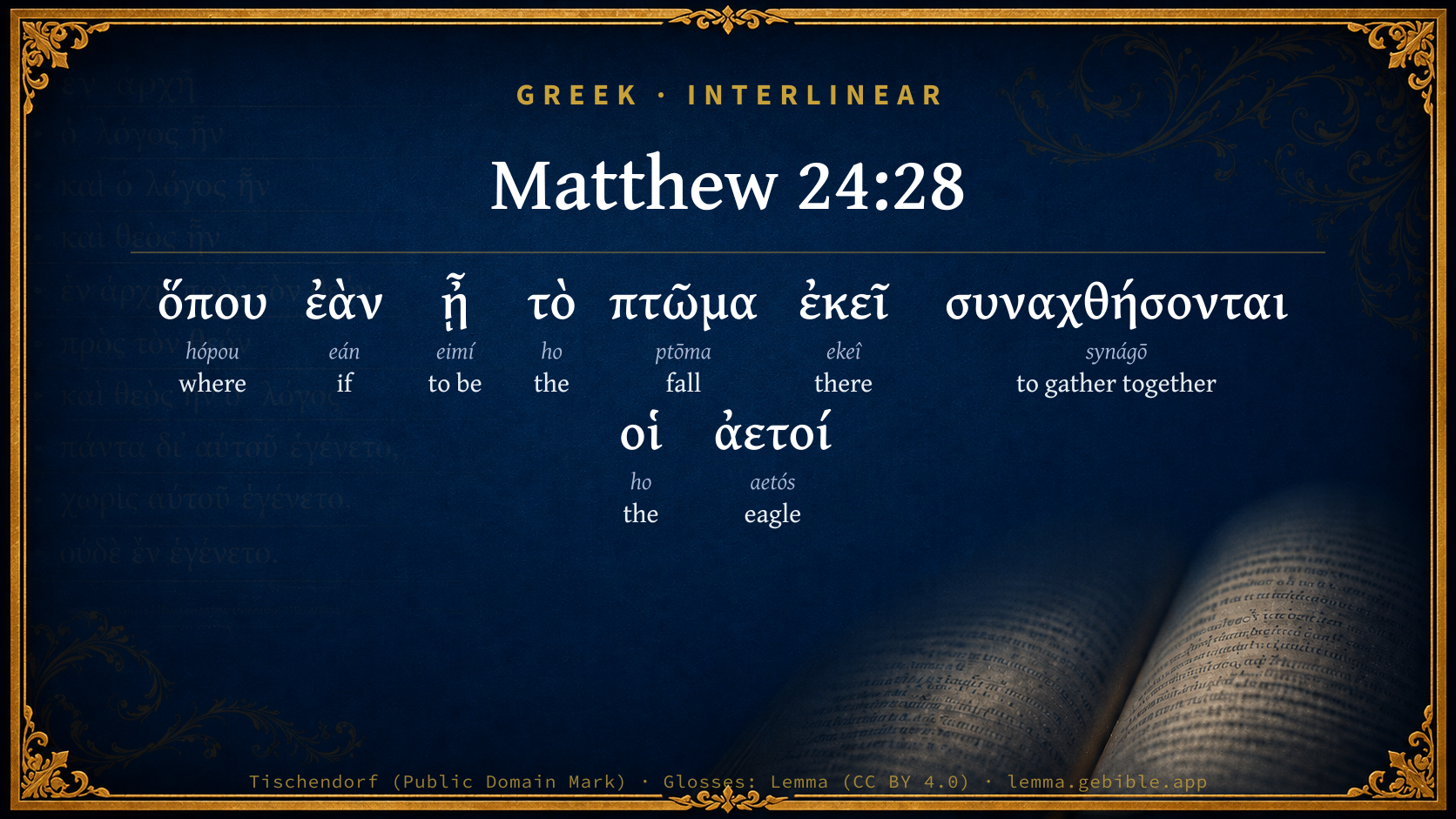
Greek (Tischendorf 8th ed.) Matthew 24:28 appears in the Greek New Testament. The text above is from the Tischendorf 8th edition. Each word links to its Strong’s number and a concise gloss. Click any word for its full Thayer’s Greek Lexicon entry.
Download image
Cite this verse

Matthew 24:28 (World English Bible). Public Domain. Lemma interlinear Bible study tool, https://lemma.gebible.app/v/matthew/24/28.

Show BibTeX & RIS
BibTeX
RIS
English Translation
For wherever the carcass is, there will the vultures be gathered together.
World English Bible · Public Domain
Highlights
  • 1 first appearance in the Greek New Testament
Full analysis ↓
Download a study sheet

One document with this verse’s original text, its word-by-word gloss line, the meaning frame, cross-references with their text, attributed commentary, and full source and license credits — printable, and it pastes into notes with its structure intact.

This verse Autodidact and up

Study sheet (.html) Plain text (.txt)

A passage Seminary Student

Up to 50 verses in one chapter. A passage sheet keeps up to 6 commentary sources and 12 cross-references per verse, in the order this page ranks them, and says so on the sheet whenever that leaves anything out. Ask for a single verse and you get the Autodidact verse sheet above.

Everything on this page stays free to read, with no account — the sheet is a download of what is already on screen, not access to it.

Want to remove ads? Support Godless Engineer
Compare translations 3

The same verse in 3 English versions, stacked beneath the original-language interlinear above. Click any original word for its lexicon entry.

Each is an independent rendering of the whole verse — the interlinear is not word-aligned to these translations.

Highlighted words mark where these versions differ — a whole-verse word diff, not a word-by-word alignment.

  • World English Bible Public Domain
    For wherever the carcass is, there will the vultures be gathered together.
  • King James Version Public Domain
    For wheresoever the carcase is, there will the eagles be gathered together.
  • unfoldingWord Literal Text CC BY-SA 4.0
    Wherever the corpse is, there the vultures will be gathered.

unfoldingWord Literal Text — © unfoldingWord, licensed CC BY-SA 4.0. Word-aligned USFM3 via Door43 (git.door43.org/unfoldingWord/en_ult).

Versions to compare (up to 4)

3 of 4 selected

Show all 19 translations

Every available English version of this verse, each an independent rendering of the whole verse.

  • World English Bible Public Domain
    For wherever the carcass is, there will the vultures be gathered together.
  • Berean Standard Bible Public Domain
    Wherever there is a carcass, there the vultures will gather.
  • Majority Standard Bible Public Domain
    For wherever there is a carcass, there the vultures will gather.
  • King James Version Public Domain
    For wheresoever the carcase is, there will the eagles be gathered together.
  • American Standard Version (1901) Public Domain
    Wheresoever the carcase is, there will the eagles be gathered together.
  • Revised Version (1885) Public Domain
    Wheresoever the carcase is, there will the eagles be gathered together.
  • Geneva Bible (1599) Public Domain
    For wheresoeuer a dead carkeis is, thither will the Egles be gathered together.
  • Douay-Rheims (1899) Public Domain
    Wheresoever the body shall be, there shall the eagles also be gathered together.
  • Young's Literal Translation Public Domain
    for wherever the carcase may be, there shall the eagles be gathered together.
  • Literal Standard Version CC BY-SA 4.0
    for wherever the carcass may be, there the eagles will be gathered together.
  • Unlocked Literal Bible CC BY-SA 4.0
    Wherever a dead animal is, there the vultures will gather.
  • unfoldingWord Literal Text CC BY-SA 4.0
    Wherever the corpse is, there the vultures will be gathered.
  • Darby Bible Public Domain
    [For] wherever the carcase is, there will be gathered the eagles.
  • World Messianic Bible Public Domain
    For wherever the carcass is, that is where the vultures gather together.
  • Webster's Bible Public Domain
    For wherever the carcass is, there will the eagles be collected.
  • Free Bible Version CC BY-SA 4.0
    ‘Vultures gather where the carcass is.’
  • Bible in Basic English Public Domain
    Wherever the dead body is, there will the eagles come together.
  • Text-Critical English NT CC BY 4.0
    For where the carcass is, there the vultures will be gathered together.
  • Tyndale New Testament (1534) Public Domain
    For wheresoever a deed karkas is even thyther will the egles resorte.

Literal Standard Version (2020), Covenant Press — licensed CC BY-SA 4.0. Text via the HelloAO Bible API (eBible.org). Unlocked Literal Bible (unfoldingWord) — licensed CC BY-SA 4.0. Text via the HelloAO Bible API (eBible.org). unfoldingWord Literal Text — © unfoldingWord, licensed CC BY-SA 4.0. Word-aligned USFM3 via Door43 (git.door43.org/unfoldingWord/en_ult). Free Bible Version, Dr. Jonathan Gallagher — licensed CC BY-SA 4.0. Text via the HelloAO Bible API (eBible.org).

Word by word

More ways to search: Search by grammar → Find every occurrence → Compare this word →

Practice this passage: Drill this verse → Learn its vocabulary →

About this verse

These counts appear in no published source. They are computed here, from the morphology-tagged text and Lemma’s own curated glosses. What Lemma adds →

9
words
8
distinct lemmas
Gospels
section

Notable vocabulary

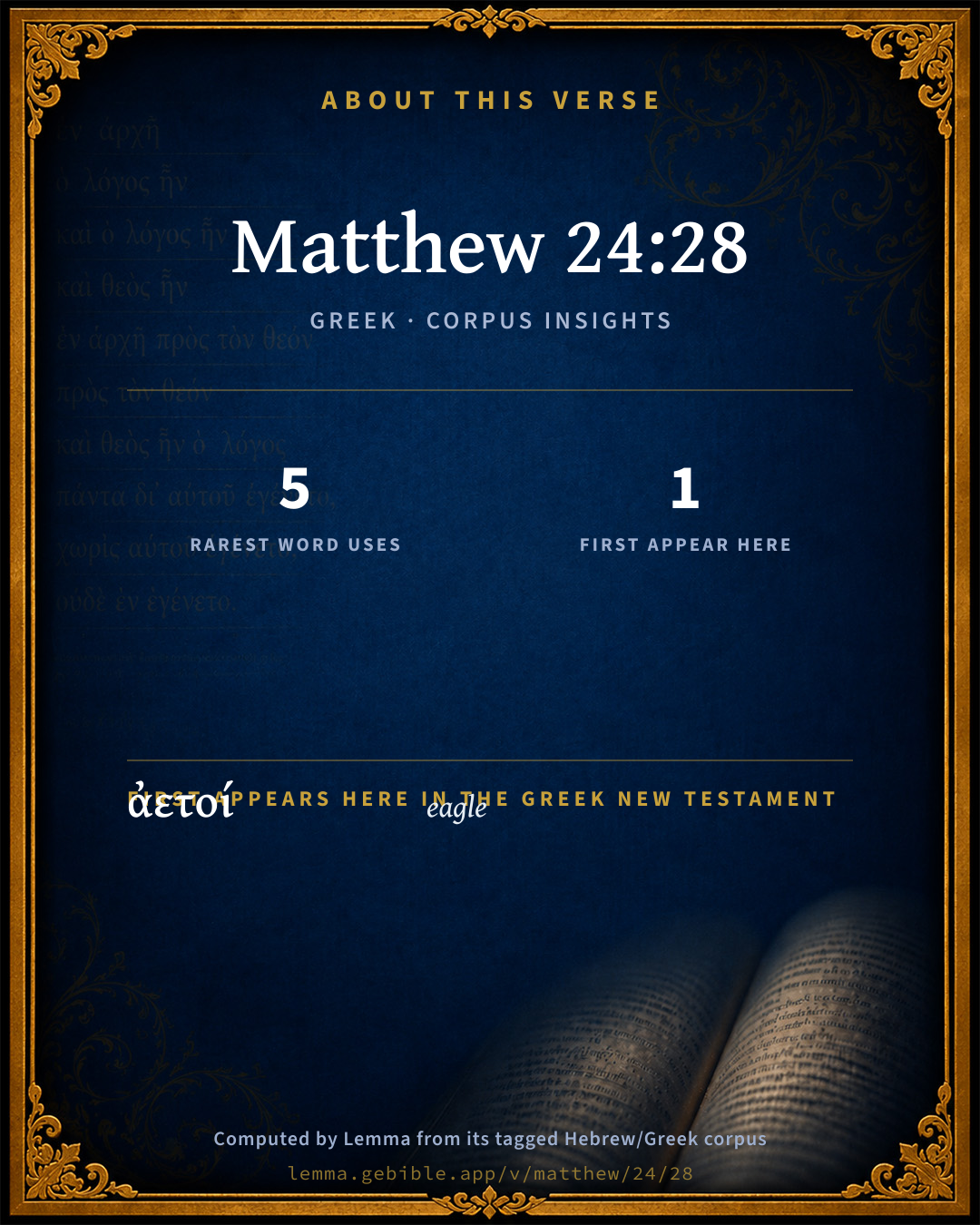
The rarest word here is ἀετοί eagle G105 — appearing just 5 times in the whole Greek New Testament.

First appearance in Scripture

This word makes its first canonical appearance in the Greek New Testament here:

  • ἀετοί eagle G105

Shared distinctive vocabulary

ἀετοί eagle G105 occurs in 5 verses of the Greek New Testament. Also found in:

Repetition

A word recurs within this verse:

Cross-references

5

Topical passages linked to Matthew 24:28 in the Treasury of Scripture Knowledge — connected by theme and wording, ordered by reader-vote popularity; previews shown in the World English Bible.

  • Luke 17:37 They answering, asked him, "Where, Lord?" He said to them, "Where the body is, there will the vultures also be gathered together."
  • Job 39:27–30 Is it at your command that the eagle mounts up, And makes his nest on high?
  • Amos 9:1–4 I saw the Lord standing beside the altar, and he said, "Strike the tops of the pillars, that the thresholds may shake; and break them in pieces on the head of all of them; and I will kill the last of them with the sword: there shall not one of them flee away, and there shall not one of them escape.
  • Deuteronomy 28:49 Yahweh will bring a nation against you from far, from the end of the earth, as the eagle flies; a nation whose language you shall not understand;
  • Jeremiah 16:16 Behold, I will send for many fishermen, says Yahweh, and they shall fish them up; and afterward I will send for many hunters, and they shall hunt them from every mountain, and from every hill, and out of the clefts of the rocks.

Cross-references courtesy of OpenBible.info (CC BY 4.0).

Commentary

Notes on Matthew 24:28 from classic Christian and Jewish commentators (each source and its license shown beneath its notes). The classic Christian expositions comment on the surrounding passage and are grouped to its opening verse, so a note may address several verses; the Jewish commentaries on the Tanakh (Rashi and others) are per-verse, so they appear only where the commentator wrote on this verse.

Lemma curates 59 commentaries, every one of them public domain or Creative Commons licensed, each selected and text-cleaned for this edition rather than reprinted as found. About our sources →

The Biblical Illustrator

Joseph S. Exell

Mat_24:28

For wherever the carcase is.

The carcase and the vultures

Our Lord says, wherever there is a rotting, dead society, a carcase hopelessly corrupt and evil, down upon it, as if drawn by some unerring attraction, will come the angel, the vulture of the Divine judgment. There are many comings of the Lord which on a smaller scale have embodied the same principles as shall be displayed in world-wide awfulness at the last judgment.

I. The first thing in these words is that they are to us a revelation of a law which operates with unerring certainty through all the course of the worlds history. God can tell when evil has become incurable, when the man or country has become a carcase. There may be flickerings of life unseen by our eyes. So long as there is possibility of amendment, sentence against an evil work is not executed speedily.

II. We have here A law which shall have a far more tremendous accomplishment in the future. These days proclaim the day of the Lord. In the prophecies both of the Old and New Testament the universal judgment is seen gleaming through the nearer partial judgments. That judgment is to be the destruction of opposing forces, the sweeping away of the carrion and moral evil. There are many temptations to put the day of the Lord in the background; such suppression is unfaithfulness.

III. That this is a law which need never touch you, nor need you know about it except by the hearing of the ear. It is told us that we may escape it. Take Christ for your Saviour and you shall have a refuge from the vultures. (A. Maclaren,D. D.)

Suppression of retributive warnings

Such suppression is unfaithfulness. Surely if we preachers believe that tremendous truth, we are bound to speak. It is cruel kindness to be silent. If a traveller is about plunging into some gloomy jungle infested by wild beasts, he is a friend who sits by the wayside to warn him of his danger. Surely you would not call a signalman unfeeling because he held out a red lamp when he knew that just round the curve beyond his cabin, the rails were up, and that any train that reached the place would go over in horrid ruin; and surely that preaching is not justly charged with harshness which rings out the wholesome proclamation of a day of judgment when we shall give each account of ourselves to the Divine-human Judge. (A. Maclaren,D. D.)

Retribution operative in delay

Now that is the law that has been working from the beginning, working as well in regard of the long delays as in regard of the swift execution. There is another metaphor, in the Old Testament, that puts the same idea in a very striking form. It speaks about Gods awakening, as if His judgment slumbered. All round that dial there the hand goes creeping, creeping, creeping slowly, but when it comes to the appointed line, then the bell strikes. And so years and centuries go by, all chance of recovery departs, and then the crash! The ice palace, built upon the frozen blocks, stands for a while, but when the spring thaws come it breaks up.

The sanitary order of human life

You know how in Eastern lands, if any beast of burden falls and dies, though the moment before the whole horizon may have been clear, with not a bird in sight, a stream of vultures suddenly appears to wrangle over the unexpected feast. You know how on any tropical ocean, if a carcase be thrown overboard, though at the moment there may not be a speck in the sky, the albatross and other birds of mighty wing appear as if by magic, and scold and fight over the welcome repast. Our Lord, then applies this familiar image of the carcase and the birds of prey to the judicial and retributive forces of human history, and intends to illustrate some law or principle by which they are governed.

I. A certain order underlies the events of human history. Catastrophes do not come by chance, or spring from caprice. The effect always has a cause. Judgment only follows on the heels of offence.

II. This order is a sanitary and beneficent order. Unconsumed, the carcase would but rot and fester and infect the air. All the birds that prey on carrion are scavenger birds, and we owe them nothing short of health and life, for a world without scavengers would soon become a stinking sepulchre.

III. All the strifes and discords of time are parts of that great convict between good and evil in which the ultimate defeat of evil is assured. The calamities and miseries to which men lie open, are intended to remove only that which must be removed if we are to live in health and peace. Wherever there is evil, there also is good, to replace the evil as well as to overcome and destroy it. What greater consolation than to know that the very miseries of men are messengers of the Divine mercy, come to give health and life rather than to destroy, since they come only to destroy that which is fatal to life and health. (S. Cox, D. D.)

Inner reading of history

If only we have eyes to read it aright, to see the Divine will and the Divine laws at work in it, the history of the Kings of England is just as instructive to us as the history of the Kings of Israel, the decline and fall of the Roman Empire as the siege and capture of Jerusalem, the reformation wrought by Luther as the revival of religion under Hezekiah, the French Revolution as the rupture between the ten Hebrew tribes and the two. No historical event is without its religious lesson for us, if only we can trace it to its moral cause; no human life, if only we can read its illustrations of that law-abiding Providence which watches over us as carefully as it did over the Jews, and shapes our rough-hewed ends for us as it shaped theirs. (S. Cox, D. D.)

The need for scavengers

That the vultures gather wheresoever the carcase is, and gather to consume it, is clearly for the health of the world; for, unconsumed, the carcase would but rot and fester, and infect the air; by its infection turning the very breath of life into a minister of death. All the birds that prey on carrion are scavenger birds. Most of the scavengers, from the vulture of the East down to the flies which cleanse our shops and rooms from every morsel of corruption are a little loathsome to us: yet how much we owe them! We owe them nothing short of health and life. A world without scavengers would soon become a stinkingcsepulchre. (S. Cox, D. D.)

Speedy destruction of carcases

On the highway, the ass, mule, or camel, which has fallen under its burden, and is no longer able to rise, is unloaded by its master, its saddle, halter, and even its shoes are taken off, and it is scarcely dead when its skin, too, is hastily removed to be sold to a tanner; the carcase is left where it fell; and as the traveller passes by upon the narrow road his horse is frightened, not more by the repulsive scent and sight, than by the eagles, vultures, ravens, crows, and magpies, that take wing on his approach, or continue, to dispute the prey with hungry dogs. When night comes on, however, the winged devourers withdraw, and give place to sneaking jackals and foxes, and to the hyenas and wolves, which now warily quit their lairs, and hasten to secure a share of the feast. (Van Lennep.)

The Biblical Illustrator, edited by Joseph S. Exell (c. 1880s–1900s) — public domain. Text from a community e-Sword module.

Bengel's Gnomon

Johann Albrecht Bengel

Mat 24:28. Ὅπου γὰρ κ.τ.λ., for where, etc.) This adage is combined here with the mention of the false teachers which occurs in Mat 24:23; but in Luk 17:37; Luk 17:31-32, with that of sufferings caused by war. The carcase, therefore, must be carnal Judaism, devoid of that life by which the body of Christ is sustained, and yet boasting some appearance of a body, upon which, as upon a carcase left to them, the eagles will pounce greedily and in great numbers.—(συναχθήσονται, will be gathered together—the future tense.) Christ, however, who comes as the lightning, is not to be sought for at that carcase; Mat 24:23; Mat 24:27. All kinds of eagles are not carnivorous, but only some species;[1050] cf. Job 39:30. These eagles are partly the false Christs and false prophets, partly the Roman forces. The Romans bore an eagle on their standards, and were not the first nation who did so; and some are of opinion that the eagle in this passage, and the boar in Psa 80:14 (13) allude to their military standards; cf. Hos 8:1.

[1050] Bengel would seem to mean, they do not all feed on carrion, as vultures do. The Greek word comprehends both tribes, the latter of which are probably meant in the text.—(I. B.)

Bengel's Gnomon of the New Testament — English translation (T&T Clark, Edinburgh, 1860) — public domain. Text from a community e-Sword module.

Meyer's Critical & Exegetical Commentary

Heinrich August Wilhelm Meyer

Mat_24:28. Confirmation of the truth that the advent will announce its presence everywhere, and that from the point of view of the retributive punishment which the coming One will be called upon everywhere to execute. The emphasis of this figurative adage is on ὅπου ἐὰν ᾖ and ἐκεῖ: Wherever the carcase may happen to be, there will the eagles be gathered together,on no spot where there is a carcase will this gathering fail, so that, when the Messiah shall have come, He will reveal Himself everywhere in this aspect also (namely, as an avenger). Such is the sense in which this saying was evidently understood as early as the time of Luk_17:37. The carcase is a metaphorical expression denoting the spiritually dead (Mat_8:22; Luk_16:24) who are doomed to the Messianic ἀπώλεια, while the words συναχθήσονται (namely, at the advent) οἱ ἀετοί convey the same idea as that expressed in Mat_13:41, and which is as follows: the angels, who are sent forth by the Messiah for the purpose, συλλέξουσιν ἐκ τῆς βασιλείας αὐτοῦ πάντα τὰ σκάνδαλα, καὶ βαλοῦσιν αὐτοὺς εἰς τὴν κάμινον τοῦ πυρός, the only difference being, that in our passage the prophetic imagery depicting the mode of punishment is not that of consuming by fire, and that for the simple reason that the latter would not harmonize with the idea of the carcase and the eagles (Bleek, Luthardt, Auberlen). Others (Lightfoot, Hammond, Clericus, Wolf, Wetstein) have erroneously supposed that the carcase alludes to Jerusalem or the Jews, and that the eagles are intended to denote the Roman legions with their standards (Xen. Anab, i. 10. 12; Plut. Mar. 23). But it is the advent that is in question; while, according to Mat_24:23-27, ὅπου ἐὰν ᾖ cannot be taken as referring to any one particular locality, so that Hoelemann is also in error, inasmuch as, though he interprets the eagles as representing the Messiah and His angel-hosts, he nevertheless understands the carcase to mean Jerusalem as intended to form the central scene of the advent. It is no less mistaken to explain the latter of the corpses of Judaism (Hilgenfeld), on the ground that, as Keim also supposes, Christ means to represent Himself as Him who is to win the spoils amid the physical and moral ruins of Israel. According to Cremer, the carcase denotes the anti-Messianic agitation previously described, which is destined to be suppressed and punished by the imperial power (the eagles). This view is erroneous; for, according to Mat_24:27, the συναχθ. οἱ ἀετοί can only represent the παρουσία τ. υἱοῦ τ. ἀνθρ. Fritzsche and Fleck, p. 384: ubi Messias, ibi homines, qui ejus potestatis futuri sint (οἱ ἐκλεκτοί, Mat_24:31). Similarly such early expositors as Chrysostom (who thinks the angels and martyrs are intended to be included), Jerome, Theophylact (ὥσπερ ἐπὶ νεκρὸν σῶμα συνάγονται ὀξέως οἱ ἀετοὶ, οὕτω καὶ ἔνθα ἂν εἴη ὁ Χριστός, ἐλεύσονται πάντες οἱ ἅγιοι), Euthymius Zigabenus, Münster, Luther, Erasmus (non deerunt capiti sua membra), Beza, Calvin, Clarius, Zeger, Calovius, Jansen. But how inappropriate and incongruous it would be to compare the Messiah (who is conceived of as τροφὴ πνευματική, Euthymius Zigabenus) to the carcase; which is all the more offensive when, with Jerome, πτῶμα is supposed to contain a reference to the death of Jesusa view which Calvin rejected. Wittichen in the Jahrb. f. D. Theol. 1862, p. 337, reverses the subjects of comparison, and takes the carcase as representing the Israelitish ἐκλεκτοί, and the eagles as representing the Messiah. But this interpretation is likewise forbidden by the incongruity that would result from the similitude of the carcase so suggestive of the domain of death, as well as by that universal character of the advent to which the context bears testimony. With astonishing disregard of the context, Kaeuffer observes: μὴ πιστεύσητε, sc. illis, nam ubi materies ad praedandum, ibi praedatores avidi, h. e. nam in fraudem vestram erit. On the question as to whether πτῶμα without a qualifying genitive be good Greek, see Lobeck, ad Phryn. p. 375.

οἱ ἀετοί] are the carrion-kites (vultur percnopterus, Linnaeus) which the ancients regarded as belonging to the eagle species. See Plin. N. H. x. 3; Aristot. ix. 22. For the similitude, comp. Job_39:30; Hos_8:1; Hab_1:8; Pro_30:17; Eze_39:17.

Meyer — Critical and Exegetical Commentary on the New Testament — English translation by Peter Christie, edited by Frederick Crombie (T&T Clark, 1880) — public domain. Text from a community e-Sword module.

Expositor's Greek Testament

ed. W. Robertson Nicoll

Mat 24:28 . πτῶμα , carcase, as in Mat 14:12 , q.v. ἀετοί , eagles, doubtless the carrion vultures are meant. The reference of this proverbial saying, as old as the book of Job (Job 39:30 ), in this place is not clear. In the best text it comes in without connecting particle, the γὰρ of T. R. being wanting. If we connect it with Mat 24:27 the idea will be that Messiah’s judicial function will be as universal as His appearance (Meyer and Weiss). But does not Mat 24:28 as well as Mat 24:27 refer to what is said about the false Christs, and mean: heed not these pretended Saviours; Israel cannot be saved: she is dead and must become the prey of the vultures? (So Lutteroth.) In this view the Jewish people are the carcase and the Roman army the eagles.

The Expositor's Greek Testament, edited by W. Robertson Nicoll (1897–1910) — public domain. Text from a community e-Sword module.

Geneva Bible (1599)

Geneva Bible translators

The only remedy against the furious rage of the world, is to be gathered and joined to Christ.

Christ, who will come with speed and his presence will be with a majesty to whom all shall flock even as Eagles.

Geneva Bible (1599) marginal notes — public domain. Text via Bolls.life.

Adam Clarke's Commentary

Verse 28. For wheresoever the carcass is] πτωμα, the dead carcass. The Jewish nation, which was morally and judicially dead.

There will the eagles] The Roman armies, called so partly from their strength and fierceness, and partly from the figure of these animals which was always wrought on their ensigns, or even in brass, placed on the tops of their ensign-staves. It is remarkable that the Roman fury pursued these wretched men wheresoever they were found. They were a dead carcass doomed to be devoured; and the Roman eagles were the commissioned devourers. See the pitiful account in Josephus, WAR, b. vii. c. 2, 3, 6, 9, 10, and 11.

Adam Clarke's Commentary on the Bible (1810–1826) — public domain. Text from a community e-Sword/MySword module.

Ellicott's Commentary for English Readers

(28) Wheresoever the carcase is.—Two interpretations of this verse may, without much risk of error, be at once rejected:—(1) That which sees in the “eagles” the well-known symbols of the strength of the Roman legions, and in the “carcass” the decayed and corrupted Judaism which those legions came to destroy. This, true as far as it goes, is too narrow and localised in its range for so wide and far-reaching a comparison. (2) The strange fantastic imagination of many of the Fathers that the “carcass” is Christ Himself, as crucified and slain, and that the eagles are His true saints and servants who hasten to meet Him in His coming. Those who picture to themselves with what purpose and with what results the vultures of the East swoop down on the carrion which they scent far off upon the breeze, will surely find such an explanation at once revolting and irrational. What the enigmatic proverb (if indeed it be enigmatic) means, is that wherever life is gone, wherever a church or nation is decaying and putrescent, there to the end of time will God’s ministers of vengeance, the vultures that do their work of destruction, and so leave room for new forms of life by sweeping off that which was “ready to vanish away” (comp. Heb_8:13 for the phrase and thought), assuredly be found. What the disciples should witness in the fall of Jerusalem would repeat itself scores of times in the world’s history, and be fulfilled on the largest scale at the end of all things. The words of Isaiah (Isa_46:11) and Ezekiel (Eze_39:4), in which the “ravenous bird” is a symbol of the nations who do the work of destruction to which God sends them, illustrate the meaning of the generalised law which is here asserted.

A Bible Commentary for English Readers, edited by Charles John Ellicott (1878–1897) — public domain. Text from a community e-Sword module.

The Cambridge Bible for Schools and Colleges

gen. ed. J. J. S. Perowne

28. wheresoever the carcase is] The spiritual perception will discern when the Lord comes and where, by a subtle sense like that by which the vulture is cognisant of his distant prey.

Another interpretation fixes upon the idea of corruption in the body, and taking the “eagles” to mean the eagles of the Roman standards reads the sense thus: “where the corrupt body of sin lies there will the eagles of vengeance be gathered.”

This view is excluded by the division of the prophecy adopted in these notes.

The Cambridge Bible for Schools and Colleges (gen. ed. J. J. S. Perowne; Cambridge University Press, 1878–1918) — public domain. Text from a community e-Sword module.

John Gill's Exposition

Immediately after the tribulation of those days,.... That is, immediately after the distress the Jews would be in through the siege of Jerusalem, and the calamities attending it; just upon the destruction of that city, and the temple in it, with the whole nation of the Jews, shall the following things come to pass; and therefore cannot be referred to the last judgment, or what should befall the church, or world, a little before that time, or should be accomplished in the whole intermediate time, between the destruction of Jerusalem, and the last judgment: for all that is said to account for such a sense, as that it was usual with the prophets to speak of judgments afar off as near; and that the apostles often speak of the coming of Christ, the last judgment, and the end of the world, as just at hand; and that one day with the Lord is as a thousand years, will not answer to the word "immediately", or show that that should be understood of two thousand years after: besides, all the following things were to be fulfilled before that present generation, in which Christ lived, passed away, Mat 24:34 and therefore must be understood of things that should directly, and immediately take place upon, or at the destruction of the city and temple,

Shall the sun be darkened: not in a literal but in a figurative sense; and is to be understood not of the religion of the Jewish church; nor of the knowledge of the law among them, and the decrease of it; nor of the Gospel being obscured by heretics and false teachers; nor of the temple of Jerusalem, senses which are given into by one or another; but of the Shekinah, or the divine presence in the temple. The glory of God, who is a sun and a shield, filled the tabernacle, when it was reared up; and so it did the temple, when it was built and dedicated; in the most holy place, Jehovah took up his residence; here was the symbol of his presence, the mercy seat, and the two cherubim over it: and though God had for some time departed from this people, and a voice was heard in the temple before its destruction, saying, "let us go hence"; yet the token of the divine presence remained till the utter destruction of it; and then this sun was wholly darkened, and there was not so much as the outward symbol of it:

and the moon shall not give her light; which also is to be explained in a figurative and metaphorical sense; and refers not to the Roman empire, which quickly began to diminish; nor to the city of Jerusalem; nor to the civil polity of the nation; but to the ceremonial law, the moon, the church is said to have under her feet, Rev 12:1 so called because the observance of new moons was one part of it, and the Jewish festivals were regulated by the moon; and especially, because like the moon, it was variable and changeable. Now, though this, in right, was abolished at the death of Christ, and ceased to give any true light, when he, the substance, was come; yet was kept up by the Jews, as long as their temple was standing; but when that was destroyed, the daily sacrifice, in fact, ceased, and so it has ever since; the Jews esteeming it unlawful to offer sacrifice in a strange land, or upon any other altar than that of Jerusalem; and are to this day without a sacrifice, and without an ephod:

and the stars shall fall from heaven; which phrase, as it elsewhere intends the doctors of the church, and preachers falling off from purity of doctrine and conversation; so here it designs the Jewish Rabbins and doctors, who departed from the word of God, and set up their traditions above it, fell into vain and senseless interpretations of it, and into debates about things contained in their Talmud; the foundation of which began to be laid immediately upon their dispersion into other countries:

and the powers of the heavens shall be shaken; meaning all the ordinances of the legal dispensation; which shaking, and even removing of them, were foretold by Hag 2:6 and explained by the author of the Epistle to the Hebrews, Heb 12:26 whereby room and way were made for Gospel ordinances to take place, and be established; which shall not be shaken, so as to be removed, but remain till the second coming of Christ. The Jews themselves are sensible, and make heavy complaints of the great declensions and alterations among them, since the destruction of the temple; for after having taken notice of the death of several of their doctors, who died a little before, or after that; and that upon their death ceased the honour of the law, the splendour of wisdom, and the glory of the priesthood, they add (g),

"from the time that the temple was destroyed, the wise men, and sons of nobles, were put to shame, and they covered their heads; liberal men were reduced to poverty; and men of violence and calumny prevailed; and there were none that expounded, or inquired, or asked. R. Elezer the great, said, from the time the sanctuary were destroyed, the wise men began to be like Scribes, and the Scribes like to the Chazans, (or sextons that looked after the synagogues,) and the Chazans like to the common people, and the common people grew worse and worse, and there were none that inquired and asked;

that is, of the wise men there were no scholars, or very few that studied in the law,

(g) Misn. Sotah, c. 9. sect. 15.

John Gill's Exposition of the Whole Bible (1746–1763) — public domain (CC PDM 1.0). Text via the HelloAO Bible API.

Trapp's Complete Commentary

John Trapp

28 For wheresoever the carcase is, there will the eagles be gathered together.

Ver. 28. For wheresoever the carcase is, &c.] That is, saith M. Lambert, martyr, wheresoever is declared by the course of the Scriptures, the benefits granted to us by Christ’s death, thither will men seek and flee, to know how they may enjoy the same. The sacrificed body of Christ (saith another) hath a most fragrant smell, inviting the saints (like birds of prey) to fly from far with marvellous swiftness to this dead but all quickening carcase. Some interpret it thus: Where the carcase is, that is, the body of the Jews, that had forsaken God and his truth, and so was a dead carcase, {confer Hos 13:1} there will the Roman eagles and enemies be.

There will the eagles be gathered] The vulturine eagles especially, whereof read Job 39:29-30: they follow armies, and feed on carcases. Eagles the saints are called, 1. For their delight in high flying. 2. For their sharp sightedness, and steadfast looking into the Sun of righteousness. 3. For their singular sagacity in smelling out Christ, and resenting things above, for the which they are said to have "a nose like the tower of Lebanon," Son 7:4; Son 4:1-16. For their feeding upon the bloody sacrifice of Christ, the true carcase. Briefly, this proverbial speech may be well understood, either of the conflux of the godly to the light and liberty of the gospel, or else of their indissoluble union with Christ to be perfectly enjoyed at the resurrection. For the sense of it is, that let the devil use what means soever he can by his emissaries, the false prophets, to divide, between Christ and his people, by telling them, There he is, or here he is, it will not be; for they will fly to him as a cloud, or as the doves to their windows, Isa 60:8. Nay, as the eagles to their carcase, with incredible swiftness; so forcible is the tie that is between them, that they will not be kept asunder. The Israelites removed their tents from Mithcah, which signifies sweetness, to Hashmonah, which signifies swiftness, Num 33:29. To teach us, saith a divine, that no sooner have the saints tasted Christ’s sweetness but presently they are carried after him with swiftness; they cannot rest till they are joined unto him whom their soul loveth. In reference to whom, Christ’s last supper is called by the ancients, Festum aquilarum, non graculorum, a feast for eagles, not for daws. {a}

{a} A silly fellow, simpleton, noodle, fool. ŒD

John Trapp, A Commentary or Exposition upon All the Books of the Old and New Testament (1647–1656) — public domain. Text from a community e-Sword module.

Albert Barnes' Notes on the Bible

Wheresoever ... - The words in this verse are proverbial. Vultures and eagles easily ascertain where dead bodies are, and hasten to devour them. So with the Roman army. Jerusalem is like a dead and putrid corpse. Its life is gone, and it is ready to be devoured. The Roman armies will find it out, as the vultures do a dead carcass, and will come around it to devour it. This proverb also teaches a universal truth. Wherever wicked people are, there will be assembled the instruments of their chastisement. The providence of God will direct them there, as the vultures are directed to a dead carcass.

This verse is connected with the preceding by the word “for,” implying that this is a reason for what is said there that the Son of man would certainly come to destroy the city, and that he would come suddenly. The meaning is that he would come, by means of the Roman armies, as “certainly;” as “suddenly,” and as unexpectedly as whole flocks of vultures and eagles, though unseen before, see their prey at a great distance and suddenly gather in multitudes around it. Travelers in the deserts of Arabia tell us that they sometimes witness a speck in the distant sky which for a long time is scarcely visible. At length it grows larger, it comes nearer, and they at last find that it is a vulture that has from an immense distance seen a carcass lying on the sand. So keen is their vision as aptly to represent the Roman armies, though at an immense distance, spying, as it were, Jerusalem, a putrid carcass, and hastening in multitudes to destroy it.

Albert Barnes' Notes on the Bible (1834–1885) — public domain. Text from a community e-Sword/MySword module.

Haydock's Catholic Bible Commentary

Wheresoever the body,[3] &c. This seems to have been a proverb or common saying among the Jews. Several of the ancient interpreters, by this body, understand Christ himself, who died for us; and they tell us, that at his second coming the angels and saints, like eagles, with incredible swiftness, will join him at the place of judgment. (Witham) --- When he shall come to judgment, all, as it were by a natural instinct, shall fly to meet him, and receive their judgment. St. Hilary understands this literally; that where his body shall hang upon the cross, there will he appear in judgment, i.e. near the valley of Josaphat; in which place the prophet Joel (chap. iii. ver. 2,) declares, that the general judgment shall take place. (Tirinus)

===============================

[BIBLIOGRAPHY]

Corpus; in most Greek copies, ptoma, cadaver. See again St. Jerome, and St. John Chrysostom, hom. lxxvii, p. 492.

George Leo Haydock (1774–1849), Haydock's Catholic Family Bible and Commentary, 1859 edition — public domain. Excludes Psalms (Douay-Rheims chapter numbering differs from Protestant) and Deuterocanonical books (Catholic canon only).

Whedon's Commentary on the Bible

Daniel D. Whedon

IV. THE CONTRAST BETWEEN THE LENGTHENED CALAMITIES OF THE JEWS THROUGH AGES, AND THE SUDDEN CONSUMMATION OF THE END, 28-31.

After the tribulation of Jerusalem’s destruction, a long train of calamities follows till a later day of restoration. And then after the tribulation of the later day the world shall be dissolved.

28. For wheresoever the carcass is, there will the eagles — It is perfectly obvious that this verse stands in isolation, having no clear connection with what precedes or follows. The for which commences this verse clearly refers to nothing in Mat_24:27; while in our harmonizing below its reference is natural and convincing.

We may suggest that this arises from the fact that the sentence is but a part, which Matthew has preserved, of a passage which Luke presents more fully; in which the long train of calamities which succeeds the downfall of Jerusalem is briefly sketched, in order to present a contrast with the rapid consummation of the end.

If, in the usual manner of the harmonists, we incorporate Matthew and Luke together in this passage, it will read thus: “There shall be great distress in the land and wrath upon this people. And they shall fall by the edge of the sword; for wheresoever the carcass is, there shall the eagles be gathered together. And they shall be led away captive into all nations, and Jerusalem shall be trodden down of the Gentiles, until the times of the Gentiles be fulfilled.” On this passage we may remark,

1. That it traces with great clearness the sad train of wars which succeed the “these things” of the apostles’ question. Massacres and slaughters there would be at various periods, wherever the Roman army could find with its standard eagles a body of Jews, as an eagle finds a carcass; the dispersion through nations; the subjection of Jerusalem until a time of latter-day restoration.

2. The eagles are no doubt in some sense an allusion to the images of eagles which were upon the standards of the Roman armies. Yet not directly. It would be more correct perhaps to say that the adoption of the eagles by armies for their standard, and the adoption of the term by our Lord to designate the pitiless enemy falling upon his prey, are founded in the same natural symbol. Yet the coincidence is of the most striking character.

3. “Jerusalem shall be trodden down” is a phrase of the most abject subjection; but history furnishes its complete fulfillment. “The times of the Gentiles” are the times of Gentile pre-eminence in the kingdom of God. It is the period of the more exclusive Gentile Churchdom, lasting during the casting off of Israel until her restoration.

4. This brings us to the very millennial threshhold, when Israel is restored, and ages of Gospel reign commence. These millennial ages terminate in the tribulation of those days, and an immediate judgment, as described in the twenty-ninth verse.

5. This passage, as above harmonized, furnishes the first member of the contrast of which the second member is furnished in Mat_24:29-31.

29. Immediately after the tribulation of those days — The words those days here refer to the latter days, implied in the passage in Luke above quoted, of which Matthew has preserved but a fragment. The those days of this verse, then, are the days of the great period of which the eagles and the carcass in the preceding verse are a fragmentary symbol. This symbol is a broken label of the whole period between the downfall and the advent, Luke supplying the condensed remainder of the label. The contrast lies between the slow expansion of that period and the suddenness of the advent to break and close it. Immediately, suddenly, after the “tribulation” following the those days of the treading down of Jerusalem, and the fulness of the Gentiles, shall the advent take place.

We have already shown that a tribulation before the judgment was a doctrine of the Jews, as well as that of the Scripture. See the note on Mar_13:24-27.

Thus the tribulation and destruction of Jerusalem, and the tribulation and judgment day, are parallel if not mutually typical.

This view is sustained by the parallel passage in Mark. His words are: “In those days, after that tribulation.” This language is inconsistent with the idea that the judgment immediately succeeds the tribulation of Jerusalem’s downfall.

The judgment is broadly described as being in those days after the Jerusalem tribulation. The those days of Mark may, by perspective, be made to cover the entire time of the dispersion, as described by Luke. So Bengel, and so Mr. Wesley has rendered Mark’s words. And we may here remark that the common interpretation, which makes Mat_24:29 figurative, has no countenance from Mr. Wesley. His comment is thus on Mar_13:24 : “But in those days — Which immediately preceded the end of the world. After that tribulation — Above described.” We may add that the translators of our version have omitted the word but or and before the word “immediately” in Mat_24:29. Combining then the words of both Mark and Matthew, we should have: “But in those days, after that tribulation — and immediately after the tribulation of those days — the sun shall be darkened,” etc. The whole contrast, then, of the paragraph would be as follows: “There shall be great distress in the land, and wrath upon this people. And they shall fall by the edge of the sword, for wheresoever the carcass is there shall the eagles be gathered together. And they shall be led away captive into all nations; and Jerusalem shall be trodden down of the Gentiles, until the times of the Gentiles be fulfilled. But in those days after that tribulation, and immediately after the tribulation of those days, shall the sun be darkened, and the moon,” etc.

This precise verbal adjustment, however, of Matthew and Mark, though apparently satisfactory, need not be insisted upon as necessary to our interpretation of the general passage.

Those who find it difficult to extend our Lord’s discourse over “a chasm” of centuries may be aided by the following points:

1. Our supplementary note, p. 301, shows that the leap of thought and language over the chasm of time to the judgment day is required in a whole class of passages; and will show, too, the principle upon which the leap is taken.

2. Our Lord’s words were intentionally susceptible of expansion and contraction so far as time was concerned, on the very principle that the true extension of time was even to himself unknown. He specifies events, not periods; events of unknown duration. How long or short should be the “fall by the edge of the sword,” or the “captivity among all the nations,” or the “times of the Gentiles,” or the later “tribulation of those days,” or the time in which the “gospel should be preached to all nations” before the final tribulation, he does not say. “Immediately after” this train of events the advent will take place; but the length of that train, like the whole scale of ante-judgment chronology, is professedly unknown.

Daniel D. Whedon (gen. ed.), Commentary on the Old and New Testaments (1874–1909) — public domain. Text from a community e-Sword module.

The Pulpit Commentary

For. The particle seems to be spurious, and is omitted by late editors. Christ applies a proverbial saying in confirmation of the certainty and universality of is appearance. He had used the same under other circumstances; (Luk_17:37) and analogous expressions are found in Job_39:30 Hos_8:1 Hab_1:8, etc. Wheresoever the carcase (ptwma) is, there will the eagles be gathered together. Eagles (aetoi) do not live on carrion, so that here probably vultures are meant. The Hebrew word nesher, translated "eagle" in our version, often signifies "the vulture," as in Mic_1:16. This bird"s keenness of sight is almost incredible; it will discern a prey at an enormous distance, and its movements being watched by others, all eager to secure food, a carcase is very quickly surrounded by a multitude of these rapacious birds, flocking from all quarters. What our Lord meant by this proverb has occasioned great disputation. If Christ were referring primarily and chiefly to Jerusalem, it would be easy to explain "the carcase" to be the corrupt city, "the eagles" the ministers of God"s vengeance, especially the Roman armies, whose standards bore the image of this bird of prey. Or if it were a mere general truth, and to be taken entirely in a spiritual sense, the gnome would imply that moral corruption calls for heavenly chastisement. But neither of these interpretations would satisfy the context, which speaks of Christ"s second advent. Hence many regard the sentence as altogether parallel to the preceding verse, expressing in metaphor that which was there set forth in more direct terms, viz. that all men shall assemble to the place where Christ shall summon them to be judged, as vultures congregate round a carcase. In this case the carcase is Christ, the eagles or vultures are the men to be judged. This exposition has satisfied commentators of reputation, but it has its weak points. One fails to see the propriety of describing men coming to the great assize as vultures gathering to devour a dead body, or how in this case the body can be Christ or the place of his appearance. More probable is the interpretation which regards the carcase as antichrist or the world power, and the eagles as the saints and angels who shall attend Christ when he comes in judgment. (Rev_19:17, Rev_19:18) Others expound the clause entirely in a mystical sense. The carcase is Christ, or the body of Christ; the eagles are the saints, or true Christians; these, whatever happens, will, with keen spiritual sight, always be able to discern Christ and his body, and to flock thereto. He calls himself ptwma , because he saves us by his death, and feeds us by his body, in his Church, Word, and sacraments (see Wordsworth, in loc. ). Such is the interpretation of many of the Fathers, and it has many analogies in other places of Scripture. Far be it from us to restrict the sphere of Divine prediction, or to assert that any legitimate reference which we may discover was not in the Lord"s mind when he spake the words. But it is more simple to regard the proverbial saying in itself, without looking for abstruse or mystical meanings. As a carcase, fall where it may, is immediately observed by the vultures and attracts them, so Christ"s coming shall at once be discerned by all men and draw them into it.

The Pulpit Commentary (1880–1919), ed. H.D.M. Spence-Jones & Joseph S. Exell — public domain. Text from a community e-Sword module.

John Wesley's Explanatory Notes

For wheresoever the carcass is, there will the eagles he gathered together - Our Lord gives this, as a farther reason, why they should not hearken to any pretended deliverer. As if he had said, Expect not any deliverer of the Jewish nation; for it is devoted to destruction. It is already before God a dead carcass, which the Roman eagles will soon devour. Luke xvii, 37.

John Wesley, Explanatory Notes Upon the Whole Bible (1754–1765) — public domain. Text via the GEBible commentary corpus.

Burkitt's Expository Notes on the New Testament

William Burkitt

If the coming of Christ be understood in the former verse of his coming to destroy Jerusalem, then by the carcass in this verse are to be understood the people of Jerusalem, and the body of the Jewish nation; and by eagles are to be understood the Roman armies, who carried an eagle in their standard. These were the instruments which Almighty God made use of, as his rod and scourge, to chastise and punish the people of Jerusalem.

Learn thence, That the appointed messengers of God’s wrath, and the instruments of his vengeance, will certainly gather together, certainly find out, and severely punish and plague, an impenitent people devoted to destruction. Where the carcass is (the body of the Jewish nation) there will the eagles (the Roman soldiers) be gathered together.

William Burkitt's Expository Notes on the New Testament (1700–1703) — public domain. Text from a community e-Sword module.

The People's New Testament

B. W. Johnson

28. The carcase is, there will be the eagles. The term “carcase” well represents the utterly corrupted Jewish state; the “eagles” is a fit symbol of the Roman army, every legion of which bore the eagle as its standard.

B. W. Johnson's The People's New Testament with Notes (1889–1891) — public domain. Electronic text from the Christian Classics Ethereal Library (CCEL) ThML edition.

Cambridge Greek Testament for Schools and Colleges

28. ὅπου ἐὰν ᾖ τὸ πτῶμα. The spiritual perception will discern wherever the Lord comes, by a subtle sense like that by which the vulture is cognisant of his distant prey.

Another interpretation fixes upon the idea of corruption in the body, and reads the sense thus: ‘where the corrupt body of sin lies, wherever there is the corruption of moral death and decay, there the vultures of judgment will gather upon the carrion.’

Cambridge Greek Testament for Schools and Colleges (Cambridge University Press, 1896; 21 vols, various authors incl. Carr, Maclear, Plummer, Farrar, Lumby, Moule, M. R. James, Simcox) — public domain. Text from a community e-Sword module.

Alford’s Greek Testament

Henry Alford

28.] The coming of the Lord in the end, even as that in the type was, shall be a plain unmistakable fact, understood of all;—and like that also, sudden and all-pervading. But here again the full meaning of the words is only to be found in the final fulfilment of them. The lightning, lighting both ends of heaven at once, seen of all beneath it, can only find its full similitude in is Personal coming, Whom every eye shall see, Rev 1:7.

28.] The stress is on ὅπου ἐάν and ἐκεῖ, pointing out the universality. In the similar discourse, Luk 17:37, before this saying, the disciples ask, ‘Where, Lord?’ The answer is,—first, at Jerusalem: where the corrupting body lies, thither shall the vultures (literally) gather themselves together, coming as they do from far on the scent of prey. Secondly, in its final fulfilment,—over the whole world;—for that is the πτῶμα now, and the ἀετοί the angels of vengeance. See Deu 28:49, which is probably here referred to; also Hos 8:1: Hab 1:8. The interpretation (Theophylact, , Calvin, Bp. Wordsw., &c) which makes the πτῶμα our Lord, and the ἀετοί the elect, is quite beside the purpose. The mystical defence of it may be seen in Wordsw.’s notes. Neither is any allusion (Lightfoot, Ham., Wetstein, Wolf, &c.) to the Roman eagles to be for a moment thought of. The ἀετοί are the vultures (vultur percnopterus, Linn.), usually reckoned by the ancients as belonging to the eagle kind, Plin. Nat. Hist. ix. 3.

Henry Alford, The Greek Testament (1849–1861) — public domain. Text from a community e-Sword module.

International Critical Commentary

28. Occurs in Luk 17:37.

(L) 28. Wheresoever the corpse is, there will be gathered the eagles.] An enigmatic sentence, probably a proverbial saying; cf. Job 39:30 οὗ δʼ ἄν ὦσι τεθνεῶτες παραχρῆμα εὑρίσκονται, sc. “young vultures.” Here the meaning probably is that the Parousia will be at the destined time when evil has reached its fated climax. Just as when life has abandoned a body, and it becomes a corpse, the vultures immediately swoop down upon it; so when the world has become rotten with evil, the Son of Man and His angels will come to execute the divine judgement. See Hastings, DCG. i. p. 65.

International Critical Commentary — older volumes (1896–1929), various authors — public domain. Text from a community e-Sword module.

Vincent's Word Studies in the New Testament

Marvin R. Vincent

Carcase [πτωμα] . From piptw, to fall. Originally a fall, and thence a fallen body; a corpse. Compare Lat. cadaver, from cado, to fall. See Mr 6:29; Rev 11:8. On the saying itself, compare Job 39:30.

Eagles [αετοι] . Rev. puts vultures in margin. The griffon vulture is meant, which surpasses the eagle in size and power. Aristotle notes how this bird scents its prey from afar, and congregates in the wake of an army. In the Russian war vast numbers were collected in the Crimea, and remained until the end of the campaign in the neighborhood of the camp, although previously scarcely know in the country.

Marvin R. Vincent, Word Studies in the New Testament (1887–1900) — public domain. Text from a community e-Sword/MySword module.

Lesson kit

Teaching starters — assembled from the data on this page, not authored interpretation. Every prompt links to the verse data it draws on. Edit before teaching.

Matthew, in the Gospels, opens this verse with 9 words (8 distinct Greek lemmas). Its most distinctive word is aetós (“eagle”). A historical commentator’s framing appears above. Read the whole chapter for the surrounding context.

Discussion questions

  1. What does “eagle” (aetós) contribute to the verse as a whole?
  2. The word “eagle” first appears here in Scripture. What is being introduced at this debut?
  3. Luke 17:37 shares the word «eagle» with this verse. How do the two illuminate each other?
  4. “the” occurs 2× in this one verse. What is the effect of the repetition?
  5. The translations on this page render this verse differently — a whole-verse word diff, not a word-by-word alignment. What might account for the different wordings?
  6. Reading how The Biblical Illustrator and Bengel's Gnomon read this verse, where do the two commentators agree and where do they part?

Things to notice

  • 1 word makes its first canonical appearance in Scripture here.
  • These translations choose different wording for 8 words in this verse.
  • “the” occurs 2× in this single verse.
  • 8 distinct Greek lemmas span 9 words in this verse.

Reading settings

Reading text

Shown beneath each verse's original-language words.

Old Testament
Old Testament edition

Read the OT as the Masoretic Hebrew (MT) or the Greek Septuagint (LXX).

English shown for the Greek Septuagint (in the Hebrew ↔ Greek comparison).

Comparing translations? Open the Compare panel on any verse page to stack up to four side by side.