Revelation 21:25

Greek (Tischendorf 8th ed.) Revelation 21:25 appears in the Greek New Testament. The text above is from the Tischendorf 8th edition. Each word links to its Strong’s number and a concise gloss. Click any word for its full Thayer’s Greek Lexicon entry.
Download image
Cite this verse

Revelation 21:25 (World English Bible). Public Domain. Lemma interlinear Bible study tool, https://lemma.gebible.app/v/revelation/21/25.

Show BibTeX & RIS
BibTeX
RIS
English Translation
Its gates will in no way be shut by day (for there will be no night there),
World English Bible · Public Domain
Download a study sheet

One document with this verse’s original text, its word-by-word gloss line, the meaning frame, cross-references with their text, attributed commentary, and full source and license credits — printable, and it pastes into notes with its structure intact.

This verse Autodidact and up

Study sheet (.html) Plain text (.txt)

A passage Seminary Student

Up to 50 verses in one chapter. A passage sheet keeps up to 6 commentary sources and 12 cross-references per verse, in the order this page ranks them, and says so on the sheet whenever that leaves anything out. Ask for a single verse and you get the Autodidact verse sheet above.

Everything on this page stays free to read, with no account — the sheet is a download of what is already on screen, not access to it.

Want to remove ads? Support Godless Engineer
Compare translations 3

The same verse in 3 English versions, stacked beneath the original-language interlinear above. Click any original word for its lexicon entry.

Each is an independent rendering of the whole verse — the interlinear is not word-aligned to these translations.

Highlighted words mark where these versions differ — a whole-verse word diff, not a word-by-word alignment.

  • World English Bible Public Domain
    Its gates will in no way be shut by day (for there will be no night there),
  • King James Version Public Domain
    And the gates of it shall not be shut at all by day: for there shall be no night there.
  • unfoldingWord Literal Text CC BY-SA 4.0
    And her gates will certainly not be shut by day, for night will not be there.

unfoldingWord Literal Text — © unfoldingWord, licensed CC BY-SA 4.0. Word-aligned USFM3 via Door43 (git.door43.org/unfoldingWord/en_ult).

Versions to compare (up to 4)

3 of 4 selected

Show all 19 translations

Every available English version of this verse, each an independent rendering of the whole verse.

  • World English Bible Public Domain
    Its gates will in no way be shut by day (for there will be no night there),
  • Berean Standard Bible Public Domain
    Its gates will never be shut at the end of the day, because there will be no night there.
  • Majority Standard Bible Public Domain
    Its gates will never be shut at the end of the day, because there will be no night there.
  • King James Version Public Domain
    And the gates of it shall not be shut at all by day: for there shall be no night there.
  • American Standard Version (1901) Public Domain
    And the gates thereof shall in no wise be shut by day (for there shall be no night there):
  • Revised Version (1885) Public Domain
    And the gates thereof shall in no wise be shut by day (for there shall be no night there):
  • Geneva Bible (1599) Public Domain
    And the gates of it shall not be shut by day: for there shalbe no night there.
  • Douay-Rheims (1899) Public Domain
    And the gates thereof shall not be shut by day: for there shall be no night there.
  • Young's Literal Translation Public Domain
    and its gates shall not at all be shut by day, for night shall not be there;
  • Literal Standard Version CC BY-SA 4.0
    and its gates will never be shut by day, for night will not be there;
  • Unlocked Literal Bible CC BY-SA 4.0
    Its gates will not be shut during the day, and there will be no night there.
  • unfoldingWord Literal Text CC BY-SA 4.0
    And her gates will certainly not be shut by day, for night will not be there.
  • Darby Bible Public Domain
    And its gates shall not be shut at all by day, for night shall not be there.
  • World Messianic Bible Public Domain
    Its gates will in no way be shut by day (for there will be no night there),
  • Webster's Bible Public Domain
    And the gates of it shall not be shut by day: for there shall be no night there.
  • Free Bible Version CC BY-SA 4.0
    The gates of the city will never be shut during the day (and there will be no night there).
  • Bible in Basic English Public Domain
    And the doors of it will never be shut by day (for there is no night there):
  • Text-Critical English NT CC BY 4.0
    Its gates will never be shut at the end of the day, for there will be no night there.
  • Tyndale New Testament (1534) Public Domain
    And the gates of it are not shut by daye. For there shalbe no nyght there.

Literal Standard Version (2020), Covenant Press — licensed CC BY-SA 4.0. Text via the HelloAO Bible API (eBible.org). Unlocked Literal Bible (unfoldingWord) — licensed CC BY-SA 4.0. Text via the HelloAO Bible API (eBible.org). unfoldingWord Literal Text — © unfoldingWord, licensed CC BY-SA 4.0. Word-aligned USFM3 via Door43 (git.door43.org/unfoldingWord/en_ult). Free Bible Version, Dr. Jonathan Gallagher — licensed CC BY-SA 4.0. Text via the HelloAO Bible API (eBible.org).

Word by word

More ways to search: Search by grammar → Find every occurrence → Compare this word →

Practice this passage: Drill this verse → Learn its vocabulary →

κλεισθῶσιν
kleíō
G2808
“to shut”
Verb, Aorist, Passive, Subjunctive, 3rd person, Plural
Part of Speech
Verb
Tense
Aorist
Voice
Passive
Mood
Subjunctive
Person
3rd person
Number
Plural
Full Thayer's Definition

Origin: a primary verb

TDNT: None

1. to shut, shut up 2. metaph. a. to cause the heavens to withhold rain b. to shut up compassion so that it is like a thing inaccessible to one, to be devoid of pity towards one c. to obstruct the entrance into the kingdom of heaven
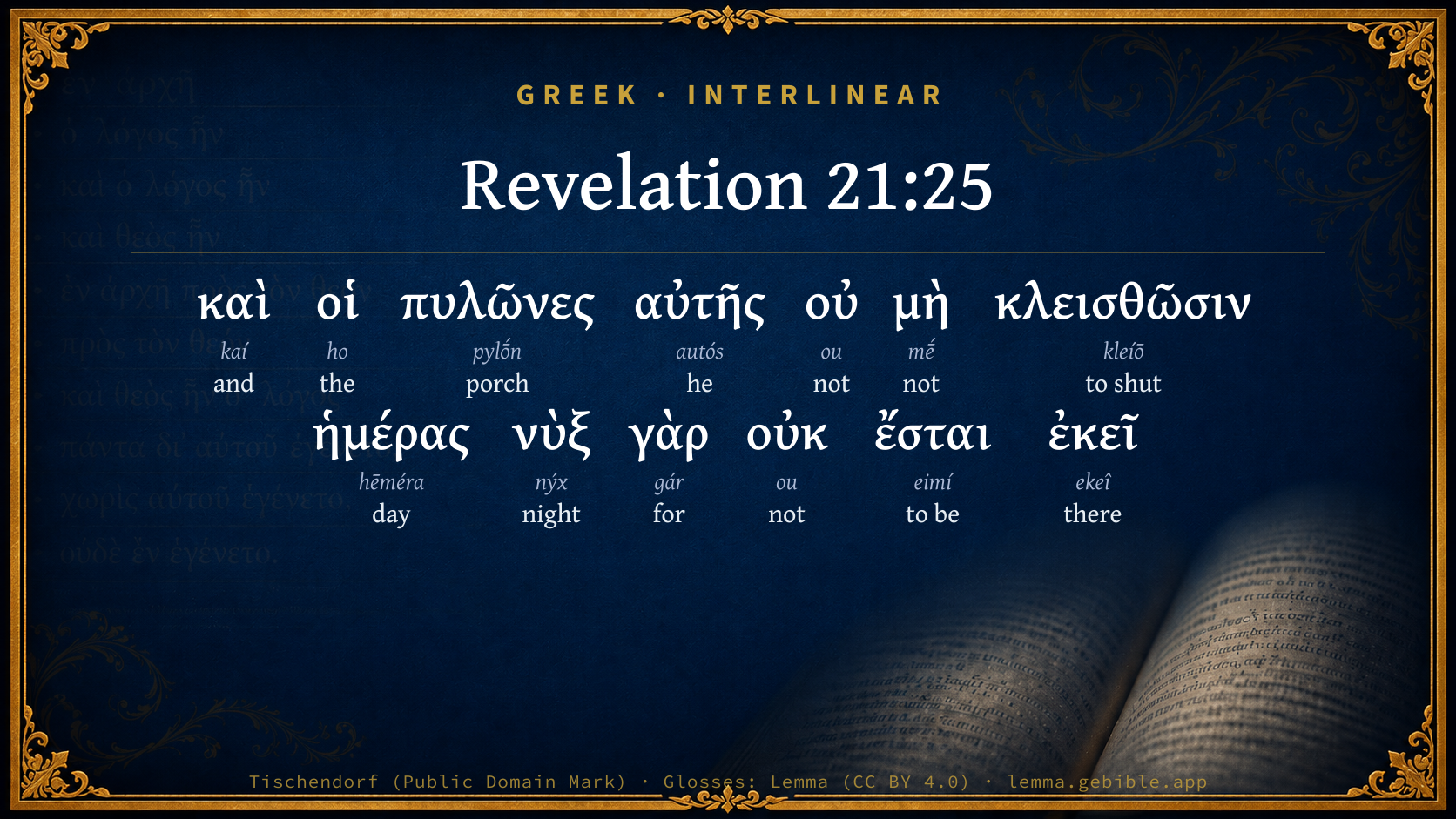
  1. καὶ kaí G2532 “and” Conjunction
  2. οἱ ho G3588 “the” Article, Nominative, Plural, Masculine
  3. πυλῶνες pylṓn G4440 “porch” Noun, Nominative, Plural, Masculine
  4. αὐτῆς autós G846 “he” Personal pronoun, Genitive, Singular, Feminine
  5. οὐ ou G3756 “not” Particle, Negative
  6. μὴ mḗ G3361 “not” Particle, Negative
  7. ἡμέρας hēméra G2250 “day” Noun, Genitive, Singular, Feminine
  8. νὺξ nýx G3571 “night” Noun, Nominative, Singular, Feminine
  9. γὰρ gár G1063 “for” Conjunction
  10. οὐκ ou G3756 “not” Particle, Negative
  11. ἔσται eimí G1510 “to be” Verb, Future, Middle deponent, Indicative, 3rd person, Singular
  12. ἐκεῖ ekeî G1563 “there” Adverb

About this verse

These counts appear in no published source. They are computed here, from the morphology-tagged text and Lemma’s own curated glosses. What Lemma adds →

13
words
12
distinct lemmas
Revelation
section

Notable vocabulary

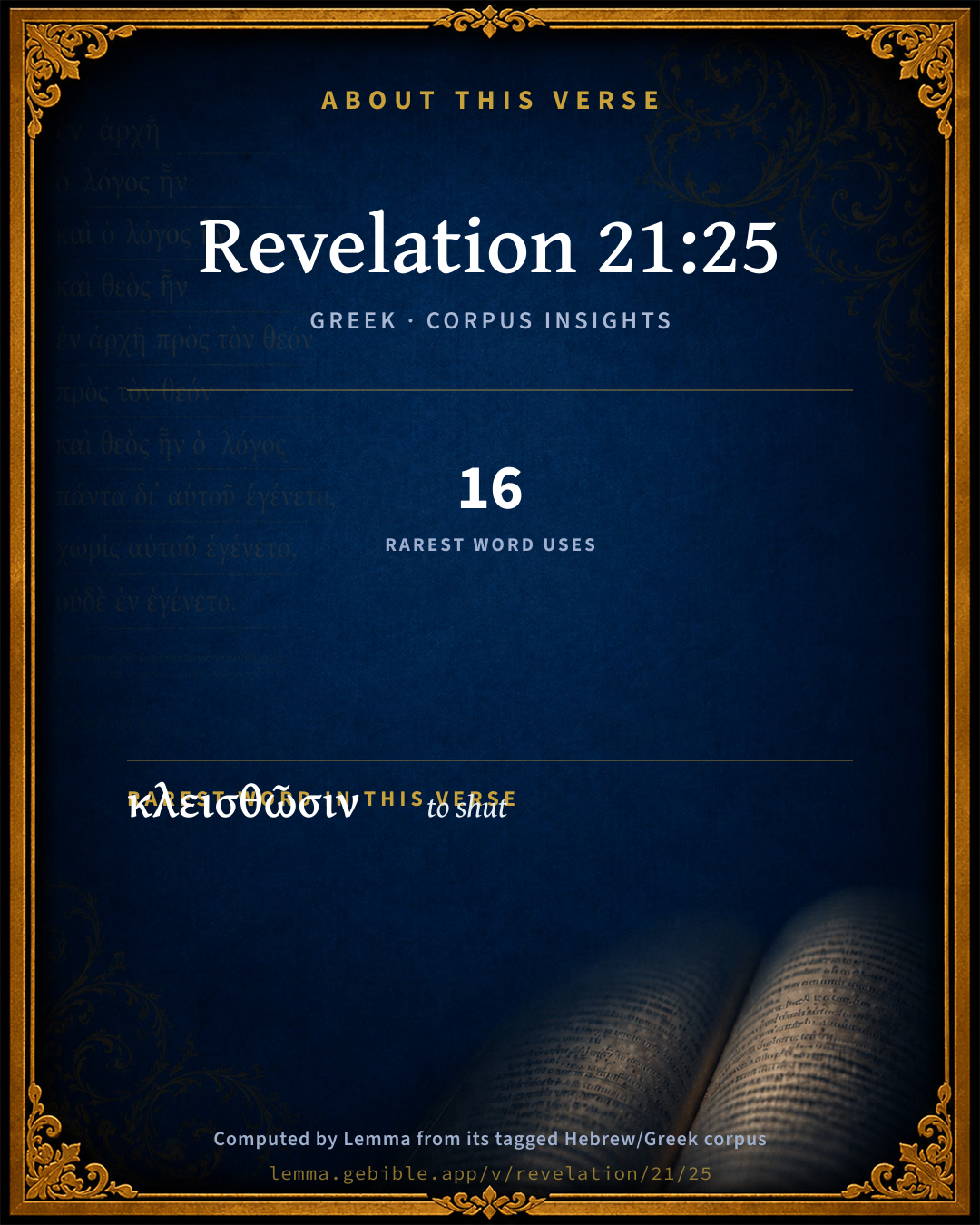
The rarest word here is κλεισθῶσιν to shut G2808 — appearing just 16 times in the whole Greek New Testament.

Shared distinctive vocabulary

κλεισθῶσιν to shut G2808 occurs in 15 verses of the Greek New Testament. Also found in:

Repetition

A word recurs within this verse:

Cross-references

5

Topical passages linked to Revelation 21:25 in the Treasury of Scripture Knowledge — connected by theme and wording, ordered by reader-vote popularity; previews shown in the World English Bible.

  • Isaiah 60:11 Your gates also shall be open continually; they shall not be shut day nor night; that men may bring to you the wealth of the nations, and their kings led captive.
  • Zechariah 14:7 It will be a unique day which is known to Yahweh; not day, and not night; but it will come to pass, that at evening time there will be light.
  • Revelation 22:5 There will be no night, and they need no lamp light; for the Lord God will illuminate them. They will reign forever and ever.
  • Isaiah 60:20 Your sun shall no more go down, neither shall your moon withdraw itself; for Yahweh will be your everlasting light, and the days of your mourning shall be ended.
  • Revelation 21:23 The city has no need for the sun, neither of the moon, to shine, for the very glory of God illuminated it, and its lamp is the Lamb.

Cross-references courtesy of OpenBible.info (CC BY 4.0).

Commentary

Notes on Revelation 21:25 from classic Christian and Jewish commentators (each source and its license shown beneath its notes). The classic Christian expositions comment on the surrounding passage and are grouped to its opening verse, so a note may address several verses; the Jewish commentaries on the Tanakh (Rashi and others) are per-verse, so they appear only where the commentator wrote on this verse.

Lemma curates 59 commentaries, every one of them public domain or Creative Commons licensed, each selected and text-cleaned for this edition rather than reprinted as found. About our sources →

The Biblical Illustrator

Joseph S. Exell

Rev_21:25

No night there.

The everlasting day

I. No natural night there. The large portion of our existence that sleep now consumes will be added to our peaceful, our blissful occupations.

II. No night of sin there.

III. No night of suffering there.

IV. No night of ignorance there.

V. No night of infirmities there.

VI. No night of mysterious providences there.

VII. No night of hindered prayers there.

VIII. No night of disappointed expectations there.

IX. No night of separation there.

X. No night of temptation there. (T. Nunns, M. A.)

No night there

In looking at the emblems employed in the Word of God, you cannot fail to be impressed with their simplicity as well as their beauty. Night is one of these.

1. It is the season of repose.

2. It is the time of evil--the season chosen for the performance of deeds of darkness and of sin.

3. And it is the time of fear. Yet notwithstanding all this I praise God for the night.

4. Night is suggestive of sorrow. This is the inevitable lot of the good on earth. But there shall be no night of sorrow there! No tears shall be shed, no hopes shall be frustrated, no disappointments felt, no friends removed, no graves opened. Night, as we have seen, is associated with deeds of darkness. And hence, when it is affirmed of the heavenly state that there shall be no night there, we are reminded of the perfect purity of our eternal home. Further, night is associated with weariness and fatigue. To affirm, therefore, of the heavenly world that there shall be no night there, is to declare that weariness and fatigue shall be unknown. One of the most difficult questions is that of the exact nature of the glorified body the redeemed will possess. And then, night is associated with obscurity. Its shades conceal much from our vision, and hence it has ever been regarded as an appropriate emblem of mental obscurity. Mystery surrounds us on every hand. Questions are continually arising to which we can return no complete answer. Now it is night with us. The unclouded day is yonder. (S. D. Hillman, B. A.)

No night there

I. The absence of night in the glorified church implies that there will be no sin there.

II. The absence of night implies there shall be no ignorance there

III. The absence of night implies there shall be no weariness there. Here Gods people are wearied with labours.

IV. The absence of night implies that there shall be no change there.

V. The absence of night implies that there shall be no death there. (B. W. Bucke, M. A.)

The happiness of heaven

I. The import of the representation by which this state is here distinguished.

1. Among the mansions of the blessed, there shall be no fatigue, no tendency to lassitude, and no reason for repose.

2. There shall be no hostile intrusion there; there is no reason for precaution.

3. There is no impurity and no sin.

4. But night is a season of privation; and when we are told of heaven as a state where no privation shall be, we are well reminded that no night shall be there. Do you speak of privation of society? In heaven you will have delightful and hallowed fellowship. Do you speak of privation of knowledge? In heaven, illumination will be poured upon our faculties to the utmost extent which those faculties can, by possibility, bear. Do you speak of privation of happiness? In heaven, perturbation and pain, and fear, and distress, will be removed for ever.

5. No more death--no more death to our persons: for this corruptible shall put on incorruption. No more death to our happiness; no more death to our attainments; no more death to our joy. All unchangeable, and all imperishable, and all for ever!

II. The conclusions which our contemplations of the heavenly state under this representation ought forcibly to impress upon our minds.

1. Our contemplations ought to induce preparation.

2. Our contemplations of the heavenly state ought to induce gratitude. You were the slave led captive by the devil at his will, and now have been brought into the glorious liberty of the sons of God--a liberty which is to be consummated in the skies.

3. These contemplations of the heavenly state should induce desire. And truly there is nothing--if we are preparing for such scenes as those which have now been laid before you--there is nothing which should keep your desires from heaven. (J. Parsons.)

Heaven without night

1. We are wont to associate with night the idea of weariness. Sweet to the myriad toilers in the worlds vast workshop is the coming of the still evening hour, when the tasks of day are laid aside, and tired limbs and overwrought brains draw refreshment from slumber. So benign is this provision that Scripture has included it among the special acts of Divine goodness, in the beautiful saying, He giveth His beloved sleep. Now, as this arrangement is not found in heaven, the inference is obvious that the denizens of that bright realm do not require its operation, and are so constituted as to be inaccessible to fatigue from any intensity or duration of employment.

2. Night is the symbol of ignorance. How often do the Sacred Writers represent the intellectual and moral blindness of men under the figure of darkness! Thus Job, describing the errors and follies of the devotees of human wisdom, says, They meet with darkness in the daytime, and grope at noonday as in the night. And the fearful ignorance of God and of truth, which overspread the world at the period of the Redeemers advent, is pourtrayed by the graphic declaration, Darkness covered the earth, and gross darkness the people. In this emblematic sense, a deep and cloudy night stretches over the sphere which we now inhabit. How imperfect are our faculties! How narrow the limits of our knowledge! How obscure and uncertain our researches! What barriers of gloom and mystery meet us on whatever side we attempt to push our investigations! But in heaven there will be no intellectual night. All the errors that now shade and darken our minds--all the obstacles which here impede and limit our acquisitions-shall there be for ever removed. The faculties of the soul which, amid the fogs and illusions of sense, are so restricted in their range, and so distorted in their vision, will, in that radiant world, expand into seraphic strength, and under the beams of eternal day receive a new impulse, and a right direction. The veil also, which now hangs over so many departments of Truth, will then be lifted, and we shall enter her inmost temple, and worship at her most secret shrine.

3. Night is the symbol of sin. The time which God has ordained for rest, man has appropriated to crime. All classes of the depraved and lawless look upon night as their chosen patron and protector. The way of the wicked is as darkness. Men love darkness rather than light, because their deeds are evil. When, therefore, we read of heaven as being without night, the expression evidently implies that into those holy realms no impurity can ever be admitted. There shall in no ease enter into it anything that defileth, neither whatsoever worketh abomination, or maketh a lie, but they that are written in the Lambs book of life.

4. Night is the symbol of danger. The hours in which darkness broods over the earth are peculiar for their insecurity. It is then that the robber, the housebreaker, the incendiary, and the whole tribe of depredators on property and life, steal from their lurking places, and roam abroad on their work of mischief. And then it is that perils easily avoided by day deepen and multiply their terrors. The exclusion of night from heaven may, therefore, be interpreted as a pledge that, in that secure asylum, no adversary shall assail us, and no possibility of evil ever menace our peace. The seductions of the world, and the treachery of our own hearts, will not follow us there, nor can Satan cross the great gulf fixed between hell and heaven to vex us with his assaults.

5. Night is the symbol of want. Sleep is the sister of death. During its reign over us, we retire within ourselves; the senses close their portals, and the soul is shut in from all its wonted delights. Communion with man and with Nature has ceased. Perception is suspended. Reason is in abeyance. Gone are consciousness, memory, hope. And even should slumber be interrupted, what a dreary blank does the eye behold! Hidden is the rich land-scape--stream, and forest, and mountain--all the grand things and the lovely on which the daylight looks. Above us may glimmer the watching stars and the silvery moon, but they only awaken regret for the nobler luminary departed. So is it that night typifies want; and the fact that heaven knows no night is a most expressive sign that it also knows no privation. Want, in one or another of its forms, is inseparable from our earthly condition. Pilgrims in the desert, we must expect to sigh in vain for much that is essential to perfect felicity. But when we reach the land of Divine fulness above, every need will be supplied. Everything around us, every scene, every object, every employment, will be adapted to exclude disquietude, and to minister delight. Every faculty, every passion, will be absorbed in adoration, and overflowing with ecstasy. And He that sitteth on the throne will bring out His treasures to augment our bliss, showering down upon our spirits all the raptures which Almighty Goodness can bestow.

6. Night is the symbol of death. There are few analogies in the whole range of sacred imagery more suited to represent death than the season of night. And thus we find it very frequently employed by the inspired writers. The Psalmist, in speaking of the removal of his friends by death, says, Mine acquaintance hast Thou put into darkness. Job calls death the day of darkness, and the grave the bed of darkness, a land of darkness, as darkness itself; and of the shadow of death, without any order, and where the light is as darkness. Our Divine Teacher has also given us a very striking description of death under the figure of night. I must work the works of Him that sent Me while it is day; the night cometh in which no man can work. To beings situated as we are, it is hardly possible to form an idea of a state of existence in which death is unknown. Yet this is true of heaven. There shall be no more death. Oh, what a soul-ravishing announcement is this! No more death! Then hope has dawned on the midnight of the tomb; the King of Terrors is despoiled of his power, and the all-conqueror is himself conquered! No more death to our persons--no more death to our attainments--no more death to our usefulness--no more death to our joys! All are changeless and perfect. God is our portion, holiness our vesture, happiness our allotment, eternity our home. Oh, what a boon is Immortality when it thus stamps its own endless duration on all that awaits us in the Better Land! (Dr. Ide.)

The vision of the truth

I. Now here is seen the value of Christian principle. The Man of Sorrows is on His march for the morning; for the principles of the passion place you on the track of the dawn.

II. These principles are powers of guidance in three important--nay, momentous--questions of conduct.

1. What is seriously necessary for any soul in order, in its mortal journey, to be useful and happy? The answer is--Not to live at random, but to have an object in life.

2. What is to be my view of the world? What is the attitude of the soul of the Christian towards the mass of mankind? The optimist views it all through the medium of a rose-coloured dream. All is going onward as merry as a marriage-bell. The only objection is--theories do not alter human suffering, and to this theory facts do not square. It is impossible here reasonably to deny the darkness. It is true it is blessed to remember there shall be no night there.

3. There is here a revelation of the future. The eternal city is in fact the working out of the twofold Divine benediction. It is the completion and beatified result of purified characters. Blessed are the undefiled in the way, and Blessed is he whose unrighteousness is forgiven and whose sin is covered. This is the glorious end of innocence and penitence. The breaking of the dawn! It is coming, there is a land of brightness after darkness; amid all sorrow hope will yet have its triumph: there shall be no night there!

III. Night here, however. Why? From the absence of the sun: from the accumulation of the clouds.

1. There is sin. Wills opposed to the will of changeless goodness: wills almost fixed in evil--eyes from which all vision of brightness seems gone: hearts which seem to keep no trace of pity. Ah me!--a ruined soul, or a soul on the road to ruin, how terrible! To be growing worse instead of better: to be losing foothold, not climbing boldly on. Soul of a sinner! Pause, think twice. It is hard to imagine deliverance: hard to believe at times that Gods grace, that fresh breezes from the heavenly courts, can disperse such clouds, but it is true. Look up, march eastward; repent, cry for help, take heart; though the path be rough it is the path of the Holy Passion. The city of the saints is the land of the sunlight. There shall be no night there.

2. There is sorrow. Ah! who has ever read, who can ever read, the mystery of tears? But there it is. There is a home where no sorrow enters--there dwelleth no evil, there is no night there.

3. There is death. However it be lightened by the faith of a Christian, what thinking mind can fail to acknowledge there is the solemnity of night about the grave? Well, the dawn of eternity shall break, and death itself shall die.

IV. There are many difficulties, many sorrows; yet are there not some alleviations? Life is never altogether darkness When it is illuminated by hope. Look upward, take courage, never allow the cowardice of permanent despondency, or the blasphemy of final despair. Trust God. Surely even here are streaks in the darkness. There are quiet hours of rest and blessing; such a converse with a dear friend; such a happy day of pleasure; such evidence that the sun is there, though veiled by the vapour; such approaches of the daylight; such streaks of the dawn. To repent, heartily, manfully, thoroughly, when you have sinned; to receive trial and sorrow with loving submission, and willingly to taste the sweet uses of adversity; to love goodness, truth, duty, God in Christ, and by the power, the moral power of love, to help and make men better--this, this, surely, whatever happens, is to plant your feet firmly on the track of the dawn.

V. What about the future? Well, John assures us that there lies before us something beyond all words happy, which he can only convey to us by speaking of it as a city. Remember that in that city you will find the result of your toil and the end of your journey. (Canon Knox Little.)

The Biblical Illustrator, edited by Joseph S. Exell (c. 1880s–1900s) — public domain. Text from a community e-Sword module.

Jamieson, Fausset & Brown

Robert Jamieson, A. R. Fausset & David Brown

not be shut . . . by day--therefore shall never be shut: for it shall always be day. Gates are usually shut by night: but in it shall be no night. There shall be continual free ingress into it, so as that all which is blessed and glorious may continually be brought into it. So in the millennial type.

Jamieson, Fausset & Brown — Commentary Critical and Explanatory on the Whole Bible (1871) — public domain (CC PDM 1.0). Text via the HelloAO Bible API.

Adam Clarke's Commentary

Verse 25. The gates of it shall not be shut at all] The Christian Church shall ever stand open to receive sinners of all sorts, degrees, and nations.

There shall be no night there.] No more idolatry, no intellectual darkness; the Scriptures shall be everywhere read, the pure word everywhere preached, and the Spirit of God shall shine and work in every heart.

Adam Clarke's Commentary on the Bible (1810–1826) — public domain. Text from a community e-Sword/MySword module.

Ellicott's Commentary for English Readers

(25, 26) And the gates of it . . .—Better, And the gates (or, gate-towers) shall never be shut by day, for night shall not be there. The gates shall never be shut: all day they shall be open, and that day shall be for ever, for there shall be no night there. All that darkens—the sin that brings night on the soul; the sorrow that brings night on the heart—shall be banished for ever. In peace by day, the city gates will be open; nor can there be night when God the Almighty is the Sun. (Comp. Isa_60:11; Eze_38:11.) Through its open gates they (i.e., men) will bring the glory and honour of the nations into her. As men find that every good gift and every perfect gift is from above, and that their strength is in Christ, without whom they can do nothing, so will their lives bring back to Him the lustre of all their achievements.

A Bible Commentary for English Readers, edited by Charles John Ellicott (1878–1897) — public domain. Text from a community e-Sword module.

The Cambridge Bible for Schools and Colleges

gen. ed. J. J. S. Perowne

25. And the gates &c.] Isa_60:11. But the later prophet speaks of a further glory than the earlier: Isaiah recognises the succession of day and night, while St John sees that in that perpetual day the gates cannot need to be closed. In an earthly city they are not closed by day except in time of war; but even in perfect peace they are closed every night (cf. Neh_13:19); here the daylight is as perpetual as the peace.

The Cambridge Bible for Schools and Colleges (gen. ed. J. J. S. Perowne; Cambridge University Press, 1878–1918) — public domain. Text from a community e-Sword module.

John Gill's Exposition

And they shall bring the glory and honour of the nations into it. The glory of the nations are the people of God, who, though they are reckoned the filth of the world, are the excellent in the earth; these will be brought into this city, and be presented to the King of it, in a glorious manner, and that by the kings of the earth; either such who have been ecclesiastical rulers over them, who will introduce them as their joy and crown of rejoicing; or who have been political governors of them, their fathers and protectors; or the sense is as before, that whatever is great and glorious in the nations of the world, will be counted as nothing in comparison of the glory and magnificence of this state, and not to be mentioned with it: the Arabic version renders it, "the nations shall bring glory and honour to it"; in the sense before given.

Revelation 21:27

John Gill's Exposition of the Whole Bible (1746–1763) — public domain (CC PDM 1.0). Text via the HelloAO Bible API.

Trapp's Complete Commentary

John Trapp

25 And the gates of it shall not be shut at all by day: for there shall be no night there.

Ver. 25. For there shall be no night there] And so no need to fear a sudden surprise by the enemy watching his opportunity. Their day above is ανεσπερος ημερα, a nightless day, as a Father calls it.

John Trapp, A Commentary or Exposition upon All the Books of the Old and New Testament (1647–1656) — public domain. Text from a community e-Sword module.

Albert Barnes' Notes on the Bible

And the gates of it shall not be shut at all by day - It shall be constantly open, allowing free ingress and egress to all who reside there. The language is derived from Isa 60:11. See the notes on that place. Applied to the future state of the blessed, it would seem to mean, that while this will be their permanent abode, yet that the dwellers there will not be prisoners. The universe will be open to them. They will be permitted to go forth and visit every world, and survey the works of God in all parts of his dominions.

For there shall be no night there - It shall be all day; all unclouded splendor. When, therefore, it is said that the gates should not be “shut by day,” it means that they would never be shut. When it is said that there would be no night there, it is, undoubtedly, to be taken as meaning that there would be no literal darkness, and nothing of which night is the emblem: no calamity, no sorrow, no bereavement, no darkened windows on account of the loss of friends and kindred. Compare the notes on Rev 21:4.

Albert Barnes' Notes on the Bible (1834–1885) — public domain. Text from a community e-Sword/MySword module.

Matthew Poole's English Annotations

And the gates of it shall not be shut at all by day: the reason of shutting a city’s gates, is either to shut out enemies, or to keep in such as are within: there will be no need of shutting these gates on either of these accounts; there will be no enemies to fear, and those that are within this city will have no need nor desire to go out.

For there shall be no night there: we do not ordinarily shut our city gates by day, but there shall be nothing but day, no night in a natural or metaphorical sense.

Matthew Poole's English Annotations on the Holy Bible (1683–1685) — public domain. Text from a community e-Sword/MySword module.

Whedon's Commentary on the Bible

Daniel D. Whedon

25. The twelve pearl gates or doors, each three approachable from the four points of compass, shall never be shut. The twice twelve tribal nations shall ever find it day, and ever find open gates. The gates of gospel grace are ever open here on earth, the gates of the New Jerusalem shall ever be open to the dwellers of the heavenly earth.

For—Reason for mentioning day only, there shall be no night. The divine glory never remits, never dims. No revolving of the orb renders the opposite hemisphere dark. No north pole caps the arctic with ice. No glaciers chill the air, no night-shade broods with malaria, or spreads her cover over crime. Here we may read into this description the beautiful passage, Rev_7:14-17. See our notes there.

Daniel D. Whedon (gen. ed.), Commentary on the Old and New Testaments (1874–1909) — public domain. Text from a community e-Sword module.

The Pulpit Commentary

And the gates of it shall not be shut at all by day: for there shall be no night there. The Revised Version correctly places the last clause in parentheses. The meaning is: The gates shall never be shut, either by day or night; but it is superfluous to say, "by night," for there is no night there. Some commentators think the open gates are a sign of perfect security; others, that they are open to admit the nations, as described in the following verse. Both ideas may well be understood.

"No night there.

I THE NIGHT A COMMON EMBLEM OF THINGS EVIL. The Bible notices of it are, like this of our text, almost always of a disparaging and deprecatory tone. It is represented as undesirable, and as telling of things that are evil. Sorrow (Isaiah 21, "Watchman, what of the night? speaking of Edom"s affliction). "Songs in the night" mean songs in sorrowful seasons. Ignorance. "Darkness shall cover the land, and gross darkness the people." And concerning this land it was said that "it sat in darkness," so dense was the ignorance of the people. Sin. "Men love darkness rather than light, because their deeds are evil;" "We are not the children of the darkness, but of the light." Death. "Work... while it is day: the night cometh, when no man can work." The power of Satan. "This is your hour, and the power of darkness." And there are many more of a like sort. And yet

II THE NIGHT IS ONE OF GOD"S GOOD GIFTS. In plant-life it is essential to their growth. Night so naturalists tell is the time that the root of the plant feeds. During the day the light acts as a force upon the lining of the bark of the plant or tree, by which the nutriment is drawn up from the root. Now, at night that action ceases, and the root is able to thrust itself downward, deeper and deeper into the soil, wherever it can gain the nourishment it needs, and which it will have to supply when again the light comes, and yet more when the spring comes. The night is needed for this. And it is the time when the plant rids itself of that which would be hurtful to its life. The sap that the light and warmth of day have drawn up from the roots returns thither at night, but changed because charged with elements that the root will reject. It is these rejections of the root that render necessary the rotation of crops. The soil is poisoned for the same plant, but is ready for others. Now, for this, and much more in vegetable life, the night is needed. And for animal life. Psalm 104. sings, "Thou makest darkness, and it is night: wherein all the beasts of the forest do creep forth. The young lions roar after their prey, and seek their meat from God." Night is their feeding time, the sleeping time of most of their victims. Thus much suffering is avoided, and yet "the young lions" are fed. And for human life. The body is compelled to rest if its powers are to continue in vigour, and the night time is plainly given for that end. They who turn night into day and defraud the body of its due rest, frustrating the purpose for which night was given, violate the Creator"s laws, and must pay the certain and severe penalty which such violation involves. And the mind owes much to the night season, for it gains enlargement and instruction by the spectacle of the starry heavens; they, then, declare the glory of God. And the soul is uplifted by the contemplation of that glory. Thus, and for yet other reasons, is night to be regarded as one of God"s good gifts to met. Nevertheless, in the new heavens and the new earth it is said, "There is no night there.

III HOWEVER UNDERSTOOD, THE TEXT IS A BLESSED PROMISE.

1. Suppose we understand it figuratively. Then the promise is that all those varied ills of the mind and the soul which night has been the symbol of as in the declaration that there shall be "no more sea shall be absent from the saints" eternal home.

2. Or if we take the words literally and it is possible that this may be meant then they involve other glorious elements of the future which God"s Word leads us to look for; e.g. a new physical nature. For if there be no night, then no need of rest. Indeed, we are told "they cease not" in their high employ "day nor night." But for such unresting and yet untiring occupation a body not limited, frail, and easily fatigued, like our present body, must be given; a physical nature altogether different from the present. And that which we should have inferred is clearly stated in other Scriptures. "There is a natural body," such as we now have, "and there is a spiritual body," which is what we shall have. But if there be a new and a more glorious body, that is the index of a new and more glorious spiritual nature. The external is the fit clothing of the internal. There is congruity between them, so that we argue, and for the most part rightly, from the outward to the inward, and we gather much as to the character of any creature from its external form. If, then, there shall be a new and glorious body, what shall be the spirit within, which is furnished with so glorious an instrument for the carrying out of its purposes? But if a new physical and spiritual nature, then there must be a new mind towards God. For it is plain that the embargo laid upon our present nature, by which it is "made subject to vanity," has been taken off. That limitation was because we were not to be trusted with larger powers. "And now," said God, "lest he put forth his hand and take also of the tree of life, and eat, and live forever"; (Gen_3:22) "so he drove out the man." Man was, because of sin, made as he is, because if more had been given him he could not be trusted to use it aright. That is the teaching of the verse in Genesis. But the possession of the new physical and spiritual nature proves that that restriction has been removed. But that proves that a new mind is in man towards God. No longer a rebellious disobedient mind, but "the mind of Christ," of "a dear child." But if this, then there must be a new social state; no longer discord and strife, because there is one mind towards God, and hence all are one. But this is the Paradise of God, the kingdom of heaven itself. That we may have ever-growing surety that we shall come to that blessed home of God"s saints, let us look within the region of our own hearts, and see if there be no night there no darkness of sin and unbelief. If there be, then at once let us turn to him, who giveth to all who seek, that he may "shine into our hearts, to give us the light of the knowledge of the glory of God in the face of Jesus Christ. S.C.

The negative glory of heaven (No. 2).

"For there shall be no night there." In our observations on the preceding verses we pointed to the spiritual commonwealth of the good and the negative glory of heaven. Of the latter point the text at the head is not the least suggestive. The commonwealth of the good in its perfect state will be nightless, and the vision suggests

(1) constant luminosity;

(2) unclouded beauty; and

(3) uninterrupted favours.

I CONSTANT LUMINOSITY. Night draws her veil over nature, and hides from mortals the world in which they live, and it is therefore the symbol of ignorance. Never, of course, shall we see all things in heaven. There will always be universes lying beyond the ken of the most penetrating eye. The elevation that lies today at the utmost boundary of an angel"s horizon he may perhaps reach in the course of time, and one day stand upon its lofty brow. But even from this towering apex he may find other elevations concealing the infinite beyond. The finite intellect will never grasp the Infinite. Nor do I believe that different minds will ever have exactly the same view of things, see things exactly in the same light. This seems to me impossible, from the fact that no two spirits are exactly alike, nor can any two occupy exactly the same points of observation. Our views will necessarily be relative. They will be true to us, but not necessarily true to others. God alone can see the whole of a thing. We only see sections and sides. Not only does it appear impossible, but also undesirable. Diversity of view gives a freshness and charm to society. A city where all the citizens had precisely the same views on the same subjects would be characterized by a drowsy monotony. A loving comparison of views, a generous debate, a magnanimous controversy, are amongst the blessings and charms of social life. Still, our range of vision, though relative, and our views though relative, will be clear and accurate. Here, in a world of nights, our most correct conceptions of things are clouded more or less with error. We see now through a "glass, darkly," says Paul. The glass he refers to was not like our window-glass, offering no obstruction to light, but a semi-transparent horn. How different the landscape looked through such a thick medium, as looked at directly with a clear, strong eye! Notwithstanding this, all will be light enough to make the path of duty clear. The depravities of our nature, the Carnal and selfish inclinations of our hearts, often throw the darkness of night upon that course of life which is true and just. But in that world without a night, eternal sunshine will settle on the path of duty; it will lie straight before us, and we shall move on with the steps of certitude. God"s will will radiate on everything without, and will express itself in every impulse within. In that nightless sphere all will be morally pure. Moral impurity reigns in the night. It is the season in which great sins are generally committed. The thief and the assassin go forth with stealthy tread on their mission of wickedness in the night. The gambler, the debauchee, and the serfs of carnal appetites meet and hold their revelries in the night. "They that be drunken are drunken in the night." The prince of darkness and all his ghostly legions win their most terrible victories in the gloom and the silence of nocturnal hours. The day is the emblem and the minister of purity. How pure is the light! In heaven all is pure. There are the holy angels whose natures, through the ages of their being, have never been clouded by one impure thought or touched by the thrill of one unholy passion. The redeemed of all ages are there.

II UNCLOUDED BEAUTY. The negation implies that it is a realm ever beautiful in aspect. Darkness hides the beauty of the world, but light is the creator and minister of beauty. All the variegated colours of the summer"s landscape we owe to the sun; and all the exquisite forms of life owe their existence to his renewing power. The sun is nature"s great painter. All the pictures of loveliness that charm us as we walk the galleries of life have been photographed by his smiles and tinged by his hues. What, then, will be the beauty of a world where there is "no night a world of perpetual sunshine? All the beauties of nature will be clear. The very distant shores and the seas, the meads and the mountains, the rivers and the ravines all, in fact, beneath, around, above will be one grand universe of beauty. All the beauties of artists will be clear. The very instinct of genius is to invent, imitate, and create, and there genius will flourish in perfection. May it not be that numbers will there be employed in copying the forms of loveliness around them with pencils more delicate, lines more life like, hands more skilful, than our Raphaels and Rubenses, our Da Vincis and Correggios? May it not be that we shall see numbers there employed in weaving the sounds of nature into melodies more soul stirring and Divine than ever struck the lyre of our Handels and Mozarts? May it not be that numbers will he there hymning their praises in strains of seraphic poetry, compared with which the epics of Milton and the lyrics of Cowper are but the vapid fancies of childhood? Genius there will undoubtedly be active, and all her productions will be distinguished by the highest perfection of beauty. All the moral beauties will be clear. The beauty of holiness, the beauty of the Lord, will adorn every spirit. All will be endowed with those attributes of moral loveliness that will command the admiration of each and all. Thus all will rejoice in each other, and all rejoice in the Lord, whence all their beauty came.

III UNINTERRUPTED FAVOURS. Night checks the progress of life. The processes of life, it is true, go on in the night, but they are slow and feeble. Life cannot bear the darkness long; pulse grows feeble under its ebon reign. Its tide ebbs under its cold breath. Take a vigorous, blooming plant, and shut it up in the dark. How soon will it lose its vitality, become delicate, colourless, and die! Were our sun to shine on without setting from year to year on this earth, who could tell how high the tide of life would rise in every living thing? Where there is "no night," there will be no check to the advance of life. The vital energies will always be increasing. Sinew and soul, character and conscience, will be ever growing in force. "From strength to strength" all these proceed. No blight to wither, no shadow to chill, there. But all the influences that play around existence there inspire, invigorate, and uplift. Night checks the progress of labour. We "go forth unto our labour until the evening;" then night shuts us in. We retire to unconsciousness and inaction. "Are there not twelve hours in the day? If any man walk in the day, he stumbleth not, because he seeth the light of this world. But if a man walk in the night, he stumbleth, because there is no light in him." "The night cometh, when no man can work." But in a world where there is "no night," there is no checking of labour. Our range of action would be unrestrained. We shall be always abounding in the work of the Lord. Night checks the progress of happiness. Darkness is depressing. Hence it is often used as the emblem of misery; the scene where the wicked one,is is spoken of as "outer darkness." Even the irrational creatures around us feel the depressing influence of a gloomy day. Under the dark clouds and murky sky, the cattle cease to gambol on the hills, and the fowls of heaven cease their music in the groves. All feel the pressure of darkness. Light is the condition and emblem of joy. A bright day sets the world to music. What happiness, then, must there be in a world where there is no night! In what does its happiness consist? The context answers the question the absence of all evil. No pain, no sorrow, no death, no hunger, no thirst, no temple, no night. The presence of all the good: the river of life, the tree of life, companionship with the holy, fellow ship with God, oneness with Christ. This is heaven.

Such are the ideas suggested by this nightless condition. It is a scene where the vision is ever clear, where the character is ever pure, the aspect is ever beautiful, life is ever advancing, joy is ever rising. The sun never sinks beneath the hills, nor does a cloud ever intercept his rays. D.T.

The Pulpit Commentary (1880–1919), ed. H.D.M. Spence-Jones & Joseph S. Exell — public domain. Text from a community e-Sword module.

The People's New Testament

B. W. Johnson

25. And the gates of it shall not be shut at all by day. The gates were never shut. This implies, first, that the city has no fear of any foes. These have all been conquered and subdued. The struggles have been ended forever and no enemies remain to invade its happy precincts. It implies, in the second place, that “the nations of the saved” can always enter. There is always admittance freely to those “who have the right to enter in through the gate into the city.”

B. W. Johnson's The People's New Testament with Notes (1889–1891) — public domain. Electronic text from the Christian Classics Ethereal Library (CCEL) ThML edition.

Expositor's Greek Testament

ed. W. Robertson Nicoll

νὺξ κ . τ . λ . “for no night (when even in peace they would be shut, Neh 13:19 ) shall be there”.

The Expositor's Greek Testament, edited by W. Robertson Nicoll (1897–1910) — public domain. Text from a community e-Sword module.

Cambridge Greek Testament for Schools and Colleges

25. καὶ οἱ πυλῶνες. Isa 60:11. But the latter prophet speaks of a further glory than the earlier: Isaiah recognises the succession of day and night, while St John sees that in that perpetual day the gates cannot need to be closed. In an earthly city they are not closed by day except in time of war; but even in perfect peace they are closed every night (cf. Neh 13:19); here the daylight is as perpetual as the peace.

Cambridge Greek Testament for Schools and Colleges (Cambridge University Press, 1896; 21 vols, various authors incl. Carr, Maclear, Plummer, Farrar, Lumby, Moule, M. R. James, Simcox) — public domain. Text from a community e-Sword module.

Lesson kit

Teaching starters — assembled from the data on this page, not authored interpretation. Every prompt links to the verse data it draws on. Edit before teaching.

Revelation, in the Revelation, opens this verse with 13 words (12 distinct Greek lemmas). Its most distinctive word is kleíō (“to shut”). A historical commentator’s framing appears above. Read the whole chapter for the surrounding context.

Discussion questions

  1. The word kleíō carries the sense “to shut.” How does it shape the verse?
  2. How does Matthew 6:6, which shares the word «to shut», read alongside this verse?
  3. What does the repetition of “not” (2× in this one verse) do in this verse?
  4. These translations render this verse differently; the difference is in the English rendering, not the original. What questions does that raise?
  5. Compare how The Biblical Illustrator and Jamieson, Fausset & Brown read this verse. Where do they agree or differ?

Things to notice

Reading settings

Reading text

Shown beneath each verse's original-language words.

Old Testament
Old Testament edition

Read the OT as the Masoretic Hebrew (MT) or the Greek Septuagint (LXX).

English shown for the Greek Septuagint (in the Hebrew ↔ Greek comparison).

Comparing translations? Open the Compare panel on any verse page to stack up to four side by side.