
Revelation 2:14

Greek (Tischendorf 8th ed.) Revelation 2:14 appears in the Greek New Testament. The text above is from the Tischendorf 8th edition. Each word links to its Strong’s number and a concise gloss. Click any word for its full Thayer’s Greek Lexicon entry.
Download image
Cite this verse

Revelation 2:14 (World English Bible). Public Domain. Lemma interlinear Bible study tool, https://lemma.gebible.app/v/revelation/2/14.

Show BibTeX & RIS
BibTeX
RIS
English Translation
But I have a few things against you, because you have there some who hold the teaching of Balaam, who taught Balak to throw a stumbling block before the children of Israel, to eat things sacrificed to idols, and to commit sexual immorality.
World English Bible · Public Domain
Highlights
  • 1 hapax legomenon — only here in the Greek New Testament
  • 1 first appearance in the Greek New Testament
Full analysis ↓
Download a study sheet

One document with this verse’s original text, its word-by-word gloss line, the meaning frame, cross-references with their text, attributed commentary, and full source and license credits — printable, and it pastes into notes with its structure intact.

This verse Autodidact and up

Study sheet (.html) Plain text (.txt)

A passage Seminary Student

Up to 50 verses in one chapter. A passage sheet keeps up to 6 commentary sources and 12 cross-references per verse, in the order this page ranks them, and says so on the sheet whenever that leaves anything out. Ask for a single verse and you get the Autodidact verse sheet above.

Everything on this page stays free to read, with no account — the sheet is a download of what is already on screen, not access to it.

Want to remove ads? Support Godless Engineer
Compare translations 3

The same verse in 3 English versions, stacked beneath the original-language interlinear above. Click any original word for its lexicon entry.

Each is an independent rendering of the whole verse — the interlinear is not word-aligned to these translations.

Highlighted words mark where these versions differ — a whole-verse word diff, not a word-by-word alignment.

  • World English Bible Public Domain
    But I have a few things against you, because you have there some who hold the teaching of Balaam, who taught Balak to throw a stumbling block before the children of Israel, to eat things sacrificed to idols, and to commit sexual immorality.
  • King James Version Public Domain
    But I have a few things against thee, because thou hast there them that hold the doctrine of Balaam, who taught Balac to cast a stumblingblock before the children of Israel, to eat things sacrificed unto idols, and to commit fornication.
  • unfoldingWord Literal Text CC BY-SA 4.0
    But I have a few things against you, that you have there ones holding the teaching of Balaam, who taught Balak to throw a stumbling block before the sons of Israel, to eat idol-offerings and to be sexually immoral.

unfoldingWord Literal Text — © unfoldingWord, licensed CC BY-SA 4.0. Word-aligned USFM3 via Door43 (git.door43.org/unfoldingWord/en_ult).

Versions to compare (up to 4)

3 of 4 selected

Show all 19 translations

Every available English version of this verse, each an independent rendering of the whole verse.

  • World English Bible Public Domain
    But I have a few things against you, because you have there some who hold the teaching of Balaam, who taught Balak to throw a stumbling block before the children of Israel, to eat things sacrificed to idols, and to commit sexual immorality.
  • Berean Standard Bible Public Domain
    But I have a few things against you, because some of you hold to the teaching of Balaam, who taught Balak to place a stumbling block before the Israelites so they would eat food sacrificed to idols and commit sexual immorality.
  • Majority Standard Bible Public Domain
    But I have a few things against you, because some of you hold to the teaching of Balaam, who taught Balak to place a stumbling block before the Israelites so they would eat food sacrificed to idols and commit sexual immorality.
  • King James Version Public Domain
    But I have a few things against thee, because thou hast there them that hold the doctrine of Balaam, who taught Balac to cast a stumblingblock before the children of Israel, to eat things sacrificed unto idols, and to commit fornication.
  • American Standard Version (1901) Public Domain
    But I have a few things against thee, because thou hast there some that hold the teaching of Balaam, who taught Balak to cast a stumblingblock before the children of Israel, to eat things sacrificed to idols, and to commit fornication.
  • Revised Version (1885) Public Domain
    But I have a few things against thee, because thou hast there some that hold the teaching of Balaam, who taught Balak to cast a stumblingblock before the children of Israel, to eat things sacrificed to idols, and to commit fornication.
  • Geneva Bible (1599) Public Domain
    But I haue a fewe things against thee, because thou hast there them that maintaine the doctrine of Balaam, which taught Balac to put a stumbling blocke before ye children of Israel, that they should eate of things sacrificed vnto Idoles, and commit fornication.
  • Douay-Rheims (1899) Public Domain
    But I have against thee a few things: because thou hast there them that hold the doctrine of Balaam, who taught Balac to cast a stumblingblock before the children of Israel, to eat, and to commit fornication:
  • Young's Literal Translation Public Domain
    `But I have against thee a few things: That thou hast there those holding the teaching of Balaam, who did teach Balak to cast a stumbling-block before the sons of Israel, to eat idol-sacrifices, and to commit whoredom;
  • Literal Standard Version CC BY-SA 4.0
    But I have a few things against you: that you have there those holding the teaching of Balaam, who taught Balak to cast a stumbling-block before the sons of Israel, to eat idol-sacrifices, and to commit whoredom;
  • Unlocked Literal Bible CC BY-SA 4.0
    But I have a few things against you: You have there some who hold tightly to the teaching of Balaam, who taught Balak to throw a stumbling block before the children of Israel, so they would eat food sacrificed to idols and be sexually immoral.
  • unfoldingWord Literal Text CC BY-SA 4.0
    But I have a few things against you, that you have there ones holding the teaching of Balaam, who taught Balak to throw a stumbling block before the sons of Israel, to eat idol-offerings and to be sexually immoral.
  • Darby Bible Public Domain
    But I have a few things against thee: that thou hast there those who hold the doctrine of Balaam, who taught Balak to cast a snare before the sons of Israel, to eat [of] idol sacrifices and commit fornication.
  • World Messianic Bible Public Domain
    But I have a few things against you, because you have there some who hold the teaching of Balaam, who taught Balak to throw a stumbling block before the children of Israel, to eat things sacrificed to idols, and to commit sexual immorality.
  • Webster's Bible Public Domain
    But I have a few things against thee, because thou hast there them that hold the doctrine of Balaam, who taught Balak to cast a stumbling-block before the children of Israel, to eat things sacrificed to idols, and to commit lewdness.
  • Free Bible Version CC BY-SA 4.0
    But I have a few things against you: There are some among you who hold to the teaching of Balaam, who taught Balak how to entrap the children of Israel by means of eating food sacrificed to idols and committing sexual sins.
  • Bible in Basic English Public Domain
    But I have some things against you, because you have with you those who keep the teaching of Balaam, by whose suggestion Balak made the children of Israel go out of the right way, taking food which was offered to false gods, and going after the desires of the flesh.
  • Text-Critical English NT CC BY 4.0
    But I have a few things against yoʋ: Yoʋ have some there who hold to the teaching of Balaam, who taught Balak to put a stumbling block before the sons of Israel and to eat food sacrificed to idols and to commit fornication.
  • Tyndale New Testament (1534) Public Domain
    But I have a fewe thynges agaynst the: that thou hast there they that mayntayne the doctryne of Balam which taught in balake to put occasion of syn before the chylderne of Israhell that they shulde eate of meate dedicat vnto ydoles and to commyt fornicacion.

Literal Standard Version (2020), Covenant Press — licensed CC BY-SA 4.0. Text via the HelloAO Bible API (eBible.org). Unlocked Literal Bible (unfoldingWord) — licensed CC BY-SA 4.0. Text via the HelloAO Bible API (eBible.org). unfoldingWord Literal Text — © unfoldingWord, licensed CC BY-SA 4.0. Word-aligned USFM3 via Door43 (git.door43.org/unfoldingWord/en_ult). Free Bible Version, Dr. Jonathan Gallagher — licensed CC BY-SA 4.0. Text via the HelloAO Bible API (eBible.org).

Word by word

More ways to search: Search by grammar → Find every occurrence → Compare this word →

Practice this passage: Drill this verse → Learn its vocabulary →

Βαλὰκ
Balák
G904
“king of Moab”
Noun, Proper, indeclinable
Part of Speech
Noun · Proper, indeclinable
Full Thayer's Definition

Origin: of hebrew origin H1111

TDNT: None

Balak = "a devastator or spoiler" 1. a king of Moab
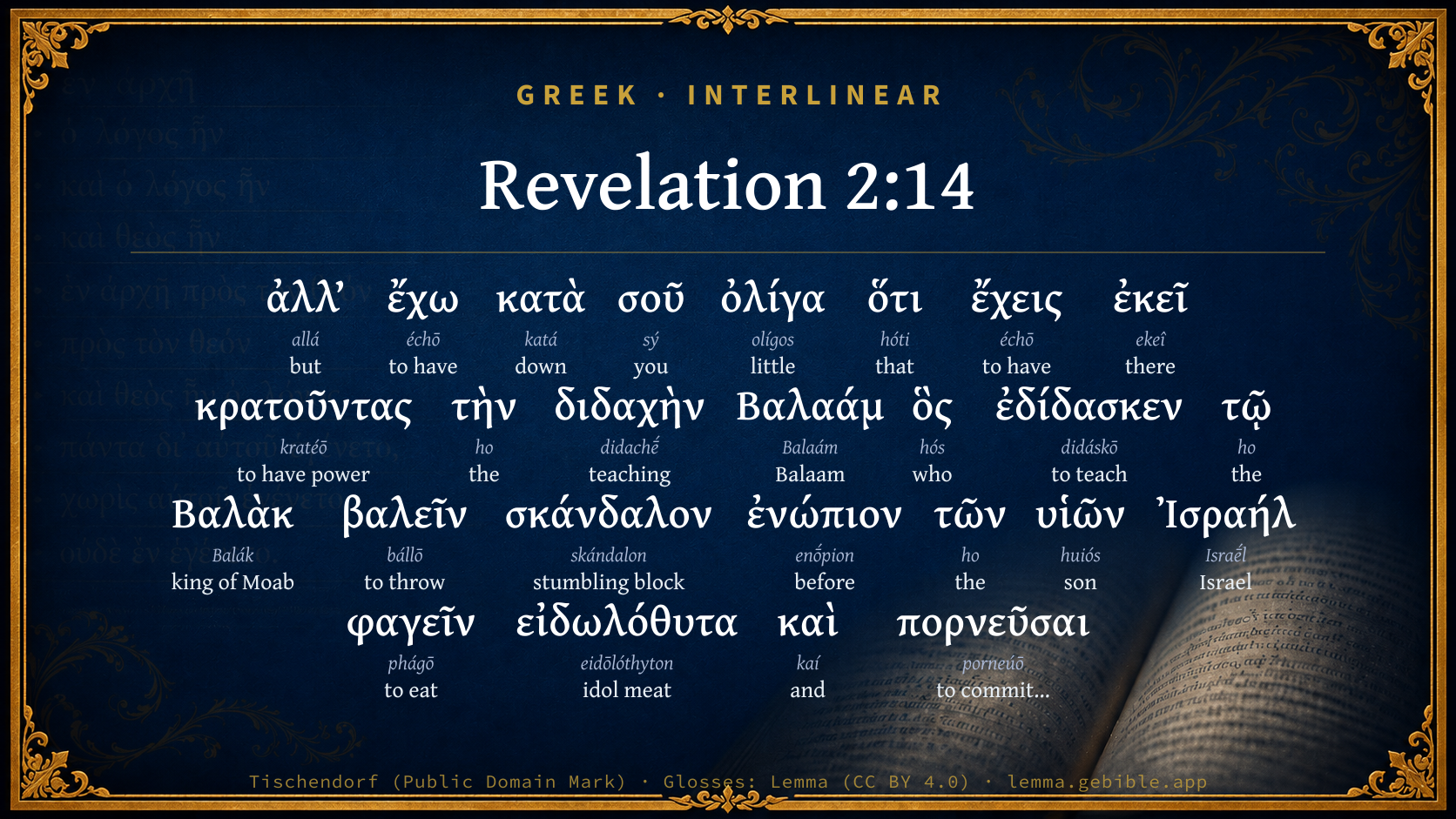
  1. ἀλλ’ allá G235 “but” Conjunction
  2. ἔχω échō G2192 “to have” Verb, Present, Active, Indicative, 1st person, Singular
  3. κατὰ katá G2596 “down” Preposition
  4. σοῦ sý G4771 “you” Personal pronoun, 2nd person, Genitive, Singular
  5. ὀλίγα olígos G3641 “little” Adjective, Accusative, Plural, Neuter
  6. ὅτι hóti G3754 “that” Conjunction
  7. ἔχεις échō G2192 “to have” Verb, Present, Active, Indicative, 2nd person, Singular
  8. ἐκεῖ ekeî G1563 “there” Adverb
  9. κρατοῦντας kratéō G2902 “to have power” Verb, Present, Active, Participle, Accusative, Plural, Masculine
  10. τὴν ho G3588 “the” Article, Accusative, Singular, Feminine
  11. διδαχὴν didachḗ G1322 “teaching” Noun, Accusative, Singular, Feminine
  12. Βαλαάμ Balaám G903 “Balaam” Noun, Proper, indeclinable
  13. ὃς hós G3739 “who” Relative pronoun, Nominative, Singular, Masculine
  14. ἐδίδασκεν didáskō G1321 “to teach” Verb, Imperfect, Active, Indicative, 3rd person, Singular
  15. τῷ ho G3588 “the” Article, Dative, Singular, Masculine
  16. βαλεῖν bállō G906 “to throw” Verb, Aorist, Active, Infinitive
  17. σκάνδαλον skándalon G4625 “stumbling block” Noun, Accusative, Singular, Neuter
  18. ἐνώπιον enṓpion G1799 “before” Adverb
  19. τῶν ho G3588 “the” Article, Genitive, Plural, Masculine
  20. υἱῶν huiós G5207 “son” Noun, Genitive, Plural, Masculine
  21. Ἰσραήλ Israḗl G2474 “Israel” Noun, Proper, indeclinable
  22. φαγεῖν phágō G5315 “to eat” Verb, Aorist, Active, Infinitive
  23. εἰδωλόθυτα eidōlóthyton G1494 “idol meat” Adjective, Accusative, Plural, Neuter
  24. καὶ kaí G2532 “and” Conjunction
  25. πορνεῦσαι porneúō G4203 “to commit immorality” Verb, Aorist, Active, Infinitive

About this verse

These counts appear in no published source. They are computed here, from the morphology-tagged text and Lemma’s own curated glosses. What Lemma adds →

26
words
23
distinct lemmas
Revelation
section

Notable vocabulary

1 hapax legomenon — a word that appears only here in the entire Greek New Testament:

  • Βαλὰκ king of Moab G904

First appearance in Scripture

This word makes its first canonical appearance in the Greek New Testament here:

  • Βαλὰκ king of Moab G904

Shared distinctive vocabulary

Βαλαάμ Balaam G903 occurs in 3 verses of the Greek New Testament. Also found in:
Repetition

Words recur within this verse:

Cross-references

30

Topical passages linked to Revelation 2:14 in the Treasury of Scripture Knowledge — connected by theme and wording, ordered by reader-vote popularity; previews shown in the World English Bible.

  • Numbers 31:16 Behold, these caused the children of Israel, through the counsel of Balaam, to commit trespass against Yahweh in the matter of Peor, and so the plague was among the congregation of Yahweh.
  • 2 Peter 2:15 forsaking the right way, they went astray, having followed the way of Balaam the son of Beor, who loved the wages of wrong-doing;
  • Revelation 2:20 But I have this against you, that you tolerate your woman, Jezebel, who calls herself a prophetess. She teaches and seduces my servants to commit sexual immorality, and to eat things sacrificed to idols.
  • Numbers 25:1–3 Israel abode in Shittim; and the people began to play the prostitute with the daughters of Moab:
  • Acts 15:29 that you abstain from things sacrificed to idols, from blood, from things strangled, and from sexual immorality, from which if you keep yourselves, it will be well with you. Farewell."
  • Jude 1:11 Woe to them! For they went in the way of Cain, and ran riotously in the error of Balaam for hire, and perished in Korah's rebellion.
  • Joshua 24:9 Then Balak the son of Zippor, king of Moab, arose and fought against Israel: and he sent and called Balaam the son of Beor to curse you;
  • Hebrews 13:4 Let marriage be held in honor among all, and let the bed be undefiled: but God will judge the sexually immoral and adulterers.
  • Numbers 31:8 They killed the kings of Midian with the rest of their slain: Evi, and Rekem, and Zur, and Hur, and Reba, the five kings of Midian: Balaam also the son of Beor they killed with the sword.
  • Acts 15:20–21 but that we write to them that they abstain from the pollution of idols, from sexual immorality, from what is strangled, and from blood.
  • Acts 21:25 But concerning the Gentiles who believe, we have written our decision that they should observe no such thing, except that they should keep themselves from food offered to idols, from blood, from strangled things, and from sexual immorality."
  • 1 Corinthians 10:18–31 Consider Israel after the flesh. Don't those who eat the sacrifices have communion with the altar?
  • 1 Peter 2:8 and, "A stone of stumbling, and a rock of offense." For they stumble at the word, being disobedient, whereunto also they were appointed.
  • Numbers 24:14 Now, behold, I go to my people: come, [and] I will advertise you what this people shall do to your people in the latter days.
  • Ezekiel 3:20 Again, when a righteous man does turn from his righteousness, and commit iniquity, and I lay a stumbling block before him, he shall die: because you have not given him warning, he shall die in his sin, and his righteous deeds which he has done shall not be remembered; but his blood will I require at your hand.
  • Matthew 18:7 "Woe to the world because of occasions of stumbling! For it must be that the occasions come, but woe to that person through whom the occasion comes!
  • 1 Corinthians 6:13–18 "Foods for the belly, and the belly for foods," but God will bring to nothing both it and them. But the body is not for sexual immorality, but for the Lord; and the Lord for the body.
  • 1 Corinthians 7:2 But, because of sexual immoralities, let each man have his own wife, and let each woman have her own husband.
  • Revelation 21:8 But for the cowardly, unbelieving, sinners, abominable, murderers, sexually immoral, sorcerers, idolaters, and all liars, their part is in the lake that burns with fire and sulfur, which is the second death."
  • Revelation 22:15 Outside are the dogs, the sorcerers, the sexually immoral, the murderers, the idolaters, and everyone who loves and practices falsehood.
  • Jeremiah 6:21 Therefore thus says Yahweh, Behold, I will lay stumbling-blocks before this people; and the fathers and the sons together shall stumble against them; the neighbor and his friend shall perish.
  • Ezekiel 44:12 Because they ministered to them before their idols, and became a stumbling block of iniquity to the house of Israel; therefore have I lifted up my hand against them, says the Lord Yahweh, and they shall bear their iniquity.
  • Romans 14:13 Therefore let's not judge one another any more, but judge this rather, that no man put a stumbling block in his brother's way, or an occasion for falling.
  • Romans 14:21 It is good to not eat meat, drink wine, nor do anything by which your brother stumbles, is offended, or is made weak.
  • 1 Corinthians 8:4–13 Therefore concerning the eating of things sacrificed to idols, we know that no idol is anything in the world, and that there is no other God but one.
  • Isaiah 57:14 He will say, Cast up, cast up, prepare the way, take up the stumbling-block out of the way of my people.
  • Romans 9:32 Why? Because they didn't seek it by faith, but as it were by works of the law. They stumbled over the stumbling stone;
  • Romans 11:9 David says, "Let their table be made a snare, and a trap, A stumbling block, and a retribution to them.
  • 1 Corinthians 1:23 but we preach Christ crucified; a stumbling block to Jews, and foolishness to Greeks,
  • Revelation 2:4 But I have this against you, that you left your first love.

Cross-references courtesy of OpenBible.info (CC BY 4.0).

Commentary

Notes on Revelation 2:14 from classic Christian and Jewish commentators (each source and its license shown beneath its notes). The classic Christian expositions comment on the surrounding passage and are grouped to its opening verse, so a note may address several verses; the Jewish commentaries on the Tanakh (Rashi and others) are per-verse, so they appear only where the commentator wrote on this verse.

Lemma curates 59 commentaries, every one of them public domain or Creative Commons licensed, each selected and text-cleaned for this edition rather than reprinted as found. About our sources →

The Biblical Illustrator

Joseph S. Exell

Rev_2:14-15

Thou hast there them that hold the doctrine of Balaam.

The convictions of Balaam

The forty years wandering of the children of Israel in the wilderness was now done. The king of Moab, Balak, alarmed at the destruction which had fallen upon the powerful northern neighbours, and no doubt unaware of the command which had left him unharmed, did not venture upon open violence against the desert-wearied tribes. He bethought him of a more skilful mode of attack. He sent the elders of Moab and the elders of Midian, laden with presents, the reward of divination, to the diviner, or soothsayer--to Balaam. Balaam, the diviner, waits upon God for direction. Balaam obeys the word of God. He refuses to go, and the messengers return. Balak, however, is importunate. Why did Balaam hesitate? Why did he bid the princes tarry yet that night? He asked in madness, and he received the permission he coveted from God in anger. It was madness in the servant of God to wish to go against Gods will. The incident of the miraculous voice of the ass brought him to a sense of his sin. However, he is bidden to proceed on his mission. Thus far we read in Balaams history the struggle between the love of the world and the overwhelming consciousness of truth in the same mind. It is an instructive lesson. How often do we feel ourselves placed, more or less, in the same position; our liking, our ambition, our heart, all set one way,--our reason, our consciousness of truth, our intellectual faith distinctly calling us the other! To Balaam, indeed, the case was thus far different from ours, that he could not, in so broad and obvious an instance as the one of which we have been speaking, go directly against God. The voice of God in his ears compelled him; miracles dragged him; his inspiration overbore him. He was, as it were, forced into speaking the truth. To us, alas! the danger is, in such sort, greater, that our consciousness of truth, our intellectual faith, are in themselves less imperative, and are sure to sink and die away if they be smothered by want of love. Yet we also know only too well what it is to speak out faithfully, to stick to the truth in outward words, to be, it may be, its staunch defenders and admirers, while our hearts neither love it nor obey it; holding on, as it were, by our knowledge, or our logic, or our consistency, while our heart and love would fain rebel against it. A dangerous antagonism! yet one out of which there is a safe and holy escape, if those who are at all conscious of it in themselves will throw themselves, heart and soul, into confession, and win by prayer that great and precious gift, never denied to those who pray in earnest, the heart to love,--the simple, godly heart to do the thing that they know to be right, and nought beside. Let us see how it fared with Balaam. He had gone home to his place by the Euphrates in disgrace. The Lord had kept him back from honour. How he returned again to the court of Moab, whether summoned again by Balak or of his own irrepressible ambition, we are not told. But he came. He found the children of Israel still holding their encampment on the acacia plain of the Jordan. Wearied as they were with the desert life, surrounded by heathen rites that were full of luxury and temptation, might they not be easily led to bring upon themselves the curse, which in his unwilling lips had been turned into a blessing? Were it not a fine stroke of policy to make them curse, so to speak, themselves? No word, probably, would need to be spoken, no formal scheme proposed. A look, a gesture might suffice. Balak would be able to understand a slight hint. There were the women of Midian, they took part in the dances and plays of the sacrifices. Would it be Balaams fault if those hardy desert warriors, so young, so impetuous, so dangerous in their fidelity to the true God, were led by skilful and unseen management to partake in the feasts of the idol-sacrifices, and by degrees, losing their allegiance to the true Jehovah, and breaking the first of His laws, to break the seventh also, and unite themselves to the wanton women who had used every artifice to lure them to rebellion and ruin? The scheme answered only too well. And the anger of the Lord was kindled against Israel, not to be slaked till the zeal of Phineas, the son of Eleazar the high priest, after twenty-four thousand had died, stayed the plague from the children of Israel. But what of the crafty politician? Is he to triumph in secret? to compass his ends, and keep his character too? to cheat God? How his advice and double-dealing became known to the Israelites we are not told. In some way, no doubt, God, whom his cunning had outraged, revealed it to them. Balaam also, the son of Boor, the soothsayer, did the children of Israel slay with the sword, among them that were slain by them. And from that day forth, Balaam the son of Boor is known throughout the Holy Scriptures, in the writings of prophets and apostles, as the type of those who for the sake of the wages of unrighteousness, of health, reward, honour, in defiance of better knowledge, wilfully sin by casting a stumbling-block before the children of God. And what a strange course was his! strange, I mean, regarded theoretically, and without reference to the weakness and wilfulness of men. But alas for the deadly gift of cleverness! alas for the danger of that sharpness of wit which leads us to endeavour to compass our ends by indirect and circuitous means! The politician, who could not forego true words, tried his craft. He succeeded, and he failed. He succeeded against man; he failed against God. The evil that he planned, by means of other mens sins he brought about. The personal advancement that he sought was overthrown by a miserable death, and a name blasted to all generations in the inspired oracles of God. Oh, let us turn our eyes upon ourselves! How apt we are to totter thus and stagger upon the edge of truth and duty! Not indeed visibly, intentionally, distinctly giving it up and forsaking it; but trying to hold it together with as much of worldly indulgence and prosperity as we can; trying to serve God and mammon. But if a man does thus allow himself to palter with that which ought to be the foundation and basis of all else, if he divides his aim between two objects in his life, do you suppose that that conflict will continue long? No, by no means: that which the intellect holds will yield and give way; that which the heart loves will gain strength and have victory. One way or the other, the worldly heart will have its way. It smothers the intellectual faith. It necessarily kills it. The world cannot be taken in to share the empire of the heart without becoming, ere long, the sole ruler and tyrant in it. It is, I think, not to be denied that the particular sin of Balaam, the sin, I mean, which consists in yielding to worldly temptation in defiance of better knowledge, as it was the characteristic sin of the Church of Pergamos, so it is a very particular danger in the Church of England. There is among a very large proportion of our countrymen a general knowledge of religion, however much it may be overlaid in general and forgotten in the midst of the tumult and interests of our common life. In outer life--luxury, fashion, idleness, company, business, politics--think what multitudes of men and women, who know what truth is, and have a sort of wish to be good and true in the end, these things do keep from anything like a real conversion to God, a real yielding of themselves up, in body, soul, and conscience, to the direction of the Holy Spirit! Then blessed be sickness! blessed pain! blessed adversity! blessed sorrow! for what would become of this poor world if these things did not come upon us, now and then, to waken us up from this worldly incrustation, this growing of stone round about our hearts, and force us to lay our consciences bare and sore and naked before the merciful eye of our Heavenly Father! Oh, think of Balaams sin! Look forth upon these young men, whose tents are pitched around you, by these willow-shaded streams. The sacrifices to idols, the pleasant games and plays which are not of God, are soliciting them dally. The women of Midian are around them to lure them into sin. What if any of the old prophets, who know the truth, should be so fond of his ease, or so careful of his popularity, or so busy with his comfort, or his preferment, or I know not what else, as to shut his eyes, to wink at Israels sin, and let Gods children bring down upon themselves a curse, which he would not utter with his lips for all the world? What if his neglect to act upon his own convictions should give encouragement to them to forget the truth that is in them, and practically and finally to desert God? Let us obey the holy calling. Remember the exceeding danger of those who know the truth, and yet follow their own evil likings. Beware of the gradual and imperceptible on-coming of that fatal worldliness,--like the sleep of the weary traveller among the Alpine snows,--in which faith inevitably dies. Statedly, regularly, and really search your own consciences before God. (Bp. Moberly.)

Idolatry and sensuality in the Church

We can gather from the context that the introduction into the Church of the worlds idolatrous and sensual habits is denoted as the great evil against which the Church was listless and supine. In the apostolic day the fashion of the world had what would be to us a grosser form in its idolatry and sensuality; but in its principles and essential practice it differed in no respect then from what it is to-day. Every walk in life is full of idol fanes, before which the youth entering upon his career is tempted to worship as part of the necessary progress to preferment. In business life, in Government employ, in social circles, he is required to connive at or co-operate in falsehood and fraud, and to adopt a standard of morals such as destroyed the empire of Rome. The only alternative is a bold, heroic refusal, which thrusts him back into isolation and want. No! not isolation, not want, for no young man can take that noble position in the fear of God without being fully supplied and sustained by the Lord God of Daniel. The idolatry and sensuality of the world go together. They are parts of one whole. Men depart from the holy God and seek unto idols on purpose that they may indulge their fleshly lusts. Now when this poison enters the Church, when idols are set up in the house of God, when the rites of Molech and Ashtoreth are combined with the worship of Jehovah, a deadly disease threatens the life of the Church. The worlds fashions, introduced into the Church and allowed to go unrebuked, soon captivate weak saints, suggest further compromises to stronger ones, and lower the standard of Christian life and experience for all. (H. Crosby.)

The doctrine of Balaam

We are very much in the habit of supposing that when a character has been explained and denounced in Scripture, we may thenceforth regard it both as very rare and very easily detected. We are thus naturally led into a sort of security about our own resemblance to the very persons against whose sins we need to be most on our guard.

1. There is no character in Scripture concerning which it is more necessary to be careful against making these mistakes than that of Balaam, because he was not only very bad, but really very much better than many who consider themselves to be in no danger of resembling him. The fact is that Balaam had about him many good points. There was just one thing which he lacked. What that one thing was we shall see as we proceed. I should say, indeed, that Balaam, if he were among us, would be considered the pattern of a religious character; because he really proposed to himself a very high standard, and followed it rigidly, and to his own cost. How many persons are as scrupulous as Balaam was? How many persons similarly circumstanced would have hesitated about going with the messengers the first time? He was far beyond the mere sayer of religious words. He was in a certain way--and that no very common way--conscientious: he was conscientious to his cost: and, more than this, his view of Gods requirements in man was perfectly unexceptionable, and such as to show no ordinary Divine illumination. For these reasons Balaam himself might be described, up to a certain point, as holding fast by Gods name, and not denying his faith. Therefore it is not so strange that he should be the sort of character against which strictly conscientious persons should be warned, and his the doctrine which they might be inclined to embrace.

2. Now what is that view of religion that may be considered the doctrine of Balaam? As illustrated by his character, it would seem to be this, that what we have to do is to serve God without loving Him; to seek our own will and our own ends, and yet to contrive to keep out of punishment at His hands; not to desire our will to be moulded to Gods will, and to be subservient to it readily and in all things; but to desire our will to be done, as far as ever it can be, within the strict letter of Gods commandments. This is the main feature in the doctrine of Balaam. Strict duty, without any love; resolute observance of a disagreeable rule, not earnest obedience to a loved parent: determination to escape punishment--no desire to please God. Now this is very much the sort of religion into which many honourable, upright men have a tendency to sink. To those who have no sense of religious obligation--no dread of the future--no regard for Gods law--Balaam furnishes no lesson at all. They and he have no points in common. You cannot warn them against being like him, because he is so much below what he ought to be. Now, the particular act of Balaam alluded to in the text is quite in harmony with such a character as I have described. He taught Balak, says St. John, to cast a stumbling-block before the children of Israel, to eat things sacrificed unto idols, and to commit fornication. Balaam would not curse, because he was told in so many words not to curse; but he brought about a like end, by worse means--all in order that his own selfish desires might be gratified: as it would seem they were, (J. C. Coghlan, D. D.)

Minor departure from truth

The carpenters gimlet makes but a small hole, but it enables him to drive a great nail. May we not here see a representation of those minor departures from the truth which prepare the minds of men for grievous errors, and of those thoughts of sin which open a way for the worst crimes? Beware, then, of Satans gimlet. (C. H. Spurgeon.)

Sin uncomely in the Church

As a wen looks worse on a face of beauty, and a skull on a bank of snow, so a sinner in a holy church, most uncomely and loathsome. (T. Guthrie.)

The Church as a whole injured by individual evil

The Church in Pergamos failed, not because she encouraged the sin blamed, but because she did not take more vigorous steps for its extinction. She did not sufficiently realise the fact that she was a part of the body of Christ, and that, if one member suffer, all the members suffer with it. Believers in her community were too easily satisfied with working out their own salvation, and thought too little of presenting the whole Church as a pure virgin to Christ. Therefore it was that, even amidst much faithfulness, they need to repent to feel more deeply than they did that a little leaven leaveneth the whole lump, and that in the Church of the Lord Jesus we are to a large extent responsible not only for our own but for our neighbours sins. By keeping up the Christian tone of the whole Church the tone of each member of the Church is heightened. (W. Milligan, D. D.)

The Biblical Illustrator, edited by Joseph S. Exell (c. 1880s–1900s) — public domain. Text from a community e-Sword module.

Joseph Benson's Commentary

Rev 2:14-15. But I have a few things against thee — Things that deserve reproof, and require reformation; because thou hast there — Those whom thou oughtest to have immediately cast out from the flock, that hold the doctrine of Balaam — Doctrine nearly resembling his: who taught Balak — And the rest of the Moabites; to cast a stumbling-block before the children — Rather, the sons, as των υιων signifies; of Israel — So named in opposition to the daughters of Moab, by whom Balaam enticed them to the commission of gross sin; to eat things sacrificed to idols — Which, in so idolatrous a city as Pergamos, was, in the highest degree, hurtful to Christianity: and to commit fornication — Which was constantly joined with the idol-worship of the heathen. So hast thou also — As well as the angel at Ephesus; them that hold the doctrine, &c. — Who go so far as to justify their bad conduct by receiving the principles of the Nicolaitanes; which thing I hate — Condemn and detest as most inconsistent with the purity of the Christian faith and religion: and these thou sufferest to remain in the flock. “It seems not improbable,” Doddridge thinks, “that the doctrine of Balaam and that of the Nicolaitanes might be the same; or the latter might be more strenuous in justifying and propagating their doctrine, and acting upon it; and that this doctrine might be like that of some modern seducers, namely, that it is lawful to dissemble the Christian faith, and to conform to the established superstition, to prevent persecution: a fatal error, which tends most effectually to overthrow Christianity, the existence of which, in these later ages, is owing to the contrary doctrine and practice.”

Joseph Benson's Commentary on the Old and New Testaments (1811–1818) — public domain. Text from a community e-Sword module.

The Pulpit Commentary

But I have a few things against thee. They are few in comparison with the things commended; but they are very serious; and there must be a sad want of care in the Church at Pergamum to allow such things. These corrupt teachers are alluded to in 2Pe_2:15 and Jud_1:11. Like Balaam, they debased spiritual gifts to the vilest purposes, and thus became a skandalon , a snare or stumbling block, to ethers. Like the Nicolaitans, they held that the freedom of the gospel placed them above the moral Law, and conferred licence to commit the foulest sins. The liberty to eat meats which might have been offered to idols was made a plea for liberty to take part in idolatrous rites, (1Co_8:10; Justin Martyr, "Trypho," 35; Irenaeus, I 6:3) and for introducing heathen orgies into Christian ceremonies. The doctrine of these antinomian teachers was "the doctrine of Balaam," because, like him, (Num_31:16; Josephus, "Ant.," 4:6. 6; Philo, "Vita Mosis," 1. p. 647) they prostituted their influence to the seducing of God"s people into idolatry and impurity. The similarity of this doctrine with that of the Nicolaitans is obvious; but that Nicolaus (which is equivalent to "conquering the people") is intended as a translation of Balaam (which is possibly equivalent to "lord of the people") is mere conjecture. That there were two sects side by side at Pergamum is the natural meaning of this passage; and though their doctrines were alike in being autinomian in principle and licentious in result, yet there is no need to identify them. Among countless small improvements made by the Revisers, note that the remarkable word eidwloyuton , which in the Authorized Version is rendered in six different ways, is by them rendered consistently. (Act_15:29 Act_21:25 1Co_8:4, 10 10:19 Rev_2:14, Rev_2:20)

The Pulpit Commentary (1880–1919), ed. H.D.M. Spence-Jones & Joseph S. Exell — public domain. Text from a community e-Sword module.

Tyndale Open Study Notes

Tyndale Open Resources

2:14-15 Some in Pergamum were syncretists, combining Christianity with paganism and engaging in immoral activities. John compares them to Balaam, who lured Israel into sin (see Num 25:1-3; 2 Pet 2:15; Jude 1:11). • Nicolaitans: see study note on Rev 2:6.

Tyndale Open Study Notes — © Tyndale Open Resources, licensed CC BY-SA 4.0. Text via the HelloAO Bible API.

Bengel's Gnomon

Johann Albrecht Bengel

Rev 2:14. Τῷ Βαλὰκ) This is the reading of the Alex. Cod.,[33] and indeed, as I have mentioned in the Apparatus, in the first edition of Mill. See App. Ed. ii.: The changes which the Edition of Kuster was the first to make for the worse, or even for the better, are everywhere ascribed by philologists on this side of the sea to Mill himself. I indeed corrected with great labour, from the first edition of Mill, the errors of the second, especially in the Apocalypse: therefore where my Apparatus differs from the second edition, I again and again assert, that the difference is not the result of carelessness. In this phrase, who taught τῷ Balak, the Dative of advantage [for Balak] is the sense which holds good, which Wolf does not deny, p. 463; nor is that case more to be met with anywhere than in the history of Balaam: κατάρασαί μοι τὸν λαὸν τοῦτου, κ.τ.λ., Numbers 22, 23. Josephus, l. 4, Ant. ch. vi. § 6, makes Balaam speak thus: ΒΆΛΑΚΕ ΚΑῚ ΤῶΝ ΜΑΔΙΑΝΙΤῶΝ ΟἹ ΠΑΡΌΝΤΕς· ΧΡῊ ΓΆΡ ΜΕ ΚΑῚ ΠΑΡᾺ ΒΟΎΛΗΣΙΝ ΤΟῦ ΘΕΟῦ ΧΑΡΊΣΑΘΑΙ ΥΜΙΝ, Κ.Τ.Λ With the same meaning the Apocalypse has, ἘΔΊΑΣΚΕΝ Τῷ ΒΑΛΆΚ: for Balaam did not teach Balak, but he taught the people of Balak, for the sake of Balak, by whom Balaam had been hired. See Num 24:14; Num 25:1-2; Num 31:8; Num 31:16.

[33] AC read τῷ: Rec. Text Elz. τόν; Steph. ἐν τῷ; both without good authority.—E.

Bengel's Gnomon of the New Testament — English translation (T&T Clark, Edinburgh, 1860) — public domain. Text from a community e-Sword module.

Meyer's Critical & Exegetical Commentary

Heinrich August Wilhelm Meyer

Rev_2:14-15. The reproof contrasted with the commendation[1142] refers to a few things: ὀλίγα. Hence the plural occurs not because the tolerance of the false teachers is conceived as more than one want,[1143] but, without noting the idea of plurality as such, designates in a certain abstract way only the general conception a few.[1144] What follows shows that actually only one particular thing is meant[1145] The subject of the reproof, moreover, is designated as small, not by litotes,[1146] also not with respect to atonement,[1147] but because the church itself was not so much involved in the false doctrines, as, on the contrary, only certain adherents of the same are enumerated among its members.[1148] The ἜΧΕΙςnot precisely equivalent to ἈΝΈΧΕΙς, thou bearest[1149]contains, in accordance with the connection, the additional idea, that the unaffected part, properly the heart of the church,[1150] may have been slothful in efforts to reclaim the erring;[1151] at all events, the church as such[1152] is regarded as a whole, and hence is made responsible for containing within it the Nicolaitan false teachers, for this may always be referred to a defect of its nature with respect to the critical life of faith. Hence the call to repentance is made to the church as a whole, even though the conflict with the Lord coming to judgment pertains only to the false teachers (Rev_2:16). The ἘΚΕῖ stands in inner relation with Rev_2:13, as also the designation of the false teachers (ΚΡΑΤΟῦΝΤΑς Τ. ΔΙΔ. ΒΑΛ., Rev_2:14, and ΚΡΑΤΟῦΝΤΑς. Τ. ΔΙΔ. ΝΙΚ., Rev_2:15) forms an antithesis to the commendation of the church, ΚΡΑΤΕῖς Τ. ὈΝ ΜΟΥ, Rev_2:13. Even in a place where a church has held fast to the name of the Lord even unto death, is there to be room at least for such godless doctrines.

Τῷ ΒΑΛΆΚ. Luther incorrectly according to the Var., ἘΝ Τῷ Β., through Balak. Nor is the dative to be regarded a dat. comm., to please B., in the interest of B., so that it could result only from the connection that the people of Balak were strictly the women of Moab[1153] whom especially Balaam had taught to lead astray the Israelites.[1154] Here no appeal dare be made to the fact that in Rev_2:20 the acc. is construed regularly with ΔΙΔΆΣΚΕΙΝ, for there the use of the acc. is conditioned also by the ΠΛΑΝᾷ. The dat. with ΔΙΔΆΣΚΕΙΝ is Hebraizing.[1155] The entire construction is like that of, e.g., Rev_2:7, where first the dat. and then the inf. follows the ΔΏΣΩ. On the other hand, a dat. comm. in the above sense seems too refined for the writer of the Apoc. Besides, it can in no way be inferred from the construction in Num_31:16, that Balaam immediately perverted the Moabite women: he may have given the advice referred to for leading the children of Israel astray, by means of Balak, whom he immediately taught.

τὴν διδαχὴν βαλ. The expression διδαχὴ is not to be explained simply from the counterpart, the διδαχὴ Νικ., since with the Nicolaitans an actual doctrine was the fundamental principle, which with Balaam was only an advice,[1156] but has its justification in the succeeding δς ἐδίδασκεν. The doctrine communicated to Balak is first condemned according to its ungodly and corrupt nature: βαλεῖν σκάνδαλον ἐνώπιον τ. ὑ. Ἰσρ., then is stated according to its contents, so far as it refers to the present Nicolaitans: φαγ. εἰδωλ. κ. πορν. The instruction of Balaam contained a σκάνδαλον[1157] because the Israelites were thereby led to a sin against their God,[1158] viz., to participation in the idol-worship of Baal Peor and to fornication. In Num_25:1 sqq., mention is made not only of the eating of the sacrifices made to idols, but also of the making of sacrifices. But here Christ regarded it sufficient to state what the Israelites had in common with the Nicolaitans.[1159] ΟὝΤΩς ἜΧΕΙς ΚΑῚ ΣΎ, Κ.Τ.Λ. Just as Balak held the pestiferous doctrine of Balaam, so among you there are some holding the erroneous doctrine of Nicolaus. Thus N. de Lyra with substantial correctness explains the ΟὝΤ. ΚΑῚ ΣΎ, while he errs only by[1160] combining the ὉΜΟΊΩς at the close of Rev_2:15, referring back to what precedes, with ΜΕΤΑΝΌΗΣΟΝ, Rev_2:16, as if the church at Perg. were called to repentance like the church at Ephesus (Rev_2:5). But this reference is almost still more unnatural than that proposed by De Wette,[1161] according to which the ΚΑῚ ΣΎ is used by way of comparison with Ephesus, Rev_2:6, and thereby a clear distinction is to be indicated between Balaamites and Nicolaitans, both of whom are considered as being in Perg. But by ὍΝΤΩς

ὉΜΟΊΩς is the Nicolaitan misconduct, consisting in ΦΑΓΕῖΝ ΕἸΔΩΛ. and ΠΟΡΝΕῦΣΑΙ,[1162] compared with the type of Balaamite sins, while the ΚΑῚ ΣΎ in this line of thought either points back to Balak,[1163] or, as is more probable, refers for its meaning to the ancient church of the children of Israel. As then there were in Israel many who sinned after the doctrine of Balaam, so thou hast likewise Nicolaitan offenders. But it in no way follows, that, because the name Nicolaitan recalls symbolically the meaning of Balaams name,[1164] therefore also the ΦΑΓ. ΕἸΔΩΛ. and ΠΟΡΝ. are to be understood, in some way figuratively and improperly,[1165] of gluttons and voluptuaries whose belly is their god,[1166] or of the visions and false teachers in general;[1167] but rather as in the times of Balaam, participation in idol-worship and fornication actually occurred, so with respect to the so-called Nicolaitans the eating of sacrifices to idols, and fornication, are seriously meant; and the very circumstance that both things also named elsewhere in apostolic times[1168] are here reproved with a passing-by of the proper idol-worship mentioned in Num_25:1 sqq., indicates that these were actually the wicked works of the Nicolaitans[1169] with respect to which they might have pleaded their Christian freedom.[1170] [See Note XXXII., p. 156.]

[1142] Cf. Rev_2:4.

[1143] Bengel, who therefore fixes a certain distinction between Balaamites and Nicolaitans.

[1144] Not a little. Luther, Hengstenb.

[1145] Cf. Winer, p. 166.

[1146] Heinr.: I complain grievously of thee. Ebrard.

[1147] Aret.: Christ readily extenuates their sine, because, at the same time, he makes expiation for them; but, in fact, the ὀλίγα are atrocious.

[1148] Cf. De Wette.

[1149] Heinr.

[1150] De Wette.

[1151] Cf. Calov., Vitr., Beng., Hengstenb.

[1152] The angel of the church. Cf. Rev_1:20

[1153] Num_31:16.

[1154] Hengstenb., following Beng.

[1155] Cf. לִמֵד לְ, Job_21:22. Ew., De Wette, Ebrard.

[1156] De Wette.

[1157] i.e., properly σκανδάληθρον, i.e., the trendle in a trap, מוֹקֵש. Cf. Jer_6:21; Eze_14:3; Rom_14:13. See my Commentary on 1Jn_2:10.

[1158] מַעַל בַּיְהֹוָה, Num_31:16.

[1159] Grot.

[1160] Cf. C. a Lap., Beng., Tirin., etc.

[1161] Cf. also Heinr.

[1162] Cf. Rev_2:20.

[1163] N. de Lyra.

[1164] Cf. on Rev_2:6.

[1165] Herder.

[1166] C. a Lap. Cf. Areth., Vitr., etc.

[1167] Eichh., Herd., Züll., etc.

[1168] Acts 15.

[1169] Rev_2:6.

[1170] Heinr., Ewald, De Wette, Hengstenb., Ebrard, etc.

NOTES BY THE AMERICAN EDITOR

XXXII. Rev_2:14-15

Alford: We may remark: (1) That it is most according to the sense of the passage to understand these sins in the case of the Nicolaitans, as in that of those whom Balaam tempted, literally, and not mystically; (2) That the whole sense of the passage is against the identity of the Balaamites and Nicolaitans, and would be, in fact, destroyed by it. The mere existence of the etymological relation [see Düst. on Rev_2:6] is extremely doubtful. So also Gebhardt. Trench identifies the Balaamites and Nicolaitans.

Meyer — Critical and Exegetical Commentary on the New Testament — English translation by Peter Christie, edited by Frederick Crombie (T&T Clark, 1880) — public domain. Text from a community e-Sword module.

Expositor's Greek Testament

ed. W. Robertson Nicoll

Rev 2:14 . ὀλίγα , the errorists are a mere minority; they do not represent or affect the main body of the church, whose fault is not sympathy but indifference. This carelessness arose probably from contempt or fear rather than through ignorance. ἐκεῖ (in the midst of loyalty and martyrdom). κρατ . (not τὸ ὄνομά μου , but) lax principles worthy of a Balaam, the note of a pupil of Balaam being (according to Pirke Aboth, Rev 2:19 ), an evil eye, a proud spirit, and a sensual soul. Contemporary opponents of Gnostic tendencies evidently found it an effective weapon to employ O.T. analogies or identifications such as this or the similar ones in 2Ti 3:8 , Jud 1:2 . In the Hexateuch (JE = Num 25:1-5 , [901] =Num 25:6-18 , 31; Numbers 8-16, Jos 13:22 ) Balaam is represented as a magician who prompts the Moabite women to seduce the Israelites into foreign worship and its attendant sensualism; but in the subsequent Jewish Midrash (followed here) his advice is given to Balak (Joseph. Ant. iv. 6, 6; cf. iv. 6, 11 for Zimri, and Philo’s Vit. Mos. i. 48 55), and the sorcerer comes to be regarded as the prototype of all corrupt teachers and magicians (for this sombre reputation, see E.J. ii. 467), as of this party at Pergamos who held to John’s indignation that it was legitimate for a Christian to buy food in the open market, which had already been consecrated to an idol. This problem, which had occurred years before in a sharp form at Corinth, was certain to cause embarrassment and trouble in a city like Pergamos, or indeed in any pagan town, where entertainments had a tendency towards obscenity. It is a curious instance of how at certain periods a scruple may assume the rank of a principle, and of how the ethical inexpediency of some practices lies in their associations rather than in their essential elements. Such questions of religious conscience in the East were frequently connected with food; for the association of the latter with sexual vice, see the notes on Act 15:20 (also 1Co 10:4 ; 1Co 10:8 , in its context). The literal sense is preferable, although the usage of the Apocalypse makes the metaphorical sense of πορν . possible, as a general description of pagan religions viewed under the aspect of unfaithfulness to the true God ( cf. Joh 8:41 , Philo de migr Abr. § 12) For the connexion between certain forms of popular religion in Phrygia and prostitution, see C.B.P. , i. 94 f. Such burning questions arose from the nature of the early Christian society, which never aspired to form a ghetto , and consequently, in a pagan township, had to face many nice problems with regard to the prudence and limits of conformity or the need of nonconformity ( cf. 2Co 6:16-17 ). In social and trading pursuits the individual Christian met and mingled with fellow-citizens outside his own religious circle, and these relationships started serious points of ethical principle (Dobschütz, 26 f., 188 f.). The line was drawn, but not always at the same place; and naturally laxity lay on the borders of enlightenment.

[901] Codex Porphyrianus (sæc. ix.), at St. Petersburg, collated by Tischendorf. Its text is deficient for chap. Rev 2:13-16 .

The Expositor's Greek Testament, edited by W. Robertson Nicoll (1897–1910) — public domain. Text from a community e-Sword module.

Geneva Bible (1599)

Geneva Bible translators

That which is here spoken of things offered to idols, is meant of the same kind which Paul speaketh of, 1 Cor. 10:13.

Geneva Bible (1599) marginal notes — public domain. Text via Bolls.life.

Jamieson, Fausset & Brown

Robert Jamieson, A. R. Fausset & David Brown

few--in comparison of the many tokens of thy faithfulness.

hold the doctrine of Balaam--"the teaching of Balaam," namely, that which he "taught Balak." Compare "the counsel of Balaam," Num 31:16. "Balak" is dative in the Greek, whence BENGEL translates, "taught (the Moabites) for (that is, to please) Balak." But though in Numbers it is not expressly said he taught Balak, yet there is nothing said inconsistent with his having done so; and JOSEPHUS [Antiquities,4. 6. 6], says he did so. The dative case is a Hebraism for the accusative case.

children--Greek, "sons of Israel."

stumbling-block--literally, that part of a trap on which the bait was laid, and which, when touched, caused the trap to close on its prey; then any entanglement to the foot [TRENCH].

eat things sacrificed unto idols--the act common to the Israelites of old, and the Nicolaitanes in John's day; he does not add what was peculiar to the Israelites, namely, that they sacrificed to idols. The temptation to eat idol-meats was a peculiarly strong one to the Gentile converts. For not to do so involved almost a withdrawal from partaking of any social meal with the heathen around. For idol-meats, after a part had been offered in sacrifice, were nearly sure to be on the heathen entertainer's table; so much so, that the Greek "to kill" (thuein) meant originally "to sacrifice." Hence arose the decree of the council of Jerusalem forbidding to eat such meats; subsequently some at Corinth ate unscrupulously and knowingly of such meats, on the ground that the idol is nothing; others needlessly tortured themselves with scruples, lest unknowingly they should eat of them when they got meat from the market or in a heathen friend's house. Paul handles the question in Co1 8:1-13; Co1 10:25-33.

fornication--often connected with idolatry.

Jamieson, Fausset & Brown — Commentary Critical and Explanatory on the Whole Bible (1871) — public domain (CC PDM 1.0). Text via the HelloAO Bible API.

Adam Clarke's Commentary

Verse 14. I have a few things against thee] Their good deeds are first carefully sought out and commended; what was wrong in them is touched with a gentle but effectual hand.

The followers of Balaam, the Nicolaitanes, and the Gnostics, were probably all the same kind of persons; but See Clarke on Re 2:6. What the doctrine of Balaam was, see the notes on Nu 24:1-25:18; Nu 31:1-54. It appears that there were some then in the Church at Pergamos who held eating things offered to idols in honour of those idols, and fornication, indifferent things. They associated with idolaters in the heathen temples, and partook with them in their religious festivals.

Adam Clarke's Commentary on the Bible (1810–1826) — public domain. Text from a community e-Sword/MySword module.

Ellicott's Commentary for English Readers

(14) But I have a few things against thee.—The word “few” is not to be taken as though the ground of rebuke was a trifling one. The little leaven might leaven the whole lump; and those who had been brave unto death in the days of persecution had been less temptation-proof against more seductive influences. The church tolerated without remonstrance men holding [the word is the same as that used in commendation (Rev_2:13), “Thou holdest (fast) My name”] “the teaching of Balaam, who taught Balak to put a stumbling-block before the sons of Israel; (namely) to eat things sacrified to idols, and to commit fornication.” Israel could not be cursed, but they might be made to bring a curse upon themselves by yielding to sin; so the counsel of Balaam was to tempt them through the women of Midian, and “Behold, these caused the children of Israel to commit trespass against the Lord in the matter of Peor, and there was a plague among the congregation of the Lord” (Num_31:16). A similar temptation was endangering the Pergamene Church.

A Bible Commentary for English Readers, edited by Charles John Ellicott (1878–1897) — public domain. Text from a community e-Sword module.

The Cambridge Bible for Schools and Colleges

gen. ed. J. J. S. Perowne

14. that hold the doctrine of Balaam, who taught] As we should say “who adhere to the practice taught by Balaam, of eating.…” It is called doctrine, because it is a thing that was taught—the words are cognate and correlative. For the fact of Israel being taught such practices, see Num_25:1-2 : for Balaam’s responsibility, ibid. Num_31:16. That of Balac is not directly mentioned in the Pentateuch, but is naturally inferred, as we find Moab and Midian united throughout the story.

The Cambridge Bible for Schools and Colleges (gen. ed. J. J. S. Perowne; Cambridge University Press, 1878–1918) — public domain. Text from a community e-Sword module.

John Gill's Exposition

But I have a few things against thee,.... The members of this church before their open separation from the apostasy; who still continued in the communion of the corrupt church of Rome, though they remonstrated against the errors and evil practices that crept in; and so were a stumbling block, and a snare to others to join in their idolatry and superstition:

because thou hast there them that hold the doctrine of Balaam, who taught Balak to cast a stumbling block before the children of Israel,

to eat things sacrificed unto idols, and to commit fornication: which latter was in order to the former: the instruction Balaam gave to Balak, which is here called his doctrine, was, that Balak should get some of the most beautiful women in his kingdom to ply the men of Israel, and draw them into uncleanness, and so to idolatry; by which means, God being angry with them, he might get an advantage over them: that the Israelites did commit whoredom with the daughters of Moab, and eat things sacrificed to idols, and bowed down to Baal Peor, is certain, Num 25:1; but that this was brought about through the counsel of Balaam is not so plainly expressed, though it is hinted at in Num 31:15; but the Jewish writers are very express about this matter. Jonathan ben Uzziel, one of their Targumists on Num 24:14, has these words of Balaam,

"Come, and I will counsel thee, (speaking to Balak,) go and set up inns, and place in them whorish women, to sell food and drink at a low price: and this people will come and eat and drink, and be drunken, and will lie with them, and deny their God; and they will be quickly delivered into thine hands, and many of them shall fall.

This now was the stumbling block he taught Balak to lay before them. And elsewhere (g) it is said,

"that Balaam, the wicked, gave counsel to Balak, the son of Zippor, to cause the Israelites to fall by the sword; he said to him, the God of this people hates whoredom, cause thy daughters to commit whoredom with them, and ye shall rule over them.

And then they go on to relate how they built shops, and placed an old woman without, and a young woman within; and when the Israelites came to buy, how well they used them, and what familiarity they admitted them to; how they made them drink of Ammonitish wine, which inclined to lust and when the signified their desire, oblige them to worship Baal Peor, and renounce the law of Moses. Both Philo (h) and Josephus (i) speak of this counsel of Balaam, much to the same purpose. The Samaritan Chronicle says (k) that this counsel pleased the king, and he sent into the camp of Israel, on a sabbath day, twenty four thousand young women, by whom the Israelites were so seduced, that they did everything they desired them, which was just the number of those that were slain, Num 25:9. By Balaam may be meant the pope of Rome, for that name signifies, "the lord of the people"; and is very appropriate to him, who in this interval took upon him to be universal bishop, and lorded it over both church and state, in a most haughty and tyrannical manner; and the Balaamites were those who submitted to his power and authority, and received his doctrines; and by Balak, king of Moab, may be intended the secular powers, the emperors, kings, and princes of the earth, who were instructed by the popes of Rome, to draw their subjects into idolatry, which is spiritual fornication, to eat the breaden God, to worship the host, images, and saints departed; and which proved a snare, and a stumbling to some of this church, as to the Israelites of old, to do the same things,

(g) T. Hieros. Sanhedrin, fol. 28. 4. & Bab. Sanhedrin, fol. 106. 1. Bemidbar Rabba, sect. 20. fol. 229. 1. Yalkut, par. 1. fol. 244. 3, 4. & par. 2. fol. 76. 4. (h) De Vita Mosis, l. 7. p. 647, 648. (i) Antiqu. l. 4. c. 6. sect. 6, 7, 8, 9. (k) Apud Hottinger. Exercit. Antimorin. p. 109.

John Gill's Exposition of the Whole Bible (1746–1763) — public domain (CC PDM 1.0). Text via the HelloAO Bible API.

Trapp's Complete Commentary

John Trapp

14 But I have a few things against thee, because thou hast there them that hold the doctrine of Balaam, who taught Balac to cast a stumblingblock before the children of Israel, to eat things sacrificed unto idols, and to commit fornication.

Ver. 14. I have a few things] More he might have had, but the Lord is not extreme to mark what is amiss in his weak but willing people. The high places were not removed; nevertheless (though that was his fault) the heart of Asa was perfect all his days, 2Ch 15:17.

And to commit fornication] Nothing hath so enriched hell (saith one) as fair faces. These were those Balaam’s stumblingblocks that Israel so stumbled at.

John Trapp, A Commentary or Exposition upon All the Books of the Old and New Testament (1647–1656) — public domain. Text from a community e-Sword module.

Albert Barnes' Notes on the Bible

But I have a few things against thee - As against the church at Ephesus, Rev 2:4. The charge against this church, however, is somewhat different from that against the church at Ephesus. The charge there was, that they had “left their first love”; but it is spoken in commendation of them that they “hated the deeds of the Nicolaitanes,” Rev 2:6. Here the charge is, that they tolerated that sect among them, and that they had among them also those who held the doctrine of Balaam. Their general course had been such that the Saviour could approve it; he did not approve, however, of their tolerating those who held to pernicious practical error - error that tended to sap the very foundation of morals.

Because thou hast there them that hold the doctrine of Balaam - It is not necessary to suppose that they professedly held to the same opinion as Balaam, or openly taught the same doctrines. The meaning is, that they taught substantially the same doctrine which Balaam did, and deserved to be classed with him. What that doctrine was is stated in the subsequent part of the verse.

Who taught Balac to cast a stumbling-block before the children of Israel - The word “stumbling-block” properly means anything over which one falls or stumbles, and then anything over which anyone may fall into sin, or which becomes the occasion of one’s falling into sin. The meaning here is, that it was through the instructions of Balaam that Balak learned the way by which the Israelites might be led into sin, and might thus bring upon themselves the divine malediction. The main circumstances in the case were these:

(1) Balak, king of Moab, when the children of Israel approached his borders, felt that he could not contend successfully against so great a host, for his people were dispirited and disheartened at their numbers, Num 22:3-4.

(2) In these circumstances he resolved to send for one who had a distinguished reputation as a prophet, that he might “curse” that people, or might utter a malediction over them, in order, at the same time, to ensure their destruction, and to inspirit his own people in making war on them: in accordance with a prevalent opinion of ancient times, that prophets had the power of blighting anything by their curse. Compare the notes on Job 3:8. For this purpose he sent messengers to Balaam to invite him to come and perform this service, Num 22:5-6.

(3) Balaam professed to be a prophet of the Lord, and it was obviously proper that he should inquire of the Lord whether he should comply with this request. He did so, and was positively forbidden to go, Num 22:12.

(4) When the answer of Balaam was reported to Balak, he supposed that he might be prevailed to come by the offer of rewards, and he sent more distinguished messengers with an offer of ample honor if he would come, Num 22:15-17.

(5) Balaam was evidently strongly inclined to go, but, in accordance with his character as a prophet, he said that if Balak would give him his house full of silver and gold he could do no more, and say no more, than the Lord permitted, and he proposed again to consult the Lord, to see if he could obtain permission to go with the messengers of Balak. He obtained permission, but with the express injunction that he was only to utter what God should say; and when he came to Balak, notwithstanding his own manifest desire to comply with the wish of Balak, and notwithstanding all the offers which Balak made to him to induce him to do the contrary, he only continued to bless the Hebrew people, until, in disgust and indignation, Balak sent him away again to his own land, Num. 22; Num. 23; Num 24:10 ff.

(6) Balaam returned to his own house, but evidently with a desire still to gratify Balak. Being forbidden to curse the people of Israel; having been overruled in all his purposes to do it; having been, contrary to his own desires, constrained to bless them when he was himself more than willing to curse them; and having still a desire to comply with the wishes of the King of Moab, he cast about for some way in which the object might yet he accomplished - that is, in which the curse of God might in fact rest upon the Hebrew people, and they might become exposed to the divine displeasure. To do this, no way occurred so plausible, and that had such probability of success, as to lead them into idolatry, and into the sinful and corrupt practices connected with idolatry. It was, therefore, resolved to make use of the charms of the females of Moab, that through their influence the Hebrews might be drawn into licentiousness. This was done. The abominations of idolatry spread through the camp of Israel; licentiousness everywhere prevailed, and God sent a plague upon them to punish them, Num 25:1 ff. That also this was planned and instigated by Balaam is apparent from Num 31:16; “Behold these (women) caused the children of Israel, through the counsel of Balaam, to commit trespass against the Lord, in the matter of Peor, and there was a plague among the congregation of the Lord.” The attitude of Balaam’s mind in the matter was this:

I. He had a strong desire to do what he knew was wrong, and which was forbidden expressly by God.

II. He was restrained by internal checks and remonstrances, and prevented from doing what he wished to do.

III. He cast about for some way in which he might do it, notwithstanding these internal checks and remonstrances, and finally accomplished the same thing in fact, though in form different from that which he had first prepared. This is not an unfair description of what often occurs in the plans and purposes of a wicked man. The meaning in the passage before us is, that in the church at Pergamos there were those who taught, substantially, the same thing that Balaam did; that is, the tendency of whose teaching was to lead people into idolatry, and the ordinary accompaniment of idolatry - licentiousness.

To eat things sacrificed unto idols - Balaam taught the Hebrews to do this - perhaps in some way securing their attendance on the riotous and gluttonous feasts of idolatry celebrated among the people among whom they sojourned. Such feasts were commonly held in idol temples, and they usually led to scenes of dissipation and corruption. By plausibly teaching that there could be no harm in eating what had been offered in sacrifice - since an idol was nothing, and the flesh of animals offered in sacrifice was the same as if slaughtered for some other purpose, it would seem that these teachers at Pergamos had induced professing Christians to attend on those feasts - thus lending their countenance to idolatry, and exposing themselves to all the corruption and licentiousness that commonly attended such celebrations. See the banefulness of thus eating the meat offered in sacrifice to idols considered in the notes on 1 Cor. 8.

And to commit fornication - Balaam taught this; and that was the tendency of the doctrines inculcated at Pergamos. On what pretence this was done is not said; but it is clear that the church had regarded this in a lenient manner. So accustomed had the pagan world been to this vice, that many who had been converted from idolatry might be disposed to look on it with less severity than we do now, and there was a necessity of incessant watchfulness lest the members of the church should fall into it. Compare the notes on Act 15:20.

Albert Barnes' Notes on the Bible (1834–1885) — public domain. Text from a community e-Sword/MySword module.

Matthew Poole's English Annotations

But I have a few things against thee; though I have much to commend thee for, yet I have some things to accuse thee of, and to complain of thee for.

Because thou hast there them that hold the doctrine of Balaam: by the doctrine of Balaam, he means the doctrine of the Nicolaitanes, (as he expounds himself, Rev 2:15), which was like the doctrine of Balaam.

Who taught Balac to cast a stumblingblock before the children of Israel; that Balaam of whom we read, Num 24:1-25:18, who being sent for by Balak the king of Moab to come and curse Israel, and finding that God restrained him, and turned his tongue from cursing them to pronounce blessings to them, instructed Balak at last how to lay a stumblingblock before them, to make them to fall, viz. to set the Moabitish women to tempt them to commit uncleanness with them, and so to feast with them in their idols’ temples, and eat of their meat first offered unto their idols.

Matthew Poole's English Annotations on the Holy Bible (1683–1685) — public domain. Text from a community e-Sword/MySword module.

Whedon's Commentary on the Bible

Daniel D. Whedon

14. Doctrine of Balaam—The teachings of Balaam and of the Nicolaitans, had each a very different historical origin and doctrinal basis. The former is Shemitic, the latter is Aryan; the former came from Phoenicia, the latter from India. Baal-Peor, the god of Balaam and the Moabites, was no other than the Phoenician god Baal, with Peor added to designate the local name of his Moabite worship. Baal was held by the glowing sensuality of the Phoenicians to be the sun-god, the fire-god; thence the god of all sexual generation in nature, vegetable, animal, human. The taurus, bull, was his animal representative, the type of vigorous generative power. His image for worship was the phallus. In the religious theory the sexual impulse was a holy sensation, the temple was a consecrated brothel, the priestess was a harlot, and the rites were debauchery; not only made decent and respectable, but sacred and religious by this most satanic of systems. As counterpart this same Baal, as fire-god, was Moloch, the representative of the destructive power of the element of heat. Human victims were made sacrifices to this form of the god, by “passing through the fire,” fully proving the serious earnestness of the belief of the people in both forms of deity and both systems of rites. Ashtaroth (Greek form, Astarte) was the feminine side of the same worship, to which the lustful Venus was in later ages the Roman parallel. It was the most seductive of religions, and haunted Israel through his whole history, requiring all the energy of prophets and priests, and of pious kings, to repel its inroads and preserve the nation true to its holy mission. The failure was at last complete, and brought on the captivity. Pictures of the ruin wrought by Israel’s adoption of this double system of sensuality and cruelty—of Baal and Moloch— abound in the sacred history, but as specimen passages, 2Ki_17:6-33, and Hos_4:12-14, may be read. In the Apocalyptic age, some of the more sensual traits of this system passed to the Roman mythology, (see our vol. iv, p. 9,) and its ideas would often be adopted by mystical sensualists who loved to veil base indulgences with religious sanctions. In our own day sexual promiscuity is sometimes blended with religious pretences, but more usually under the authority of physiology and race developments. The existence of the doctrine of Balaam at Pergamos seemed to be rather in intimate proximity with the Church than within it. The Church was responsible, not so much for sharing in it, as for too little energy of opposition to it.

Stumblingblock—Note on Mat_18:7.

Idols… fornication—It was this union of sacrificial feasting with regularly established and expected debaucheries, which we at this day can hardly understand, that rendered it dangerous for the Christian to attend a feast or to eat of sacrificial meat. It was by this route that sexuality would have a short cut into a primitive Church. So it was in Corinth. 1Co_5:1.

Daniel D. Whedon (gen. ed.), Commentary on the Old and New Testaments (1874–1909) — public domain. Text from a community e-Sword module.

John Wesley's Explanatory Notes

But thou hast there - Whom thou oughtest to have immediately cast out from the flock. Them that hold the doctrine of Balaam - Doctrine nearly resembling his. Who taught Balak - And the rest of the Moabites. To cast a stumblingblock before the sons of Israel - They are generally termed, the children, but here, the sons, of Israel, in opposition to the daughters of Moab, by whom Balaam enticed them to fornication and idolatry. To eat things sacrificed to idols - Which, in so idolatrous a city as Pergamos, was in the highest degree hurtful to Christianity. And to commit fornication - Which was constantly joined with the idol-worship of the heathens.

John Wesley, Explanatory Notes Upon the Whole Bible (1754–1765) — public domain. Text via the GEBible commentary corpus.

Scofield Reference Notes

C. I. Scofield

The "doctrine" of Balaam

The doctrine of Balaam (CF) (See Scofield "2Pe 2:15") See Scofield "Jud 1:11" was his teaching Balak to corrupt the people who could not be cursed.; Num 31:15; Num 31:16; Num 22:5; Num 23:8 by tempting them to marry women of Moab, defile their separation, and abandon their pilgrim character. It is that union with the world and the church which is spiritual unchastity. Jas 4:4. Pergamos had lost the pilgrim character and was "dwelling" Rev 2:13 "where Satan’s throne is," in the world.; Joh 12:31; Joh 14:30; Joh 16:11.

The Scofield Reference Bible (1917 edition), notes by C. I. Scofield — public domain. Text from a community e-Sword module.

The People's New Testament

B. W. Johnson

14. But I have a few things against thee. Much as been to the credit of the church, but there is another side. Hold the doctrine of Balaam. Teachers like Balaam who seduce the true Israel into sin. Balaam showed Balak how to lead the children of Israel astray. See Num. 25:2, and 31:16. In the same way there were false teachers at Pergamos who taught that Christians might join the idol feasts and in heathen fornication.

B. W. Johnson's The People's New Testament with Notes (1889–1891) — public domain. Electronic text from the Christian Classics Ethereal Library (CCEL) ThML edition.

unfoldingWord translationNotes

Door43 World Missions Community

But I have a few things against you

"I disapprove of you because of a few things you have done" or "I am angry with you because of a few things you did." See how you translated a similar phrase in Revelation 2:4.

who hold tightly to the teaching of Balaam, who

Possible meanings are 1) "who teach what Balaam taught; he" or 2) "who do what Balaam taught; he." (See: Metaphor)

Balak

This is the name of a king. (See: How to Translate Names)

who taught Balak to throw a stumbling block before the children of Israel

Something that leads people to sin is spoken of as a stone in the road that people stumble on. AT: "who showed Balak how to cause the people of Israel to sin" (See: Metaphor)

be sexually immoral

"sin sexually" or "commit sexual sin"

Nicolaitans

This was the name for a group of people who followed the teachings of a man named Nicolaus. See how you translated this in Revelation 2:6 (See: How to Translate Names)

translationWords

Balaam

stumbling block

children

Israel

sacrifice

false god

sexual immorality

unfoldingWord translationNotes — © Distant Shores Media and the Door43 World Missions Community, licensed CC BY-SA 4.0. Source: git.door43.org/Door43/en_tn.

Cambridge Greek Testament for Schools and Colleges

14. ἔχεις. A reads ἔχει.

βαλεῖν. A reads βασιλεῖ.

14. κρατοῦντας τὴν διδαχὴν Βαλαάμ. As we should say “who adhere to the practice taught by Balaam, of eating …” It is called doctrine, because it is a thing that was taught. For the fact of Israel being taught such practices, see Num 25:1-2: for Balaam’s responsibility, ibid. Num 31:16. That of Balak is not directly mentioned in the Pentateuch, but is naturally inferred, as we find Moab and Midian united throughout the story.

Cambridge Greek Testament for Schools and Colleges (Cambridge University Press, 1896; 21 vols, various authors incl. Carr, Maclear, Plummer, Farrar, Lumby, Moule, M. R. James, Simcox) — public domain. Text from a community e-Sword module.

Vincent's Word Studies in the New Testament

Marvin R. Vincent

Doctrine [διδαχην] . Rev., better, teaching.

Balaam. See Num 25:1 - 9; Num 31:15, 16. Compare 2Pe 2:15; Jude 1:11. A stumbling - block [σκανδαλον] . See on offend, Mt 5:29, and offense, Mt 16:23.

Before [ενωπιον] . Lit., in the sight of. See on Luk 24:11.

Things sacrificed to idols [ειδωλοθυτα] . In the A. V. the word is rendered in four different ways : meats offered to idols (Act 14:29) : things offered to idols (Act 21:25) : things that are offered in sacrifice unto idols (1Co 8:4); and as here Rev., uniformly, things sacrificed to idols. The eating of idol meats, which was no temptation to the Jewish Christian, was quite otherwise to the Gentile. The act of sacrifice, among all ancient nations, was a social no less than a religious act. Commonly only a part of the victim was consumed as an offering, and the rest became the portion of the priests, was given to the poor, or was sold again in the markets. Hence sacrifice and feast were identified. The word originally used for killing in sacrifice [θυειν] obtained the general sense of killing (Act 10:13). Among the Greeks this identification was carried to the highest pitch. Thucydides enumerates sacrifices among popular entertainments. "We have not forgotten," he says, "to provide for our weary spirits many relaxations from toil. We have regular games and sacrifices throughout the year" (ii. 38). So Aristotle : "And some fellowships seem to be for the sake of pleasure; those of the followers of Love, and those of club - diners; for these are for the sake of sacrifice and social intercourse" (" Ethics, "8, 9, 5). Suetonius relates of Claudius, the Roman Emperor, that, on one occasion, while in the Forum of Augustus, smelling the odor of the banquet which was being prepared for the priests in the neighboring temple of Mars, he left the tribunal and placed himself at the table with the priests (" Claudius," 33). Also how Vitellius would snatch from the altar - fire the entrails of victims and the corn, and consume them (" Vitellius, "13). Thus, for the Gentile," refusal to partake of the idol - meats involved absence from public and private festivity, a withdrawal, in great part, from the social life of his time. "The subject is discussed by Paul in Rom 14:2 - 21, and 1 Cor. viii. l - 11. 1. The council of Jerusalem (Acts 15) forbade the eating of meat offered to idols, not as esteeming it forbidden by the Mosaic law, but as becoming a possible occasion of sin to weak Christians. In his letter to the Corinthians, among whom the Jewish and more scrupulous party was the weaker, Paul, in arguing with the stronger and more independent party, never alludes to the decree of the Jerusalem council, but discusses the matter from the stand - point of the rights of conscience. While he admits the possibility of a blameless participation in a banquet, even in the idol - temple, he dissuades from it on the ground of its dangerous consequences to weak consciences, and as involving a formal recognition of the false worship which they had renounced at their baptism." In the Epistle to the Romans we see the excess to which the scruples of the weaker brethren were carried, even to the pitch of abstaining altogether from animal food; as, ill the Nicolaitans of the Apocalyptic churches, we see the excess of the indifferentist party, who plunged without restraint into all the pollutions, moral as well as ceremonial, with which the heathen rites were accompanied "(Stanley," On Corinthians "). "It may be noted as accounting for the stronger and more vehement language of the Apocalypse, considered even as a simply Human book, that the conditions of the case had altered. Christians and heathen were no longer dwelling together, as at Corinth, with comparatively slight interruption to their social intercourse, but were divided by a sharp line of demarcation. The eating of things sacrificed to idols was more and more a crucial test, involving a cowardly shrinking from the open confession of a Christian 's faith. Disciples who sat at meat in the idol 's temple were making merry with those whose hands were red with the blood of their fellow - worshippers, and whose lips had uttered blaspheming scoffs against the Holy Name" (Plumptre).

In times of persecution, tasting the wine of the libations or eating meat offered to idols, was understood to signify recantation of Christianity.

Marvin R. Vincent, Word Studies in the New Testament (1887–1900) — public domain. Text from a community e-Sword/MySword module.

Lesson kit

Teaching starters — assembled from the data on this page, not authored interpretation. Every prompt links to the verse data it draws on. Edit before teaching.

Revelation, in the Revelation, opens this verse with 26 words (23 distinct Greek lemmas). Its most distinctive word is Balák (“king of Moab”). A historical commentator’s framing appears above. Read the whole chapter for the surrounding context.

Discussion questions

  1. How does “king of Moab” (Balák) shape what this verse is saying?
  2. This verse holds 1 word here found nowhere else in the Greek New Testament. What might the rare word draw attention to?
  3. The word “king of Moab” first appears here in Scripture. What is being introduced at this debut?
  4. 2 Peter 2:15 shares the word «Balaam» with this verse. How do the two illuminate each other?
  5. “to have” occurs 2× in this one verse. What is the effect of the repetition?
  6. The translations on this page render this verse differently — a whole-verse word diff, not a word-by-word alignment. What might account for the different wordings?
  7. Reading how The Biblical Illustrator and Joseph Benson's Commentary read this verse, where do the two commentators agree and where do they part?

Things to notice

  • 1 word in this verse appears nowhere else in the Greek New Testament.
  • 1 word makes its first canonical appearance in Scripture here.
  • These translations choose different wording for 26 words in this verse.
  • “to have” occurs 2× in this single verse.
  • 23 distinct Greek lemmas span 26 words in this verse.

Reading settings

Reading text

Shown beneath each verse's original-language words.

Old Testament
Old Testament edition

Read the OT as the Masoretic Hebrew (MT) or the Greek Septuagint (LXX).

English shown for the Greek Septuagint (in the Hebrew ↔ Greek comparison).

Comparing translations? Open the Compare panel on any verse page to stack up to four side by side.