
Genesis 26:8

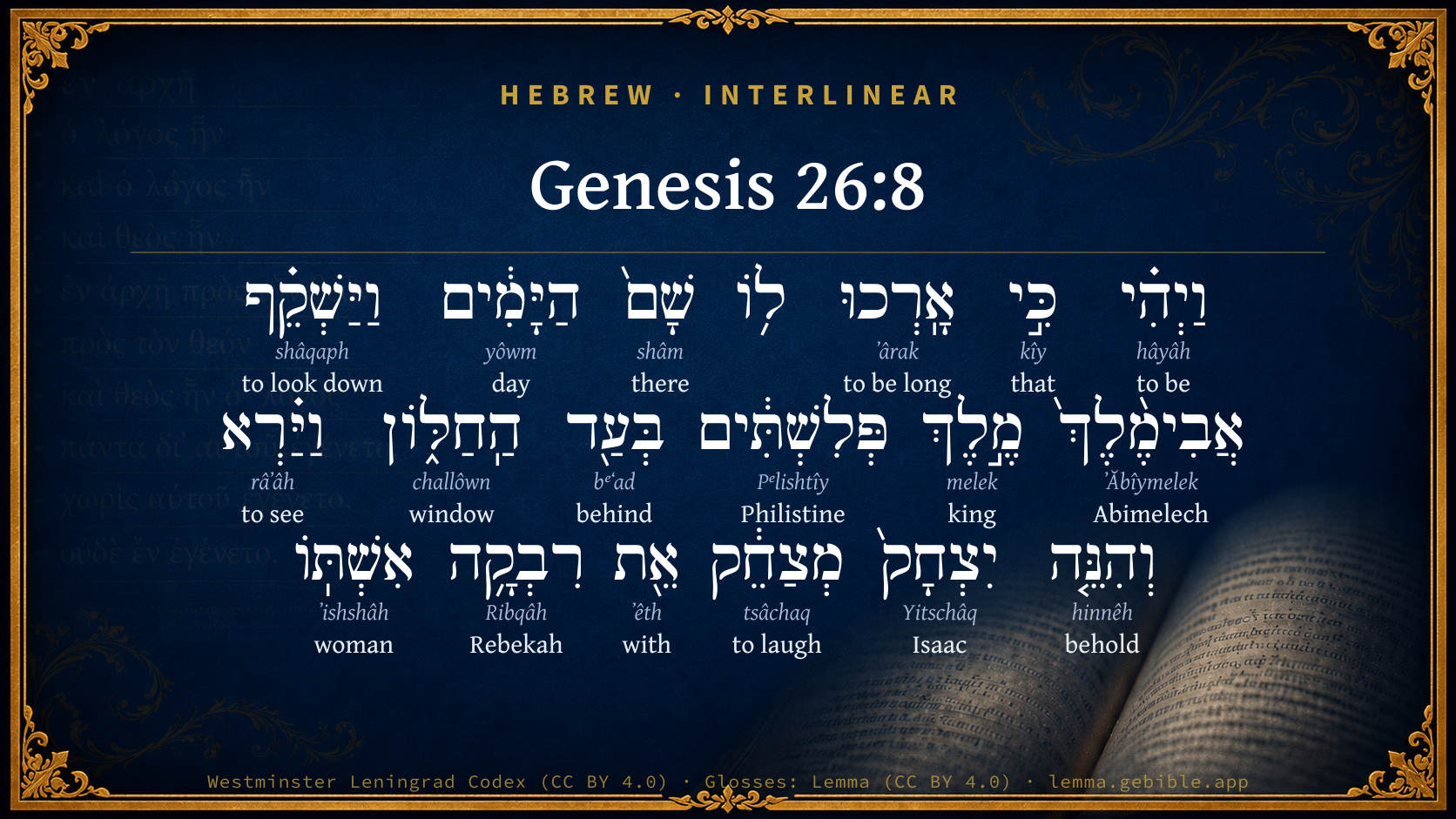
Hebrew (Westminster Leningrad Codex) Genesis 26:8 appears in the Hebrew Old Testament. The text above is from the Westminster Leningrad Codex. Each word links to its Strong’s number, a concise gloss, and parsing drawn from the Open Scriptures Hebrew Bible morphology. Click any word for its full Brown-Driver-Briggs (BDB) entry.
Download image
Cite this verse

Genesis 26:8 (World English Bible). Public Domain. Lemma interlinear Bible study tool, https://lemma.gebible.app/v/genesis/26/8.

Show BibTeX & RIS
BibTeX
RIS
English Translation
It happened, when he had been there a long time, that Abimelech king of the Philistines looked out at a window, and saw, and, behold, Isaac was caressing Rebekah, his wife.
World English Bible · Public Domain
Highlights
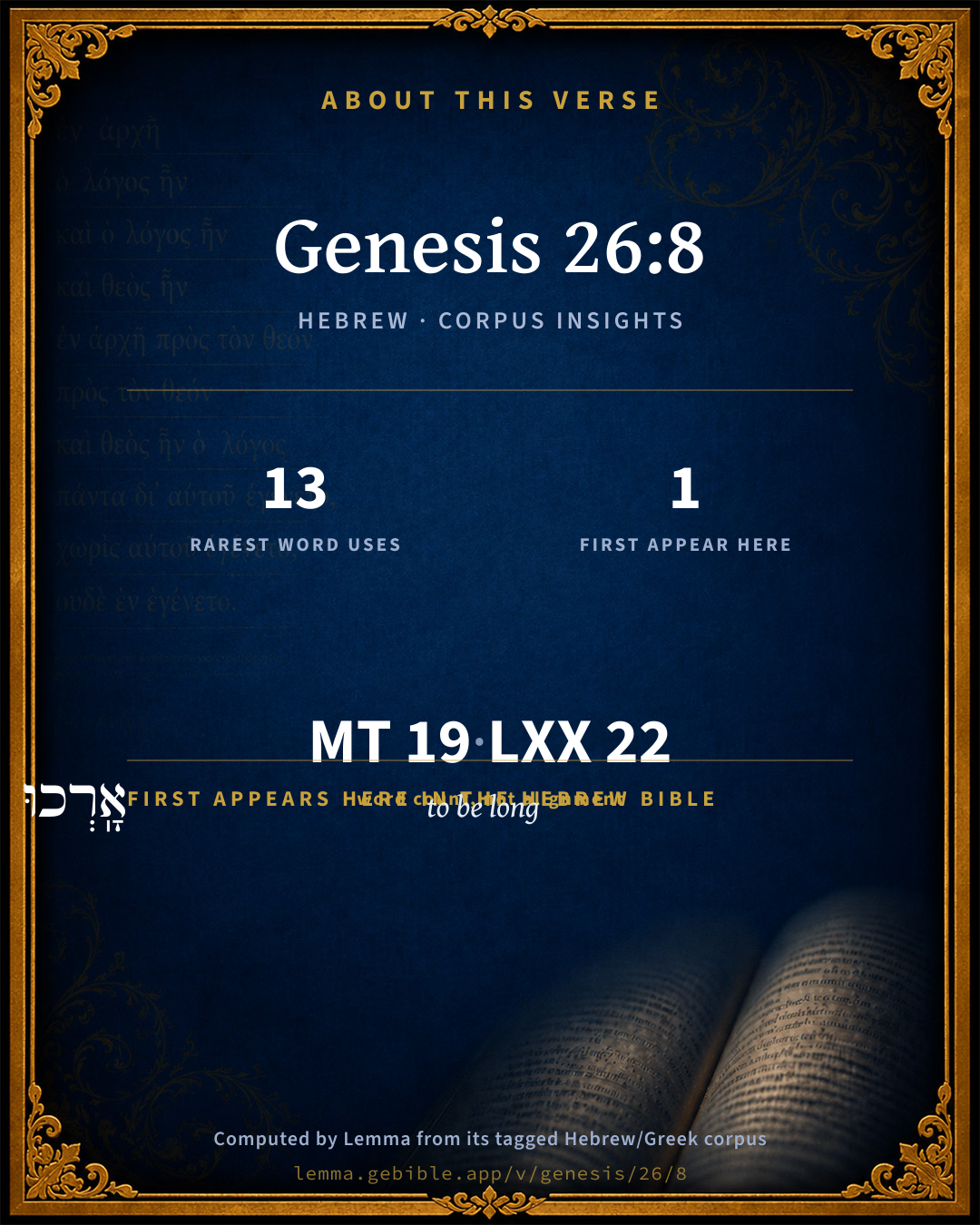
  • 1 first appearance in the Hebrew Bible
Full analysis ↓
Download a study sheet

One document with this verse’s original text, its word-by-word gloss line, the meaning frame, cross-references with their text, attributed commentary, and full source and license credits — printable, and it pastes into notes with its structure intact.

This verse Autodidact and up

Study sheet (.html) Plain text (.txt)

A passage Seminary Student

Up to 50 verses in one chapter. A passage sheet keeps up to 6 commentary sources and 12 cross-references per verse, in the order this page ranks them, and says so on the sheet whenever that leaves anything out. Ask for a single verse and you get the Autodidact verse sheet above.

Everything on this page stays free to read, with no account — the sheet is a download of what is already on screen, not access to it.

Want to remove ads? Support Godless Engineer
Compare translations 3

The same verse in 3 English versions, stacked beneath the original-language interlinear above. Click any original word for its lexicon entry.

Each is an independent rendering of the whole verse — the interlinear is not word-aligned to these translations.

Highlighted words mark where these versions differ — a whole-verse word diff, not a word-by-word alignment.

  • World English Bible Public Domain
    It happened, when he had been there a long time, that Abimelech king of the Philistines looked out at a window, and saw, and, behold, Isaac was caressing Rebekah, his wife.
  • King James Version Public Domain
    And it came to pass, when he had been there a long time, that Abimelech king of the Philistines looked out at a window, and saw, and, behold, Isaac was sporting with Rebekah his wife.
  • unfoldingWord Literal Text CC BY-SA 4.0
    Then it happened, when the days had been long for him there, then Abimelech the king of the Philistines looked down from a window and saw that, behold, Isaac was laughing with Rebekah his wife.

unfoldingWord Literal Text — © unfoldingWord, licensed CC BY-SA 4.0. Word-aligned USFM3 via Door43 (git.door43.org/unfoldingWord/en_ult).

Versions to compare (up to 4)

3 of 4 selected

Show all 18 translations

Every available English version of this verse, each an independent rendering of the whole verse.

  • World English Bible Public Domain
    It happened, when he had been there a long time, that Abimelech king of the Philistines looked out at a window, and saw, and, behold, Isaac was caressing Rebekah, his wife.
  • Berean Standard Bible Public Domain
    When Isaac had been there a long time, Abimelech king of the Philistines looked down from the window and was surprised to see Isaac caressing his wife Rebekah.
  • Majority Standard Bible Public Domain
    When Isaac had been there a long time, Abimelech king of the Philistines looked down from the window and was surprised to see Isaac caressing his wife Rebekah.
  • King James Version Public Domain
    And it came to pass, when he had been there a long time, that Abimelech king of the Philistines looked out at a window, and saw, and, behold, Isaac was sporting with Rebekah his wife.
  • American Standard Version (1901) Public Domain
    And it came to pass, when he had been there a long time, that Abimelech king of the Philistines looked out at a window, and saw, and, behold, Isaac was sporting with Rebekah his wife.
  • Revised Version (1885) Public Domain
    And it came to pass, when he had been there a long time, that Abimelech king of the Philistines looked out at a window, and saw, and, behold, Isaac was sporting with Rebekah his wife.
  • Geneva Bible (1599) Public Domain
    So after hee had bene there long time, Abimelech King of the Philistims looked out at a windowe, and loe, he sawe Izhak sporting with Rebekah his wife.
  • Douay-Rheims (1899) Public Domain
    And when very many days were passed, and he abode there, Abimelech king of the Palestines looking out through a window, saw him playing with Rebecca his wife.
  • Young's Literal Translation Public Domain
    And it cometh to pass, when the days have been prolonged to him there, that Abimelech king of the Philistines looketh through the window, and seeth, and lo, Isaac is playing with Rebekah his wife.
  • Literal Standard Version CC BY-SA 4.0
    And it comes to pass, when the days have been prolonged to him there, that Abimelech king of the Philistines looks through the window, and sees, and behold, Isaac is playing with his wife Rebekah.
  • Unlocked Literal Bible CC BY-SA 4.0
    After Isaac had been there a long time, Abimelech king of the Philistines happened to look out of a window. He saw, behold, Isaac was caressing Rebekah, his wife.
  • unfoldingWord Literal Text CC BY-SA 4.0
    Then it happened, when the days had been long for him there, then Abimelech the king of the Philistines looked down from a window and saw that, behold, Isaac was laughing with Rebekah his wife.
  • Darby Bible Public Domain
    And it came to pass when he had been there some time, that Abimelech the king of the Philistines looked out of the window, and saw, and behold, Isaac was dallying with Rebecca his wife.
  • World Messianic Bible Public Domain
    When he had been there a long time, Abimelech king of the Philistines looked out at a window, and saw, and, behold, Isaac was caressing Rebekah, his wife.
  • Webster's Bible Public Domain
    And it came to pass when he had been there a long time, that Abimelech king of the Philistines looked out at a window, and saw, and behold, Isaac was sporting with Rebekah his wife.
  • Free Bible Version CC BY-SA 4.0
    But later on, after he'd been there a while, Abimelech, king of the Philistines, happened to look out the window and saw Isaac lovingly fondling his wife Rebekah.
  • Bible in Basic English Public Domain
    And when he had been there for some time, Abimelech, king of the Philistines, looking through a window, saw Isaac playing with Rebekah his wife.
  • JPS Tanakh (1917) Public Domain
    And it came to pass, when he had been there a long time, that Abimelech king of the Philistines looked out at a window, and saw, and, behold, Isaac was sporting with Rebekah his wife.

Literal Standard Version (2020), Covenant Press — licensed CC BY-SA 4.0. Text via the HelloAO Bible API (eBible.org). Unlocked Literal Bible (unfoldingWord) — licensed CC BY-SA 4.0. Text via the HelloAO Bible API (eBible.org). unfoldingWord Literal Text — © unfoldingWord, licensed CC BY-SA 4.0. Word-aligned USFM3 via Door43 (git.door43.org/unfoldingWord/en_ult). Free Bible Version, Dr. Jonathan Gallagher — licensed CC BY-SA 4.0. Text via the HelloAO Bible API (eBible.org).

Word by word

More ways to search: Search by grammar → Find every occurrence → Compare this word →

Practice this passage: Drill this verse → Learn its vocabulary →

מְצַחֵ֔ק
tsâchaq
H6711
“laughing”
Verb, Piel, Participle Active, Masculine, Singular, Absolute
Part of Speech
Verb
Stem
Piel
Form
Participle Active
Gender
Masculine
Number
Singular
State
Absolute
Full BDB Definition

Origin: a primitive root

TWOT: 1905

to laugh, mock, play - (Qal) to laugh - (Piel) - to jest - to sport, play, make sport, toy with, make a toy of
  1. וַיְהִ֗י hâyâh H1961 “and · to be” Conjunction + Verb, Qal, Sequential Imperfect, 3rd Person, Masculine, Singular
  2. כִּ֣י kîy H3588 “that” Conjunction
  3. אָֽרְכוּ ʼârak H748 “to be long” Verb, Qal, Perfect, 3rd Person, Common, Plural
  4. שָׁם֙ shâm H8033 “there” Adverb
  5. הַיָּמִ֔ים yôwm H3117 “the · days” Particle, Definite Article + Noun, Common, Masculine, Plural, Absolute
  6. וַיַּשְׁקֵ֗ף shâqaph H8259 “and · to look down” Conjunction + Verb, Hiphil, Sequential Imperfect, 3rd Person, Masculine, Singular
  7. אֲבִימֶ֨לֶךְ֙ ʼĂbîymelek H40 “Abimelech” Noun, Proper
  8. מֶ֣לֶךְ melek H4428 “king of” Noun, Common, Masculine, Singular, Construct
  9. פְּלִשְׁתִּ֔ים Pᵉlishtîy H6430 “Philistines” Noun, Gentilic, Masculine, Plural, Absolute
  10. בְּעַ֖ד bᵉʻad H1157 “behind” Preposition
  11. הַֽחַלּ֑וֹן challôwn H2474 “the · window” Particle, Definite Article + Noun, Common, Both, Singular, Absolute
  12. וַיַּ֗רְא râʼâh H7200 “and · to see” Conjunction + Verb, Qal, Sequential Imperfect, 3rd Person, Masculine, Singular
  13. וְהִנֵּ֤ה hinnêh H2009 “and · behold” Conjunction + Particle, Demonstrative
  14. יִצְחָק֙ Yitschâq H3327 “Isaac” Noun, Proper
  15. אֵ֖ת ʼêth H854 “with” Preposition
  16. רִבְקָ֥ה Ribqâh H7259 “Rebekah” Noun, Proper
  17. אִשְׁתּֽוֹ ʼishshâh H802 “woman · his” Noun, Common, Feminine, Singular, Construct + Suffix, Personal, 3rd Person, Masculine, Singular

About this verse

These counts appear in no published source. They are computed here, from the morphology-tagged text and Lemma’s own curated glosses. What Lemma adds →

19
words
18
distinct lemmas
Pentateuch
section

Notable vocabulary

The rarest word here is מְצַחֵ֔ק to laugh H6711 — appearing just 13 times in the whole Hebrew Bible.

First appearance in Scripture

This word makes its first canonical appearance in the Hebrew Bible here:

  • אָֽרְכוּ to be long H748

Shared distinctive vocabulary

מְצַחֵ֔ק to laugh H6711 occurs in 12 verses of the Hebrew Bible. Also found in:

Grammatical profile

  • 5 verbs
  • 8 nouns
  • 3 prepositions
  • 1 conjunction
  • 1 adverb
  • 1 particle

Verb forms

  • וַיְהִ֗י Qal · Sequential Imperfect
  • אָֽרְכוּ Qal · Perfect
  • וַיַּשְׁקֵ֗ף Hiphil · Sequential Imperfect
  • וַיַּ֗רְא Qal · Sequential Imperfect
  • מְצַחֵ֔ק Piel · Participle Active

Hebrew & Septuagint length

In English translation the verse runs 31 words from the Hebrew and 27 from the Septuagint (LXX English) — closely comparable.

A rough comparison of the two English renderings, which tokenize alike — not a word-level alignment.

Word counts can differ between the Hebrew and the Greek without any difference in meaning — e.g. the Hebrew direct-object marker אֵת has no separate Greek word, and Greek often adds the article ὁ.

In the original languages it is 19 Hebrew tokens and 22 Greek tokens — but the two are counted differently (Hebrew bundles its prefixes and suffixes into one token; the Greek is in lemma form), so that isn’t a like-for-like length.

Cross-references

6

Topical passages linked to Genesis 26:8 in the Treasury of Scripture Knowledge — connected by theme and wording, ordered by reader-vote popularity; previews shown in the World English Bible.

  • Isaiah 62:5 For as a young man marries a virgin, so shall your sons marry you; and as the bridegroom rejoices over the bride, so shall your God rejoice over you.
  • Judges 5:28 Through the window she looked forth, and cried, The mother of Sisera [cried] through the lattice, Why is his chariot so long in coming? Why do the wheels of his chariots wait?
  • Proverbs 5:18–19 Let your spring be blessed. Rejoice in the wife of your youth.
  • Proverbs 7:6 For at the window of my house, I looked out through my lattice.
  • Song of Solomon 2:9 My beloved is like a roe or a young hart. Behold, he stands behind our wall! He looks in at the windows. He glances through the lattice.
  • Ecclesiastes 9:9 Live joyfully with the wife whom you love all the days of your life of vanity, which he has given you under the sun, all your days of vanity: for that is your portion in life, and in your labor in which you labor under the sun.

Cross-references courtesy of OpenBible.info (CC BY 4.0).

Hebrew and Greek witnesses Masoretic Hebrew ↔ Greek Septuagint

The same verse in the two great witnesses to the Old Testament, shown verse-for-verse.

These are two independent witnesses, not word-aligned to each other, and the Septuagint is shown in lemma (dictionary) form.

Hebrew Genesis 26:8 Masoretic · Westminster Leningrad Codex

וַיְהִ֗י כִּ֣י אָֽרְכוּ ל֥וֹ שָׁם֙ הַיָּמִ֔ים וַיַּשְׁקֵ֗ף אֲבִימֶ֨לֶךְ֙ מֶ֣לֶךְ פְּלִשְׁתִּ֔ים בְּעַ֖ד הַֽחַלּ֑וֹן וַיַּ֗רְא וְהִנֵּ֤ה יִצְחָק֙ מְצַחֵ֔ק אֵ֖ת רִבְקָ֥ה אִשְׁתּֽוֹ

It happened, when he had been there a long time, that Abimelech king of the Philistines looked out at a window, and saw, and, behold, Isaac was caressing Rebekah, his wife.

World English Bible · Public Domain

Greek LXX Genesis 26:8 Septuagint · lemma form

γίγνομαι δέ πολυχρόνιος ἐκεῖ παρακύπτω δέ αβιμελεχ ὁ βασιλεύς γεραρα διά ὁ θυρίς ὁράω ὁ ισαακ παίζω μετά ρεβεκκα ὁ γυνή αὐτός

And he remained there a long time, and Abimelech the king of Gerara leaned to look through the window, and saw Isaac sporting with Rebecca his wife.

LXX2012 (modern English Septuagint) · Public Domain

On this verse, The Cambridge Bible for Schools and Colleges discusses the Septuagint’s reading. Read the note in Commentary ↓

Hebrew: Westminster Leningrad Codex (CC BY 4.0). Greek: Septuagint (public domain); English from LXX2012 (modern English Septuagint) (Public Domain). How the Septuagint differs from the Hebrew →

Targum (Aramaic paraphrase)

2

The Targum is the ancient Jewish Aramaic paraphrase of the Hebrew Scriptures — an interpretive translation, not the Hebrew text itself. Onkelos (literal) and Pseudo-Jonathan (expansive) render the Torah, and Jonathan the Prophets. Coverage is partial: where no permissively-licensed English translation exists for a verse, only the Aramaic is shown. This is verse-level text, not a word-by-word alignment to the Hebrew.

  1. Targum Onkelos Torah (Genesis–Deuteronomy)
    וַהֲוָה כַּד סְגִיאוּ לֵהּ תַּמָּן יוֹמַיָּא וְאִסְתְּכִי אֲבִימֶלֶךְ מַלְכָּא דִּפְלִשְׁתָּאֵי מִן חֲרַכָּא וַחֲזָא וְהָא יִצְחָק מְחַיִּיךְ עִם רִבְקָה אִתְּתֵהּ

    (no public-domain English translation for this verse)

    Targum Onkelos — Aramaic: “Onkelos Genesis” (public domain); “Onkelos Exodus” (public domain); “Onkelos Leviticus” (public domain); “Onkelos Numbers” (public domain); “Onkelos Deuteronomy” (public domain). English: “Sefaria Community Translation” (CC0 1.0 (public-domain dedication)); “J.W. Etheridge. The Targums of Onkelos and Jonathan Ben Uzziel on the Pentateuch. London: Longmans, Green, 1862” (public domain). Text via Sefaria.

  2. Targum Pseudo-Jonathan Torah (Genesis–Deuteronomy)
    וַהֲוָה כַּד סְגוֹ לֵיהּ תַּמָן יוֹמַיָא לְמִשְׁרֵי וְאוֹדִיק אֲבִימֶלֶךְ מַלְכָּא דִפְלִשְׁתָּאֵי מִן חֲרַכָּא וַחֲמָא וַהֲוָה יִצְחָק חָאִיךְ עִם רִבְקָה אִנְתְּתֵיהּ

    And it was when days had increased to him in abiding there, that Abimelek the king of the Philistaee looked from a window, and beheld, and Izhak was disporting with Rivekah his wife.

    Targum Pseudo-Jonathan — Aramaic: “Targum Jonathan on Genesis” (public domain); “Targum Jonathan on Exodus” (public domain); “Targum Jonathan on Leviticus” (public domain); “Targum Jonathan on Numbers” (public domain); “Targum Jonathan on Deuteronomy” (public domain). English: “The Targum of Jonathan ben Uzziel, trans. J. W. Etheridge, London, 1862” (public domain). Text via Sefaria.

Commentary

Notes on Genesis 26:8 from classic Christian and Jewish commentators (each source and its license shown beneath its notes). The classic Christian expositions comment on the surrounding passage and are grouped to its opening verse, so a note may address several verses; the Jewish commentaries on the Tanakh (Rashi and others) are per-verse, so they appear only where the commentator wrote on this verse.

Lemma curates 59 commentaries, every one of them public domain or Creative Commons licensed, each selected and text-cleaned for this edition rather than reprinted as found. About our sources →

Trapp's Complete Commentary

John Trapp

Gen 26:8 And it came to pass, when he had been there a long time, that Abimelech king of the Philistines looked out at a window, and saw, and, behold, Isaac [was] sporting with Rebekah his wife.

Ver. 8. Sporting with Rebekah his wife.] Or, laughing and rejoicing; according to that of Solomon, "Rejoice with the wife of thy youth: let her be as the loving hind, and pleasant roe," &c. {Pro 5:18} The hind and roe are the females of the hart and roebuck. Now of the hart and roebuck, it is noted, saith a grave divine, {a} that of all other beasts they are most enamoured, as I may so speak, with their mates, and even mad again with heat and desire after them. Which, being taken in a good sense, doth set forth the lawful vehement affection that an Isaac may bear to his Rebekah; which may be such, as that others may think he even dotes on her. And so much is imported in that which follows: "Let her breasts satisfy thee at all times, and err thou always in her love". {Pro 5:19, marg.} Not but that a man may be out in this lawful error too, and exceed in love to his wife; as he in Seneca did, who, whenever he went abroad, wore his wife’s fillet on his bosom for a favour, would never willingly be without her company, nor drink, but when she drank to him; with many the like fooleries, in quae improvida vis affectus erumpebat, saith he. The beginning of this love was honest; but the nimiety was not without deformity. Est modus in rebus.

{a} D. Gouge.

John Trapp, A Commentary or Exposition upon All the Books of the Old and New Testament (1647–1656) — public domain. Text from a community e-Sword module.

Joseph Benson's Commentary

Gen 26:8. This Abimelech was not the same that was in Abraham’s days, (chapter 20.,) for this was near a hundred years after; but that was the common name of the Philistine kings, as Cesar of the Roman emperors.

Joseph Benson's Commentary on the Old and New Testaments (1811–1818) — public domain. Text from a community e-Sword module.

Tyndale Open Study Notes

Tyndale Open Resources

26:8 Abimelech . . . saw Isaac caressing Rebekah: The word for “caressing” (Hebrew metsakheq) is the same as the word used for Ishmael’s “making fun of” Isaac (21:9); the word is related to the name “Isaac” (Hebrew yitskhaq). It is as though Isaac’s lapse of faith made fun of Abimelech and made a mockery of Rebekah and the great promise embodied in Isaac’s name.

Tyndale Open Study Notes — © Tyndale Open Resources, licensed CC BY-SA 4.0. Text via the HelloAO Bible API.

Geneva Bible (1599)

Geneva Bible translators

Or showing some familiar sign of love, whereby it might be known that she was his wife.

Geneva Bible (1599) marginal notes — public domain. Text via Bolls.life.

Adam Clarke's Commentary

Verse 8. Isaac was sporting with Rebekah his wife.] Whatever may be the precise meaning of the word, it evidently implies that there were liberties taken and freedom used on the occasion, which were not lawful but between man and wife.

Adam Clarke's Commentary on the Bible (1810–1826) — public domain. Text from a community e-Sword/MySword module.

John Calvin's Commentaries

8. Abimelech, king of the Philistines, looked out at a window. Truly admirable is the kind forbearance of God, in not only condescending to pardon the twofold fault of his servant, but in stretching forth his hand, and in wonderfully averting, by the application of a speedy remedy, the evil which he would have brought upon himself. God did not suffer — what twice had occurred to Abraham — that his wife should be torn from his bosom; but stirred up a heathen king, mildly, and without occasioning him any trouble, to correct his folly. But although God sets before us such an example of his kindness, that the faithful, if at any time they may have fallen, may confidently hope to find him gentle and propitious; yet we must beware of self-security, when we observe, that the holy woman who was, at that time, the only mother of the Church on earth, was exempted from dishonor, by a special privilege. Meanwhile, we may conjecture, from the judgment of Abimelech, how holy and pure had been the conduct of Isaac, on whom not even a suspicion of evil could fall; and further, how much greater integrity flourished in that age than in our own. For why does he not condemn Isaac as one guilty of fornication, since it was probable that some crime was concealed, when he disingenuously obtruded the name of sister, and tacitly denied her to be his wife? And therefore I have no doubt that his religion, and the integrity of his life, availed to defend his character. By this example we are taught so to cultivate righteousness in our whole life, that men may not be able to suspect anything wicked or dishonorable respecting us; for there is nothing which will more completely vindicate us from every mark of infamy than a life passed in modesty and temperance. We must, however, add, what I have also before alluded to, that lusts were not, at that time, so commonly and so profusely indulged, as to cause an unfavourable suspicion to enter into the mind of the king concerning a sojourner of honest character. Wherefore, he easily persuades himself that Rebekah was a wife and not a harlot. The chastity of that age is further proved from this, that Abimelech takes the familiar sporting of Isaac with Rebekah as an evidence of their marriage. For Moses does not speak about marital intercourse, but about some too free movement, which was a proof of either dissolute exuberance or conjugal love. But now licentiousness has so broken through all bounds, that husbands are compelled to hear in silence of the dissolute conduct of their wives with strangers.

John Calvin's Commentaries (1540-1563) — public domain. Text from the Calvin Translation Society English edition (1840s-50s) via the Christian Classics Ethereal Library (ccel.org). Calvin's coverage is partial (roughly two-thirds of the Bible); uncommented books and verses are honest gaps, never fabricated. The 19th-century editor's footnotes and remarks are omitted so the notes are faithfully Calvin's own voice.

Ellicott's Commentary for English Readers

(8) Abimelech.—Upon this title of the Philistine monarchs see Note on Gen_21:22. As eighty years had elapsed since Abraham’s sojourn in Gerar, it is highly improbable that the same king was still reigning; but both king and people maintain on this occasion the good character previously deserved. The Philistines, however, at this period, were a feeble colony of strangers, and were kept in restraint by a sense of their weakness. They had received a vast accession of strength from abroad before they became formidable enemies of the Israelites at the end of the period of the Judges. (See Gen_10:14.)

A Bible Commentary for English Readers, edited by Charles John Ellicott (1878–1897) — public domain. Text from a community e-Sword module.

The Cambridge Bible for Schools and Colleges

gen. ed. J. J. S. Perowne

8. at a window] The account suggests that Isaac and Rebekah were in the courtyard overlooked by the king’s residence. Cf. 2Sa_11:2.

sporting] See Gen_21:9 marg., “playing.” The word in the original is the same as that from which the name “Isaac” was popularly derived; cf. Gen_17:17; Gen_17:19, Gen_21:6. Here the meaning seems to be that of “fondling,” the caress of husband and wife, rather than of brother and sister. LXX παίζοντα, Lat. jocantem.

The Cambridge Bible for Schools and Colleges (gen. ed. J. J. S. Perowne; Cambridge University Press, 1878–1918) — public domain. Text from a community e-Sword module.

John Gill's Exposition

And Abimelech called Isaac,.... Sent a messenger to desire him to come to him:

and said, behold, of a surety she is thy wife: and then perhaps told him of what he had observed that passed between them; which was a clear proof that they must be man and wife, or he would never have took such liberties with her:

and how saidst thou, she is my sister? what reason hadst thou for it? what could induce thee to say so?

and Isaac said unto him; not alleging, as Abraham did, any relation that was between them before marriage:

because I said; that is, within himself, for, he did not speak it out to others:

lest I die for her; for her sake, that another might have and enjoy her; it was fear of losing his life that led him to take such a step, and give out that she was his sister.

John Gill's Exposition of the Whole Bible (1746–1763) — public domain (CC PDM 1.0). Text via the HelloAO Bible API.

Haydock's Catholic Bible Commentary

His wife; using greater familiarity that a grave and virtuous man, like Isaac, would offer to do with his sister, or with another person’s wife. --- Sin, or punishment, (Menochius) such as Abimelech’s father had formerly experienced. (Haydock)

George Leo Haydock (1774–1849), Haydock's Catholic Family Bible and Commentary, 1859 edition — public domain. Excludes Psalms (Douay-Rheims chapter numbering differs from Protestant) and Deuterocanonical books (Catholic canon only).

Matthew Poole's English Annotations

Using more free and familiar carriage than became a brother and sister, but such as was allowable between husband and wife. See Deu 24:5; Pro 5:18,19. But that this was not the conjugal act, may easily be gathered from the circumstances of the time and place; which was open to Abimelech’s view; and therefore that was not consistent either with Isaac’s modesty or with his prudence, because he would not have her thought to be his wife.

Matthew Poole's English Annotations on the Holy Bible (1683–1685) — public domain. Text from a community e-Sword/MySword module.

Whedon's Commentary on the Bible

Daniel D. Whedon

8. Sporting — See note on Gen_21:8.

Daniel D. Whedon (gen. ed.), Commentary on the Old and New Testaments (1874–1909) — public domain. Text from a community e-Sword module.

The Pulpit Commentary

And it came to pass, when he had been there a long time (literally, when were prolonged to him there the days), that Abimelech king of the philistines looked out at a window, and saw, and, behold, Isaac was sporting with Rebekah his wifei.e. caressing and using playful liberties with her, which showed she was not a sister, but a wife paizonta (LXX), jocantem (Vulgate).

The Pulpit Commentary (1880–1919), ed. H.D.M. Spence-Jones & Joseph S. Exell — public domain. Text from a community e-Sword module.

John Wesley's Explanatory Notes

This Abimelech was not the same that was in Abraham's days, chap. xx, 2-18, for this was near an hundred years after, but that was the common name of the Philistine kings, as Caesar of the Roman emperors.

John Wesley, Explanatory Notes Upon the Whole Bible (1754–1765) — public domain. Text via the GEBible commentary corpus.

Rashi

Rabbi Shlomo Yitzchaki (Rashi)

כי ארכו WHEN HE HAD BEEN THERE A LONG TIME — He thought, “From now I need have no fear since they have not molested her up to now”, and he was not sufficiently strict in guarding his actions (Genesis 20:13).

Rashi on the Tanakh — English translations: “The Judaica Press complete Tanach with Rashi, translated by A. J. Rosenberg” (CC BY 4.0); “Pentateuch with Rashi's commentary by M. Rosenbaum and A.M. Silbermann, 1929-1934” (public domain); “The Metsudah Tanach series, Lakewood, N.J” (CC BY 4.0); and “The Book of Joshua, Metsudah Publications, 1997” (CC BY 4.0). Text via Sefaria.

Radak

Rabbi David Kimhi (Radak)

ויהי...וישקף, compare our commentary on 18,16 on the word וישקיפו.

Radak on the Tanakh — English translations: “Sefaria Community Translation” (CC0 1.0 (public-domain dedication)); “Eliyahu Munk, HaChut Hameshulash” (CC BY 4.0); “Rabbi Mike Feuer, Jerusalem Anthology” (CC BY 4.0); and “R. David Kimhi on the first book of Psalms, Translated by R.G. Finch, London, 1919” (public domain). Text via Sefaria.

Lesson kit

Teaching starters — assembled from the data on this page, not authored interpretation. Every prompt links to the verse data it draws on. Edit before teaching.

Genesis, in the Pentateuch, opens this verse with 19 words (18 distinct Hebrew lemmas). Its most distinctive word is tsâchaq (“to laugh”). A historical commentator’s framing appears above. Read the whole chapter for the surrounding context.

Discussion questions

  1. The word tsâchaq carries the sense “to laugh.” How does it shape the verse?
  2. The word “to be long” first appears here in Scripture. What is being introduced at this debut?
  3. Genesis 17:17 shares the word «to laugh» with this verse. How do the two illuminate each other?
  4. These translations render this verse differently. What is at stake in choosing one wording over another?
  5. The verb «וַיְהִ֗י» is Qal Sequential Imperfect. How does its form color the action?
  6. Reading how Trapp's Complete Commentary and Joseph Benson's Commentary read this verse, where do the two commentators agree and where do they part?

Things to notice

Reading settings

Reading text

Shown beneath each verse's original-language words.

Old Testament
Old Testament edition

Read the OT as the Masoretic Hebrew (MT) or the Greek Septuagint (LXX).

English shown for the Greek Septuagint (in the Hebrew ↔ Greek comparison).

Comparing translations? Open the Compare panel on any verse page to stack up to four side by side.