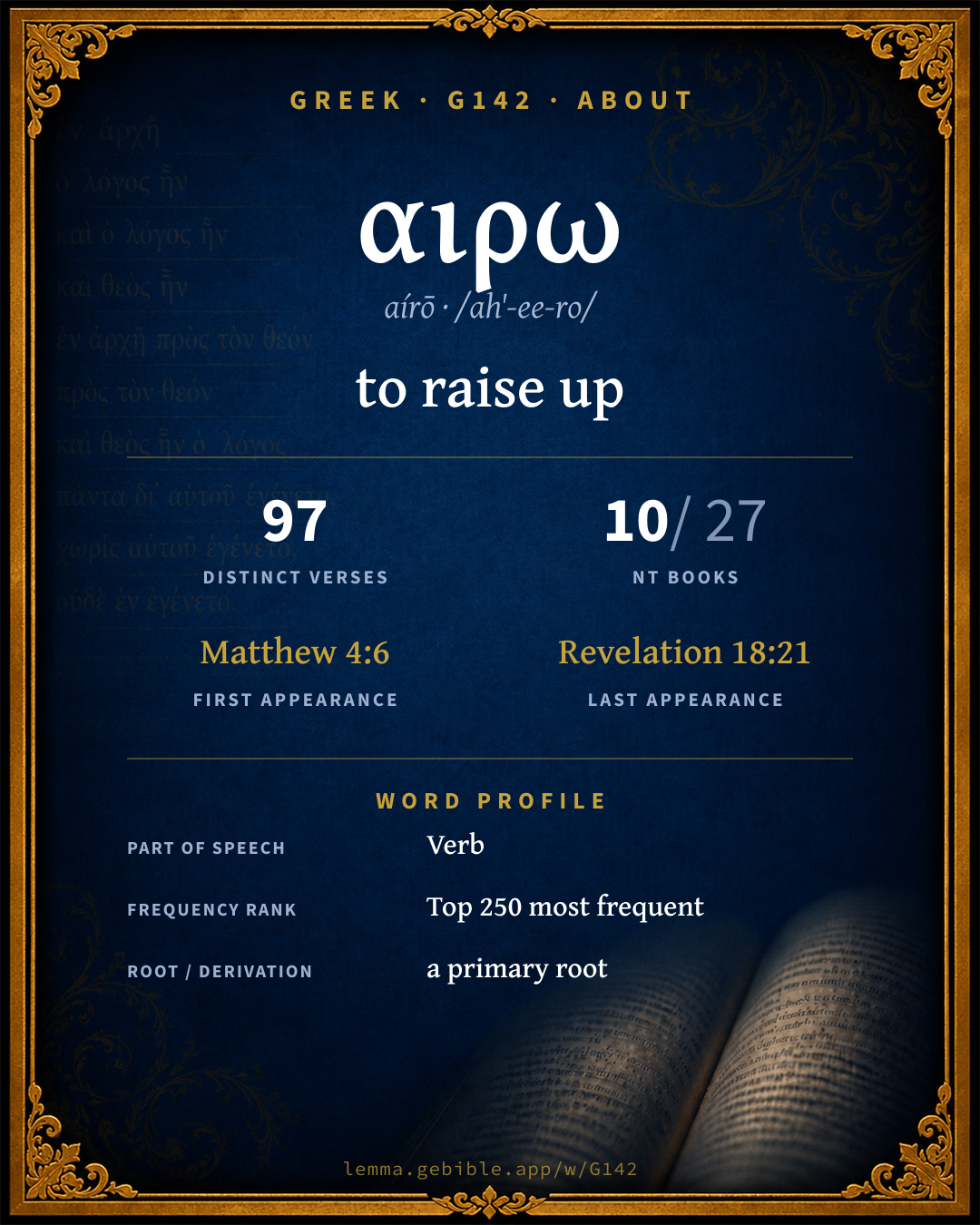
αἴρω
to raise up
also: elevate, lift up fuller range ↓
Full lexicon entry — Thayer's Greek Lexicon
From Thayer's Greek Lexicon
Where this word appears
See every Aorist-tense verb in the Greek New Testament →
Grammar key — what these labels mean
Part of speech
- Verb
- An action or state-of-being word.
Tense
- Aorist
- Action viewed as a simple whole, without regard to duration — often past (perfective aspect).
- Present
- Ongoing or general action in present time (imperfective aspect).
- Future
- Action expected in future time.
- Perfect
- A completed past action with continuing present results.
Voice
- Active
- The subject performs the action.
- Passive
- The subject receives the action.
Mood
- Indicative
- States a fact or asks a factual question (the mood of reality).
- Imperative
- Expresses a command or request.
- Infinitive
- A verbal noun (“to write”), unmarked for person or number.
- Participle
- A verbal adjective (“writing,” “having written”).
- Subjunctive
- Expresses probability, purpose, or possibility (the mood of contingency).
Case
- Nominative
- The case of the subject (and the predicate nominative).
- Genitive
- The case of source, possession, or “of” — answers “whose / from what.”
- Accusative
- The case of the direct object and of extent.
Person
- 3rd person
- The one spoken about (“he / she / it / they”).
- 2nd person
- The one addressed (“you”).
- 1st person
- The speaker (“I / we”).
Gender
- Masculine
- Grammatically masculine.
Number
- Plural
- More than one.
- Singular
- One.
Grammatical forms 30 distinct
- Verb, Aorist, Active, Indicative, 3rd person, Plural 13 times (13%)
- Verb, Aorist, Active, Imperative, 2nd person, Singular 10 times (10%)
- Verb, Present, Active, Indicative, 3rd person, Singular 8 times (8%)
- Verb, Aorist, Active, Infinitive 6 times (6%)
- Verb, Future, Passive, Indicative, 3rd person, Singular 6 times (6%)
- Verb, Aorist, Active, Indicative, 3rd person, Singular 5 times (5%)
- Verb, Aorist, Active, Imperative, 2nd person, Plural 5 times (5%)
- Verb, Aorist, Active, Participle, Nominative, Singular, Masculine 5 times (5%)
+22 more forms (43 occurrences)
Parsed forms decoded from the imported morphology (Robinson–Tischendorf, public domain), counted across 101 parsed occurrences — not distinct verses.
Every verse where G142 appears — 97 distinct verses across 10 books. Click any verse to open its interlinear word-by-word view. Verse text shown in the World English Bible for context — . Each verse’s Greek form is shown with its reference; the English is not keyword-highlighted, since the data carries no word-level English alignment. Use “Compare translations” on any verse to read it across multiple English versions. This concordance covers the Greek New Testament; Septuagint (Greek Old Testament) occurrences of this word are not indexed here.
Matthew 19 verses
- Matthew 4:6 ἀροῦσίν fut act ind 3pl and said to him, "If you are the Son of God, throw yourself down, for it is written, 'He will give his angels charge concerning you.' and, 'On their hands they will bear you up, So that you don't dash your foot against a stone.'"
- Matthew 9:6 ἆρόν aor act impv 2sg But that you may know that the Son of Man has authority on earth to forgive sins..." (then he said to the paralytic), "Get up, and take up your mat, and go up to your house."
- Matthew 9:16 αἴρει pres act ind 3sg No one puts a piece of unshrunk cloth on an old garment; for the patch would tear away from the garment, and a worse hole is made.
- Matthew 11:29 ἄρατε aor act impv 2pl Take my yoke upon you, and learn from me, for I am gentle and lowly in heart; and you will find rest for your souls.
- Matthew 13:12 ἀρθήσεται fut pass ind 3sg For whoever has, to him will be given, and he will have abundance, but whoever doesn't have, from him will be taken away even that which he has.
- Matthew 14:12 ἦραν aor act ind 3pl His disciples came, and took the body, and buried it; and they went and told Jesus.
- Matthew 14:20 ἦραν aor act ind 3pl They all ate, and were filled. They took up twelve baskets full of that which remained left over from the broken pieces.
- Matthew 15:37 ἦραν aor act ind 3pl They all ate, and were filled. They took up seven baskets full of the broken pieces that were left over.
- Matthew 16:24 ἀράτω aor act impv 3sg Then Jesus said to his disciples, "If anyone desires to come after me, let him deny himself, and take up his cross, and follow me.
- Matthew 17:27 ἆρον aor act impv 2sg But, lest we cause them to stumble, go to the sea, and cast a hook, and take up the first fish that comes up. When you have opened its mouth, you will find a stater coin. Take that, and give it to them for me and you."
- Matthew 20:14 ἆρον aor act impv 2sg Take that which is yours, and go your way. It is my desire to give to this last just as much as to you.
- Matthew 21:21 ἄρθητι aor pass impv 2sg Jesus answered them, "Most assuredly I tell you, if you have faith, and don't doubt, you will not only do what is done to the fig tree, but even if you told this mountain, 'Be taken up and cast into the sea,' it would be done.
- Matthew 21:43 ἀρθήσεται fut pass ind 3sg "Therefore I tell you, the Kingdom of God will be taken away from you, and will be given to a nation bringing forth its fruits.
- Matthew 24:17 ἆραι aor act inf Let him who is on the housetop not go down to take out things that are in his house.
- Matthew 24:18 ἆραι aor act inf Let him who is in the field not return back to get his clothes.
- Matthew 24:39 ἦρεν aor act ind 3sg and they didn't know until the flood came, and took them all away, so will be the coming of the Son of Man.
- Matthew 25:28 ἄρατε aor act impv 2pl Take away therefore the talent from him, and give it to him who has the ten talents.
- Matthew 25:29 ἀρθήσεται fut pass ind 3sg For to everyone who has will be given, and he will have abundance, but from him who has not, even that which he has will be taken away.
- Matthew 27:32 ἄρῃ aor act subj 3sg As they came out, they found a man of Cyrene, Simon by name, and they compelled him to go with them, that he might carry his cross.
Mark 20 verses
- Mark 2:3 αἰρόμενον pres pass ptcp acc sg masc Four people came, carrying a paralytic to him.
- Mark 2:9 ἆρον aor act impv 2sg Which is easier, to tell the paralytic, 'Your sins are forgiven;' or to say, 'Arise, and take up your bed, and walk?'
- Mark 2:11 ἆρον aor act impv 2sg "I tell you, arise, take up your mat, and go to your house."
- Mark 2:12 ἄρας aor act ptcp nom sg masc He arose, and immediately took up the mat, and went out in front of them all; so that they were all amazed, and glorified God, saying, "We never saw anything like this!"
- Mark 2:21 αἴρει pres act ind 3sg No one sews a piece of unshrunk cloth on an old garment, or else the patch shrinks and the new tears away from the old, and a worse hole is made.
- Mark 4:15 αἴρει pres act ind 3sg These are the ones by the road, where the word is sown; and when they have heard, immediately Satan comes, and takes away the word which has been sown in them.
- Mark 4:25 ἀρθήσεται fut pass ind 3sg For whoever has, to him will more be given, and he who doesn't have, from him will be taken away even that which he has."
- Mark 6:8 αἴρωσιν pres act subj 3pl He charged them that they should take nothing for their journey, except a staff only: no bread, no wallet, no money in their purse,
- Mark 6:29 ἦραν aor act ind 3pl When his disciples heard this, they came and took up his corpse, and laid it in a tomb.
- Mark 6:43 ἦραν aor act ind 3pl They took up twelve baskets full of broken pieces and also of the fish.
- Mark 8:8 ἦραν aor act ind 3pl They ate, and were filled. They took up seven baskets of broken pieces that were left over.
- Mark 8:19 ἤρατε aor act ind 2pl When I broke the five loaves among the five thousand, how many baskets full of broken pieces did you take up?" They told him, "Twelve."
- Mark 8:20 ἤρατε aor act ind 2pl "When the seven loaves fed the four thousand, how many baskets full of broken pieces did you take up?" They told him, "Seven."
- Mark 8:34 ἀράτω aor act impv 3sg He called the multitude to himself with his disciples, and said to them, "Whoever wants to come after me, let him deny himself, and take up his cross, and follow me.
- Mark 11:23 ἄρθητι aor pass impv 2sg For most assuredly I tell you, whoever may tell this mountain, 'Be taken up and cast into the sea,' and doesn't doubt in his heart, but believes that what he says is happening; he shall have whatever he says.
- Mark 13:15 ἆραί aor act inf and let him who is on the housetop not go down, nor enter in, to take anything out of his house.
- Mark 13:16 ἆραι aor act inf Let him who is in the field not return back to take his cloak.
- Mark 15:21 ἄρῃ aor act subj 3sg They compelled one passing by, coming from the country, Simon of Cyrene, the father of Alexander and Rufus, to go with them, that he might bear his cross.
- Mark 15:24 ἄρῃ aor act subj 3sg Crucifying him, they parted his garments among them, casting lots on them, what each should take.
- Mark 16:18 ἀροῦσιν fut act ind 3pl they will take up serpents; and if they drink any deadly thing, it will in no way hurt them; they will lay hands on the sick, and they will recover."
Luke 20 verses
- Luke 4:11 ἀροῦσίν fut act ind 3pl and, 'On their hands they will bear you up, Lest perhaps you dash your foot against a stone.'"
- Luke 5:24 ἄρας aor act ptcp nom sg masc But that you may know that the Son of Man has authority on earth to forgive sins" (he said to the paralyzed man), "I tell you, arise, and take up your cot, and go to your house."
- Luke 5:25 ἄρας aor act ptcp nom sg masc Immediately he rose up before them, and took up that which he was laying on, and departed to his house, glorifying God.
- Luke 6:29 αἴροντός pres act ptcp gen sg masc To him who strikes you on the cheek, offer also the other; and from him who takes away your cloak, don't withhold your coat also.
- Luke 6:30 αἴροντος pres act ptcp gen sg masc Give to everyone who asks you, and don't ask him who takes away your goods to give them back again.
- Luke 8:12 αἴρει pres act ind 3sg Those along the road are those who hear, then the devil comes, and takes away the word from their heart, that they may not believe and be saved.
- Luke 8:18 ἀρθήσεται fut pass ind 3sg Be careful therefore how you hear. For whoever has, to him will be given; and whoever doesn't have, from him will be taken away even that which he thinks he has."
- Luke 9:3 αἴρετε pres act impv 2pl He said to them, "Take nothing for your journey--neither staffs, nor wallet, nor bread, nor money; neither have two coats apiece.
- Luke 9:17 ἤρθη aor pass ind 3sg They ate, and were all filled. They gathered up twelve baskets of broken pieces that were left over.
- Luke 9:23 ἀράτω aor act impv 3sg He said to all, "If anyone desires to come after me, let him deny himself, take up his cross, and follow me.
- Luke 11:22 αἴρει pres act ind 3sg But when someone stronger attacks him and overcomes him, he takes from him his whole armor in which he trusted, and divides his spoils.
- Luke 11:52 ἤρατε aor act ind 2pl Woe to you lawyers! For you took away the key of knowledge. You didn't enter in yourselves, and those who were entering in, you hindered."
- Luke 17:13 ἦραν aor act ind 3pl They lifted up their voices, saying, "Jesus, Master, have mercy on us!"
- Luke 17:31 ἆραι aor act inf In that day, he who will be on the housetop, and his goods in the house, let him not go down to take them away. Let him who is in the field likewise not turn back.
- Luke 19:21 αἴρεις pres act ind 2sg for I feared you, because you are an exacting man. You take up that which you didn't lay down, and reap that which you didn't sow.'
- Luke 19:22 αἴρων pres act ptcp nom sg masc "He said to him, 'Out of your own mouth will I judge you, you wicked servant! You knew that I am an exacting man, taking up that which I didn't lay down, and reaping that which I didn't sow.
- Luke 19:24 ἄρατε aor act impv 2pl He said to those who stood by, 'Take the mina away from him, and give it to him who has the ten minas.'
- Luke 19:26 ἀρθήσεται fut pass ind 3sg 'For I tell you that to everyone who has, will more be given; but from him who doesn't have, even that which he has will be taken away from him.
- Luke 22:36 ἀράτω aor act impv 3sg Then he said to them, "But now, whoever has a purse, let him take it, and likewise a wallet. Whoever has none, let him sell his cloak, and buy a sword.
- Luke 23:18 αἶρε pres act impv 2sg But they all cried out together, saying, "Away with this man! Release to us Barabbas!" --
John 23 verses
- John 1:29 αἴρων pres act ptcp nom sg masc The next day, he saw Jesus coming to him, and said, "Behold, the Lamb of God, who takes away the sin of the world!
- John 2:16 ἄρατε aor act impv 2pl To those who sold the doves, he said, "Take these things out of here! Don't make my Father's house a marketplace!"
- John 5:8 ἆρον aor act impv 2sg Jesus said to him, "Arise, take up your mat, and walk."
- John 5:9 ἦρεν aor act ind 3sg Immediately, the man was made well, and took up his mat and walked. Now it was the Sabbath on that day.
- John 5:10 ἆραι aor act inf So the Jews said to him who was cured, "It is the Sabbath. It is not lawful for you to carry the mat."
- John 5:11 ἆρον aor act impv 2sg He answered them, "He who made me well, the same said to me, 'Take up your mat, and walk.'"
- John 5:12 ἆρον aor act impv 2sg Then they asked him, "Who is the man who said to you, 'Take up your mat, and walk'?"
- John 8:59 ἦραν aor act ind 3pl Therefore they took up stones to throw at him, but Jesus was hidden, and went out of the temple, having gone through the midst of them, and so passed by.
- John 10:18 αἴρει pres act ind 3sg No one takes it away from me, but I lay it down by myself. I have power to lay it down, and I have power to take it again. I received this commandment from my Father."
- John 10:24 αἴρεις pres act ind 2sg The Jews therefore came around him and said to him, "How long will you hold us in suspense? If you are the Christ, tell us plainly."
- John 11:39 ἄρατε aor act impv 2pl Jesus said, "Take away the stone." Martha, the sister of him who was dead, said to him, "Lord, by this time there is a stench, for he has been dead four days."
- John 11:41 ἦραν ἦρεν aor act ind 3pl aor act ind 3sg So they took away the stone from the place where the dead man was lying. Jesus lifted up his eyes, and said, "Father, I thank you that you listened to me.
- John 11:48 ἀροῦσιν fut act ind 3pl If we leave him alone like this, everyone will believe in him, and the Romans will come and take away both our place and our nation."
- John 15:2 αἴρει pres act ind 3sg Every branch in me that doesn't bear fruit, he takes away. Every branch that bears fruit, he prunes, that it may bear more fruit.
- John 16:22 αἴρει pres act ind 3sg Therefore you now have sorrow, but I will see you again, and your heart will rejoice, and no one will take your joy away from you.
- John 17:15 ἄρῃς aor act subj 2sg I pray not that you would take them from the world, but that you would keep them from the evil one.
- John 19:15 ἆρον ἆρον aor act impv 2sg aor act impv 2sg They cried out, "Away with him! Away with him! Crucify him!" Pilate said to them, "Shall I crucify your King?" The chief priests answered, "We have no king but Caesar!"
- John 19:31 ἀρθῶσιν aor pass subj 3pl Therefore the Jews, because it was the Preparation Day, so that the bodies wouldn't remain on the cross on the Sabbath (for that Sabbath was a special one), asked of Pilate that their legs might be broken, and that they might be taken away.
- John 19:38 ἄρῃ ἦραν aor act subj 3sg aor act ind 3pl After these things, Joseph of Arimathaea, being a disciple of Jesus, but secretly for fear of the Jews, asked of Pilate that he might take away Jesus' body. Pilate gave him permission. He came therefore and took away his body.
- John 20:1 ἠρμένον perf pass ptcp acc sg masc Now on the first day of the week, Mary Magdalene went early, while it was still dark, to the tomb, and saw the stone taken away from the tomb.
- John 20:2 ἦραν aor act ind 3pl Therefore she ran and came to Simon Peter, and to the other disciple whom Jesus loved, and said to them, "They have taken away the Lord out of the tomb, and we don't know where they have laid him!"
- John 20:13 ἦραν aor act ind 3pl They told her, "Woman, why are you weeping?" She said to them, "Because they have taken away my Lord, and I don't know where they have laid him."
- John 20:15 ἀρῶ fut act ind 1sg Jesus said to her, "Woman, why are you weeping? Who are you looking for?" She, supposing him to be the gardener, said to him, "Sir, if you have carried him away, tell me where you have laid him, and I will take him away."
Acts 8 verses
- Acts 4:24 ἦραν aor act ind 3pl When they heard it, they lifted up their voice to God with one accord, and said, "O Lord, you are God, who made the heaven, the earth, the sea, and all that is in them;
- Acts 8:33 ἤρθη αἴρεται aor pass ind 3sg pres pass ind 3sg In his humiliation, his judgment was taken away. Who will declare His generation? For his life is taken from the earth."
- Acts 20:9 ἤρθη aor pass ind 3sg A certain young man named Eutychus sat in the window, weighed down with deep sleep. As Paul spoke still longer, being weighed down by his sleep, he fell down from the third story, and was taken up dead.
- Acts 21:11 ἄρας aor act ptcp nom sg masc Coming to us, and taking Paul's belt, he bound his own feet and hands, and said, "Thus says the Holy Spirit: 'So will the Jews at Jerusalem bind the man who owns this belt, and will deliver him into the hands of the Gentiles.'"
- Acts 21:36 αἶρε pres act impv 2sg for the multitude of the people followed after, crying out, "Away with him!"
- Acts 22:22 αἶρε pres act impv 2sg They listened to him until he said that; then they lifted up their voice, and said, "Rid the earth of this fellow, for he isn't fit to live!"
- Acts 27:13 ἄραντες aor act ptcp nom pl masc When the south wind blew softly, supposing that they had obtained their purpose, they weighed anchor and sailed along Crete, close to shore.
- Acts 27:17 ἄραντες aor act ptcp nom pl masc After they had hoisted it up, they used cables to help reinforce the ship. Fearing that they would run aground on the Syrtis sand bars, they lowered the sea anchor, and so were driven along.
1 Corinthians 2 verses
- 1 Corinthians 5:2 ἀρθῇ aor pass subj 3sg You are puffed up, and didn't rather mourn, that he who had done this deed might be removed from among you.
- 1 Corinthians 6:15 ἄρας aor act ptcp nom sg masc Don't you know that your bodies are members of Christ? Shall I then take the members of Christ, and make them members of a prostitute? May it never be!
Ephesians 1 verse
Colossians 1 verse
1 John 1 verse
Revelation 2 verses
- Revelation 10:5 ἦρεν aor act ind 3sg The angel who I saw standing on the sea and on the land lifted up his right hand to the sky,
- Revelation 18:21 ἦρεν aor act ind 3sg A mighty angel took up a stone like a great millstone and cast it into the sea, saying, "Thus with violence will Babylon, the great city, be thrown down, and will be found no more at all.
About this entry
At a glance — auto-summarized from this page’s data, not written by a person. Every figure links to its source below. This summary describes the numbers; it doesn’t interpret them.
“to raise up” is the headline sense of the Greek verb αιρω (aírō). Where the King James Version says “take up,” newer translations reach for “pick up” (Berean Standard Bible); the renderings breakdown has the detail. It appears 97 verses across 10 books of the Greek New Testament, among its moderately common vocabulary. Debuting at Matthew 4:6, it then recurs through the corpus. Lexicons map it across 3 senses — beyond “to raise up” it also covers “elevate” and “lift up”. The sections below give every sense, occurrence, and version rendering.
Gloss history
Strong's 1890 vs modern scholarship

About this word
Strong's G142 catalogs a Greek word from the Greek New Testament.
These counts are not copied from any lexicon or concordance. They are computed here, from the morphology-tagged Greek New Testament. What Lemma adds →
- 97
- distinct verses
- The word appears in 97 distinct verses.
- 10 / 27
- NT books
- The word appears in 10 of 27 New Testament books.
- #163
- by frequency
- Top 250 most frequent Greek words (rank 163 of 5,347 Greek words by occurrence).
View all 97 occurrences in the concordance →
By section of the New Testament
By traditional corpus
Conventional, traditional groupings — biblical authorship is debated, so this is a traditional corpus grouping, not an authorship claim. Some books belong to more than one corpus (Luke is in both the Gospels and the Lukan corpus, and so on), so these shares overlap and need not total 100%. Each figure is a share of the word’s 97 distinct verses.
- Gospels 82 verses · 85%
- Lukan (Luke–Acts) 28 verses · 29%
- Johannine 26 verses · 27%
- Pauline corpus 4 verses · 4%
- Revelation 2 verses · 2%
- General (Catholic) Epistles 1 verse · 1%
How translations render this word
Counts come from each version’s own published word-to-Strong’s tagging or interlinear alignment — an approximate guide to how each version renders this word, not a word-level alignment the data otherwise carries. Because each total is that version’s own tagged count, the per-version totals vary from one another and need not match the appearance or distinct-verse counts above. These counts may also differ from a printed concordance because Lemma counts each distinctly tagged rendering and does not collapse phrase taggings into a single head-word total. This is a fixed set of word-tagged versions (KJV, ASV, BSB, ULT) and does not change with the reading translation you choose elsewhere. Each version’s license is shown beside its name below (and on Sources).
- King James Version: Take up 13×, Take 11×, Taketh away 6×
- American Standard Version: Take 13×, Take up 11×, Took up 6×
- Berean Standard Bible: Pick up 7×, Picked up 7×, Take 7×
- unfoldingWord Literal Text: Take 12×, Away 9×, Will be taken away 6×
King James Version Public Domain
Renders G142 across 110 tagged occurrences — most commonly:
Plus other, less common renderings. Plus 31 renderings that appear only once — usually multi-word phrases or single function words the recovered tagging swept in, not distinct renderings.
American Standard Version Public Domain
Renders G142 across 105 tagged occurrences — most commonly:
Plus other, less common renderings. Plus 35 renderings that appear only once — usually multi-word phrases or single function words the recovered tagging swept in, not distinct renderings.
Berean Standard Bible Public Domain
Renders G142 across 100 tagged occurrences — most commonly:
Plus other, less common renderings. Plus 36 renderings that appear only once — usually multi-word phrases or single function words the recovered tagging swept in, not distinct renderings. Not rendered by a distinct English word in 1 further occurrence.
unfoldingWord Literal Text CC BY-SA 4.0
Renders G142 across 117 tagged occurrences — most commonly:
Plus other, less common renderings. Plus 43 renderings that appear only once — usually multi-word phrases or single function words the recovered tagging swept in, not distinct renderings.
Senses in Thayer's
The 3 senses Thayer's distinguishes for this word, in lexicon order (not ranked by frequency or importance). The full entry — with sub-senses — is in the Lexicon Entry tab.
- to raise up, elevate, lift up
- to take upon one's self and carry what has been raised up, to bear
- to bear away what has been raised, carry off
Word origin
Origin: a primary root
A primary verb; to lift ; by implication to take up or away ; figuratively to raise (the voice) keep in suspense (the mind); specifically to sail away (that is weigh anchor ); by hebraism (compare [ H5375 ]) to expiate sin : - away with bear (up) carry lift up loose make to doubt put away remove take (away up).
— Strong’s Exhaustive Concordance (1890), public domain.
Forms in the corpus
The 34 distinct written forms G142 takes in the Greek New Testament, most frequent first — each parse links to that tense’s occurrences in the concordance.
Same root — word family
Other Thayer's entries built from the same root as G142, grouped by Strong’s listed origin. These share a root / origin per the lexicon — not necessarily a shared meaning. Each links to that word’s own entry.
Derived from this word
- αιρεομαι hairéomai G138 to choose
- αρα ará G685 curse
- αρα ára G686 therefore
- αρεσκω aréskō G700 to please
- αριθμος arithmós G706 number
- αρκεω arkéō G714 to ward off
- αρρην árrhēn G730 male
- αρτι árti G737 now
- αρτος ártos G740 bread
- αρτυω artýō G741 to season
- αρωμα árōma G759 spice
- ορος óros G3735 mountain
Compare all same-root words → Showing 4 of 13 — not the complete family. They share a root, not necessarily a meaning.
Septuagint usage
The same Greek word αιρω appears 245 times in the Greek Old Testament (Septuagint), across 227 verses in 28 books.
- 245
- LXX occurrences
- Tagged occurrences of this Greek word in the Septuagint.
- 227
- verses
- Distinct Septuagint verses containing this word.
- 28 / 39
- OT books
- The word appears in 28 of the 39 Old Testament books.
Sample Septuagint occurrences
- Genesis 35:2 αἴρω
- Exodus 25:14 αἴρω
- Leviticus 10:4 αἴρω
- Numbers 1:50 αἴρω
- Deuteronomy 10:8 αἴρω
- Joshua 3:3 αἴρω
- Judges 8:28 αἴρω
- Ruth 2:18 αἴρω
- 1 Samuel 2:28 αἴρω
- 2 Samuel 2:22 αἴρω
- 1 Kings 2:26 αἴρω
- 2 Kings 2:16 αἴρω
Septuagint occurrences (same lexeme)
Every verse where the same Strong’s number (G142) appears in the Greek Septuagint — showing the first 50 of 227. Verse text shown in the World English Bible for context; the Greek form is the matched word — the English is not keyword-highlighted.
- Genesis 35:2 αἴρω Then Jacob said to his household, and to all who were with him, "Put away the foreign gods that are among you, purify yourselves, change your garments.
- Genesis 40:16 αἴρω When the chief baker saw that the interpretation was good, he said to Joseph, "I also was in my dream, and, behold, three baskets of white bread were on my head.
- Genesis 43:34 αἴρω He sent portions to them from before him, but Benjamin's portion was five times as much as any of theirs. They drank, and were merry with him.
- Genesis 44:1 αἴρω He commanded the steward of his house, saying, "Fill the men's sacks with food, as much as they can carry, and put every man's money in his sack's mouth.
- Genesis 45:23 αἴρω To his father, he sent after this manner: ten donkeys loaded with the good things of Egypt, and ten female donkeys loaded with grain and bread and provision for his father by the way.
- Genesis 46:5 αἴρω Jacob rose up from Beersheba, and the sons of Israel carried Jacob, their father, their little ones, and their wives, in the wagons which Pharaoh had sent to carry him.
- Genesis 47:30 αἴρω but when I sleep with my fathers, you shall carry me out of Egypt, and bury me in their burying place." He said, "I will do as you have said."
- Exodus 25:14 αἴρω You shall put the poles into the rings on the sides of the ark to carry the ark.
- Exodus 25:27 αἴρω the rings shall be close to the rim, for places for the poles to carry the table.
- Exodus 25:28 αἴρω You shall make the poles of acacia wood, and overlay them with gold, that the table may be carried with them.
- Exodus 27:7 αἴρω Its poles shall be put into the rings, and the poles shall be on the two sides of the altar, when carrying it.
- Exodus 30:4 αἴρω You shall make two golden rings for it under its molding; on its two ribs, on its two sides you shall make them; and they shall be for places for poles with which to bear it.
- Exodus 38:4 αἴρω He made for the altar a grating of a network of brass, under the ledge around it beneath, reaching halfway up.
- Exodus 38:10 αἴρω their pillars were twenty, and their sockets twenty, of brass; the hooks of the pillars and their fillets were of silver.
- Exodus 38:24 αἴρω All the gold that was used for the work in all the work of the sanctuary, even the gold of the offering, was twenty-nine talents, and seven hundred thirty shekels, after the shekel of the sanctuary.
- Leviticus 10:4 αἴρω Moses called Mishael and Elzaphan, the sons of Uzziel the uncle of Aaron, and said to them, "Draw near, carry your brothers from before the sanctuary out of the camp."
- Leviticus 10:5 αἴρω So they drew near, and carried them in their coats out of the camp, as Moses had said.
- Leviticus 11:25 αἴρω Whoever carries any part of their carcass shall wash his clothes, and be unclean until the evening.
- Leviticus 11:28 αἴρω He who carries their carcass shall wash his clothes, and be unclean until the evening. They are unclean to you.
- Leviticus 11:40 αἴρω He who eats of its carcass shall wash his clothes, and be unclean until the evening. He also who carries its carcass shall wash his clothes, and be unclean until the evening.
- Leviticus 15:10 αἴρω Whoever touches anything that was under him shall be unclean until the evening. He who carries those things shall wash his clothes, and bathe himself in water, and be unclean until the evening.
- Numbers 1:50 αἴρω but appoint the Levites over the Tabernacle of the Testimony, and over all its furnishings, and over all that belongs to it. They shall carry the tabernacle, and all its furnishings; and they shall take care of it, and shall encamp around it.
- Numbers 2:17 αἴρω "Then the tent of meeting shall set out, with the camp of the Levites in the midst of the camps. As they encamp, so shall they set out, every man in his place, by their standards.
- Numbers 4:15 αἴρω "When Aaron and his sons have finished covering the sanctuary, and all the furniture of the sanctuary, as the camp moves forward; after that, the sons of Kohath shall come to carry it: but they shall not touch the sanctuary, lest they die. These things are the burden of the sons of Kohath in the Tent of Meeting.
- Numbers 4:24 αἴρω This is the service of the families of the Gershonites, in serving and in bearing burdens:
- Numbers 4:25 αἴρω they shall carry the curtains of the tabernacle, and the Tent of Meeting, its covering, and the covering of sealskin that is above on it, and the screen for the door of the Tent of Meeting,
- Numbers 4:31 αἴρω This is the charge of their burden, according to all their service in the Tent of Meeting: the tabernacle's boards, its bars, its pillars, its sockets,
- Numbers 4:32 αἴρω and the pillars of the court around it, and their sockets, and their pins, and their cords, with all their instruments, and with all their service: and by name you shall appoint the instruments of the charge of their burden.
- Numbers 4:47 αἴρω from thirty years old and upward even to fifty years old, everyone who entered in to do the work of service, and the work of bearing burdens in the Tent of Meeting,
- Numbers 4:49 αἴρω According to the commandment of Yahweh they were numbered by Moses, everyone according to his service, and according to his burden. Thus were they numbered by him, as Yahweh commanded Moses.
- Numbers 7:9 αἴρω But to the sons of Kohath he gave none, because the service of the sanctuary belonged to them; they carried it on their shoulders.
- Numbers 10:17 αἴρω The tent was taken down; and the sons of Gershon and the sons of Merari, who bore the tent, set forward.
- Numbers 10:21 αἴρω The Kohathites set forward, bearing the sanctuary: and [the others] did set up the tent against their coming.
- Numbers 11:12 αἴρω Have I conceived all this people? have I brought them forth, that you should tell me, Carry them in your bosom, as a nursing-father carries the sucking child, to the land which you swore to their fathers?
- Numbers 13:23 αἴρω They came to the valley of Eshcol, and cut down from there a branch with one cluster of grapes, and they bore it on a staff between two; [they brought] also of the pomegranates, and of the figs.
- Deuteronomy 10:8 αἴρω At that time Yahweh set apart the tribe of Levi, to bear the ark of the covenant of Yahweh, to stand before Yahweh to minister to him, and to bless in his name, to this day.
- Deuteronomy 31:9 αἴρω Moses wrote this law, and delivered it to the priests the sons of Levi, who bore the ark of the covenant of Yahweh, and to all the elders of Israel.
- Deuteronomy 31:25 αἴρω that Moses commanded the Levites, who bore the ark of the covenant of Yahweh, saying,
- Deuteronomy 32:40 αἴρω For I lift up my hand to heaven, And say, As I live forever,
- Joshua 3:3 αἴρω and they commanded the people, saying, When you see the ark of the covenant of Yahweh your God, and the priests the Levites bearing it, then you shall remove from your place, and go after it.
- Joshua 3:6 αἴρω Joshua spoke to the priests, saying, Take up the ark of the covenant, and pass over before the people. They took up the ark of the covenant, and went before the people.
- Joshua 3:8 αἴρω You shall command the priests who bear the ark of the covenant, saying, When you are come to the brink of the waters of the Jordan, you shall stand still in the Jordan.
- Joshua 3:13 αἴρω It shall come to pass, when the soles of the feet of the priests who bear the ark of Yahweh, the Lord of all the earth, shall rest in the waters of the Jordan, that the waters of the Jordan shall be cut off, even the waters that come down from above; and they shall stand in one heap.
- Joshua 3:14 αἰρω It happened, when the people removed from their tents, to pass over the Jordan, the priests who bore the ark of the covenant being before the people;
- Joshua 3:15 αἴρω and when those who bore the ark were come to the Jordan, and the feet of the priests who bore the ark were dipped in the brink of the water (for the Jordan overflows all its banks all the time of harvest),
- Joshua 3:17 αἴρω The priests who bore the ark of the covenant of Yahweh stood firm on dry ground in the midst of the Jordan; and all Israel passed over on dry ground, until all the nation were passed clean over the Jordan.
- Joshua 4:5 αἴρω and Joshua said to them, Pass over before the ark of Yahweh your God into the midst of the Jordan, and take up every man of you a stone on his shoulder, according to the number of the tribes of the children of Israel;
- Joshua 4:9 αἴρω Joshua set up twelve stones in the midst of the Jordan, in the place where the feet of the priests who bore the ark of the covenant stood: and they are there to this day.
- Joshua 4:10 αἴρω For the priests who bore the ark stood in the midst of the Jordan, until everything was finished that Yahweh commanded Joshua to speak to the people, according to all that Moses commanded Joshua: and the people hurried and passed over.
- Joshua 4:16 αἴρω Command the priests who bear the ark of the testimony, that they come up out of the Jordan.
These are occurrences of the same Greek lexeme (G142) in the Septuagint — not a translation of any one Hebrew word. The store carries no word-level Hebrew↔Greek alignment, so no Hebrew original is asserted here. Counts come from the recovered LXX Strong's tagging — high-frequency vocabulary is well covered, while rare or late forms may be untagged — so they reflect tagged occurrences and may slightly undercount.