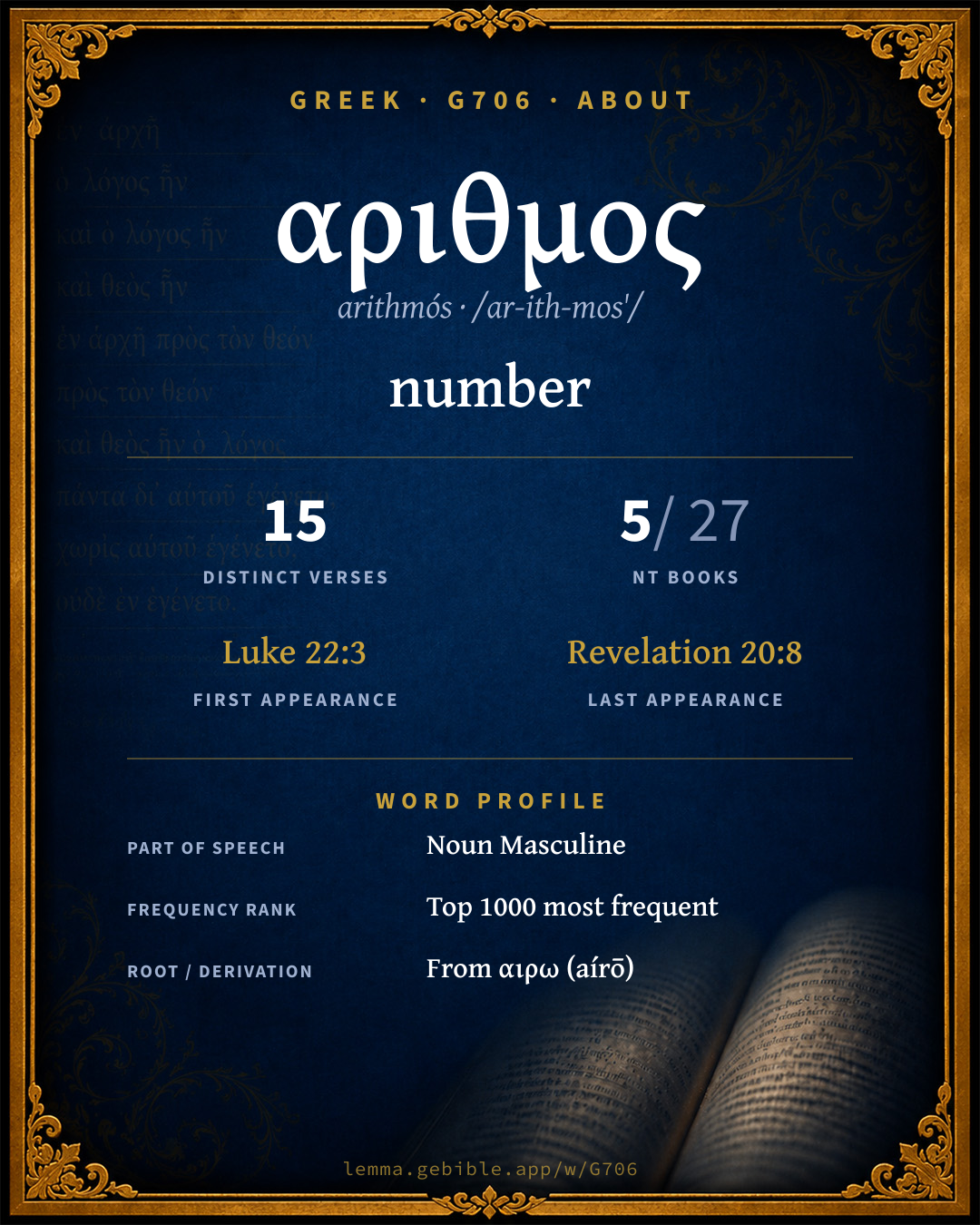
ἀριθμός
number
‘number’ is one of 2 main senses fuller range ↓
Full lexicon entry — Thayer's Greek Lexicon
From Thayer's Greek Lexicon
Where this word appears
See every Nominative-case word in the Greek New Testament →
Grammar key — what these labels mean
Part of speech
- Noun
- A naming word — a person, place, thing, or idea.
Case
- Nominative
- The case of the subject (and the predicate nominative).
- Accusative
- The case of the direct object and of extent.
- Genitive
- The case of source, possession, or “of” — answers “whose / from what.”
- Dative
- The case of the indirect object, means, or location — “to / for / with / in.”
Gender
- Masculine
- Grammatically masculine.
Number
- Singular
- One.
Grammatical forms
- Noun, Nominative, Singular, Masculine 10 times (56%)
- Noun, Accusative, Singular, Masculine 5 times (28%)
- Noun, Genitive, Singular, Masculine 2 times (11%)
- Noun, Dative, Singular, Masculine 1 time (6%)
Parsed forms decoded from the imported morphology (Robinson–Tischendorf, public domain), counted across 18 parsed occurrences — not distinct verses.
Every verse where G706 appears — 15 distinct verses across 5 books. Click any verse to open its interlinear word-by-word view. Verse text shown in the World English Bible for context — . Each verse’s Greek form is shown with its reference; the English is not keyword-highlighted, since the data carries no word-level English alignment. Use “Compare translations” on any verse to read it across multiple English versions. This concordance covers the Greek New Testament; Septuagint (Greek Old Testament) occurrences of this word are not indexed here.
Luke 1 verse
John 1 verse
Acts 5 verses
- Acts 4:4 ἀριθμὸς n nom sg masc But many of those who heard the word believed, and the number of the men came to be about five thousand.
- Acts 5:36 ἀριθμὸς n nom sg masc For before these days Theudas rose up, making himself out to be somebody; to whom a number of men, about four hundred, joined themselves: who was slain; and all, as many as obeyed him, were dispersed, and came to nothing.
- Acts 6:7 ἀριθμὸς n nom sg masc The word of God increased and the number of the disciples multiplied in Jerusalem exceedingly. A great company of the priests were obedient to the faith.
- Acts 11:21 ἀριθμὸς n nom sg masc The hand of the Lord was with them, and a great number believed and turned to the Lord.
- Acts 16:5 ἀριθμῷ n dat sg masc So the assemblies were strengthened in the faith, and increased in number daily.
Romans 1 verse
Revelation 7 verses
- Revelation 5:11 ἀριθμὸς n nom sg masc I saw, and I heard something like a voice of many angels around the throne, the living creatures, and the elders; and the number of them was ten thousands of ten thousands, and thousands of thousands;
- Revelation 7:4 ἀριθμὸν n acc sg masc I heard the number of those who were sealed, one hundred forty-four thousand, sealed out of every tribe of the children of Israel:
- Revelation 9:16 ἀριθμὸς ἀριθμὸν n nom sg masc n acc sg masc The number of the armies of the horsemen was two hundred million. I heard the number of them.
- Revelation 13:17 ἀριθμὸν n acc sg masc and that no one would be able to buy or to sell, unless he has that mark, the name of the beast or the number of his name.
- Revelation 13:18 ἀριθμὸν ἀριθμὸς ἀριθμὸς n acc sg masc n nom sg masc n nom sg masc Here is wisdom. He who has understanding, let him calculate the number of the beast, for it is the number of a man. His number is six hundred sixty-six.
- Revelation 15:2 ἀριθμοῦ n gen sg masc I saw something like a sea of glass mixed with fire, and those who overcame the beast, his image, and the number of his name, standing on the sea of glass, having harps of God.
- Revelation 20:8 ἀριθμὸς n nom sg masc and he will come out to deceive the nations which are in the four corners of the earth, Gog and Magog, to gather them together to the war; the number of whom is as the sand of the sea.
About this entry
At a glance — auto-summarized from this page’s data, not written by a person. Every figure links to its source below. This summary describes the numbers; it doesn’t interpret them.
αριθμος (arithmós) is a Greek noun most often rendered “number.” Debuting at Luke 22:3, it then recurs through the corpus. The Greek New Testament uses it across 15 verses — uncommon. Revelation dominates its distribution — 7 of 15 verses. Its lexical range runs to 2 senses. The sections below give every sense, occurrence, and version rendering.
Gloss history
Strong's 1890 vs modern scholarship
About this word
Strong's G706 catalogs a Greek word from the Greek New Testament.
These counts are not copied from any lexicon or concordance. They are computed here, from the morphology-tagged Greek New Testament. What Lemma adds →
- 15
- distinct verses
- The word appears in 15 distinct verses.
- 5 / 27
- NT books
- The word appears in 5 of 27 New Testament books.
- #664
- by frequency
- Top 1000 most frequent Greek words (rank 664 of 5,347 Greek words by occurrence).
View all 15 occurrences in the concordance →
Most concentrated in
- Revelation 7 verses 47%
- Acts 5 verses 33%
- Luke 1 verse 7%
By section of the New Testament
By traditional corpus
Conventional, traditional groupings — biblical authorship is debated, so this is a traditional corpus grouping, not an authorship claim. Some books belong to more than one corpus (Luke is in both the Gospels and the Lukan corpus, and so on), so these shares overlap and need not total 100%. Each figure is a share of the word’s 15 distinct verses.
- Johannine 8 verses · 53%
- Revelation 7 verses · 47%
- Lukan (Luke–Acts) 6 verses · 40%
- Gospels 2 verses · 13%
- Pauline corpus 1 verse · 7%
How translations render this word
Counts come from each version’s own published word-to-Strong’s tagging or interlinear alignment — an approximate guide to how each version renders this word, not a word-level alignment the data otherwise carries. Because each total is that version’s own tagged count, the per-version totals vary from one another and need not match the appearance or distinct-verse counts above. These counts may also differ from a printed concordance because Lemma counts each distinctly tagged rendering and does not collapse phrase taggings into a single head-word total. This is a fixed set of word-tagged versions (KJV, ASV, BSB, ULT) and does not change with the reading translation you choose elsewhere. Each version’s license is shown beside its name below (and on Sources).
- King James Version: Number 18×
- American Standard Version: Number 18×
- Berean Standard Bible: Number 14×
- unfoldingWord Literal Text: Number 18×
King James Version Public Domain
Renders G706 across 18 tagged occurrences — most commonly:
American Standard Version Public Domain
Renders G706 across 18 tagged occurrences — most commonly:
Berean Standard Bible Public Domain
Renders G706 across 15 tagged occurrences — most commonly:
Plus 1 rendering that appears only once — usually multi-word phrases or single function words the recovered tagging swept in, not distinct renderings. Not rendered by a distinct English word in 3 further occurrences.
unfoldingWord Literal Text CC BY-SA 4.0
Renders G706 across 18 tagged occurrences — most commonly:
Senses in Thayer's
The 2 senses Thayer's distinguishes for this word, in lexicon order (not ranked by frequency or importance). The full entry — with sub-senses — is in the Lexicon Entry tab.
- a fixed and definite number
- an indefinite number, a multitude
Word origin
Derived from αιρω (aírō) (G142) — to raise up.
From G142 ; a number (as reckoned up ): - number.
— Strong’s Exhaustive Concordance (1890), public domain.
Forms in the corpus
The 4 distinct written forms G706 takes in the Greek New Testament, most frequent first — each parse links to that case’s occurrences in the concordance.
| Form | Parsing | Example | Uses |
|---|---|---|---|
| ἀριθμὸς arithmòs | Noun, Nominative, Singular, Masculine | Acts 4:4 | 10 |
| ἀριθμὸν arithmòn | Noun, Accusative, Singular, Masculine | John 6:10 | 5 |
| ἀριθμοῦ arithmoû | Noun, Genitive, Singular, Masculine | Luke 22:3 | 2 |
| ἀριθμῷ arithmō̂ | Noun, Dative, Singular, Masculine | Acts 16:5 | 1 |
Same root — word family
Other Thayer's entries built from the same root as G706, grouped by Strong’s listed origin. These share a root / origin per the lexicon — not necessarily a shared meaning. Each links to that word’s own entry.
Derives from
Shares the same root
- αιρεομαι hairéomai G138 to choose
- αρα ará G685 curse
- αρα ára G686 therefore
- αρεσκω aréskō G700 to please
- αρκεω arkéō G714 to ward off
- αρρην árrhēn G730 male
- αρτι árti G737 now
- αρτος ártos G740 bread
- αρτυω artýō G741 to season
- αρωμα árōma G759 spice
- ορος óros G3735 mountain
Derived from this word
Compare all same-root words → Showing 4 of 14 — not the complete family. They share a root, not necessarily a meaning.
Septuagint usage
The same Greek word αριθμος appears 140 times in the Greek Old Testament (Septuagint), across 132 verses in 23 books.
- 140
- LXX occurrences
- Tagged occurrences of this Greek word in the Septuagint.
- 132
- verses
- Distinct Septuagint verses containing this word.
- 23 / 39
- OT books
- The word appears in 23 of the 39 Old Testament books.
Sample Septuagint occurrences
- Genesis 34:30 ἀριθμός
- Exodus 12:4 ἀριθμός
- Leviticus 25:15 ἀριθμός
- Numbers 1:2 ἀριθμός
- Deuteronomy 4:27 ἀριθμός
- Joshua 4:5 ἀριθμός
- Judges 6:5 ἀριθμός
- 1 Samuel 6:4 ἀριθμός
- 2 Samuel 2:15 ἀριθμός
- 1 Kings 7:40 ἀριθμός
- 1 Chronicles 7:2 ἀριθμός
- 2 Chronicles 2:16 ἀριθμός
Septuagint occurrences (same lexeme)
Every verse where the same Strong’s number (G706) appears in the Greek Septuagint — showing the first 50 of 132. Verse text shown in the World English Bible for context; the Greek form is the matched word — the English is not keyword-highlighted.
- Genesis 34:30 ἀριθμός Jacob said to Simeon and Levi, "You have troubled me, to make me odious to the inhabitants of the land, among the Canaanites and the Perizzites. I am few in number. They will gather themselves together against me and strike me, and I will be destroyed, I and my house."
- Genesis 41:49 ἀριθμός Joseph laid up grain as the sand of the sea, very much, until he stopped counting, for it was without number.
- Exodus 12:4 ἀριθμός and if the household be too little for a lamb, then he and his neighbor next to his house shall take one according to the number of the souls; according to what everyone can eat you shall make your count for the lamb.
- Exodus 16:16 ἀριθμός This is the thing which Yahweh has commanded: "Gather of it everyone according to his eating; an omer a head, according to the number of your persons, shall you take it, every man for those who are in his tent."
- Exodus 23:26 ἀριθμός No one will miscarry or be barren in your land. I will fulfill the number of your days.
- Leviticus 25:15 ἀριθμός According to the number of years after the Jubilee you shall buy from your neighbor. According to the number of years of the crops he shall sell to you.
- Leviticus 25:16 ἀριθμός According to the length of the years you shall increase the price of it, and according to the shortness of the years you shall diminish the price of it; for he is selling the number of the crops to you.
- Leviticus 27:32 ἀριθμός All the tithe of the herds or the flocks, whatever passes under the rod, the tenth shall be holy to Yahweh.
- Numbers 1:2 ἀριθμός "Take a census of all the congregation of the children of Israel, by their families, by their fathers' houses, according to the number of the names, every male, one by one;
- Numbers 1:18 ἀριθμός They assembled all the congregation together on the first day of the second month; and they declared their ancestry by their families, by their fathers' houses, according to the number of the names, from twenty years old and upward, one by one.
- Numbers 1:20 ἀριθμός The children of Reuben, Israel's firstborn, their generations, by their families, by their fathers' houses, according to the number of the names, one by one, every male from twenty years old and upward, all who were able to go out to war;
- Numbers 1:22 ἀριθμός Of the children of Simeon, their generations, by their families, by their fathers' houses, those who were numbered of it, according to the number of the names, one by one, every male from twenty years old and upward, all who were able to go out to war;
- Numbers 1:24 ἀριθμός Of the children of Gad, their generations, by their families, by their fathers' houses, according to the number of the names, from twenty years old and upward, all who were able to go out to war;
- Numbers 1:26 ἀριθμός Of the children of Judah, their generations, by their families, by their fathers' houses, according to the number of the names, from twenty years old and upward, all who were able to go out to war;
- Numbers 1:28 ἀριθμός Of the children of Issachar, their generations, by their families, by their fathers' houses, according to the number of the names, from twenty years old and upward, all who were able to go out to war;
- Numbers 1:30 ἀριθμός Of the children of Zebulun, their generations, by their families, by their fathers' houses, according to the number of the names, from twenty years old and upward, all who were able to go out to war;
- Numbers 1:32 ἀριθμός Of the children of Joseph, of the children of Ephraim, their generations, by thir families, by their fathers' houses, according to the number of the names, from twenty years old and upward, all who were able to go out to war;
- Numbers 1:34 ἀριθμός Of the children of Manasseh, their generations, by their families, by their fathers' houses, according to the number of the names, from twenty years old and upward, all who were able to go out to war;
- Numbers 1:36 ἀριθμός Of the children of Benjamin, their generations, by their families, by their fathers' houses, according to the number of the names, from twenty years old and upward, all who were able to go out to war;
- Numbers 1:38 ἀριθμός Of the children of Dan, their generations, by their families, by their fathers' houses, according to the number of the names, from twenty years old and upward, all who were able to go forth to war;
- Numbers 1:40 ἀριθμός Of the children of Asher, their generations, by their families, by their fathers' houses, according to the number of the names, from twenty years old and upward, all who were able to go forth to war;
- Numbers 1:42 ἀριθμός Of the children of Naphtali, their generations, by their families, by their fathers' houses, according to the number of the names, from twenty years old and upward, all who were able to go forth to war;
- Numbers 1:49 ἀριθμός "Only the tribe of Levi you shall not number, neither shall you take a census of them among the children of Israel;
- Numbers 3:22 ἀριθμός Those who were numbered of them, according to the number of all the males, from a month old and upward, even those who were numbered of them were seven thousand five hundred.
- Numbers 3:28 ἀριθμός According to the number of all the males, from a month old and upward, there were eight thousand six hundred, keeping the charge of the sanctuary.
- Numbers 3:34 ἀριθμός Those who were numbered of them, according to the number of all the males, from a month old and upward, were six thousand two hundred.
- Numbers 3:40 ἀριθμός Yahweh said to Moses, "Number all the firstborn males of the children of Israel from a month old and upward, and take the number of their names.
- Numbers 3:43 ἀριθμός All the firstborn males according to the number of names, from a month old and upward, of those who were numbered of them, were twenty-two thousand two hundred seventy-three.
- Numbers 9:20 ἀριθμός Sometimes the cloud was a few days on the tabernacle; then according to the commandment of Yahweh they remained encamped, and according to the commandment of Yahweh they traveled.
- Numbers 14:34 ἀριθμός After the number of the days in which you spied out the land, even forty days, for every day a year, shall you bear your iniquities, even forty years, and you shall know my alienation.
- Numbers 15:12 ἀριθμός According to the number that you shall prepare, so shall you do to everyone according to their number.
- Numbers 26:53 ἀριθμός To these the land shall be divided for an inheritance according to the number of names.
- Numbers 29:18 ἀριθμός and their meal-offering and their drink-offerings for the bulls, for the rams, and for the lambs, according to their number, after the ordinance;
- Numbers 29:21 ἀριθμός and their meal-offering and their drink-offerings for the bulls, for the rams, and for the lambs, according to their number, after the ordinance;
- Numbers 29:24 ἀριθμός their meal-offering and their drink-offerings for the bulls, for the rams, and for the lambs, according to their number, after the ordinance;
- Numbers 29:27 ἀριθμός and their meal-offering and their drink-offerings for the bulls, for the rams, and for the lambs, according to their number, after the ordinance;
- Numbers 29:30 ἀριθμός and their meal-offering and their drink-offerings for the bulls, for the rams, and for the lambs, according to their number, after the ordinance;
- Numbers 29:33 ἀριθμός and their meal-offering and their drink-offerings for the bulls, for the rams, and for the lambs, according to their number, after the ordinance;
- Numbers 29:37 ἀριθμός their meal-offering and their drink-offerings for the bull, for the ram, and for the lambs, shall be according to their number, after the ordinance:
- Numbers 31:36 ἀριθμός The half, which was the portion of those who went out to war, was in number three hundred thirty-seven thousand five hundred sheep:
- Deuteronomy 4:27 ἀριθμός Yahweh will scatter you among the peoples, and you shall be left few in number among the nations, where Yahweh shall lead you away.
- Deuteronomy 25:2 ἀριθμός and it shall be, if the wicked man be worthy to be beaten, that the judge shall cause him to lie down, and to be beaten before his face, according to his wickedness, by number.
- Deuteronomy 26:5 ἀριθμός You shall answer and say before Yahweh your God, A Syrian ready to perish was my father; and he went down into Egypt, and sojourned there, few in number; and he became there a nation, great, mighty, and populous.
- Deuteronomy 28:62 ἀριθμός You shall be left few in number, whereas you were as the stars of the sky for multitude; because you didn't listen to the voice of Yahweh your God.
- Deuteronomy 32:8 ἀριθμός When the Most High gave to the nations their inheritance, When he separated the children of men, He set the bounds of the peoples According to the number of the children of Israel.
- Deuteronomy 33:6 ἀριθμός Let Reuben live, and not die; Nor let his men be few.
- Joshua 4:5 ἀριθμός and Joshua said to them, Pass over before the ark of Yahweh your God into the midst of the Jordan, and take up every man of you a stone on his shoulder, according to the number of the tribes of the children of Israel;
- Judges 6:5 ἀριθμός For they came up with their cattle and their tents; they came in as locusts for multitude; both they and their camels were without number: and they came into the land to destroy it.
- Judges 7:6 ἀριθμός The number of those who lapped, putting their hand to their mouth, was three hundred men: but all the rest of the people bowed down on their knees to drink water.
- Judges 7:12 ἀριθμός The Midianites and the Amalekites and all the children of the east lay along in the valley like locusts for multitude; and their camels were without number, as the sand which is on the sea-shore for multitude.
These are occurrences of the same Greek lexeme (G706) in the Septuagint — not a translation of any one Hebrew word. The store carries no word-level Hebrew↔Greek alignment, so no Hebrew original is asserted here. Counts come from the recovered LXX Strong's tagging — high-frequency vocabulary is well covered, while rare or late forms may be untagged — so they reflect tagged occurrences and may slightly undercount.