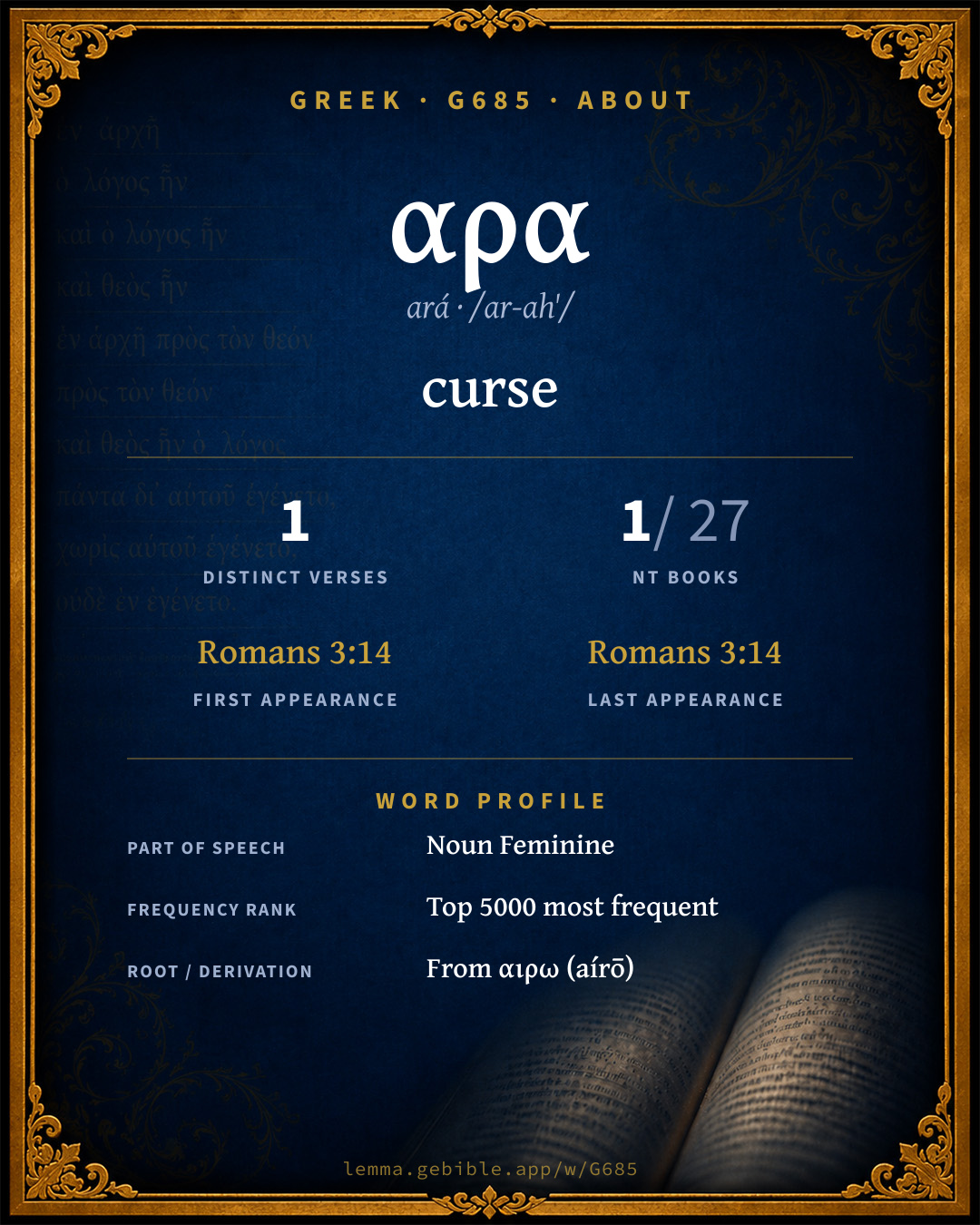
ἀρά
curse
‘curse’ is one of 2 main senses fuller range ↓
Full lexicon entry — Thayer's Greek Lexicon
From Thayer's Greek Lexicon
Where this word appears
Grammar key — what these labels mean
Part of speech
- Noun
- A naming word — a person, place, thing, or idea.
Case
- Genitive
- The case of source, possession, or “of” — answers “whose / from what.”
Gender
- Feminine
- Grammatically feminine.
Number
- Singular
- One.
Every verse where G685 appears — 1 distinct verse across 1 book. Click any verse to open its interlinear word-by-word view. Verse text shown in the World English Bible for context — . Each verse’s Greek form is shown with its reference; the English is not keyword-highlighted, since the data carries no word-level English alignment. Use “Compare translations” on any verse to read it across multiple English versions. This concordance covers the Greek New Testament; Septuagint (Greek Old Testament) occurrences of this word are not indexed here.
Romans 1 verse
About this entry
At a glance — auto-summarized from this page’s data, not written by a person. Every figure links to its source below. This summary describes the numbers; it doesn’t interpret them.
“curse” is the headline sense of the Greek noun αρα (ará). With only 1 verse it sits in the long tail of Greek New Testament vocabulary. More than three-quarters of its appearances fall in Romans. A true hapax — its single appearance is Romans 3:14. Catalogued under 2 senses, its meaning is not single-sense. See the sense tree, 1-verse concordance, and the renderings breakdown below.
Gloss history
Strong's 1890 vs modern scholarship

About this word
Strong's G685 catalogs a Greek word from the Greek New Testament.
These counts are not copied from any lexicon or concordance. They are computed here, from the morphology-tagged Greek New Testament. What Lemma adds →
- 1
- distinct verses
- The word appears in 1 distinct verse.
- 1 / 27
- NT books
- The word appears in 1 of 27 New Testament books.
- #3,503
- by frequency
- Top 5000 most frequent Greek words (rank 3,503 of 5,347 Greek words by occurrence).
View all 1 occurrence in the concordance →
Most concentrated in
- Romans 1 verse 100%
By section of the New Testament
By traditional corpus
Conventional, traditional groupings — biblical authorship is debated, so this is a traditional corpus grouping, not an authorship claim. Some books belong to more than one corpus (Luke is in both the Gospels and the Lukan corpus, and so on), so these shares overlap and need not total 100%. Each figure is a share of the word’s 1 distinct verse.
- Pauline corpus 1 verse · 100%
How translations render this word
Counts come from each version’s own published word-to-Strong’s tagging or interlinear alignment — an approximate guide to how each version renders this word, not a word-level alignment the data otherwise carries. Because each total is that version’s own tagged count, the per-version totals vary from one another and need not match the appearance or distinct-verse counts above. These counts may also differ from a printed concordance because Lemma counts each distinctly tagged rendering and does not collapse phrase taggings into a single head-word total. This is a fixed set of word-tagged versions (KJV, ASV, BSB, ULT) and does not change with the reading translation you choose elsewhere. Each version’s license is shown beside its name below (and on Sources).
- King James Version: Cursing 1×
- American Standard Version: Cursing 1×
- Berean Standard Bible: Cursing 1×
- unfoldingWord Literal Text: Cursing 1×
King James Version Public Domain
Renders G685 across 1 tagged occurrence — most commonly:
American Standard Version Public Domain
Renders G685 across 1 tagged occurrence — most commonly:
Berean Standard Bible Public Domain
Renders G685 across 1 tagged occurrence — most commonly:
unfoldingWord Literal Text CC BY-SA 4.0
Renders G685 across 1 tagged occurrence — most commonly:
Senses in Thayer's
The 2 senses Thayer's distinguishes for this word, in lexicon order (not ranked by frequency or importance). The full entry — with sub-senses — is in the Lexicon Entry tab.
- a prayer, a supplication
- an imprecation, curse, malediction
Word origin
Derived from αιρω (aírō) (G142) — to raise up.
Probably from G142 ; properly prayer (as lifted to Heaven) that is (by implication) imprecation : - curse.
— Strong’s Exhaustive Concordance (1890), public domain.
Same root — word family
Other Thayer's entries built from the same root as G685, grouped by Strong’s listed origin. These share a root / origin per the lexicon — not necessarily a shared meaning. Each links to that word’s own entry.
Derives from
Shares the same root
- αιρεομαι hairéomai G138 to choose
- αρα ára G686 therefore
- αρεσκω aréskō G700 to please
- αριθμος arithmós G706 number
- αρκεω arkéō G714 to ward off
- αρρην árrhēn G730 male
- αρτι árti G737 now
- αρτος ártos G740 bread
- αρτυω artýō G741 to season
- αρωμα árōma G759 spice
- ορος óros G3735 mountain
Compare all same-root words → Showing 4 of 13 — not the complete family. They share a root, not necessarily a meaning.
Septuagint usage
The same Greek word αρα appears 68 times in the Greek Old Testament (Septuagint), across 64 verses in 18 books.
- 68
- LXX occurrences
- Tagged occurrences of this Greek word in the Septuagint.
- 64
- verses
- Distinct Septuagint verses containing this word.
- 18 / 39
- OT books
- The word appears in 18 of the 39 Old Testament books.
Sample Septuagint occurrences
- Genesis 18:3 ἄρα
- Numbers 5:21 ἀρά
- Deuteronomy 29:11 ἀρά
- Joshua 15:21 αρα
- 1 Kings 8:31 ἀρά
- 1 Chronicles 7:38 αρα
- 2 Chronicles 6:22 ἀρά
- Ezra 20:30 ἀρά
- Job 23:3 ἄρα
- Psalms 7:5 ἄρα
- Proverbs 12:23 ἀρά
- Isaiah 24:6 ἀρά
Septuagint occurrences (same lexeme)
Every verse where the same Strong’s number (G685) appears in the Greek Septuagint — showing the first 50 of 64. Verse text shown in the World English Bible for context; the Greek form is the matched word — the English is not keyword-highlighted.
- Genesis 18:3 ἄρα and said, "My lord, if now I have found favor in your sight, please don't go away from your servant.
- Genesis 18:13 ἆρα Yahweh said to Abraham, "Why did Sarah laugh, saying, 'Will I really bear a child, yet I am old?'
- Genesis 20:11 ἄρα Abraham said, "Because I thought, 'Surely the fear of God is not in this place. They will kill me for my wife's sake.'
- Genesis 24:41 ἀρά Then will you be clear from my oath, when you come to my relatives. If they don't give her to you, you shall be clear from my oath.'
- Genesis 26:9 ἄρα Abimelech called Isaac, and said, "Behold, surely she is your wife. Why did you say, 'She is my sister?'" Isaac said to him, "Because I said, 'Lest I die because of her.'"
- Genesis 26:28 ἀρά They said, "We saw plainly that Yahweh was with you. We said, 'Let there now be an oath between us, even between us and you, and let us make a covenant with you,
- Genesis 37:10 ἆρα He told it to his father and to his brothers. His father rebuked him, and said to him, "What is this dream that you have dreamed? Will I and your mother and your brothers indeed come to bow ourselves down to you to the earth?"
- Numbers 5:21 ἀρά then the priest shall cause the woman to swear with the oath of cursing, and the priest shall tell the woman, 'Yahweh make you a curse and an oath among your people, when Yahweh allows your thigh to fall away, and your body to swell;
- Numbers 5:23 ἀρά "The priest shall write these curses in a book, and he shall blot them out into the water of bitterness.
- Numbers 5:27 ἀρά When he has made her drink the water, then it shall happen, if she is defiled, and has committed a trespass against her husband, that the water that causes the curse will enter into her and become bitter, and her body will swell, and her thigh will fall away: and the woman will be a curse among her people.
- Numbers 22:11 ἄρα Behold, the people that is come out of Egypt, it covers the surface of the earth: now, come curse me them; peradventure I shall be able to fight against them, and shall drive them out.
- Deuteronomy 29:11 ἀρά your little ones, your wives, and your foreigner who is in the midst of your camps, from the one who cuts your wood to the one who draws your water;
- Deuteronomy 29:13 ἀρά that he may establish you this day to himself for a people, and that he may be to you a God, as he spoke to you, and as he swore to your fathers, to Abraham, to Isaac, and to Jacob.
- Deuteronomy 29:18 ἀρά lest there should be among you man, or woman, or family, or tribe, whose heart turns away this day from Yahweh our God, to go to serve the gods of those nations; lest there should be among you a root that bears gall and wormwood;
- Deuteronomy 29:19 ἀρά and it happen, when he hears the words of this curse, that he bless himself in his heart, saying, I shall have peace, though I walk in the stubbornness of my heart, to destroy the moist with the dry.
- Deuteronomy 29:20 ἀρά Yahweh will not pardon him, but then the anger of Yahweh and his jealousy will smoke against that man, and all the curse that is written in this book shall lie on him, and Yahweh will blot out his name from under the sky.
- Deuteronomy 30:7 ἀρά Yahweh your God will put all these curses on your enemies, and on those who hate you, who persecuted you.
- Joshua 15:21 αρα The uttermost cities of the tribe of the children of Judah toward the border of Edom in the South were Kabzeel, and Eder, and Jagur,
- 1 Kings 8:31 ἀρά If a man sin against his neighbor, and an oath be laid on him to cause him to swear, and he come [and] swear before your altar in this house;
- 1 Chronicles 7:38 αρα The sons of Jether: Jephunneh, and Pispa, and Ara.
- 2 Chronicles 6:22 ἀρά If a man sin against his neighbor, and an oath is laid on him to cause him to swear, and he comes and swears before your altar in this house;
- Ezra 20:30 ἀρά
- Job 23:3 ἄρα Oh that I knew where I might find him! That I might come even to his seat!
- Job 27:8 ἆρα For what is the hope of the godless, when he is cut off, When God takes away his life?
- Job 31:6 ἄρα (Let me be weighed in an even balance, That God may know my integrity);
- Job 31:8 ἄρα Then let me sow, and let another eat; Yes, let the produce of my field be rooted out.
- Job 31:10 ἄρα Then let my wife grind for another, And let others sleep with her.
- Job 31:22 ἄρα Then let my shoulder fall from the shoulder-blade, And my arm be broken from the bone.
- Job 31:28 ἄρα This also would be an iniquity to be punished by the judges; For I should have denied the God who is above.
- Job 31:30 ἄρα (Yes, I have not allowed my mouth to sin By asking his life with a curse);
- Job 31:40 ἄρα Let briars grow instead of wheat, And stinkweed instead of barley." The words of Job are ended.
- Job 38:21 ἄρα Surely you know, for you were born then, And the number of your days is great!
- Job 40:14 ἄρα Then I will also admit to you That your own right hand can save you.
- Psalms 7:5 ἄρα Let the enemy pursue my soul, and overtake it; Yes, let him tread my life down to the earth, And lay my glory in the dust. Selah.
- Psalms 7:6 ἄρα Arise, Yahweh, in your anger. Lift up yourself against the rage of my adversaries. Awake for me. You have commanded judgment.
- Psalms 9:28 ἀρά
- Psalms 13:3 ἀρά Behold, and answer me, Yahweh, my God. Give light to my eyes, lest I sleep in death;
- Psalms 30:23 ἄρα
- Psalms 57:2 ἄρα I cry out to God Most High, To God who accomplishes my requests for me.
- Psalms 57:12 ἄρα
- Psalms 58:13 ἀρά
- Psalms 72:13 ἄρα He will have pity on the poor and needy. He will save the souls of the needy.
- Psalms 123:3 ἄρα Have mercy on us, Yahweh, have mercy on us, For we have endured much contempt.
- Psalms 123:4 ἄρα Our soul is exceedingly filled with the scoffing of those who are at ease, With the contempt of the proud.
- Psalms 123:5 ἄρα
- Psalms 138:11 ἄρα
- Proverbs 12:23 ἀρά A prudent man keeps his knowledge, But the hearts of fools proclaim foolishness.
- Proverbs 26:2 ἀρά Like a fluttering sparrow, Like a darting swallow, So the undeserved curse doesn't come to rest.
- Isaiah 24:6 ἀρά Therefore has the curse devoured the earth, and those who dwell therein are found guilty: therefore the inhabitants of the earth are burned, and few men left.
- Isaiah 28:8 ἀρά For all tables are full of vomit [and] filthiness, [so that there is] no place [clean].
These are occurrences of the same Greek lexeme (G685) in the Septuagint — not a translation of any one Hebrew word. The store carries no word-level Hebrew↔Greek alignment, so no Hebrew original is asserted here. Counts come from the recovered LXX Strong's tagging — high-frequency vocabulary is well covered, while rare or late forms may be untagged — so they reflect tagged occurrences and may slightly undercount.