Numbers 10:21

Hebrew (Westminster Leningrad Codex) Numbers 10:21 appears in the Hebrew Old Testament. The text above is from the Westminster Leningrad Codex. Each word links to its Strong’s number, a concise gloss, and parsing drawn from the Open Scriptures Hebrew Bible morphology. Click any word for its full Brown-Driver-Briggs (BDB) entry.
Download image
Cite this verse

Numbers 10:21 (World English Bible). Public Domain. Lemma interlinear Bible study tool, https://lemma.gebible.app/v/numbers/10/21.

Show BibTeX & RIS
BibTeX
RIS
English Translation
The Kohathites set forward, bearing the sanctuary: and [the others] did set up the tent against their coming.
World English Bible · Public Domain
Download a study sheet

One document with this verse’s original text, its word-by-word gloss line, the meaning frame, cross-references with their text, attributed commentary, and full source and license credits — printable, and it pastes into notes with its structure intact.

This verse Autodidact and up

Study sheet (.html) Plain text (.txt)

A passage Seminary Student

Up to 50 verses in one chapter. A passage sheet keeps up to 6 commentary sources and 12 cross-references per verse, in the order this page ranks them, and says so on the sheet whenever that leaves anything out. Ask for a single verse and you get the Autodidact verse sheet above.

Everything on this page stays free to read, with no account — the sheet is a download of what is already on screen, not access to it.

Want to remove ads? Support Godless Engineer
Compare translations 3

The same verse in 3 English versions, stacked beneath the original-language interlinear above. Click any original word for its lexicon entry.

Each is an independent rendering of the whole verse — the interlinear is not word-aligned to these translations.

Highlighted words mark where these versions differ — a whole-verse word diff, not a word-by-word alignment.

  • World English Bible Public Domain
    The Kohathites set forward, bearing the sanctuary: and [the others] did set up the tent against their coming.
  • King James Version Public Domain
    And the Kohathites set forward, bearing the sanctuary: and the other did set up the tabernacle against they came.
  • unfoldingWord Literal Text CC BY-SA 4.0
    And the Kohathites, the ones carrying the holy place, set out, and they raised up the Dwelling until their coming.

unfoldingWord Literal Text — © unfoldingWord, licensed CC BY-SA 4.0. Word-aligned USFM3 via Door43 (git.door43.org/unfoldingWord/en_ult).

Versions to compare (up to 4)

3 of 4 selected

Show all 18 translations

Every available English version of this verse, each an independent rendering of the whole verse.

  • World English Bible Public Domain
    The Kohathites set forward, bearing the sanctuary: and [the others] did set up the tent against their coming.
  • Berean Standard Bible Public Domain
    Then the Kohathites set out, transporting the holy objects; the tabernacle was to be set up before their arrival.
  • Majority Standard Bible Public Domain
    Then the Kohathites set out, transporting the holy objects; the tabernacle was to be set up before their arrival.
  • King James Version Public Domain
    And the Kohathites set forward, bearing the sanctuary: and the other did set up the tabernacle against they came.
  • American Standard Version (1901) Public Domain
    And the Kohathites set forward, bearing the sanctuary: and `the others' did set up the tabernacle against their coming.
  • Revised Version (1885) Public Domain
    And the Kohathites set forward, bearing the sanctuary: and the other did set up the tabernacle against they came.
  • Geneva Bible (1599) Public Domain
    The Kohathites also went forward and bare the Sanctuarie, and the former did set vp the Tabernacle against they came.
  • Douay-Rheims (1899) Public Domain
    Then the Caathites also marched carrying the sanctuary. So long was the tabernacle carried, till they same to the place of setting it up.
  • Young's Literal Translation Public Domain
    And the Kohathites have journeyed, bearing the tabernacle, and the `others' have raised up the tabernacle until their coming in.
  • Literal Standard Version CC BY-SA 4.0
    And the Kohathites have journeyed, carrying the Dwelling Place, and the [others] have raised up the Dwelling Place until their coming in.
  • Unlocked Literal Bible CC BY-SA 4.0
    The Kohathites set out. They carried the sanctuary's holy equipment. Others would set up the tabernacle before the Kohathites arrived at the next camp.
  • unfoldingWord Literal Text CC BY-SA 4.0
    And the Kohathites, the ones carrying the holy place, set out, and they raised up the Dwelling until their coming.
  • Darby Bible Public Domain
    And the Kohathites set forward bearing the sanctuary: and [the others] set up the tabernacle whilst they came.
  • World Messianic Bible Public Domain
    The Kohathites set forward, bearing the sanctuary. The others set up the tabernacle before they arrived.
  • Webster's Bible Public Domain
    And the Kohathites moved forward, bearing the sanctuary: and the other set up the tabernacle against they came.
  • Free Bible Version CC BY-SA 4.0
    Then the Kohathites set off, carrying the holy objects. The Tabernacle would be put up before they arrived.
  • Bible in Basic English Public Domain
    Then the Kohathites went forward with the holy place; the others put up the House ready for their coming.
  • JPS Tanakh (1917) Public Domain
    And the Kohathites the bearers of the sanctuary set forward, that the tabernacle might be set up against their coming.

Literal Standard Version (2020), Covenant Press — licensed CC BY-SA 4.0. Text via the HelloAO Bible API (eBible.org). Unlocked Literal Bible (unfoldingWord) — licensed CC BY-SA 4.0. Text via the HelloAO Bible API (eBible.org). unfoldingWord Literal Text — © unfoldingWord, licensed CC BY-SA 4.0. Word-aligned USFM3 via Door43 (git.door43.org/unfoldingWord/en_ult). Free Bible Version, Dr. Jonathan Gallagher — licensed CC BY-SA 4.0. Text via the HelloAO Bible API (eBible.org).

Word by word

More ways to search: Search by grammar → Find every occurrence → Compare this word →

Practice this passage: Drill this verse → Learn its vocabulary →

הַקְּהָתִ֔ים
Qŏhâthîy
H6956
“the · Kohathites”
Particle, Definite Article + Noun, Gentilic, Masculine, Plural, Absolute
Part of Speech
Particle + Noun
Type
Gentilic
Gender
Masculine
Number
Plural
State
Absolute
Full BDB Definition

Origin: patronymically from H6955

TWOT: None

Kohathites = see Kohath " assembly" - the descendants of Kohath, the 2nd son of Levi
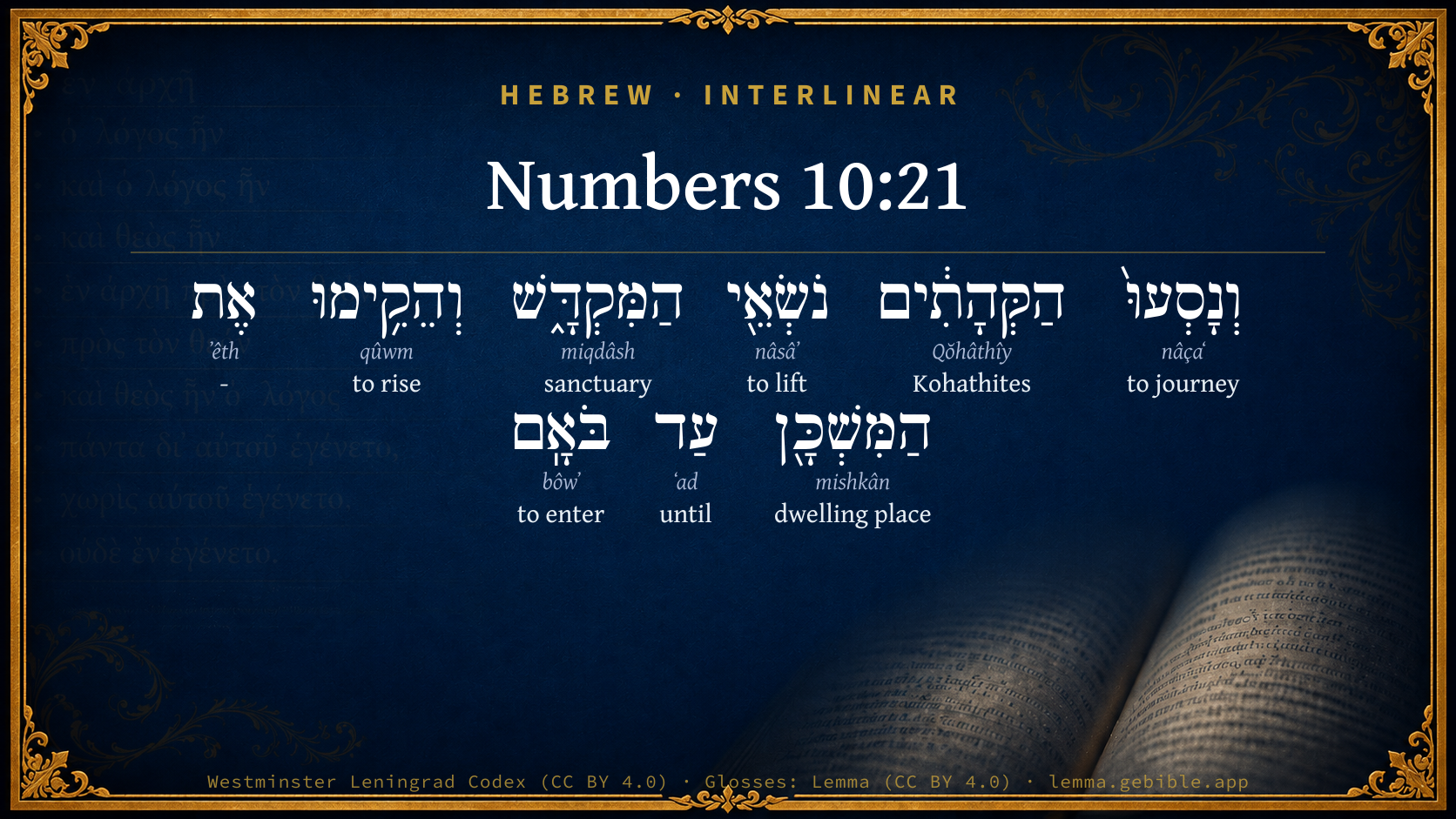
  1. וְנָסְעוּ֙ nâçaʻ H5265 “and · to journey” Conjunction + Verb, Qal, Sequential Perfect, 3rd Person, Common, Plural
  2. נֹשְׂאֵ֖י nâsâʼ H5375 “lifting” Verb, Qal, Participle Active, Masculine, Plural, Construct
  3. הַמִּקְדָּ֑שׁ miqdâsh H4720 “the · sanctuary” Particle, Definite Article + Noun, Common, Masculine, Singular, Absolute
  4. וְהֵקִ֥ימוּ qûwm H6965 “and · to rise” Conjunction + Verb, Hiphil, Sequential Perfect, 3rd Person, Common, Plural
  5. אֶת ʼêth H853 “-” Particle, Direct Object
  6. הַמִּשְׁכָּ֖ן mishkân H4908 “the · dwelling place” Particle, Definite Article + Noun, Common, Masculine, Singular, Absolute
  7. עַד ʻad H5704 “until” Preposition
  8. בֹּאָֽם bôwʼ H935 “to enter · them” Verb, Qal, Infinitive Construct + Suffix, Personal, 3rd Person, Masculine, Plural

About this verse

These counts appear in no published source. They are computed here, from the morphology-tagged text and Lemma’s own curated glosses. What Lemma adds →

9
words
9
distinct lemmas
Pentateuch
section

Notable vocabulary

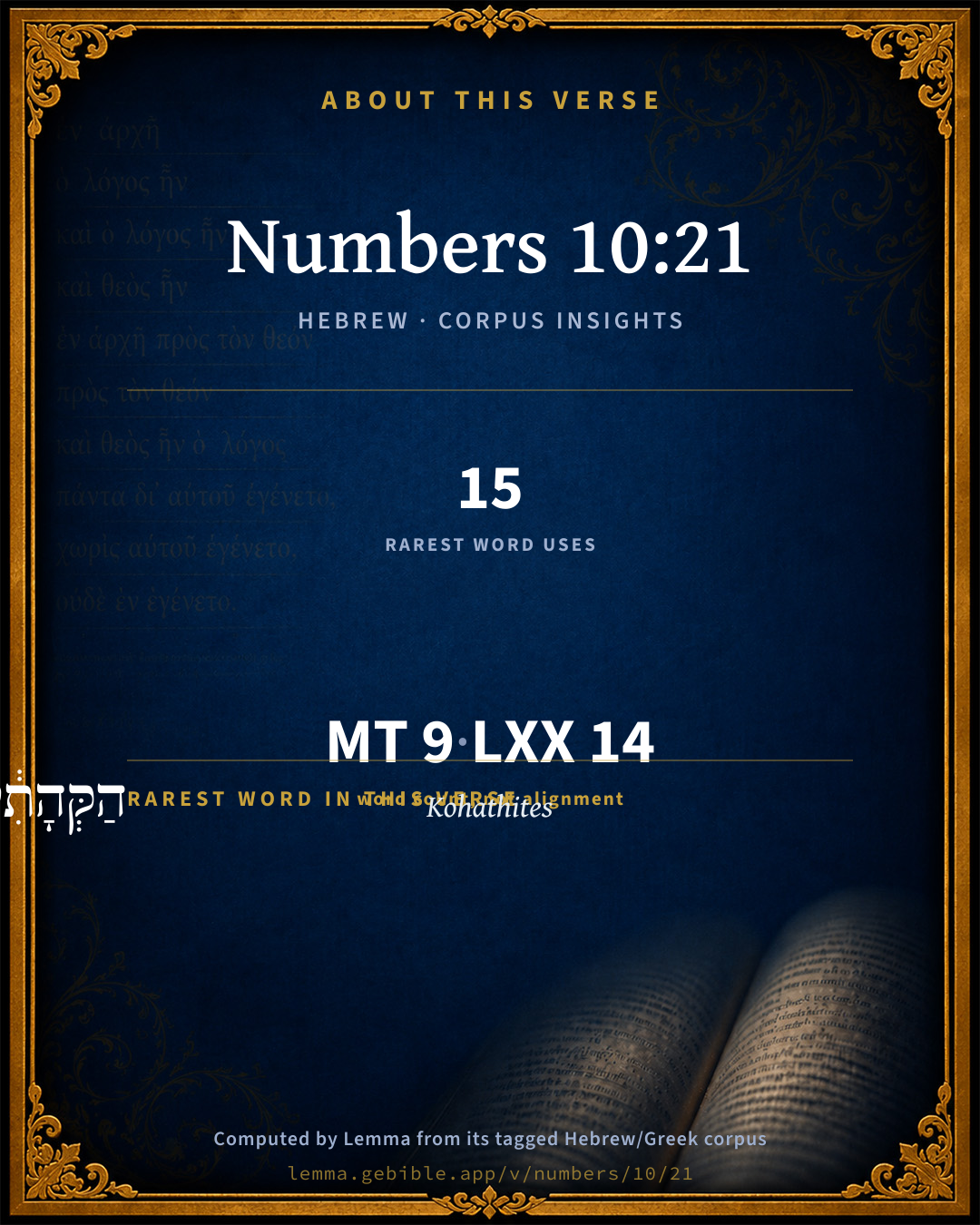
The rarest word here is הַקְּהָתִ֔ים Kohathites H6956 — appearing just 15 times in the whole Hebrew Bible.

Shared distinctive vocabulary

הַקְּהָתִ֔ים Kohathites H6956 occurs in 15 verses of the Hebrew Bible. Also found in:

Grammatical profile

  • 4 verbs
  • 3 nouns
  • 1 preposition
  • 1 particle

Verb forms

  • וְנָסְעוּ֙ Qal · Sequential Perfect
  • נֹשְׂאֵ֖י Qal · Participle Active
  • וְהֵקִ֥ימוּ Hiphil · Sequential Perfect
  • בֹּאָֽם Qal · Infinitive Construct

Hebrew & Septuagint length

In English translation the verse runs 18 words from the Hebrew and 23 from the Septuagint (LXX English) — closely comparable.

A rough comparison of the two English renderings, which tokenize alike — not a word-level alignment.

Word counts can differ between the Hebrew and the Greek without any difference in meaning — e.g. the Hebrew direct-object marker אֵת has no separate Greek word, and Greek often adds the article ὁ.

In the original languages it is 9 Hebrew tokens and 14 Greek tokens — but the two are counted differently (Hebrew bundles its prefixes and suffixes into one token; the Greek is in lemma form), so that isn’t a like-for-like length.

Cross-references

9

Topical passages linked to Numbers 10:21 in the Treasury of Scripture Knowledge — connected by theme and wording, ordered by reader-vote popularity; previews shown in the World English Bible.

  • Numbers 10:17 The tent was taken down; and the sons of Gershon and the sons of Merari, who bore the tent, set forward.
  • Numbers 4:4–16 This is the service of the sons of Kohath in the Tent of Meeting, the most holy things.
  • Numbers 7:9 But to the sons of Kohath he gave none, because the service of the sanctuary belonged to them; they carried it on their shoulders.
  • Numbers 1:51 When the tabernacle is to move, the Levites shall take it down; and when the tabernacle is to be set up, the Levites shall set it up. The stranger who comes near shall be put to death.
  • Numbers 2:17 "Then the tent of meeting shall set out, with the camp of the Levites in the midst of the camps. As they encamp, so shall they set out, every man in his place, by their standards.
  • Numbers 3:27–32 Of Kohath was the family of the Amramites, and the family of the Izharites, and the family of the Hebronites, and the family of the Uzzielites: these are the families of the Kohathites.
  • Numbers 4:20 but they shall not go in to see the sanctuary even for a moment, lest they die."
  • 1 Chronicles 15:2 Then David said, None ought to carry the ark of God but the Levites: for them has Yahweh chosen to carry the ark of God, and to minister to him forever.
  • 1 Chronicles 15:12–15 and said to them, You are the heads of the fathers' [houses] of the Levites: sanctify yourselves, both you and your brothers, that you may bring up the ark of Yahweh, the God of Israel, to [the place] that I have prepared for it.

Cross-references courtesy of OpenBible.info (CC BY 4.0).

Hebrew and Greek witnesses Masoretic Hebrew ↔ Greek Septuagint

The same verse in the two great witnesses to the Old Testament, shown verse-for-verse.

These are two independent witnesses, not word-aligned to each other, and the Septuagint is shown in lemma (dictionary) form.

Hebrew Numbers 10:21 Masoretic · Westminster Leningrad Codex

וְנָסְעוּ֙ הַקְּהָתִ֔ים נֹשְׂאֵ֖י הַמִּקְדָּ֑שׁ וְהֵקִ֥ימוּ אֶת הַמִּשְׁכָּ֖ן עַד בֹּאָֽם

The Kohathites set forward, bearing the sanctuary: and [the others] did set up the tent against their coming.

World English Bible · Public Domain

Greek LXX Numbers 10:21 Septuagint · lemma form

καί ἐκαἴρω ὁ υἱός κααθ αἴρω ὁ ἅγιος καί ἵστημι ὁ σκηνή ἕως παραγίγνομαι

And the sons of Caath shall set forward bearing the holy things, and the others shall set up the tabernacle until they arrive.

LXX2012 (modern English Septuagint) · Public Domain

On this verse, The Pulpit Commentary discusses the Septuagint’s reading. Read the note in Commentary ↓

Hebrew: Westminster Leningrad Codex (CC BY 4.0). Greek: Septuagint (public domain); English from LXX2012 (modern English Septuagint) (Public Domain). How the Septuagint differs from the Hebrew →

Targum (Aramaic paraphrase)

2

The Targum is the ancient Jewish Aramaic paraphrase of the Hebrew Scriptures — an interpretive translation, not the Hebrew text itself. Onkelos (literal) and Pseudo-Jonathan (expansive) render the Torah, and Jonathan the Prophets. Coverage is partial: where no permissively-licensed English translation exists for a verse, only the Aramaic is shown. This is verse-level text, not a word-by-word alignment to the Hebrew.

  1. Targum Onkelos Torah (Genesis–Deuteronomy)
    וְנָטְלִין בְּנֵי קְהָת נָטְלֵי מַקְדְשָׁא וּמְקִימִין יָת מַשְׁכְּנָא עַד מֵיתֵיהוֹן

    (no public-domain English translation for this verse)

    Targum Onkelos — Aramaic: “Onkelos Genesis” (public domain); “Onkelos Exodus” (public domain); “Onkelos Leviticus” (public domain); “Onkelos Numbers” (public domain); “Onkelos Deuteronomy” (public domain). English: “Sefaria Community Translation” (CC0 1.0 (public-domain dedication)); “J.W. Etheridge. The Targums of Onkelos and Jonathan Ben Uzziel on the Pentateuch. London: Longmans, Green, 1862” (public domain). Text via Sefaria.

  2. Targum Pseudo-Jonathan Torah (Genesis–Deuteronomy)
    וְנַטְלִין גְנִיסַת קְהָת נַטְלֵי מוּקְדְשָׁא וּמְקִימִין יַת מַשְׁכְּנָא עַד מֵיתֵיהוֹן

    And the family of Kehath went forward, carrying the sanctuary; and they (the men of Gershon) reared up the tabernacle against their coming.

    Targum Pseudo-Jonathan — Aramaic: “Targum Jonathan on Genesis” (public domain); “Targum Jonathan on Exodus” (public domain); “Targum Jonathan on Leviticus” (public domain); “Targum Jonathan on Numbers” (public domain); “Targum Jonathan on Deuteronomy” (public domain). English: “The Targum of Jonathan ben Uzziel, trans. J. W. Etheridge, London, 1862” (public domain). Text via Sefaria.

Commentary

Notes on Numbers 10:21 from classic Christian and Jewish commentators (each source and its license shown beneath its notes). The classic Christian expositions comment on the surrounding passage and are grouped to its opening verse, so a note may address several verses; the Jewish commentaries on the Tanakh (Rashi and others) are per-verse, so they appear only where the commentator wrote on this verse.

Lemma curates 59 commentaries, every one of them public domain or Creative Commons licensed, each selected and text-cleaned for this edition rather than reprinted as found. About our sources →

Joseph Benson's Commentary

Num 10:21. The others — The Gershonites and Merarites, who therefore marched after the first camp, a good distance from, and before the Kohathites, that they might prepare the tabernacle for the reception of its utensils, which the Kohathites brought some time after them.

Joseph Benson's Commentary on the Old and New Testaments (1811–1818) — public domain. Text from a community e-Sword module.

Geneva Bible (1599)

Geneva Bible translators

The Merarites and Gershonites.

Upon their shoulders.

Geneva Bible (1599) marginal notes — public domain. Text via Bolls.life.

The Cambridge Bible for Schools and Colleges

gen. ed. J. J. S. Perowne

21. the sanctuary] But the sacred structure is already in the hands of the Gershonites and Merarites. The required meaning is the holy things, and Ḳôdesh is probably the true reading, as in Num_4:15 (see note there).

the other did set up] Heb. has loosely ‘and they [used to] set up,’ which is equivalent to the passive verb ‘and the Tabernacle used to be set up,’ i.e. by the other Levites.

29–33 J . This earlier account of the departure from Sinai relates that Moses asked Ḥobab to be their guide, because he would be well acquainted with the places of encampment en route.

The Cambridge Bible for Schools and Colleges (gen. ed. J. J. S. Perowne; Cambridge University Press, 1878–1918) — public domain. Text from a community e-Sword module.

John Gill's Exposition

And over the host of the tribe of the children of Manasseh was Gamaliel the son of Pedahzur. See Gill on Num 10:22.

.

Numbers 10:24

num 10:24

num 10:24

num 10:24And over the host of the tribe of the children of Benjamin was Abidan the son of Gideoni. See Gill on Num 10:22.

John Gill's Exposition of the Whole Bible (1746–1763) — public domain (CC PDM 1.0). Text via the HelloAO Bible API.

Haydock's Catholic Bible Commentary

Sanctuary, or holy vessels. They never set them down, till they arrived at the place where the tabernacle was to be fixed. Hebrew may be, "the sons of Caath set forward, bearing the vessels of the sanctuary, (Calmet) and they (the other Levites, ver. 17,) set up the boards and curtains of the tabernacle till they arrived;" that so both the vessels and the ark might be placed in proper order. If the ark had to return into the middle of the camp from leading the way, as Salien insinuates; while it passed between the ranks of Juda, the Levites would have time to arrange every thing. (Haydock)

George Leo Haydock (1774–1849), Haydock's Catholic Family Bible and Commentary, 1859 edition — public domain. Excludes Psalms (Douay-Rheims chapter numbering differs from Protestant) and Deuterocanonical books (Catholic canon only).

Matthew Poole's English Annotations

The other, i.e. the Gershonites and Merarites, as is evident both from their work and office, which was to take down and set up the tabernacle, Num 3:25,26; 4:22-33; and from Num 10:17, who therefore marched after the first camp, a good distance kern and before the Kohathites, that they might prepare the tabernacle for the reception of its utensils, which the Kohathites brought some time after them.

Matthew Poole's English Annotations on the Holy Bible (1683–1685) — public domain. Text from a community e-Sword/MySword module.

The Pulpit Commentary

The sanctuary. Rather, "the holy things." vDqMih, equivalent to the vdqo if Num_4:4. Septuagint, ta agia . The sacred furniture mentioned in Num_3:31 (but cf. verse 33). The other did set up the tabernacle. Literally, "they set up," but no doubt it means the Gershonites and Merarites, whose business it was.

The Pulpit Commentary (1880–1919), ed. H.D.M. Spence-Jones & Joseph S. Exell — public domain. Text from a community e-Sword module.

John Wesley's Explanatory Notes

The others - The Gershonites, and Merarites, who therefore marched after the first camp, a good distance from, and before the Kohathites, that they might prepare the tabernacle for the reception of its utensils, which the Kohathites brought some time after them.

John Wesley, Explanatory Notes Upon the Whole Bible (1754–1765) — public domain. Text via the GEBible commentary corpus.

unfoldingWord translationNotes

Door43 World Missions Community

Kohathites

This refers to the descendants of Kohath. See how you translated this in Numbers 3:27.

The armies under the banner of Ephraim's descendants

This refers to the armies of the tribes under the division of Ephraim: Ephraim, Manasseh, and Benjamin.

Elishama son of Ammihud

See how you translated this man's name in Numbers 1:10.

Gamaliel son of Pedahzur

See how you translated this man's name in Numbers 1:10.

Abidan son of Gideoni

See how you translated this man's name in Numbers 1:11.

translationWords

sanctuary

holy

Ephraim

Manasseh

Benjamin

unfoldingWord translationNotes — © Distant Shores Media and the Door43 World Missions Community, licensed CC BY-SA 4.0. Source: git.door43.org/Door43/en_tn.

Rashi

Rabbi Shlomo Yitzchaki (Rashi)

נשאי המקדש means, the bearers of the holy articles (not of the structure of the Sanctuary itself for this was the burden of the sons of Gershon and Merari; cf. v. 17).

והקימו את המשכן AND THEY SET UP THE TABERNACLE [BEFORE THEY CAME] — this means: The sons of Gershon and the sons of Merari who were in front of them (the Kohathites) travelling together with the two divisions, those of Judah and Reuben, set up the Tabernacle as soon as the cloud rested, and the sign for encamping became visible above the division of the camp of Judah (cf. Rashi on 9:17). Now when they encamped and whilst the sons of Kohath were coming after them with the two last divisions (Ephraim and Dan), the sons of Gershon and the sons of Merari erected the Sanctuary. When the sons of Kohath arrived, they already found it in its proper place and they put into it the Ark, the table, the candelabrum and the altars. The following therefore is what the verse implies: והקימו, and they — i.e. those who had to erect the Tabernacle — erected it, עד before באם their arrival — the arrival of the sons of Kohath.

Rashi on the Tanakh — English translations: “The Judaica Press complete Tanach with Rashi, translated by A. J. Rosenberg” (CC BY 4.0); “Pentateuch with Rashi's commentary by M. Rosenbaum and A.M. Silbermann, 1929-1934” (public domain); “The Metsudah Tanach series, Lakewood, N.J” (CC BY 4.0); and “The Book of Joshua, Metsudah Publications, 1997” (CC BY 4.0). Text via Sefaria.

Ibn Ezra

Rabbi Abraham ibn Ezra

The carriers of the sacred. This refers to the Aron.

And they erected. The sons of Gershon and the sons of Merori erected the Mishkon before the arrival of the sons of Kehos. Then, the kohanim immediately brought the Aron to its place.

Ibn Ezra on the Tanakh — English translations: “Sefaria Community Translation” (CC0 1.0 (public-domain dedication)); “Yalkut, Sifsei Chachomim Chumash, Metsudah Publications, 2009” (CC BY 4.0); and “Commentary of Ibn Ezra on Isaiah - trans. by M. Friedlander, 1873” (public domain). Text via Sefaria.

Lesson kit

Teaching starters — assembled from the data on this page, not authored interpretation. Every prompt links to the verse data it draws on. Edit before teaching.

Numbers, in the Pentateuch, opens this verse with 9 words (9 distinct Hebrew lemmas). Its most distinctive word is Qŏhâthîy (“Kohathites”). A historical commentator’s framing appears above. Read the whole chapter for the surrounding context.

Discussion questions

  1. The word Qŏhâthîy carries the sense “Kohathites.” How does it shape the verse?
  2. Numbers 3:27 shares the word «Kohathites» with this verse. How do the two illuminate each other?
  3. These translations render this verse differently; the difference is in the English rendering, not the original. What questions does that raise?
  4. The verb «וְנָסְעוּ֙» is Qal Sequential Perfect. How does its form color the action?
  5. Reading how Joseph Benson's Commentary and Geneva Bible (1599) read this verse, where do the two commentators agree and where do they part?

Things to notice

Reading settings

Reading text

Shown beneath each verse's original-language words.

Old Testament
Old Testament edition

Read the OT as the Masoretic Hebrew (MT) or the Greek Septuagint (LXX).

English shown for the Greek Septuagint (in the Hebrew ↔ Greek comparison).

Comparing translations? Open the Compare panel on any verse page to stack up to four side by side.