

Luke 19:22
Greek (Tischendorf 8th ed.) Luke 19:22 appears in the Greek New Testament. The text above is from the Tischendorf 8th edition. Each word links to its Strong’s number and a concise gloss. Click any word for its full Thayer’s Greek Lexicon entry.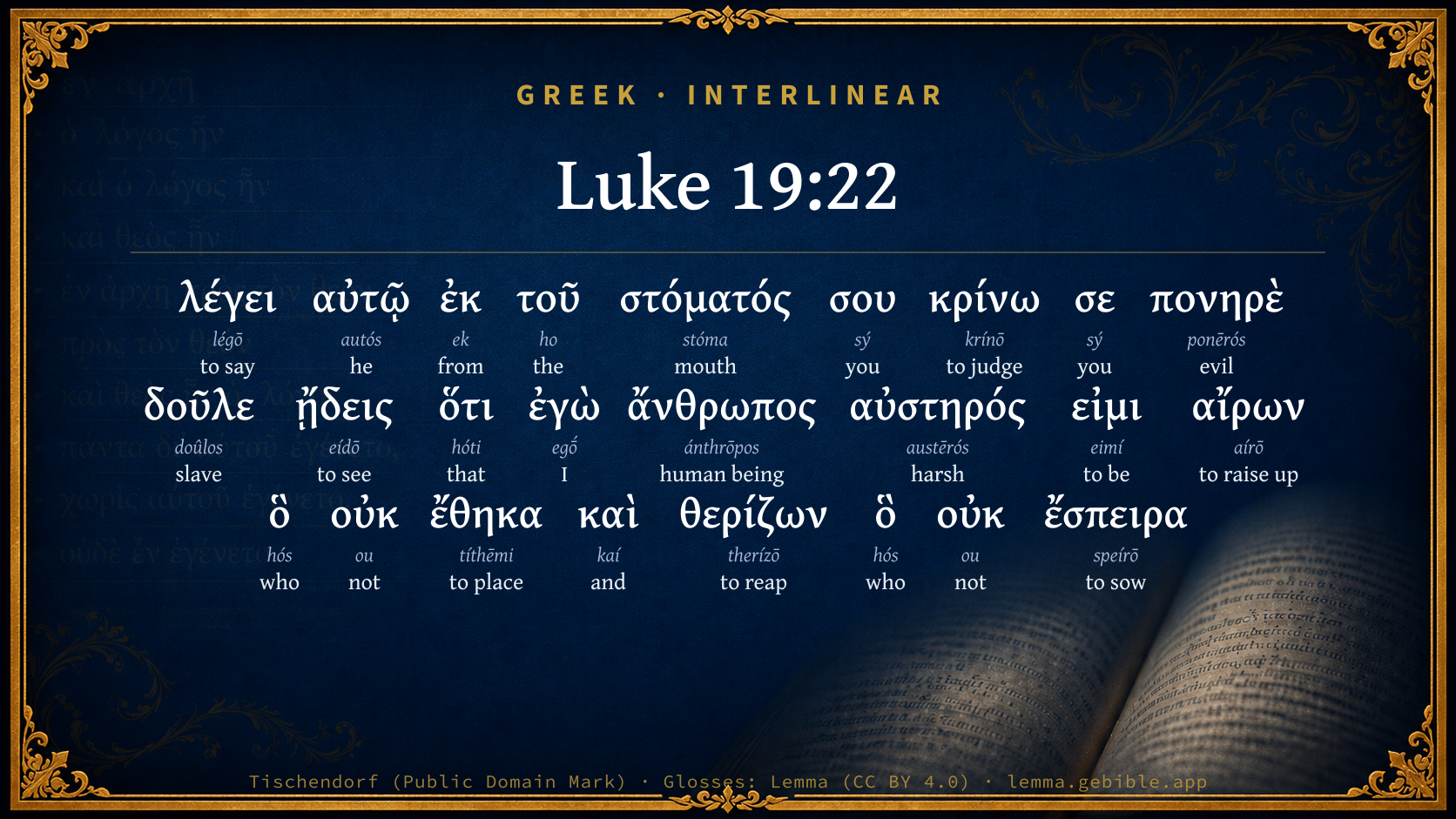
"He said to him, 'Out of your own mouth will I judge you, you wicked servant! You knew that I am an exacting man, taking up that which I didn't lay down, and reaping that which I didn't sow.
Download a study sheet
One document with this verse’s original text, its word-by-word gloss line, the meaning frame, cross-references with their text, attributed commentary, and full source and license credits — printable, and it pastes into notes with its structure intact.
This verse Autodidact and up
A passage Seminary Student
Up to 50 verses in one chapter. A passage sheet keeps up to 6 commentary sources and 12 cross-references per verse, in the order this page ranks them, and says so on the sheet whenever that leaves anything out. Ask for a single verse and you get the Autodidact verse sheet above.
Everything on this page stays free to read, with no account — the sheet is a download of what is already on screen, not access to it.
Compare translations 3
The same verse in 3 English versions, stacked beneath the original-language interlinear above. Click any original word for its lexicon entry.
Each is an independent rendering of the whole verse — the interlinear is not word-aligned to these translations.
Highlighted words mark where these versions differ — a whole-verse word diff, not a word-by-word alignment.
-
World English Bible Public Domain
"He said to him, 'Out of your own mouth will I judge you, you wicked servant! You knew that I am an exacting man, taking up that which I didn't lay down, and reaping that which I didn't sow.
-
King James Version Public Domain
And he saith unto him, Out of thine own mouth will I judge thee, thou wicked servant. Thou knewest that I was an austere man, taking up that I laid not down, and reaping that I did not sow:
-
unfoldingWord Literal Text CC BY-SA 4.0
He says to him, ‘By your mouth I will judge you, wicked servant! Did you know that I am a harsh man, taking up what I did not put down, and reaping what I did not sow?
unfoldingWord Literal Text — © unfoldingWord, licensed CC BY-SA 4.0. Word-aligned USFM3 via Door43 (git.door43.org/unfoldingWord/en_ult).
Show all 19 translations
Every available English version of this verse, each an independent rendering of the whole verse.
-
World English Bible Public Domain
"He said to him, 'Out of your own mouth will I judge you, you wicked servant! You knew that I am an exacting man, taking up that which I didn't lay down, and reaping that which I didn't sow.
-
Berean Standard Bible Public Domain
His master replied, ‘You wicked servant, I will judge you by your own words. So you knew that I am a harsh man, withdrawing what I did not deposit and reaping what I did not sow?
-
Majority Standard Bible Public Domain
His master replied, ‘You wicked servant, I will judge you by your own words. So you knew that I am a harsh man, withdrawing what I did not deposit and reaping what I did not sow?
-
King James Version Public Domain
And he saith unto him, Out of thine own mouth will I judge thee, thou wicked servant. Thou knewest that I was an austere man, taking up that I laid not down, and reaping that I did not sow:
-
American Standard Version (1901) Public Domain
He saith unto him, Out of thine own mouth will I judge thee, thou wicked servant. Thou knewest that I am an austere man, taking up that which I laid not down, and reaping that which I did not sow;
-
Revised Version (1885) Public Domain
He saith unto him, Out of thine own mouth will I judge thee, thou wicked servant. Thou knewest that I am an austere man, taking up that I laid not down, and reaping that I did not sow;
-
Geneva Bible (1599) Public Domain
Then he sayde vnto him, Of thine owne mouth will I iudge thee, O euill seruant. Thou knewest that I am a straight man, taking vp that I layd not downe, and reaping that I did not sowe.
-
Douay-Rheims (1899) Public Domain
He saith to him: Out of thy own mouth I judge thee, thou wicked servant. Thou knewest that I was an austere man, taking up what I laid not down, and reaping that which I did not sow:
-
Young's Literal Translation Public Domain
`And he saith to him, Out of thy mouth I will judge thee, evil servant: thou knewest that I am an austere man, taking up what I did not lay down, and reaping what I did not sow!
-
Literal Standard Version CC BY-SA 4.0
And he says to him, Out of your mouth I will judge you, evil servant: you knew that I am an austere man, taking up what I did not lay down, and reaping what I did not sow!
-
Unlocked Literal Bible CC BY-SA 4.0
The nobleman said to him, 'By your own words I will judge you, you wicked servant. You knew that I am a demanding person, that I take up what I did not put in, and that I reaped what I did not sow.
-
unfoldingWord Literal Text CC BY-SA 4.0
He says to him, ‘By your mouth I will judge you, wicked servant! Did you know that I am a harsh man, taking up what I did not put down, and reaping what I did not sow?
-
Darby Bible Public Domain
He says to him, Out of thy mouth will I judge thee, wicked bondman: thou knewest that *I* am a harsh man, taking up what I have not laid down and reaping what I have not sowed.
-
World Messianic Bible Public Domain
“He said to him, ‘Out of your own mouth I will judge you, you wicked servant! You knew that I am an exacting man, taking up that which I didn’t lay down and reaping that which I didn’t sow.
-
Webster's Bible Public Domain
And he saith to him, Out of thy own mouth will I judge thee, thou wicked servant. Thou knewest me to be an austere man, taking up what I laid not down, and reaping what I did not sow:
-
Free Bible Version CC BY-SA 4.0
‘I'll judge you by your own words,’ the king replied. ‘You know I'm a hard man, who as you say, takes what doesn't belong to me, and I harvest what I didn't plant.
-
Bible in Basic English Public Domain
He said to him, By the words of your mouth you will be judged, you bad servant. You had knowledge that I am a hard man, taking up what I have not put down and getting in grain where I have not put seed;
-
Text-Critical English NT CC BY 4.0
The king said to him, ‘I will condemn yoʋ by the words coming out of yoʋr own mouth, yoʋ evil servant. Yoʋ knew, did yoʋ, that I was a stern man, taking out what I did not put in, and reaping what I did not sow?
-
Tyndale New Testament (1534) Public Domain
And he sayde vnto him: Of thine awne mouth iudge I the thou evyll servaunt. knewest thou that I am a strayte man takinge vp that I layde not doune and repinge that I dyd not sowe?
Literal Standard Version (2020), Covenant Press — licensed CC BY-SA 4.0. Text via the HelloAO Bible API (eBible.org). Unlocked Literal Bible (unfoldingWord) — licensed CC BY-SA 4.0. Text via the HelloAO Bible API (eBible.org). unfoldingWord Literal Text — © unfoldingWord, licensed CC BY-SA 4.0. Word-aligned USFM3 via Door43 (git.door43.org/unfoldingWord/en_ult). Free Bible Version, Dr. Jonathan Gallagher — licensed CC BY-SA 4.0. Text via the HelloAO Bible API (eBible.org).
Word by word
More ways to search: Search by grammar → Find every occurrence → Compare this word →
Practice this passage: Drill this verse → Learn its vocabulary →
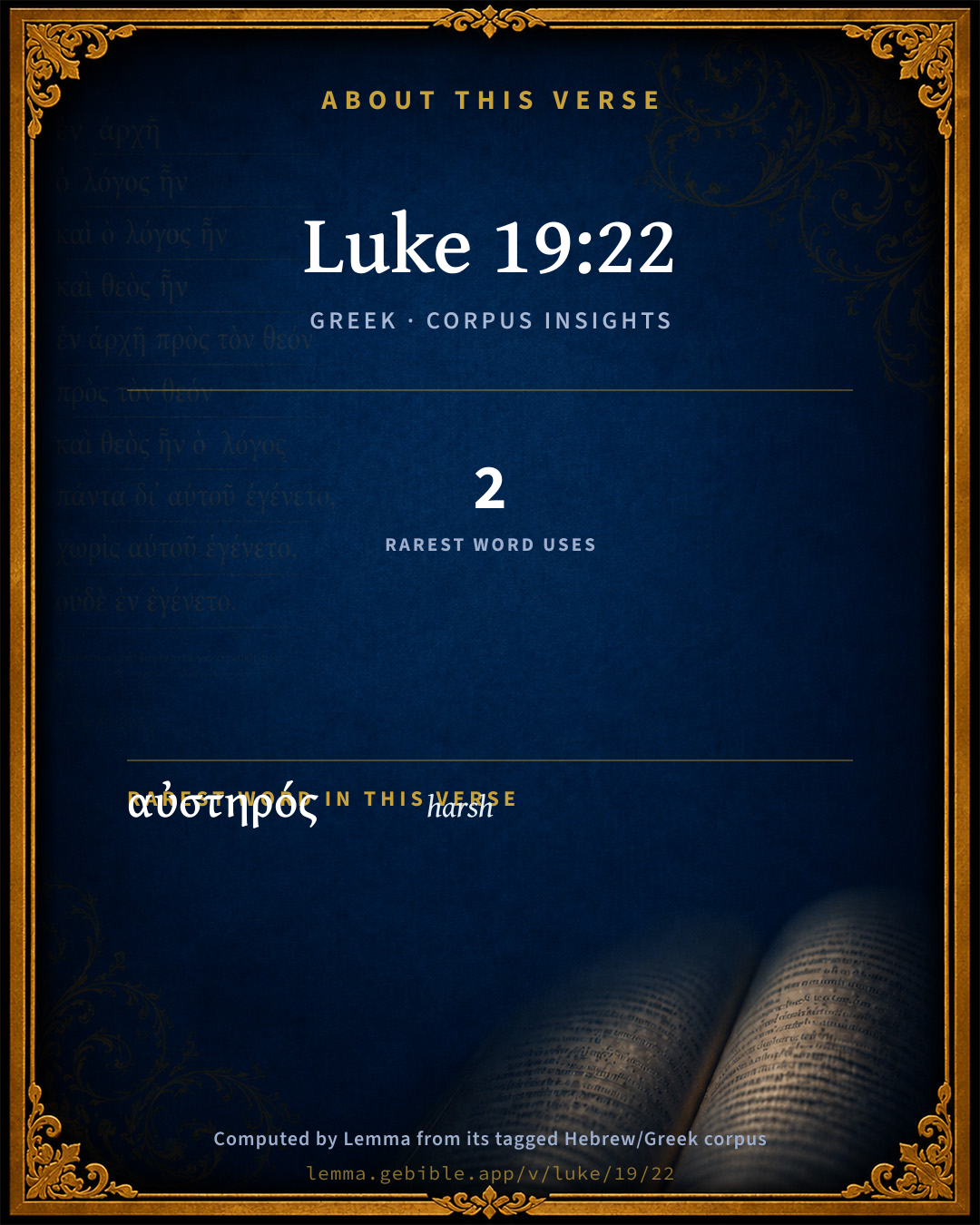
- Appears 2× in the Greek New Testament
- First appears at Luke 19:21
- Part of Speech
- Adjective
- Case
- Nominative
- Number
- Singular
- Gender
- Masculine
Full Thayer's Definition
- λέγει légō G3004 “to say” Verb, Present, Active, Indicative, 3rd person, Singular
- αὐτῷ autós G846 “he” Personal pronoun, Dative, Singular, Masculine
- ἐκ ek G1537 “from” Preposition
- τοῦ ho G3588 “the” Article, Genitive, Singular, Neuter
- στόματός stóma G4750 “mouth” Noun, Genitive, Singular, Neuter
- σου sý G4771 “you” Personal pronoun, 2nd person, Genitive, Singular
- κρίνω krínō G2919 “to judge” Verb, Future, Active, Indicative, 1st person, Singular
- σε sý G4771 “you” Personal pronoun, 2nd person, Accusative, Singular
- πονηρὲ ponērós G4190 “evil” Adjective, Vocative, Singular, Masculine
- δοῦλε doûlos G1401 “slave” Noun, Vocative, Singular, Masculine
- ᾔδεις eídō G1492 “to see” Verb, Pluperfect, Active, Indicative, 2nd person, Singular
- ὅτι hóti G3754 “that” Conjunction
- ἐγὼ egṓ G1473 “I” Personal pronoun, 1st person, Nominative, Singular
- ἄνθρωπος ánthrōpos G444 “human being” Noun, Nominative, Singular, Masculine
- αὐστηρός austērós G840 “harsh” Adjective, Nominative, Singular, Masculine
- εἰμι eimí G1510 “to be” Verb, Present, Active, Indicative, 1st person, Singular
- αἴρων aírō G142 “to raise up” Verb, Present, Active, Participle, Nominative, Singular, Masculine
- ὃ hós G3739 “who” Relative pronoun, Accusative, Singular, Neuter
- οὐκ ou G3756 “not” Particle, Negative
- ἔθηκα títhēmi G5087 “to place” Verb, Aorist, Active, Indicative, 1st person, Singular
- καὶ kaí G2532 “and” Conjunction
- θερίζων therízō G2325 “to reap” Verb, Present, Active, Participle, Nominative, Singular, Masculine
- ὃ hós G3739 “who” Relative pronoun, Accusative, Singular, Neuter
- οὐκ ou G3756 “not” Particle, Negative
- ἔσπειρα speírō G4687 “to sow” Verb, Aorist, Active, Indicative, 1st person, Singular
About this verse
These counts appear in no published source. They are computed here, from the morphology-tagged text and Lemma’s own curated glosses. What Lemma adds →
- 25
- words
- 22
- distinct lemmas
- Gospels
- section
Cross-references
6Topical passages linked to Luke 19:22 in the Treasury of Scripture Knowledge — connected by theme and wording, ordered by reader-vote popularity; previews shown in the World English Bible.
- 2 Samuel 1:16 David said to him, Your blood be on your head; for your mouth has testified against you, saying, I have slain Yahweh's anointed.
- Job 15:5–6 For your iniquity teaches your mouth, And you choose the language of the crafty.
- Matthew 12:37 For by your words you will be justified, and by your words you will be condemned."
- Matthew 22:12 and he said to him, 'Friend, how did you come in here not wearing wedding clothing?' He was speechless.
- Matthew 25:26–27 "But his lord answered him, 'You wicked and slothful servant. You knew that I reap where I didn't sow, and gather where I didn't scatter.
- Romans 3:19 Now we know that whatever things the law says, it speaks to those who are under the law, that every mouth may be closed, and all the world may be brought under the judgment of God.
Cross-references courtesy of OpenBible.info (CC BY 4.0).
Lesson kit
Teaching starters — assembled from the data on this page, not authored interpretation. Every prompt links to the verse data it draws on. Edit before teaching.
Luke, in the Gospels, opens this verse with 25 words (22 distinct Greek lemmas). Its most distinctive word is austērós (“harsh”). A historical commentator’s framing appears above. Read the whole chapter for the surrounding context.
Discussion questions
- How does “harsh” (austērós) shape what this verse is saying?
- How does Luke 19:21, which shares the word «harsh», read alongside this verse?
- What does the repetition of “you” (2× in this one verse) do in this verse?
- These translations render this verse differently. What is at stake in choosing one wording over another?
- Compare how Joseph Benson's Commentary and Bengel's Gnomon read this verse. Where do they agree or differ?
Things to notice
- These translations choose different wording for 19 words in this verse.
- “you” occurs 2× in this single verse.
- 22 distinct Greek lemmas span 25 words in this verse.
Commentary
Notes on Luke 19:22 from classic Christian and Jewish commentators (each source and its license shown beneath its notes). The classic Christian expositions comment on the surrounding passage and are grouped to its opening verse, so a note may address several verses; the Jewish commentaries on the Tanakh (Rashi and others) are per-verse, so they appear only where the commentator wrote on this verse.
Lemma curates 59 commentaries, every one of them public domain or Creative Commons licensed, each selected and text-cleaned for this edition rather than reprinted as found. About our sources →
Joseph Benson's Commentary
Joseph Benson's Commentary on the Old and New Testaments (1811–1818) — public domain. Text from a community e-Sword module.
Bengel's Gnomon
Johann Albrecht Bengel
Bengel's Gnomon of the New Testament — English translation (T&T Clark, Edinburgh, 1860) — public domain. Text from a community e-Sword module.
Ellicott's Commentary for English Readers
A Bible Commentary for English Readers, edited by Charles John Ellicott (1878–1897) — public domain. Text from a community e-Sword module.
The Cambridge Bible for Schools and Colleges
gen. ed. J. J. S. Perowne
The Cambridge Bible for Schools and Colleges (gen. ed. J. J. S. Perowne; Cambridge University Press, 1878–1918) — public domain. Text from a community e-Sword module.
John Gill's Exposition
John Gill's Exposition of the Whole Bible (1746–1763) — public domain (CC PDM 1.0). Text via the HelloAO Bible API.
Trapp's Complete Commentary
John Trapp
John Trapp, A Commentary or Exposition upon All the Books of the Old and New Testament (1647–1656) — public domain. Text from a community e-Sword module.
Albert Barnes' Notes on the Bible
Albert Barnes' Notes on the Bible (1834–1885) — public domain. Text from a community e-Sword/MySword module.
Kretzmann's Popular Commentary
Paul E. Kretzmann
Paul E. Kretzmann, Popular Commentary of the Bible (1921–1924) — public domain. Text from a community e-Sword module.
unfoldingWord translationNotes
Door43 World Missions Community
unfoldingWord translationNotes — © Distant Shores Media and the Door43 World Missions Community, licensed CC BY-SA 4.0. Source: git.door43.org/Door43/en_tn.
Cambridge Greek Testament for Schools and Colleges
Cambridge Greek Testament for Schools and Colleges (Cambridge University Press, 1896; 21 vols, various authors incl. Carr, Maclear, Plummer, Farrar, Lumby, Moule, M. R. James, Simcox) — public domain. Text from a community e-Sword module.
International Critical Commentary
International Critical Commentary — older volumes (1896–1929), various authors — public domain. Text from a community e-Sword module.
Vincent's Word Studies in the New Testament
Marvin R. Vincent
Marvin R. Vincent, Word Studies in the New Testament (1887–1900) — public domain. Text from a community e-Sword/MySword module.