John 8:59

Greek (Tischendorf 8th ed.) John 8:59 appears in the Greek New Testament. The text above is from the Tischendorf 8th edition. Each word links to its Strong’s number and a concise gloss. Click any word for its full Thayer’s Greek Lexicon entry.
Download image
Cite this verse

John 8:59 (World English Bible). Public Domain. Lemma interlinear Bible study tool, https://lemma.gebible.app/v/john/8/59.

Show BibTeX & RIS
BibTeX
RIS
English Translation
Therefore they took up stones to throw at him, but Jesus was hidden, and went out of the temple, having gone through the midst of them, and so passed by.
World English Bible · Public Domain
Download a study sheet

One document with this verse’s original text, its word-by-word gloss line, the meaning frame, cross-references with their text, attributed commentary, and full source and license credits — printable, and it pastes into notes with its structure intact.

This verse Autodidact and up

Study sheet (.html) Plain text (.txt)

A passage Seminary Student

Up to 50 verses in one chapter. A passage sheet keeps up to 6 commentary sources and 12 cross-references per verse, in the order this page ranks them, and says so on the sheet whenever that leaves anything out. Ask for a single verse and you get the Autodidact verse sheet above.

Everything on this page stays free to read, with no account — the sheet is a download of what is already on screen, not access to it.

Want to remove ads? Support Godless Engineer
Compare translations 3

The same verse in 3 English versions, stacked beneath the original-language interlinear above. Click any original word for its lexicon entry.

Each is an independent rendering of the whole verse — the interlinear is not word-aligned to these translations.

Highlighted words mark where these versions differ — a whole-verse word diff, not a word-by-word alignment.

  • World English Bible Public Domain
    Therefore they took up stones to throw at him, but Jesus was hidden, and went out of the temple, having gone through the midst of them, and so passed by.
  • King James Version Public Domain
    Then took they up stones to cast at him: but Jesus hid himself, and went out of the temple, going through the midst of them, and so passed by.
  • unfoldingWord Literal Text CC BY-SA 4.0
    Therefore, they picked up stones in order to throw at him, but Jesus hid himself and went out from the temple.

unfoldingWord Literal Text — © unfoldingWord, licensed CC BY-SA 4.0. Word-aligned USFM3 via Door43 (git.door43.org/unfoldingWord/en_ult).

Versions to compare (up to 4)

3 of 4 selected

Show all 19 translations

Every available English version of this verse, each an independent rendering of the whole verse.

  • World English Bible Public Domain
    Therefore they took up stones to throw at him, but Jesus was hidden, and went out of the temple, having gone through the midst of them, and so passed by.
  • Berean Standard Bible Public Domain
    At this, they picked up stones to throw at Him. But Jesus was hidden and went out of the temple area.
  • Majority Standard Bible Public Domain
    At this, they picked up stones to throw at Him. But Jesus was hidden and went out of the temple area, going through the midst of them. And so He passed by.
  • King James Version Public Domain
    Then took they up stones to cast at him: but Jesus hid himself, and went out of the temple, going through the midst of them, and so passed by.
  • American Standard Version (1901) Public Domain
    They took up stones therefore to cast at him: but Jesus hid himself, and went out of the temple.
  • Revised Version (1885) Public Domain
    They took up stones therefore to cast at him: but Jesus hid himself, and went out of the temple.
  • Geneva Bible (1599) Public Domain
    Then tooke they vp stones, to cast at him, but Iesus hid himselfe, and went out of the Temple: And hee passed through the middes of them, and so went his way.
  • Douay-Rheims (1899) Public Domain
    They took up stones therefore to cast at him. But Jesus hid himself, and went out of the temple.
  • Young's Literal Translation Public Domain
    they took up, therefore, stones that they may cast at him, but Jesus hid himself, and went forth out of the temple, going through the midst of them, and so passed by.
  • Literal Standard Version CC BY-SA 4.0
    they took up, therefore, stones that they may cast at Him, but Jesus hid Himself, and went forth out of the temple, going through the midst of them, and so passed by.
  • Unlocked Literal Bible CC BY-SA 4.0
    Then they picked up stones to throw at him, but Jesus hid himself and went out of the temple.
  • unfoldingWord Literal Text CC BY-SA 4.0
    Therefore, they picked up stones in order to throw at him, but Jesus hid himself and went out from the temple.
  • Darby Bible Public Domain
    They took up therefore stones that they might cast [them] at him; but Jesus hid himself and went out of the temple, [going through the midst of them, and thus passed on.]
  • World Messianic Bible Public Domain
    Therefore they took up stones to throw at him, but Yeshua hid himself and went out of the temple, having gone through the middle of them, and so passed by.
  • Webster's Bible Public Domain
    Then they took up stones to cast at him: but Jesus hid himself, and went out of the temple, going through the midst of them, and so passed by.
  • Free Bible Version CC BY-SA 4.0
    At this they picked up stones to stone him, but Jesus was hidden from them and he left the Temple.
  • Bible in Basic English Public Domain
    So they took up stones to send at him: but Jesus got secretly out of their way and went out of the Temple.
  • Text-Critical English NT CC BY 4.0
    So they picked up stones to throw at him, but Jesus hid himself and went out from the temple grounds. And passing through the crowd, he walked away.
  • Tyndale New Testament (1534) Public Domain
    Then toke they vp stones to caste at him. But Iesus hid him selfe and went out of the temple.

Literal Standard Version (2020), Covenant Press — licensed CC BY-SA 4.0. Text via the HelloAO Bible API (eBible.org). Unlocked Literal Bible (unfoldingWord) — licensed CC BY-SA 4.0. Text via the HelloAO Bible API (eBible.org). unfoldingWord Literal Text — © unfoldingWord, licensed CC BY-SA 4.0. Word-aligned USFM3 via Door43 (git.door43.org/unfoldingWord/en_ult). Free Bible Version, Dr. Jonathan Gallagher — licensed CC BY-SA 4.0. Text via the HelloAO Bible API (eBible.org).

Word by word

More ways to search: Search by grammar → Find every occurrence → Compare this word →

Practice this passage: Drill this verse → Learn its vocabulary →

ἐκρύβη
krýptō
G2928
“to hide”
Verb, Aorist, Passive, Indicative, 3rd person, Singular
Part of Speech
Verb
Tense
Aorist
Voice
Passive
Mood
Indicative
Person
3rd person
Number
Singular
Full Thayer's Definition

Origin: a primary verb

TDNT: 18:57,5

1. to hide, conceal, to be hid 2. escape notice 3. metaph. to conceal (that it may not become known)
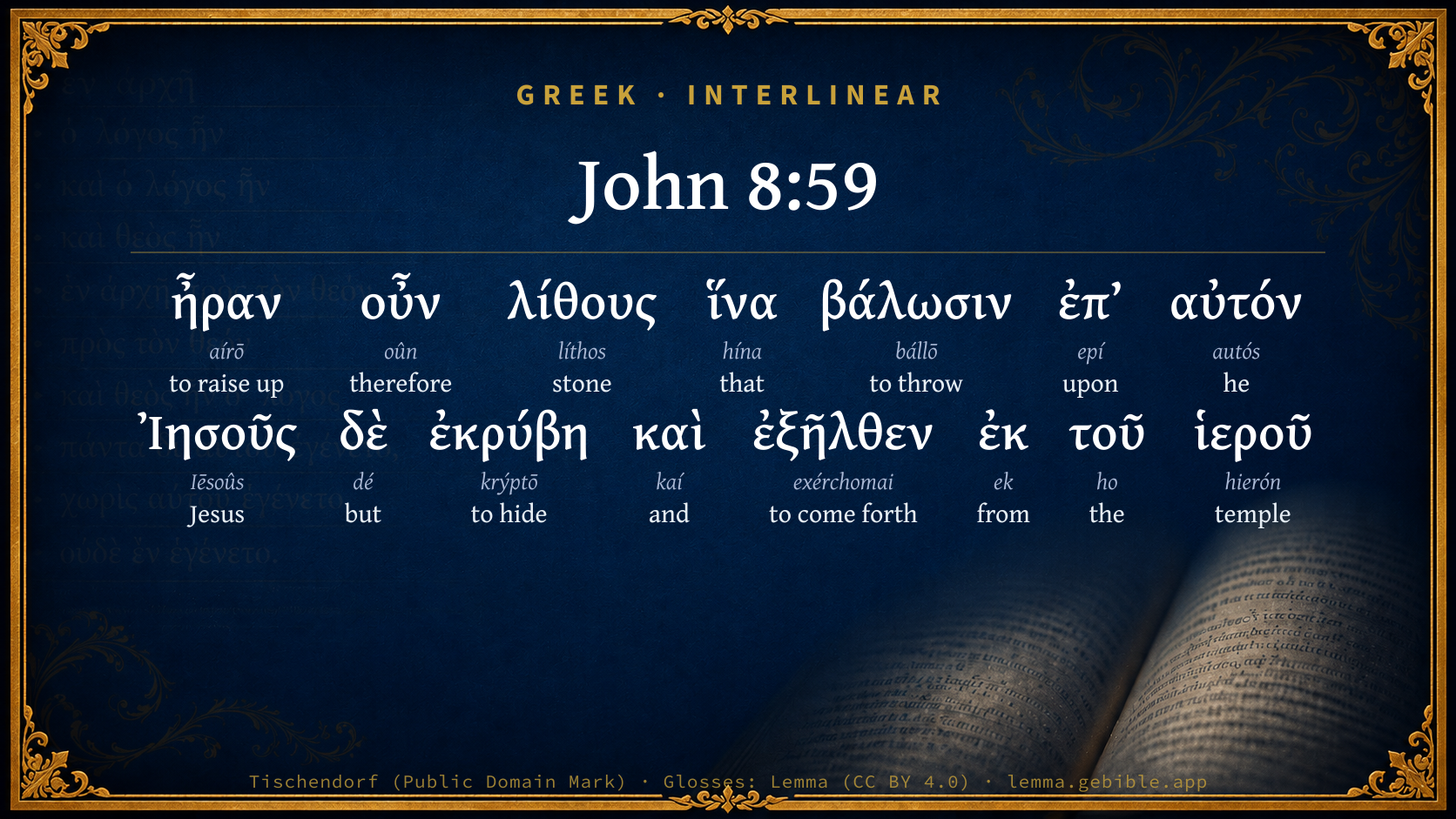
  1. ἦραν aírō G142 “to raise up” Verb, Aorist, Active, Indicative, 3rd person, Plural
  2. οὖν oûn G3767 “therefore” Conjunction
  3. λίθους líthos G3037 “stone” Noun, Accusative, Plural, Masculine
  4. ἵνα hína G2443 “that” Conjunction
  5. βάλωσιν bállō G906 “to throw” Verb, Aorist, Active, Subjunctive, 3rd person, Plural
  6. ἐπ’ epí G1909 “upon” Preposition
  7. αὐτόν autós G846 “he” Personal pronoun, Accusative, Singular, Masculine
  8. Ἰησοῦς Iēsoûs G2424 “Jesus” Noun, Nominative, Singular, Masculine
  9. δὲ dé G1161 “but” Conjunction
  10. καὶ kaí G2532 “and” Conjunction
  11. ἐξῆλθεν exérchomai G1831 “to come forth” Verb, Aorist, Active, Indicative, 3rd person, Singular
  12. ἐκ ek G1537 “from” Preposition
  13. τοῦ ho G3588 “the” Article, Genitive, Singular, Neuter
  14. ἱεροῦ hierón G2411 “temple” Noun, Genitive, Singular, Neuter

About this verse

These counts appear in no published source. They are computed here, from the morphology-tagged text and Lemma’s own curated glosses. What Lemma adds →

15
words
15
distinct lemmas
Gospels
section

Notable vocabulary

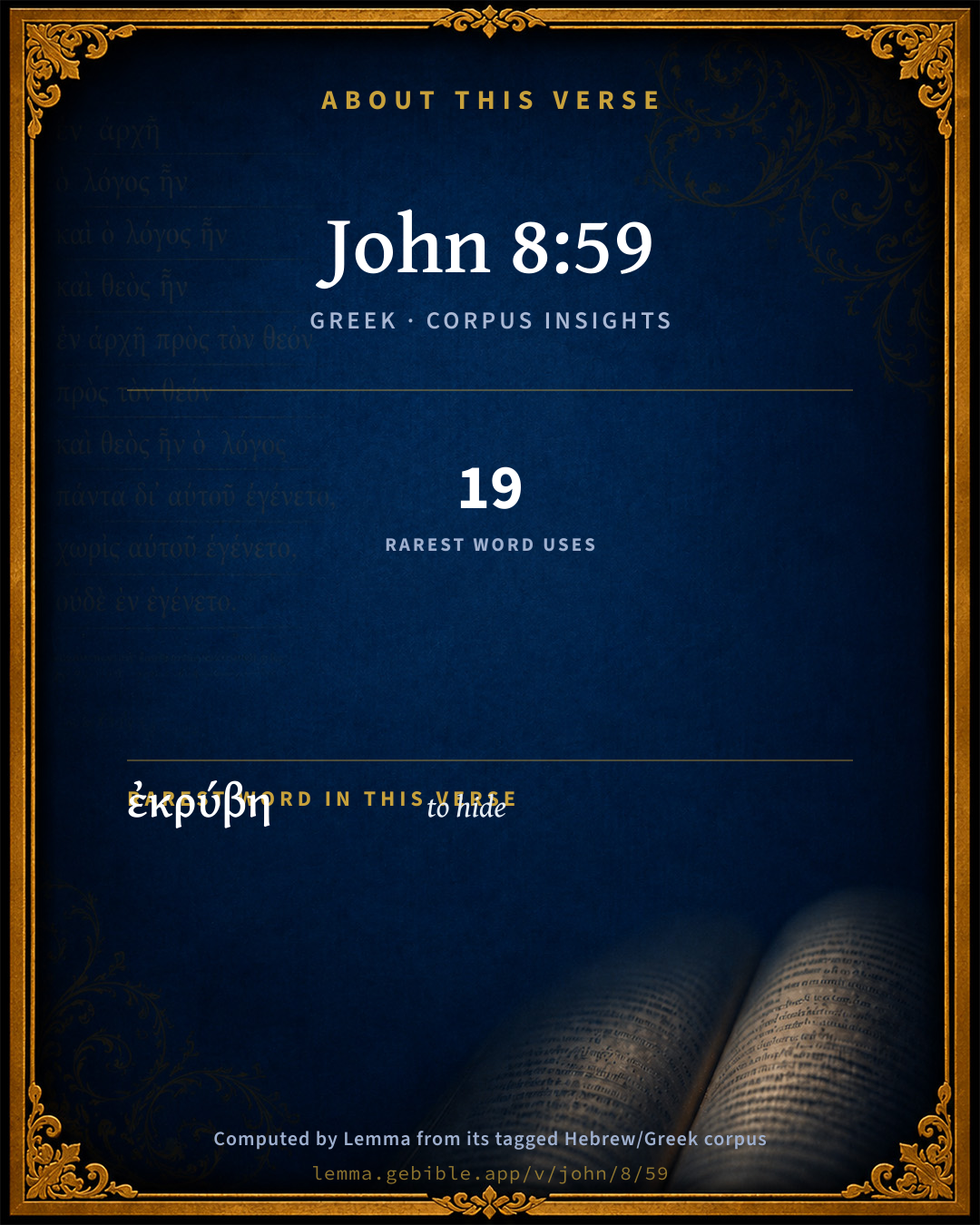
The rarest word here is ἐκρύβη to hide G2928 — appearing just 19 times in the whole Greek New Testament.

Shared distinctive vocabulary

ἐκρύβη to hide G2928 occurs in 18 verses of the Greek New Testament. Also found in:

Cross-references

15

Topical passages linked to John 8:59 in the Treasury of Scripture Knowledge — connected by theme and wording, ordered by reader-vote popularity; previews shown in the World English Bible.

  • John 11:8 The disciples told him, "Rabbi, the Jews were just trying to stone you, and are you going there again?"
  • John 10:30–33 I and the Father are one."
  • John 10:39–40 They sought again to seize him, and he went out of their hand.
  • Leviticus 24:16 He who blasphemes the name of Yahweh, he shall surely be put to death; all the congregation shall certainly stone him: the foreigner as well as the native-born, when he blasphemes the Name, shall be put to death.
  • Luke 4:29–30 They rose up, threw him out of the city, and led him to the brow of the hill that their city was built on, that they might throw him off the cliff.
  • Genesis 19:11 They struck the men who were at the door of the house with blindness, both small and great, so that they wearied themselves to find the door.
  • 2 Kings 6:18–20 When they came down to him, Elisha prayed to Yahweh, and said, Please smite this people with blindness. He struck them with blindness according to the word of Elisha.
  • Luke 24:31 Their eyes were opened, and they recognized him, and he vanished out of their sight.
  • John 5:13 But he who was healed didn't know who it was, for Jesus had withdrawn, a crowd being in the place.
  • John 8:5–6 Now in our law, Moses commanded us to stone such. What then do you say about her?"
  • John 11:54 Jesus therefore walked no more openly among the Jews, but departed from there into the country near the wilderness, to a city called Ephraim. He stayed there with his disciples.
  • John 12:36 While you have the light, believe in the light, that you may become children of light." Jesus said these things, and he departed and hid himself from them.
  • John 18:31 Pilate therefore said to them, "Take him yourselves, and judge him according to your law." Therefore the Jews said to him, "It is not lawful for us to put anyone to death,"
  • Acts 7:57 But they cried out with a loud voice, and stopped their ears, and rushed at him with one accord.
  • Acts 8:39–40 When they came up out of the water, the Spirit of the Lord caught Philip away, and the eunuch didn't see him any more, for he went on his way rejoicing.

Cross-references courtesy of OpenBible.info (CC BY 4.0).

Where the printed editions differ

1 variant

Places in this verse where the major printed Greek editions disagree on the wording in a way that affects the translation — a comparison of editions, not a manuscript-by-manuscript collation. The editions are the modern critical texts (Nestlé-Aland 28/27, SBL, Westcott-Hort, Tregelles, Tyndale House) and the traditional texts behind the KJV (the Textus Receptus and the Byzantine/Majority text). It is not a claim about which reading is original.

  1. Extra text
    διελθὼν διὰ μέσου αὐτῶν καὶ παρῆγεν οὕτως.¶

    “having passed through through midst of them and He was passing by thus.”

    In TRByz Not in NA28NA27TynSBLWHTreg

    διελθὼν διὰ μέσου αὐτῶν καὶ παρῆγεν οὕτως.¶ (dielthōn dia mesou autōn kai parēgen houtōs) 'having passed through through midst of them and He was passing by thus.' is only in traditional manuscripts (TR+Byz)

Textual data: Translators Amalgamated Greek New Testament (STEPBible TAGNT) · CC BY 4.0.

Commentary

Notes on John 8:59 from classic Christian and Jewish commentators (each source and its license shown beneath its notes). The classic Christian expositions comment on the surrounding passage and are grouped to its opening verse, so a note may address several verses; the Jewish commentaries on the Tanakh (Rashi and others) are per-verse, so they appear only where the commentator wrote on this verse.

Lemma curates 59 commentaries, every one of them public domain or Creative Commons licensed, each selected and text-cleaned for this edition rather than reprinted as found. About our sources →

The Biblical Illustrator

Joseph S. Exell

Joh_8:59

Then took they up stones to cast at Him.

Stones of the visible Temple cast at the cornerstone of the Temple of God. (W. H. Van Doren, D. D.)

The Jews and Jesus

Followeth now the issue of this long dispute, and particularly of this last contest. They look upon Him as so absurd in what He had just spoken that they will reason no more, but seek to cut Him off as a blasphemer; and He takes no more pains to convince them, but delivers Himself miraculously from their fury. Whence learn

1. Malicious persecutors will not hearken to truth, though never so clearly told them; but when all arguments fail them, they will betake themselves to violence; for then they take up stones to cast at Him, wherein they were injurious, in returning Him the reward of a blasphemer, who had told them the truth, and unjust, in their tumultuous procedure, and not taking a legal way. And this is it which may be expected of all contradictors of Christs doctrine, if they get power and be not bridled.

2. It is lawful for Gods servants to withdraw from the fury of bloody persecutors, when the persecution is personal, as Christs example doth teach.

3. Our blessed Lord did condescend to sanctify all the weak means prescribed to His people in hard times, in His own person; for, He who could have destroyed them, hid Himself, and made use of fleeing, He went out, etc.

4. Christ can disappoint persecutors, and deliver His people, even in greatest extremity; for, when they have Him among their hands in the Temple, He first hid Himself, and then went out of the Temple, going through the midst of them, etc. Either he dazzled their eyes, and made Himself invisible, both when He hid Himself, and went away; or having done so for a while, while he hid Himself, He did bind up their hands that they could not touch Him when He went openly through them out of the Temple. And so He evinced His great power even in His infirmity, and so also doth He make His people prove strong while they are weak, and perfects His strength in their weakness. (G. Hutcheson.)

Hatred of the truth

Truth is hated because

I. IT SEES TOO DEEPLY.

II. SPEAKS TOO PLAINLY.

III. JUDGES TOO SEVERELY. (Schnur.)

Jesus hid Himself and went out of the Temple

Christ and His Church in a bad world

The escape of our Lord was no doubt a great miracle. As an old Divine remarks on it, Christ here hides Himself, not by shrinking behind partition walls, nor by interposing anything else between them and His own Body, but by the power of His Godhead making Himself invisible to those who sought Him. Once before, as it seems, He had wrought the same wonder, but not in the same place, nor among the same people (Luk_4:29-30). Thus, as another old writer observes, you may understand that our Lords passion was endured not of constraint, but willingly: that He was not so much taken by the Jews, as offered by Himself. For when He will, He is taken; when He will, He escapes; when He will, He is hanged on a tree; when He will, they can lay no hold on Him. St. John says, He hid Himself; St. Luke does not say so--therefore it may be, that in the one case His enemies could not see Him, any more than Balaam could the angel; in the other ease, that though they saw Him, the hand of God was on them in some remarkable way, to keep them from laying hands on Him. Another circumstance much to be observed, in our Lords manner, in both these two several miracles, is His passing immediately from His danger and the midst of His enemies, to the performance of works of mercy among worthier and more thankful people. When He became visible again, it was to heal those who had need of healing. The particular way in which at present I wish to consider this great miracle is the following: How it throws light on the true condition of Christ and His servants here in this evil world. It shows us what the true Church of Christ and what true Christians must expect; and it shows us also how they may behave themselves, in such trials, worthy of Him whom they serve. The plain doctrine of Scripture is, that as affliction is the lot of all men--for man is born to trouble as surely as the sparks fly upward--so persecution is the lot of Christians. They declare themselves in baptism bound to be always at war with the world and the devil; and the world and the devil for their part will never leave them alone. But further: the attack on our Lord on this occasion seems to show what way of thinking it is, and what particular part of the Churchs doctrine, which is most apt to draw on itself the censure and enmity of the world. Why did the Jews try to stone our Lord? because He represented Himself as having been before Abraham. So a while after, when He plainly said to them, I and My Father are one, they presently took up stones to stone Him. And His final condemnation to death by the High Priest went on no other ground. Thus it has ever been between Christ and the wicked world. They would hear him teach many things--speak in praise of love and charity, or utter His great unspeakable promises. But when it comes to this, You are members of Christ, walk worthy, then, of the vocation wherewith ye are called; Christ, who accounts you part of Himself, is the Most High God; you, as united to Him, are partakers of the Divine Nature; therefore you must really keep the commandments, you must be inwardly and really holy as He is holy: when this kind of doctrine is put forth, and urged home to the hearts of men, they grow uneasy, and start objections, and make difficulties, and say it is requiring too much; they never can come up to so high a standard, and they take people to have become their enemies, who talk to them in such a tone. This of course makes our duty, in respect of Gods Truth and worship, harder to perform; but it does not in the least make it obscure or doubtful. We must not neglect, or forget, high and mysterious doctrines, or severe rules, because those with whom we are concerned are impatient of being put in mind of them; yet again, we must so teach them as they may be able to bear--tempting them as little as possible to irreverent hearing and careless forgetting. Jesus Christ, His hour being not yet come, retired out of the way of His enemies, and gave them time to consider and repent. So it becomes us, when we bear witness to the truth, to be full of that great charity, which will make us put ourselves in the gainsayers place, and always consider what is most likely to do them good, and bring them to a better mind. As for example: if a bad or profane word is spoken in our hearing, it can never of course be right to seem amused at it, or in any way to become partaker of the sin; but it may often be best not openly to rebuke it at the time, but rather to turn the discourse for the present, and await some opportunity, when we can speak with the offender alone, and he is otherwise more disposed to listen to us. This is withdrawing the name of our Lord out of the way of reproach, as He did His Person from the stones that were cast at Him. Only we must be very careful, that we do not so retire through cowardice or sloth, or out of care what men may say of us: and the proof of this will be, if we seek anxiously afterwards for opportunities of doing the good, which we thought we could not do at that time; and if we deny ourselves something for the sake of doing it. (Plain Sermons by Contributors to Tracts for the Times. )

.

The Biblical Illustrator, edited by Joseph S. Exell (c. 1880s–1900s) — public domain. Text from a community e-Sword module.

Tyndale Open Study Notes

Tyndale Open Resources

8:59 Jesus’ audience finally understood his claim to divinity (8:58), and they were furious. They believed they had heard blasphemy and picked up stones to throw at him, which was the proper legal response (Lev 24:16). • Jesus was hidden from them because God had appointed a different time for his death (see study note on John 12:23; see also 7:30, 44; Luke 4:29-30).

Tyndale Open Study Notes — © Tyndale Open Resources, licensed CC BY-SA 4.0. Text via the HelloAO Bible API.

Bengel's Gnomon

Johann Albrecht Bengel

Joh 8:59. Ἦραν, took up) They were accounting Him as a blasphemer.—λίθους, stones) The weapons of the multitude.—ἐκρύβη, He hid Himself) Not by betaking Himself to a hiding-place, but that He ceased to be visible to their eyes, in a miraculous manner; (comp. Jer 36:26, “The king commanded—to take Baruch and Jeremiah; but the Lord hid them”) whilst He went out from the temple.

Joh 8:59 and Joh 9:1. Καὶ ἐξῆλθεν ἐκ τοῦ ἱεροῦ, καὶ παρῆγεν οὕτως· καὶ παράγων εἶδεν, κ.τ.λ.) This appears to be the mediate[240] and genuine reading [see App. Crit., Ed. ii. on this passage]: for ΠΑΡΆΓΩΝ manifestly has reference to ΠΑΡῆΓΕΝ, and ΟὝΤΩς denotes the miraculous ease of His departure.—ΠΑΡῆΓΕΝ—ΚΑῚ ΠΑΡΆΓΩΝ, He passed by—and passing by) A similar connection [of participle and verb] occurs, Acts 27 at the close, and 28 at the beginning [διασωθῆναι—διασωθέντες].—ΟὝΤΩς, so) As if no one were seeking Him. [241], and ace. to Lachm. [242], read ΔΙΕΛΘῺΝ ΔΙᾺ ΜΈΣΟΥ ΑὐΤῶΝ ([243] adding probably, from Luk 4:36, through the Harmonies, ἘΠΟΡΕΎΕΤΟ) ΚΑῚ ΠΑΡῆΓΕΝ ΟὝΤΩς. [244], and acc. to Tischendorf, [245], omit these words: so also [246][247][248], Orige[249] 4, 292, [250], Theb[251] and Vulg. versions.]

[240] From which the other readings diverged, as from a common starting point.

[241] the Alexandrine MS.: in Brit. Museum: fifth century: publ. by Woide, 1786–1819: O. and N. Test. defective.

[242] the Vatican MS., 1209: in Vat. Iibr., Rome: fourth cent.: O. and N. Test. def.

[243] the Alexandrine MS.: in Brit. Museum: fifth century: publ. by Woide, 1786–1819: O. and N. Test. defective.

[244] Bezæ, or Cantabrig.: Univ. libr., Cambridge: fifth cent.: publ. by Kipling, 1793: Gospels, Acts, and some Epp. def.

[245] the Vatican MS., 1209: in Vat. Iibr., Rome: fourth cent.: O. and N. Test. def.

[246] Vercellensis of the old ‘Itala,’ or Latin Version before Jerome’s, probably made in Africa, in the second century: the Gospels.

[247] Veronensis, do.

[248] Colbertinus, do.

[249] rigen (born about 186 A.D., died 253 A.D., a Greek father: two-thirds of the N. Test. are quoted in his writings). Ed. Vinc. Delarue, Paris. 1733, 1740, 1759.

[250] Laudianus, do.: Acts.

[251] heb. the Thebaic, or Sahidic do.: publ. by Woide and Ford, from MS. Alex, at Oxford, 1799.

Bengel's Gnomon of the New Testament — English translation (T&T Clark, Edinburgh, 1860) — public domain. Text from a community e-Sword module.

Meyer's Critical & Exegetical Commentary

Heinrich August Wilhelm Meyer

Joh_8:59. The last assertion of Jesus strikes the Jews as blasphemous; they therefore set themselves, in the spirit of zealotry, to inflict punishment (comp. Joh_10:31). A stoning in the temple is mentioned also by Joseph. Antt. xvii. 9. 3. The stones were probably building stones lying in the fore-court. See Lightfoot, p. 1048.

ἐκρύβη κ. ἐξῆλθεν] He hid Himself (probably in the crowd), and went out (whilst thus hidden).[43] The word ἐκρύβη explains how He was able to go out, and therefore (how very different from this is Luk_4:30!) precludes the notion of anything miraculous (ἀόρατος αὐτοῖς κατέστη τῇ ἐξουσίᾳ τῆς θεότητος, Euth. Zigabenus; comp. Grotius, Wolf, Bengel, Luthardt, Hilgenfeld, and even Augustine),a notion which gave rise to the addition in the Text. Rec. (see the critical observations), which Ewald defends. Baur, who likewise defends the Text. Rec. (p. 384 ff.), finds here also a docetic disappearance (comp. on Joh_7:10 f.); if, however, such was Johns meaning, he selected the most unsuitable possible terms to express it in writing ἐκρύβη (comp. on the contrary, Luk_24:31 : ἄφαντος ἐγένετο ἀπʼ αὐτῶν) and ἐξῆλθεν ἐκ τοῦ ἱεροῦ. The providential protection of God (Tholuck) is a matter of course, but is not expressed.

There is no exegetical ground for supposing that the simple close of the narrative is designed to prefigure the death of Christ, which, being accomplished under the appearance of legality, released the Lord from the judgment of Israel, so that He left the old Israel as the school of Satan, and, on the other hand, gathered around Him the true Israel (Luthardt). Note how the breach between Jesus and the Jews gradually approached the extremity, and how admirable, even in the details, is the delineation of the ever-increasing intensification of the crisis (Ewald, Gesch. Chr. p. 477, ed. 3).

[43] Hengstenberg reverses the logical relation: καὶ ἐξῆλθε stands, he says, for ἐξελθών, and describes the manner in which He hid Himself,a purely arbitrary statement. Even if ἐξελθών had been used, it would be that which preceded the ἐκρύβη (egressus), as in the case of ἀπελθών, Joh_12:36.

Meyer — Critical and Exegetical Commentary on the New Testament — English translation by Peter Christie, edited by Frederick Crombie (T&T Clark, 1880) — public domain. Text from a community e-Sword module.

Expositor's Greek Testament

ed. W. Robertson Nicoll

Joh 8:59 . What the Jews thought of the assertion appeared in their action: ἦραν … αὐτόν . Believing that He was speaking sheer blasphemy and claiming equality with the great “I Am,” they sought to stone Him. For this purpose there was material ready to hand even in the Temple court, for, as Lightfoot reminds us, the building was still going on. “A stoning in the temple is mentioned by Josephus, Ant. , xvii. 9, 3,” Meyer. Ἰησοῦς δὲ ἐκρύβη καὶ ἐξῆλθεν . “But Jesus went out unperceived”; on this usage vide Winer, and cf. Thayer. Why it should be supposed that there is anything miraculous or doketic in this (Holtzmann and others) does not appear. Many in the crowd would favour the escape of Jesus. The remaining words of the chapter are omitted by recent editors.

The Expositor's Greek Testament, edited by W. Robertson Nicoll (1897–1910) — public domain. Text from a community e-Sword module.

Geneva Bible (1599)

Geneva Bible translators

Zeal without knowledge, breaketh out at length into a most open madness: and yet the wicked cannot do what they list.

Geneva Bible (1599) marginal notes — public domain. Text via Bolls.life.

Adam Clarke's Commentary

Verse 59. Then took they up stones, c.] It appears that the Jews understood him as asserting his Godhead and, supposing him to be a blasphemer, they proceeded to stone him, according to the law. Le 24:16.

But Jesus hid himself] In all probability he rendered himself invisible-though some will have it that he conveyed himself away from those Jews who were his enemies, by mixing himself with the many who believed on him, (Joh 8:30-31), and who, we may suppose, favoured his escape. Pearce.

But where did they find the stones, Christ and they being in the temple? It is answered:

1st. It is probable, as the buildings of the temple had not been yet completed, there might have been many stones near the place; or,

2dly. They might have gone out so the outer courts for them; and, before their return, our Lord had escaped. See Lightfoot and Calmet.

Going through the midst of them, and so passed by.] These words are wanting in the Codex Bezae, and in several editions and versions. Erasmus, Grotius, Beza, Pearce, and Griesbach, think them not genuine. The latter has left them out of the test. But, notwithstanding what these critics have said, the words seem necessary to explain the manner of our Lord's escape.

1st. He hid himself, by becoming invisible; and then,

2dly. He passed through the midst of them, and thus got clear away from the place.

See a similar escape mentioned, Lu 4:30, and the note there.

THE subjects of this chapter are both uncommon and of vast importance.

1. The case of the woman taken in adultery, when properly and candidly considered, is both intelligible and edifying. It is likely that the accusation was well founded; and that the scribes and Pharisees endeavoured maliciously to serve themselves of the fact, to embroil our Lord with the civil power, or ruin his moral reputation. Our Lord was no magistrate, and therefore could not, with any propriety, give judgment in the case; had he done it, it must have been considered an invasion of the rights and office of the civil magistrate, and would have afforded them ground for a process against him. On the other hand, had he acquitted the woman, he might have been considered, not only as setting aside the law of Moses, but as being indulgent to a crime of great moral turpitude, and the report of this must have ruined his moral character. He disappointed this malice by refusing to enter into the case; and overwhelmed his adversaries with confusion, by unmasking their hearts, and pointing out their private abominations. It is generally supposed that our Lord acquitted the woman: this is incorrect; he neither acquitted nor condemned her: he did not enter at all juridically into the business. His saying, Neither do I condemn thee, was no more than a simple declaration that he would not concern himself with the matter-that being the office of the chief magistrate; but, as a preacher of righteousness, he exhorted her to abandon her evil practices, lest the punishment, which she was now likely to escape, should be inflicted on her for a repetition of her transgression.

2. In several places in this chapter, our Lord shows his intimate union with the Father, both in will, doctrine, and deed; and though he never speaks so as to confound the persons, yet he evidently shows that such was the indivisible unity, subsisting between the Father and the Son, that what the one witnessed, the other witnessed; what the one did, the other did; and that he who saw the one necessarily saw the other.

3. The original state of Satan is here pointed out-he abode not in the truth, Joh 8:44. Therefore he was once in the truth, in righteousness and true holiness-and he fell from that truth into sin and falsehood, so that he became the father of lies and the first murderer. Our Lord confirms here the Mosaic account of the fall of man, and shows that this fall was brought about by his lies, and that these lies issued in the murder or destruction both of the body and soul of man.

4. The patience and meekness exercised by our Lord, towards his most fell and unrelenting enemies, are worthy the especial regard of all those who are persecuted for righteousness.-When he was reviled, he reviled not again. As the searcher of hearts, he simply declared their state, Joh 8:44, in order to their conviction and conversion: not to have done so, would have been to betray their souls. In this part of his conduct we find two grand virtues united, which are rarely associated in man, MEEKNESS and FIDELITY-patience to bear all insults and personal injuries; and boldness, is the face of persecution and death, to declare the truth. The meek man generally leaves the sinner unreproved: the bold and zealous man often betrays a want of due self-management, and reproves sin in a spirit which prevents the reproof from reaching the heart. In this respect also, our blessed Lord has left us an example, that we should follow his steps. Let him that readeth understand.

Adam Clarke's Commentary on the Bible (1810–1826) — public domain. Text from a community e-Sword/MySword module.

John Calvin's Commentaries

59. Then they took up stones. There is reason to believe that they did this, as if Christ ought to be stoned according to the injunction of the Law, (Leviticus 24:16.) Hence we infer how great is the madness of inconsiderate zeal; for they have no ears to know the cause, but they have hands ready to commit murder. I have no doubt that Christ rescued himself by his secret power, but yet under the appearance of a low condition; for he did not intend to make a clear display of his Divinity without leaving something for human infirmity. Some copies have the words, And so Jesus passed through the midst of them; which Erasmus justly considers to have been borrowed from the Gospel by Luke 4:30. It deserves notice also, that the wicked priests and scribes, after having banished Christ,

in whom dwelleth all the fullness of the Godhead, |(Colossians 2:9,)

retain possession of the outward temple; but they are greatly deceived, when they think that they have a temple in which God does not dwell. Such is the course now pursued by the Pope and his followers. After having banished Christ, and in this manner profaned the Church, they foolishly glory in the false disguise of a Church.

John Calvin's Commentaries (1540-1563) — public domain. Text from the Calvin Translation Society English edition (1840s-50s) via the Christian Classics Ethereal Library (ccel.org). Calvin's coverage is partial (roughly two-thirds of the Bible); uncommented books and verses are honest gaps, never fabricated. The 19th-century editor's footnotes and remarks are omitted so the notes are faithfully Calvin's own voice.

Ellicott's Commentary for English Readers

(59) Then took they up stones to cast at him.—At last the meaning of His words flashes upon them. They had heard this I AM before (Joh_8:24) without perceiving that in it He applied to Himself the name Jehovah. Now there is no room for doubt. His own Divinity is the only explanation of what He has said; and it is in these words so plainly asserted, that those who had constantly misunderstood can misunderstand no more. The subtleties of later days, by which men have tried to show that there is no claim to Divinity here, was not suggested to their minds. They will not acknowledge the claim, but they feel that He has made it. They have heard the fearful words which seemed to them as blasphemy, and they take up the stones which are at hand for the rebuilding of the Temple, in which they are, to cast at the Lord of the Temple. (Comp. Joh_10:33.)

Going through the midst of them, and so passed by.—These words are omitted in a majority of the better MSS. They were probably inserted in others to explain what was taken to be the miraculous disappearance. (Comp. Luk_4:30.) Here we are simply told that He “hid Himself and went out of the Temple, and this does not imply more than that He passed among the crowd which was around Him, out of the Temple, and thus avoided the stones which they had taken up to cast at Him.

A Bible Commentary for English Readers, edited by Charles John Ellicott (1878–1897) — public domain. Text from a community e-Sword module.

The Cambridge Bible for Schools and Colleges

gen. ed. J. J. S. Perowne

59. Then took they up stones] Or, Therefore took they up stones, i.e. in consequence of His last words. They see clearly what He means. He has taken to Himself the Divine Name and they prepare to stone Him for blasphemy. Material lying there for completing and repairing the Temple would supply them with missiles. Comp. Joh_10:31; Joh_10:33.

but Jesus hid himself] Probably we are not to understand a miraculous withdrawal as in Luk_4:30, where the ‘passing through the midst of them’ seems to be miraculous. Here we need not suppose more than that He drew back into the crowd away from those who had taken up stones. The Providence which ordered that as yet the fears of the hierarchy should prevail over their hostility (Joh_7:30, Joh_8:20), ruled that the less hostile in this multitude should screen Him from the fury of the more fanatical. It is quite arbitrary to invert the clauses and render, ‘Jesus went out of the Temple and hid Himself.’

going through the midst of them, and so passed by] These words are apparently an insertion, and probably an adaptation of Luk_4:30. No English Version previous to the one of 1611 contains the passage.

As a comment on the whole discourse see 1Pe_2:22-23, remembering that S. Peter was very possibly present on the occasion.

“The whole of the Jews’ reasoning is strictly what we should expect from them. These constant appeals to their descent from Abraham, these repeated imputations of diabolic possession, this narrow intelligence bounded by the letter, this jealousy of anything that seemed in the slightest degree to trench on their own rigid monotheism—all these, down to the touch in Joh_8:57, in which the age they fix upon in round numbers is that assigned to completed manhood, give local truth and accuracy to the picture; which in any case, we may say confidently, must have been drawn by a Palestinian Jew, and was in all probability drawn by a Jew who had been himself an early disciple of Christ.” S. p. 160.

The Cambridge Bible for Schools and Colleges (gen. ed. J. J. S. Perowne; Cambridge University Press, 1878–1918) — public domain. Text from a community e-Sword module.

Trapp's Complete Commentary

John Trapp

59 Then took they up stones to cast at him: but Jesus hid himself, and went out of the temple, going through the midst of them, and so passed by.

Ver. 59. Then took they up stones] This is merces mundi, the world’s wages. Let us look up with Stephen, and see heaven, as he did, through a shower of stones.

John Trapp, A Commentary or Exposition upon All the Books of the Old and New Testament (1647–1656) — public domain. Text from a community e-Sword module.

Albert Barnes' Notes on the Bible

Then took they up stones - It seems they understood him as blaspheming, and proceeded, even without a form of trial, to stone him as such, because this was the punishment prescribed in the law for blasphemy, Lev 24:16. See Joh 10:31. The fact that the Jews understood him in this sense is strong proof that his words naturally conveyed the idea that he was divine. This was in the temple. Herod the Great had not yet completed its repairs, and Dr. Lightfoot has remarked that stones would be lying around the temple in repairing it, which the people could easily use in their indignation.

Jesus hid himself - See Luk 4:30. That is, he either by a miracle rendered himself invisible, or he so mixed with the multitude that he was concealed from them and escaped. Which is the meaning cannot be determined.

Albert Barnes' Notes on the Bible (1834–1885) — public domain. Text from a community e-Sword/MySword module.

Matthew Poole's English Annotations

Then took they up stones to cast at him; as they also did, Joh 5:31. It is vain to inquire where they had stones in the temple; they might be repairing some part of it, or some parts of it paved with stones might be loose, &c.; it is enough that we are assured that some they found. He did not go

through the midst of them that were in this uproar, but first thrust himself into the more innocent crowd, then passed through the midst of them. Some make a question here, how he could pass through the midst of them? Whether he made his body invisible? (so the Lutherans think); or whether he struck his enemies with blindness, or thickened the air before their eyes? But what needs that dispute? Admit some few of the rabble to be in a rage, the greatest part innocent, it is no hard thing for us to conceive how a person, discerning the disorder, may thrust himself into the more innocent crowd, and pass by, escaping the rage of his enemies.

Matthew Poole's English Annotations on the Holy Bible (1683–1685) — public domain. Text from a community e-Sword/MySword module.

Whedon's Commentary on the Bible

Daniel D. Whedon

59. Took they up stones—Upon the climax follows an explosion. For the honour of Abraham and all the prophets, this professed giver of life shall die. This claimant to an eternity of existence shall come to a speedy end. However Socinian in their sentiments these angry Jews may themselves have been, they put no Socinian interpretation on Jesus’s words.

Stones to cast—To the query how should stones be lying in the temple court, the plausible reply is, they may have been there for temple repairs.

Hid himself—There is no indication that his disciples, as some think, formed a covert to defend his person. Such a movement on their part could hardly be unmentioned. While the Jews were in the act of selecting the fatal stones, Jesus probably moved away by a route which interposed protecting objects between him and them, and so escaped from the temple. The closing phrases, going through the midst of them, and so passed by, are the same Greek as Luk_4:30, improperly transferred to this place.

Daniel D. Whedon (gen. ed.), Commentary on the Old and New Testaments (1874–1909) — public domain. Text from a community e-Sword module.

The Pulpit Commentary

(7) The conflict and the victory. Therefore because he said this, which if it had no basis in act was rank blasphemythey took up stones of the temple court to cast at (upon) him. "They rushed from the porch into the court of the Gentiles, to pick up stones to cast them at him; but once more "his hour had not yet come," and their fury proved impotent. Hiding himself in one of the many passages or gateways of the temple, he presently passed out" (Edersheim). But Jesus hid himself, and went forth from the temple going through the midst of them, and so passed by]. There is no need to imagine more than the exercise of his majestic energy before which daemoniacs quailed, and Pilate trembled, and the guards of the temple fell abashed. The crisis of his ministry in Jerusalem is approaching. How often would he have gathered them, and given to them eternal life, but they would not!

The Pulpit Commentary (1880–1919), ed. H.D.M. Spence-Jones & Joseph S. Exell — public domain. Text from a community e-Sword module.

John Wesley's Explanatory Notes

Then they took up stones - To stone him as a blasphemer; but Jesus concealed himself - Probably by becoming invisible; and so passed on - With the same ease as if none had been there.

John Wesley, Explanatory Notes Upon the Whole Bible (1754–1765) — public domain. Text via the GEBible commentary corpus.

The People's New Testament

B. W. Johnson

59. They took up stones to cast at him. They regarded his language blasphemy. If he had been only a man it would have been.

B. W. Johnson's The People's New Testament with Notes (1889–1891) — public domain. Electronic text from the Christian Classics Ethereal Library (CCEL) ThML edition.

Cambridge Greek Testament for Schools and Colleges

59. Omit διελθὼν διὰ μέσου αὐτῶν καὶ παρῆγεν οὔτω after ἱεροῦ (an addition from Joh 9:1 combined with Luk 4:30) with א1BD against א3A. Other MSS. have the addition in another form. No English Version earlier than 1611 recognises the addition.

59. ἦραν οὖν. They took up therefore; i.e. in consequence of His last words. They clearly understand Him to have taken to Himself the Divine Name, and they prepare to stone Him for blasphemy. Building materials for completing and repairing the Temple would supply them with missiles (comp. Joh 10:31-33): Josephus mentions a stoning in the Temple (Ant. XVII. ix. 3). They would not have stoned Him for merely claiming to be the Messiah (Joh 10:24).

ἐκρύβη κ. ἐξῆλθεν. Probably we are not to understand a miraculous withdrawal as in Luk 4:30, where the ‘passing through the midst of them’ seems to be miraculous. Comp. ἄφαντος ἐγένετο, Luk 24:31. Here we need not suppose more than that He drew back into the crowd away from those who had taken up stones. The Providence which ordered that as yet the fears of the hierarchy should prevail over their hostility (Joh 7:30, Joh 8:20), ruled that the less hostile in this multitude should screen Him from the fury of the more fanatical. It is quite arbitrary to invert the clauses and render, ‘Jesus went out of the Temple and hid Himself.’

As a comment on the whole discourse see 1Pe 2:22-23, remembering that S. Peter was very possibly present on the occasion.

“The whole of the Jews’ reasoning is strictly what we should expect from them. These constant appeals to their descent from Abraham, these repeated imputations of diabolic possession, this narrow intelligence bounded by the letter, this jealousy of anything that seemed in the slightest degree to trench on their own rigid monotheism—all these, down to the touch in Joh 8:57, in which the age they fix upon in round numbers is that assigned to completed manhood, give local truth and accuracy to the picture; which in any case, we may say confidently, must have been drawn by a Palestinian Jew, and in all probability by a Jew who had been himself an early disciple of Christ” (Sanday).

Cambridge Greek Testament for Schools and Colleges (Cambridge University Press, 1896; 21 vols, various authors incl. Carr, Maclear, Plummer, Farrar, Lumby, Moule, M. R. James, Simcox) — public domain. Text from a community e-Sword module.

Alford’s Greek Testament

Henry Alford

59.] Probably there were stones (for building) lying about in the outer court of the temple, where these words seem to have been spoken. The reason of the Jews’ doing this is given by them on a similar occasion, ch. 10:33, ὅτι σὺ ἄνθρωπος ὢν ποιεῖς σεαυτὸν θεόν.

There does not appear to be any miraculous escape intended here, although certainly the assumption of one is natural under the circumstances. Jesus was probably surrounded by His disciples, and might thus hide himself (see ch. 12:36), and go out of the temple.

Henry Alford, The Greek Testament (1849–1861) — public domain. Text from a community e-Sword module.

International Critical Commentary

59. ἦραν οὖν λίθους κτλ. So again at 10:31-33, when He said “I and the Father are One,” the Jews attempted to stone Him for blasphemy. The Temple was not finished, and stones were lying about its courts (cf. Mar 13:1); Josephus (Antt. XVII. ix. 3) gives an account of the stoning of soldiers in the Temple precincts.

Ἰησοῦς δὲ ἐκρύβη, “But He hid Himself,” as again at 12:36.

After ἱεροῦ the rec. text (so NΘcorr) adds διελθὼν διὰ μέσου αὐτῶν (from Luk 4:30) καὶ παρῆγεν οὕτως, probably suggesting that the escape of Jesus from the angry Jews was miraculous. But of this there is no trace in the true text, ending with ἱεροῦ, which is supported by אBDWΘ* latt sah arm. The words παρῆγεν οὕτω are added in the rec. text to the interpolation from Luk 4:30, in order to introduce c. 9.

See 10:39, where Jesus again escapes from the hostile Jews.

אԠSinaiticus (δ 2). Leningrad. iv.

B Vaticanus (δ 1). Rome. Cent. iv.

N Purpureus Petropolitanus (ε 19). Dispersed through the libraries of Leningrad, Patmos, Rome, Vienna, and British Museum. vi. Some pages are missing. Edited by H. S. Cronin in Cambridge Texts and Studies (1899).

T Borgianus (ε 5). Rome. v. Græco-Sahidic. Contains cc. 6:28-67 7:6-8:31.

W Freer (ε 014). Washington. iv-vi. Discovered in Egypt in 1906. The Gospels are in the order Mt., Jn., Lk., Mk. Collation in The Washington MS. of the Four Gospels, by H. A. Sanders (1912).

Θ̠Koridethi (ε 050). Tiflis. vii-ix. Discovered at Koridethi, in Russian territory, and edited by Beermann & Gregory (Leipzig, 1913). The text is akin to that of fam. 13, fam. 1, and the cursives 28, 565, 700 See Lake and Blake in Harvard Theol. Review (July 1923) and Streeter, The Four Gospels. Cf. also J.T.S. Oct. 1915, April and July 1925.

L Regius (ε 56). Paris. viii. Cc. 15:2-20 21:15-25 are missing.

Δ̠Sangallensis (ε 76). St. Gall. ix-x. Græco-Latin.

C Ephræmi (δ 3). Paris. v. Palimpsest. Contains considerable fragments of Jn.

D Bezæ (δ 5). Cambridge. v-vi. Græco-Latin. Cc. 18:14-20:13 are missing in the Greek text, and the gap has been filled by a ninth-century scribe (Dsupp).

1 See Conybeare, D.B. i. 154; and Burkitt, Two Lectures on the Gospels, p. 88.

2 Perhaps Seeley’s comment hits on the truth: “He was seized with an intolerable sense of shame. He could not meet the eye of the crowd, or of the accusers, and perhaps at that moment least of all of the woman. … In His burning embarrassment and confusion He stooped down so as to hide His face, and began writing with His fingers on the ground” (Ecce Homo, c. ix.).

1 See Gwynn. Trans. R.I. Acad. xvii. p. 292.

Bernard, J. H. (1929). A critical and exegetical commentary on the Gospel according to St. John. Paged continuously. (A. H. McNeile, Ed.) (2:715-721). New York: C. Scribner’ Sons.

1 For the section 7:53-8:11, see the notes at the end of this volume on the Pericope de Adultera.

2 Strayer (J.T.S., 1900, p. 138) argues that the imagery was suggested by the Feast of Dedication or τὰ Φῶτα (10:22), in connexion with which he puts this discourse.

1 Lightfoot, Hor. Hebr., iii. 330.

2 This majestic claim is weakened in the form in which it appears in the Acts of John (§ 95): λύχνος εἰμί σοι τῷ βλέποντί με.

3 Westcott quotes from Buxtorf a sentence from the Jerusalem Talmud (Shabb. c. 2) to the effect that “the first Adam was the light of the world”; but the parallelism seems to be only verbal. Indeed, the Hebrews had not any clear idea of the κόσμος as an ordered universe of being.

4 Abbott (Diat. 1748; cf. 435) urges that Mt.’s report must be wrong, and that what Jesus really said was, “Ye have the Light of the World.” But there is no evidence for this, nor would it suit the context, Mat 5:13-16.

אԠSinaiticus (δ 2). Leningrad. iv.

B Vaticanus (δ 1). Rome. Cent. iv.

D Bezæ (δ 5). Cambridge. v-vi. Græco-Latin. Cc. 18:14-20:13 are missing in the Greek text, and the gap has been filled by a ninth-century scribe (Dsupp).

N Purpureus Petropolitanus (ε 19). Dispersed through the libraries of Leningrad, Patmos, Rome, Vienna, and British Museum. vi. Some pages are missing. Edited by H. S. Cronin in Cambridge Texts and Studies (1899).

T Borgianus (ε 5). Rome. v. Græco-Sahidic. Contains cc. 6:28-67 7:6-8:31.

L Regius (ε 56). Paris. viii. Cc. 15:2-20 21:15-25 are missing.

W Freer (ε 014). Washington. iv-vi. Discovered in Egypt in 1906. The Gospels are in the order Mt., Jn., Lk., Mk. Collation in The Washington MS. of the Four Gospels, by H. A. Sanders (1912).

Θ̠Koridethi (ε 050). Tiflis. vii-ix. Discovered at Koridethi, in Russian territory, and edited by Beermann & Gregory (Leipzig, 1913). The text is akin to that of fam. 13, fam. 1, and the cursives 28, 565, 700 See Lake and Blake in Harvard Theol. Review (July 1923) and Streeter, The Four Gospels. Cf. also J.T.S. Oct. 1915, April and July 1925.

1 Cf. Introd., p. cx.

Γ̠(ε 70) Oxford and Leningrad. ix-x. Contains Son 1:1-13 8:3-15:24 19:6 to end.

Δ̠Sangallensis (ε 76). St. Gall. ix-x. Græco-Latin.

Diat. E. A. Abbott’s Diatessarica, including his Johannine Vocabulary and Johannine Grammar, Parts I.-X. (1900-1915).

1 See also McNeile in Cambridge Biblical Essays, p. 242.

1 Cf. Hobhouse, The Church and the World, p. 352, Note D.

1 In the passage from Alciphron (Ep. iii. 7) quoted by Field in support of this rendering, χωρεῖν is used transitively, and so the passage does not provide a parallel.

2 Dr. L. C. Purser has pointed out this passage to me.

C Ephræmi (δ 3). Paris. v. Palimpsest. Contains considerable fragments of Jn.

1 Origen has it frequently (Comm. in Joann. 308, 313, 316, 317, etc.; but he has ἤτε … ἐποιειτε, 104).

1 See on 1:14.

1 i.e. on the Rosetta Stone; see Moulton-Milligan, Vocab. of N.T., s.v. ἐκ.

1 Westcott’s rendering was suggested by Middleton (On the Greek Article, ed. 1808, p. 362), who mentions an emendation τις for τό before ψεῦδος, which would remove the difficulty about the subject of the verb.

1 New Sayings of Jesus, ed. B. P. Grenfell and A. S. Hunt (1904), p. 12.

A Alexandrinus (δ 4). British Museum. v. Cc. 6:50-8:52 are missing.

1 Cf. a fanciful version of a similar idea in the Testament of Abraham, § ix. (A).

2 F. H. Chase (J.T.S., July 1925, p. 381) suggested that ἠγαλλιάσατε may be a primitive error for ἠγωνίσατο (cf. 18:36).

1 Vocab., s.v. ἵνα.

2 Evang. Nicodemi, II. ii (18).

1 Dr. L. C. Purser has pointed out to me a striking passage in Plutarch (De Ei apud Delphos, c. 20, p. 393) where εἶναι is similarly used for the timeless existence of Deity, being contrasted with γίγνεσθαι: Ἀλλʼ ἔστιν ὁ θεὸς … καὶ ἔστι κατʼ οὐδένα χρόνον ἀλλὰ κατὰ τὸν αἰῶνα τὸν ἀκίνητον καὶ ἄχρονον … καὶ μόνον ἐστὶ τὸ κατὰ τοῦτον ὄντως ὄν, οὐ γεγονὸς οὐδʼ ἐσόμενον οὐδʼ ἀρξάμενον οὐδὲ παυσόμενον. Plutarch uses the remarkable expression ἀλλʼ εἶς ὢν ἑνὶ τῷ νῦν τὸ ἀεὶ πεπλήρωκε, “But He, being One with the One Now has filled up the Ever”; and adds that we should address God as εἷ ἕν, “Thou art One Being.”

International Critical Commentary — older volumes (1896–1929), various authors — public domain. Text from a community e-Sword module.

Vincent's Word Studies in the New Testament

Marvin R. Vincent

Going through the midst of them, and so passed by. The best texts omit.

Marvin R. Vincent, Word Studies in the New Testament (1887–1900) — public domain. Text from a community e-Sword/MySword module.

Godet's Commentaries

Frédéric Louis Godet

Ver. 59. “Thereupon, they took up stones to stone him; but Jesus hid himself and went out of the temple.”

In the face of this reply, there was indeed nothing left to the Jews except to worship—or to stone him. The word ᾖραν, strictly: they lifted up, indicates a volition, a menace, still more, perhaps than a well-settled purpose. Comp. the stronger expression in Joh 10:31. These stones were probably lying in the court, for the building of the temple, which was not yet finished. The word ἐκρύβη, hid himself, does not include, but rather excludes the idea of a miracle. Jesus was surrounded by a circle of disciples and friends who facilitated His escape. Whatever may be the authority of the documents and Versions which support the T. R. here (see the note), it is evident that the last words are a marginal gloss formed by means of the first words of the following chapter and of Luk 4:30. Baur defends their authenticity, and tries to draw from them a proof of the Docetism of the author. But the normal expression, from the Docetic point of view, would have been, not ἐκρύβη (he hid himself), but ἄφαντος or ἀφανὴς ἐγένετο (he vanished).

Here is the end of the most violent conflict which Jesus had had to sustain in Judea. Chaps. 7 and 8 correspond in this regard with chap. 6. The general victory of unbelief is here decided for Judea, as it had been in chap. 6 for Galilee. So from this time Jesus gradually abandons the field of battle to His adversaries, until that other final ἐκρύβη, Joh 12:36, which will close His public ministry in Israel.

We have seen all the improbabilities, which criticism has found in such large numbers in this chapter and the preceding one, vanish before a calm and conscientious exegesis. The answers and objections of the Jews, whichReuss charges with being grotesque and absurd, have appeared to us, when placing ourselves at the point of view of those who make them, natural and logical. The argument of Jesus which, according to Renan, “is very weak when judged by the rules of Aristotelian logic,” appears so only because it is forgotten that the question is of things which Jesus, counting on the moral consciousness of His adversaries, thought He might lay down as axioms. There is certainly, in the narrative of these two chapters, chap. 7 and 8, not a single improbability which approaches that which there would be in supposing such conversations invented afterwards outside of the historical situation to which they so perfectly adapt themselves. There is no verbiage, no incongruity, no break of continuity. This reproduction of the conversations of Jesus is made with such delicacy, that one almost gives his assent to the hypothesis of a rationalist of the past century, Bertholdt, who supposed that the evangelist had taken notes of the discourses of Jesus at the very time when he heard them. Two features strike us especially in these two chapters:

1. The dialogue form, so full of reality, which could have engraved itself on the mind of a witness more easily than a consecutive discourse;

2. The summary character of the testimonies of Jesus. There is always, at the beginning, a simple and grand affirmation without development, Joh 7:37-38; Joh 8:12; Joh 8:31-32; then, in proportion as it becomes the subject of a discussion between Jesus and His hearers, the developments are given. These two features would be sufficient to prove the historical character of the narrative.

Frédéric Louis Godet — Commentaries on Luke, John, Romans, and 1 Corinthians — English translation (T&T Clark, Edinburgh, 1870s–1890s) — public domain. Text from a community e-Sword module.

Lesson kit

Teaching starters — assembled from the data on this page, not authored interpretation. Every prompt links to the verse data it draws on. Edit before teaching.

John, in the Gospels, opens this verse with 15 words (15 distinct Greek lemmas). Its most distinctive word is krýptō (“to hide”). A historical commentator’s framing appears above. Read the whole chapter for the surrounding context.

Discussion questions

  1. The word krýptō carries the sense “to hide.” How does it shape the verse?
  2. How does Matthew 5:14, which shares the word «to hide», read alongside this verse?
  3. These translations render this verse differently. What is at stake in choosing one wording over another?
  4. Compare how The Biblical Illustrator and Tyndale Open Study Notes read this verse. Where do they agree or differ?

Things to notice

Reading settings

Reading text

Shown beneath each verse's original-language words.

Old Testament
Old Testament edition

Read the OT as the Masoretic Hebrew (MT) or the Greek Septuagint (LXX).

English shown for the Greek Septuagint (in the Hebrew ↔ Greek comparison).

Comparing translations? Open the Compare panel on any verse page to stack up to four side by side.