

John 15:2
Greek (Tischendorf 8th ed.) John 15:2 appears in the Greek New Testament. The text above is from the Tischendorf 8th edition. Each word links to its Strong’s number and a concise gloss. Click any word for its full Thayer’s Greek Lexicon entry.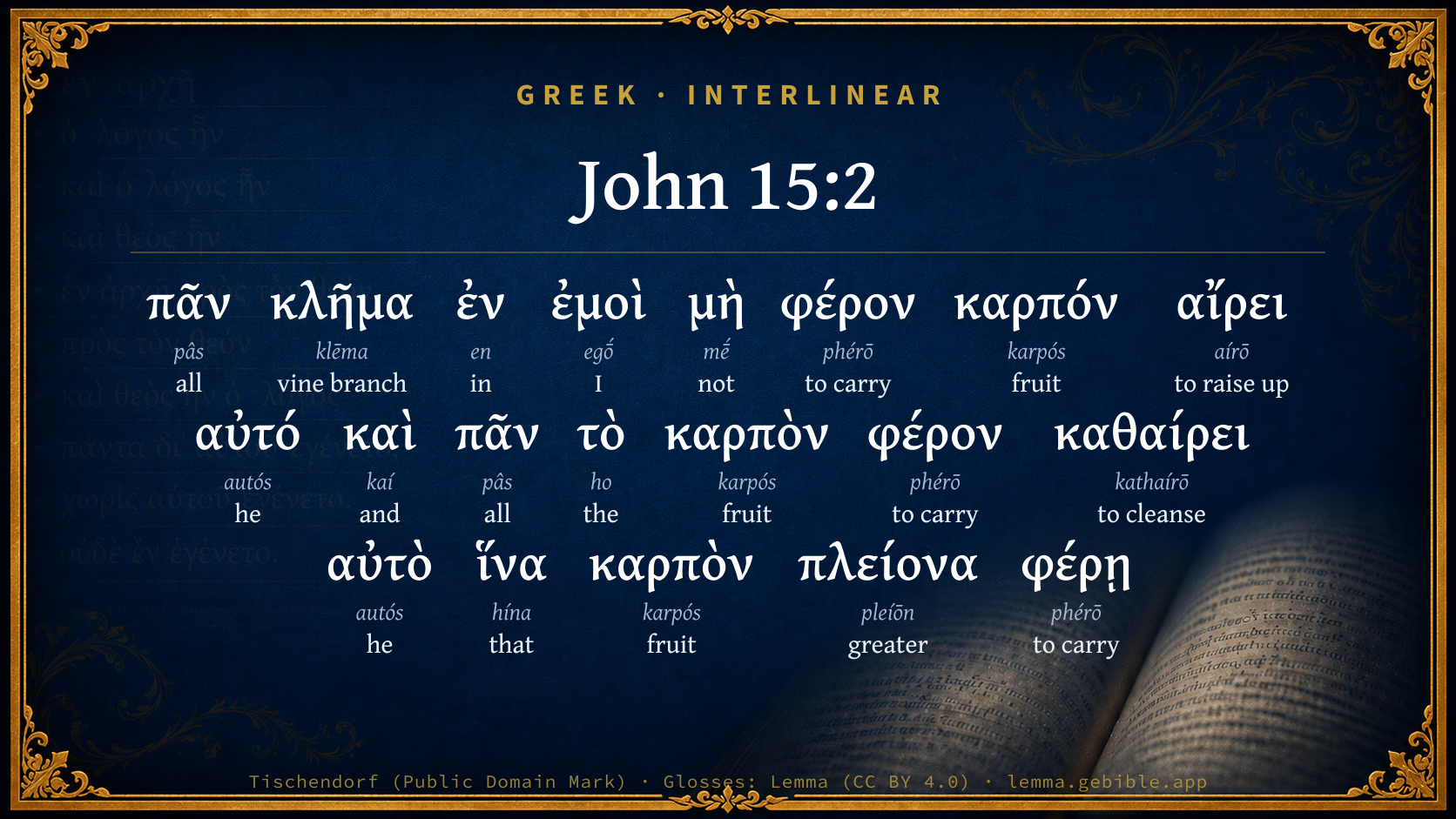
Every branch in me that doesn't bear fruit, he takes away. Every branch that bears fruit, he prunes, that it may bear more fruit.
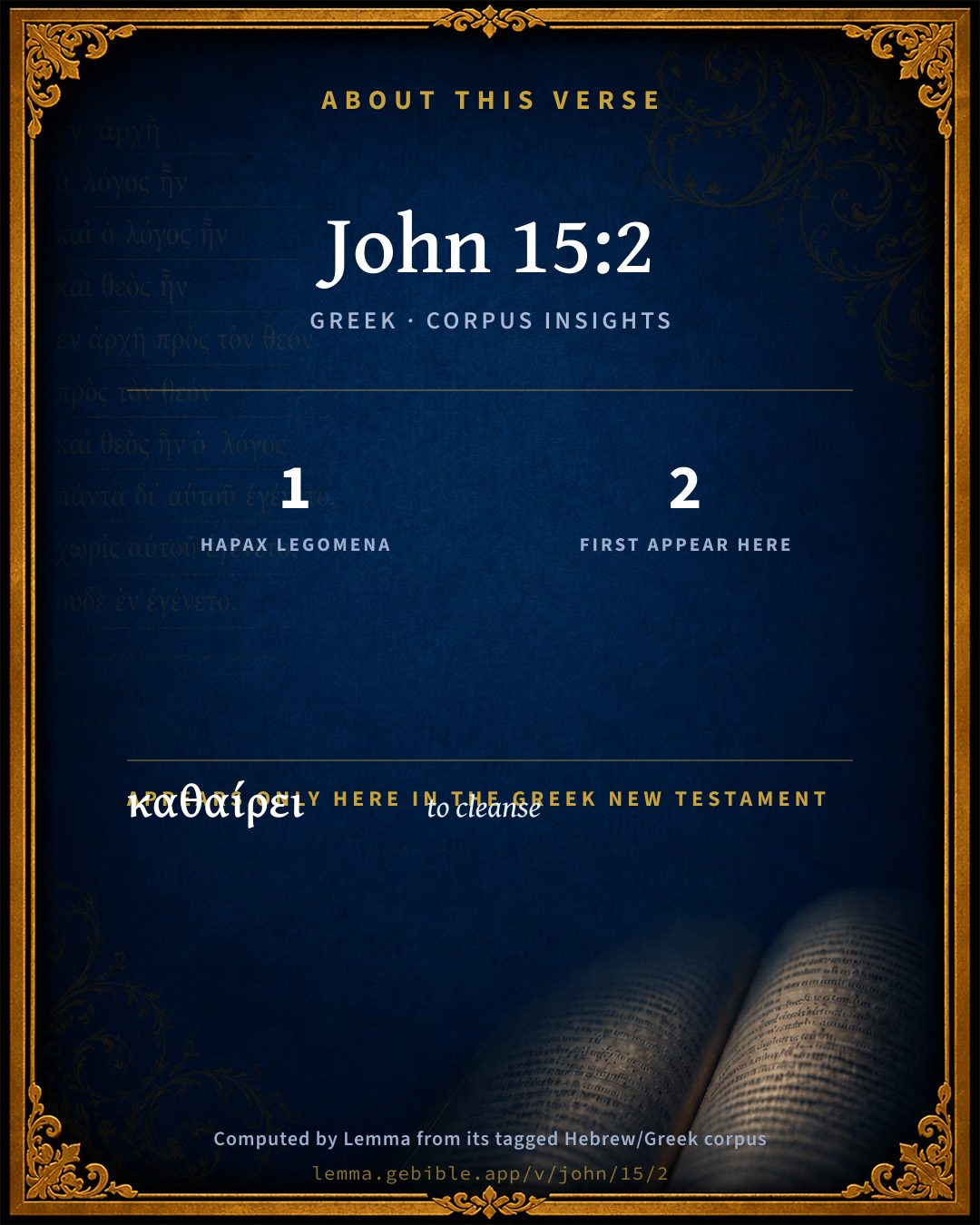
- 1 hapax legomenon — only here in the Greek New Testament
- 2 first appearances in the Greek New Testament
Download a study sheet
One document with this verse’s original text, its word-by-word gloss line, the meaning frame, cross-references with their text, attributed commentary, and full source and license credits — printable, and it pastes into notes with its structure intact.
This verse Autodidact and up
A passage Seminary Student
Up to 50 verses in one chapter. A passage sheet keeps up to 6 commentary sources and 12 cross-references per verse, in the order this page ranks them, and says so on the sheet whenever that leaves anything out. Ask for a single verse and you get the Autodidact verse sheet above.
Everything on this page stays free to read, with no account — the sheet is a download of what is already on screen, not access to it.
Compare translations 3
The same verse in 3 English versions, stacked beneath the original-language interlinear above. Click any original word for its lexicon entry.
Each is an independent rendering of the whole verse — the interlinear is not word-aligned to these translations.
Highlighted words mark where these versions differ — a whole-verse word diff, not a word-by-word alignment.
-
World English Bible Public Domain
Every branch in me that doesn't bear fruit, he takes away. Every branch that bears fruit, he prunes, that it may bear more fruit.
-
King James Version Public Domain
Every branch in me that beareth not fruit he taketh away: and every branch that beareth fruit, he purgeth it, that it may bring forth more fruit.
-
unfoldingWord Literal Text CC BY-SA 4.0
Every branch in me not bearing fruit, he takes it away; and every one that bears fruit, he prunes it so that it might bear more fruit.
unfoldingWord Literal Text — © unfoldingWord, licensed CC BY-SA 4.0. Word-aligned USFM3 via Door43 (git.door43.org/unfoldingWord/en_ult).
Show all 18 translations
Every available English version of this verse, each an independent rendering of the whole verse.
-
World English Bible Public Domain
Every branch in me that doesn't bear fruit, he takes away. Every branch that bears fruit, he prunes, that it may bear more fruit.
-
Berean Standard Bible Public Domain
He cuts off every branch in Me that bears no fruit, and every branch that does bear fruit, He prunes to make it even more fruitful.
-
Majority Standard Bible Public Domain
He cuts off every branch in Me that bears no fruit, and every branch that does bear fruit, He prunes to make it even more fruitful.
-
King James Version Public Domain
Every branch in me that beareth not fruit he taketh away: and every branch that beareth fruit, he purgeth it, that it may bring forth more fruit.
-
American Standard Version (1901) Public Domain
Every branch in me that beareth not fruit, he taketh it away: and every `branch' that beareth fruit, he cleanseth it, that it may bear more fruit.
-
Revised Version (1885) Public Domain
Every branch in me that beareth not fruit, he taketh it away: and every branch that beareth fruit, he cleanseth it, that it may bear more fruit.
-
Geneva Bible (1599) Public Domain
Euery branch that beareth not fruite in me, he taketh away: and euery one that beareth fruite, he purgeth it, that it may bring forth more fruite.
-
Young's Literal Translation Public Domain
every branch in me not bearing fruit, He doth take it away, and every one bearing fruit, He doth cleanse by pruning it, that it may bear more fruit;
-
Literal Standard Version CC BY-SA 4.0
every branch not bearing fruit in Me, He takes it away, and everyone bearing fruit, He cleanses by pruning it, that it may bear more fruit;
-
Unlocked Literal Bible CC BY-SA 4.0
He takes away every branch in me that does not bear fruit, and he prunes every branch that bears fruit so that it will bear more fruit.
-
unfoldingWord Literal Text CC BY-SA 4.0
Every branch in me not bearing fruit, he takes it away; and every one that bears fruit, he prunes it so that it might bear more fruit.
-
Darby Bible Public Domain
[As to] every branch in me not bearing fruit, he takes it away; and [as to] every one bearing fruit, he purges it that it may bring forth more fruit.
-
World Messianic Bible Public Domain
Every branch in me that doesn’t bear fruit, he takes away. Every branch that bears fruit, he prunes, that it may bear more fruit.
-
Webster's Bible Public Domain
Every branch in me that beareth not fruit, he taketh away; and every branch that beareth fruit, he cleaneth it, that it my bring forth more fruit.
-
Free Bible Version CC BY-SA 4.0
He cuts off every one of my branches that doesn't bear fruit. He prunes every branch that bears fruit so it can bear even more.
-
Bible in Basic English Public Domain
He takes away every branch in me which has no fruit, and every branch which has fruit he makes clean, so that it may have more fruit.
-
Text-Critical English NT CC BY 4.0
Every branch in me that does not bear fruit he takes away, and every branch that does bear fruit he prunes so that it will bear more fruit.
-
Tyndale New Testament (1534) Public Domain
Every braunche that beareth not frute in me he will take awaye. And every braunche that beareth frute will he pourge that it maye bringe moare frute.
Literal Standard Version (2020), Covenant Press — licensed CC BY-SA 4.0. Text via the HelloAO Bible API (eBible.org). Unlocked Literal Bible (unfoldingWord) — licensed CC BY-SA 4.0. Text via the HelloAO Bible API (eBible.org). unfoldingWord Literal Text — © unfoldingWord, licensed CC BY-SA 4.0. Word-aligned USFM3 via Door43 (git.door43.org/unfoldingWord/en_ult). Free Bible Version, Dr. Jonathan Gallagher — licensed CC BY-SA 4.0. Text via the HelloAO Bible API (eBible.org).
Word by word
More ways to search: Search by grammar → Find every occurrence → Compare this word →
Practice this passage: Drill this verse → Learn its vocabulary →
- Appears 1× in the Greek New Testament
- First appears here
- Part of Speech
- Verb
- Tense
- Present
- Voice
- Active
- Mood
- Indicative
- Person
- 3rd person
- Number
- Singular
Full Thayer's Definition
- πᾶν pâs G3956 “all” Adjective, Accusative, Singular, Neuter
- κλῆμα klēma G2814 “vine branch” Noun, Accusative, Singular, Neuter
- ἐν en G1722 “in” Preposition
- ἐμοὶ egṓ G1473 “I” Personal pronoun, 1st person, Dative, Singular
- μὴ mḗ G3361 “not” Particle, Negative
- φέρον phérō G5342 “to carry” Verb, Present, Active, Participle, Accusative, Singular, Neuter
- καρπόν karpós G2590 “fruit” Noun, Accusative, Singular, Masculine
- αἴρει aírō G142 “to raise up” Verb, Present, Active, Indicative, 3rd person, Singular
- αὐτό autós G846 “he” Personal pronoun, Accusative, Singular, Neuter
- καὶ kaí G2532 “and” Conjunction
- πᾶν pâs G3956 “all” Adjective, Accusative, Singular, Neuter
- τὸ ho G3588 “the” Article, Accusative, Singular, Neuter
- καρπὸν karpós G2590 “fruit” Noun, Accusative, Singular, Masculine
- φέρον phérō G5342 “to carry” Verb, Present, Active, Participle, Accusative, Singular, Neuter
- καθαίρει kathaírō G2508 “to cleanse” Verb, Present, Active, Indicative, 3rd person, Singular
- αὐτὸ autós G846 “he” Personal pronoun, Accusative, Singular, Neuter
- ἵνα hína G2443 “that” Conjunction
- καρπὸν karpós G2590 “fruit” Noun, Accusative, Singular, Masculine
- πλείονα pleíōn G4119 “greater” Adjective, Accusative, Singular, Masculine, Comparative
- φέρῃ phérō G5342 “to carry” Verb, Present, Active, Subjunctive, 3rd person, Singular
About this verse
These counts appear in no published source. They are computed here, from the morphology-tagged text and Lemma’s own curated glosses. What Lemma adds →
- 20
- words
- 14
- distinct lemmas
- Gospels
- section
Notable vocabulary
1 hapax legomenon — a word that appears only here in the entire Greek New Testament:
- καθαίρει to cleanse G2508
First appearance in Scripture
These words make their first canonical appearance in the Greek New Testament here:
Shared distinctive vocabulary
κλῆμα vine branch G2814 occurs in 4 verses of the Greek New Testament. Also found in:
Cross-references
32Topical passages linked to John 15:2 in the Treasury of Scripture Knowledge — connected by theme and wording, ordered by reader-vote popularity; previews shown in the World English Bible.
- Matthew 3:10 "Even now the axe lies at the root of the trees. Therefore, every tree that doesn't bring forth good fruit is cut down, and cast into the fire.
- Hebrews 12:10–11 For they indeed, for a few days, punished us as seemed good to them; but he for our profit, that we may be partakers of his holiness.
- Matthew 15:13 But he answered, "Every plant which my heavenly Father didn't plant will be uprooted.
- Revelation 3:19 As many as I love, I reprove and chasten. Be zealous therefore, and repent.
- John 15:8 "In this is my Father glorified, that you bear much fruit; and so you will be my disciples.
- Luke 13:7–9 He said to the vine dresser, 'Behold, these three years I have come looking for fruit on this fig tree, and found none. Cut it down. Why does it waste the soil?'
- Hebrews 6:7–8 For the land which has drunk the rain that comes often on it, and brings forth a crop suitable for them for whose sake it is also tilled, receives blessing from God;
- Matthew 13:12 For whoever has, to him will be given, and he will have abundance, but whoever doesn't have, from him will be taken away even that which he has.
- Matthew 3:12 His winnowing fork is in his hand, and he will thoroughly cleanse his threshing floor. He will gather his wheat into the barn, but the chaff he will burn up with unquenchable fire."
- 1 Thessalonians 5:23–24 May the God of peace himself sanctify you completely. May your whole spirit, soul, and body be preserved blameless at the coming of our Lord Jesus Christ.
- Philippians 1:9–11 This I pray, that your love may abound yet more and more in knowledge and all discernment;
- Galatians 5:22–23 But the fruit of the Spirit is love, joy, peace, patience, kindness, goodness, faithfulness,
- Job 17:9 Yet shall the righteous hold on his way. He who has clean hands shall grow stronger and stronger.
- Matthew 21:19 Seeing a fig tree by the road, he came to it, and found nothing on it but leaves. He said to it, "Let there be no fruit from you forever!" Immediately the fig tree withered away.
- Luke 8:13 Those on the rock are they who, when they hear, receive the word with joy; but these have no root, who believe for a while, then fall away in time of temptation.
- John 15:16 You didn't choose me, but I chose you, and appointed you, that you should go and bear fruit, and that your fruit should remain; that whatever you will ask of the Father in my name, he may give it to you.
- Hebrews 12:15 looking carefully lest there be any man who falls short of the grace of God; lest any root of bitterness springing up trouble you, and thereby the many be defiled;
- Malachi 3:3 and he will sit as a refiner and purifier of silver, and he will purify the sons of Levi, and refine them as gold and silver; and they shall offer to Yahweh offerings in righteousness.
- Romans 5:3–5 Not only this, but we also rejoice in our sufferings, knowing that suffering works perseverance;
- Psalms 51:7–13 Purify me with hyssop, and I will be clean. Wash me, and I will be whiter than snow.
- Proverbs 4:18 But the path of the righteous is like the dawning light, That shines more and more until the perfect day.
- John 17:12 While I was with them in the world, I kept them in your name. Those whom you have given me I have kept. None of them is lost, except the son of destruction, that the Scripture might be fulfilled.
- Colossians 1:5–10 because of the hope which is laid up for you in the heavens, of which you heard before in the word of the truth of the Gospel,
- Titus 2:14 who gave himself for us, that he might redeem us from all iniquity, and purify for himself a people for his own possession, zealous for good works.
- 1 John 2:19 They went out from us, but they didn't belong to us; for if they had belonged to us, they would have continued with us. But they left, that they might be revealed that none of them belong to us.
- Romans 8:28 We know that all things work together for good for those who love God, to those who are called according to his purpose.
- 1 Corinthians 13:1 If I speak with the languages of men and of angels, but don't have love, I have become sounding brass, or a clanging cymbal.
- 2 Corinthians 4:17–18 For our light affliction, which is for the moment, works for us more and more exceedingly an eternal weight of glory;
- Isaiah 29:19 The humble also shall increase their joy in Yahweh, and the poor among men shall rejoice in the Holy One of Israel.
- Hosea 6:3 Let us acknowledge Yahweh. Let us press on to know Yahweh. As surely as the sun rises, Yahweh will appear. He will come to us like the rain, Like the spring rain that waters the earth."
- Matthew 13:33 He spoke another parable to them. "The Kingdom of Heaven is like yeast, which a woman took, and hid in three measures of meal, until it was all leavened."
- Isaiah 27:9 Therefore by this shall the iniquity of Jacob be forgiven, and this is all the fruit of taking away his sin: that he makes all the stones of the altar as chalk stones that are beaten in sunder, [so that] the Asherim and the sun-images shall rise no more.
Cross-references courtesy of OpenBible.info (CC BY 4.0).
Lesson kit
Teaching starters — assembled from the data on this page, not authored interpretation. Every prompt links to the verse data it draws on. Edit before teaching.
John, in the Gospels, opens this verse with 20 words (14 distinct Greek lemmas). Its most distinctive word is kathaírō (“to cleanse”). A historical commentator’s framing appears above. Read the whole chapter for the surrounding context.
Discussion questions
- The word kathaírō carries the sense “to cleanse.” How does it shape the verse?
- 1 word here appears nowhere else in the Greek New Testament. Why might the author reach for such rare wording?
- 2 words make their first appearance in Scripture here. What does this debut establish?
- How does John 15:4, which shares the word «vine branch», read alongside this verse?
- What does the repetition of “to carry” (3× in this one verse) do in this verse?
- These translations render this verse differently. What is at stake in choosing one wording over another?
- Compare how The Biblical Illustrator and Joseph Benson's Commentary read this verse. Where do they agree or differ?
Things to notice
- 1 word in this verse appears nowhere else in the Greek New Testament.
- 2 words make their first canonical appearance in Scripture here.
- These translations choose different wording for 14 words in this verse.
- “to carry” occurs 3× in this single verse.
- 14 distinct Greek lemmas span 20 words in this verse.
Commentary
Notes on John 15:2 from classic Christian and Jewish commentators (each source and its license shown beneath its notes). The classic Christian expositions comment on the surrounding passage and are grouped to its opening verse, so a note may address several verses; the Jewish commentaries on the Tanakh (Rashi and others) are per-verse, so they appear only where the commentator wrote on this verse.
Lemma curates 59 commentaries, every one of them public domain or Creative Commons licensed, each selected and text-cleaned for this edition rather than reprinted as found. About our sources →
The Biblical Illustrator
Joseph S. Exell
The Biblical Illustrator, edited by Joseph S. Exell (c. 1880s–1900s) — public domain. Text from a community e-Sword module.
Joseph Benson's Commentary
Joseph Benson's Commentary on the Old and New Testaments (1811–1818) — public domain. Text from a community e-Sword module.
The Pulpit Commentary
The Pulpit Commentary (1880–1919), ed. H.D.M. Spence-Jones & Joseph S. Exell — public domain. Text from a community e-Sword module.
Scofield Reference Notes
C. I. Scofield
The Scofield Reference Bible (1917 edition), notes by C. I. Scofield — public domain. Text from a community e-Sword module.
Tyndale Open Study Notes
Tyndale Open Resources
Tyndale Open Study Notes — © Tyndale Open Resources, licensed CC BY-SA 4.0. Text via the HelloAO Bible API.
Bengel's Gnomon
Johann Albrecht Bengel
Bengel's Gnomon of the New Testament — English translation (T&T Clark, Edinburgh, 1860) — public domain. Text from a community e-Sword module.
Meyer's Critical & Exegetical Commentary
Heinrich August Wilhelm Meyer
Meyer — Critical and Exegetical Commentary on the New Testament — English translation by Peter Christie, edited by Frederick Crombie (T&T Clark, 1880) — public domain. Text from a community e-Sword module.
Expositor's Greek Testament
ed. W. Robertson Nicoll
The Expositor's Greek Testament, edited by W. Robertson Nicoll (1897–1910) — public domain. Text from a community e-Sword module.
Cambridge Greek Testament for Schools and Colleges
Cambridge Greek Testament for Schools and Colleges (Cambridge University Press, 1896; 21 vols, various authors incl. Carr, Maclear, Plummer, Farrar, Lumby, Moule, M. R. James, Simcox) — public domain. Text from a community e-Sword module.
Jamieson, Fausset & Brown
Robert Jamieson, A. R. Fausset & David Brown
Jamieson, Fausset & Brown — Commentary Critical and Explanatory on the Whole Bible (1871) — public domain (CC PDM 1.0). Text via the HelloAO Bible API.
Adam Clarke's Commentary
Adam Clarke's Commentary on the Bible (1810–1826) — public domain. Text from a community e-Sword/MySword module.
John Calvin's Commentaries
John Calvin's Commentaries (1540-1563) — public domain. Text from the Calvin Translation Society English edition (1840s-50s) via the Christian Classics Ethereal Library (ccel.org). Calvin's coverage is partial (roughly two-thirds of the Bible); uncommented books and verses are honest gaps, never fabricated. The 19th-century editor's footnotes and remarks are omitted so the notes are faithfully Calvin's own voice.
Ellicott's Commentary for English Readers
A Bible Commentary for English Readers, edited by Charles John Ellicott (1878–1897) — public domain. Text from a community e-Sword module.
The Cambridge Bible for Schools and Colleges
gen. ed. J. J. S. Perowne
The Cambridge Bible for Schools and Colleges (gen. ed. J. J. S. Perowne; Cambridge University Press, 1878–1918) — public domain. Text from a community e-Sword module.
John Gill's Exposition
John Gill's Exposition of the Whole Bible (1746–1763) — public domain (CC PDM 1.0). Text via the HelloAO Bible API.
Trapp's Complete Commentary
John Trapp
John Trapp, A Commentary or Exposition upon All the Books of the Old and New Testament (1647–1656) — public domain. Text from a community e-Sword module.
Albert Barnes' Notes on the Bible
Albert Barnes' Notes on the Bible (1834–1885) — public domain. Text from a community e-Sword/MySword module.
Haydock's Catholic Bible Commentary
George Leo Haydock (1774–1849), Haydock's Catholic Family Bible and Commentary, 1859 edition — public domain. Excludes Psalms (Douay-Rheims chapter numbering differs from Protestant) and Deuterocanonical books (Catholic canon only).
Matthew Poole's English Annotations
Matthew Poole's English Annotations on the Holy Bible (1683–1685) — public domain. Text from a community e-Sword/MySword module.
Whedon's Commentary on the Bible
Daniel D. Whedon
Daniel D. Whedon (gen. ed.), Commentary on the Old and New Testaments (1874–1909) — public domain. Text from a community e-Sword module.
John Wesley's Explanatory Notes
John Wesley, Explanatory Notes Upon the Whole Bible (1754–1765) — public domain. Text via the GEBible commentary corpus.
The People's New Testament
B. W. Johnson
B. W. Johnson's The People's New Testament with Notes (1889–1891) — public domain. Electronic text from the Christian Classics Ethereal Library (CCEL) ThML edition.
Alford’s Greek Testament
Henry Alford
Henry Alford, The Greek Testament (1849–1861) — public domain. Text from a community e-Sword module.
International Critical Commentary
International Critical Commentary — older volumes (1896–1929), various authors — public domain. Text from a community e-Sword module.
Vincent's Word Studies in the New Testament
Marvin R. Vincent
Marvin R. Vincent, Word Studies in the New Testament (1887–1900) — public domain. Text from a community e-Sword/MySword module.