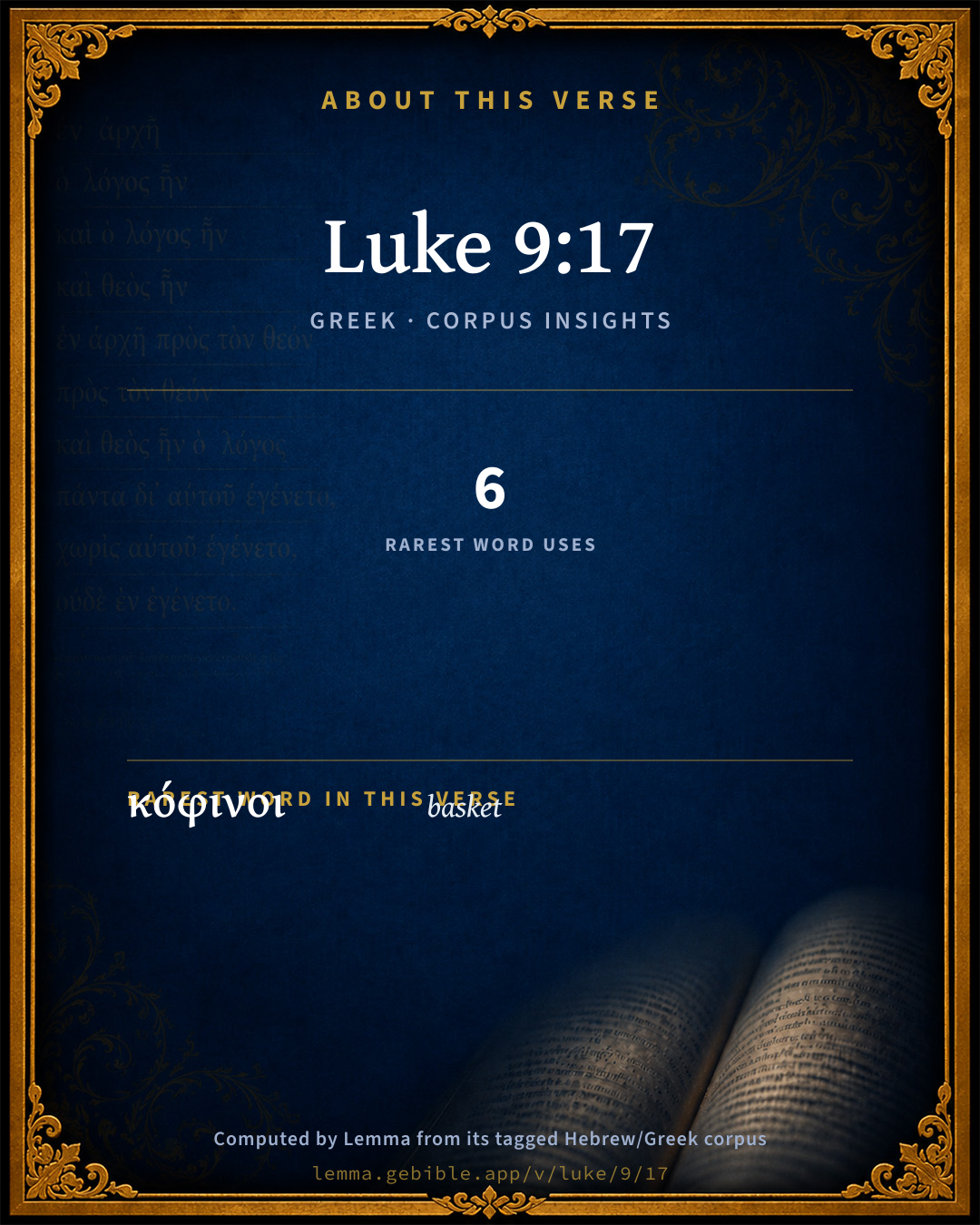
Luke 9:17

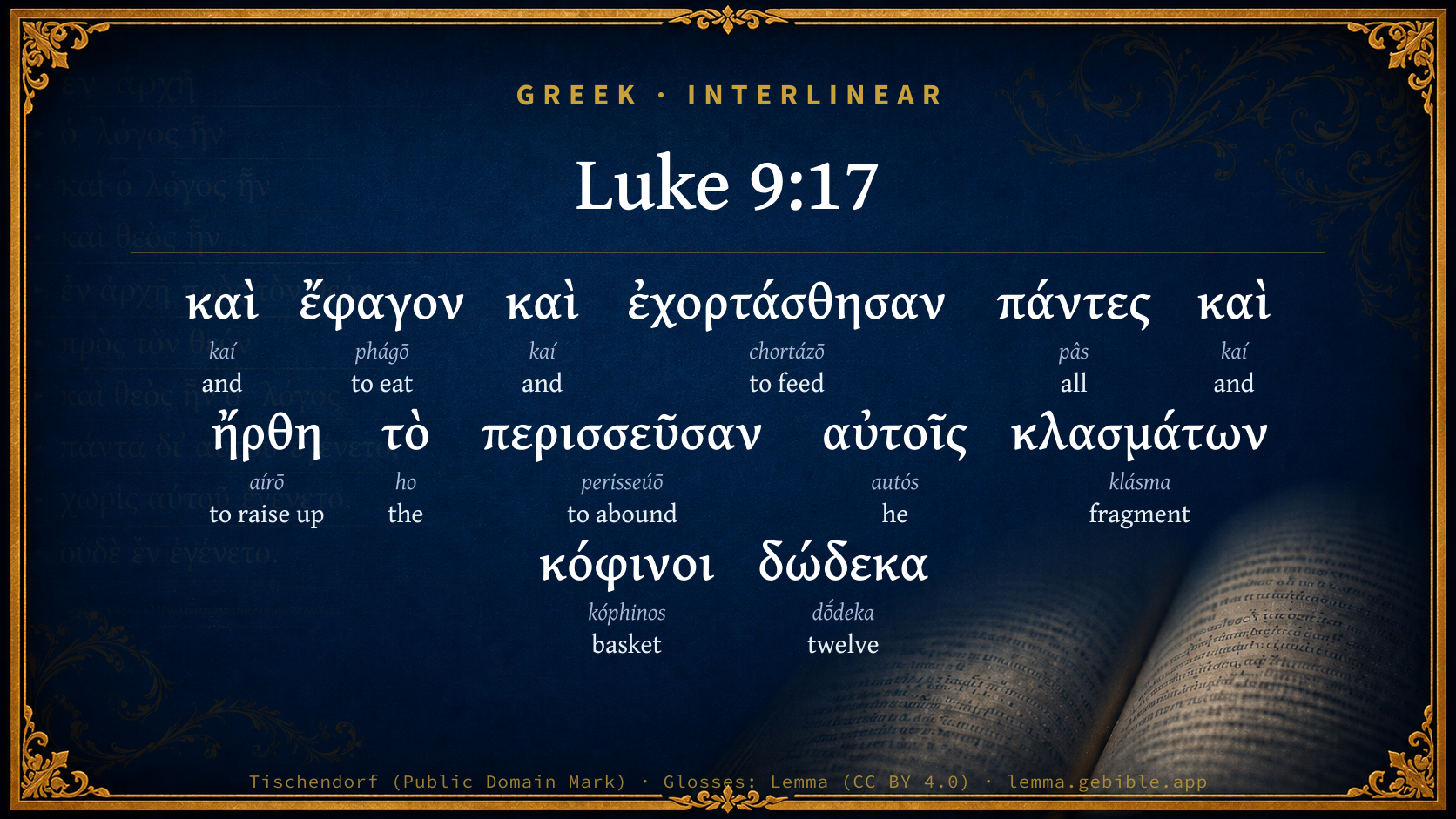
Greek (Tischendorf 8th ed.) Luke 9:17 appears in the Greek New Testament. The text above is from the Tischendorf 8th edition. Each word links to its Strong’s number and a concise gloss. Click any word for its full Thayer’s Greek Lexicon entry.
Download image
Cite this verse

Luke 9:17 (World English Bible). Public Domain. Lemma interlinear Bible study tool, https://lemma.gebible.app/v/luke/9/17.

Show BibTeX & RIS
BibTeX
RIS
English Translation
They ate, and were all filled. They gathered up twelve baskets of broken pieces that were left over.
World English Bible · Public Domain
Download a study sheet

One document with this verse’s original text, its word-by-word gloss line, the meaning frame, cross-references with their text, attributed commentary, and full source and license credits — printable, and it pastes into notes with its structure intact.

This verse Autodidact and up

Study sheet (.html) Plain text (.txt)

A passage Seminary Student

Up to 50 verses in one chapter. A passage sheet keeps up to 6 commentary sources and 12 cross-references per verse, in the order this page ranks them, and says so on the sheet whenever that leaves anything out. Ask for a single verse and you get the Autodidact verse sheet above.

Everything on this page stays free to read, with no account — the sheet is a download of what is already on screen, not access to it.

Want to remove ads? Support Godless Engineer
Compare translations 3

The same verse in 3 English versions, stacked beneath the original-language interlinear above. Click any original word for its lexicon entry.

Each is an independent rendering of the whole verse — the interlinear is not word-aligned to these translations.

Highlighted words mark where these versions differ — a whole-verse word diff, not a word-by-word alignment.

  • World English Bible Public Domain
    They ate, and were all filled. They gathered up twelve baskets of broken pieces that were left over.
  • King James Version Public Domain
    And they did eat, and were all filled: and there was taken up of fragments that remained to them twelve baskets.
  • unfoldingWord Literal Text CC BY-SA 4.0
    And they all ate and were satisfied, and what was left over to them was picked up—12 baskets of broken pieces.

unfoldingWord Literal Text — © unfoldingWord, licensed CC BY-SA 4.0. Word-aligned USFM3 via Door43 (git.door43.org/unfoldingWord/en_ult).

Versions to compare (up to 4)

3 of 4 selected

Show all 19 translations

Every available English version of this verse, each an independent rendering of the whole verse.

  • World English Bible Public Domain
    They ate, and were all filled. They gathered up twelve baskets of broken pieces that were left over.
  • Berean Standard Bible Public Domain
    They all ate and were satisfied, and the disciples picked up twelve basketfuls of broken pieces that were left over.
  • Majority Standard Bible Public Domain
    They all ate and were satisfied, and the disciples picked up twelve basketfuls of broken pieces that were left over.
  • King James Version Public Domain
    And they did eat, and were all filled: and there was taken up of fragments that remained to them twelve baskets.
  • American Standard Version (1901) Public Domain
    And they ate, and were all filled: and there was taken up that which remained over to them of broken pieces, twelve baskets.
  • Revised Version (1885) Public Domain
    And they did eat, and were all filled: and there was taken up that which remained over to them of broken pieces, twelve baskets.
  • Geneva Bible (1599) Public Domain
    So they did all eate, and were satisfied: and there was taken vp of that remained to them, twelue baskets full of broken meate.
  • Douay-Rheims (1899) Public Domain
    And they did all eat, and were filled. And there were taken up of fragments that remained to them, twelve baskets.
  • Young's Literal Translation Public Domain
    and they did eat, and were all filled, and there was taken up what was over to them of broken pieces, twelve baskets.
  • Literal Standard Version CC BY-SA 4.0
    and they ate, and were all filled, and there was taken up what was over to them of broken pieces, twelve baskets.
  • Unlocked Literal Bible CC BY-SA 4.0
    They all ate and were satisfied, and what was left over was picked up—twelve baskets of broken pieces.
  • unfoldingWord Literal Text CC BY-SA 4.0
    And they all ate and were satisfied, and what was left over to them was picked up—12 baskets of broken pieces.
  • Darby Bible Public Domain
    And they all ate and were filled; and there was taken up of what had remained over and above to them in fragments twelve hand-baskets.
  • World Messianic Bible Public Domain
    They ate and were all filled. They gathered up twelve baskets of broken pieces that were left over.
  • Webster's Bible Public Domain
    And they ate, and were all satisfied: and there was taken up of fragments that remained to them, twelve baskets.
  • Free Bible Version CC BY-SA 4.0
    Everybody ate until they were full, and then twelve baskets of leftovers were collected.
  • Bible in Basic English Public Domain
    And they all took the food and had enough; and they took up of the broken bits which were over, twelve baskets full.
  • Text-Critical English NT CC BY 4.0
    They all ate and were filled, and what was left over was picked up, twelve baskets of broken pieces.
  • Tyndale New Testament (1534) Public Domain
    And they ate and were all satisfied. And ther was taken vp of that remayned to the twelve baskettes full of broken meate.

Literal Standard Version (2020), Covenant Press — licensed CC BY-SA 4.0. Text via the HelloAO Bible API (eBible.org). Unlocked Literal Bible (unfoldingWord) — licensed CC BY-SA 4.0. Text via the HelloAO Bible API (eBible.org). unfoldingWord Literal Text — © unfoldingWord, licensed CC BY-SA 4.0. Word-aligned USFM3 via Door43 (git.door43.org/unfoldingWord/en_ult). Free Bible Version, Dr. Jonathan Gallagher — licensed CC BY-SA 4.0. Text via the HelloAO Bible API (eBible.org).

Word by word

More ways to search: Search by grammar → Find every occurrence → Compare this word →

Practice this passage: Drill this verse → Learn its vocabulary →

About this verse

These counts appear in no published source. They are computed here, from the morphology-tagged text and Lemma’s own curated glosses. What Lemma adds →

13
words
11
distinct lemmas
Gospels
section

Notable vocabulary

The rarest word here is κόφινοι basket G2894 — appearing just 6 times in the whole Greek New Testament.

Shared distinctive vocabulary

κόφινοι basket G2894 occurs in 6 verses of the Greek New Testament. Also found in:

Repetition

A word recurs within this verse:

Cross-references

12

Topical passages linked to Luke 9:17 in the Treasury of Scripture Knowledge — connected by theme and wording, ordered by reader-vote popularity; previews shown in the World English Bible.

  • 2 Kings 4:44 So he set it before them, and they ate, and left of it, according to the word of Yahweh.
  • Proverbs 13:25 The righteous one eats to the satisfying of his soul, But the belly of the wicked goes hungry.
  • Matthew 14:20–21 They all ate, and were filled. They took up twelve baskets full of that which remained left over from the broken pieces.
  • Matthew 15:37–38 They all ate, and were filled. They took up seven baskets full of the broken pieces that were left over.
  • Matthew 16:9–10 Don't you yet perceive, neither remember the five loaves for the five thousand, and how many baskets you took up?
  • Mark 6:42–44 They all ate, and were filled.
  • Mark 8:8–9 They ate, and were filled. They took up seven baskets of broken pieces that were left over.
  • Mark 8:19–20 When I broke the five loaves among the five thousand, how many baskets full of broken pieces did you take up?" They told him, "Twelve."
  • John 6:11–13 Jesus took the loaves; and having given thanks, he distributed to the disciples, and the disciples to those who were sitting down; likewise also of the fish as much as they desired.
  • Philippians 4:18–19 But I have all things, and abound. I am filled, having received from Epaphroditus the things that came from you, a sweet-smelling fragrance, an acceptable and well-pleasing sacrifice to God.
  • Psalms 37:16 Better is a little that the righteous has, Than the abundance of many wicked.
  • Psalms 107:9 For he satisfies the longing soul. He fills the hungry soul with good.

Cross-references courtesy of OpenBible.info (CC BY 4.0).

Commentary

Notes on Luke 9:17 from classic Christian and Jewish commentators (each source and its license shown beneath its notes). The classic Christian expositions comment on the surrounding passage and are grouped to its opening verse, so a note may address several verses; the Jewish commentaries on the Tanakh (Rashi and others) are per-verse, so they appear only where the commentator wrote on this verse.

Lemma curates 59 commentaries, every one of them public domain or Creative Commons licensed, each selected and text-cleaned for this edition rather than reprinted as found. About our sources →

Tyndale Open Study Notes

Tyndale Open Resources

9:17 twelve baskets of leftovers: God abundantly provides for his people.

Tyndale Open Study Notes — © Tyndale Open Resources, licensed CC BY-SA 4.0. Text via the HelloAO Bible API.

Ellicott's Commentary for English Readers

(17) Twelve baskets.—See Note on Mat_14:20.

A Bible Commentary for English Readers, edited by Charles John Ellicott (1878–1897) — public domain. Text from a community e-Sword module.

The Cambridge Bible for Schools and Colleges

gen. ed. J. J. S. Perowne

17. of fragments] Compare 2Ki_4:43-44. These were collected by the order of Jesus, who thus strikingly taught that wastefulness even of miraculous plenty is entirely alien to the divine administration.

twelve baskets] Cophini, probably wicker-baskets (salsilloth, Jer_6:9). Every Jew carried such a basket about with him to avoid the chance of his food contracting any Levitical pollution in heathen places (Juv. Sat. iii. 14, vi. 542). The baskets used at the miracle of the four thousand were large rope-baskets, ‘frails’ (spurides). The accuracy with which each word is reserved by all the narrators for each miracle is remarkable.

At this point there is a considerable gap in the continuity of St Luke’s narrative. He omits the amazement of the multitude which made it likely that they would seize Jesus to make Him king; His compelling His reluctant disciples to sail back towards the other—the western—Bethsaida; the gradual dismissal of the multitude; His flight, φεύγει, Joh_6:15, א) to the hill top to escape those who still lingered, and to pray alone; the gathering of the storm; the walking on the sea; the failure of Peter’s faith; the very memorable discourse at Capernaum, intended to teach what was the true bread from heaven, and to dissipate the material expectations of the popular Messianism; the crisis of offence caused by these hard sayings; the dispute with the Pharisees on the question of the Oral Law or Tradition of the Elders; the deepening opposition and the one great day of conflict and rupture with the Pharisees (which St Luke appears to relate out of chronological order in Luke 11); the flight among the heathen as far as Tyre and Sidon; the incident of the Syrophoenician woman; the feeding of the four thousand; the return to Galilee and demand for a sign; the sailing away, and the warning against the leaven of the Pharisees; and the healing of a blind man at Bethsaida Julias during His second journey northwards. These must be sought for in Mat_24:1 to Mat_26:12; Mar_6:45—viii. 30; John 4. For my view of them, and their sequence, I may perhaps be allowed to refer the reader to my Life of Christ, I. 403-11. 9.

The Cambridge Bible for Schools and Colleges (gen. ed. J. J. S. Perowne; Cambridge University Press, 1878–1918) — public domain. Text from a community e-Sword module.

John Gill's Exposition

And it came to pass, as he was alone praying,.... To his God and Father, for himself as man, and mediator; for the success of his Gospel, and the increase of his interest; and for his disciples, that they might have a clearer revelation of him; and which they had, as appears in their after confession of him by Peter, as the mouth of them all. The place where he now retired for private devotion, was somewhere in the coasts of Caesarea Philippi; for he was now gone from the desert of Bethsaida, as appears from Mat 16:13 and when he is said to be alone, the meaning is, that he was retired from the multitude, but not from his disciples; for it follows,

his disciples were with him, in this solitary place:

and he asked them, being with them alone;

saying, Whom say the people that I am? what are the sentiments of the common people, or of the people in general concerning me? The Alexandrian copy, and the Arabic version read, "men", as in Mat 16:13. See Gill on Mat 16:13.

John Gill's Exposition of the Whole Bible (1746–1763) — public domain (CC PDM 1.0). Text via the HelloAO Bible API.

Trapp's Complete Commentary

John Trapp

17 And they did eat, and were all filled: and there was taken up of fragments that remained to them twelve baskets.

Ver. 17. {See Trapp on "Luk 9:13"}

John Trapp, A Commentary or Exposition upon All the Books of the Old and New Testament (1647–1656) — public domain. Text from a community e-Sword module.

The Pulpit Commentary

And they did eat, and were all filled: and there was taken up of fragments that remained to them, twelve baskets. A very impressive lesson from the Creator himself against waste or extravagance. St. John expressly tells us that this order to gather up the fragments of their meal emanated from Jesus himself. Carefulness, thrift, and economy in small things as in great, form part of the teaching of the loving Master. From such passages as Mar_6:37 and Joh_13:29, it seems probable that the disciples, acting under their Master"s direction, were in the habit of distributing, out of their comparative abundance, food to those persons in the villages who were poorer than themselves. It was, no doubt, for some such hallowed object as this that the careful collection of the fragments which filled twelve baskets was made. The "baskets" (cophinus) were usually carried by travelling Jews to keep their food from contracting Levitical pollution in Gentile places. Juvenal, in a well-known passage ("Sat.," 3:14), writes of the Jews travelling about Italy with no baggage save a little bundle of hay to serve as a pillow, and this cophinus, or basket, for their food. So abundant had been the provision created by Jesus, that the fragments collected far exceeded the original stock of food which the disciples gave to Jesus to bless, to break, and to distribute among the five thousand and upward who were fed that memorable afternoon. This miracle is the only one in the entire Galilaean ministry which is told by all the four evangelists. It evidently had a very prominent place in the teaching of the first days. Rationalizing interpretation in the case of this miracle is singularly at fault. After eighteen centuries of unremitting hostility to the teaching of Jesus Christ, not even a plausible explanation of this miraculous multiplication of the loaves and fishes has been found by adverse critics. In our own days, Renan, following the ancient interpretation of Paulus, simply suggests that the multitudes were fed by materials provided by themselves. "Every one took his little store of provision from his wallet; they lived on very little an explanation, as it has been happily termed, "ludicrously inadequate.

After the relation of the great miracle of feeding the five thousand, St. Luke omits in his Gospel a variety of incidents and several discourses told at greater or lesser length by the other evangelists. For instance, the reverential amazement of the people when the nature of the stupendous miracle in connection with the creation of the loaves and fishes flashed upon them, they wished to recognize him as King Messiah; the walking on the sea; the long and important discourse on the true Bread at Capernaum, the text of which was the late great miracle of the loaves; the journey among the heathen as far as Tyre and Sidon; the meeting with the Syro-phoenician woman; the feeding of the four thousand, etc. These incidents are related in Mat 14:1-16:12 Mar 6:45-8:30 Joh 6. No commentator has satisfactorily explained the reason of this omission of important portions of our Lord"s public ministry. The reason for St. Luke"s action here probably will never be guessed. We must, however, in all theories which we may form of the composition of these Gospels, never lose sight of this fact, that while SS. Matthew and Peter (Mark) were eyewitnesses of the events of the life, St. Luke, and his master, Paul, simply reproduced what they had heard or read. We may, therefore, suppose that St. Luke exercised larger discretionary powers in dealing with materials derived from others than the other two, who desired, no doubt, to reproduce a fairly general summary of their Divine Master"s acts. On such a theory of composition, a gap in the story like the one we are now alluding to, in the more eclectic Gospel of St. Luke, would seem scarcely possible in the first two Gospels. We, of course, make no allusion here to the Fourth Gospel; the whole plan and design of St. John was different to that upon which the first three were modelled.

The Pulpit Commentary (1880–1919), ed. H.D.M. Spence-Jones & Joseph S. Exell — public domain. Text from a community e-Sword module.

Cambridge Greek Testament for Schools and Colleges

17. κλασμάτων. Compare 2Ki 4:43-44. These were collected by the order of Jesus, who thus strikingly taught that wastefulness even of miraculous plenty is entirely alien to the divine administration.

κόφινοι δώδεκα. Probably wicker-baskets (salsilloth, Jer 6:9). Every Jew carried such a basket about with him to avoid the chance of his food contracting any Levitical pollution in heathen places (Juv. Sat. III. 14, VI. 542). The baskets used at the miracle of the four thousand were large rope-baskets, ‘frails’ (σπυρίδες). The accuracy with which each word is reserved for its own proper miracle by all the narrators is remarkable.

At this point there is a considerable gap in the continuity of St Luke’s narrative. He omits the amazement of the multitude which made it likely that they would seize Jesus to make Him king; His compelling His reluctant disciples to sail back towards the other—the western—Bethsaida; the gradual dismissal of the multitude; His flight (φεύγει, Joh 6:15, א) to the hill top to escape those who still lingered, and to pray alone; the gathering of the storm; the walking on the sea; the failure of Peter’s faith; the very memorable discourse at Capernaum, intended to teach what was the true bread from heaven, and to dissipate the material expectations of the popular Messianism; the crisis of offence caused by these hard sayings; the dispute with the Pharisees on the question of the Oral Law or Tradition of the Elders; the deepening opposition and the one great day of conflict and rupture with the Pharisees (which St Luke appears to relate out of chronological order in 11); the flight among the heathen as far as Tyre and Sidon; the incident of the Syrophoenician woman; the feeding of the four thousand; the return to Galilee and demand for a sign; the sailing away; the warning against the leaven of the Pharisees; and the healing of a blind man at Bethsaida Julias during His second journey northwards. These must be sought for in Mat 14:1 to Mat 16:12; Mar 6:45 to Mar 8:30; John 6. For my view of them, and their sequence, I may perhaps be allowed to refer the reader to my Life of Christ, I. 403–II. 9.

Cambridge Greek Testament for Schools and Colleges (Cambridge University Press, 1896; 21 vols, various authors incl. Carr, Maclear, Plummer, Farrar, Lumby, Moule, M. R. James, Simcox) — public domain. Text from a community e-Sword module.

Alford’s Greek Testament

Henry Alford

17.] κλασ. in Matt. is joined with τὸ περισσεῦον,—in Mark with κοφίνους πλήρεις: here it may be taken with τὸ περισ. (ordinarily, and De Wette) or κόφ. (Meyer), but best, it appears to me, the latter,—because the article is not expressed as in Matt.

Immediately after this miracle, Matt., Mark, and John relate the walking on the sea, which, and the whole series of events following as far as Mat 16:12,—the healings in the land of Gennesaret, the discourse about unwashen hands, the Syrophœnician woman, the healing of multitudes by the sea of Galilee, the feeding of the 4000, the asking of a sign from Heaven, and the forgetting to take bread,—are wholly omitted by our Evangelist. Supposing him to have had Matt. before him, how is this to be explained?

It is also an important observation, that the omission by Luke of the second miracle of feeding is not to be adduced against its historical reality, as has been done by Schleiermacher (transl. p. 144), since it is only omitted as occurring in the midst of a large section, which the accounts gathered by Luke did not contain. We see also, that the characteristic κοφίνους of the first feeding is preserved, without any confusion of terms: σπυρίδας being always used in relating and referring to the second,—Mat 15:37; Mat 16:10: Mar 8:8, Mar 8:20.

Henry Alford, The Greek Testament (1849–1861) — public domain. Text from a community e-Sword module.

International Critical Commentary

17. The verbal resemblance between the three accounts continues. For ἐχορτάσθησαν see on 6:21, and take κλασμάτων after τὸ περισσεῦσαν (De W. Hahn). All four mention the twelve κόφινοι, as also does Mt. in referring to this miracle (16:9); whereas at the feeding of the four thousand (Mat 15:37; Mar 8:8), and in referring to it (Mat 16:10), the word used for basket is σπυρίς. It is the more remarkable that Lk. and Jn. both have κόφινοι because they do not mention the other miracle. The σπυρίς was large, capable of holding a man (Act 9:25). The κόφινος was the wallet carried by every travelling Jew, to avoid buying food from Gentiles: Judæis quorum cophinus fænumque supellex (Juv. Sat. iii. 14). Comp. nupsisti, Gellia, cistifero, “thou hast married a Jew” (Mart. Epig. v. 17, 4). These exact details would scarcely have been maintained so consistently in a deliberate fiction or in a myth. Still less would either fiction or myth have represented one who could multiply food at will as giving directions that the fragments should not be wasted (Joh 6:12). The possessor of an inexhaustible purse is never represented as being watchful against extravagance.

Note the climax in ver. 17. They not only ate, but were satisfied,—all of them; and not only so, but there was something over,—far more than the original supply.

Weiss well remarks that “the criticism which is afraid of miracles finds itself in no small difficulty in the presence of this narrative. It is guaranteed by all our sources which rest upon eye-witness; and these show the independence of their tradition by their deviations, which do not affect the kernel of the matter, and cannot be explained by any tendencies whatever. In the presence of this fact the possibility of myth or invention is utterly inadmissible. … Only this remains absolutely incontrovertible, that it is the intention of all our reports to narrate a miracle; and by this we must abide, if the origin of the tradition is not to abide an entirely inexplicable riddle” (L. J. 2. pp. 196-200, Eng. tr. 2. pp. 381-385). The explanation that Christ’s generosity in giving away the food of His party induced others who had food to give it away, and that thus there was enough for all, is plainly not what the Evangelists mean, and it does not explain their statements. Would such generosity suggest that He was the Messiah, or induce them to try to make Him king? Still more inadequate is the suggestion of Renan: Grace à une extrême frugalité, la troupe sainte y vécut; on crut naturellement voir en cela un miracle (V. de. J. p. 198, ed. 1863).

International Critical Commentary — older volumes (1896–1929), various authors — public domain. Text from a community e-Sword module.

Vincent's Word Studies in the New Testament

Marvin R. Vincent

Were filled. See on Mt 5:6.

There were taken up of fragments that remained to them twelve baskets [και ηρθη το περισσευσαν αυτπις κλασματων κοφινοι δωδεκα] . The Rev. is more accurate, putting the comma after aujtoiv, to them, instead of after klasmatwn, fragments; and making the latter word depend on kofinoi, baskets. Render, therefore, And there was taken up that which remained over to them, of broken pieces, twelve baskets.

Baskets. See on Mt 14:20.

18 - 21. Compare Mt 16:13 - 20. Mr 8:27 - 30.

Marvin R. Vincent, Word Studies in the New Testament (1887–1900) — public domain. Text from a community e-Sword/MySword module.

Lesson kit

Teaching starters — assembled from the data on this page, not authored interpretation. Every prompt links to the verse data it draws on. Edit before teaching.

Luke, in the Gospels, opens this verse with 13 words (11 distinct Greek lemmas). Its most distinctive word is kóphinos (“basket”). A historical commentator’s framing appears above. Read the whole chapter for the surrounding context.

Discussion questions

  1. How does “basket” (kóphinos) shape what this verse is saying?
  2. Matthew 14:20 shares the word «basket» with this verse. How do the two illuminate each other?
  3. “and” occurs 3× in this one verse. What is the effect of the repetition?
  4. These translations render this verse differently. What is at stake in choosing one wording over another?
  5. Reading how Tyndale Open Study Notes and Ellicott's Commentary for English Readers read this verse, where do the two commentators agree and where do they part?

Things to notice

Reading settings

Reading text

Shown beneath each verse's original-language words.

Old Testament
Old Testament edition

Read the OT as the Masoretic Hebrew (MT) or the Greek Septuagint (LXX).

English shown for the Greek Septuagint (in the Hebrew ↔ Greek comparison).

Comparing translations? Open the Compare panel on any verse page to stack up to four side by side.