
Colossians 2:14

Greek (Tischendorf 8th ed.) Colossians 2:14 appears in the Greek New Testament. The text above is from the Tischendorf 8th edition. Each word links to its Strong’s number and a concise gloss. Click any word for its full Thayer’s Greek Lexicon entry.
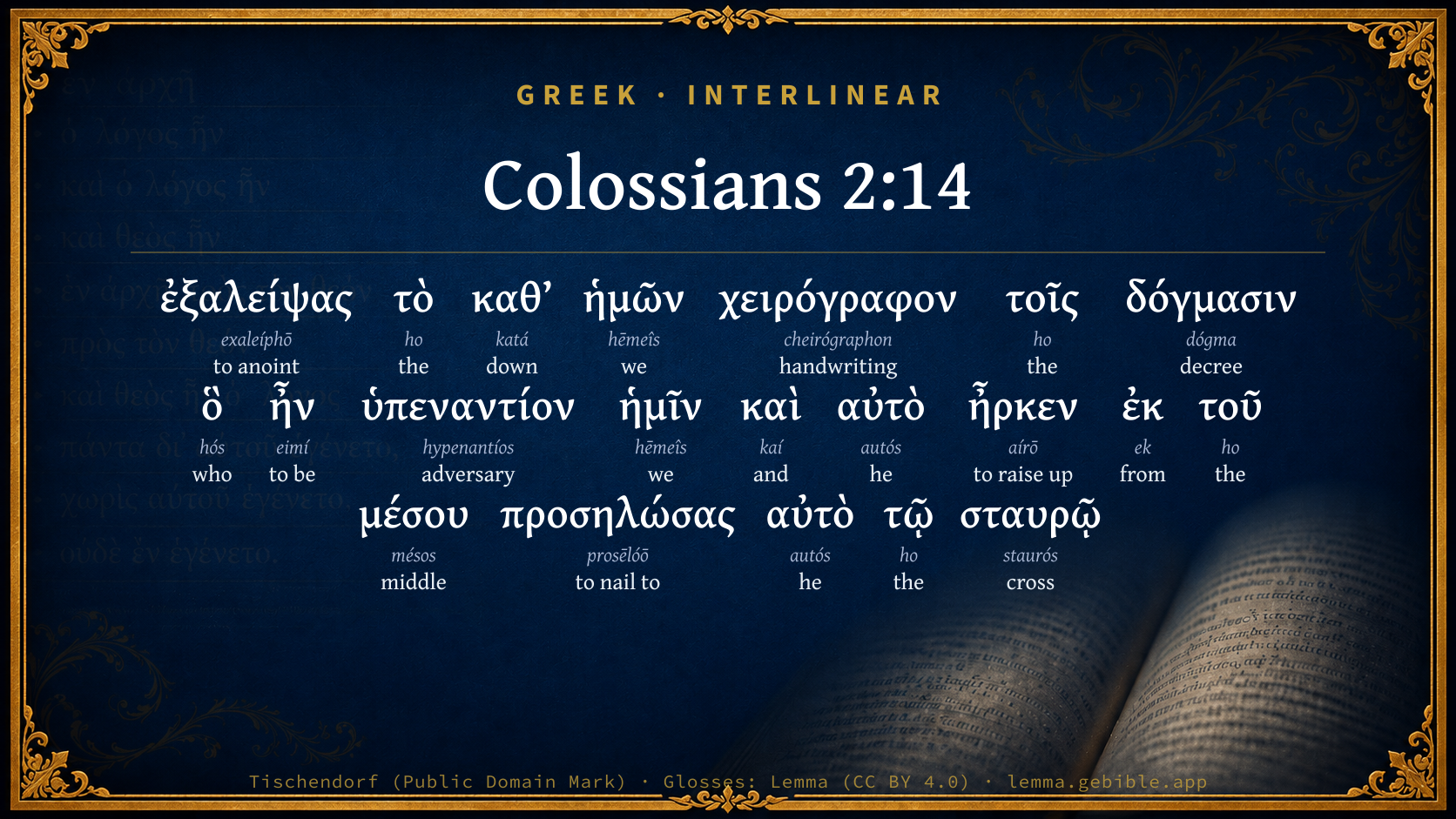
Download image
Cite this verse

Colossians 2:14 (World English Bible). Public Domain. Lemma interlinear Bible study tool, https://lemma.gebible.app/v/colossians/2/14.

Show BibTeX & RIS
BibTeX
RIS
English Translation
wiping out the handwriting in ordinances which was against us; and he has taken it out of the way, nailing it to the cross;
World English Bible · Public Domain
Highlights
  • 2 hapax legomena — only here in the Greek New Testament
  • 3 first appearances in the Greek New Testament
Full analysis ↓
Download a study sheet

One document with this verse’s original text, its word-by-word gloss line, the meaning frame, cross-references with their text, attributed commentary, and full source and license credits — printable, and it pastes into notes with its structure intact.

This verse Autodidact and up

Study sheet (.html) Plain text (.txt)

A passage Seminary Student

Up to 50 verses in one chapter. A passage sheet keeps up to 6 commentary sources and 12 cross-references per verse, in the order this page ranks them, and says so on the sheet whenever that leaves anything out. Ask for a single verse and you get the Autodidact verse sheet above.

Everything on this page stays free to read, with no account — the sheet is a download of what is already on screen, not access to it.

Want to remove ads? Support Godless Engineer
Compare translations 3

The same verse in 3 English versions, stacked beneath the original-language interlinear above. Click any original word for its lexicon entry.

Each is an independent rendering of the whole verse — the interlinear is not word-aligned to these translations.

Highlighted words mark where these versions differ — a whole-verse word diff, not a word-by-word alignment.

  • World English Bible Public Domain
    wiping out the handwriting in ordinances which was against us; and he has taken it out of the way, nailing it to the cross;
  • King James Version Public Domain
    Blotting out the handwriting of ordinances that was against us, which was contrary to us, and took it out of the way, nailing it to his cross;
  • unfoldingWord Literal Text CC BY-SA 4.0
    having canceled the written record of the decrees against us, which were opposed to us, and he has taken out from our midst, having nailed it to the cross;

unfoldingWord Literal Text — © unfoldingWord, licensed CC BY-SA 4.0. Word-aligned USFM3 via Door43 (git.door43.org/unfoldingWord/en_ult).

Versions to compare (up to 4)

3 of 4 selected

Show all 19 translations

Every available English version of this verse, each an independent rendering of the whole verse.

  • World English Bible Public Domain
    wiping out the handwriting in ordinances which was against us; and he has taken it out of the way, nailing it to the cross;
  • Berean Standard Bible Public Domain
    having canceled the debt ascribed to us in the decrees that stood against us. He took it away, nailing it to the cross!
  • Majority Standard Bible Public Domain
    having canceled the debt ascribed to us in the decrees that stood against us. He took it away, nailing it to the cross!
  • King James Version Public Domain
    Blotting out the handwriting of ordinances that was against us, which was contrary to us, and took it out of the way, nailing it to his cross;
  • American Standard Version (1901) Public Domain
    having blotted out the bond written in ordinances that was against us, which was contrary to us: and he hath taken it out that way, nailing it to the cross;
  • Revised Version (1885) Public Domain
    having blotted out the bond written in ordinances that was against us, which was contrary to us: and he hath taken it out of the way, nailing it to the cross;
  • Geneva Bible (1599) Public Domain
    And putting out the hand writing of ordinances that was against vs, which was contrarie to vs, hee euen tooke it out of the way, and fastened it vpon the crosse,
  • Douay-Rheims (1899) Public Domain
    Blotting out the handwriting of the decree that was against us, which was contrary to us. And he hath taken the same out of the way, fastening it to the cross:
  • Young's Literal Translation Public Domain
    having blotted out the handwriting in the ordinances that is against us, that was contrary to us, and he hath taken it out of the way, having nailed it to the cross;
  • Literal Standard Version CC BY-SA 4.0
    having blotted out the handwriting in the ordinances that is against us, that was contrary to us, and He has taken it out of the way, having nailed it to the Cross;
  • Unlocked Literal Bible CC BY-SA 4.0
    He canceled the written record of debts that stood against us with its regulations. He took it away by nailing it to the cross.
  • unfoldingWord Literal Text CC BY-SA 4.0
    having canceled the written record of the decrees against us, which were opposed to us, and he has taken out from our midst, having nailed it to the cross;
  • Darby Bible Public Domain
    having effaced the handwriting in ordinances which [stood out] against us, which was contrary to us, he has taken it also out of the way, having nailed it to the cross;
  • World Messianic Bible Public Domain
    wiping out the handwriting in ordinances which was against us. He has taken it out of the way, nailing it to the cross.
  • Webster's Bible Public Domain
    Blotting out the hand-writing of ordinances that was against us, which was contrary to us, and took it out of the way, nailing it to his cross;
  • Free Bible Version CC BY-SA 4.0
    He wiped out the record of our debts according to the Law that was written down against us; he took away this barrier by nailing it to the cross.
  • Bible in Basic English Public Domain
    Having put an end to the handwriting of the law which was against us, taking it out of the way by nailing it to his cross;
  • Text-Critical English NT CC BY 4.0
    by blotting out the certificate of debt that stood against us with its legal demands; he took it away by nailing it to the cross.
  • Tyndale New Testament (1534) Public Domain
    and hath put out the handwritinge that was agaynst vs contayned in the lawe writte and that hath he take out of the waye and hath fastened it to his crosse

Literal Standard Version (2020), Covenant Press — licensed CC BY-SA 4.0. Text via the HelloAO Bible API (eBible.org). Unlocked Literal Bible (unfoldingWord) — licensed CC BY-SA 4.0. Text via the HelloAO Bible API (eBible.org). unfoldingWord Literal Text — © unfoldingWord, licensed CC BY-SA 4.0. Word-aligned USFM3 via Door43 (git.door43.org/unfoldingWord/en_ult). Free Bible Version, Dr. Jonathan Gallagher — licensed CC BY-SA 4.0. Text via the HelloAO Bible API (eBible.org).

Word by word

More ways to search: Search by grammar → Find every occurrence → Compare this word →

Practice this passage: Drill this verse → Learn its vocabulary →

χειρόγραφον
cheirógraphon
G5498
“handwriting”
Noun, Accusative, Singular, Neuter
Part of Speech
Noun
Case
Accusative
Number
Singular
Gender
Neuter
Full Thayer's Definition

Origin: from a compound of G5495 and G1125

TDNT: 16:15,1

1. a handwriting, what one has written by his own hand 2. a note of hand or writing in which one acknowledges that money has either been deposited with him or lent to him by another, to be returned at the appointed time
  1. ἐξαλείψας exaleíphō G1813 “to anoint” Verb, Aorist, Active, Participle, Nominative, Singular, Masculine
  2. τὸ ho G3588 “the” Article, Accusative, Singular, Neuter
  3. καθ’ katá G2596 “down” Preposition
  4. ἡμῶν hēmeîs G2249 “we” Personal pronoun, 1st person, Genitive, Plural
  5. τοῖς ho G3588 “the” Article, Dative, Plural, Neuter
  6. δόγμασιν dógma G1378 “decree” Noun, Dative, Plural, Neuter
  7. ὃ hós G3739 “who” Relative pronoun, Nominative, Singular, Neuter
  8. ἦν eimí G1510 “to be” Verb, Imperfect, Active, Indicative, 3rd person, Singular
  9. ὑπεναντίον hypenantíos G5227 “adversary” Adjective, Nominative, Singular, Neuter
  10. ἡμῖν hēmeîs G2249 “we” Personal pronoun, 1st person, Dative, Plural
  11. καὶ kaí G2532 “and” Conjunction
  12. αὐτὸ autós G846 “he” Personal pronoun, Accusative, Singular, Neuter
  13. ἦρκεν aírō G142 “to raise up” Verb, Perfect, Active, Indicative, 3rd person, Singular
  14. ἐκ ek G1537 “from” Preposition
  15. τοῦ ho G3588 “the” Article, Genitive, Singular, Neuter
  16. μέσου mésos G3319 “middle” Adjective, Genitive, Singular, Neuter
  17. προσηλώσας prosēlóō G4338 “to nail to” Verb, Aorist, Active, Participle, Nominative, Singular, Masculine
  18. αὐτὸ autós G846 “he” Personal pronoun, Accusative, Singular, Neuter
  19. τῷ ho G3588 “the” Article, Dative, Singular, Masculine
  20. σταυρῷ staurós G4716 “cross” Noun, Dative, Singular, Masculine

About this verse

These counts appear in no published source. They are computed here, from the morphology-tagged text and Lemma’s own curated glosses. What Lemma adds →

21
words
16
distinct lemmas
Pauline Epistles
section

Notable vocabulary

2 hapax legomena — words that appear only here in the entire Greek New Testament:

  • χειρόγραφον handwriting G5498
  • προσηλώσας to nail to G4338

First appearance in Scripture

These words make their first canonical appearance in the Greek New Testament here:

  • χειρόγραφον handwriting G5498
  • ὑπεναντίον adversary G5227
  • προσηλώσας to nail to G4338

Shared distinctive vocabulary

ὑπεναντίον adversary G5227 occurs in 2 verses of the Greek New Testament. Also found in:
Repetition

Words recur within this verse:

Cross-references

21

Topical passages linked to Colossians 2:14 in the Treasury of Scripture Knowledge — connected by theme and wording, ordered by reader-vote popularity; previews shown in the World English Bible.

  • Isaiah 44:22 I have blotted out, as a thick cloud, your transgressions, and, as a cloud, your sins: return to me; for I have redeemed you.
  • Ephesians 2:14–16 For he is our peace, who made both one, and broke down the middle wall of partition,
  • Isaiah 43:25 I, even I, am he who blots out your transgressions for my own sake; and I will not remember your sins.
  • Hebrews 8:13 In that he says, "A new covenant," he has made the first old. But that which is becoming old and grows aged is near to vanishing away.
  • Colossians 2:20 If you died with Christ from the elements of the world, why, as though living in the world, do you subject yourselves to ordinances,
  • 1 Peter 2:24 who his own self bore our sins in his body on the tree, that we, having died to sins, might live to righteousness; by whose stripes you were healed.
  • Hebrews 7:18 For there is an annulling of a foregoing commandment because of its weakness and uselessness
  • Hebrews 10:8–9 Previously saying, "Sacrifices and offerings and whole burnt offerings and sacrifices for sin you didn't desire, neither had pleasure in them" (those which are offered according to the law),
  • Hebrews 9:9–10 which is a symbol of the present age, where gifts and sacrifices are offered that are incapable, concerning the conscience, of making the worshipper perfect;
  • Isaiah 57:14 He will say, Cast up, cast up, prepare the way, take up the stumbling-block out of the way of my people.
  • Acts 3:19 "Repent therefore, and turn again, that your sins may be blotted out, so that there may come times of refreshing from the presence of the Lord,
  • Psalms 51:1 Have mercy on me, God, according to your loving kindness. According to the multitude of your tender mercies, blot out my transgressions.
  • Galatians 4:1–4 But I say that so long as the heir is a child, he is no different from a bondservant, though he is lord of all;
  • Psalms 51:9 Hide your face from my sins, And blot out all of my iniquities.
  • Numbers 5:23 "The priest shall write these curses in a book, and he shall blot them out into the water of bitterness.
  • Luke 1:6 They were both righteous before God, walking blamelessly in all the commandments and ordinances of the Lord.
  • 2 Thessalonians 2:7 For the mystery of lawlessness already works. Only there is one who restrains now, until he is taken out of the way.
  • Esther 3:12 Then were the king's scribes called in the first month, on the thirteenth day of it; and there was written according to all that Haman commanded to the king's satraps, and to the governors who were over every province, and to the princes of every people, to every province according to the writing of it, and to every people after their language; in the name of king Ahasuerus was it written, and it was sealed with the king's ring.
  • Esther 8:8 Write you also to the Jews, as it pleases you, in the king's name, and seal it with the king's ring; for the writing which is written in the king's name, and sealed with the king's ring, may no man reverse.
  • Daniel 5:7–8 The king cried aloud to bring in the enchanters, the Chaldeans, and the soothsayers. The king spoke and said to the wise men of Babylon, Whoever shall read this writing, and show me the interpretation of it, shall be clothed with purple, and have a chain of gold about his neck, and shall be the third ruler in the kingdom.
  • Nehemiah 4:5 and don't cover their iniquity, and don't let their sin be blotted out from before you; for they have provoked [you] to anger before the builders.

Cross-references courtesy of OpenBible.info (CC BY 4.0).

Commentary

Notes on Colossians 2:14 from classic Christian and Jewish commentators (each source and its license shown beneath its notes). The classic Christian expositions comment on the surrounding passage and are grouped to its opening verse, so a note may address several verses; the Jewish commentaries on the Tanakh (Rashi and others) are per-verse, so they appear only where the commentator wrote on this verse.

Lemma curates 59 commentaries, every one of them public domain or Creative Commons licensed, each selected and text-cleaned for this edition rather than reprinted as found. About our sources →

The Biblical Illustrator

Joseph S. Exell

Col_2:14

Blotting out the handwriting of ordinances.

I. The handwriting.

1. It is often the practice of Scripture to liken a sin to a debt: whence remitting it is equivalent to pardoning it (Mat_6:12; cf. Luk_11:4). Indeed the Chaldees and Syrians used the words sinner and debtor interchangeably. The reason is that there is a resemblance between the two. As the one obliges the debtor to payment, the other obliges the sinner to punishment. As a debt gives the creditor power over his debtor, so sin consigns the offender to God.

2. The word handwriting signifies an acknowledgement signed by us that we owe a certain sum and bind ourselves to pay. It is an authentic testimony of our debt, and makes our body and goods liable. The handwriting of the text is the instrument of our condemnation, and subjects us to the justice of God.

3. This handwriting was the old law, as the word ordinances, the following context, and the purpose of the apostle to show that Judaism was not binding on the Colossians, prove.

4. This handwriting in itself is good and profitable, but it became contrary through sin.

(1) It serves to convict us, as an obligation produced in judgment stops the mouth of an unfaithful debtor.

(2) It is against our inclinations, which are lawless.

(3) It threatens punishment, which we feel to be deserved and which we cannot evade.

II. What is done with it? It is made void by the Cross.

1. It is blotted out, as it is usual with men when a debt is paid to efface the name of the creditor and the amount he owed. So God has erased the handwriting of this debt which was written in His law for our consciences.

2. The means employed is some fluid, as ink, which is drawn over the page; so our obligation is made void by the effusion of Christs blood.

3. Men who are exact not only efface their debtors writings but tear them up, that no sign of the debt may remain. So God has so effaced the handwriting against us that not even the erasures appear; it is rent by the nails of the cross.

Conclusion:

1. This furnishes us with a clear proof of Christs satisfaction. If Christs death is merely an example the law could sustain no injury, and if these words can be applied to Him they can be applied to other martyrs; but who would dare to do that?

2. This shows us the error of the doctrine of human merit: for God can exact nothing now that Christ has paid all.

3. The enjoyment of this privilege wrought on the cross is conditional upon faith. (J. Daille.)

The handwriting blotted out

I. What is meant by handwriting?

1. Opinions are various; yet all agree in this that something is intended which by force of testimony may prove us guilty before God. Some assert it to be--

(1) The covenant of God with Adam (Gen_2:17), for this being violated, Adam and his posterity were held guilty of death as by a bond.

(2) The stipulation of the Jews (Exo_19:7-8), by which they bound themselves to perfect obedience, by the non-performance of which they might be justly condemned by their own hand.

(3) The remembrance of our sins in the Divine mind and in our own conscience (Isa_43:25), by which we are convicted, as by a bond. The Divine law says, Thou shalt love the Lord, etc. Conscience suggests, I have not done so, and am, therefore, cursed.

(4) Ceremonial rites which testified to guilt, circumcision to depravity, purifications to the filthiness of sin, sacrifices to the heinousness of guilt.

2. I explain it to mean the moral law binding to perfect obedience and condemning defect, laden with rites as appendages.

II. How is it against us?

1. As to the moral law, it is holy, just, and good; nevertheless it has become deadly to us through sin (Rom_7:12-13), because--

(1) It propounds decrees contrary to human nature (Rom_7:12-13).

(2) It arraigns, convicts, and brings us in guilty of sin (Rom_3:20).

(3) It denounces against us the sentence of condemnation (Gal_3:10).

2. As to ordinances, they were contrary, because

(1) They were almost infinite as to number, and most burdensome as to observance Hence the appeal, Gal_5:1.

(2) By their signification and testimony. For although they seemed to promise the destruction of sin, yet there entered into them a confession rather than expiation thereof.

III. How it is made void.

1. Universally and sufficiently as it respects God; because by the blood of Christ such satisfaction is made to God that according to His own justice He is engaged to acquit those debtors who flee by faith to the Deliverer.

2. Particularly and efficaciously when it is blotted out from the conscience of those who lay hold of God by faith (Rom_5:1). There is no peace to a man who sees himself overwhelmed in debt and entangled by a bond; but when Christs deliverance is accepted the soul enters into peace.

3. Notice the beautiful gradation. Not content with telling us we are forgiven, Paul subjoins that the handwriting is blotted out; but lest any should think that it is not so, but that a new charge may be raised, he adds it is taken out of the way; and lest it should be thought to be preserved somewhere, and may yet be preferred, he says it is nailed to the Cross, rent in pieces.

Conclusion: We learn--

1. From the handwriting.

(1) Since every man through it is guilty of death, how dreadful is the condition of those who trample on the blood by which alone the handwriting can be blotted out. God will require from them the uttermost farthing.

(2) We see the insane pride of those who think they can satisfy God, yea, pay Him more than is due by works of supererogation. But what need then of blotting out the handwriting by the Cross?

2. From its contrariety.

(1) The depravity and corruption of our nature; for at its institution it was friendly and wholesome.

(2) The error of those who would restore ceremonies and rob us of our liberty in Christ.

3. From the abolition.

(1) Since it is deprived of its condemning force we infer that it still retains its directing force, and so we have not a licence to sin but a motive to obey (Luk_1:74-75).

(2) Since the comfort of a troubled conscience consists in its being blotted out, we must labour to maintain by faith not only that Christ has procured that but that it is blotted out as respects ourselves. A debtor does not consider himself safe until he has seen with his own eyes that his bond is cancelled. (Bp. Davenant.)

Our indictment cancelled by the Cross

Liberty is the way to true life for man. A slave has nothing to live for: but proclaim his freedom, and he becomes another being. So with the man whom God sets free. Quickening from God comes in forgiveness of sins.

I. The indictment against us--the law of God as expressed in the ten commandments and written in the heart (Rom_2:14).

1. Here we hate mans moral obligation, of which men everywhere have been more or less conscious. Moral sense of the two great duties of love to God and our neighbour is everywhere diffused. The handwriting is so on every mans soul that he knows and feels that some things ought to be done while others are forbidden as wrong. Many attempt to efface the handwriting, as well as to defy it, but that only confirms the fact that it exists in all the fulness of its claim.

2. This handwriting is against us because we have broken it. The law is for the lawless, and its verdict is only against the sinful. It commands our supreme love to God, and we have not loved Him, This is the debt we owe to God as our Creator and Father; we have not paid it and now cannot.

3. It is also contrary to us. The terms are not exactly equivalent. The one expresses silent condemnation, the other a positive hostility. A man may owe a debt he cannot pay, and this fact is an obligation against him, even though there be no positive demand for payment. But if by the process of dunning the debt is often brought before him, and he is unpleasantly reminded of it, then the obligation is not only against him, it is contrary to him: it disturbs his peace and fills him with dread. So the Divine law acting on the law of our mind is constantly reminding us of our obligation, and is hostile to our peace. Its spirituality is against us, for we are carnal; its purity, for we are unholy; its justice, for we have kept back Gods due. Such is the indictment, that every mouth may be stopped (Rom_3:19).

II. The indictment cancelled. The verdict against sinful men is erased or wiped out. This idea often recurs in Scripture in reference to sin--blot out all my iniquities.

2. It is taken out of the way; not that the law and moral obligation are abolished, but the verdict is removed so that it cannot be adduced for our condemnation. Literally it is taken out of the midst, as if the handwriting had lain between God and His people--a barrier to their approach to Him, and to their peace with Him.

3. The means. Nailing to the cross and so destruction. Its condemning force was exhausted on Christ, so that it is powerless against all who are in Him. This is our discharge: the law has been fulfilled, and its finding against us for ever taken away. (J. Spence, D. D.)

The Cross the death of law

I. The handwriting or bond.

1. Law means primarily the ceremonial law which was being pressed on the Colossians. The early controversies on this matter are difficult for us to understand. It is harder to change customs than creeds, and religious observances live on, as every Maypole on a village green tells us, long after the beliefs which animated them are forgotten. So there was a party Who refused the admittance of Gentile converts to the Church except through the old doorway of circumcision. This was the point at issue between Paul and these teachers.

2. But the modern distinction between moral and ceremonial had no existence in Pauls mind, nor in the Old Testament, where we find the highest morality and the merest ritual inter-stratified. The law was a homogeneous whole.

3. And the principles laid down are true about all law. Law, as such, is dealt with by Christianity in the same way as the God-given code.

4. Law, Paul tells us, is antagonistic. It stands opposite, frowning at us and barring our road.

(1) Is it then become our enemy because it tells us the truth? This conception is a strange contrast to the rapturous delight of Psalmists in it. Surely Gods greatest gift to man is the knowledge of His will, and law is beneficent, a light, and a guide, and even its strokes are merciful.

(2) Nevertheless the antagonism is very real. As with God, so with law--if we be against Him, He cannot but be against us. We make Him our dearest friend or our foe. The revelation of duty to which we are not inclined is ever unwelcome. Law is against us because--

(a) It comes like a taskmaster bidding us do, but neither putting the inclination into our hearts nor the power into our hands.

(b) The revelation of unfulfilled duty is the accusation of the defaulter.

(c) It comes with threatenings and foretastes of penalty. Thus, as standard, accuser, and avenger, it is against us.

(3) We all know this. Each of us has seen that apparition like the sword-bearing angel that Balaam saw, blocking our path when we wanted to go frowardly in the way of our heart. The law of the Lord should be sweeter than honey, etc., but the corruption of the best is the worst, and we can make it poison. Obeyed, it is as the chariot of fire to bear us heavenward; disobeyed, it is an iron car crushing all who set themselves against it.

II. Its destruction in the cross.

1. The Cross ends the laws power of punishment. Paul believed that the burden and penalty of sin had been laid on Christ, and trusting ourselves to the power of that great sacrifice, the dread of punishment will fade from our hearts, and the law will have to draw the bolts of the prison and let the captive go free.

2. The Cross is the end of the law as ceremonial. The Jewish ritual had the prediction of the Great Sacrifice for its highest purpose. When the fruit has set there is no more need for petals. We have the reality and do not need the shadow.

3. The Cross is the end of the law as moral rule. Of course it is not meant that Christian men are freed from the obligations of morality, but that we are not bound to do the things contained in the law because they are there. Duty is duty now because we see the pattern of conduct and character in Christ. The weakness of law is that it has no power to get its commandments obeyed; but Christ puts His love in our hearts, and so we pass from the dominion of an external commandment into the liberty of an inward spirit. The long schism between duty and inclination is at an end. So a higher morality ought to characterize the partakers of the life of Christ. Law died with Christ on the cross that it might rise and reign in our inmost hearts. (A. Maclaren, D. D.)

Cancelled and nailed up

There is a beautiful oriental custom which illustrates the Atonement. When a debt had to be settled either by payment or forgiveness, the creditor took the cancelled bond and nailed it over the door of him who had owed it, that all passers by might see that it was paid. So there is the Cross, the door of grace, behind which a bankrupt world lies in hopeless debt to the law. See Jesus our bondman and brother, coming forth with a long list of our indebtedness in His hand. He lifts it up where God and angels and men may see it, and there as the nail goes through His hand it goes through the bond of our transgressions to cancel it for ever. Come to that Cross! Not in order that you may wash away your sins by your tears or atone for them by your good works, or efface them by your sophistries and self-deceptions. But come rather that you may read the long black list that is against you, and be pierced to your heart by sorrow that you have offended such a Being; and then that lifting up your eyes you may see God turning His eyes at that same cross at which you are looking, and saying, I, even I, am He that blotteth out thy transgressions, etc. (New Testament Anecdotes.)

The law is against sinners

There are stronger things in the world than force. There are powers more difficult to overcome than strong or brazen gates. Suppose we found a prisoner condemned to die, and locked up in his ceil, and we were to ask ourselves how he could be saved from execution. There would appear great difficulty in getting him out of prison. That iron door, with its great bolt; that high window, with its guard of strong bars; those thick, strong walls; those heavy gates outside; that watchful jailer, how impossible it seems to overcome them all! Yet these are not the only difficulties, nor the greatest. There is another thing, stronger than all these, holding the poor prisoner to death: there is the sentence of the law. For, unless he would himself become a criminal, no man dares to help the condemned one out. Get the sentence repealed, and the other difficulties are removed. (J. Edmond, D. D.)

The Biblical Illustrator, edited by Joseph S. Exell (c. 1880s–1900s) — public domain. Text from a community e-Sword module.

Whedon's Commentary on the Bible

Daniel D. Whedon

4. The legalism sought to be imposed is abolished, Col_2:14.

14. Blotting out—Rather, having blotted out. The interpretations of this verse are very various, and many of their difficulties arise, as we think, from a failure to observe its logical connexion. We conceive it to be a simple statement that God had wiped out the whole ritual system. Circumcision could not, therefore, be required as a condition of spiritual life, and they themselves had found that life without it.

Handwriting of ordinances—The Mosaic ceremonial law: the obligatory bond, whose numerous minute decrees were difficult and oppressive.

Contrary to us— Peter expressed the same when he styled it “a yoke… which neither our fathers nor we were able to bear.” Act_15:10. We cannot interpret it of the decalogue, for that was not abolished by Christ’s death, as was the ritual, whose provisions pointed to and were thus fulfilled in him. It was, doubtless, the best possible system for the period of its enactment; but it had accomplished its purpose, and the time had come for it to pass away. Its precepts were obliterated; it was as if nailed to the cross, and thus, as a document, destroyed. As the cross was the instrument of death, when Christ died it died. Ritual circumcision is, therefore, at an end.

Daniel D. Whedon (gen. ed.), Commentary on the Old and New Testaments (1874–1909) — public domain. Text from a community e-Sword module.

The Pulpit Commentary

Having blotted out the bond (that was) against us with (or, written in) decrees, which was opposed to us (Eph_2:14-16; Rom_3:9-26 Rom_7:7-14; 2Co_5:19; Gal_3:10; 1Co_15:56; Act_13:38, Act_13:39) The ancients commonly used wax tablets in writing, and the flat end of the pointed stylus drawn over the writing smeared it out (expunged) and so cancelled it (comp. Act_3:19; Psa_51:9; Isa_43:25) "God," not "Christ," is the subject of this verb, which stands in immediate sequence to those of vers. 12, 13 (comp. 2Co_5:19) It is the receiver rather than the offerer of satisfaction who cancels the debt: in Eph_2:15. (comp. Col_1:22) a different verb is used. Ceirografon ("handwritten;" a word of later Greek, only here in the New Testament) is used specially of an account of debt, a bond signed by the debtor"s hand (see Meyer and Lightfoot). This bond (with its decrees) can be nothing other than "the law" (Eph_2:14-16; Act_13:38, Act_13:39; Rom_3:20 Rom_7:25; Gal_3:21, Gal_3:22, etc.) not, however, the ritual law, nor even the Mosaic Law as such (as Meyer contends), but law as law, the Divine rule of human life impressed even on Gentile hearts, (Rom_2:14, Rom_2:15) to which man"s conscience gives its consent, (Rom_7:16, Rom_7:22) and yet which becomes by his disobedience just a list of charges against him (so Neander and Lightfoot; see the latter on. Gal_2:19 Exo_24:3 andgmasin Deu_27:14-26, indeed, illustrate this wider relation of Divine law to the human conscience generally. Toiv do) is dative of reference either to kaq hJmwn ("against us:" qualifying or explanatoryin respect of its decrees) or to the verbal idea contained in ceirgorafon ("written in," or "with decrees"). The former explanation (that of Winer and Ellicott) is preferable. The Greek Fathers made it instrumental dative to ejxaleiyav, understanding by these dogmata the doctrines (dogmas) of the gospel by which the charges of the Law against us are expunged.

But this puts on dogma a later theological sense foreign to St. Paul, and universally rejected by modern interpreters. In the New Testament (comp. (Luk_2:1; Act_16:4; Heb_11:23) as in classical Greek, dogma is a decree, setting forth the will of some public authority (comp. note on dogmatizw, ver. 20). The added clause, "which was opposed to us," affirms the active opposition, as "against us" the essential hostility of the decrees of God"s law to our sinful nature (Rom_4:15; Gal_3:10: comp. Rom_7:13, Rom_7:14) The emphasis with which St. Paul dwells on this point is characteristic of the author of Romans and Galatians. Ypenantiov occurs besides only in Heb_10:27; the prefix uJpo implies close and persistent opposition (Lightfoot).

And he hath taken it out of the midst, having nailed it to the cross (Col_1:20-22; Eph_2:18; 2Co_5:19; Rom_3:24-26 Rom_5:1, Rom_5:2; Gal_3:13; Heb_1:3; Joh_1:29; 1Jn_4:10) A third time in these three verses (12-14) we note the transition from participle to coordinate finite verb; and here, in addition, the aorist tense passes into the perfect ("hath taken"), marking the finality of the removal of the Law"s condemning power: (Act_13:39) comp. the opposite transition in Col_1:26, Col_1:27. The moral deliverance of ver. 11 is traced up to this legal release, both contained in our completeness in Christ (ver. 10). The subject is still "God." Cancelling the bond which he held against us in his Law, God has forver removed the barrier which stood between mankind and himself. (2Co_5:19) Christ"s place in this work, already shown in Col_1:18-23, (in its relation to himself) is vividly recalled by the mention of the cross. And the abolition of the Law"s condemnation is finally set forth by a yet bolder metaphor"having nailed it to the cross." The nails of the cross in piercing Christ pierced the legal instrument which held us debtors, and nullified it; (see Gal_3:13 comp.; sav Gal_2:19, 20 Rom_7:4-6) Proshlw may suggest the further idea of nailing up the cancelled document, by way of publication. At the cross all may read, "There is now no condemnation" (compare the "making a show" of ver. 15; also Rom_3:25; Gal_3:1) (For vers. 11-14, compare concluding remark on Col_1:14)

The Pulpit Commentary (1880–1919), ed. H.D.M. Spence-Jones & Joseph S. Exell — public domain. Text from a community e-Sword module.

MacLaren's Expositions of Holy Scripture

Alexander MacLaren

Jeremiah

SIN’S WRITING AND ITS ERASURE

Jer 17:1. - 2Co 3:3. - Col 2:14.

I have put these verses together because they all deal with substantially the same metaphor. The first is part of a prophet’s solemn appeal. It describes the sin of the nation as indelible. It is written in two places. First, on their hearts, which reminds us of the promise of the new covenant to be written on the heart. The ‘red-leaved tablets of the heart’ are like waxen tables on which an iron stylus makes a deep mark, an ineradicable scar. So Judah’s sin is, as it were, eaten into their heart, or, if we might so say, tattooed on it. It is also written on the stone horns of the altar, with a diamond which can cut the rock {an illustration of ancient knowledge of the properties of the diamond}. That sounds a strange place for the record of sin to appear, but the image has profound meaning, as we shall see presently.

Then the two New Testament passages deal with other applications of the same metaphor. Christ is, in the first, represented as writing on the hearts of the Corinthians, and in the second, as taking away ‘the handwriting contrary to us.’ The general thought drawn from all is that sin’s writing on men’s hearts is erased by Christ and a new inscription substituted.

I. The handwriting of sin.

Sin committed is indelibly written on the heart of the doer.

‘The heart,’ of course, in Hebrew means more than merely the supposed seat of the affections. It is figuratively the centre of the spiritual life, just as physically it is the centre of the natural. Thoughts and affections, purposes and desires are all included, and out of it are ‘the issues of life,’ the whole outgoings of the being. It is the fountain and source of all the activity of the man, the central unity from which all comes. Taken in this wide sense it is really the whole inner self that is meant, or, as is said in one place, ‘the hidden man of the heart.’ And so the thought in this vigorous metaphor may be otherwise put, that all sin makes indelible marks on the whole inward nature of the man who does it.

Now to begin with, think for a moment of that truth that everything which we do reacts on us the doers.

We seldom think of this. Deeds are done, and we fancy that when done, they are done with. They pass, as far as outward seeming goes, and their distinguishable consequences in the outward world, in the vast majority of cases, soon apparently pass. All seems evanescent and irrecoverable as last year’s snows, or the water that flowed over the cataract a century ago. But there is nothing more certain than that all which we do leaves indelible traces on ourselves. The mightiest effect of a man’s actions is on his own inward life. The recoil of the gun is more powerful than the blow from its shot. Our actions strike inwards and there produce their most important effects. The river runs ceaselessly and its waters pass away, but they bring down soil, which is deposited and makes firm land, or perhaps they carry down grains of gold.

This is the true solemnity of life, that in all which we do we are carrying on a double process, influencing others indeed, but influencing ourselves far more.

Consider the illustrations of this law in regard to our sins.

Now the last thing people think of when they hear sermons about ‘sin’ is that what is meant is the things that they are doing every day. I can only ask you to try to remember, while I speak, that I mean those little acts of temper, or triflings with truth, or yieldings to passion or anger, or indulgence in sensuality, and above all, the living without God, to which we are all prone.

{a} All wrong-doing makes indelible marks on character. It makes its own repetition easier. Habit strengthens inclination. Peter found denying his Lord three times easier than doing it once. It weakens resistance. In going downhill the first step is the only one that needs an effort; gravity will do the rest.

It drags after it a tendency to other evil. All wrong things have so much in common that they lead on to one another. A man with only one vice is a rare phenomenon. Satan sends his apostles forth two by two. Sins hunt in couples, or more usually in packs, like wolves, only now and then do they prey alone like lions. Small thieves open windows for greater ones. It requires continually increasing draughts, like indulgence in stimulants. The palate demands cayenne tomorrow, if it has had black pepper to-day.

So, whatever else we do by our acts, we are making our own characters, either steadily depraving or steadily improving them. There will come a slight slow change, almost unnoticed but most certain, as a dim film will creep over the peach, robbing it of all its bloom, or some microscopic growth will steal across a clearly cut inscription, or a breath of mist will dim a polished steel mirror.

{b} All wrong-doing writes indelible records on the memory, that awful and mysterious power of recalling past things out of the oblivion in which they seem to lie. How solemn and miserable it is to defile it with the pictures of things evil! Many a man in his later years has tried to ‘turn over a new leaf,’ and has never been able to get the filth out of his memory, for it has been printed on the old page in such strong colours that it shines through. I beseech you all, and especially you young people, to keep yourselves ‘innocent of much transgression,’ and ‘simple concerning evil’-to make your memories like an illuminated missal with fair saints and calm angels bordering the holy words, and not an Illustrated Police News. Probably there is no real oblivion. Each act sinks in as if forgotten, gets overlaid with a multitude of others, but it is there, and memory will one day bring it to us.

And all sin pollutes the imagination. It is a miserable thing to have one’s mind full of ugly foul forms painted on the inner walls of our chamber of imagery, like the hideous figures in some heathen temple, where gods of lust and murder look out from every inch of space on the walls.

{c} All wrong-doing writes indelible records on the conscience. It does so partly by sophisticating it-the sensibility to right and wrong being weakened by every evil act, as a cold in the head takes away the sense of smell. It brings on colour-blindness to some extent. One does not know how far one may go towards ‘Evil! be thou my good’-or how far towards incapacity of distinguishing evil. But at all events the tendency of each sin is in that direction. So conscience may become seared, though perhaps never so completely as that there are no intervals when it speaks. It may long lie dormant, as Vesuvius did, till great trees grow on the floor of the crater, but all the while the communication with the central fires is open, and one day they will burst out.

The writing may be with invisible ink, but it will be legible one day. So, then, all this solemn writing on the heart is done by ourselves. What are you writing? There is a presumption in it of a future retribution, when you will have to read your autobiography, with clearer light and power of judging yourselves. At any rate there is retribution now, which is described by many metaphors, such as sowing and reaping, drinking as we have brewed, and others-but this one of indelible writing is not the least striking.

Sin is graven deep on sinful men’s worship.

The metaphor here is striking and not altogether clear. The question rises whether the altars are idolatrous altars, or Jehovah’s. If the former, the expression may mean simply that the Jews’ idolatry, which was their sin, was conspicuously displayed in these altars, and had, as it were, its most flagrant record in their sacrifices. The altar was the centre point of all heathen and Old Testament worship, and altars built by sinners were the most conspicuous evidences of their sins.

So the meaning would be that men’s sin shapes and culminates in their religion; and that is very true, and explains many of the profanations and abominations of heathenism, and much of the formal worship of so-called Christianity.

For instance, a popular religion which is a mere Deism, a kind of vague belief in a providence, and in a future state where everybody is happy, is but the product of men’s sin, striking out of Christianity all which their sin makes unwelcome in it. The justice of God, punishment, sinfulness of sin, high moral tone, are all gone. And the very horns of their altars are marked with the signs of the worshippers’ sin.

But the ‘altars’ may be God’s altars, and then another idea will come in. The horns of the altar were the places where the blood of the sacrifice was smeared, as token of its offering to God. They were then a part of the ritual of propitiation. They had, no doubt, the same meaning in the heathen ritual. And so regarded, the metaphor means that a sense of the reality of sin shapes sacrificial religion.

There can be no doubt that a very real conviction of sin lies at the foundation of much, if not all, of the system of sacrifices. And it is a question well worth considering whether a conviction so widespread is not valid, and whether we should not see in it the expression of a true human need which no mere culture, or the like, will supply.

At all events, altars stand as witnesses to the consciousness of sin. And the same thought may be applied to much of the popular religion of this day. It may be ineffectual and shallow but it bears witness to a consciousness of evil. So its existence may be used in order to urge profounder realisation of evil on men. You come to worship, you join in confessions, you say ‘miserable sinners’-do you mean anything by it? If all that be true, should it not produce a deeper impression on you?

But another way of regarding the metaphor is this. The horns of the altar were to be touched with the blood of propitiation. But look! the blood flows down, and after it has trickled away, there, deep carven on the horns, still appears the sin, i.e. the sin is not expiated by the sinner’s sacrifice. Jeremiah is then echoing Isaiah’s word, ‘Bring no more vain oblations.’ The picture gives very strikingly the hopelessness, so far as men are concerned, of any attempt to blot out this record. It is like the rock-cut cartouches of Egypt on which time seems to have no effect. There they abide deep for ever. Nothing that we can do can efface them. ‘What I have written, I have written.’ Pen-knives and detergents that we can use are all in vain.

II. Sin’s writing may be erased, and another put in its place.

The work of Christ, made ours by faith, blots it out.

{a} Its influence on conscience and the sense of guilt. The accusations of conscience are silenced. A red line is drawn across the indictment, or, as Colossians has it, it is ‘nailed to the cross.’ There is power in His death to set us free from the debt we owe.

{b} Its influence on memory. Christ does not bring oblivion, but yet takes away the remorse of remembrance. Faith in Christ makes memory no longer a record which we blush to turn over, or upon which we gloat with imaginative delight in guilty pleasures past, but a record of our shortcomings that humbles us with a penitence which is not pain, but serves as a beacon and warning for the time to come. He who has a clear beam of memory on his backward track, and a bright light of hope on his forward one, will steer right.

{c} Its influence on character.

We attain new hopes and tastes. ‘We become epistles of Christ known and read of all men,’ like palimpsests, Homer or Ovid written over with the New Testament gospels or epistles.

Christ’s work is twofold, erasure and rewriting. For the one, ‘I will blot out as a cloud their transgressions.’ None but He can remove these. For the other, ‘I will put My law into their minds and will write it on their hearts.’ He can impress all holy desires on, and can put His great love and His mighty spirit into, our hearts.

So give your hearts to Him. They are all scrawled over with hideous and wicked writing that has sunk deep into their substance. Graven as if on rock are your sins in your character. Your worship and sacrifices will not remove them, but Jesus Christ can. He died that you might be forgiven, He lives that you may be purified. Trust yourself to Him, and lean all your sinfulness on His atonement and sanctifying power, and the foul words and bad thoughts that have been scored so deep into your nature will be erased, and His own hand will trace on the page, poor and thin though it be, which has been whitened by His blood, the fair letters and shapes of His own likeness. Do not let your hearts be the devil’s copybooks for all evil things to scrawl their names there, as boys do on the walls, but spread them before Him, and ask Him to make them clean and write upon them His new name, indicating that you now belong to another, as a new owner writes his name on a book that he has bought.

Alexander MacLaren, Expositions of Holy Scripture (1904–1910) — public domain. Text from a community e-Sword module.

The Expositor's Bible

Chapter 2 Part 5

THE CROSS THE DEATH OF LAW AND THE TRIUMPH OVER EVIL POWERS

Col_2:14-15 (R.V.)

The same double reference to the two characteristic errors of the Colossians which we have already met so frequently, presents itself here. This whole section vibrates continually between warnings against the Judaising enforcement of the Mosaic law on Gentile Christians, and against the Oriental figments about a crowd of angelic beings filling the space betwixt man and God, betwixt pure spirit and gross matter. One great fact is here opposed to these strangely associated errors. The cross of Christ is the abrogation of the Law; the cross of Christ is the victory over principalities and powers. If we hold fast by it, we are under no subjection to the former, and have neither to fear nor reverence the latter.

I. The Cross of Christ is the death of Law. The law is a written document. It has an antagonistic aspect to us all, Gentiles as well as Jews. Christ has blotted it out. More than that, He has taken it out of the way, as if it were an obstacle lying right in the middle of our path. More than that, it is "nailed to the cross." That phrase has been explained by an alleged custom of repealing laws and cancelling bonds by driving a nail into them, and fixing them up in public, but proof of the practice is said to be wanting. The thought seems to be deeper than that. This antagonistic "law" is conceived of as being, like "the world," crucified in the crucifixion of our Lord. The nails which fastened Him to the cross fastened it, and in His death it was done to death. We are free from it, "that being dead in which we were held."

We have first, then, to consider the "handwriting," or, as some would render the word, "the bond." Of course, by law here is primarily meant the Mosaic ceremonial law, which was being pressed upon the Colossians. It is so completely antiquated for us, that we have difficulty in realising what a fight for life and death raged round the question of its observance by the primitive Church. It is always harder to change customs than creeds, and religious observances live on, as every maypole on a village green tells us, long after the beliefs which animated them are forgotten. So there was a strong body among the early believers to whom it was flat blasphemy to speak of allowing the Gentile Christian to come into the Church, except through the old doorway of circumcision, and to whom the outward ceremonial of Judaism was the only visible religion. That is the point directly at issue between Paul and these teachers.

But the modern distinction between moral and ceremonial law had no existence in Pauls mind, any more than it has in the Old Testament, where precepts of the highest morality and regulations of the merest ceremonial are interstratified in a way most surprising to us moderns. To him the law was a homogeneous whole, however diverse its commands, because it was all the revelation of the will of God for the guidance of man. It is the law as a whole, in all its aspects and parts, that is here spoken of, whether as enjoining morality, or external observances, or as an accuser fastening guilt on the conscience, or as a stern prophet of retribution and punishment.

Further, we must give a still wider extension to the thought. The principles laid down are true not only in regard to "the law," but about all law, whether it be written on the tables of stone, or on "the fleshly tables of the heart" or conscience, or in the systems of ethics, or in the customs of society. Law, as such, howsoever enacted and whatever the bases of its rule, is dealt with by Christianity in precisely the same way as the venerable and God given code of the Old Testament. When we recognise that fact, these discussions in Pauls Epistles flash up into startling vitality and interest. It has long since been settled that Jewish ritual is nothing to us. But it ever remains a burning question for each of us, What Christianity does for us in relation to the solemn law of duty under which we are all placed, and which we have all broken?

The antagonism of law is the next point presented by these words. Twice, to add to the emphasis, Paul tells us that the law is against us. It stands opposite us fronting us and frowning at us, and barring our road. Is "law" then become our "enemy because it tells us the truth"? Surely this conception of law is a strange contrast to and descent from the rapturous delight of psalmists and prophets in the "law of the Lord." Surely Gods greatest gift to man is the knowledge of His will, and law is beneficent, a light and a guide to men, and even its strokes are merciful. Paul believed all that too. But nevertheless the antagonism is very real. As with God, so with law, if we be against Him, He cannot but be against us. We may make Him our dearest friend or our foe. "They rebelled therefore He was turned to be their enemy and fought against them." The revelation of duty to which we are not inclined is ever unwelcome. Law is against us, because it comes like a taskmaster, bidding us do, but neither putting the inclination into our hearts, nor the power into our hands. And law is against us, because the revelation of unfulfilled duty is the accusation of the defaulter and a revelation to him of his guilt. And law is: against us, because it comes with threatenings and foretastes of penalty and pain. Thus as standard, accuser, and avenger, it is-sad perversion of its nature and function though such an attitude be-against us.

We all know that. Strange and tragic it is, but alas! it is true, that Gods law presents itself before us as an enemy. Each of us has seen that apparition, severe in beauty, like the sword-bearing angel that Balaam saw "standing in the way" between the vineyards, blocking our path when we wanted to "go frowardly in the way of our heart." Each of us knows what it is to see our sentence in the stern face. The law of the Lord should be to us "sweeter than honey and the honeycomb," but the corruption of the best is the worst, and we can make it poison. Obeyed, it is as the chariot of fire to bear us heavenward. Disobeyed, it is an iron car that goes crashing on its way, crushing all who set themselves against it. To know what we ought to be and to love and try to be it, is blessedness, but to know it and to refuse to be it, is misery. In herself she "wears the Godheads most benignant grace," but if we turn against her, Law, the "daughter of the voice of God," gathers frowns upon her face and her beauty becomes stern and threatening.

But the great principle here asserted is the destruction of law in the cross of Christ. The cross ends the laws power of punishment. Paul believed that the burden and penalty of sin had been laid on Jesus Christ and borne by Him on His cross. In deep, mysterious, but most real identification of Himself with the whole race of man, He not only Himself took our infirmities and bare our sicknesses, by the might of His sympathy and the reality of His manhood, but "the Lord made to meet upon Him the iniquity of us all"; and He, the Lamb of God, willingly accepted the load, and bare away our sins by bearing their penalty.

To philosophise on that teaching of Scripture is not my business here. It is my business to assert it. We can never penetrate to a full understanding of the rationale of Christs bearing the worlds sins, but that has nothing to do with the earnestness of our belief in the fact. Enough for us that in His person He willingly made experience of all the bitterness of sin: that when He agonised in the dark on the cross, and when from out of the darkness came that awful cry, so strangely compact of wistful confidence and utter isolation, "My God, My God, why hast Thou forsaken Me?" it was something deeper than physical pain or shrinking from physical death that found utterance- even the sin-laden consciousness of Him who in that awful hour gathered into His own breast the spear points of a worlds punishment. The cross of Christ is the endurance of the penalty of sin, and therefore is the unloosing of the grip of the law upon us, in so far as threatening and punishment are concerned. It is not enough that we should only intellectually recognise that as a principle-it is the very heart of the gospel, the very life of our souls. Trusting ourselves to that great sacrifice, the dread of punishment will fade from our hearts, and the thunder clouds melt out of the sky, and the sense of guilt will not be a sting, but an occasion for lowly thankfulness, and the law will have to draw the bolts of her prison house and let our captive souls go free.

Christs cross is the end of law as ceremonial. The whole elaborate ritual of the Jew had sacrifice for its vital centre, and the prediction of the Great Sacrifice for its highest purpose. Without the admission of these principles, Pauls position is unintelligible, for he holds, as in this context, that Christs coming puts the whole system out of date, because it fulfils it all. When the fruit has set, there is no more need for petals; or, as the Apostle himself puts it, "when that which is perfect is come, that which is in part is done away." We have the reality, and do not need the shadow. There is but one temple for the Christian soul-the "temple of His body." Local sanctity is at an end, for it was never more than an external picture of that spiritual fact which is realised in the Incarnation. Christ is the dwelling place of Deity, the meeting place of God and man, the place of sacrifice; and, builded on Him, we in Him become a spiritual house. There are none other temples than these. Christ is the great priest, and in His presence all human priesthood loses its consecration, for it could offer only external sacrifice, and secure a local approach to a "worldly sanctuary." He is the real Aaron, and we in Him become a royal priesthood. There are none other priests than these. Christ is the true sacrifice. His death is the real propitiation for sin, and we in Him become thank offerings, moved by His mercies to present ourselves living sacrifices. There are none other offerings than these. So the law as a code of ceremonial worship is done to death in the cross, and, like the temple veil, is torn in two from the top to the bottom.

Christs cross is the end of law as moral rule. Nothing in Pauls writings warrants the restriction to the ceremonial law of the strong assertion in the text, and its many parallels. Of course, such words do not mean that Christian men are freed from the obligations of morality, but they do mean that we are not bound to do the "things contained in the law" because they are there. Duty is duty now because we see the pattern of conduct and character in Christ. Conscience is not our standard, nor is the Old Testament conception of the perfect ideal of manhood. We have neither to read law in the fleshy tables of the heart, nor in the tables graven by Gods own finger, nor in mens parchments and prescriptions. Our law is the perfect life and death of Christ, who is at once the ideal of humanity and the reality of, Deity.

The weakness of all law is that it merely commands, but has no power to get its commandments obeyed. Like a discrowned king, it posts its proclamations, but has no army at its back to execute them. But Christ puts His own power within us, and His love in our hearts; and so we pass from under the dominion of an external commandment into the liberty of an inward spirit. He is to His followers both "law and impulse." He gives not the "law of a carnal commandment, but the power of an endless life." The long schism between inclination and duty is at an end, in so far as we are under the influence of Christs cross. The great promise is fulfilled, "I will put My law into their minds and write it in their hearts"; and so, glad obedience with the whole power of the new life, for the sake of the love of the dear Lord who has bought us by His dearth, supersedes the constrained submission to outward precept. A higher morality ought to characterise the partakers of the life of Christ, who have His example for their code, and His love for their motive. The tender voice that says, "If ye love Me, keep My commandments," wins us to purer and more self-sacrificing goodness than the stern accents that can only say, "Thou shalt-or else!" can ever enforce. He came "not to destroy, but to fulfil." The fulfilment was destruction in order to reconstruction in higher form. Law died with Christ on the cross in order that it might rise and reign with Him in our inmost hearts.

II. The Cross is the triumph over all the powers of evil.

There are considerable difficulties in the interpretation of Col_2:15; the main question being the meaning of the word rendered in the Authorised Version "spoiled," and in the R.V, "having put off from Himself." It is the same word as is used in Col_3:9, and is there rendered "have put off"; while a cognate noun is found in verse 11 of this chapter (Col_2:11), and is there translated "the putting off." The form here must either mean "having put off from oneself," or "having stripped (others) for oneself." The former meaning is adopted by many commentators, as well as by the R.V, and is explained to mean that Christ, having assumed our humanity, was, as it were, wrapped about and invested with Satanic temptations, which He finally flung from Him forever in His death, which was His triumph over the powers of evil. The figure seems far-fetched and obscure, and the rendering necessitates the supposition of a change in the person spoken of, which must be God in the earlier part of the period, and Christ in the latter.

But if we adopt the other meaning, which has equal warrant in the Greek form, "having stripped for Himself," we get the thought that in the cross God has, for His greater glory, stripped principalities and powers. Taking this meaning, we avoid the necessity of supposing with Bishop Lightfoot that there is a change of subject from God to Christ at some point in the period including Col_2:13 -an expedient which is made necessary by the impossibility of supposing that God "divested Himself of principalities or powers"-and also avoid the other necessity of referring the whole period to Christ, which is another way out of that impossibility. We thereby obtain a more satisfactory meaning than that Christ in assuming humanity was assailed by temptations from the powers of evil which were, as it were, a poisoned garment clinging to Him, and which He stripped off from Himself in His death. Further, such a meaning as that which we adopt makes the whole verse a consistent metaphor in three stages, whereas the other introduces an utterly incongruous and irrelevant figure. What connection has the figure of stripping off a garment with that of a conqueror in his triumphal procession? But if we read "spoiled for Himself principalities and powers," we see the whole process before our eyes-the victor stripping his foes of arms and ornaments and dress, then parading them as his captives, and then dragging them at the wheels of his triumphal car.

The words point us into dim regions of which we know nothing more than Scripture tells us. These dreamers at Colossae had much to say about a crowd of beings, bad and good, which linked men and matter with spirit and God. We have heard already the emphasis with which Paul has claimed for his Master the sovereign authority of Creator over all orders of being, the headship over all principality and power. He has declared, too, that from Christs cross a magnetic influence streams out upwards as well as earthwards, binding all things together in the great reconciliation-and now he tells us that from that same cross shoot downwards darts of conquering power which subdue and despoil reluctant foes of other realms and regions than ours, in so far as they work among men.

That there are such seems plainly enough asserted in Christs own words. However much discredit has been brought on the thought by monastic and Puritan exaggerations, it is clearly the teaching of Scripture; and however it may be ridiculed or set aside, it can never be disproved. But the position which Christianity takes in reference to the whole matter is to maintain that Christ has conquered the banded kingdom of evil, and that no man owes it fear or obedience, if he will only hold fast by his Lord. In the cross is the judgment of this world, and by it is the prince of this world cast out. He has taken away the power of these Powers who were so mighty amongst men. They held men captive by temptations too strong to be overcome, but He has conquered the lesser temptations of the wilderness and the sorer of the cross, and therein has made us more than conquerors. They held men captive by ignorance of God, and the cross reveals Him; by the lie that sin was a trifle, but the cross teaches us its gravity and power; by the opposite lie that sin was unforgivable, but the cross brings pardon for every transgression and cleansing for every stain. By the cross the world is a redeemed world, and, as our Lord said in words which may have suggested the figure of our text, the strong man is bound, and his house spoiled of all his armour wherein he trusted. The prey is taken from the mighty and men are delivered from the dominion of evil. So that dark kingdom is robbed of its subjects and its rulers impoverished and restrained. The devout imagination of the monk painter drew on the wall of the cell in his convent the conquering Christ with white banner bearing a blood-red cross, before whose glad coming the heavy doors of the prison house fell from their hinges, crushing beneath their weight the demon jailor, while the long file of eager captives, from Adam onwards through ages of patriarchs and psalmists and prophets, hurried forward with outstretched hands to meet the Deliverer, who came bearing His own atmosphere of radiance and joy. Christ has conquered. His cross is His victory; and in that victory God has conquered. As the long files of the triumphal procession swept upwards to the temple with incense and music, before the gazing eyes of a gathered glad nation, while the conquered trooped chained behind the chariot, that all men might see their fierce eyes gleaming beneath their matted hair, and breathe more freely for the chains on their hostile wrists, so in the worldwide issues of the work of Christ, God triumphs before the universe, and enhances His glory in that He has rent the prey from the mighty and won men back to Himself.

So we learn to think of evil as conquered, and for ourselves in our own conflicts with the world, the flesh, and the devil, as well as for the whole race of man, to be of good cheer. True, the victory is but slowly being realised in all its consequences, and often it seems as if no territory had been won. But the main position has been carried, and though the struggle is still obstinate, it can end only in one way. The brute dies hard, but the naked heel of our Christ has bruised his head, and though still the dragon

"Swinges the scaly horror of his folded tail,"

his death will come sooner or later. The regenerating power is lodged in the heart of humanity, and the centre from which it flows is the cross. The history of the world thenceforward is but the history of its more or less rapid assimilation of that power, and of its consequent deliverance from the bondage in which it has been held. The end can only be the entire and universal manifestation of the victory which was won when He bowed His head and died. Christs cross is Gods throne of triumph.

Let us see that we have our own personal part in that victory. Holding to Christ, and drawing from Him by faith a share in His new life, we shall no longer be under the yoke of law, but enfranchised into the obedience of love, which is liberty. We shall no longer be slaves of evil, but sons and servants of our conquering God, who wooes and wins us by showing us all His love in Christ, and by giving us His own Son on the Cross, our peace offering. If we let Him overcome, His victory will be life, not death. He will strip us of nothing but rags, and clothe us in garments of purity; He will so breathe beauty into us that He will show us openly to the universe as examples of His transforming power, and He will bind us glad captives to His chariot wheels, partakers of His victory as well as trophies of His all-conquering love. "Now thanks be unto God, which always triumphs over us in Jesus Christ."

William Robertson Nicoll, ed., The Expositor's Bible (London: Hodder & Stoughton, 1887–1910) — public domain. 65 of 66 books (1 Corinthians is not separately keyed, as that volume carries no machine-parseable verse references); section-level commentary keyed to the opening verse. Introductory and overview sections not keyed to a specific passage are excluded.

Tyndale Open Study Notes

Tyndale Open Resources

2:14 the record of the charges against us: The Greek phrase suggests an IOU that we have all signed. Since we are unable to pay what we owe, it stands against us. The law of God required obedience that people are unable to give, but God has forgiven our debt through the work of Christ (2:13).

Tyndale Open Study Notes — © Tyndale Open Resources, licensed CC BY-SA 4.0. Text via the HelloAO Bible API.

Bengel's Gnomon

Johann Albrecht Bengel

Col 2:14. Ἐξαλείψας, having blotted out) A word appropriate in regard to writing: join it with ἦρκεν, took away.—καθʼ ἡμῶν, against us) This verse brings in the Jews speaking. [Not only was the law against us, καθʼ ἡμῶν, by its demands, but also an adversary to us, ὑπενάντιον ἡμῖν (Engl. Vers. contrary to us), by its accusation.—V. g.]—χειρόγραφον, handwriting) When a debt has been contracted, it generally follows, that the debtor by his handwriting acknowledges himself to be bound. The debt is forgiven: and then, and not till then, the handwriting is blotted out. Our sins were debts: our sins themselves were not the handwriting, but that which flowed from them as a consequence, the undeniable stain, the remembrance, the outcry (see Jer 17:1-2), not so much in our conscience, as in the presence of God, while the law in various ways accuses and condemns us. [All this constitutes the handwriting.] Heb 10:3; Heb 10:17; 1Co 15:56. To be against (καθʼ ἡμῶν), and to be our adversary or inimical (ὑπενάντιον ἡμῖν), differ, as a state of war and an actual engagement. The handwriting was against us, but God blotted it out. The handwriting was an enemy to us, but God took it out of the way, Eph 2:15, seq.—τοῖς δόγμασιν, by the decrees) the determinations of His good pleasure. These are the decrees of grace.[But Engl. Vers. the handwriting of ordinances, viz. the legal ordinances.] The mention of the writing is included in that which was against us, not in that by which we were relieved.[10] The letter killeth, 2Co 3:6. See Ven. D. Hauberi tract. ad h. l.—ὑπεναντίον, an adversary [Engl. Vers. contrary]) ὑπὸ does not mean, secretly, underhand, in this compound, as is evident from the LXX.[11]—καὶ αὐτὸ) it also.[12]—ἮΡΚΕΝ ἘΚ ΤΟῦ ΜΈΣΟΥ) So ΚΑΤΑΡΓΉΣΑς, Eph 2:15.—ΠΡΟΣΗΛΏΣΑς, having nailed it to) The allusion is to the nails of the cross of Christ. The handwriting, being pierced through, is considered as abolished. It may be resolved into, after He had nailed it to His cross; for ἦρκεν, He took away, refers to the fruit of the resurrection. So also Col 2:15, after He had triumphed over them. The full exercise of power over the vanquished is now the beginning of the triumph, when the vanquished are bound, and are made ready for becoming a show. The triumph takes for granted the victory, and follows it after an interval. It perhaps took place when Christ descended into hell.

[10] i.e. No writing is mentioned in connection with the decrees of grace, as it is in the case of the law.—ED.

[11] Tittmann, however, says, Ὑπενάντιος and ἐνάντιος certè sic differunt ut illud denotet adversarium, nullâ manifestœ vis notione, potius contrarium. somewhat contrary, having a latent opposition to us.—N. T. Syn.—ED.

[12] Not, as Engl. Vers., the καὶ joining συνεζωοποίησεν and ἧρκεν: there is Asyndeton.—ED.

Bengel's Gnomon of the New Testament — English translation (T&T Clark, Edinburgh, 1860) — public domain. Text from a community e-Sword module.

Meyer's Critical & Exegetical Commentary

Heinrich August Wilhelm Meyer

Col_2:14. The participle, which is by no means parallel and synchronous with χαρισάμενος in Col_2:13, or one and the same with it (Hofmann), is to be resolved as: after that He had blotted out, etc. For it is the historical divine reconciling act of the death of Christ that is meant, with which χαρισάμενος κ.τ.λ. cannot coincide, since that work of reconciliation had first to be accomplished before the χαρίζεσθαι κ.τ.λ. could take place through its appropriation to believers.

ἐξαλείφειν] is to be left quite in its proper signification, as in Act_3:19, Rev_3:5; Rev_7:17; Rev_21:4, and frequently in LXX. and Apocrypha, since the discourse has reference to something written, the invalidating of which is represented in the sensuous form of blotting out, even more forcibly than by διαγράφειν (to score out; see Ruhnken, ad Tim. p. 81). Comp. Plat. Rep. p. 386 C, p. 501 B: ἐξαλείφοιεν … πάλιν ἐγγράφοιεν, Ep. 7, p. 342 C: τὸ ζωγραφούμενόν τε καὶ ἐξαλειφόμενον, Dem. 468. 1 in reference to a law: εἰ χρὴ τοῦτον ἐξαλεῖψαι, Xen. Hell. ii. 3. 51; Lucian, Imag. 26; Eur. Iph. A. 1486. Comp. Valckenaer, ad Act. iii. 19.

τὸ καθʼ ἡμῶν χειρόγραφον] the handwriting existing against us. What is thus characterized is not the burden of debt lying upon man, which is, as it were, his debt-schedule (Bleek), but the Mosaic law. A χειρόγραφον, namely, is an obligatory document of debt (Tob_5:3; Tob_9:5; Polyb. 30:8. 4; Dion. Hal. v. 8; and the passages in Wetstein; also the passages quoted from the Rabbins in Schoettgen), for which the older Greek writers use συγγραφή or γραμματεῖον, Dem. 882. 7, 956. 2; see also Hermann, Privatalterth. § 49, 12. And the law is the χειρόγραφον confronting us, in so far as men are bound to fulfil it perfectly, in order to avoid the threatened penal curse; and consequently because no one renders this fulfilment, it, like a bill of debt, proves them debtors (the creditor is God). We are not to carry the figure further, in which case we should come to the halting point in the comparison, that the man who is bound has not himself written the χειρόγραφον.[106] Hofmann maintains that this element also, namely, mans having written it with his own hand, is retained in the conception of the figurative χειρόγραφον. But the apostle himself precludes this view by his having written, not: ΤῸ ἩΜῶΝ ΧΕΙΡΌΓΡ. (which would mean: the document of debt drawn by us), but: τὸ καθʼ ἡμῶν χειρόγρ.; which purposely chosen expression does not affirm that we have ourselves written the document, but it does affirm that it authenticates us as arrested for debt, and is consequently against us. The words τοῖς δόγμασιν appended (see below) also preclude the conception of the debt-record being written by mans own hand. Moreover, the law is to be understood as an integral whole, and the various limitations of it, either to the ceremonial law (Calvin, Beza, Schoettgen, and others), or to the moral law (Calovius), are altogether in opposition to the connection (see above, πάντα τὰ παραπτ.), and un-Pauline. The explanation referring it to the conscience (Luther, Zwingli, Melanchthon, and others) is also at variance both with the word and with the context.[107] The conscience is the medium for the knowledge of the law as the handwriting which testifies against us; without the activity of the conscience, this relation, in which the law stands to us, would remain unknown. Exception has been taken to its being explained of the Mosaic law on account of the use of ἡμῶν, seeing that this law existed only for the Jews. But without due ground; for it is in fact also the schedule of debt against the Gentiles, in so far, namely, as the latter have the knowledge of the δικαίωμα τοῦ Θεοῦ (Rom_1:32), have in fact ΤῸ ἚΡΓΟΝ ΤΟῦ ΝΌΜΟΥ ΓΡΑΠΤῸΝ ἘΝ ΤΑῖς ΚΑΡΔΊΑΙς ΑὐΤῶΝ (Rom_2:15), and, consequently, fall likewise under the condemning sentence of the law, though not directly (Rom_3:19; Rom_2:12), but indirectly, because they, having incurred through their own fault a darkening of their minds (Rom_1:20-23), transgress the ΚΟΙΝῸΝ ἉΠΆΝΤΩΝ ἈΝΘΡΏΠΩΝ ΝΌΜΟΝ (Dem. 639. 22). The earnest and graphic description of the abrogation of the condemning law in Col_2:14 is dictated by an apologetic motive, in opposition to the Judaism of the false teachers; hence it is the more inappropriate to understand with Cornelius a Lapide and others the covenant of God with Adam in Gen_2:16, as was already proposed by Chrysostom, Oecumenius, Theophylact (comp. Iren. Haer. v. 17. 3, and Tertullian).

τοῖς δόγμασιν] Respecting ΔΌΓΜΑ, command, especially of legal decrees, see on Eph_2:15; Wetstein on Luk_2:1; the dative is closely connected with χειρόγραφον, and is instrumental: what is written with the commands (therein given), so that the δόγματα, which form the constituent elements of the law, are regarded as that wherewith it is written. Thus the tenor of the contents of what is written is indicated by the dative of the instrument (ablativus modi), just as the external constituent elements of writing, e.g. γράμμασι in Gal_6:11, and ΤΎΠΟΙς in Plat. Ep. 7, p. 343 A, are expressed by the same dative. Observe the verbal nature of χειρόγραφον, and that the dative is joined to it, as to ΤῸ ΓΕΓΡΑΜΜΈΝΟΝ (comp. Plat. l.c.: τὰ γεγραμμένα τύποις). This direct combination of a verbal substantive with a dative of the instrument is such an unquestionable and current phenomenon in classical Greek (see Matthiae, II. p. 890; Heindorf, ad Plat. Cratyl. p. 131; and especially Kühner, II. 1, p. 374), that the connection in question cannot in the least degree appear as harsh (Winer, Buttmann), or even as unnatural (Hofmann); nor should it have been regarded as something welded on by the interpolator (Holtzmann, p. 74), who had desired thereby to give to χειρόγρ. its reference to the law. The explanation given by many writers (Calvin, Beza, Vitringa, Wolf, Michaelis, Heinrichs, and others, comp. Luther), which hits nearly the true sense: the ΧΕΙΡΌΓΡΑΦΟΝ, consisting in the ΔΌΓΜΑΣΙ, is to be corrected grammatically in accordance with what we have said above. It is in complete variance with the arrangement of the words to join ΤΟῖς ΔΌΓΜ. to ΤῸ ΚΑΘʼ ἩΜῶΝ by supplying an ὌΝ (Calovius).[108] Bähr, Huther, and Dalmer (comp. de Wette) regard it as a more precise definition of the entire τὸ καθʼ ἡμ. χειρόγρ., so that Paul explains what he means by the χειρόγρ., and, at the same time, how it comes to be a debt-document testifying against us. So also Winer, p. 206 [E. T. 275]. This, however, would have been expressed by τὸ τοῖς δόγμασι καθʼ ἡμῶν χειρόγρ., or in some other way corresponding grammatically with the sense assumed. Ewald joins τοῖς δόγμ. as appropriating dative (see Bernhardy, p. 88 f.) to χειρόγρ.: our bond of obligation to the statutes.[109] But if χειρόγρ. were our bond of obligation (subjectively), the expression τὸ καθʼ ἡμῶν χειρ. would be inappropriate, and Paul would have said merely τὸ ἡμῶν χειρ. τ. δόγμ. It is incorrect as to sense, though not linguistically erroneous, to connect τοῖς δόγμ. with ἐξαλείψας, in which case it is explained to mean (as by Harless on Eph_2:15) that the abrogation of the law had taken place either as regards its statutes (Steiger); or by the evangelical doctrines of faith (the Greek expositors, Estius, Grotius, Hammond, Bengel, and others); or nova praecepta stabiliendo (Fritzsche, Diss. in 2 Cor. II. p. 168 f.). In opposition to these views, see Eph_2:15. Erasmus, Storr, Flatt, Olshausen, Schenkel, Bleek, and Hofmann have attached it to the following relative clause,[110] in opposition to the simple order of the words, without any certain precedent in the N. T. (with regard to Act_1:2, Rom_16:27, see on those passages), and thereby giving an emphasis to the τοῖς δόγμ. which is not warranted (for the law as such contains, in fact, nothing else than δόγματα).

Ὃ ἮΝ ὙΠΕΝΑΝΤΊΟΝ ἩΜῖΝ] an emphatic repetitionbringing into more marked prominence the hostile relationof the thought already expressed by ΚΑΘʼ ἩΜῶΝ, with the view of counteracting the legalistic efforts of the false teachers. Bengels distinction, that there is here expressed ipsa pugna, and by καθʼ ἡμῶν, status belli, is arbitrary and artificial. It means simply: which was against us, not: secretly against us, as Beza and others, including Böhmer, interpret the word, which Paul uses only in this place, but which is generally employed in Greek writers, in the Apocrypha and LXX., and in the N. T. again in Heb_10:27. The relative attaches itself to the entire τὸ καθʼ ἡμ. χειρόγρ. τοῖς δόγμ.

καὶ αὐτο ἦρκεν κ.τ.λ.] Observe not only the emphatic change of structure (see on Col_1:6) which passes from the participle, not from the relative (Hofmann), over to the further act connected with the former in the finite tense, but also (comp. on Col_1:16) the perfect (Thuc. viii. 100; Dem. 786. 4): and itself (the bill of debt) he has taken out of the way, whereby the abrogation now stands completed. A graphically illustrative representation: the bill of debt was blotted out, and it has itself been carried away and is no longer in its place; ἦρκεν αὐτὸ ἐκ τοῦ μέσου μὴ ἀφεὶς ἐπὶ χώρας, Oecumenius. ΑὐΤΌ denotes the handwriting itself, materialiter, in contrast to the just mentioned blotting out of its contents. For He has nailed it, etc.; see the sequel. Hofmann imports the idea: it in this (hostile) quality; as if, namely, it ran καὶ τοιοῦτο ὄν (Xen. Anab. vi. 5.13; Phm_1:9).

The ἐκ τοῦ μέσου is our: out of the way, said of obstructions which are removed. Comp. Plat. Eryx. p. 401 E; Xen. Anab. i. 5. 14; de praefect. 3. 10, and the passages in Kypke, II. p. 323. The opposite: ἐν μέσῳ εἶναι, to be in the way, Dem. 682. 1; Aesch. Suppl. 735; Dorv. ad Charit. vii.3, p. 601. Thus the law stood in the way of reconciliation to God, of the χαρίζεσθαι κ.τ.λ. in Col_2:13.

ΠΡΟΣΗΛΏΣΑς Κ.Τ.Λ.] ΠΡΟΣΗΛΟῦΝ only found here in the N. T.; see, however, Plat. Phaed. p. 83 D (with πρός); Lucian, Prom. 2, Dial. D. I. (τῷ Καυκάσῳ προσηλωμένος); Galen. IV. p. 45, 9: Τῷ ΣΤΑΥΡῷ, 3Ma_4:9. Since the law which condemned man lost its punitive force through the death of Christ on the cross, inasmuch as Christ through this death suffered the curse of the law for men (Gal_3:13), and became the end of the law (Rom_10:4), at the same time that Christ was nailed as ἱλαστήριον to the cross, the law was nailed to it also, and thus it ceased to be ἘΝ ΜΈΣῼ. Observe, moreover, the logical relation of the aorist participle to the perfect ἦρκεν. The latter is the state of the matter, which has emerged and exists after God has nailed, etc. The κ. αὐτὸ ἦρκεν ἐκ μέσου takes place since that nailing. In the strong expression προσηλώσας, purposely chosen and placed foremost, there is involved an antinomistic triumph, which makes the disarming of the law very palpably apparent. Chrysostom has aptly observed on the whole passage: οὐδαμοῦ οὕτως μεγαλοφώνως ἐφθέγξατο. Ὁρᾷς σπουδὴν τοῦ ἀφανισθῆναι τὸ χειρόγραφον ὅσην ἐποιήσατο; οἷον πάντες ἦμεν ὑφʼ ἁμαρτίαν κ. κόλασιν· αὐτὸς κολασθεὶς ἔλυσε καὶ τὴν ἁμαρτίαν καὶ τὴν κόλασιν. Nevertheless, ΠΡΟΣΗΛΏΣΑς neither figuratively depicts the tearing in pieces of the χειρόγρ. (Chrysostom, Oecumenius, Theophylact), nor is there any allusion to an alleged custom of publicly placarding antiquated laws (Grotius). According to Hofmann (comp. also his Schriftbew. II. 1, p. 370 f.), a public placarding with a view to observance is meant; the requirement of Israelitish legal obligation has become changed into the requirement of faith in the Crucified One which may be read on the cross, and this transformation is also the pardon of transgressions of the law. This is a fanciful pushing further of the apostolic figure, the point of which is merely the blotting out and taking away of the law, as the debt-document hostile to us, by the death of the cross. The entire representation which is presented in this sensuous concrete form, and which is not to be expanded into the fanciful figure of transformation which we have just referred to, is intended, in fact, to illustrate merely the forgiveness of sins introduced by χαρισάμενος κ.τ.λ. in Col_2:13, and nothing more. Comp. 1Pe_2:24. It is to be observed, at the same time, that the ἘΞΑΛΕΊΦΕΙΝ and the ΑἼΡΕΙΝ ἘΚ Τ. ΜΈΣΟΥ do not represent two acts substantially different, but the same thing, the perfect accomplishment of which is explained by way of climax with particularising vividness.

[106] The relation of obligation and indebtedness in which man stands to the law (comp. Gal_3:10) is quite sufficient to justify the conception of the latter as the χειρόγραφον, without seeking this specially in the promise of the people, Exo_24:3 (Chrysostom, (Oecumenius, Theophylact, and others; also Hofmann); which the reader could not guess without some more precise indication. Indeed, that promise of the people in Exo_24:3 has by no means the mark of being self-written, but contains only the self-obligation, and would not, therefore, any more than the amen in Deuteronomy 27 (which Castalio suggests), suffice for the idea of the χειρόγραφον, if the latter had to contain the debtors own handwriting. In accordance with the apostles words (τὸ καθʼ ἡμῶν χειρόγρ., see above), and with the type of his doctrine regarding the impossibility of legal righteousness, his readers could think only of the γράμμα of the law itself as that which proves man a debtor; comp. Rom_2:27; Rom_2:29; Rom_7:6; 2Co_3:6. Wieseler, on Gal. p. 258 (appealing to Luk_16:5 ff.), Bleek, and Holtzmann, p. 64, also erroneously press the point that the χειρόγρ. must necessarily be written or signed by the debtor himself.

[107] Luthers gloss: Nothing is so hard against us as our own conscience, whereby we are convinced as by our own handwriting, when the law reveals to us our sin. Melanchthon: sententia in mente et corde tanquam scripta lege et agnitione lapsus, in connection with which he regards the conscience as syllogismus practicus ex lege ductus.

[108] So also Wieseler in Rosenmüllers Rep. II. p. 135 ff.: τὸ χειρόγρ. τὸ τοῖς δόγμ. καθʼ ἡμῶν ὄν.

[109] Comp. Wieseler on Gal. p. 258: with reference to the statutes. He takes Pauls meaning to be, our testimony with our own hand, that we have transgressed the statutes of the law of Moses.

[110] So also Thomasius, Chr. Pers. u. Work, III. 1, p. 110. He considers as the χειρόγραφον not the Mosaic law itself, but the bill of debt which the broken law has drawn up against us. The very parallel in Eph_2:15 is decisive against this view.

Meyer — Critical and Exegetical Commentary on the New Testament — English translation by Peter Christie, edited by Frederick Crombie (T&T Clark, 1880) — public domain. Text from a community e-Sword module.

Expositor's Greek Testament

ed. W. Robertson Nicoll

Col 2:14 . Partially parallel to Eph 2:15 . Apparently Paul now passes to the historic fact which supplied the ground for the forgiveness. χαρισ . therefore refers to the subjective appropriation of the objective blotting out of the bond in the death of Christ. ἐξαλείψας : “having blotted out,” i.e. , having cancelled. τὸ καθʼ ἡμῶν χειρόγραφον τοῖς δόγμασιν . The original sense of χειρόγ . is handwriting, but it had come to mean a bond or note of hand. It is generally agreed that the reference here is to the Law ( cf. Eph 2:15 , τὸν νόμον τῶν ἐντολῶν ἐν δόγμασιν ). That those under the Law did not write the Law has been pressed against this. It is true that χειρόγ . means strictly a bond given by the debtor in writing. It is not necessary, with Chrysostom and many others, to meet the objection by reference to the promise of the people in Exo 24:3 . There is no need to press rigidly this detail of the metaphor. It is disputed in what sense we are to take the reference to the Law. Some (including Lightf., Ol., Sod., Abb.) think it embraces the Mosaic Law and the law written in the hearts of Gentiles. It is quite possible, however, that καθʼ ἡμῶν means simply against us Jews. But, apart from this, the addition of τ . δογ . points to formulated commandment. This is confirmed by Eph 2:15 , where the similar expression is used, not of what Jews and Gentiles had in common, but that which created the separation between them, viz. , the Jewish Law. Whether, with Calvin, Klöpper and Haupt, we should still further narrow the reference to the ceremonial Law is very questionable. It is true that circumcision and laws of meat and drink and sacred seasons are the chief forms that the “bond” takes. And it might make the interpretation of Col 2:15 a little easier to regard the ceremonial as that part of the Law specially given by angels. But this distinction between the moral and ceremonial Law has no meaning in Paul. The Law is a unity and is done away as a whole. And for Paul the hostile character of the Law is peculiarly associated with the moral side of it. The law which slew him is illustrated by the tenth commandment, and the ministry of death was engraved on tablets of stone. It was the moral elements in the Law that made it the strength of sin. It is not certain how τοῖς δόγμασιν should be taken. Frequently it is interpreted “consisting in decrees”. For this we ought to have had τὸ ἐν δόγ . Ellicott says this construction “seems distinctly ungrammatical”. Others (including Mey., Lightf., Sod., Haupt, Abb.) connect closely with χειρόγ ., in such a way that the dative is governed by γεγραμμένον implied in χειρόγ . This is questionable in point of grammar. Winer says: “Meyer’s explanation, that which was written with the commandments (the dative being used as in the phrase written with letters ), is the more harsh, as χειρόγραφον has so completely established itself in usage as an independent word that it is hardly capable of governing (like γεγραμμένον ) such a dative as this”. (Winer-Moulton, p. 275; cf. also Ellicott ad loc. ) It seems best then (with De W., Ell., Kl [15] , Ol.) to translate “the handwriting which was against us by its ordinances”. For this we should have expected τ . καθʼ ἡμ . τ . δόγ . χειρόγ . or τ . τοῖς δόγ . καθʼ ἡμ . χειρόγ ; but this seems to be the best way of taking the text as it stands, and perhaps the position of τ . δόγ . is for emphasis. The Greek commentators, followed by Bengel, explained the passage to mean having blotted out the Law by the doctrines of the Gospel. But δόγ . is a most un-Pauline, because legalist, expression for the Gospel, and by itself could not mean Christian doctrines. Nor is the sense it gives Pauline, for it was not by the teaching of the Gospel, but by the death of Christ, that the Law was done away. Erasmus’ view (followed by Hofm.) that τ . δόγ . should be connected with what follows is very improbable. ὃ ἦν ὑπεναντίον ἡμῖν : stronger than καθʼ ἡμῶν , asserting not merely that the bond had a claim against us, but that it was hostile to us, the suggestion being that we could not meet its claim. No idea of secret hostility is present. καὶ αὐτὸ ἦρκεν ἐκ τοῦ μέσου . “And it He hath taken out of the midst.” The change from aorist to perfect is significant, as expressing the abiding character of the abolition. Lightfoot thinks that a change of subject takes place here, from God to Christ. His reason is that Christ must be the subject of ἀπεκδ ., since “no grammatical meaning can be assigned to ἀπεκδυσάμενος , by which it could be understood of God the Father”. Since, however, no change of subject is hinted at in the passage, and would involve great difficulty, it is more reasonable to conclude that an interpretation which requires Christ to be the subject of ἀπεκδ . is self-condemned. προσηλώσας αὐτὸ τῷ σταυρῷ : “having nailed it to the cross”. When Christ was crucified, God nailed the Law to His cross. Thus it, like the flesh, was abrogated, sharing His death. The bond therefore no longer exists for us. To explain the words by reference to a custom of driving a nail through documents to cancel them, is not only to call in a questionable fact (see Field, Notes on Transl. of the N.T. , p. 196), but to dilute in the most tasteless way one of Paul’s most striking and suggestive phrases. Quite on a level with it is Field’s own suggestion as to “this seemingly superfluous addition” (!) that the reference is to the custom of hanging up spoils of war in temples. Zahn ( Einl. in das N.T. , i., 335) draws a distinction between what was written on the bond and was blotted out by God, and the bond itself which was nailed to the cross and taken out of the way. We thus have two thoughts expressed: the removal of guilt incurred by transgression of the Law, and the abolition of the Law itself. It is questionable if this distinction is justified. The object is the same, αὐτὸ simply repeats χειρόγραφον .

[15] Klöpper.

The Expositor's Greek Testament, edited by W. Robertson Nicoll (1897–1910) — public domain. Text from a community e-Sword module.

Cambridge Greek Testament for Schools and Colleges

14. ἐξαλείψας τὸ … χειρόγραφον. The mention of forgiveness in Col 2:13 leads the apostle to the figure of a bond which is first described as cancelled, then as permanently removed, as it were, from being between us and God, and then as because settled and being in itself worthless nailed up in triumph.

ἐξαλείψας, “blotting out.” The word was applied to the process of obliterating writing on ordinary books or records. In the case of papyrus, the substance in most common use, this would consist of washing off, especially if it were to be done on a large scale (contrast exx. of χειρόγραφα on papyrus scored through and thus cancelled, referred to in Deissmann, Bible Studies, p. 247), for the ink was made generally of soot and gum, and did not, as with our modern inks, sink into the texture of the paper (see Kenyon in Hastings, IV. 948, “Writing”). Chrysostom expressly takes it here of complete obliteration: ἐξήλειψεν, οὐκ ἐχάραξε μόνον (i.e. he did not only draw a line through it), ὥστε μὴ φαίνεσθαι. So of a name being blotted out of a register, Rev 3:5 (cf. Exo 32:32-33). Act 3:19 is probably the same use of the figure as here. In the remaining two passages of the N.T. where the word occurs it is used of wiping away tears, Rev 7:17; Rev 21:4.

The translators of the LXX. use it often, generally to translate מחה “wipe out,” literally or metaphorically, but also שחת “destroy,” and טוח “plaster,” e.g. Lev 14:42.

τὸ καθʼ ἡμῶν χειρόγραφον. χειρόγραφον in itself does not mean the Law, even as God’s holograph, but probably a bond written by a person pledging himself to make certain payments. Wetstein rightly compares Phm 1:19, ἐγὼ Παῦλος ἔγραψα τῇ ἐμῇ χειρί, ἐγὼ ἀποτίσω, although this is not a formal example. Such a χειρόγραφον Gabael had given to Tobit, acknowledging that he held ten talents of his, and Tobit entrusted to his son Tobias in order that the latter might receive the money, Tob 4:1; Tob 4:20, with Tob 5:3; cf. Tob 9:2 (א), 5. P. Ewald indeed shows from the papyri that χ. does not always mean a bond. Yet this seems to be the meaning here. Compare Origen’s words immediately following.

What, however, is the reality underlying the figure? First, perhaps, as developed from the thought of χαρισάμενος, the debt of sin incurred by us and owing to God. So Origen, Hom. in Gen. XIII. § 4, referring to our passage, Istud quidem quod dicit chirographum, peccatorum nostrorum cautio fuit. Unusquisque etenim nostrum, in his, quae delinquit, efficitur debitor, et peccati sui literas scribit … Si vero delinquas, ipse tibi conscribis peccati chirographum.

But, secondly, in any case this passes over almost immediately into that which gives sin its δύναμις (1Co 15:56), the Law defined here by τοῖς δόγμασι; Quia reos Lex faciebat, quae subintraverat ut abundaret delictum, Aug. Ep. 149, § 26. The assent which the word “bond” presupposes on our part lies in the acceptance by our conscience of the Law not only quâ τοῖς δόγμασι but in itself (vide infra). For whether we be Jews or only Gentiles we have virtually accepted it, cf. Rom 1:32.

τοῖς δόγμασιν. A very difficult phrase. Assuming that it is to be taken with χειρόγραφον we have to decide upon the force of the dative and the meaning of the word.

I. The force of the dative. This may be (1) instrumental and closely connected with καθʼ ἡμῶν. It became a “bond” in force against us by τὰ δόγματα. So Winer, III. xxxi. 10, R. 1 (p. 275). But this is very harsh. (2) Descriptive of that in which the bond at least primarily consists. In this case the γράφειν appears to retain something of its original force. Lightfoot suggests that ἐν has dropped out; cf. Eph 2:15.

II. The meaning of τοῖς δόγμασι.

δόγμα occurs only three times in the N.T. besides our passage and Eph 2:15, viz. (1) Luk 2:1; Act 17:7, in both of which places it = decree of Caesar; (2) Act 16:4, where δόγματα = orders of the Apostles, etc. affecting ritual and morals.

Similarly in the LXX. it = (1) royal decree in Esther, Dan. (LXX. and Theod.), and 4 Mac. (ter), but (2) in 3Ma 1:3 and 4Ma 10:2 δόγματα seems to mean the ritual laws of the Jews.

In our passage the sense of royal decrees is in itself just tolerable if God be He who issues them, but the context does not suggest this. δόγματα seems to mean laws affecting practice, in contrast to both objective and subjective faith, so also Col 2:21 sq. Observe also that these laws are not necessarily limited to the direct commands of the Pentateuch. They at least include, and indeed probably have special reference to, the many items of traditional religious customs and laws, such as all religions possess, and Judaism in particular. In these lay the weight of the yoke (Act 15:10) of Judaism; in these the adverse force of the “bond.” And yet the false teachers would have the Colossian Christians return to them. For a similar use of δόγματα cf. Suicer, p. 934, “Basilius M. de Spiritu sancto, cap. 27. tom. II. p. 212, doctrinae Christianae duas facit partes, τὰ κηρύγματα, praeconia, et τὰ δόγματα. Dogmata ea appellat, quae alii vocant τὰ ἀπόῤῥητα, ritus et ceremonias, quarum ratio non omnibus constat: dicitque, τὰ δόγματα haberi ex non scripta traditione, τὰ δὲ κηρύγματα, id est, doctrinam fidei, e scripturis Domini.” See also his further quotations. Cf. Westcott on Eph 2:15, “The addition of ἐν δόγμασιν defines the commandments as specific, rigid, and outward, fulfilled in external obedience.”

III. Three improbable constructions of τοῖς δόγμασιν may be mentioned:

(1) With ἐξαλείψας (a) instrumentally, blotting out the bond by means of the Christian δόγματα, so several of the Greek Fathers, e.g. Theophylact, τὸ χειρόγραφον ἐξήλειψεν ὁ χριστὸς τοῖς δόγμασι, τουτέστι, τῇ πίστει· οὐ γὰρ ἔργοις, ἀλλὰ τοῖς τῆς πίστεως δόγμασι λέλυται τοῦτο (in Suicer, p. 933). And so too Bengel, Haec sunt decreta gratiae; (b) blotting out the bond as regards its δόγματα.

(2) With the following relative clause (Erasmus, P. Ewald), “the handwriting, which, by its ordinances, was opposed to us,” a construction which lays extraordinary stress on τοῖς δόγμασι, and has no certain parallel in the N.T.

δ ἦν ὑπεναντίον ἡμῖν, “which was opposed to us.” ὑπεναντίος, Heb 10:27†. In the LXX. it often = enemy. Perhaps also here, when St Paul’s meaning is that the Law not only is against us quâ its ritual enactments, but also in itself, as a whole and as Law, is our enemy. It stands up to resist man, like Satan in Zec 3:1, τοῦ ἀντικεῖσθαι αὐτῷ.

καὶ αὐτὸ ἦρκεν, “and He hath taken it.” A second stage in the annulling of the bond, He has permanently removed it, so that it no longer prevents intercourse between us and God.

Observe (1) the change from a participle to the finite verb. This is due partly to emphasis, and partly perhaps to the semi-conscious change, beginning, as it seems, here, from the First to the Second Person of the Trinity. For though it is true that ἀπεκδυσάμενος can receive a plausible meaning if the subject be still “God” (vide infra) both it and the reference to the cross much more readily suggest our Lord.

(2) The change from the aorist (D*G ἦρεν) to the perfect, thereby expressing the permanency of the removal.

ἐκ τοῦ μέσου. The exact phrase occurs here only in the N.T. Isa 57:2 affords a verbal parallel, ὁ δίκαιος … ἦρται ἐκ τοῦ μέσου, which apparently = has been taken away from his ordinary surroundings. Cf. also 1Co 5:2, and 2Th 2:7. In our passage it apparently = from between us and God; cf. the parallel passage Eph 2:14, where μεσότοιχον is the temple balustrade between Jew and Gentiles taken figuratively.

προσηλώσας αὐτὸ τῷ σταυρῷ, “nailing it to the cross.” The figure is not that of cancelling a bond (for which there is no evidence, see Field, Otium Norv. III.) but of nailing it up in triumph. St Paul means, apparently, that Christ’s death on the Cross not only rendered the Law useless, but by its publicity showed that it was so.

προσηλόω occurs here only in the N.T. and only once in the LXX., 3Ma 4:9, in a purely literal sense. For ἦλος see Joh 20:25 bis†.

Observe St Paul’s characteristic repetition of αὐτό.

Cambridge Greek Testament for Schools and Colleges (Cambridge University Press, 1896; 21 vols, various authors incl. Carr, Maclear, Plummer, Farrar, Lumby, Moule, M. R. James, Simcox) — public domain. Text from a community e-Sword module.

Geneva Bible (1599)

Geneva Bible translators

Abolishing the rites and ceremonies.

He speaketh now more generally against the whole service of the Law, and showeth by two reasons that it is abolished: First, to what purpose should he that hath obtained remission of all his sins in Christ require those helps of the Law? Secondly, because that if a man do rightly consider those rites, he shall find that they were so many testimonies of our guiltiness, whereby we manifestly witnessed as it were by our own handwriting that we deserved damnation. Therefore did Christ put out that handwriting by his coming and fastening it to the cross, triumphed over all our enemies, were they never so mighty. Therefore to what end and purpose should we now use those ceremonies, as though we were still guilty of sin, and subject to the tyranny of our enemies?

Geneva Bible (1599) marginal notes — public domain. Text via Bolls.life.

Jamieson, Fausset & Brown

Robert Jamieson, A. R. Fausset & David Brown

Blotting out--Greek, "Having wiped out"; coincident in time with "having forgiven you" (Col 2:13); hereby having cancelled the law's indictment against you. The law (including especially the moral law, wherein lay the chief difficulty in obeying) is abrogated to the believer, as far as it was a compulsory, accusing code, and as far as "righteousness" (justification) and "life" were sought for by it. It can only produce outward works, not inward obedience of the will, which in the believer flows from the Holy Spirit in Him (Rom 3:21; Rom 7:2, Rom 7:4; Gal 2:19).

the handwriting of ordinances--rather, "IN ordinances" (see on Eph 2:15); "the law of commandments contained in ordinances." "The handwriting" (alluding to the Decalogue, the representative of the law, written by the hand of God) is the whole law, the obligatory bond, under which all lay; the Jews primarily were under the bond, but they in this respect were the representative people of the world (Rom 3:19); and in their inability to keep the law was involved the inability of the Gentiles also, in whose hearts "the work of the law was written" (Rom 2:15); and as they did not keep this, they were condemned by it.

that was against us . . . contrary to us--Greek "adversary to us"; so it is translated, Heb 10:27. "Not only was the law against us by its demands, but also an adversary to us by its accusations" [BENGEL]. TITTMANN explains the Greek, "having a latent contrariety to us"; not open designed hostility, but virtual unintentional opposition through our frailty; not through any opposition in the law itself to our good (Rom 7:7-12, Rom 7:14; Co1 15:56; Gal 3:21; Heb 10:3). The "WRITING" is part of "that which was contrary to us"; for "the letter killeth" (see on Co2 3:6).

and took it--Greek, and hath taken it out of the way" (so as to be no longer a hindrance to us), by "nailing it to the cross." Christ, by bearing the curse of the broken law, has redeemed us from its curse (Gal 3:13). In His person nailed to the cross, the law itself was nailed to it. One ancient mode of cancelling bonds was by striking a nail through the writing: this seems at that time to have existed in Asia [GROTIUS]. The bond cancelled in the present case was the obligation lying against the Jews as representatives of the world, and attested by their amen, to keep the whole law under penalty of the curse (Deu 27:26; Neh 10:29).

Jamieson, Fausset & Brown — Commentary Critical and Explanatory on the Whole Bible (1871) — public domain (CC PDM 1.0). Text via the HelloAO Bible API.

Adam Clarke's Commentary

Verse 14. Blotting out the hand-writing of ordinances] By the hand-writing of ordinances the apostle most evidently means the ceremonial law: this was against them, for they were bound to fulfil it; and it was contrary to them, as condemning them for their neglect and transgression of it. This law God himself has blotted out.

Blotting out the hand-writing is probably an allusion to Nu 5:23, where the curses written in the book, in the case of the woman suspected of adultery, are directed to be blotted out with the bitter waters. And there can be little doubt of a farther allusion, viz., to the custom of discharging the writing from parchment by the application of such a fluid as the muriatic acid, which immediately dissolves those ferruginous calces which constitute the blackening principle of most inks. But the East India inks, being formed only of simple black, such as burnt ivory, or cork, and gum water, may be wiped clean off from the surface of the paper or parchment by the application of a wet sponge, so as to leave not one legible vestige remaining: this I have often proved.

Nailing it to his cross] When Christ was nailed to the cross, our obligation to fulfil these ordinances was done away. There may be another reference here to some ancient mode of annulling legal obligations, by nailing them to a post; but I do not recollect at present an instance or example. Antiquated laws are said to have been thus abrogated.

Adam Clarke's Commentary on the Bible (1810–1826) — public domain. Text from a community e-Sword/MySword module.

John Calvin's Commentaries

14. Having blotted out the hand-writing which was against us. He now contends with the false apostles in close combat. For this was the main point in question, — whether the observance of ceremonies was necessary under the reign of Christ? Now Paul contends that ceremonies have been abolished, and to prove this he compares them to a hand-writing, by which God holds us as it were bound, that we may not be able to deny our guilt. He now says, that we have been freed from condemnation, in such a manner, that even the hand-writing is blotted out, that no remembrance of it might remain. For we know that as to debts the obligation is still in force, so long as the hand-writing remains; and that, on the other hand, by the erasing, or tearing of the handwriting, the debtor is set free. Hence it follows, that all those who still urge the observance of ceremonies, detract from the grace of Christ, as though absolution were not procured for us through him; for they restore to the hand-writing its freshness, so as to hold us still under obligation.

This, therefore, is a truly theological reason for proving the abrogation of ceremonies, because, if Christ has fully redeemed us from condemnation, he must have also effaced the remembrance of the obligation, that consciences may be pacified and tranquil in the sight of God, for these two things are conjoined. While interpreters explain this passage in various ways, there is not one of them that satisfies me. Some think that Paul speaks simply of the moral law, but there is no ground for this. For Paul is accustomed to give the name of ordinances to that department which consists in ceremonies, as he does in the Epistle to the Ephesians, (Ephesians 2:15,) and as we shall find he does shortly afterwards. More especially, the passage in Ephesians shews clearly, that Paul is here speaking of ceremonies.

Others, therefore, do better, in restricting it to ceremonies, but they, too, err in this respect, that they do not add the reason why it is called hand-writing, or rather they assign a reason different from the true one, and they do not in a proper manner apply this similitude to the context. Now, the reason is, that all the ceremonies of Moses had in them some acknowledgment of guilt, which bound those that observed them with a firmer tie, as it were, in the view of God’s judgment. For example, what else were washings than an evidence of pollution? Whenever any victim was sacrificed, did not the people that stood by behold in it a representation of his death? For when persons substituted in their place an innocent animal, they confessed that they were themselves deserving of that death. In fine, in proportion as there were ceremonies belonging to it, just so many exhibitions were there of human guilt, and hand-writings of obligation.

Should any one object that they were sacraments of the grace of God, as Baptism and the Eucharist are to us at this day, the answer is easy. For there are two things to be considered in the ancient ceremonies — that they were suited to the time, and that they led men forward to the kingdom of Christ. Whatever was done at that time shewed in itself nothing but obligation. Grace was in a manner suspended until the advent of Christ — not that the Fathers were excluded from it, but they had not a present manifestation of it in their ceremonies. For they saw nothing in the sacrifices but the blood of beasts, and in their washings nothing but water. Hence, as to present view, condemnation remained; nay more, the ceremonies themselves sealed the condemnation. The Apostle speaks, also, in this manner in the whole of his Epistle to the Hebrews, because he places Christ in direct opposition to ceremonies. But how is it now? The Son of God has not only by his death delivered us from the condemnation of death, but in order that absolution might be made more certain, he abrogated those ceremonies, that no remembrance of obligation might remain. This is full liberty — that Christ has by his blood not only blotted out our sins, but every hand-writing which might declare us to be exposed to the judgment of God. Erasmus in his version has involved in confusion the thread of Paul’s discourse, by rendering it thus — “which was contrary to us by ordinances.” Retain, therefore, the rendering which I have given, as being the true and genuine one.

Took it out of the way, fastening it to his cross. He shews the manner in which Christ has effaced the hand-writing; for as he fastened to the cross our curse, our sins, and also the punishment that was due to us, so he has also fastened to it that bondage of the law, and everything that tends to bind consciences. For, on his being fastened to the cross, he took all things to himself, and even bound them upon him, that they might have no more power over us.

John Calvin's Commentaries (1540-1563) — public domain. Text from the Calvin Translation Society English edition (1840s-50s) via the Christian Classics Ethereal Library (ccel.org). Calvin's coverage is partial (roughly two-thirds of the Bible); uncommented books and verses are honest gaps, never fabricated. The 19th-century editor's footnotes and remarks are omitted so the notes are faithfully Calvin's own voice.

Ellicott's Commentary for English Readers

(14) Blotting out the handwriting—i.e., cancelling the bond which stood against us in its ordinances. The “handwriting” is the bond, exacting payment or penalty in default. (Comp. Phm_1:19, “I Paul have written it with mine own hand; I will repay it.”) What this bond is we see by Eph_2:15, which speaks of “the law of commandments in ordinances,” there called “the enmity slain by the cross.” On the meaning of “ordinances” see Note on that passage. The metaphor, however, here is different, and especially notable as the first anticipation of those many metaphors of later theology, from Tertullian downwards, in which the idea of a debt to God, paid for us by the blood of Christ, as “a satisfaction,” is brought out. The Law is a bond, “Do this and thou shalt live.” “The soul that sinneth it shall die.” On failure to do our part it “stands against us.” But God for Christ’s sake forgives our transgressions and cancels the bond. It is a striking metaphor, full of graphic expressiveness; it is misleading only when (as in some later theologies) we hold it to be not only the truth, but the whole truth, forgetting that legal and forensic metaphors can but imperfectly represent inner spiritual realities.

And took it.—Properly, and He (Christ) hath taken it away. The change of tense is significant. The act of atonement is over; its effect remains.

Nailing it to his cross.—At this point the idea of atonement comes in. Hitherto we have heard simply of free forgiveness and love of God. Now the bond is viewed, not as cancelled by a simple act of divine mercy, but as absolutely destroyed by Christ, by “nailing it to His cross.” It has been supposed (as by Bishop Pearson) that there is allusion to some custom of cancelling documents by the striking of a nail through them. But the custom is doubtful, and the supposition unnecessary. Our Lord “redeemed us from the curse of the Law,” by His death, “being made a curse for us” (Gal_3:13). St. Paul boldly speaks of that curse as a penalty standing against us, and as nailed to the cross with Himself, so to be for ever cancelled in the great declaration, “It is finished.” If any more definite allusion is to be sought for, we might be inclined to refer to the “title” on the cross, probably nailed to it. Such title declared the explanation of the sufferer’s death. The cancelled curse of the Law was just such an explanation of the great atoning death, and the title, declaring His mediatorial kingdom, showed the curse cancelled thereby.

A Bible Commentary for English Readers, edited by Charles John Ellicott (1878–1897) — public domain. Text from a community e-Sword module.

The Cambridge Bible for Schools and Colleges

gen. ed. J. J. S. Perowne

14. blotting out] cancelled (Lightfoot).—The act of “forgiving” is described under vivid imagery. Cp. Act_3:19; and see Psa_51:1; Psa_51:9; Psa_109:14; Neh_4:5; Isa_44:22; Jer_18:23.

the handwriting] The bond, note-of-hand. The original word, cheirographon, meaning an autograph, is used often in this sense, and oftener (transliterated) in Latin than in Greek. So here the Latin Versions have chirographum decreti.—What is “the bond”? The question is best answered under the next words.

of ordinances] Lit., “with relation to ordinances”; based on them, conditioned by them. “The bond written in ordinances”; R. V.—These “ordinances” (dogmata) are not rites but, as the Greek word always means in the N.T., orders, decrees. The reference cannot be solely to the “decrees” of the Jewish Law, for here the case of all believing sinners is in view. The decrees are rather that of which that Law was only one grand instance, the Divine precept of holiness, however conveyed, whether by revelation or by conscience (see Rom_2:12-15). Man’s assent, however imperfect, to the lightness of that precept, is as it were his signature of obligation to “the bond”; a bond which his sin has made to be a terribly adverse engagement.

Lightfoot points out that the Greek commentators “universally” interpret the words rendered “of ordinances” quite differently; “by the dogmata, or doctrines (of the Gospel)”; the Gospel being the means of the abrogation of the Law. But this, as he shews, is (a) alien to the context, (b) out of harmony with an important parallel word in Col_2:20 below (see notes on that verse), (c) not supported by the usage (elsewhere in N.T.) of the Greek word dogma.

contrary] directly opposed (Lightfoot). The Greek is a single compound word, giving by its form the thought of a close and grappling opposition. The broken Law becomes an active enemy of the transgressor.

and took it out of the way] Quite lit., and it (emphatic) He hath taken out of the midst; from between us and God, as a barrier to our peace.—“He hath taken”:—the tense indicates the lasting and present result of the decisive act of atonement.

nailing it to his cross] Lit., to the Cross.—See Col_1:20 for a previous allusion to the Cross.—The Lord was “made a curse for us” (Gal_3:13), “made sin for us” (2Co_5:21), in other words, treated as Transgression personified, in His atoning death. He there discharged our bond, and thus cancelled it, tore it up as it were; and the tearing up is vividly described as the piercing of it with the nails which had affixed Him, our Satisfaction, to the Cross.—There seems to be no evidence for the existence of any legal custom, such as the nailing up an abrogated decree in public, which could have suggested this language. It comes wholly from the Crucifixion.

Observe carefully the free use in Scripture of legal and commercial imagery to convey great aspects of the truth of our salvation.

The Cambridge Bible for Schools and Colleges (gen. ed. J. J. S. Perowne; Cambridge University Press, 1878–1918) — public domain. Text from a community e-Sword module.

John Gill's Exposition

Blotting out the handwriting of ordinances,.... Various are the senses interpreters give of these words; some think by the handwriting is meant the covenant God made with Adam, Gen 2:17, which being broken, obliged him and all his posterity to the penalty of death, but is cancelled and abolished by Christ; others, the agreement which the Israelites made with God at Mount Sinai, when they said, "all that the Lord hath said will we do, and be obedient", Exo 24:7; which was as it were setting their hands, and laying themselves under obligation to obedience, and, in case of failure, to the penalty of the law; others, God's book of remembrance of the sins of men, out of which they are blotted when pardoned; others, the book of conscience, which bears witness to every debt, to every violation and transgression of the law, which may be said to be blotted out, when pacified with an application of the blood and righteousness of Christ; rather with others it signifies the ceremonial law, which lay in divers ordinances and commands, and is what, the apostle afterwards speaks of more clearly and particularly; and may be called so, because submission to it was an acknowledgment both of the faith and guilt of sin; every washing was saying, that a man was polluted and unclean; and every sacrifice was signing a man's own guilt and condemnation, and testifying that he deserved to die as the creature did, which was offered in sacrifice: or rather the whole law of Moses is intended, which was the handwriting of God, and obliged to obedience to it, and to punishment in case of disobedience; and this the Jews (z) call , "the writing of the debt", and is the very phrase the Syriac version uses here: now this was as a debt book, which showed and testified the debts of men; that is, their sins, how many they are guilty of, and what punishment is due unto them: and may well be said to be that

that was against us, which was contrary to us; its nature being holy, just, good, and spiritual, is contrary to the unholy and carnal heart of man, and its commands disagreeable to his mind and will; nor can he perform what it requires; nor can he be subject to it without the grace of God, any more than he can like its precepts; and besides, it is contrary to him, and against him, as it charges him with debts, and proves them upon him, so that he has nothing to say in his defence; yea, it proceeds against him, and curses and condemns, and kills him: but God has "blotted" it out, Christ having engaged as a surety for his people, to pay off all their debts; and this being done by him, God has crossed the debt book of the law, has blotted it out, so that this book is of no force; it does not stand against these persons, it cannot show or prove any standing debt, it cannot demand any, or inflict any penalty: nay, he has

took it out of the way; it is not to be seen or looked into as a debt book; it is abolished and done away; it is no more as administered by Moses, as a covenant of works, or as to its rigorous exaction, curse, and condemnation; this is true of the whole law of Moses, as well as of the ceremonial, which is utterly abolished and disannulled in every sense, because of the weakness and unprofitableness of it:

nailing it to his cross: to the cross of Christ, showing that the abolition of it is owing to the cross of Christ; where and when he bore the curse and penalty of the law for his people, as well as answered all the types and shadows of it: it is thought to be an allusion to a custom in some countries, to cancel bonds, or antiquate edicts and decrees, by driving a nail through them, so that they could not be legible any more: or it may be to the writing of Pilate, which contained the charge and accusation against Christ; and which was placed over his head upon the cross, and fastened to it with nails (a); every nail in the cross made a scissure in this handwriting, or bond of the law, that lay against us, whereby it was so rent and torn, as to be of no force: thus the Holy Ghost makes use of various expressions, to show that there is nothing in the law standing against the saints; it is blotted out, and cannot be read; it is took away, and cannot be seen; it is nailed to the cross of Christ, and is torn to pieces thereby, that nothing can ever be produced from it to their hurt and condemnation,

(z) Tzeror Hammor, fol. 87. 1, 3. (a) Nonnus in Joh. xix. 19. Vid. Niccqueti Titulus S. Crucis, l. 1. c. 18. p. 128.

John Gill's Exposition of the Whole Bible (1746–1763) — public domain (CC PDM 1.0). Text via the HelloAO Bible API.

Trapp's Complete Commentary

John Trapp

14 Blotting out the handwriting of ordinances that was against us, which was contrary to us, and took it out of the way, nailing it to his cross;

Ver. 14. Blotting out the handwriting] Crossing out the black lines of our sins with the red lines of his Son’s blood.

John Trapp, A Commentary or Exposition upon All the Books of the Old and New Testament (1647–1656) — public domain. Text from a community e-Sword module.

Albert Barnes' Notes on the Bible

Blotting out the handwriting - The word rendered handwriting means something written by the hand, a manuscript; and here, probably, the writings of the Mosaic law, or the law appointing many ordinances or observances in religion. The allusion is probably to a written contract, in which we bind ourselves to do any work, or to make a payment, and which remains in force against us until the bond is cancelled. That might be done, either by blotting out the names, or by drawing lines through it, or, as appears to have been practiced in the East, by driving a nail through it. The Jewish ceremonial law is here represented as such a contract, binding those under it to its observance, until it was nailed to the cross. The meaning here is, that the burdensome requirements of the Mosaic law are abolished, and that its necessity is superseded by the death of Christ. His death had the same effect, in reference to those ordinances, as if they had been blotted from the statute-book. This it did by fulfilling them, by introducing a more perfect system, and by rendering their observance no longer necessary, since all that they were designed to typify had been now accomplished in a better way; compare the notes at Eph 2:15.

Of ordinances - Prescribing the numerous rites and ceremonies of the Jewish religion.

That was against us - That is, against our peace, happiness, comfort; or in other words, which was oppressive and burdensome; compare the notes at Act 15:10. Those ordinances bound and lettered the soul, restrained the expansive spirit of true piety which seeks the salvation of all alike, and thus operated as a hindrance to the enlarged spirit of true religion. Thus, they really operated against the truly pious Jew, whose religion would lead him to seek the salvation of the world; and to the Gentile, since he was not in a situation to avail himself of them, and since they would be burdensome if he could. It is in this sense, probably, that the apostle uses the word “us,” as referring to all, and as cramping and restraining the true nature of religion.

Which was contrary to us - Operated as a hindrance, or obstruction, in the matter of religion. The ordinances of the Mosaic law were necessary, in order to introduce the gospel; but they were always burdensome. They were to be confined to one people; and, if they were continued, they would operate to prevent the spread of the true religion around the world; compare 2Co 3:7, note, 9, note. Hence, the exulting language of the apostle in view of the fact that they were now taken away, and that the benefits of religion might be diffused all over the world. The gospel contains nothing which is “against,” or “contrary to,” the true interest and happiness of any nation or any class of people.

And took it out of the way - Greek, “Out of the midst;” that is, he wholly removed it. He has removed the obstruction, so that it no longer prevents union and harmony between the Jews and the Gentiles.

Nailing it to his cross - As if he had nailed it to his cross, so that it would be entirely removed out of our way. The death of Jesus had the same effect, in regard to the rites and institutions of the Mosaic religion, as if they had been affixed to his cross. It is said that there is an allusion here to the ancient method by which a bond or obligation was cancelled, by driving a nail through it, and affixing it to a post. This was practiced, says Grotius, in Asia. In a somewhat similar manner, in our banks now, a sharp instrument like the blade of a knife is driven through a check, making a hole through it, and furnishing to the teller of the bank a sign or evidence that it has been paid. If this be the meaning, then the expression here denotes that the obligation of the Jewish institutions ceased on the death of Jesus, as if he had taken them and nailed them to his own cross, in the manner in which a bond was cancelled.

Albert Barnes' Notes on the Bible (1834–1885) — public domain. Text from a community e-Sword/MySword module.

Haydock's Catholic Bible Commentary

Blotting out, &c.[4] This is commonly expounded of the sentence of eternal death pronounced against sinful Adam, and all his posterity, for having sinned in him. Others would have it to signify only the yoke and obligations of the Mosaical law, which could not of itself remit sins, and occasionally made persons greater sinners. This sentence of death (whether we understand the one or the other) Christ took away, fastening it as it were, to the cross, taking it away by his death on the cross. (Witham)

===============================

[BIBLIOGRAPHY]

Chirographum decreti; Greek: cheirographon tou dogmatos. In the common Greek copies, Greek: tois dogmasi, as Ephesians ii. 15.

George Leo Haydock (1774–1849), Haydock's Catholic Family Bible and Commentary, 1859 edition — public domain. Excludes Psalms (Douay-Rheims chapter numbering differs from Protestant) and Deuterocanonical books (Catholic canon only).

Matthew Poole's English Annotations

Blotting out the handwriting of ordinances that was against us: having just before manifested God’s grace in the free forgiveness of all their trespasses, he doth here adjoin the foundation and means of this remission, viz. "Wiping out the bill of decrees," as one reads; or effacing and cancelling "the handwriting that was against us, which was contrary to us in traditions," as another, pointing after chirograph or handwriting: upon the matter in the explanation there will be no difference from our reading of it. Sin, in Scripture, is frequently accounted a debt, and the acquitting, the pardoning of it, Mat 6:12; Luk 11:4; 13:4; as the debtor is obliged to payment, so the sinner to punishment; only it is to be remembered, that though a private creditor may forgive his debt, yet unless the conservator of public justice do exempt an offender against the law, he is not acquitted, but is still under an obligation, bond or handwriting, having, as they under the Mosaic law, professed allegiance, Exo 24:7, which upon default was an evidence of this guilt to avenging justice. The law prescribed by the ministration of Moses was appendaged with many ceremonial ordinances, to the observation of all which circumcision did oblige: this obligation interpretatively was as a handwriting which did publicly testify a man’s native pollution, and was a public confession of his sin and misery, as washings did testify the filth of his sins, and sacrifices, capital guilt to them who lived under it, and did not perform it; that they were accursed, Gal 3:10,19, under a ministration of death, 2Co 3:7,9; while by laying their hands on the sacrifices, they did as it were sign a bill or bond against themselves, whereby conscience of guilt was retained, Heb 10:2,3, and a conscience of sin renewed, so that the heart could not be stablished in any firm peace, Heb 9:9; 10:1; but they did confess sin to remain, and that they did want a removal of the curse by a better sacrifice. Upon the offering up of this, the law of commandments was blotted out, cancelled or abolished, even that contained in ordinances, saith the apostle elsewhere; see Eph 2:15, compared with, Col 2:16,20,21; and therefore there is no condemnation to them that are circumcised with the circumcision of Christ, being found in him, Col 2:11, with Rom 8:1; 7:4.

Which was contrary to us; so that however the law, which was in itself holy, just, and good, through sin became in some sort contrary, or subcontrary, to us, in that it did serve to convict, and terrify with the curse for our default, Rom 7:5,9, aggravating all by its ceremonies, and shutting the gate of God’s house against the Gentiles, of whose number the Colossians were, strangers from the covenants of promise, Eph 2:12; yet this obligation was abrogated and annulled by the death of Christ, as the apostle expresseth it with great elegancy, having not only said that the debt was wiped out, defaced by the blood of Christ being drawn over it, as they used to blot out debts or draw red lines across them; but he adds,

and took it out of the way; taken out of the way, as the debtor’s bond or obligation is, being cancelled and torn to pieces, so that there is no memorial or evidence of the debt doth remain, all matter of controversy being altogether removed. Yet, if it may be, to speak more fully and satisfactorily, he annexeth,

nailing it to his cross; what could be more significant? Implying that Christ, by once offering himself a sacrifice on the cross, had disarmed the law, and taken away its condemning power, Rom 7:4; Gal 3:13. It being customary (as learned men say) of old, especially in Asia, to pierce cancelled obligations and antiquated writings with nails; Christ by his plenary satisfaction did not only discharge from the condemnation of the law, Rom 8:1,34, but he did effectually, with the nails with which he himself was crucified, by interpretation, fasten the handwriting of ordinances to his cross, and abolished the ceremonial law in every regard, since the substance of it was come, and that which it tended to was accomplished, in giving himself a ransom for all, 1Ti 2:6, to the putting away of sin, Heb 9:26, and obtaining eternal redemption, Heb 9:12.

Matthew Poole's English Annotations on the Holy Bible (1683–1685) — public domain. Text from a community e-Sword/MySword module.

John Wesley's Explanatory Notes

Having blotted out - in consequence of his gracious decrees, that Christ should come into the world to save sinners, and that whosoever believeth on him should have everlasting life. The handwriting against us - Where a debt is contracted, it is usually testified by some handwriting; and when the debt is forgiven, the handwriting is destroyed, either by blotting it out, by taking it away, or by tearing it. The apostle expresses in all these three ways, God's destroying the handwriting which was contrary to us, or at enmity with us. This was not properly our sins themselves, (they were the debt,) but their guilt and cry before God.

John Wesley, Explanatory Notes Upon the Whole Bible (1754–1765) — public domain. Text via the GEBible commentary corpus.

The People's New Testament

B. W. Johnson

14. Blotting out the handwriting. The Revision says, “The bond.” That is, the written law of ordinances; the law of Jewish rites. This was “blotted out,” erased, removed. Against us. Especially in the sense that they made Gentiles aliens and strangers to the covenant, and without God and hope. Nailing it to his cross. When the Jews nailed Jesus to the cross they drove the nails into their own law. The old dispensation was ended; the blood of the new covenant was shed from the wounds of the nails.

B. W. Johnson's The People's New Testament with Notes (1889–1891) — public domain. Electronic text from the Christian Classics Ethereal Library (CCEL) ThML edition.

International Critical Commentary

14. ἐξαλείψας, “blotting out” (because simultaneous with χαρισάμενος, and specifying the act by which the χαρ. was carried out). Strictly, it means “wiping out or away,” “cera obducta delere.” It is used of “sins,” Act 3:19; of a “name,” Rev 3:5; of “tears,” Rev 7:17, Rev 21:4. It is used also in classical writers of blotting out or wiping out a writing, e.g. Plato, Rep. p. 386 C, p. 501 B, and hence of abolishing a law, Dem. p. 468, 1, etc.

τὸ καθʼ ἡμῶν χειρόγραφον. “The bond that was against us.” χειρόγραφον, properly an autograph, was in later Greek a technical term for a written acknowledgment of debt, for which the older term was συγγραφή or γραμματεῖον. “Chirographum” became the usual Roman legal term; cf. Cic. Fam. vii. 18; Juvenal, Sat. xvi. 41.

Here the χειρόγραφον is the Mosaic Law, which being unfulfilled is analogous to an unpaid “note of hand.” But the figure must not be pressed too far, for in this case the χειρόγραφον was not written by the debtor. Nor is it necessary to suppose that the apostle had in view the assent of the Jewish people; Deu 27:14-26; Exo 24:3 (Chrys., Oecum., Theoph., Lightfoot, etc.), or in the case of the Gentiles the assent of conscience to the moral law. The fact of obligation is sufficient to justify the use of the figure. Hence it is τὸ καθʼ ἡμῶν χειρόγραφον, but not ἡμῶν χειρόγραφον. Although the Gentiles had not the written law, they had “the work of the law written in their hearts,” and therefore come under the same obligation.

For a detailed account of other views of χειρόγραφον, see Eadie.

δόγμασιν, “consisting in δόγματα, i.e. ordinances,” compare Eph 2:15, τὸν νόμον τῶν ἐντολῶν ἐν δόγμασι, where see note on the meaning of δόγμα, which in the N.T. is always “a decree.”

The dative is best regarded as closely connected with χειρόγραφον only, being dependent on the idea of γεγραμμένον involved in the word. Compare Plato, Ep. 7. p. 243 A, ὃ δὴ πάσχει τὰ γεγραμμένα τύποις. So Meyer, Alford, Eadie, Lightfoot, Soden. The explanation is not without difficulty, as χειρογ. is a synthetic compound; and Lightfoot thinks it possible that ἐν may have dropped out after the similar termination -ον. If so, it must have been in the earliest ages that the error occurred, since no trace remains of the reading ἐν.

Two or three other explanations deserve notice; first, that of Winer, al., followed by Ellicott, according to which δόγμασι is a nearer definition of the whole, τὸ καθʼ ἡμῶν χειρόγραφον expressing at the same time what the χειρόγραφον was, and in what respect it was against us. For this we should expect τὸ τοῖς δόγμασιν καθʼ ἡμῶν χ., or τὸ καθʼ ἡμῶν χ. τῶν δογμάτων, or the like.

Erasmus, Olshausen, Conybeare, and others connect τοῖς δόγμασιν with the following clause: “the handwriting, which by its ordinances, was against us,” a very unnatural construction, for which Act 1:2 affords no parallel.

The Greek commentators (Chrysostom, Severianus, Theodore Mops., Theodoret, Oec., Theoph.) connect δόγμασιν with ἐξαλείψας, understanding the word to mean the doctrines or precepts of the gospel, as the instrument by which the blotting out was effected. Jerome adopts this view; and so, amongst moderns, Grotius, Estius, Bengel, Fritzsche.

But this is not only opposed to the use of δόγμα in the N T., but, what is of more importance, it is inconsistent with fact. For it is not by precepts or doctrines (ἡ εὐαγγελικὴ διδασκαλία, Theoph.), nor by faith (Theodoret), that the handwriting, i.e. the Mosaic Law, is abrogated. Moreover, the cognate verb δογματίζεσθε in ver. 20 has obvious reference to the δόγματα here, and it is implied that such δόγματα are obsolete. It is remarkable that the Greek commentators named above do not even allude to the correct interpretation, adopting without question that construction which was grammatically simplest. Irenaeus, however (quoted by Lightfoot), appears to have taken the more correct view.

The term δόγματα is used here instead of νόμος, doubtless in order to fix attention on the formal element, the plurality of precepts,—an element which was common to it and the δογματίζειν of the false teachers. It thus prepares for the τί δογματίζεσθε of ver. 20. See on Luk 2:1.

ὃ ἦν ὑπεναντίον ἡμῖν. “Which was directly opposed to us.” Here first the idea of the hostility of the χειρόγραφον is expressed, the καθʼ ὑμῶν only asserting its validity with reference to us.

ὑπεναντίος occurs again Heb 10:27. The ὑπό does not in this word imply either secrecy (Beza, al.) or mitigation, as = “subcontrarius,” a signification which ὑπό in composition often has, but which does not belong to ὑπενατίος either in the Sept. or in classical writers. For the Sept. cf. Gen. 22:27; Exo 23:27; and for classical usage, two passages cited by Lightfoot, viz. Arist. De Gen. et Corr i. 7, ἐοίκασι οἱ τοῦτον τὸν τρόπον λέγοντες ὑπεναντία φαίνεσθαι λέγειν, where it means “self-contradictory,” and [Plato] Alcib. Sec. 138 C, ΣΩ. Τὸ μαίνεσθαι ἆρα ὑπεναντίον σοι δοκεῖ τῷ φρονεῖν; ΑΛ. Πάνυ μὲν οὖν … 139 B, ΣΩ. Καὶ μὴν δύο γε ὑπεναντία ἑνὶ πράγματι πῶς ἂν εἴη, where the argument turns on the sense of direct opposition involved in the word.

καὶ αὐτὸ ἦρκεν ἐκ τοῦ μέσου. “And it (emphatic) He hath taken out of the way.” The χειρόγραφον, the writing on which had been blotted out, has now been itself removed out of the way. αἴρειν ἐκ τοῦ μέσου or ἐκ μεσοῦ was a classical expression for removing out of the way, as, on the contrary, ἐν μέσῳ εἶναι meant “to be in the way.” For the former, compare Dem. De Corona, p. 354, τὸ καταψεύδεσθαι καὶ διʼ ἐχθράν τι λέγειν ἀνελόντας ἐκ μέσου; also Act 17:33 and 2Th 2:7, μόνον ὁ κατέχων ἄρτι ἕως ἂν ἐκ μέσου γένηται. The idea “from between us and God” is not implied, but only that of an obstacle, as these and other passages show. The change of structure from the participles to the finite verb is to be noted, as well as the perfect ἦρκεν. The perfect fixes attention on the present state of freedom resulting from the action which was especially before the apostle’s mind. “It is suggested,” says Lightfoot, “by the feeling of relief and thanksgiving which rises up in the apostle’s mind at this point.” This is quite sufficient to account for the change of construction; but there was another and more imperative reason in the necessity for adding a further participial definition to the “taking away.” It is clear that ἆρας … προσήλωσας would not have conveyed the same idea.

Lightfoot and others suppose a change of subject at ἦρκεν, viz. from ὁ Θεός to ὁ Χριστός. A new subject, it is thought, must be introduced somewhere, because “no grammatical meaning can be assigned to ἀπεκδυσάμενος by which it could be understood of God the Father,” and the severance created here by the change of construction suggests this as the best point of transition, the alternative point being at ἀπεκδυσάμενος. Barry observes that such grammatical anomalies are not uncommon in St. Paul. But certainly this cannot be said of such a misleading confusion or hidden change of subject as this would be. Lightfoot compares the transition in i. 17-19. If the interpretation given in the note there is correct, there is no hidden transition, the subject of εὐδόκησεν being expressed. But even if ὁ Θεός is the subject of εὐδόκησεν in 1:19, there is no analogy. For the change of subject there is not concealed, and the only peculiarity is that ὁ Θεός is not expressed; and the very ground on which commentators defend this view of the construction is that the verb εὐδοκεῖν and the substantive εὐδοκία are so often used absolutely of God’s good pleasure that the verb itself suggests “God” as its subject. Here, on the contrary, there is nothing in the words to indicate or suggest a new subject. On the contrary, ἦρκεν ἐκ τοῦ μέσου only expresses a different aspect of the same idea that is presented in ἐξαλείψας. No intelligible reason has been alleged why St. Paul should say, “God blotted out the handwriting, Christ removed it out of the way.” Indeed, had this been stated with the subjects expressed, it would have created a difficulty.

Further, this view is open to the fatal objection, that it dissociates χαρισάμενος and ἐξαλείψας from the Cross. It inevitably suggests that the forgiveness and the blotting out of the χειρόγραφον ascribed to God are one thing, and the removal, etc., ascribed to Christ a distinct and subsequent work. V. Soden, indeed (who, however, does not suppose any change of subject), suggests such a distinction as possible. He remarks that in the figure itself αἴρειν προσηλώσαντα denotes a step beyond ἐξαλείφειν, so that we might regard the ἐξαλ. as accomplished in the sending of Christ, the αἴρειν ἐκ τοῦ μέσου in His death. He considers it more probable, however, that both expressions are figures for one and the same thing, the χαρίζεσθαι τὰ παραπτώματα, the former applying to it in its effect, the latter adding the means by which the effect is accomplished.

προσηλώσας αὐτὸ τῷ σταυρῷ. The aorist expresses the historical fact. The verb does not occur elsewhere in the N.T., but is found in classical writers, and with σταυρῷ in 3 Macc. 4:9, and Joseph. Bell. Jud. ii. 14. 9. The thought expressed is similar to that in Gal 3:13. As Meyer observes, “since by the death of Christ on the Cross the law which condemned men lost its penal authority, inasmuch as Christ by His death endured for men the curse of the Law and became the end of the Law, hence in the fact that Christ as a ἱλαστήριον was nailed to the Cross, the Law itself was nailed thereon, whereby it ceased to be ἐν μέσῳ.” The figure in προσηλώσας is suggested simply by the idea of the crucifixion; there is no reason to suppose, with Grotius, any allusion to a custom of driving a nail through obsolete laws or decrees, and so hanging them up in public, a custom which seems to be unproved.

International Critical Commentary — older volumes (1896–1929), various authors — public domain. Text from a community e-Sword module.

Vincent's Word Studies in the New Testament

Marvin R. Vincent

Blotting out [εξαλειψας] . See on Act 3:19; compare Rev 3:5. The simple verb ajleifw means to anoint, see on Joh 11:2. Hence to besmear. The compounded preposition ejx means completely. The compound verb here is used by Thucydides of whitewashing a wall; 1Ch 29:4, of overlaying walls with gold. The preposition also carries the sense of removal; hence to smear out; to wipe away.

The handwriting [το χειρογραφον] . The A. V. has simply translated according to the composition of the noun, ceir hand, grafw to write. Properly an autograph, and specially a note of hand, bond. Compare Tobit 5 3; 9 5. Transcribed, chirographus and chirographon, it appears often in Latin authors, especially in law - books. So Juvenal, of a rascally neighbor, who declares his note of hand void, and the tablets on which it is written as so much useless wood (xvi. 41). Suetonios, of the promise of marriage given by Caligula to Ennia Naevia "under oath and bond" (chirographo, "Caligula," 12).

Of ordinances [τοις δογμασιν] . See on Luk 2:1. Lit., in ordinances; consisting in, or, as Rev., written in, as suggested by handwriting. As Paul declares this bond to be against us, including both Jews and Gentiles, the reference, while primarily to the Mosaic law, is to be taken in a wider sense, as including the moral law of God in general, which applied to the Gentiles as much as to the Jews. See Rom 3:19. The law is frequently conceived by Paul with this wider reference, as a principle which has its chief representative in the Mosaic law, but the applications of which are much wider. See on Rom 2:12. This law is conceived here as a bond, a bill of debt, standing against those who have not received Christ. As the form of error at Colossae was largely Judaic, insisting on the Jewish ceremonial law, the phrase is probably colored by this fact. Compare Eph 2:15.

Which was contrary to us [ο ην υπεναντιον ημιν] . He has just said which was against us (to kaq' hJmwn); which stood to our debit, binding us legally. This phrase enlarges on that idea, emphasizing the hostile character of the bond, as a hindrance. Compare Rom 4:15; Rom 5:20; 1Co 14:56; Gal 3:23. "Law is against us, because it comes like a taskmaster, bidding us do, but neither putting the inclination into our hearts nor the power into our hands. And law is against us, because the revelation of unfulfilled duty is the accusation of the defaulter, and a revelation to him of his guilt. And law is against us, because it comes with threatenings and foretastes of penalty and pain. Thus, as standard, accuser, and avenger it is against us" [μαχλαρεν] .

Took it out of the way [αυτο ηρκεν εκ του μεσου] . Lit., out of the midst.

Nailing it to His cross [προσηλωσας αυτο τω σταυρω] . Rev., the cross. The verb occurs nowhere else. The law with its decrees was abolished in Christ 's death, as if crucified with Him. It was no longer in the midst, in the foreground, as a debtor 's obligation is perpetually before him, embarrassing his whole life. Ignatius : "I perceived that ye were settled in unmovable faith, as if nailed [καθηλωμενους] upon the cross of our Lord Jesus Christ, both in flesh and spirit" (To Smyrna, 1.).

Marvin R. Vincent, Word Studies in the New Testament (1887–1900) — public domain. Text from a community e-Sword/MySword module.

Lightfoot's Colossians and Philemon

J. B. Lightfoot

14. ἐξαλέιψας] ‘having cancelled’. The word ἐξαλέιφειν, like διαγράφειν, signifying ‘to blot out, to erase’, is commonly opposed to ἐγγράφειν ‘to enter a name, etc.’; e.g. Arist. Pax 1181, Lysias c. Nicom. p. 183, Plato Resp. vi. p. 501 B. More especially is it so used in reference to an item in an account, e.g. Demosth. c. Aristog. i. p. 791 ἐγγράφονται πάντες οἱ ὀφλισκάνοντες ... ἐξαλήλιπται τὸ ὄφλημα.

τὸ καθ’ ἡμῶν κ.τ.λ.] ‘the bond standing against us’. The word χειρόγραφον, which means properly an autograph of any kind, is used almost exclusively for a note of hand, a bond or obligation, as having the ‘sign-manual’ of the debtor or contractor: e.g. Tobit v. 3 (comp. ix. 5) ἔδωκεν αὐτῷ τὸ χειρόγραφον, Plut. Mor. p. 829 A τῶν χειρογράφων καὶ συμβολαίων. It is more common in Latin than in Greek, e.g. Cic. Fam. vii. 18 ‘Misi cautionem chirographi mei’, Juv. Sat. xvi. 41 ‘Debitor aut sumptos pergit non reddere nummos, vana supervacui dicens chirographa ligni’ (comp. xiii. 137). Hence chirographum, chirographarius, are frequent terms in the Roman law-books; see Hesse Handlexicon zu den Quellen des römischen Rechts s.v. p. 74.

In the case before us the Jewish people might be said to have signed the contract when they bound themselves by a curse to observe all the enactments of the law (Deut. xxvii. 14–26; comp. Exod. xxiv. 3); and the primary reference would be to them. But ἡμῖν, ἡμῶν, seem to include Gentiles as well as Jews, so that a wider reference must be given to the expression. The δόγματα therefore, though referring primarily to the Mosaic ordinances, will include all forms of positive decrees in which moral or social principles are embodied or religious duties defined; and the ‘bond’ is the moral assent of the conscience, which (as it were) signs and seals the obligation. The Gentiles, though ‘not having a law, are a law to themselves’, ὅιτινες ἐνδείκνυνται τὸ ἔργον τοῦ νόμου γραπτὸν ἐν ταῖς καρδίαις αὐτῶν, συμμαρτυρούσης αὐτων τῆς συνειδήσεως, Rom. ii. 14, 15. See the notes on Gal. ii. 19, iv. 11. Comp. Orig. Hom. in Gen. xiii. 4 (II. p. 96).

τοῖς δόγμασιν] ‘consisting in ordinances’: comp. Ephes. ii. 15 τὸν νόμον τῶν ἐντολῶν ἐν δόγμασιν. The word δόγμα is here used in its proper sense of a ‘decree’, ‘ordinance’, corresponding to δογματίζεσθε below, ver. 20. This is its only sense in the N. T.; e.g. Luke ii. 1, Acts xvii. 7, of the Emperor’s decrees; Acts xvi. 4 of the Apostolic ordinances. Here it refers especially to the Mosaic law, as in Joseph. Ant. xv. 5. 3 τὰ κάλλιστα τῶν δογμάτων καὶ τὰ ὁσιώτατα τῶν ἐν τοῖς νόμοις, Philo Leg. All. i. 16 (I. p. 54) διατήρησις τῶν ἁγίων δογμάτων, 3 Macc. i. 3 τῶν πατρίων δογμάτων. Comp. Iren. Fragm. 38 (p. 855 Stieren) where, immediately after a reference to our text, τοῖς τῶν Ἰουδαίων δόγμασι προσέρχεσθαι is opposed to πνευματικῶς λειτουργεῖν. In the parallel passage, Ephes. ii. 15, this is the exclusive reference; but here (for reasons explained in the last note) it seems best to give the term a secondary and more extensive application.

The dative is perhaps best explained as governed by the idea of γεγραμμένον involved in χειρόγραφον (comp. Plat. Ep. vii. p. 243 A τὰ γεγραμμένα τύποις); as in 1 Tim. ii. 6 τὸ μαρτύριον καιροῖς ἰδίοις, where καιροῖς depends on an implied μεμαρτυρημένον. Otherwise it is taken as closely connected with καθ’ ἡμῶν, ‘the bond which was in force against us by reason of the ordinances’: see Winer § xxxi. p. 273, A. Buttmann p. 80. Possibly an ἐν has dropped out of the text before τοῖς δόγμασιν, owing to the similar ending χειρογραφονεν (comp. Ephes. ii. 15); but, if so, the omission must date from the earliest age, since no existing authorities exhibit any traces of such a reading; see the note on ver. 18 ἃ ἑόρακεν, and comp. Phil. ii. 1 εἴ τις σπλάγχνα.

A wholly different interpretation however prevails universally among Greek commentators both here and in Ephes. ii. 15. They take τοῖς δόγμασιν, ἐν δόγμασιν, to mean the ‘doctrines or precepts of the Gospel’, and so to describe the instrument by which the abrogation of the law was effected. So Chrysostom, Severianus, Theodore of Mopsuestia, and Theodoret, followed by the later commentators Œcumenius and Theophylact. Strangely enough they do not allude to the correct interpretation; nor (with the exception of the passage ascribed to Irenæus which is quoted above) have I found any distinct traces of it in any Greek father. The grammatical difficulty would be taken to favour this interpretation, which moreover was characteristic of the age when the battle of creeds was fought. But it has been universally abandoned by modern interpreters, as plainly inappropriate to the context and also as severing the substantive δόγμα here from the verb δογματίζειν in ver. 20. The Latin fathers, who had either decretis or sententiis in their version, were saved from this false interpretation; e.g. Hilar. de Trin. i. 12 (II. p. 10), ix. 10 (II. p. 265 sq.), Ambros. Apol. Dav. 13 (I. p. 698), de Fid. iii. 2 (II. p. 499), August. de Pecc. Mer. i. 47 (X. p. 26): though they very commonly took τοῖς δόγμασιν, ἐν δόγμασιν, to refer to the decree of condemnation. Jerome however on Ephes. ii. 15 (VII. p. 581) follows the Greeks. The later Christian sense of δόγμα, meaning ‘doctrine’, came from its secondary classical use, where it was applied to the authoritative and categorical ‘sentences’ of the philosophers: comp. Just. Mart. Apol. i. 7 (p. 56 D) οἱ ἐν Ἕλλησι τὰ αὐτοῖς ἀρεστὰ δογματίσαντες ἐκ παντὸς τῷ ἑνὶ ὀνόματι φιλοσοφίας προσαγορεύονται, καίπερ τῶν δογμάτων ἐναντίων ὄντων, Cic. Acad. ii. 9 ‘de suis decretis quæ philosophi vocant δόγματα’, Senec. Epist. xcv. 10 ‘Nulla ars contemplativa sine decretis suis est, quæ Græci vocant dogmata, nobis vel decreta licet adpellare vel scita vel placita’. See the indices to Plutarch, Epictetus, etc., for illustrations of the use of the term. There is an approach towards the ecclesiastical meaning in Ignat. Magn. 13 βεβαιωθῆναι ἐν τοῖς δόγμασιν τοῦ Κυρίου καὶ τῶν ἀποστόλων, Barnab. § 1 τρία οὖν δόγματά ἐστιν Κυρίου (comp. § 9, 10).

ὃ ἦν κ.τ.λ.] ‘which was directly opposed to us’. The former expression, τὸ καθ’ ἡμῶν, referred to the validity of the bond; the present, ὃ ἦν ὑπεναντίον ἡμῖν, describes its active hostility. It is quite a mistake to suppose that the first preposition in ὑπεναντίος mitigates its force, as in ὑποδήλωσις, ὑπόλευκος, ὑπομαίνομαι, ὑποσημαίνειν, etc. Neither in classical writers nor in the LXX has the word any shade of this meaning. It is very commonly used for instance, of things which are directly antagonistic and mutually exclusive: e.g. Aristot. de Gen. et Corr. i. 7 (p. 323) Δημόκριτος ... φησὶ ... τὸ αὐτὸ καὶ ὅμοιον εἶναι τό τε ποιοῦν καὶ τὸ πάσχον ... ἐοίκασι δὲ οἱ τοῦτον τὸν τρόπον λέγοντες ὑπεναντία (i.e. self-contradictory) φαίνεσθαι λέγειν· αἴτιον δὲ τῆς ἐναντιολογίας κ.τ.λ., [Plato] Alcib. Sec. 138 C ΣΩ. Τὸ μαίνεσθαι ἆρα ὑπεναντίον σοι δοκεῖ τῷ φρονεῖν; ΑΛ. Πάνυ μὲν οὖν.... 139 B ΣΩ. Καὶ μὴν δύο γε ὑπεναντία ἑνὶ πράγματι πῶς ἂν εἴη; (i.e. how can one thing have two direct opposites?), where the whole argument depends on this sense of ὑπεναντίος. In compounds with ὑπὸ the force of the preposition will generally be determined by the meaning of the other element in the compound; and, as ἐναντίος (ἔναντι) implies locality, a local sense is communicated to ὑπό. Thus ὑπεναντίος may be compared with ὑπαλλάσσειν, ὑπαντᾶν, ὑπαντιάζειν, ὑποτρέχειν (Xen. Cyrop. i. 2. 12 ληστὰς ὑποδραμεῖν, ‘to hunt down’), ὑπελάυνειν (Xen. Anab. i. 8. 15 ὑπελάσας ὡς συναντῆσαι, ‘riding up’), ὑφιστάναι (Polyb. i. 50. 6 ὑπέστησε τὴν ἑαυτοῦ ναῦν ἀντίπρωρον τοῖς πολεμίοις, ‘he brought up’ his own ship). With this meaning, ‘over against,’ ‘close in upon,’ the preposition does not weaken but enhance the force of ἐναντίος, so that the compound will denote ‘direct,’ ‘close,’ or ‘persistent opposition.’

καὶ αὐτὸ ἦρκεν κ.τ.λ.] ‘and He, i.e. Christ, hath taken it away’. There is a double change in this clause: (1) The participles (χαρισάμενος, ἐξαλέιψας) are replaced by a finite verb. (2) The aorists (συνεζωοποίησεν, χαρισάμενος, ἐξαλέιψας) are replaced by a perfect. The substitution of ᾖρεν for ἦρκεν in some copies betrays a consciousness on the part of the scribes of the dislocation produced by the new tense. As a new subject, ὁ Χριστός, must be introduced somewhere (see the note on ver. 13), the severance thus created suggests this as the best point of transition. The perfect ἦρκεν, ‘He hath removed it’, is suggested by the feeling of relief and thanksgiving, which rises up in the Apostle’s mind at this point. For the strong expression ἄιρειν ἐκ [τοῦ] μέσου, ‘to remove and put out of sight’, comp. LXX Is. lvii. 2, Epictet. iii. 3. 15, Plut. Mor. p. 519 D; so 2 Thess. ii. 7 ἐκ μέσου γένηται.

J. B. Lightfoot, St Paul's Epistles to the Colossians and Philemon: a revised text with introductions, notes and dissertations (London: Macmillan, 1875) — public domain. Electronic text from Project Gutenberg (ebook #50857). Covers Colossians and Philemon only (the verse-by-verse notes; introductions and dissertations are omitted); Lightfoot's companion Galatians and Philippians volumes are not included, as the available public-domain scans carry garbled Greek that cannot be faithfully reproduced.

Lesson kit

Teaching starters — assembled from the data on this page, not authored interpretation. Every prompt links to the verse data it draws on. Edit before teaching.

Colossians, in the Pauline Epistles, opens this verse with 21 words (16 distinct Greek lemmas). Its most distinctive word is cheirógraphon (“handwriting”). A historical commentator’s framing appears above. Read the whole chapter for the surrounding context.

Discussion questions

  1. How does “handwriting” (cheirógraphon) shape what this verse is saying?
  2. 2 words here appear nowhere else in the Greek New Testament. Why might the author reach for such rare wording?
  3. 3 words make their first appearance in Scripture here. What does this debut establish?
  4. How does Hebrews 10:27, which shares the word «adversary», read alongside this verse?
  5. What does the repetition of “the” (4× in this one verse) do in this verse?
  6. The translations on this page render this verse differently — a whole-verse word diff, not a word-by-word alignment. What might account for the different wordings?
  7. Compare how The Biblical Illustrator and Whedon's Commentary on the Bible read this verse. Where do they agree or differ?

Things to notice

  • 2 words in this verse appear nowhere else in the Greek New Testament.
  • 3 words make their first canonical appearance in Scripture here.
  • These translations choose different wording for 18 words in this verse.
  • “the” occurs 4× in this single verse.
  • 16 distinct Greek lemmas span 21 words in this verse.

Reading settings

Reading text

Shown beneath each verse's original-language words.

Old Testament
Old Testament edition

Read the OT as the Masoretic Hebrew (MT) or the Greek Septuagint (LXX).

English shown for the Greek Septuagint (in the Hebrew ↔ Greek comparison).

Comparing translations? Open the Compare panel on any verse page to stack up to four side by side.