Numbers 10:17

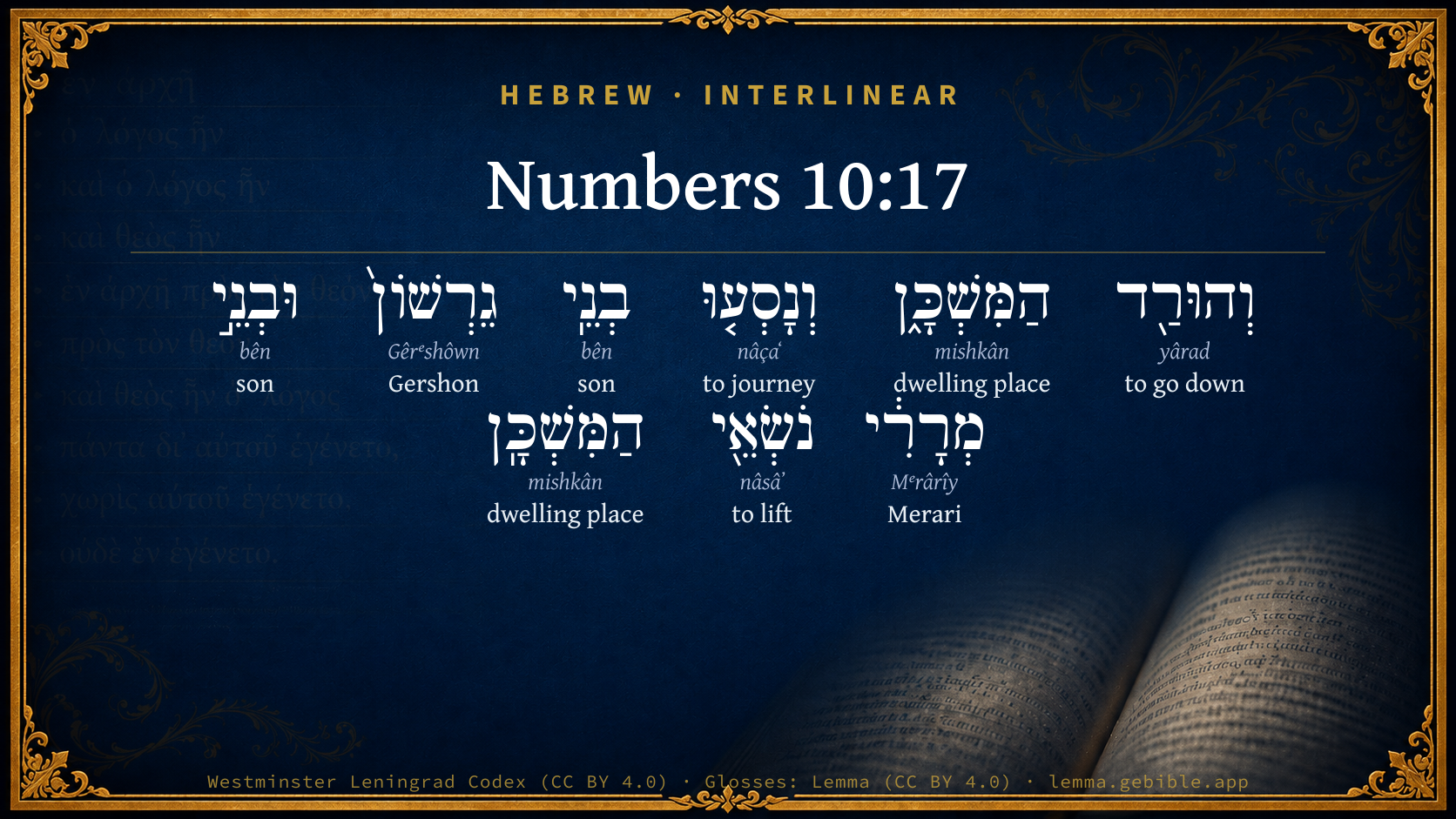
Hebrew (Westminster Leningrad Codex) Numbers 10:17 appears in the Hebrew Old Testament. The text above is from the Westminster Leningrad Codex. Each word links to its Strong’s number, a concise gloss, and parsing drawn from the Open Scriptures Hebrew Bible morphology. Click any word for its full Brown-Driver-Briggs (BDB) entry.
Download image
Cite this verse

Numbers 10:17 (World English Bible). Public Domain. Lemma interlinear Bible study tool, https://lemma.gebible.app/v/numbers/10/17.

Show BibTeX & RIS
BibTeX
RIS
English Translation
The tent was taken down; and the sons of Gershon and the sons of Merari, who bore the tent, set forward.
World English Bible · Public Domain
Download a study sheet

One document with this verse’s original text, its word-by-word gloss line, the meaning frame, cross-references with their text, attributed commentary, and full source and license credits — printable, and it pastes into notes with its structure intact.

This verse Autodidact and up

Study sheet (.html) Plain text (.txt)

A passage Seminary Student

Up to 50 verses in one chapter. A passage sheet keeps up to 6 commentary sources and 12 cross-references per verse, in the order this page ranks them, and says so on the sheet whenever that leaves anything out. Ask for a single verse and you get the Autodidact verse sheet above.

Everything on this page stays free to read, with no account — the sheet is a download of what is already on screen, not access to it.

Want to remove ads? Support Godless Engineer
Compare translations 3

The same verse in 3 English versions, stacked beneath the original-language interlinear above. Click any original word for its lexicon entry.

Each is an independent rendering of the whole verse — the interlinear is not word-aligned to these translations.

Highlighted words mark where these versions differ — a whole-verse word diff, not a word-by-word alignment.

  • World English Bible Public Domain
    The tent was taken down; and the sons of Gershon and the sons of Merari, who bore the tent, set forward.
  • King James Version Public Domain
    And the tabernacle was taken down; and the sons of Gershon and the sons of Merari set forward, bearing the tabernacle.
  • unfoldingWord Literal Text CC BY-SA 4.0
    And the Dwelling was taken down, and the sons of Gershon and the sons of Merari, the ones carrying the Dwelling, set out.

unfoldingWord Literal Text — © unfoldingWord, licensed CC BY-SA 4.0. Word-aligned USFM3 via Door43 (git.door43.org/unfoldingWord/en_ult).

Versions to compare (up to 4)

3 of 4 selected

Show all 18 translations

Every available English version of this verse, each an independent rendering of the whole verse.

  • World English Bible Public Domain
    The tent was taken down; and the sons of Gershon and the sons of Merari, who bore the tent, set forward.
  • Berean Standard Bible Public Domain
    Then the tabernacle was taken down, and the Gershonites and the Merarites set out, transporting it.
  • Majority Standard Bible Public Domain
    Then the tabernacle was taken down, and the Gershonites and the Merarites set out, transporting it.
  • King James Version Public Domain
    And the tabernacle was taken down; and the sons of Gershon and the sons of Merari set forward, bearing the tabernacle.
  • American Standard Version (1901) Public Domain
    And the tabernacle was taken down; and the sons of Gershon and the sons of Merari, who bare the tabernacle, set forward.
  • Revised Version (1885) Public Domain
    And the tabernacle was taken down; and the sons of Gershon and the sons of Merari, who bare the tabernacle, set forward.
  • Geneva Bible (1599) Public Domain
    When the Tabernacle was taken downe, then the sonnes of Gershon, and the sonnes of Merari went forward bearing the Tabernacle.
  • Douay-Rheims (1899) Public Domain
    And the tabernacle was taken down, and the sons of Gerson and Merari set forward, bearing it.
  • Young's Literal Translation Public Domain
    And the tabernacle hath been taken down, and the sons of Gershon and the sons of Merari have journeyed, bearing the tabernacle.
  • Literal Standard Version CC BY-SA 4.0
    And the Dwelling Place has been taken down, and the sons of Gershon and the sons of Merari have journeyed, carrying the Dwelling Place.
  • Unlocked Literal Bible CC BY-SA 4.0
    The descendants of Gershon and of Merari, who cared for the tabernacle, took down the tabernacle and then set out on their journey.
  • unfoldingWord Literal Text CC BY-SA 4.0
    And the Dwelling was taken down, and the sons of Gershon and the sons of Merari, the ones carrying the Dwelling, set out.
  • Darby Bible Public Domain
    And the tabernacle was taken down; and the sons of Gershon and the sons of Merari set forward bearing the tabernacle.
  • World Messianic Bible Public Domain
    The tabernacle was taken down; and the sons of Gershon and the sons of Merari, who bore the tabernacle, went forward.
  • Webster's Bible Public Domain
    And the tabernacle was taken down; and the sons of Gershon and the sons of Merari moved forward, bearing the tabernacle.
  • Free Bible Version CC BY-SA 4.0
    Then the Tabernacle was dismantled, and the Gershonites and the Merarites set off, carrying it.
  • Bible in Basic English Public Domain
    Then the House was taken down; and the sons of Gershon and the sons of Merari, who were responsible for moving the House, went forward.
  • JPS Tanakh (1917) Public Domain
    And the tabernacle was taken down; and the sons of Gershon and the sons of Merari, who bore the tabernacle, set forward.

Literal Standard Version (2020), Covenant Press — licensed CC BY-SA 4.0. Text via the HelloAO Bible API (eBible.org). Unlocked Literal Bible (unfoldingWord) — licensed CC BY-SA 4.0. Text via the HelloAO Bible API (eBible.org). unfoldingWord Literal Text — © unfoldingWord, licensed CC BY-SA 4.0. Word-aligned USFM3 via Door43 (git.door43.org/unfoldingWord/en_ult). Free Bible Version, Dr. Jonathan Gallagher — licensed CC BY-SA 4.0. Text via the HelloAO Bible API (eBible.org).

Word by word

More ways to search: Search by grammar → Find every occurrence → Compare this word →

Practice this passage: Drill this verse → Learn its vocabulary →

About this verse

These counts appear in no published source. They are computed here, from the morphology-tagged text and Lemma’s own curated glosses. What Lemma adds →

9
words
7
distinct lemmas
Pentateuch
section

Notable vocabulary

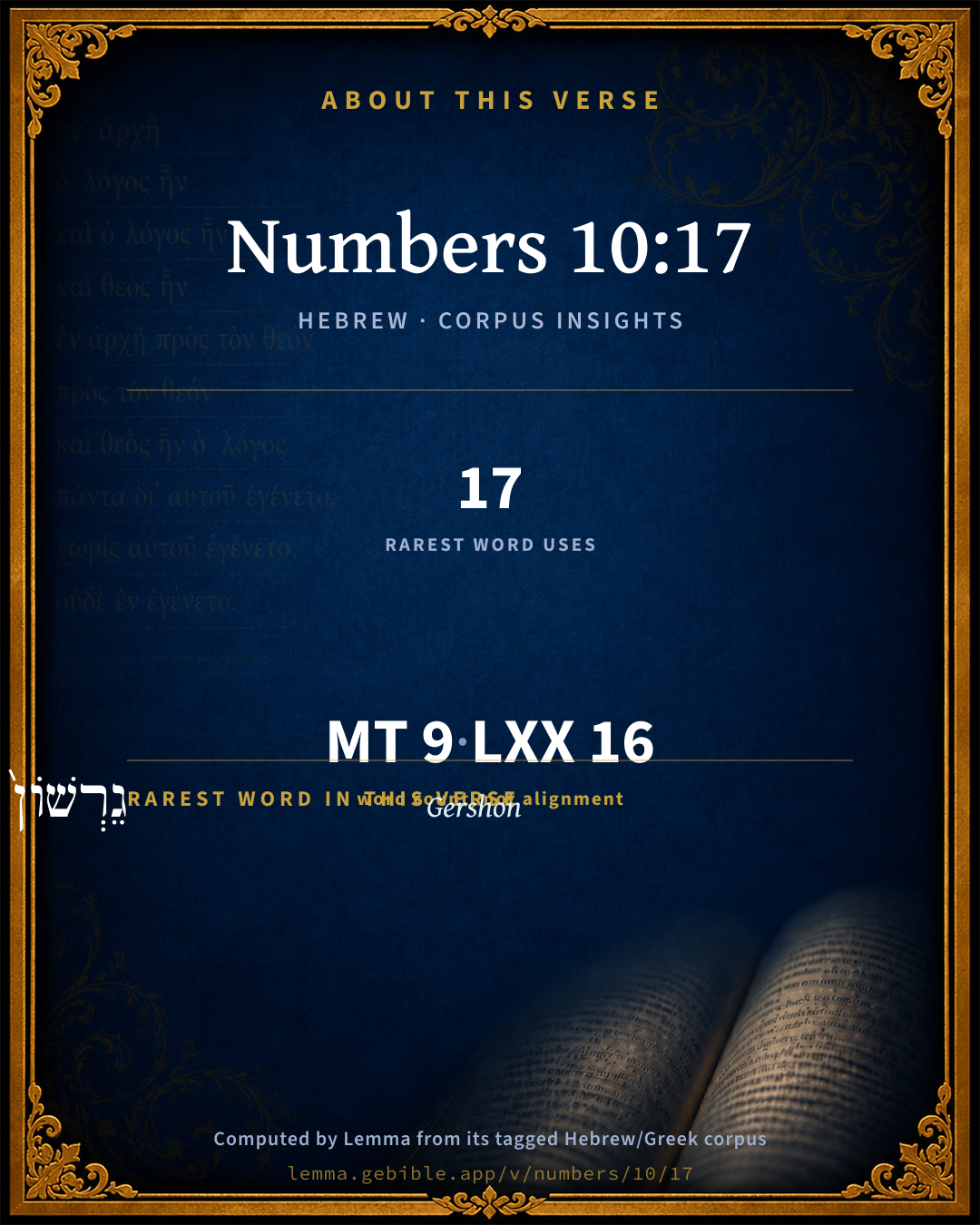
The rarest word here is גֵרְשׁוֹן֙ Gershon H1648 — appearing just 17 times in the whole Hebrew Bible.

Shared distinctive vocabulary

גֵרְשׁוֹן֙ Gershon H1648 occurs in 17 verses of the Hebrew Bible. Also found in:

Grammatical profile

  • 3 verbs
  • 6 nouns

Verb forms

  • וְהוּרַ֖ד Hophal · Sequential Perfect
  • וְנָסְע֤וּ Qal · Sequential Perfect
  • נֹשְׂאֵ֖י Qal · Participle Active

Repetition

Words recur within this verse — often emphatic in Hebrew:

  • הַמִּשְׁכָּ֑ן dwelling place H4908 ×2
  • בְנֵֽי son H1121 ×2

Hebrew & Septuagint length

In English translation the verse runs 21 words from the Hebrew and 24 from the Septuagint (LXX English) — closely comparable.

A rough comparison of the two English renderings, which tokenize alike — not a word-level alignment.

Word counts can differ between the Hebrew and the Greek without any difference in meaning — e.g. the Hebrew direct-object marker אֵת has no separate Greek word, and Greek often adds the article ὁ.

In the original languages it is 9 Hebrew tokens and 16 Greek tokens — but the two are counted differently (Hebrew bundles its prefixes and suffixes into one token; the Greek is in lemma form), so that isn’t a like-for-like length.

Cross-references

8

Topical passages linked to Numbers 10:17 in the Treasury of Scripture Knowledge — connected by theme and wording, ordered by reader-vote popularity; previews shown in the World English Bible.

  • Numbers 1:51 When the tabernacle is to move, the Levites shall take it down; and when the tabernacle is to be set up, the Levites shall set it up. The stranger who comes near shall be put to death.
  • Numbers 7:6–8 Moses took the wagons and the oxen, and gave them to the Levites.
  • Numbers 3:25–26 The charge of the sons of Gershon in the Tent of Meeting shall be the tabernacle, and the tent, its covering, and the screen for the door of the Tent of Meeting,
  • Numbers 3:36–37 The appointed charge of the sons of Merari shall be the tabernacle's boards, its bars, its pillars, its sockets, all its instruments, all its service,
  • Numbers 4:21–33 Yahweh spoke to Moses, saying,
  • Hebrews 9:11 But Christ having come as a high priest of the coming good things, through the greater and more perfect tabernacle, not made with hands, that is to say, not of this creation,
  • Hebrews 12:28 Therefore, receiving a Kingdom that can't be shaken, let us have grace, through which we serve God acceptably, with reverence and awe,
  • 2 Peter 1:14 knowing that the putting off of my tent comes swiftly, even as our Lord Jesus Christ made clear to me.

Cross-references courtesy of OpenBible.info (CC BY 4.0).

Hebrew and Greek witnesses Masoretic Hebrew ↔ Greek Septuagint

The same verse in the two great witnesses to the Old Testament, shown verse-for-verse.

These are two independent witnesses, not word-aligned to each other, and the Septuagint is shown in lemma (dictionary) form.

Hebrew Numbers 10:17 Masoretic · Westminster Leningrad Codex

וְהוּרַ֖ד הַמִּשְׁכָּ֑ן וְנָסְע֤וּ בְנֵֽי גֵרְשׁוֹן֙ וּבְנֵ֣י מְרָרִ֔י נֹשְׂאֵ֖י הַמִּשְׁכָּֽן

The tent was taken down; and the sons of Gershon and the sons of Merari, who bore the tent, set forward.

World English Bible · Public Domain

Greek LXX Numbers 10:17 Septuagint · lemma form

καί κατααἱρέω ὁ σκηνή καί ἐκαἴρω ὁ υἱός γεδσων καί ὁ υἱός μεραρι αἴρω ὁ σκηνή

And they shall take down the tabernacle, and the sons of Gedson shall set forward, and the sons of Merari, who bear the tabernacle.

LXX2012 (modern English Septuagint) · Public Domain

On this verse, The Pulpit Commentary discusses the Septuagint’s reading. Read the note in Commentary ↓

Hebrew: Westminster Leningrad Codex (CC BY 4.0). Greek: Septuagint (public domain); English from LXX2012 (modern English Septuagint) (Public Domain). How the Septuagint differs from the Hebrew →

Targum (Aramaic paraphrase)

2

The Targum is the ancient Jewish Aramaic paraphrase of the Hebrew Scriptures — an interpretive translation, not the Hebrew text itself. Onkelos (literal) and Pseudo-Jonathan (expansive) render the Torah, and Jonathan the Prophets. Coverage is partial: where no permissively-licensed English translation exists for a verse, only the Aramaic is shown. This is verse-level text, not a word-by-word alignment to the Hebrew.

  1. Targum Onkelos Torah (Genesis–Deuteronomy)
    וּמִתְפְּרַק מַשְׁכְּנָא וְנָטְלִין בְּנֵי גֵרְשׁוֹן וּבְנֵי מְרָרִי נָטְלֵי מַשְׁכְּנָא

    (no public-domain English translation for this verse)

    Targum Onkelos — Aramaic: “Onkelos Genesis” (public domain); “Onkelos Exodus” (public domain); “Onkelos Leviticus” (public domain); “Onkelos Numbers” (public domain); “Onkelos Deuteronomy” (public domain). English: “Sefaria Community Translation” (CC0 1.0 (public-domain dedication)); “J.W. Etheridge. The Targums of Onkelos and Jonathan Ben Uzziel on the Pentateuch. London: Longmans, Green, 1862” (public domain). Text via Sefaria.

  2. Targum Pseudo-Jonathan Torah (Genesis–Deuteronomy)
    וּמִתְפְּרַק מַשְׁכְּנָא וְנַטְלִין בְּנֵי גֵרְשׁוֹן וּבְנֵי מְרָרִי נַטְלֵי מַשְׁכְּנָא

    And the tabernacle was taken down, and the sons of Gershon and of Merari went forward, carrying the tabernacle.

    Targum Pseudo-Jonathan — Aramaic: “Targum Jonathan on Genesis” (public domain); “Targum Jonathan on Exodus” (public domain); “Targum Jonathan on Leviticus” (public domain); “Targum Jonathan on Numbers” (public domain); “Targum Jonathan on Deuteronomy” (public domain). English: “The Targum of Jonathan ben Uzziel, trans. J. W. Etheridge, London, 1862” (public domain). Text via Sefaria.

Commentary

Notes on Numbers 10:17 from classic Christian and Jewish commentators (each source and its license shown beneath its notes). The classic Christian expositions comment on the surrounding passage and are grouped to its opening verse, so a note may address several verses; the Jewish commentaries on the Tanakh (Rashi and others) are per-verse, so they appear only where the commentator wrote on this verse.

Lemma curates 59 commentaries, every one of them public domain or Creative Commons licensed, each selected and text-cleaned for this edition rather than reprinted as found. About our sources →

Ellicott's Commentary for English Readers

(17) And the tabernacle was taken down . . . —The order of precedence as regards the twelve tribes which were encamped on the four sides of the Tabernacle is clearly laid down in Numbers 2, where it is ordered that the camp of the Lervites should set forward “in the midst of the camps” (Num_10:17). The precise position which the three bodies of Levites were to occupy in the marches is defined in this chapter. The Gershonites, who had the charge of the curtains and hangings of the Tabernacle and the court (Num_4:25-26), with their two wagons, and the Merarites, who had the charge of the heavier and more bulky materials (Num_4:31-32), with their four wagons, were to set forward after the first or eastern camp, which was composed of the tribes of Judah, Issachar, and Zebulon, in order that they might have time to erect the Tabernacle before the arrival of the Kohathites, “bearing the sanctuary” (or sacred things). Next in order after the Gershonites and Merarites followed the southern camp, consisting of the three tribes of Reuben, Simeon, and Gad. Then followed the Kohathites in the centre of the procession, “bearing the sanctuary.” After them marched the three tribes of Ephraim, Manasseh, and Benjamin, who formed the western camp, and as the rereward, the three tribes of Dan, Asher, and Naphtali, which formed the northern camp. This arrangement serves to throw light upon Psa_80:2 : “Before Ephraim and Benjamin and Manasseh stir up thy strength, and come and save us.

A Bible Commentary for English Readers, edited by Charles John Ellicott (1878–1897) — public domain. Text from a community e-Sword module.

Geneva Bible (1599)

Geneva Bible translators

With all the appertainances thereof.

Geneva Bible (1599) marginal notes — public domain. Text via Bolls.life.

The Cambridge Bible for Schools and Colleges

gen. ed. J. J. S. Perowne

17. The verbs in this and the following verse, and in 21 f., 25, are perfects with Vav. This use, to describe consecutive actions in the past, though not unexampled in late literature, is rare. And it is probable that the writer intended them to be frequentative. The order of the host in the first march was that which was observed throughout the journeys.

The Cambridge Bible for Schools and Colleges (gen. ed. J. J. S. Perowne; Cambridge University Press, 1878–1918) — public domain. Text from a community e-Sword module.

John Gill's Exposition

And the standard of the camp of Reuben set forward according to their armies,.... Next proceeded the standard of Reuben, having under it the tribes of Simeon and Gad, Num 10:19; as "Reuben" signifies, "behold the son", and he had the tabernacle borne before him and the holy things behind him, which way soever this camp looked, it had in view what was a type of Christ the Son of God, the object of faith, the ark.

and over his host was Elizur the son of Shedeur; over which respective armies were the same captains as in Num 2:10;

John Gill's Exposition of the Whole Bible (1746–1763) — public domain (CC PDM 1.0). Text via the HelloAO Bible API.

Albert Barnes' Notes on the Bible

A more precise determination of the method of executing the order given in Num 2:17. The appointed place of the tabernacle, in the midst of the host, was represented during the march by the ark, the holy vessels, etc. carried by the Kohathites. The actual structure of the tabernacle was borne in advance by the Gershonites and Merarites, immediately behind the camp of Judah; so as to be set up ready against the arrival of the sacred utensils borne by the Kohathites. Compare Num. 2; 4,

Albert Barnes' Notes on the Bible (1834–1885) — public domain. Text from a community e-Sword/MySword module.

Haydock's Catholic Bible Commentary

It. Hence it would appear, that part of the Levites followed Juda’s division, which was preceded by the priests bearing the ark, (ver. 33,) while the Caathites bore the sacred vessels after Ruben, (ver. 21,) and were followed by Ephraim and Gad. But Calmet observes, that the Levites, and the whole camp of the Lord, came in the middle of the four great divisions, immediately after Ruben, chap. ii. 9, 17. Salien thinks, that the ark and cloud led the way, and returned to the middle at the end of the journey, ver. 36. (Haydock) (Tirinus)

George Leo Haydock (1774–1849), Haydock's Catholic Family Bible and Commentary, 1859 edition — public domain. Excludes Psalms (Douay-Rheims chapter numbering differs from Protestant) and Deuterocanonical books (Catholic canon only).

Whedon's Commentary on the Bible

Daniel D. Whedon

17-21. Bearing the tabernacle — By inspecting the plan of the camp (Num_2:5, cut) it will be seen that the bearers of the various parts of the tabernacle wheeled into the column after the entire eastern division of the camp had moved. The bearers of the sanctuary, or the most holy things, (Num_4:4, note,) waited after the removal of the tabernacle till the entire southern side of the camp was in line, when they also marched. This arrangement afforded ample protection to the body of Levites, and gave the bearers of the tabernacle the opportunity to set it up in time for the reception of its furniture against the Kohathites came, that is, by the time when they should arrive. For the place of the ark on the march see Num_10:33, note. This fixed order, rigidly adhered to, was necessary not only for military reasons, but to prevent the host from becoming a confused mob.

Daniel D. Whedon (gen. ed.), Commentary on the Old and New Testaments (1874–1909) — public domain. Text from a community e-Sword module.

The Pulpit Commentary

And the tabernacle was taken down. That is, the fabric of it; the boards, curtains, and other heavy portions which were packed upon the six wagons provided for the purpose. (Num_7:5-9) And the sons of Gershon and the sons of Merari set forward. Between the first and second divisions of the host. In chapter 2 it had been directed in general terms that "the tabernacle" should set forward with the camp of the Levites in the midst of the host, between the second and third divisions. At that time the duties of the several Levitical families had not been specified, and the orders for the taking down and transport of the tabernacle and its furniture had not been given in detail. It would be historically an error, and theologically a superstition, to imagine that Divine commands such as these had no elasticity, and left no room for adaptation, under the teaching of experience, or for the sake of obvious convenience. Whether the present modification was directly commanded by God himself, or whether it was made on the authority of Moses, does not here appear. There can be no question that subsequent theocratic rulers of Israel claimed and used a large liberty in modifying the Divinely-originated ritual and order. Compare the case of the passover, the arrangements of Solomon"s temple as corresponding with those of the tabernacle, and even the use of the silver trumpets. The Septuagint has the future tense here, kayelousi thn k.t.l. as if to mark it as a fresh command.

The Pulpit Commentary (1880–1919), ed. H.D.M. Spence-Jones & Joseph S. Exell — public domain. Text from a community e-Sword module.

unfoldingWord translationNotes

Door43 World Missions Community

Gershon ... Merari

See how you translated these men's names in Numbers 3:17.

the armies under the banner of Reuben's camp

This refers to the armies of the tribes under the division of Reuben: Reuben, Simeon, and Gad.

Elizur son of Shedeur

See how you translated this man's name in Numbers 1:5.

Shelumiel son of Zurishaddai

See how you translated this man's name Numbers 1:6.

Eliasaph son of Deuel

See how you translated this man's name in Numbers 1:14.

translationWords

tabernacle

Reuben

Simeon

Gad

unfoldingWord translationNotes — © Distant Shores Media and the Door43 World Missions Community, licensed CC BY-SA 4.0. Source: git.door43.org/Door43/en_tn.

Rashi

Rabbi Shlomo Yitzchaki (Rashi)

והורד המשכן THEN THE TABERNACLE WAS TAKEN DOWN — As soon as the division of Judah was on the point of journeying, Aaron and his sons went in (into the Tabernacle), took down the Partition Vail and covered the Ark with it, as it is said, (Numbers 4:5) “and when the camp setteth forward (i. e. is on the point of setting forward) Aaron shall come, and his sons, [and they shall take down the Partition Vail, etc.]”; the sons of Gershon and the sons of Merari then dismantled the Tabernacle, and loaded it on the waggons, and started off (so Berliner’s edition which adds ונוסעים). The Ark and the other holy vessels, the burden of the sons of Kohath (cf. Numbers 3:31), remained as they were, covered over, the latter hanging on poles, until the division of the sons of Reuben set out, and only after that did (v. 21) “the Kohathites set forward”.

Rashi on the Tanakh — English translations: “The Judaica Press complete Tanach with Rashi, translated by A. J. Rosenberg” (CC BY 4.0); “Pentateuch with Rashi's commentary by M. Rosenbaum and A.M. Silbermann, 1929-1934” (public domain); “The Metsudah Tanach series, Lakewood, N.J” (CC BY 4.0); and “The Book of Joshua, Metsudah Publications, 1997” (CC BY 4.0). Text via Sefaria.

Ramban (Nachmanides)

Rabbi Moshe ben Nachman (Ramban / Nachmanides)

AND THE TABERNACLE WAS TAKEN DOWN; AND THE SONS OF GERSHON AND THE SONS OF MERARI WHO BORE THE TABERNACLE SET FORWARD. The indication of the verses on this subject is as follows: After the standard of Judah had set forward, they would begin dismantling the Tabernacle, and the beginning of this dismantling was when Aaron and his sons came [into the Tabernacle] and took down the partition Veil, as it says, And when ‘the camp’ setteth forward, Aaron shall go in, and his sons, and they shall take down the Veil etc., that is to say, when the first camp [i.e., that of Judah] set forth. When they [the priests] finished covering the ark and all the holy vessels which were to be borne by the Kohathites, the Levites would take down the whole Tabernacle and load it upon the wagons; and the sons of Gershon and Merari then journeyed [with these wagons] after the standard of Judah, the ark and the holy vessels remaining covered and placed upon the staves until the standard of Reuben set forth. And the meaning of the verse Then the Tent of Meeting, with the camp of the Levites, shall set forward in the midst of the camps, 2:17. is that the Tent of Meeting together with all the camps of the Levites shall set forward in the midst of those camps perviously mentioned, for the Gershonites and Merarites journeyed between the standard of Judah and that of Reuben, while the Kohathites journeyed between the standard of Reuben and that of Ephraim, as He is to explain. He mentioned the reason [for the Gershonites and Merarites journeying before the Kohathites, namely] so that they might set up the Tabernacle before they [the Kohathites who carried the ark and the holy vessels] arrive [and thus they could immediately deposit the holy vessels therein].However, in the Beraitha of the Work of the Tabernacle, Chapter 13. I have seen the following text: “They blew t’kiah, t’ruah, ‘t’kiah, is a succession of nine tremulous or quavering sounds. A t’kiah is a continuous plain sound. The sh’varim are broken disconnected sounds, but they are not as broken as those of the t’ruah. The three broken sounds of the sh’varim are equal [in length of time] to the nine quavering sounds of the t’ruah. and the standard of Judah would set forth first, as it is said, And in the first place the standard of the camp of the children of Judah set forward. The sons of Aaron would then enter [the Tent of Meeting] and take down the Veil, and cover the ark with it, as it is said, And when the camp setteth forward, Aaron shall go in, and his sons etc. They then blew t’kiah, t’ruah, t’kiah, is a succession of nine tremulous or quavering sounds. A t’kiah is a continuous plain sound. The sh’varim are broken disconnected sounds, but they are not as broken as those of the t’ruah. The three broken sounds of the sh’varim are equal [in length of time] to the nine quavering sounds of the t’ruah. and the standard of the camp of Reuben would set forth. The sons of Gershon and the sons of Merari would immediately enter and dismantle the Tabernacle, and load it upon wagons and re-erect it [in the new resting-place] by the time the sons of Kohath arrived, as it is said, And the Kohathites the bearers of the Sanctuary set forward, that the Tabernacle might be set up against their coming. They blew t’kiah, t’ruah, t’kiah, is a succession of nine tremulous or quavering sounds. A t’kiah is a continuous plain sound. The sh’varim are broken disconnected sounds, but they are not as broken as those of the t’ruah. The three broken sounds of the sh’varim are equal [in length of time] to the nine quavering sounds of the t’ruah. and the standard of Ephraim would set forth. The sons of Kohath would immediately enter and dismantle the Sanctuary, (the Sanctuary) is evidently to be understood as in Verse 21 here: And the Kohathites the bearers of ‘the Sanctuary’ set forward, which Rashi explains as meaning: “the bearers of ‘the holy vessels’” [and not of the Sanctuary itself, for it was carried by the sons of Gershon and Merari]. This explanation is also clearly evident from the language of Ramban further on [“and the sons of Kohath would … load the holy vessels upon their shoulders”]. and put it upon their shoulders, as it is said, And when Aaron and his sons have finished covering the Sanctuary etc.”, since the Beraitha states that they journeyed after the standard of Reuben. Ramban now interprets the Beraitha so that it accords with the above interpretation which is in line with the simple meaning of Scripture. But perhaps the following is the correct interpretation of the Beraitha: “They blew t’kiah, t’ruah, t’kiah is a succession of nine tremulous or quavering sounds. A t’kiah is a continuous plain sound. The sh’varim are broken disconnected sounds, but they are not as broken as those of the t’ruah. The three broken sounds of the sh’varim are equal [in length of time] to the nine quavering sounds of the t’ruah. to alert the standard of Reuben to set forth, [but they did not actually set forth at once, for] immediately the sons of Gershon and the sons of Merari would precede them and dismantle the Tabernacle, but they would journey before the sons of Reuben. Similarly, they blew t’kiah, t’ruah, t’kiah is a succession of nine tremulous or quavering sounds. A t’kiah is a continuous plain sound. The sh’varim are broken disconnected sounds, but they are not as broken as those of the t’ruah. The three broken sounds of the sh’varim are equal [in length of time] to the nine quavering sounds of the t’ruah. that the standard of Ephraim be ready to set forth, and the sons of Kohath would immediately set forth and load the holy vessels upon their shoulders, and they would journey before the sons of Ephraim.” Thus the Rabbis taught that the journeying of the Levites should be preceded by blowing [of the trumpets], and immediately after them came the standard which followed them.

Ramban (Nachmanides) on the Tanakh — English translation: “Commentary on the Torah by Ramban (Nachmanides). Translated and annotated by Charles B. Chavel. New York, Shilo Pub. House, 1971-1976” (CC BY 4.0). Text via Sefaria.

Lesson kit

Teaching starters — assembled from the data on this page, not authored interpretation. Every prompt links to the verse data it draws on. Edit before teaching.

Numbers, in the Pentateuch, opens this verse with 9 words (7 distinct Hebrew lemmas). Its most distinctive word is Gêrᵉshôwn (“Gershon”). A historical commentator’s framing appears above. Read the whole chapter for the surrounding context.

Discussion questions

  1. What does “Gershon” (Gêrᵉshôwn) contribute to the verse as a whole?
  2. How does Genesis 46:11, which shares the word «Gershon», read alongside this verse?
  3. What does the repetition of “dwelling place” (2× in this one verse) do in this verse?
  4. These translations render this verse differently. What is at stake in choosing one wording over another?
  5. «וְהוּרַ֖ד» is a Hophal Sequential Perfect verb. How does that grammatical form shape the action described?
  6. Compare how Ellicott's Commentary for English Readers and Geneva Bible (1599) read this verse. Where do they agree or differ?

Things to notice

Reading settings

Reading text

Shown beneath each verse's original-language words.

Old Testament
Old Testament edition

Read the OT as the Masoretic Hebrew (MT) or the Greek Septuagint (LXX).

English shown for the Greek Septuagint (in the Hebrew ↔ Greek comparison).

Comparing translations? Open the Compare panel on any verse page to stack up to four side by side.