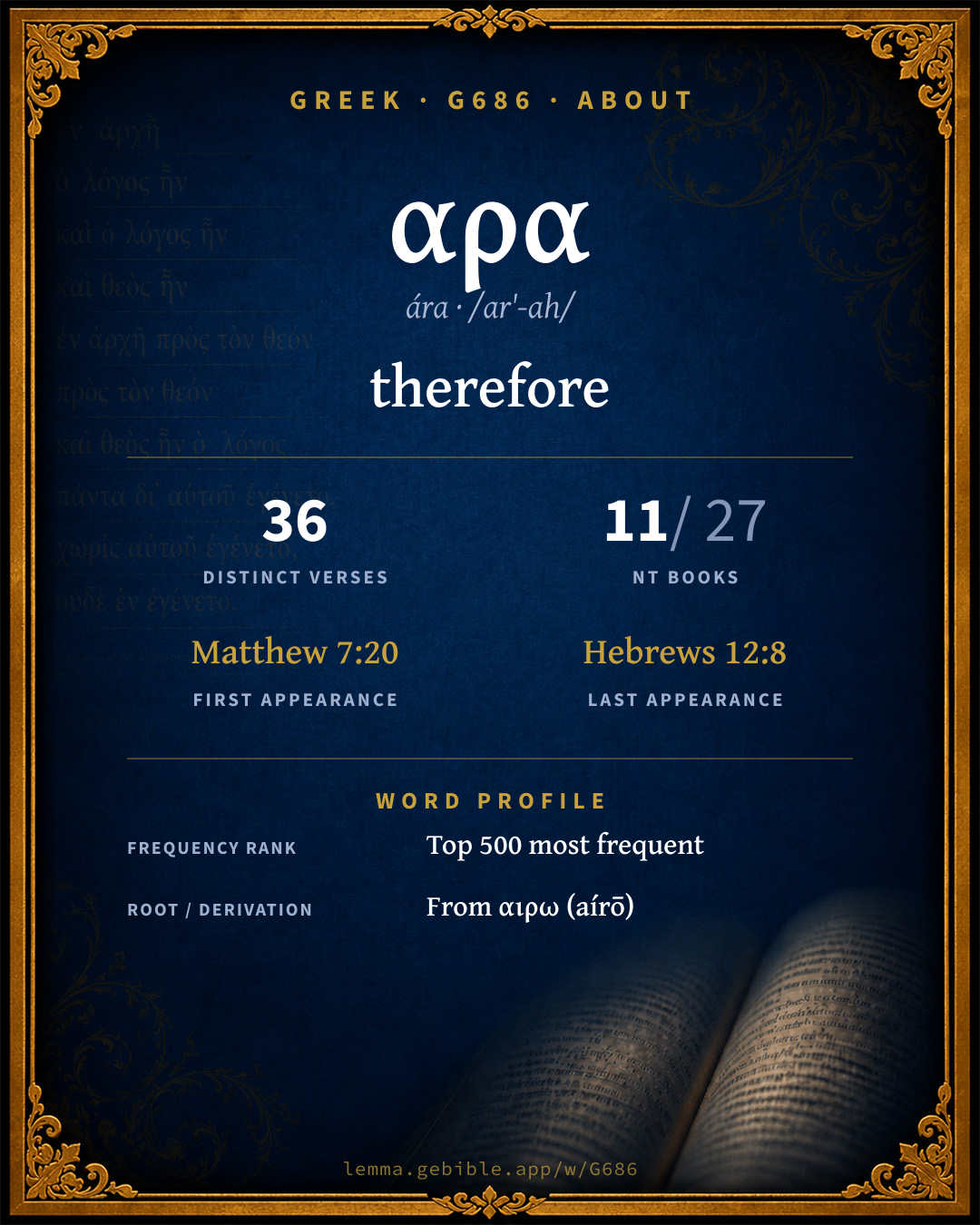
ἄρα
therefore
Full lexicon entry — Thayer's Greek Lexicon
From Thayer's Greek Lexicon
Where this word appears
Grammar key — what these labels mean
Part of speech
- Particle
- A short, often untranslatable function word adding nuance or connection.
Every verse where G686 appears — 36 distinct verses across 11 books. Click any verse to open its interlinear word-by-word view. Verse text shown in the World English Bible for context — . Each verse’s Greek form is shown with its reference; the English is not keyword-highlighted, since the data carries no word-level English alignment. Use “Compare translations” on any verse to read it across multiple English versions. This concordance covers the Greek New Testament; Septuagint (Greek Old Testament) occurrences of this word are not indexed here.
Matthew 3 verses
- Matthew 7:20 ἄραγε ptcl Therefore, by their fruits you will know them.
- Matthew 12:28 ἄρα ptcl But if I by the Spirit of God cast out demons, then the Kingdom of God has come upon you.
- Matthew 17:26 ἄραγε ptcl Peter said to him, "From strangers." Jesus said to him, "Therefore the children are exempt.
Luke 2 verses
Acts 3 verses
- Acts 8:30 ἆράγε ptcl Philip ran to him, and heard him reading Isaiah the prophet, and said, "Do you understand what you are reading?"
- Acts 11:18 ἄρα ptcl When they heard these things, they held their peace, and glorified God, saying, "Then God has also granted to the Gentiles repentance to life!"
- Acts 17:27 ἄραγε ptcl that they should seek the Lord, if perhaps they might reach out for him and find him, though he is not far from each one of us.
Romans 11 verses
- Romans 5:18 Ἄρα ptcl So then as through one trespass, all men were condemned; even so through one act of righteousness, all men were justified to life.
- Romans 7:3 ἄρα ptcl So then if, while the husband lives, she is joined to another man, she would be called an adulteress. But if the husband dies, she is free from the law, so that she is no adulteress, though she is joined to another man.
- Romans 7:21 ἄρα ptcl I find then the law, that, to me, while I desire to do good, evil is present.
- Romans 7:25 ἄρα ptcl I thank God through Jesus Christ, our Lord! So then with the mind, I myself serve God's law, but with the flesh, the sin's law.
- Romans 8:1 ἄρα ptcl There is therefore now no condemnation to those who are in Christ Jesus, who don't walk according to the flesh, but according to the Spirit.
- Romans 8:12 Ἄρα ptcl So then, brothers, we are debtors, not to the flesh, to live after the flesh.
- Romans 9:16 ἄρα ptcl So then it is not of him who wills, nor of him who runs, but of God who has mercy.
- Romans 9:18 ἄρα ptcl So then, he has mercy on whom he desires, and he hardens whom he desires.
- Romans 10:17 ἄρα ptcl So faith comes by hearing, and hearing by the word of God.
- Romans 14:12 ἄρα ptcl So then each one of us will give account of himself to God.
- Romans 14:19 ἄρα ptcl So then, let us follow after things which make for peace, and things by which we may build one another up.
1 Corinthians 5 verses
- 1 Corinthians 5:10 ἄρα ptcl yet not at all meaning with the sexual sinners of this world, or with the covetous and extortioners, or with idolaters; for then you would have to leave the world.
- 1 Corinthians 7:14 ἄρα ptcl For the unbelieving husband is sanctified in the wife, and the unbelieving wife is sanctified in the husband. Otherwise your children would be unclean, but now are they holy.
- 1 Corinthians 15:14 ἄρα ptcl If Christ has not been raised, then our preaching is in vain, and your faith also is in vain.
- 1 Corinthians 15:15 ἄρα ptcl Yes, we are found false witnesses of God, because we testified about God that he raised up Christ, whom he didn't raise up, if it is so that the dead are not raised.
- 1 Corinthians 15:18 ἄρα ptcl Then they also who are fallen asleep in Christ have perished.
2 Corinthians 2 verses
- 2 Corinthians 5:15 ἄρα ptcl He died for all, that those who live should no longer live to themselves, but to him who for their sakes died and rose again.
- 2 Corinthians 7:12 ἄρα ptcl So although I wrote to you, I wrote not for his cause that did the wrong, nor for his cause that suffered the wrong, but that your earnest care for us might be revealed in you in the sight of God.
Galatians 5 verses
- Galatians 2:21 ἄρα ptcl I don't make void the grace of God. For if righteousness is through the law, then Christ died for nothing!"
- Galatians 3:7 ἄρα ptcl Know therefore that those who are of faith, the same are children of Abraham.
- Galatians 3:29 ἄρα ptcl If you are Christ's, then you are Abraham's seed and heirs according to promise.
- Galatians 5:11 ἄρα ptcl But I, brothers, if I still preach circumcision, why am I still persecuted? Then the stumbling-block of the cross has been removed.
- Galatians 6:10 ἄρα ptcl So then, as we have opportunity, let's do what is good toward all men, and especially toward those who are of the household of the faith.
Ephesians 1 verse
1 Thessalonians 1 verse
2 Thessalonians 1 verse
Hebrews 2 verses
About this entry
At a glance — auto-summarized from this page’s data, not written by a person. Every figure links to its source below. This summary describes the numbers; it doesn’t interpret them.
At its core, αρα (ára) means “therefore.” First canonically at Matthew 7:20, it enters the text early. With 36 verses in 11 books, it is a moderately common word in the Greek New Testament. Its uses concentrate in Romans (31% of all occurrences). From the same root come αιρω, αιρεομαι and αρα. Dig into 36-verse concordance and the renderings breakdown below.
Gloss history
Strong's 1890 vs modern scholarship

About this word
Strong's G686 catalogs a Greek word from the Greek New Testament.
These counts are not copied from any lexicon or concordance. They are computed here, from the morphology-tagged Greek New Testament. What Lemma adds →
- 36
- distinct verses
- The word appears in 36 distinct verses.
- 11 / 27
- NT books
- The word appears in 11 of 27 New Testament books.
- #406
- by frequency
- Top 500 most frequent Greek words (rank 406 of 5,347 Greek words by occurrence).
View all 36 occurrences in the concordance →
Most concentrated in
- Romans 11 verses 31%
- 1 Corinthians 5 verses 14%
- Galatians 5 verses 14%
By section of the New Testament
By traditional corpus
Conventional, traditional groupings — biblical authorship is debated, so this is a traditional corpus grouping, not an authorship claim. Some books belong to more than one corpus (Luke is in both the Gospels and the Lukan corpus, and so on), so these shares overlap and need not total 100%. Each figure is a share of the word’s 36 distinct verses.
- Pauline corpus 26 verses · 72%
- Gospels 5 verses · 14%
- Lukan (Luke–Acts) 5 verses · 14%
- Hebrews 2 verses · 6%
How translations render this word
Counts come from each version’s own published word-to-Strong’s tagging or interlinear alignment — an approximate guide to how each version renders this word, not a word-level alignment the data otherwise carries. Because each total is that version’s own tagged count, the per-version totals vary from one another and need not match the appearance or distinct-verse counts above. These counts may also differ from a printed concordance because Lemma counts each distinctly tagged rendering and does not collapse phrase taggings into a single head-word total. This is a fixed set of word-tagged versions (KJV, ASV, BSB, ULT) and does not change with the reading translation you choose elsewhere. Each version’s license is shown beside its name below (and on Sources).
- King James Version: Then 20×, Therefore 11×, Haply 2×
- American Standard Version: Then 10×, So 8×, Therefore 3×
- Berean Standard Bible: Then 19×, So 8×, Therefore 6×
- unfoldingWord Literal Text: Then 27×, So 12×, Therefore 6×
King James Version Public Domain
Renders G686 across 44 tagged occurrences — most commonly:
Plus 9 renderings that appear only once — usually multi-word phrases or single function words the recovered tagging swept in, not distinct renderings. Not rendered by a distinct English word in 7 further occurrences.
American Standard Version Public Domain
Renders G686 across 29 tagged occurrences — most commonly:
Plus 8 renderings that appear only once — usually multi-word phrases or single function words the recovered tagging swept in, not distinct renderings.
Berean Standard Bible Public Domain
Renders G686 across 38 tagged occurrences — most commonly:
Plus 3 renderings that appear only once — usually multi-word phrases or single function words the recovered tagging swept in, not distinct renderings. Not rendered by a distinct English word in 9 further occurrences.
unfoldingWord Literal Text CC BY-SA 4.0
Renders G686 across 49 tagged occurrences — most commonly:
Plus 2 renderings that appear only once — usually multi-word phrases or single function words the recovered tagging swept in, not distinct renderings.
Senses in Thayer's
The 1 sense Thayer's distinguishes for this word, in lexicon order (not ranked by frequency or importance). The full entry — with sub-senses — is in the Lexicon Entry tab.
- therefore, so then, wherefore
Word origin
Derived from αιρω (aírō) (G142) — to raise up.
Probably from G142 (through the idea of drawing a conclusion); a particle denoting an inference more or less decisive (as follows): - haply (what) manner (of man) no doubt perhaps so be then therefore truly wherefore. Often used in connection with other particles especially G1065 or G3767 (after) or G1487 (before). Compare also G687 .
— Strong’s Exhaustive Concordance (1890), public domain.
Forms in the corpus
The 4 distinct written forms G686 takes in the Greek New Testament, most frequent first — each parse links to that case’s occurrences in the concordance.
| Form | Parsing | Example | Uses |
|---|---|---|---|
| ἄρα ára | Particle | Matthew 12:28 | 30 |
| ἄραγε árage | Particle | Matthew 7:20 | 3 |
| Ἄρα Ára | Particle | Romans 5:18 | 2 |
| ἆράγε âráge | Particle | Acts 8:30 | 1 |
Same root — word family
Other Thayer's entries built from the same root as G686, grouped by Strong’s listed origin. These share a root / origin per the lexicon — not necessarily a shared meaning. Each links to that word’s own entry.
Derives from
Shares the same root
- αιρεομαι hairéomai G138 to choose
- αρα ará G685 curse
- αρεσκω aréskō G700 to please
- αριθμος arithmós G706 number
- αρκεω arkéō G714 to ward off
- αρρην árrhēn G730 male
- αρτι árti G737 now
- αρτος ártos G740 bread
- αρτυω artýō G741 to season
- αρωμα árōma G759 spice
- ορος óros G3735 mountain
Derived from this word
Compare all same-root words → Showing 4 of 14 — not the complete family. They share a root, not necessarily a meaning.