

Acts 27:13
Greek (Tischendorf 8th ed.) Acts 27:13 appears in the Greek New Testament. The text above is from the Tischendorf 8th edition. Each word links to its Strong’s number and a concise gloss. Click any word for its full Thayer’s Greek Lexicon entry.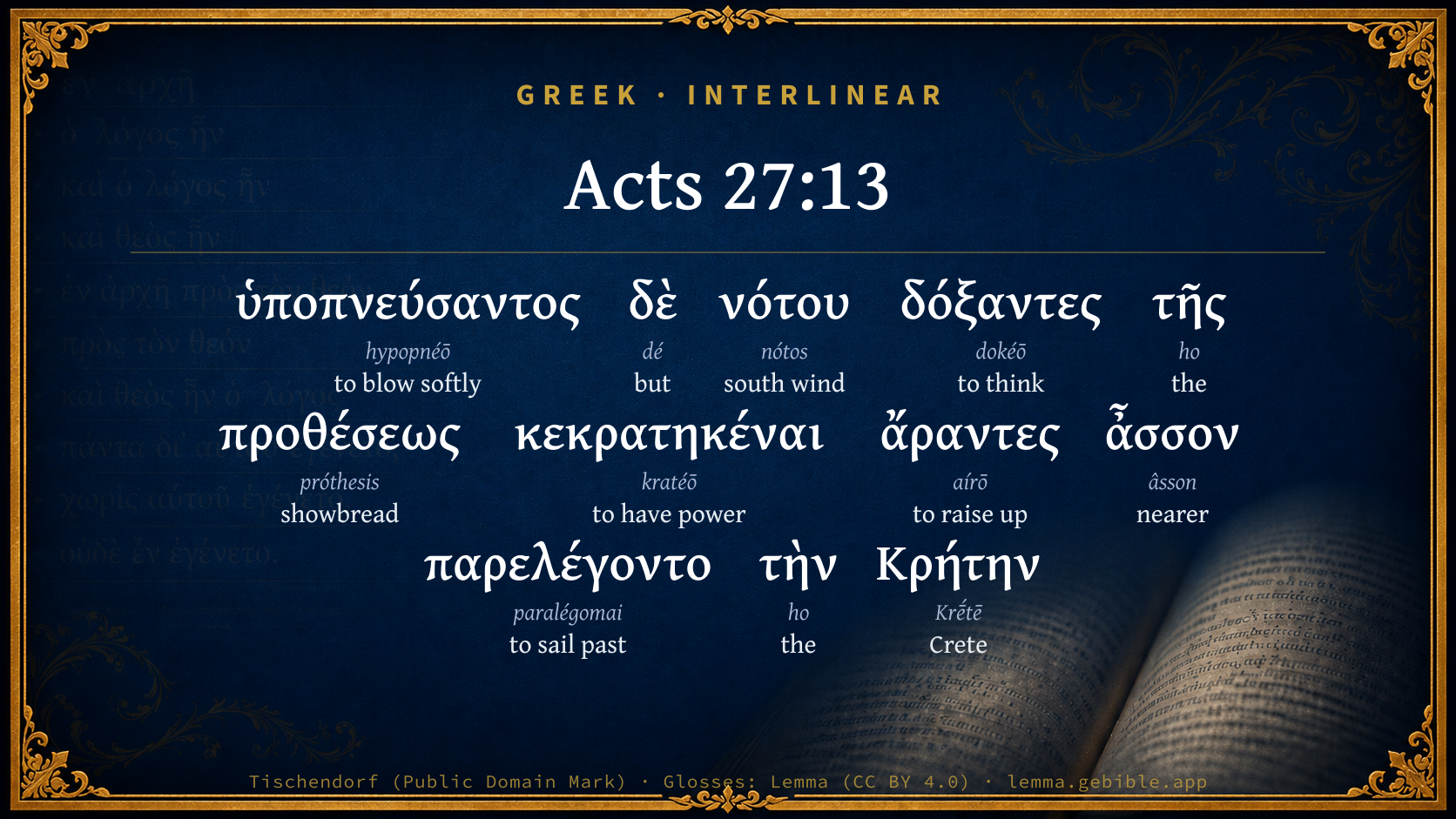
When the south wind blew softly, supposing that they had obtained their purpose, they weighed anchor and sailed along Crete, close to shore.
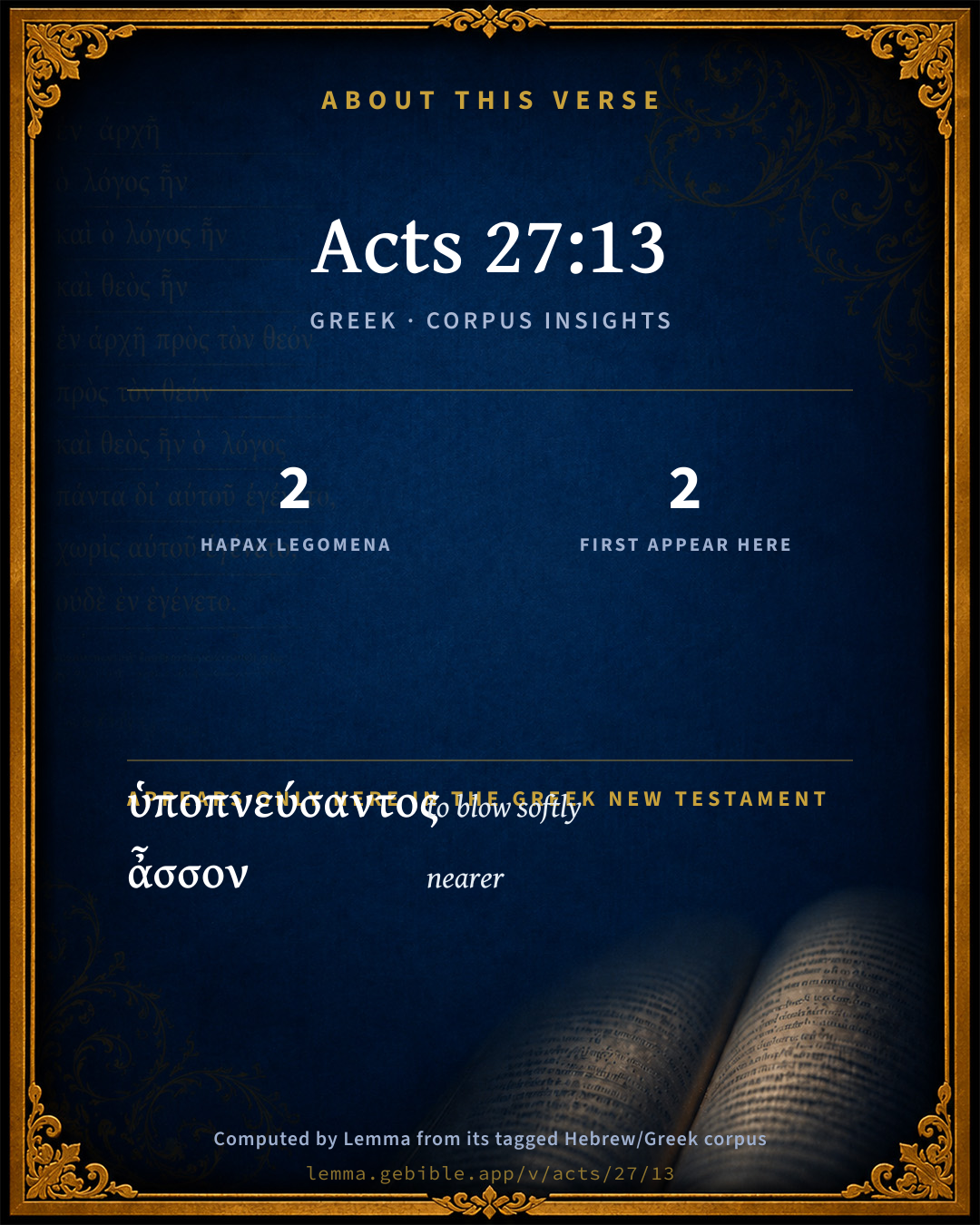
- 2 hapax legomena — only here in the Greek New Testament
- 2 first appearances in the Greek New Testament
Download a study sheet
One document with this verse’s original text, its word-by-word gloss line, the meaning frame, cross-references with their text, attributed commentary, and full source and license credits — printable, and it pastes into notes with its structure intact.
This verse Autodidact and up
A passage Seminary Student
Up to 50 verses in one chapter. A passage sheet keeps up to 6 commentary sources and 12 cross-references per verse, in the order this page ranks them, and says so on the sheet whenever that leaves anything out. Ask for a single verse and you get the Autodidact verse sheet above.
Everything on this page stays free to read, with no account — the sheet is a download of what is already on screen, not access to it.
Compare translations 3
The same verse in 3 English versions, stacked beneath the original-language interlinear above. Click any original word for its lexicon entry.
Each is an independent rendering of the whole verse — the interlinear is not word-aligned to these translations.
Highlighted words mark where these versions differ — a whole-verse word diff, not a word-by-word alignment.
-
World English Bible Public Domain
When the south wind blew softly, supposing that they had obtained their purpose, they weighed anchor and sailed along Crete, close to shore.
-
King James Version Public Domain
And when the south wind blew softly, supposing that they had obtained their purpose, loosing thence, they sailed close by Crete.
-
unfoldingWord Literal Text CC BY-SA 4.0
And as a south wind was blowing gently, thinking to have obtained purpose, having raised, they were sailing along close to Crete.
unfoldingWord Literal Text — © unfoldingWord, licensed CC BY-SA 4.0. Word-aligned USFM3 via Door43 (git.door43.org/unfoldingWord/en_ult).
Show all 19 translations
Every available English version of this verse, each an independent rendering of the whole verse.
-
World English Bible Public Domain
When the south wind blew softly, supposing that they had obtained their purpose, they weighed anchor and sailed along Crete, close to shore.
-
Berean Standard Bible Public Domain
When a gentle south wind began to blow, they thought they had their opportunity. So they weighed anchor and sailed along, hugging the coast of Crete.
-
Majority Standard Bible Public Domain
When a gentle south wind began to blow, they thought they had their opportunity. So they weighed anchor and sailed along, hugging the coast of Crete.
-
King James Version Public Domain
And when the south wind blew softly, supposing that they had obtained their purpose, loosing thence, they sailed close by Crete.
-
American Standard Version (1901) Public Domain
And when the south wind blew softly, supposing that they had obtained their purpose, they weighed anchor and sailed along Crete, close in shore.
-
Revised Version (1885) Public Domain
And when the south wind blew softly, supposing that they had obtained their purpose, they weighed anchor and sailed along Crete, close in shore.
-
Geneva Bible (1599) Public Domain
And when the Southerne winde blew softly, they supposing to atteine their purpose, loosed neerer, and sailed by Candie.
-
Douay-Rheims (1899) Public Domain
And the south wind gently blowing, thinking that they had obtained their purpose, when they had loosed from Asson, they sailed close by Crete.
-
Young's Literal Translation Public Domain
and a south wind blowing softly, having thought they had obtained `their' purpose, having lifted anchor, they sailed close by Crete,
-
Literal Standard Version CC BY-SA 4.0
and a south wind blowing softly, having thought they had obtained [their] purpose, having lifted anchor, they sailed close by Crete,
-
Unlocked Literal Bible CC BY-SA 4.0
When the south wind began to blow gently, the sailors thought that they had what they needed. So they weighed anchor and sailed along Crete, close to the shore.
-
unfoldingWord Literal Text CC BY-SA 4.0
And as a south wind was blowing gently, thinking to have obtained purpose, having raised, they were sailing along close to Crete.
-
Darby Bible Public Domain
And [the] south wind blowing gently, supposing that they had gained their object, having weighed anchor they sailed close in shore along Crete.
-
World Messianic Bible Public Domain
When the south wind blew softly, supposing that they had obtained their purpose, they weighed anchor and sailed along Crete, close to shore.
-
Webster's Bible Public Domain
And when the south wind blew softly, supposing that they had obtained their purpose, loosing thence, they sailed close by Crete.
-
Free Bible Version CC BY-SA 4.0
When a moderate south wind began to blow, they thought they could do what they planned. They pulled up the anchor and sailed close inshore along the coast of Crete.
-
Bible in Basic English Public Domain
And when the south wind came softly, being of the opinion that their purpose might be effected, they let the ship go and went sailing down the side of Crete, very near to the land.
-
Text-Critical English NT CC BY 4.0
When a south wind started blowing gently, they thought that the opportunity had come for them to carry out their plan. So they weighed anchor and sailed closely along the shore of Crete.
-
Tyndale New Testament (1534) Public Domain
When the south wynde blewe they supposynge to obtayne their purpose lowsed vnto Asson and sayled paste all Candy.
Literal Standard Version (2020), Covenant Press — licensed CC BY-SA 4.0. Text via the HelloAO Bible API (eBible.org). Unlocked Literal Bible (unfoldingWord) — licensed CC BY-SA 4.0. Text via the HelloAO Bible API (eBible.org). unfoldingWord Literal Text — © unfoldingWord, licensed CC BY-SA 4.0. Word-aligned USFM3 via Door43 (git.door43.org/unfoldingWord/en_ult). Free Bible Version, Dr. Jonathan Gallagher — licensed CC BY-SA 4.0. Text via the HelloAO Bible API (eBible.org).
Word by word
More ways to search: Search by grammar → Find every occurrence → Compare this word →
Practice this passage: Drill this verse → Learn its vocabulary →
- Appears 1× in the Greek New Testament
- First appears here
- Part of Speech
- Verb
- Tense
- Aorist
- Voice
- Active
- Mood
- Participle
- Case
- Genitive
- Number
- Singular
- Gender
- Masculine
Full Thayer's Definition
- ὑποπνεύσαντος hypopnéō G5285 “to blow softly” Verb, Aorist, Active, Participle, Genitive, Singular, Masculine
- δὲ dé G1161 “but” Conjunction
- νότου nótos G3558 “south wind” Noun, Genitive, Singular, Masculine
- δόξαντες dokéō G1380 “to think” Verb, Aorist, Active, Participle, Nominative, Plural, Masculine
- τῆς ho G3588 “the” Article, Genitive, Singular, Feminine
- προθέσεως próthesis G4286 “showbread” Noun, Genitive, Singular, Feminine
- κεκρατηκέναι kratéō G2902 “to have power” Verb, Perfect, Active, Infinitive
- ἄραντες aírō G142 “to raise up” Verb, Aorist, Active, Participle, Nominative, Plural, Masculine
- ἆσσον âsson G788 “nearer” Adverb, Comparative
- παρελέγοντο paralégomai G3881 “to sail past” Verb, Imperfect, Middle or Passive deponent, Indicative, 3rd person, Plural
- τὴν ho G3588 “the” Article, Accusative, Singular, Feminine
- Κρήτην Krḗtē G2914 “Crete” Noun, Accusative, Singular, Feminine
About this verse
These counts appear in no published source. They are computed here, from the morphology-tagged text and Lemma’s own curated glosses. What Lemma adds →
- 12
- words
- 11
- distinct lemmas
- Acts
- section
Notable vocabulary
2 hapax legomena — words that appear only here in the entire Greek New Testament:
First appearance in Scripture
These words make their first canonical appearance in the Greek New Testament here:
Shared distinctive vocabulary
παρελέγοντο to sail past G3881 occurs in 2 verses of the Greek New Testament. Also found in:
Repetition
A word recurs within this verse:
- τῆς the G3588 ×2
Cross-references
4Topical passages linked to Acts 27:13 in the Treasury of Scripture Knowledge — connected by theme and wording, ordered by reader-vote popularity; previews shown in the World English Bible.
- Job 37:17 You whose clothing is warm, When the earth is still by reason of the south wind?
- Psalms 78:26 He caused the east wind to blow in the sky. By his power he guided the south wind.
- Song of Solomon 4:16 Awake, north wind; and come, you south; Blow on my garden, that its spices may flow out. Let my beloved come into his garden, And taste his precious fruits. Lover
- Luke 12:55 When a south wind blows, you say, 'There will be a scorching heat,' and it happens.
Cross-references courtesy of OpenBible.info (CC BY 4.0).
Lesson kit
Teaching starters — assembled from the data on this page, not authored interpretation. Every prompt links to the verse data it draws on. Edit before teaching.
Acts, in the Acts, opens this verse with 12 words (11 distinct Greek lemmas). Its most distinctive word is hypopnéō (“to blow softly”). A historical commentator’s framing appears above. Read the whole chapter for the surrounding context.
Discussion questions
- The word hypopnéō carries the sense “to blow softly.” How does it shape the verse?
- This verse holds 2 words here found nowhere else in the Greek New Testament. What might the rare words draw attention to?
- 2 words here appear for the first time in Scripture. What is being introduced at this debut?
- Acts 27:8 shares the word «to sail past» with this verse. How do the two illuminate each other?
- “the” occurs 2× in this one verse. What is the effect of the repetition?
- The translations on this page render this verse differently — a whole-verse word diff, not a word-by-word alignment. What might account for the different wordings?
- Reading how Joseph Benson's Commentary and Whedon's Commentary on the Bible read this verse, where do the two commentators agree and where do they part?
Things to notice
- 2 words in this verse appear nowhere else in the Greek New Testament.
- 2 words make their first canonical appearance in Scripture here.
- These translations choose different wording for 19 words in this verse.
- “the” occurs 2× in this single verse.
- 11 distinct Greek lemmas span 12 words in this verse.
Commentary
Notes on Acts 27:13 from classic Christian and Jewish commentators (each source and its license shown beneath its notes). The classic Christian expositions comment on the surrounding passage and are grouped to its opening verse, so a note may address several verses; the Jewish commentaries on the Tanakh (Rashi and others) are per-verse, so they appear only where the commentator wrote on this verse.
Lemma curates 59 commentaries, every one of them public domain or Creative Commons licensed, each selected and text-cleaned for this edition rather than reprinted as found. About our sources →
Joseph Benson's Commentary
Joseph Benson's Commentary on the Old and New Testaments (1811–1818) — public domain. Text from a community e-Sword module.
Whedon's Commentary on the Bible
Daniel D. Whedon
Daniel D. Whedon (gen. ed.), Commentary on the Old and New Testaments (1874–1909) — public domain. Text from a community e-Sword module.
MacLaren's Expositions of Holy Scripture
Alexander MacLaren
Alexander MacLaren, Expositions of Holy Scripture (1904–1910) — public domain. Text from a community e-Sword module.
Bengel's Gnomon
Johann Albrecht Bengel
Bengel's Gnomon of the New Testament — English translation (T&T Clark, Edinburgh, 1860) — public domain. Text from a community e-Sword module.
Meyer's Critical & Exegetical Commentary
Heinrich August Wilhelm Meyer
Meyer — Critical and Exegetical Commentary on the New Testament — English translation by Peter Christie, edited by Frederick Crombie (T&T Clark, 1880) — public domain. Text from a community e-Sword module.
Expositor's Greek Testament
ed. W. Robertson Nicoll
The Expositor's Greek Testament, edited by W. Robertson Nicoll (1897–1910) — public domain. Text from a community e-Sword module.
Jamieson, Fausset & Brown
Robert Jamieson, A. R. Fausset & David Brown
Jamieson, Fausset & Brown — Commentary Critical and Explanatory on the Whole Bible (1871) — public domain (CC PDM 1.0). Text via the HelloAO Bible API.
Adam Clarke's Commentary
Adam Clarke's Commentary on the Bible (1810–1826) — public domain. Text from a community e-Sword/MySword module.
Ellicott's Commentary for English Readers
A Bible Commentary for English Readers, edited by Charles John Ellicott (1878–1897) — public domain. Text from a community e-Sword module.
The Cambridge Bible for Schools and Colleges
gen. ed. J. J. S. Perowne
The Cambridge Bible for Schools and Colleges (gen. ed. J. J. S. Perowne; Cambridge University Press, 1878–1918) — public domain. Text from a community e-Sword module.
John Gill's Exposition
John Gill's Exposition of the Whole Bible (1746–1763) — public domain (CC PDM 1.0). Text via the HelloAO Bible API.
Trapp's Complete Commentary
John Trapp
John Trapp, A Commentary or Exposition upon All the Books of the Old and New Testament (1647–1656) — public domain. Text from a community e-Sword module.
Albert Barnes' Notes on the Bible
Albert Barnes' Notes on the Bible (1834–1885) — public domain. Text from a community e-Sword/MySword module.
Matthew Poole's English Annotations
Matthew Poole's English Annotations on the Holy Bible (1683–1685) — public domain. Text from a community e-Sword/MySword module.
The Pulpit Commentary
The Pulpit Commentary (1880–1919), ed. H.D.M. Spence-Jones & Joseph S. Exell — public domain. Text from a community e-Sword module.
Godbey's Commentary on the New Testament
William B. Godbey
William B. Godbey, Commentary on the New Testament (1896–1900) — public domain. Text from a community e-Sword module.
McGarvey & Pendleton's Commentaries
J. W. McGarvey
J. W. McGarvey (with Philip Y. Pendleton), Commentaries on the New Testament (The Fourfold Gospel, 1914; Acts; and the epistles) — public domain. Text from a community e-Sword/MySword module.
Cambridge Greek Testament for Schools and Colleges
Cambridge Greek Testament for Schools and Colleges (Cambridge University Press, 1896; 21 vols, various authors incl. Carr, Maclear, Plummer, Farrar, Lumby, Moule, M. R. James, Simcox) — public domain. Text from a community e-Sword module.
Alford’s Greek Testament
Henry Alford
Henry Alford, The Greek Testament (1849–1861) — public domain. Text from a community e-Sword module.
Vincent's Word Studies in the New Testament
Marvin R. Vincent
Marvin R. Vincent, Word Studies in the New Testament (1887–1900) — public domain. Text from a community e-Sword/MySword module.