
Numbers 4:49

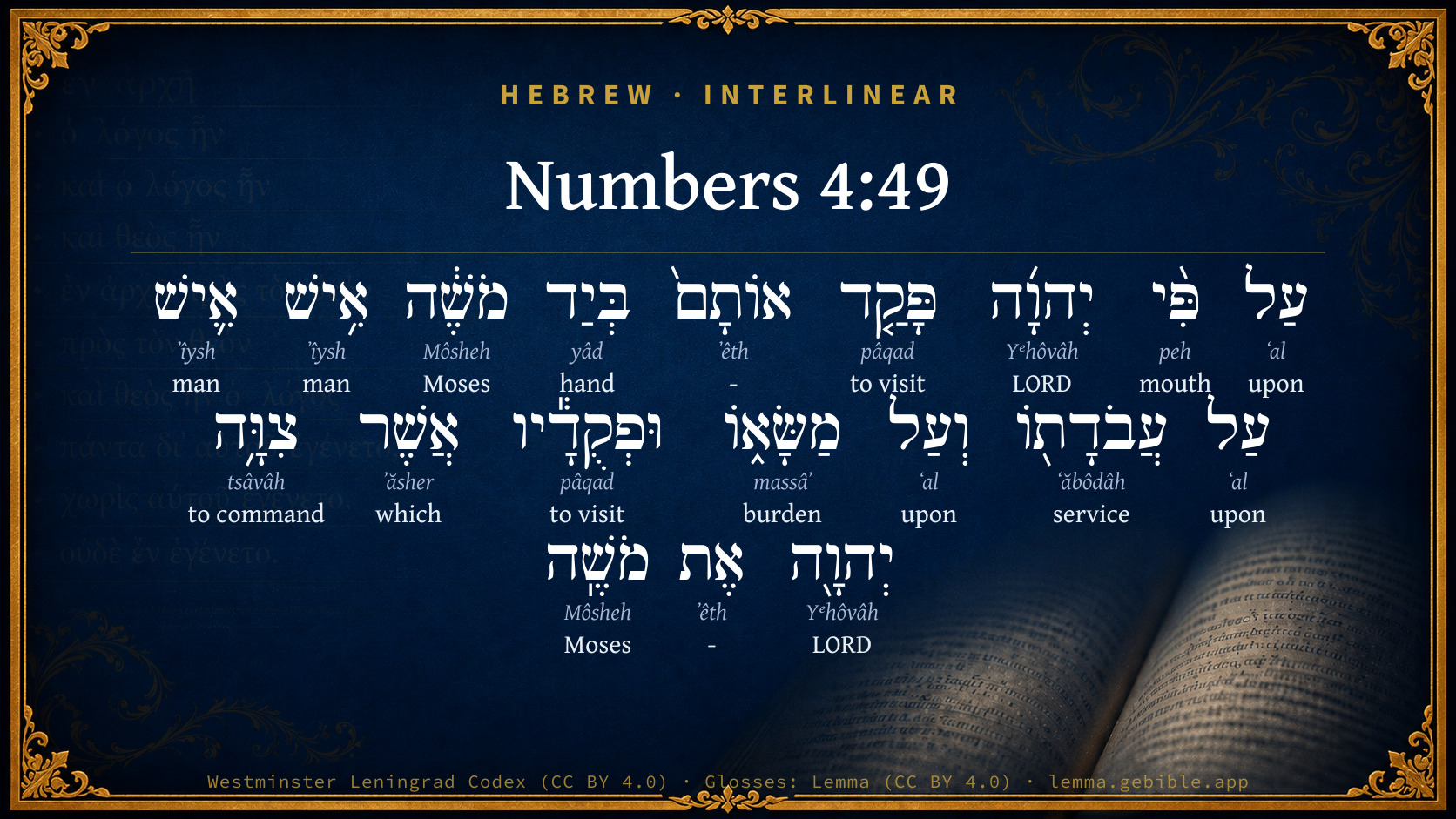
Hebrew (Westminster Leningrad Codex) Numbers 4:49 appears in the Hebrew Old Testament. The text above is from the Westminster Leningrad Codex. Each word links to its Strong’s number, a concise gloss, and parsing drawn from the Open Scriptures Hebrew Bible morphology. Click any word for its full Brown-Driver-Briggs (BDB) entry.
Download image
Cite this verse

Numbers 4:49 (World English Bible). Public Domain. Lemma interlinear Bible study tool, https://lemma.gebible.app/v/numbers/4/49.

Show BibTeX & RIS
BibTeX
RIS
English Translation
According to the commandment of Yahweh they were numbered by Moses, everyone according to his service, and according to his burden. Thus were they numbered by him, as Yahweh commanded Moses.
World English Bible · Public Domain
Download a study sheet

One document with this verse’s original text, its word-by-word gloss line, the meaning frame, cross-references with their text, attributed commentary, and full source and license credits — printable, and it pastes into notes with its structure intact.

This verse Autodidact and up

Study sheet (.html) Plain text (.txt)

A passage Seminary Student

Up to 50 verses in one chapter. A passage sheet keeps up to 6 commentary sources and 12 cross-references per verse, in the order this page ranks them, and says so on the sheet whenever that leaves anything out. Ask for a single verse and you get the Autodidact verse sheet above.

Everything on this page stays free to read, with no account — the sheet is a download of what is already on screen, not access to it.

Want to remove ads? Support Godless Engineer
Compare translations 3

The same verse in 3 English versions, stacked beneath the original-language interlinear above. Click any original word for its lexicon entry.

Each is an independent rendering of the whole verse — the interlinear is not word-aligned to these translations.

Highlighted words mark where these versions differ — a whole-verse word diff, not a word-by-word alignment.

  • World English Bible Public Domain
    According to the commandment of Yahweh they were numbered by Moses, everyone according to his service, and according to his burden. Thus were they numbered by him, as Yahweh commanded Moses.
  • King James Version Public Domain
    According to the commandment of the LORD they were numbered by the hand of Moses, every one according to his service, and according to his burden: thus were they numbered of him, as the LORD commanded Moses.
  • unfoldingWord Literal Text CC BY-SA 4.0
    Upon the mouth of Yahweh he counted them in the hand of Moses, man by man in accordance with his service and in accordance with his burden. So his counted ones that Yahweh commanded Moses.

unfoldingWord Literal Text — © unfoldingWord, licensed CC BY-SA 4.0. Word-aligned USFM3 via Door43 (git.door43.org/unfoldingWord/en_ult).

Versions to compare (up to 4)

3 of 4 selected

Show all 18 translations

Every available English version of this verse, each an independent rendering of the whole verse.

  • World English Bible Public Domain
    According to the commandment of Yahweh they were numbered by Moses, everyone according to his service, and according to his burden. Thus were they numbered by him, as Yahweh commanded Moses.
  • Berean Standard Bible Public Domain
    At the LORD’s command they were numbered through Moses and each one was assigned his work and burden, as the LORD had commanded Moses.
  • Majority Standard Bible Public Domain
    At the LORD’s command through Moses they were numbered, and each one was assigned his work and burden, as the LORD had commanded Moses.
  • King James Version Public Domain
    According to the commandment of the LORD they were numbered by the hand of Moses, every one according to his service, and according to his burden: thus were they numbered of him, as the LORD commanded Moses.
  • American Standard Version (1901) Public Domain
    According to the commandment of Jehovah they were numbered by Moses, every one according to his service, and according to his burden: thus were they numbered of him, as Jehovah commanded Moses.
  • Revised Version (1885) Public Domain
    According to the commandment of the LORD they were numbered by the hand of Moses, every one according to his service, and according to his burden: thus were they numbered of him, as the LORD commanded Moses.
  • Geneva Bible (1599) Public Domain
    According to the commandement of the Lord by the hand of Moses did Aaron nomber them, euery one according to his seruice, and according to his charge. Thus were they of that tribe nombred, as the Lord commanded Moses.
  • Douay-Rheims (1899) Public Domain
    Moses reckoned them up according to the word of the Lord, every one according to their office and burdens, as the Lord had commanded him.
  • Young's Literal Translation Public Domain
    by the command of Jehovah hath `one' numbered them, by the hand of Moses, each man by his service, and by his burden, with his numbered ones, as Jehovah hath commanded Moses.
  • Literal Standard Version CC BY-SA 4.0
    he has numbered them by the command of YHWH, by the hand of Moses, each man by his service, and by his burden, with his numbered ones, as YHWH has commanded Moses.
  • Unlocked Literal Bible CC BY-SA 4.0
    At Yahweh's command, Moses counted each man, keeping count of each by the type of work he was assigned to do. He counted each man by the kind of responsibility he would bear. In doing this, they obeyed what Yahweh had commanded them to do through Moses.
  • unfoldingWord Literal Text CC BY-SA 4.0
    Upon the mouth of Yahweh he counted them in the hand of Moses, man by man in accordance with his service and in accordance with his burden. So his counted ones that Yahweh commanded Moses.
  • Darby Bible Public Domain
    According to the commandment of Jehovah they were numbered by Moses, every one for his service, and for his burden, and numbered by him, as Jehovah had commanded Moses.
  • World Messianic Bible Public Domain
    According to the commandment of the LORD they were counted by Moses, everyone according to his service and according to his burden. Thus they were counted by him, as the LORD commanded Moses.
  • Webster's Bible Public Domain
    According to the commandment of the LORD they were numbered by the hand of Moses, every one according to his service, and according to his burden: thus were they numbered by him, as the LORD commanded Moses.
  • Free Bible Version CC BY-SA 4.0
    It was in response to the Lord's instructions that they were registered by Moses. Each of those registered were told what to do and what to carry, as the Lord had ordered Moses.
  • Bible in Basic English Public Domain
    At the order of the Lord they were numbered by Moses, every one in relation to his work and to his part in the transport; so they were numbered by Moses at the order of the Lord.
  • JPS Tanakh (1917) Public Domain
    According to the commandment of the LORD they were appointed by the hand of Moses, every one to his service, and to his burden; they were also numbered, as the LORD commanded Moses.

Literal Standard Version (2020), Covenant Press — licensed CC BY-SA 4.0. Text via the HelloAO Bible API (eBible.org). Unlocked Literal Bible (unfoldingWord) — licensed CC BY-SA 4.0. Text via the HelloAO Bible API (eBible.org). unfoldingWord Literal Text — © unfoldingWord, licensed CC BY-SA 4.0. Word-aligned USFM3 via Door43 (git.door43.org/unfoldingWord/en_ult). Free Bible Version, Dr. Jonathan Gallagher — licensed CC BY-SA 4.0. Text via the HelloAO Bible API (eBible.org).

Word by word

More ways to search: Search by grammar → Find every occurrence → Compare this word →

Practice this passage: Drill this verse → Learn its vocabulary →

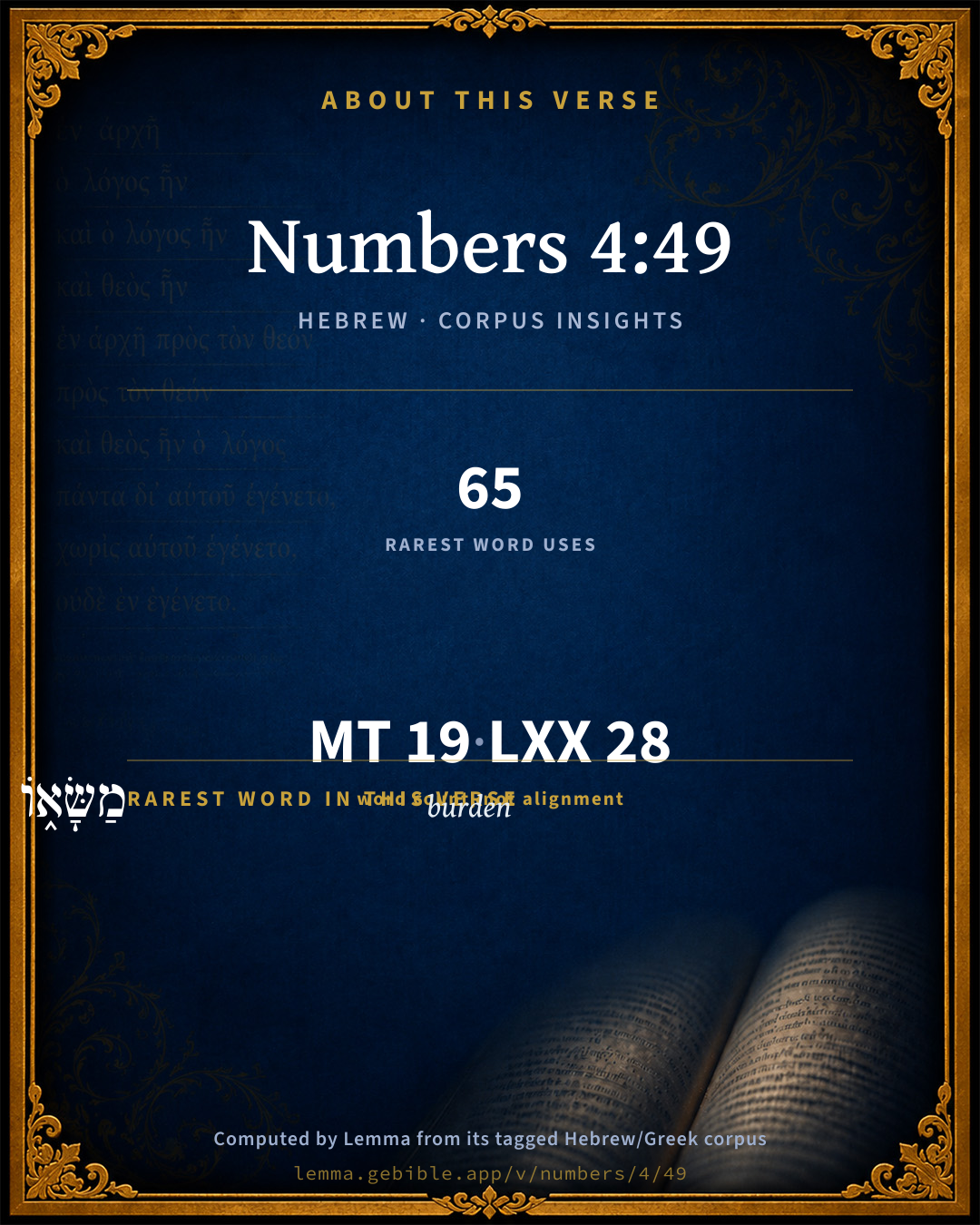
מַשָּׂא֑וֹ
massâʼ
H4853
“burden · his”
Noun, Common, Masculine, Singular, Construct + Suffix, Personal, 3rd Person, Masculine, Singular
Part of Speech
Noun
Type
Common
Gender
Masculine
Number
Singular
State
Construct
Full BDB Definition

Origin: from H5375

TWOT: 1421d , 1421e

Massa = "burden" - load, bearing, tribute, burden, lifting (noun masculine) - load, burden - lifting, uplifting, that to which the soul lifts itself up - bearing, carrying - tribute, that which is carried or brought or borne - utterance, oracle, burden (noun masculine) - a son of Ishmael (noun proper masculine)
  1. עַל ʻal H5921 “upon” Preposition
  2. פִּ֨י peh H6310 “mouth of” Noun, Common, Masculine, Singular, Construct
  3. יְהוָ֜ה Yᵉhôvâh H3068 “LORD” Noun, Proper
  4. פָּקַ֤ד pâqad H6485 “to visit” Verb, Qal, Perfect, 3rd Person, Masculine, Singular
  5. אוֹתָם֙ ʼêth H853 “- · them” Particle, Direct Object + Suffix, Personal, 3rd Person, Masculine, Plural
  6. בְּיַד yâd H3027 “in/at · hand of” Preposition + Noun, Common, Both, Singular, Construct
  7. מֹשֶׁ֔ה Môsheh H4872 “Moses” Noun, Proper
  8. אִ֥ישׁ ʼîysh H376 “man” Noun, Common, Masculine, Singular, Absolute
  9. אִ֛ישׁ ʼîysh H376 “man” Noun, Common, Masculine, Singular, Absolute
  10. עַל ʻal H5921 “upon” Preposition
  11. עֲבֹדָת֖וֹ ʻăbôdâh H5656 “service · his” Noun, Common, Feminine, Singular, Construct + Suffix, Personal, 3rd Person, Masculine, Singular
  12. וְעַל ʻal H5921 “and · upon” Conjunction + Preposition
  13. וּפְקֻדָ֕יו pâqad H6485 “and · visited · him” Conjunction + Verb, Qal, Participle Passive, Masculine, Plural, Construct + Suffix, Personal, 3rd Person, Masculine, Singular
  14. אֲשֶׁר ʼăsher H834 “which” Particle, Relative
  15. צִוָּ֥ה tsâvâh H6680 “to command” Verb, Piel, Perfect, 3rd Person, Masculine, Singular
  16. יְהוָ֖ה Yᵉhôvâh H3068 “LORD” Noun, Proper
  17. אֶת ʼêth H853 “-” Particle, Direct Object
  18. מֹשֶֽׁה Môsheh H4872 “Moses” Noun, Proper

About this verse

These counts appear in no published source. They are computed here, from the morphology-tagged text and Lemma’s own curated glosses. What Lemma adds →

19
words
12
distinct lemmas
Pentateuch
section

Grammatical profile

  • 3 verbs
  • 10 nouns
  • 3 prepositions
  • 3 particles

Verb forms

  • פָּקַ֤ד Qal · Perfect
  • וּפְקֻדָ֕יו Qal · Participle Passive
  • צִוָּ֥ה Piel · Perfect

Repetition

Words recur within this verse — often emphatic in Hebrew:

  • עַל upon H5921 ×3
  • יְהוָ֜ה LORD H3068 ×2
  • פָּקַ֤ד to visit H6485 ×2
  • מֹשֶׁ֔ה Moses H4872 ×2
  • אִ֥ישׁ man H376 ×2

Hebrew & Septuagint length

In English translation the verse runs 31 words from the Hebrew and 35 from the Septuagint (LXX English) — closely comparable.

A rough comparison of the two English renderings, which tokenize alike — not a word-level alignment.

Word counts can differ between the Hebrew and the Greek without any difference in meaning — e.g. the Hebrew direct-object marker אֵת has no separate Greek word, and Greek often adds the article ὁ.

In the original languages it is 19 Hebrew tokens and 28 Greek tokens — but the two are counted differently (Hebrew bundles its prefixes and suffixes into one token; the Greek is in lemma form), so that isn’t a like-for-like length.

Cross-references

15

Topical passages linked to Numbers 4:49 in the Treasury of Scripture Knowledge — connected by theme and wording, ordered by reader-vote popularity; previews shown in the World English Bible.

  • Numbers 1:54 Thus the children of Israel did. According to all that Yahweh commanded Moses, so they did.
  • Numbers 4:15 "When Aaron and his sons have finished covering the sanctuary, and all the furniture of the sanctuary, as the camp moves forward; after that, the sons of Kohath shall come to carry it: but they shall not touch the sanctuary, lest they die. These things are the burden of the sons of Kohath in the Tent of Meeting.
  • Numbers 4:21 Yahweh spoke to Moses, saying,
  • Numbers 4:24 This is the service of the families of the Gershonites, in serving and in bearing burdens:
  • Numbers 4:31 This is the charge of their burden, according to all their service in the Tent of Meeting: the tabernacle's boards, its bars, its pillars, its sockets,
  • Numbers 1:47 But the Levites after the tribe of their fathers were not numbered among them.
  • Numbers 2:33 But the Levites were not numbered among the children of Israel; as Yahweh commanded Moses.
  • Numbers 3:51–4:1 and Moses gave the redemption money to Aaron and to his sons, according to the word of Yahweh, as Yahweh commanded Moses.
  • Numbers 4:37 These are those who were numbered of the families of the Kohathites, all who served in the Tent of Meeting, whom Moses and Aaron numbered according to the commandment of Yahweh by Moses.
  • Numbers 4:41 These are those who were numbered of the families of the sons of Gershon, all who served in the Tent of Meeting, whom Moses and Aaron numbered according to the commandment of Yahweh.
  • Numbers 4:45 These are those who were numbered of the families of the sons of Merari, whom Moses and Aaron numbered according to the commandment of Yahweh by Moses.
  • Isaiah 11:2–4 The Spirit of Yahweh shall rest on him, the spirit of wisdom and understanding, the spirit of counsel and might, the spirit of knowledge and of the fear of Yahweh.
  • Isaiah 42:1–7 Behold, my servant, whom I uphold; my chosen, in whom my soul delights: I have put my Spirit on him; he will bring forth justice to the Gentiles.
  • Isaiah 49:1–8 Listen, isles, to me; and listen, you peoples, from far: Yahweh has called me from the womb; from the bowels of my mother has he made mention of my name:
  • Romans 12:4–8 For even as we have many members in one body, and all the members don't have the same function,

Cross-references courtesy of OpenBible.info (CC BY 4.0).

Hebrew and Greek witnesses Masoretic Hebrew ↔ Greek Septuagint

The same verse in the two great witnesses to the Old Testament, shown verse-for-verse.

These are two independent witnesses, not word-aligned to each other, and the Septuagint is shown in lemma (dictionary) form.

Hebrew Numbers 4:49 Masoretic · Westminster Leningrad Codex

עַל פִּ֨י יְהוָ֜ה פָּקַ֤ד אוֹתָם֙ בְּיַד מֹשֶׁ֔ה אִ֥ישׁ אִ֛ישׁ עַל עֲבֹדָת֖וֹ וְעַל מַשָּׂא֑וֹ וּפְקֻדָ֕יו אֲשֶׁר צִוָּ֥ה יְהוָ֖ה אֶת מֹשֶֽׁה

According to the commandment of Yahweh they were numbered by Moses, everyone according to his service, and according to his burden. Thus were they numbered by him, as Yahweh commanded Moses.

World English Bible · Public Domain

Greek LXX Numbers 4:49 Septuagint · lemma form

διά φωνή κύριος ἐπισκέπτω αὐτός ἐν χείρ μωυσῆς ἀνήρ κατά ἀνήρ ἐπί ὁ ἔργον αὐτός καί ἐπί ὅς αἴρω αὐτός καί ἐπισκέπτω ὅς τρόπος συντάσσω κύριος ὁ μωυσῆς

He reviewed them by the word of the Lord by the hand of Moses, appointing each man severally over their respective work, and over their burdens; and they were numbered, as the Lord commanded Moses.

LXX2012 (modern English Septuagint) · Public Domain

On this verse, The Cambridge Bible for Schools and Colleges discusses the Septuagint’s reading. Read the note in Commentary ↓

Hebrew: Westminster Leningrad Codex (CC BY 4.0). Greek: Septuagint (public domain); English from LXX2012 (modern English Septuagint) (Public Domain). How the Septuagint differs from the Hebrew →

Targum (Aramaic paraphrase)

2

The Targum is the ancient Jewish Aramaic paraphrase of the Hebrew Scriptures — an interpretive translation, not the Hebrew text itself. Onkelos (literal) and Pseudo-Jonathan (expansive) render the Torah, and Jonathan the Prophets. Coverage is partial: where no permissively-licensed English translation exists for a verse, only the Aramaic is shown. This is verse-level text, not a word-by-word alignment to the Hebrew.

  1. Targum Onkelos Torah (Genesis–Deuteronomy)
    עַל מֵימְרָא דַיְיָ מְנָא יָתְהוֹן בִּידָא דְמשֶׁה גְבַר גְבַר עַל פּוּלְחָנֵהּ וְעַל מַטוּלֵהּ וּמִנְיָנוֹהִי דִי פַקִיד יְיָ יָת משֶׁה

    (no public-domain English translation for this verse)

    Targum Onkelos — Aramaic: “Onkelos Genesis” (public domain); “Onkelos Exodus” (public domain); “Onkelos Leviticus” (public domain); “Onkelos Numbers” (public domain); “Onkelos Deuteronomy” (public domain). English: “Sefaria Community Translation” (CC0 1.0 (public-domain dedication)); “J.W. Etheridge. The Targums of Onkelos and Jonathan Ben Uzziel on the Pentateuch. London: Longmans, Green, 1862” (public domain). Text via Sefaria.

  2. Targum Pseudo-Jonathan Torah (Genesis–Deuteronomy)
    עַל פּוּם מֵימְרָא דַיְיָ מְנָא יַתְהוֹן בִּידָא דְמשֶׁה גְבַר גְבַר עַל פּוּלְחָנֵיהּ וְעַל מַטוּלֵיהּ וּסְכוּמֵיהּ הֵיכְמָא דְפַקֵיד יְיָ יַת משֶׁה

    By the mouth of the Word of the Lord were they numbered by Mosheh, every man according to his service and burden; and the numbering of them was as the Lord commanded Mosheh.

    Targum Pseudo-Jonathan — Aramaic: “Targum Jonathan on Genesis” (public domain); “Targum Jonathan on Exodus” (public domain); “Targum Jonathan on Leviticus” (public domain); “Targum Jonathan on Numbers” (public domain); “Targum Jonathan on Deuteronomy” (public domain). English: “The Targum of Jonathan ben Uzziel, trans. J. W. Etheridge, London, 1862” (public domain). Text via Sefaria.

Commentary

Notes on Numbers 4:49 from classic Christian and Jewish commentators (each source and its license shown beneath its notes). The classic Christian expositions comment on the surrounding passage and are grouped to its opening verse, so a note may address several verses; the Jewish commentaries on the Tanakh (Rashi and others) are per-verse, so they appear only where the commentator wrote on this verse.

Lemma curates 59 commentaries, every one of them public domain or Creative Commons licensed, each selected and text-cleaned for this edition rather than reprinted as found. About our sources →

Geneva Bible (1599)

Geneva Bible translators

So that Moses neither added, nor diminished, from that which the Lord commanded him.

Hebrew, according to the mouth, or word.

Geneva Bible (1599) marginal notes — public domain. Text via Bolls.life.

The Cambridge Bible for Schools and Colleges

gen. ed. J. J. S. Perowne

49. thus were they numbered of him, as &c.] This is a paraphrase which gives the required sense. The Heb. is corrupt, but the LXX. reads and they were numbered, as &c.1 [Note: Apparently וַיְפֻקְדוּ כַאֲשֶׁר for וּפְקֻדָיו אֲשֶׁר.]

The Cambridge Bible for Schools and Colleges (gen. ed. J. J. S. Perowne; Cambridge University Press, 1878–1918) — public domain. Text from a community e-Sword module.

Keil & Delitzsch

C. F. Keil & F. Delitzsch

"According to the commandment of Jehovah, they appointed them through the hand of Moses (i.e., under his direction), each one to his service, and his burden, and his mustered things (פּקדיו), i.e., the things assigned to him at the time of the mustering as his special charge (see Exo 38:21).

Keil & Delitzsch — Biblical Commentary on the Old Testament (1861–1891) — public domain (CC PDM 1.0). Text via the HelloAO Bible API. (Old Testament only.)

unfoldingWord translationNotes

Door43 World Missions Community

At Yahweh's command

"As Yahweh commanded"

keeping count of each by the type ... He counted each man by the kind of responsibility he would bear

These two phrase have similar meaning and are used together to emphasize how Moses counted all the men.

by the type of work he was assigned to do

This can be stated in active form. AT: "by his type of work assignment" or "by the type of work he had assigned each man to do" (See: Active or Passive)

he would bear

"he would have"

they obeyed what Yahweh had commanded them

Here "they" and "them" refer to Moses and Aaron.

translationWords

assign

unfoldingWord translationNotes — © Distant Shores Media and the Door43 World Missions Community, licensed CC BY-SA 4.0. Source: git.door43.org/Door43/en_tn.

Rashi

Rabbi Shlomo Yitzchaki (Rashi)

ופקדיו אשר צוה ה' את משה — This means, and those appointed by him (Moses) were appointed under the terms of the command which God had given to Moses (v. 43): from thirty years to fifty years old.

Rashi on the Tanakh — English translations: “The Judaica Press complete Tanach with Rashi, translated by A. J. Rosenberg” (CC BY 4.0); “Pentateuch with Rashi's commentary by M. Rosenbaum and A.M. Silbermann, 1929-1934” (public domain); “The Metsudah Tanach series, Lakewood, N.J” (CC BY 4.0); and “The Book of Joshua, Metsudah Publications, 1997” (CC BY 4.0). Text via Sefaria.

Ramban (Nachmanides)

Rabbi Moshe ben Nachman (Ramban / Nachmanides)

UPHKUDAV’ (THUS WERE THEY NUMBERED OF HIM) ‘ASHER’ THE ETERNAL COMMANDED MOSES. “A Masorah is the tradition handed down from generation to generation of the exact Scriptural text, and also refers to a collection of exegetical notes on the Scriptural text. The comment before us is of this second class. has it: Five [words in the Scriptures] are written asher (‘which,’ or ‘that’) but they are to be understood as ka’asher (‘as’), literally meaning: [and his countings] “which the Eternal commanded,” and Rashi on the basis of a Masorah interpreted it to mean: ka’asher tziva Hashem — [thus were they numbered] “‘as’ the Eternal commanded.” Ramban later on interprets the text asher tziva Hashem in its literal meaning. [this being one of the five cases, and therefore the above expression is to be interpreted as follows: thus were they numbered of him ‘as’ the Eternal commanded Moses]. And those counted were, in accordance with the command, from thirty to fifty years old.” This is Rashi’s language. If this is so, the word, uphkudav refers to Moses [thus were they numbered ‘of him’ — by Moses]. But Rabbi Abraham ibn Ezra commented that [the meaning of the verse is as follows]: every one, that is to say, of the three [Levitical] families — namely, Gershon, Kohath, and Merari — Moses appointed to his service, and to his burden as Scripture mentioned above [that he should appoint them]. And this is the meaning of [the word] uphkudav, namely “[the appointment] of every one” mentioned.But it is possible that the expression ‘asher’ tziva be understood in its plain sense [i.e., “which” He commanded, and not, as Rashi has it, as if it said ‘ka’asher’ tziva — “as” He commanded]. Scripture would thus be saying that Moses appointed [each of the sons of] these three brothers [i.e., Gershon, Kohath, and Merari] to his service and to his burden as explained above; ‘uphkudav’ (and the numbered individuals) of each of them ‘which’ the Eternal commanded Moses to count by their polls, he appointed to his service, and to his burden. Thus the verse mentioned that Moses numbered them by their families, and also that he appointed the [numbered] individuals by their polls, every one to his service, and to his burden. is to be understood as ka’asher tziva (“as” the Eternal commanded). b) Rashi explains uphkudav as meaning “his countings,” i.e., those of Moses. Ibn Ezra interprets it as “his appointments,” the pronoun “his” referring to each of the three Levitical families. c) Ramban explains asher tziva in its literal sense, “which” the Eternal commanded [as explained in the text], the word uphkudav he understands as does Rashi, i.e., as “countings,” but the pronoun [“his”] Ramban explains as referring to each of the three brothers [Gershon, Kohath, and Merari — not personally, but in the sense of the descendants of each of them] ‘which G-d commanded’ Moses to count by their polls — each of them he assigned to his individual work. And such indeed is the law, that a Levite [of one group] is not permitted to do the work of another group or to assist therein, just as the Rabbis have said: “It once happened that Rabbi Yehoshua the son of Chananyah wanted to help [his fellow-Levite] Rabbi Yochanan the son of Gudgada to close the gates [of the Sanctuary]; whereupon [the latter] said to him: ‘Turn back, [for if you do not do so] your life is already forfeit, since I am one of the gatekeepers, and you are one of the singers.’”

Ramban (Nachmanides) on the Tanakh — English translation: “Commentary on the Torah by Ramban (Nachmanides). Translated and annotated by Charles B. Chavel. New York, Shilo Pub. House, 1971-1976” (CC BY 4.0). Text via Sefaria.

Lesson kit

Teaching starters — assembled from the data on this page, not authored interpretation. Every prompt links to the verse data it draws on. Edit before teaching.

Numbers, in the Pentateuch, opens this verse with 19 words (12 distinct Hebrew lemmas). Its most distinctive word is massâʼ (“burden”). A historical commentator’s framing appears above. Read the whole chapter for the surrounding context.

Discussion questions

  1. What does “burden” (massâʼ) contribute to the verse as a whole?
  2. How does Numbers 1:54, which shares this passage’s theme, read alongside this verse?
  3. What does the repetition of “upon” (3× in this one verse) do in this verse?
  4. These translations render this verse differently; the difference is in the English rendering, not the original. What questions does that raise?
  5. «פָּקַ֤ד» is a Qal Perfect verb. How does that grammatical form shape the action described?
  6. Compare how Geneva Bible (1599) and The Cambridge Bible for Schools and Colleges read this verse. Where do they agree or differ?

Things to notice

Reading settings

Reading text

Shown beneath each verse's original-language words.

Old Testament
Old Testament edition

Read the OT as the Masoretic Hebrew (MT) or the Greek Septuagint (LXX).

English shown for the Greek Septuagint (in the Hebrew ↔ Greek comparison).

Comparing translations? Open the Compare panel on any verse page to stack up to four side by side.