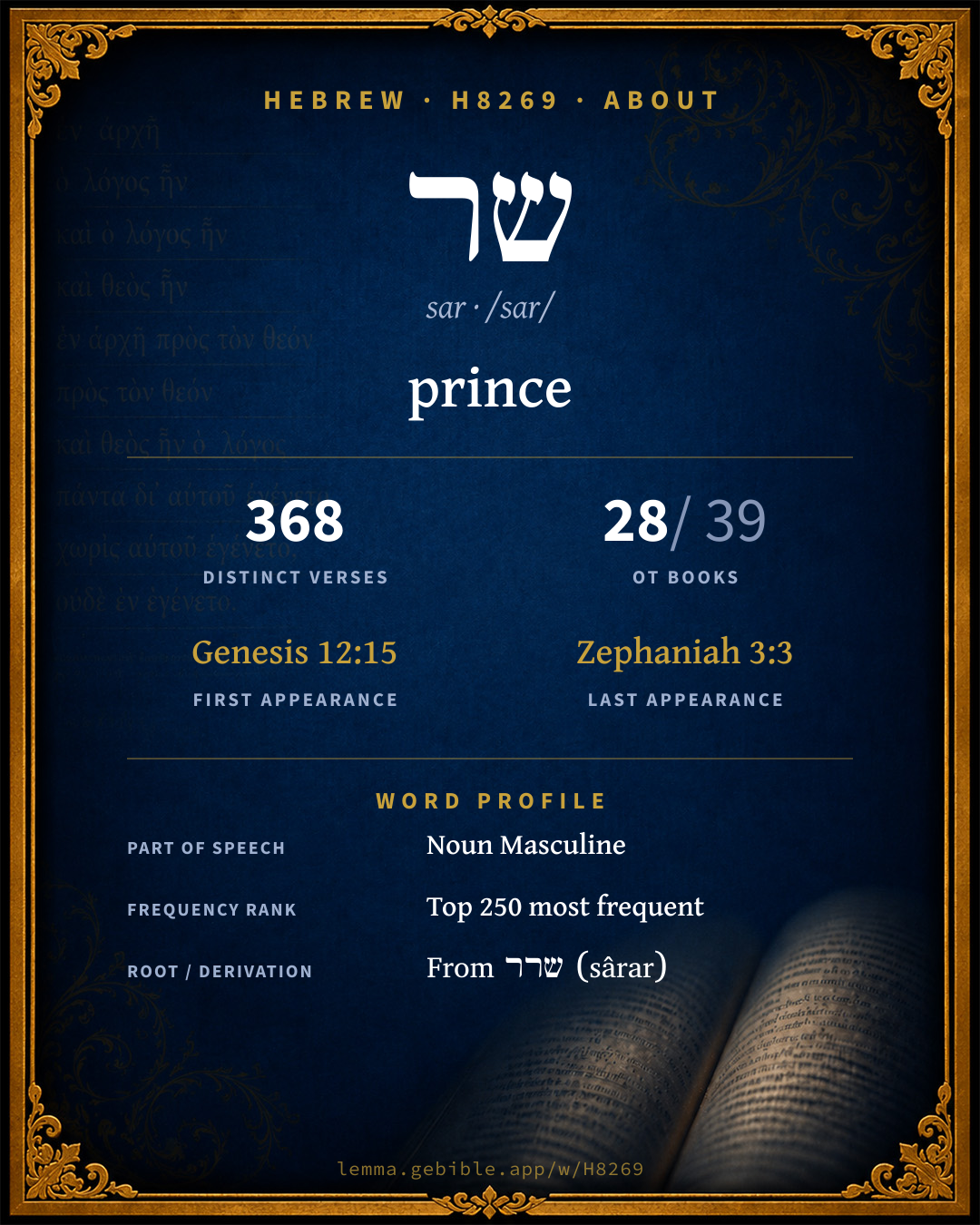
שַׂר
prince
also: ruler, leader, chief, chieftain fuller range ↓
Full lexicon entry — Brown-Driver-Briggs (BDB)
From Brown-Driver-Briggs (BDB)
Where this word appears
See every Construct-state word in the Hebrew Bible →
Grammar key — what these labels mean
Part of speech
- Noun
- A naming word — a person, place, thing, or idea.
Noun type
- Common
- A common noun — a general class of person, place, or thing (“king,” “city,” “water”), not a specific name.
State
- Construct
- A noun bound to a following noun in a possessive / “of” relationship (the construct chain).
- Absolute
- The independent form of a noun, not bound to a following word.
Gender
- Masculine
- Grammatically masculine.
Number
- Plural
- More than one (in Hebrew, generally three or more).
- Singular
- One.
Every verse where H8269 appears in the Book of 2 Chronicles — 47 distinct verses. Click any verse to open its interlinear word-by-word view. Verse text shown in the World English Bible for context — . Each verse’s Hebrew form is shown with its reference; the English is not keyword-highlighted, since the data carries no word-level English alignment. Use “Compare translations” on any verse to read it across multiple English versions. This concordance covers the Hebrew Bible; Septuagint (Greek Old Testament) occurrences are not indexed here.
2 Chronicles
- 2 Chronicles 1:2 לְ/שָׂרֵי֩ prep + n c mp cs Solomon spoke to all Israel, to the captains of thousands and of hundreds, and to the judges, and to every prince in all Israel, the heads of the fathers' [houses].
- 2 Chronicles 8:9 וְ/שָׂרֵ֣י וְ/שָׂרֵ֥י conj + n c mp cs conj + n c mp cs But of the children of Israel did Solomon make no servants for his work; but they were men of war, and chief of his captains, and rulers of his chariots and of his horsemen.
- 2 Chronicles 8:10 שָׂרֵ֤י n c mp cs These were the chief officers of king Solomon, even two hundred fifty, who ruled over the people.
- 2 Chronicles 12:5 וְ/שָׂרֵ֣י conj + n c mp cs Now Shemaiah the prophet came to Rehoboam, and to the princes of Judah, who were gathered together to Jerusalem because of Shishak, and said to them, Thus says Yahweh, You have forsaken me, therefore have I also left you in the hand of Shishak.
- 2 Chronicles 12:6 שָׂרֵֽי n c mp cs Then the princes of Israel and the king humbled themselves; and they said, Yahweh is righteous.
- 2 Chronicles 12:10 שָׂרֵ֣י n c mp cs King Rehoboam made in their place shields of brass, and committed them to the hands of the captains of the guard, who kept the door of the king's house.
- 2 Chronicles 16:4 שָׂרֵ֨י n c mp cs Ben Hadad listened to king Asa, and sent the captains of his armies against the cities of Israel; and they struck Ijon, and Dan, and Abel Maim, and all the store-cities of Naphtali.
- 2 Chronicles 17:7 לְ/שָׂרָי/ו֙ prep + n c mp cs + sfx pers 3ms Also in the third year of his reign he sent his princes, even Ben Hail, and Obadiah, and Zechariah, and Nethanel, and Micaiah, to teach in the cities of Judah;
- 2 Chronicles 17:14 שָׂרֵ֣י הַ/שָּׂ֔ר n c mp cs ptcl def.art + n c ms This was the numbering of them according to their fathers' houses: Of Judah, the captains of thousands: Adnah the captain, and with him mighty men of valor three hundred thousand;
- 2 Chronicles 17:15 הַ/שָּׂ֑ר ptcl def.art + n c ms and next to him Jehohanan the captain, and with him two hundred eighty thousand;
- 2 Chronicles 18:25 שַׂר n c ms cs The king of Israel said, Take Micaiah, and carry him back to Amon the governor of the city, and to Joash the king's son;
- 2 Chronicles 18:30 שָׂרֵ֨י n c mp cs Now the king of Syria had commanded the captains of his chariots, saying, Fight neither with small nor great, save only with the king of Israel.
- 2 Chronicles 18:31 שָׂרֵ֨י n c mp cs It happened, when the captains of the chariots saw Jehoshaphat, that they said, It is the king of Israel. Therefore they turned about to fight against him: but Jehoshaphat cried out, and Yahweh helped him; and God moved them [to depart] from him.
- 2 Chronicles 18:32 שָׂרֵ֣י n c mp cs It happened, when the captains of the chariots saw that it was not the king of Israel, that they turned back from pursuing him.
- 2 Chronicles 21:4 מִ/שָּׂרֵ֥י prep + n c mp cs Now when Jehoram was risen up over the kingdom of his father, and had strengthened himself, he killed all his brothers with the sword, and various also of the princes of Israel.
- 2 Chronicles 21:9 שָׂרָ֔י/ו שָׂרֵ֥י n c mp cs + sfx pers 3ms n c mp cs Then Jehoram passed over with his captains, and all his chariots with him: and he rose up by night, and struck the Edomites who surrounded him, along with the captains of the chariots.
- 2 Chronicles 22:8 שָׂרֵ֨י n c mp cs It happened, when Jehu was executing judgment on the house of Ahab, that he found the princes of Judah, and the sons of the brothers of Ahaziah, ministering to Ahaziah, and killed them.
- 2 Chronicles 23:1 שָׂרֵ֣י n c mp cs In the seventh year Jehoiada strengthened himself, and took the captains of hundreds, Azariah the son of Jeroham, and Ishmael the son of Jehohanan, and Azariah the son of Obed, and Maaseiah the son of Adaiah, and Elishaphat the son of Zichri, into covenant with him.
- 2 Chronicles 23:9 לְ/שָׂרֵ֣י prep + n c mp cs Jehoiada the priest delivered to the captains of hundreds the spears, and bucklers, and shields, that had been king David's, which were in the house of God.
- 2 Chronicles 23:13 וְ/הַ/שָּׂרִ֣ים conj + ptcl def.art + n c mp and she looked, and, behold, the king stood by his pillar at the entrance, and the captains and the trumpets by the king; and all the people of the land rejoiced, and blew trumpets; the singers also [played] on instruments of music, and led the singing of praise. Then Athaliah tore her clothes, and said, Treason! treason!
- 2 Chronicles 23:14 שָׂרֵ֥י n c mp cs Jehoiada the priest brought out the captains of hundreds who were set over the host, and said to them, Have her forth between the ranks; and whoever follows her, let him be slain with the sword: for the priest said, Don't kill her in the house of Yahweh.
- 2 Chronicles 23:20 שָׂרֵ֣י n c mp cs He took the captains of hundreds, and the nobles, and the governors of the people, and all the people of the land, and brought down the king from the house of Yahweh: and they came through the upper gate to the king's house, and set the king on the throne of the kingdom.
- 2 Chronicles 24:10 הַ/שָּׂרִ֖ים ptcl def.art + n c mp All the princes and all the people rejoiced, and brought in, and cast into the chest, until they had made an end.
- 2 Chronicles 24:17 שָׂרֵ֣י n c mp cs Now after the death of Jehoiada came the princes of Judah, and made obeisance to the king. Then the king listened to them.
- 2 Chronicles 24:23 שָׂרֵ֥י n c mp cs It happened at the end of the year, that the army of the Syrians came up against him: and they came to Judah and Jerusalem, and destroyed all the princes of the people from among the people, and sent all the spoil of them to the king of Damascus.
- 2 Chronicles 25:5 לְ/שָׂרֵ֤י וּ/לְ/שָׂרֵ֣י prep + n c mp cs conj + prep + n c mp cs Moreover Amaziah gathered Judah together, and ordered them according to their fathers' houses, under captains of thousands and captains of hundreds, even all Judah and Benjamin: and he numbered them from twenty years old and upward, and found them three hundred thousand chosen men, able to go forth to war, who could handle spear and shield.
- 2 Chronicles 26:11 מִ/שָּׂרֵ֖י prep + n c mp cs Moreover Uzziah had an army of fighting men, who went out to war by bands, according to the number of their reckoning made by Jeiel the scribe and Maaseiah the officer, under the hand of Hananiah, one of the king's captains.
- 2 Chronicles 28:14 הַ/שָּׂרִ֖ים ptcl def.art + n c mp So the armed men left the captives and the spoil before the princes and all the assembly.
- 2 Chronicles 28:21 וְ/הַ/שָּׂרִ֑ים conj + ptcl def.art + n c mp For Ahaz took away a portion out of the house of Yahweh, and out of the house of the king and of the princes, and gave it to the king of Assyria: but it didn't help him.
- 2 Chronicles 29:20 שָׂרֵ֣י n c mp cs Then Hezekiah the king arose early, and gathered the princes of the city, and went up to the house of Yahweh.
- 2 Chronicles 29:30 וְ/הַ/שָּׂרִים֙ conj + ptcl def.art + n c mp Moreover Hezekiah the king and the princes commanded the Levites to sing praises to Yahweh with the words of David, and of Asaph the seer. They sang praises with gladness, and they bowed their heads and worshiped.
- 2 Chronicles 30:2 וְ/שָׂרָ֛י/ו conj + n c mp cs + sfx pers 3ms For the king had taken counsel, and his princes, and all the assembly in Jerusalem, to keep the Passover in the second month.
- 2 Chronicles 30:6 וְ/שָׂרָ֗י/ו conj + n c mp cs + sfx pers 3ms So the posts went with the letters from the king and his princes throughout all Israel and Judah, and according to the commandment of the king, saying, You children of Israel, turn again to Yahweh, the God of Abraham, Isaac, and Israel, that he may return to the remnant that have escaped of you out of the hand of the kings of Assyria.
- 2 Chronicles 30:12 וְ/הַ/שָּׂרִ֖ים conj + ptcl def.art + n c mp Also on Judah came the hand of God to give them one heart, to do the commandment of the king and of the princes by the word of Yahweh.
- 2 Chronicles 30:24 וְ/הַ/שָּׂרִ֞ים conj + ptcl def.art + n c mp For Hezekiah king of Judah did give to the assembly for offerings one thousand bulls and seven thousand sheep; and the princes gave to the assembly a thousand bulls and ten thousand sheep: and a great number of priests sanctified themselves.
- 2 Chronicles 31:8 וְ/הַ/שָּׂרִ֔ים conj + ptcl def.art + n c mp When Hezekiah and the princes came and saw the heaps, they blessed Yahweh, and his people Israel.
- 2 Chronicles 32:3 שָׂרָי/ו֙ n c mp cs + sfx pers 3ms he took counsel with his princes and his mighty men to stop the waters of the springs which were outside of the city; and they helped him.
- 2 Chronicles 32:6 שָׂרֵ֥י n c mp cs He set captains of war over the people, and gathered them together to him in the broad place at the gate of the city, and spoke comfortably to them, saying,
- 2 Chronicles 32:21 וְ/שָׂ֔ר conj + n c ms Yahweh sent an angel, who cut off all the mighty men of valor, and the leaders and captains, in the camp of the king of Assyria. So he returned with shame of face to his own land. When he was come into the house of his god, those who came forth from his own bowels killed him there with the sword.
- 2 Chronicles 32:31 שָׂרֵ֣י n c mp cs However in [the business of] the ambassadors of the princes of Babylon, who sent to him to inquire of the wonder that was done in the land, God left him, to try him, that he might know all that was in his heart.
- 2 Chronicles 33:11 שָׂרֵ֤י n c mp cs Therefore Yahweh brought on them the captains of the host of the king of Assyria, who took Manasseh in chains, and bound him with fetters, and carried him to Babylon.
- 2 Chronicles 33:14 שָֽׂרֵי n c mp cs Now after this he built an outer wall to the city of David, on the west side of Gihon, in the valley, even to the entrance at the fish gate; and he compassed Ophel about [with it], and raised it up to a very great height: and he put valiant captains in all the fortified cities of Judah.
- 2 Chronicles 34:8 שַׂר n c ms cs Now in the eighteenth year of his reign, when he had purged the land and the house, he sent Shaphan the son of Azaliah, and Maaseiah the governor of the city, and Joah the son of Joahaz the recorder, to repair the house of Yahweh his God.
- 2 Chronicles 35:8 וְ/שָׂרָ֞י/ו conj + n c mp cs + sfx pers 3ms His princes gave for a freewill-offering to the people, to the priests, and to the Levites. Hilkiah and Zechariah and Jehiel, the rulers of the house of God, gave to the priests for the Passover offerings two thousand and six hundred [small cattle], and three hundred oxen.
- 2 Chronicles 35:9 שָׂרֵ֣י n c mp cs Conaniah also, and Shemaiah and Nethanel, his brothers, and Hashabiah and Jeiel and Jozabad, the chiefs of the Levites, gave to the Levites for the Passover offerings five thousand [small cattle], and five hundred oxen.
- 2 Chronicles 36:14 שָׂרֵ֨י n c mp cs Moreover all the chiefs of the priests, and the people, trespassed very greatly after all the abominations of the nations; and they polluted the house of Yahweh which he had made holy in Jerusalem.
- 2 Chronicles 36:18 וְ/שָׂרָ֑י/ו conj + n c mp cs + sfx pers 3ms All the vessels of the house of God, great and small, and the treasures of the house of Yahweh, and the treasures of the king, and of his princes, all these he brought to Babylon.
About this entry
At a glance — auto-summarized from this page’s data, not written by a person. Every figure links to its source below. This summary describes the numbers; it doesn’t interpret them.
שר — transliterated sar — is a Hebrew noun carrying the sense “prince.” The King James Version usually renders it “princes,” while modern versions prefer “commanders” (Berean Standard Bible) — see the renderings breakdown. With 368 verses in 28 books, it is a common word in the Hebrew Bible. Debuting at Genesis 12:15, it then recurs through the corpus. Alongside “prince” the lexicon also lists “ruler”, “leader”, and “chief” — part of its full sense range. Each statement above links to its evidence; the full detail follows below.
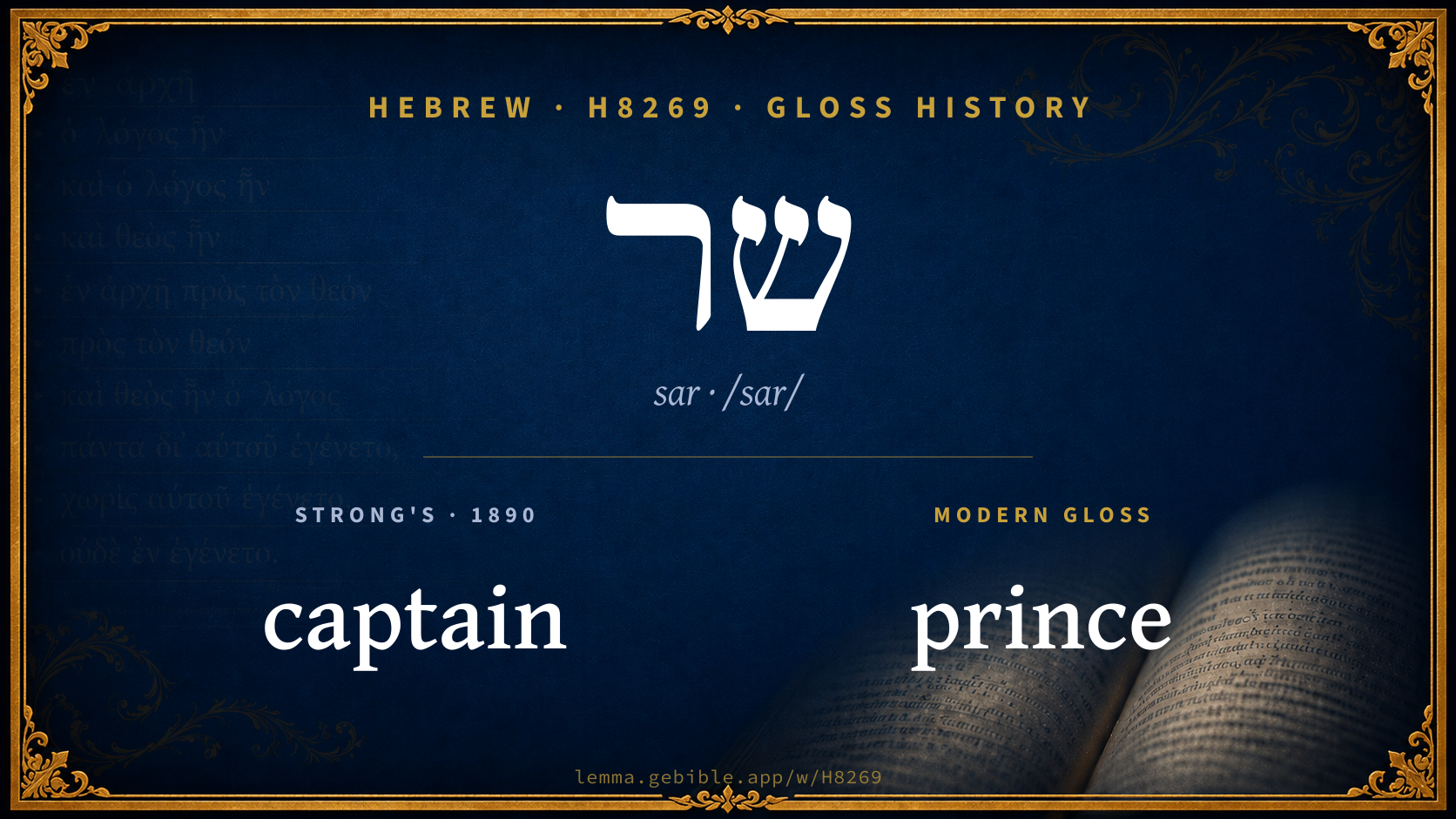
Gloss history
Strong's 1890 vs modern scholarship
About this word
Strong's H8269 catalogs a Hebrew word from the Hebrew Old Testament.
These counts are not copied from any lexicon or concordance. They are computed here, from the morphology-tagged Hebrew Old Testament. What Lemma adds →
- 368
- distinct verses
- The word appears in 368 distinct verses.
- 28 / 39
- OT books
- The word appears in 28 of 39 Old Testament books.
- #117
- by frequency
- Top 250 most frequent Hebrew words (rank 117 of 8,640 Hebrew words by occurrence).
View all 368 occurrences in the concordance →
Most concentrated in
- Jeremiah 52 verses 14%
- 2 Chronicles 47 verses 13%
- 1 Chronicles 37 verses 10%
By section of the Old Testament
By traditional corpus
Conventional, traditional groupings — biblical authorship is debated, so this is a traditional corpus grouping, not an authorship claim. Each share is this word’s portion of its verses in that division of the Hebrew canon. Each figure is a share of the word’s 368 distinct verses.
- Prophets (Nevi'im) 166 verses · 45%
- Writings (Ketuvim) 160 verses · 43%
- Torah (Pentateuch) 42 verses · 11%
How translations render this word
Counts come from each version’s own published word-to-Strong’s tagging or interlinear alignment — an approximate guide to how each version renders this word, not a word-level alignment the data otherwise carries. Because each total is that version’s own tagged count, the per-version totals vary from one another and need not match the appearance or distinct-verse counts above. These counts may also differ from a printed concordance because Lemma counts each distinctly tagged rendering and does not collapse phrase taggings into a single head-word total. This is a fixed set of word-tagged versions (KJV, ASV, BSB, ULT) and does not change with the reading translation you choose elsewhere. Each version’s license is shown beside its name below (and on Sources).
BDB lists this Strong’s number as 2 distinct words (homographs). Each count above pools all of them and is not split by sense — see the Senses section below. A low-frequency rendering may belong to a different one of those words, not the primary meaning.
- King James Version†: Princes 139×, Captains 57×, Captain 39×
- American Standard Version†: Princes 133×, Captains 54×, Captain 42×
- Berean Standard Bible†: Commanders 73×, Officials 67×, Princes 61×
- unfoldingWord Literal Text†: Princes 46×, Commanders of 39×, Leaders of 36×
King James Version Public Domain
Renders H8269 across 420† tagged occurrences — most commonly:
Plus other, less common renderings. Plus 62 renderings that appear only once — usually multi-word phrases or single function words the recovered tagging swept in, not distinct renderings. Not rendered by a distinct English word in 1 further occurrence.
American Standard Version Public Domain
Renders H8269 across 418† tagged occurrences — most commonly:
Plus other, less common renderings. Plus 77 renderings that appear only once — usually multi-word phrases or single function words the recovered tagging swept in, not distinct renderings.
Berean Standard Bible Public Domain
Renders H8269 across 399† tagged occurrences — most commonly:
Plus other, less common renderings. Plus 25 renderings that appear only once — usually multi-word phrases or single function words the recovered tagging swept in, not distinct renderings. Not rendered by a distinct English word in 21 further occurrences.
unfoldingWord Literal Text CC BY-SA 4.0
Renders H8269 across 390† tagged occurrences — most commonly:
Plus other, less common renderings. Plus 20 renderings that appear only once — usually multi-word phrases or single function words the recovered tagging swept in, not distinct renderings.
19 senses and sub-senses in the full BDB
What do BDB’s symbols mean?
BDB uses these scholarly abbreviations:
| Symbol | Meaning |
|---|---|
| 𝔊 | the Septuagint (the ancient Greek translation, LXX) |
| 𝔙 | the Vulgate (the Latin translation) |
| 𝔖 | the Syriac version (the Peshitta) |
| 𝔗 | the Targum (the Aramaic translation) |
| ψ | the Psalms |
| √ | root (the underlying root or stem) |
| ‖ | parallel passage (a synonymous or contrasted parallel) |
| † | the dagger: every passage where the word occurs is cited |
The 19 senses and sub-senses the full Brown-Driver-Briggs lexicon distinguishes for this word, in lexicon order (not ranked by frequency), with BDB’s own verbatim wording and sub-sense lettering. Shown in Hebrew script with BDB’s own scholarly abbreviations. The condensed entry is in the Lexicon Entry tab. See also the Forms in the corpus table below.
שר I be stubborn, rebellious (usually towards י׳) (NH id., (rare)
Qal
- Pf. 3 ms. ס׳ יִשְׂרָאֵל Ho 4:16 Isr. is stubborn; Pt. act. בֵּן סוֹרֵר וּמוֹרֶה Dt 21:18, cf. v 20; בָּנִים סוֹרְרִים Is 30:1, עַם סוֹרֵר 65:2, דּוֹר ס׳ וּמֹרֶה ψ 78:8 (all of Isr.); לֵב ס׳ וּמוֹרֶה Je 5:23; פָּרָה סֹרֵרָ֔ה Ho 4:16 (sim. of Isr., v. supr.); as pred. שָׂרֵיהֶם סוֹרְרִים Ho 9:15 cf. Is 1:23; סָרֵי סוֹרְרִים Je 6:28 revolters among the rebellious (? cf. סור Qal ad fin., and סַר infr.); of loose woman הֹמִיָּה הִיא וְסוֹרָ֑רֶת Pr 7:11; as subst. = the stubborn, ψ 66:7; 68:7, 19; fs. וַיִּתְּנוּ כָתֵף סֹרֶ֫רֶת Ne 9:29 and they presented a stubborn shoulder (of Isr.) = Zc 7:11 (סֹרָ֑רֶת). e.g. Hosea 4:16
שר II chieftain, chief, ruler, official, captain, prince (NH especially of angels
- 1. chieftain, leader:
- a. pl. of Isr. Nu 21:18 (poem in JE; ‖ נְדִיב הָעָם), of Issachar Ju 5:15 (poem); שָׂרֵי גִלְעָד 10:18 is dub. (we should expect וְשׂ׳, and cf. זִקְנֵי ג׳, instead, 11:5–11); of Midian 7:25; 8:3; Philistines 1 S 29:3(×2), 4(×2), 9 (appar. = סְרָנִים v 2, 6, 7 [We], yet disting. by HPS and [with reserve] Bu; 𝔊 𝔖 𝔙 Th Bu del. in v 4b), cf. 18:30; poet., of כְּמוֹשׂ (i.e. the leading Moabites) Je 48:7, of מלכם (q.v.; i.e. the leading Ammonites) Am 1:15 = Je 49:3. e.g. Numbers 21:18
- b. sg. David as leader of freebooters 1 S 22:2; cf. שׂ׳ גְּדוּד 1 K 11:24, pl. 2 S 4:2. e.g. 1 Samuel 22:2
- 2. vassal, noble, official, under king (acting, on occasion, as counsellor, commander, etc.):
- a. pl., in Egypt Gn 12:15 (J) + 3 times Is + 30:4 Di Du Skinner (> of foreign embassy [cf. ‖ מַלְאָכָיו] Che al. reading [CheHeb.Hpt. Marti] שָׂרִים), 105:22; Moab Nu 22:8 + 8 times 22, 23 (JE), Am 2:3; Edom Is 34:12 (‖ חֹרִים); As. 10:8; 31:9; Bab. 21:5 + 7 times Je + 2 Ch 32:31 (but here perhaps vaguely = authorities); other nations Je 49:38 + 17 times Ezr Est; in gen. Is 49:7; officials, officials class, under kings of Israel: David (only Chr) 1 Ch 22:17 + 5 times 1 Ch, Ezr 8:20; Sol. 1 K 4:2; Jehoiachin 2 K 24:12, 14; Zedek. Je 34:21; 2 Ch 36:18; other kings 19 times 2 Chr; in gen. Ec 10:16, 17; see also (Judah) Je 1:18 + 31 times Je (17:25a del. שׂ׳ Gf Che Gie Du), 4 times La, Ez 17:12, Zp 1:8 (where disting. from בְּנֵי הַמֶּלֶךְ, who are never called שׂ׳); so, in gen., Ne 9:32, 34 Dn 9:6, 8; and (N. Isr.) Ho 3:4 + 6 times Ho. e.g. Genesis 12:15
- b. as having powers of magistrate Ex 2:14 (E. + שֹׁפֵט); under Moses (over groups of 1000, 100, 50, 10) 18:21 + 7 times 18 (E), Dt 1:15(×4); later in Judah Ho 5:10 (Now reads שָׂרֵי יִשׂ׳), Is 1:23, cf. 3:4, 14; 32:1; Mi 7:3 (sg.; ‖ שֹׁפֵט), Zp 3:3 (‖ id.), Ez 22:27, cf. Pr 8:16 (‖ נְדִיבִים); 28:2 read perhaps צָרֶיהָ, v. Toy. e.g. Exodus 2:14
- c. as ruler or magistrate of a district (מְדִינָה), 1 K 20:14, 15, 17, 19 (cf. Est 1:3; 8:9; 9:3, שָׂרֵי עַם וָעָם 3:12). e.g. 1 Kings 20:14
- d. as commandant of city, שׂ׳ הָעִיר Ju 9:30, cf. 1 K 22:26 = 2 Ch 18:25, 2 K 23:8; 2 Ch 34:8; of citadel, שׂ׳ הַבִּירָה Ne 7:2; pl. of city officials, שׂ׳ סֻכּוֹת Ju 8:6, 14 (disting. from זְקֵנִים), cf. 2 K 10:1; 2 Ch 29:20. e.g. Judges 9:30
- 3. specif. military, = captain, general:
- a. שַׂר־(ה)צבא Gn 21:22, 32 (E), 26:26 (J), 1 S 12:9 + 23 times, + שׂ׳־צ׳־י׳ Jos 5:14, 15 (JE; צָבָא 1 b), angel-captain in vision; v. also 8, 9; שָׂרֵי הַצּ׳ 1 K 1:25 + 3 times Chr, שָׂרִים בַּצּ׳ 1 Ch 12:22 (Gi Baer; van d. H. v 21); שָׂרֵי צְבָאוֹת Dt 20:9; 1 K 2:5; 1 Ch 27:3; שַׂר־הַחַ֫יִל 2 S 24:2 (but read וְאֶל־שָׂרֵי as 𝔊L and ‖ 1 Ch 21:2 Th We Dr HPS Bu), שָׂרֵי (הַ)ח׳ v 4(×2), 2 K 9:5; 2 Ch 33:14; Ne 2:9, שָׂרֵי הַחֲיָלִים 1 K 15:20 = 2 Ch 16:4; 2 K 25:23; 26 Je 40:7, 13 + 7 times Je; שָׂרֵי מִלְחָמוֹת 2 Ch 32:6; so (ה)שׂר alone 2 S 18:5; 19:7 1 K 9:22 = 2 Ch 8:9 𝔊B Be Kit (שָׂרָיו וְשָׁלִישָׁיו, for MT שָׂרֵי שׂ׳), 2 K 9:5(×2); 1 Ch 11:6, 21 + 9 times, + Jb 39:25 Dn 11:5; שׂ׳ וְגָדוֹל 2 S 3:38 (of Abner); poss. military fig. also in שַׂר שָׁלוֹם Is 9:5 (Mess. name). e.g. Genesis 21:22
- b. leading companies of 50 2 K 1:9–14; Is 3:3, of 100; 1 S 22:7 + 16 times + 8:12 (reading מֵאוֹת for חֲמִשִּׁים 𝔊 HPS, cf. We; Bu ins. שָׂרֵי מֵאוֹת), of 1000; 1 S 17:18 + 11 times, + שָׂרֵי הָאֲלָפִים וְהַמֵּאוֹת 1 Ch 13:1 26:26 (disting. from שָׂרֵי הַצָּבָא), 27:1; 29:6; 2 Ch 1:2; also שׂ׳ הָרֶכֶב captain of the chariotry 1 K 22:31, 32, 33 = 2 Ch 18:30, 31, 32 + 3 times + שָׂרֵי ר׳ וּפָרָשָׁיו 1 K 9:22 = 2 Ch 8:9. e.g. 2 Kings 1:9
- 4.
- a. chief, head, of other official classes: שַׂר הַטַּבָּחִים, Egypt, Gn 37:36 + 5 times; שָׂרֵי הָרָצִים 1 K 14:27 = 2 Ch 12:10; שָׂרֵי הַנִּצָּבִים 1 K 5:30; 9:23 = 2 Ch 8:10; even domestic positions (court of Pharaoh), שַׂר הַמַּשְׁקִים Gn 40:2 + 5 times, שַׂר הָאוֹפוֹת 40:2 + 4 times (all E); שָׂרֵי הַמַּהְלְקוֹת 1 Ch 28:1, i.e. of the successive courses of royal military officials; cf. הַשַּׂר 27:28; שַׂר הַסָּרִיסִים Dn 1:7, 8, 9, 10, 11, 18; שַׂר מְנוּחָה Je 51:59. e.g. Genesis 37:36
- b. = overseer: שַׂר בֵּית הַסֹּהַר Gn 39:21, 23, שָׂרֵי מִקְנֶה 47:6 (all J; cf. אַבִּיר הָרֹעִים 1 S 21:8), שָׂרֵי מִסִּים Ex 1:11 (J); cf. 1 Ch 15:27; 29:6; 27:31; 28:1.—In 1 Ch 15:22 read prob. סַר הַמַּשָּׂא (= שַׂר) overseer of the carrying (for MT בְּמַשָּׂא יָסֹר בַּמַּשָּׂא), so 𝔊 Benz Kit, Be יָסֹר = יָשׂר; v. another view יָסַר Qal. e.g. Genesis 39:21
- 5. of religious office: שָׂרֵי הַכֹּהֲנִים Ezr 8:24, 29; 10:5 2 Ch 36:14; שׂ׳ הַלְוִיִּם 1 Ch 15:16, 22 2 Ch 35:9, cf. 1 Ch 15:5, 6, 7, 8, 9, 10; heads of classes or courses of priests, called שָׂרֵי קֹדֶשׁ 1 Ch 24:5, שׂ׳ אֱלֹהִים v 5;—שָׂרֵי ק׳ Is 43:28 (usually consecrated princes, whether priests, or kings, or both) is prob. corrupt, read perhaps שַׁעֲרֵי (Du) or וַיְחַלְּלוּ שָׂרֶיךָ קָדְשִׁי 𝔊 Houb Klo CheHpt Gr (substantially). e.g. Ezra 8:24
- 6. late, of representative leaders of people, tribal heads, שׂ׳ שִׁבְטֵי יִשׂ׳ 1 Ch 27:22; 29:6, cf. 28:1; appar. = elders, שׂ׳ הָעָם Ez 11:1; 2 Ch 24:23; שׂ׳ alone, ψ 68:28(×3); in post-exilic Jerus. Ezr 9:1; 2 Ne 4:10; 10:1; 11:1 (שָׂרֵי הָעָם), + elders Ezr 10:8, 14; called שָׂרֵי יְהוּדָה Ne 12:31, 32; of district-rulers 3:9, 12, 14, 15, 16, 17, 18, 19; of heads of families, שָׂרֵי הָאָבוֹת Ezr 8:29; 1 Ch 29:6 (= רָאשֵׁי הָא׳ 24:31; 27:1; Ne 7:70). e.g. 1 Chronicles 27:22
- 7. late, as term of rank and dignity, Is 23:8 (cf. ‘merchant-princes’), Jb 3:15; 29:9 (‖ נְגִידִים), 34:19 ψ 45:17; 82:7; 148:11, opp. עבד(ים) Pr 19:10; Ec 10:7; formidable foes ψ 119:23, 161. e.g. Isaiah 23:8
- 8. = patron-angel, only Dn: פָּרַס (מַלְכוּת) שַׂר 10:13, 20, שׂ׳ יָוָן v 20; specif. of מִיכָאֵל v 13, 21; 12:1. e.g. Daniel 10:13
- 9. שַׂר־הַצָבָא 8:11 = God (prob., cf. צָבָא 1 c; yet v. also צ׳ 1 b), so שַׂר שָׂרִים v 25. e.g. Daniel 8:11
Senses from the full Brown-Driver-Briggs lexicon (Brown, Driver, Briggs; Oxford 1906 — public domain), digitized via Sefaria, supplemented by the OpenScriptures HebrewLexicon (CC BY 4.0). Full attribution on Sources.
Word origin
I. vb. be stubborn, rebellious (usually towards י׳) (NH id., (rare); Assyrian sarâru);—
II. n.m. chieftain, chief, ruler, official, captain, prince (NH especially of angels; Assyrian šarru, king);—abs. שַׂר 2 S 3:38 +, הַשַּׂר Mi 7:3 +, שָׂ֑ר Ho 3:4 +; cstr. שַׂר Ju 4:2 +; sf. שַׂרְכֶם Dn 10:21; pl. שָׂרִים 1 K 4:2 +; cstr. שָׂרֵי Gn 12:15 +; sf. שָׂרַי Ju 5:15; Is 10:8, שָׂרֵיכֶם Je 44:21, שָׂרֵיהֶם Is 3:4 +;—
— Brown-Driver-Briggs (Oxford 1906, public domain), digitized via Sefaria, supplemented by the OpenScriptures HebrewLexicon (CC BY 4.0). See Sources.
Derived from שרר (sârar) (H8323) — to rule.
Jastrow Dictionary
A second Hebrew/Aramaic lexicon for comparison, covering Aramaic and post-biblical (Talmudic, Targumic, Midrashic) usage that the biblical-Hebrew BDB does not. Matched by lemma rather than by Strong’s number, so a lemma may carry more than one Jastrow headword (shown separately below), and the entries cover usage well beyond the Bible.
שֵׁר
- Tower of Sher (or Shed), Straton’s Tower (v. Hildesh. Beitr. p. 4 sq.). Sifré Deut. 51 מדבר שרשך דור, read: מגדל שר שן דור; Yalk. ib. 874 מגדל שרשן דירו (corr. acc.); Y. Shebi. VI, 36ᶜ top מגדל שיד.
שַׂר
- prince, chief.; שר (של מעלה) guardian angel, genius. Zeb. 116ᵇ שר ונגיד a prince or a nobleman. Yeb. 16ᵇ שר העולם the genius of the universe; Ḥull. 60ᵃ. Ex. R. s. 22 נטל הקב"ה שר שלהם וכ׳ the Lord took first their (the Egyptians’) guardian angel and drowned him. Pes. 118ᵃ שר הברד, v. יוּרְקָמִי. Ib. אני שר של אש I (Gabriel) am the angel of fire. B. Bath. 74ᵇ שר של ים the angel of the sea. Mekh. B’shall., Shir., s. 2 כיון שראו שָׂרָהּ של מלכות נופל (not נופלת) when they saw the genius of the (Egyptian) empire fallen; Yalk. Ex. 243; a. v. fr.—Pl. שָׂרִים. Ib. אין … משָׂרֵיהֶן תחלה the Lord will not punish governments, unless he have punished their guardian angels first. Gen. R. s. 78, beg. מיכאל … שהם ש׳ של מעלה Michael and Gabriel who are the princes on high. Yalk. l. c. קרא … לכל שָׂרֵי האומות the Lord summoned all the tutelary angels of the nations. Cant. R. to VIII, 14 ש׳ של מעלה the princes on high (angels); ש׳ של מטה the earthly (human) governors. Ib. (play on הרי בשמים, ib.) המתינו לי … על הריהם שהם שָׂרֵיהֶם שנתונים אצלי בַּשָּׁמַיִם (not שנתונות) wait until I shall have sat in judgment over their mounts, that is, their chiefs that are placed with me in heaven; a. fr.—Gen. R. s. 98 גני ש׳, v. גִּינֵּיסַר.—Fem. שָׂרָה. Tosef. Ber. I, 12 (ref. to Gen. XVII, 15) בתחלה הרי היא ש׳ על עמה ועכשיו הרי היא ש׳ על אומות העולם ed. Zuck. (Var. שָׂרַי על עמה … על כל באי העולם, v. ed. Zuck. note) at first she was a princess of her own people, and now she is a princess for the nations of the world (for all that enter into the world); Ber. 13ᵃ שרי לאומתה … ש׳ לכל העולם. e.g. Genesis 17:15
A Dictionary of the Targumim, the Talmud Babli and Yerushalmi, and the Midrashic Literature (Marcus Jastrow; London, Luzac, 1903) — Public Domain. Digitized via Sefaria. Digitized via Sefaria. Full attribution on Sources.
Forms in the corpus
The 134 distinct written forms H8269 takes in the Hebrew Bible, most frequent first — each parse links to that state’s occurrences in the concordance. Hebrew forms include their vowel points and cantillation, so a single lemma takes many written forms.
The 60 most common forms are shown; 74 rarer forms follow in the full concordance.
Same root — word family
Other BDB entries built from the same root as H8269, grouped by Strong’s listed origin. These share a root / origin per the lexicon — not necessarily a shared meaning. Each links to that word’s own entry.
Derives from
Derived from this word
Proper names from this root
People and places named from this root — a name, not an additional meaning of the word.
Compare all same-root words → 1 of the same-root words is a proper name (a person or place). They share a root, not necessarily a meaning.
Septuagint verse parallels
This word appears in 335 verses that also exist in the Greek Old Testament (Septuagint), out of the 368 Hebrew verses it occurs in. You can read those verses in Greek by switching the Old Testament edition to the Septuagint.
Read these verses in the Septuagint
- Genesis 12:15
- Exodus 1:11
- Numbers 21:18
- Deuteronomy 1:15
- Joshua 5:14
- Judges 4:2
- 1 Samuel 8:12
- 2 Samuel 2:8
- 1 Kings 1:19
- 2 Kings 1:9
- 1 Chronicles 11:6
- 2 Chronicles 1:2
This is a verse-level parallel only — the same verses exist in both the Hebrew and Greek Old Testaments. No word-level Hebrew↔Greek correspondence is claimed: the data carries no such alignment, so no Greek word is shown as this Hebrew word’s translation. Coverage is not total — the Septuagint omits the deuterocanon and renumbers the Psalms, so some Hebrew verses have no direct Greek parallel.