Numbers 21:18

Hebrew (Westminster Leningrad Codex) Numbers 21:18 appears in the Hebrew Old Testament. The text above is from the Westminster Leningrad Codex. Each word links to its Strong’s number, a concise gloss, and parsing drawn from the Open Scriptures Hebrew Bible morphology. Click any word for its full Brown-Driver-Briggs (BDB) entry.
Download image
Cite this verse

Numbers 21:18 (World English Bible). Public Domain. Lemma interlinear Bible study tool, https://lemma.gebible.app/v/numbers/21/18.

Show BibTeX & RIS
BibTeX
RIS
English Translation
The well, which the princes dug, Which the nobles of the people dug, With the scepter, [and] with their poles. From the wilderness [they traveled] to Mattanah;
World English Bible · Public Domain
Highlights
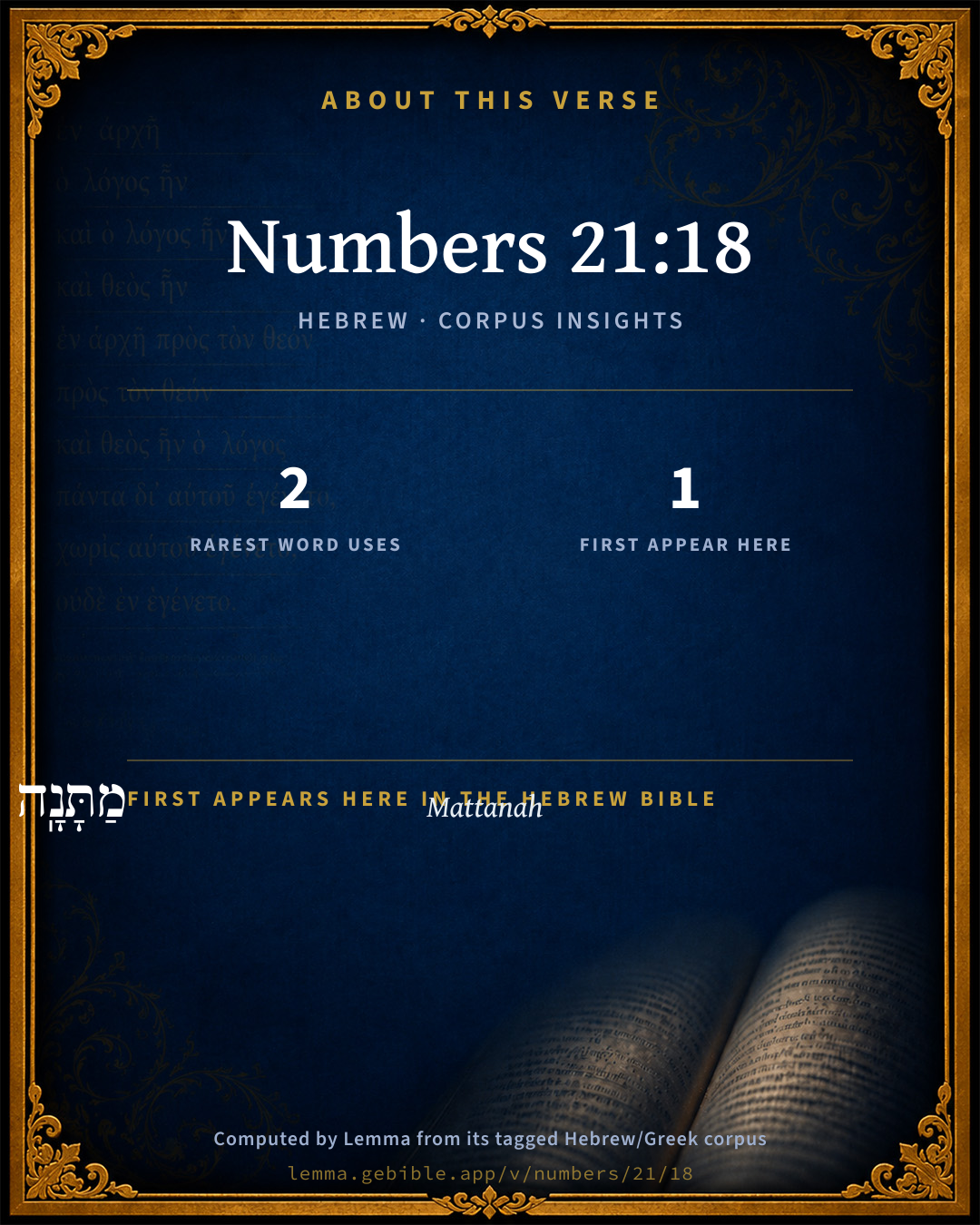
  • 1 first appearance in the Hebrew Bible
Full analysis ↓
Download a study sheet

One document with this verse’s original text, its word-by-word gloss line, the meaning frame, cross-references with their text, attributed commentary, and full source and license credits — printable, and it pastes into notes with its structure intact.

This verse Autodidact and up

Study sheet (.html) Plain text (.txt)

A passage Seminary Student

Up to 50 verses in one chapter. A passage sheet keeps up to 6 commentary sources and 12 cross-references per verse, in the order this page ranks them, and says so on the sheet whenever that leaves anything out. Ask for a single verse and you get the Autodidact verse sheet above.

Everything on this page stays free to read, with no account — the sheet is a download of what is already on screen, not access to it.

Want to remove ads? Support Godless Engineer
Compare translations 3

The same verse in 3 English versions, stacked beneath the original-language interlinear above. Click any original word for its lexicon entry.

Each is an independent rendering of the whole verse — the interlinear is not word-aligned to these translations.

Highlighted words mark where these versions differ — a whole-verse word diff, not a word-by-word alignment.

  • World English Bible Public Domain
    The well, which the princes dug, Which the nobles of the people dug, With the scepter, [and] with their poles. From the wilderness [they traveled] to Mattanah;
  • King James Version Public Domain
    The princes digged the well, the nobles of the people digged it, by the direction of the lawgiver, with their staves. And from the wilderness they went to Mattanah:
  • unfoldingWord Literal Text CC BY-SA 4.0
    well the princes dug, the nobles of the people dug it, with the scepter, with their staffs.” And from the wilderness Mattanah,

unfoldingWord Literal Text — © unfoldingWord, licensed CC BY-SA 4.0. Word-aligned USFM3 via Door43 (git.door43.org/unfoldingWord/en_ult).

Versions to compare (up to 4)

3 of 4 selected

Show all 18 translations

Every available English version of this verse, each an independent rendering of the whole verse.

  • World English Bible Public Domain
    The well, which the princes dug, Which the nobles of the people dug, With the scepter, [and] with their poles. From the wilderness [they traveled] to Mattanah;
  • Berean Standard Bible Public Domain
    The princes dug the well; the nobles of the people hollowed it out with their scepters and with their staffs.” From the wilderness the Israelites went on to Mattanah,
  • Majority Standard Bible Public Domain
    The princes dug the well; the nobles of the people hollowed it out with their scepters and with their staffs.” From the wilderness the Israelites went on to Mattanah,
  • King James Version Public Domain
    The princes digged the well, the nobles of the people digged it, by the direction of the lawgiver, with their staves. And from the wilderness they went to Mattanah:
  • American Standard Version (1901) Public Domain
    The well, which the princes digged, Which the nobles of the people delved, With the sceptre, `and' with their staves. And from the wilderness `they journeyed' to Mattanah;
  • Revised Version (1885) Public Domain
    The well, which the princes digged, Which the nobles of the people delved, With the sceptre, and with their staves. And from the wilderness they journeyed to Mattanah:
  • Geneva Bible (1599) Public Domain
    The princes digged this well, the captaines of the people digged it, euen the lawe giuer, with their staues. And from the wildernesse they came to Mattanah,
  • Douay-Rheims (1899) Public Domain
    The well, which the princes dug, and the chiefs of the people prepared by the direction of the lawgiver, and with their staves. And they marched from the wilderness to Mathana.
  • Young's Literal Translation Public Domain
    `A well -- digged it have princes, Prepared it have nobles of the people, With the lawgiver, with their staves.' And from the wilderness `they journeyed' to Mattanah,
  • Literal Standard Version CC BY-SA 4.0
    A well—princes have dug it, || Nobles of the people have prepared it, || With the lawgiver, with their staffs.” And from the wilderness [they journeyed] to Mattanah,
  • Unlocked Literal Bible CC BY-SA 4.0
    about the well that our leaders dug, the well the nobles of the people dug, with the scepter and their staffs.” Then from the wilderness they traveled to Mattanah.
  • unfoldingWord Literal Text CC BY-SA 4.0
    well the princes dug, the nobles of the people dug it, with the scepter, with their staffs.” And from the wilderness Mattanah,
  • Darby Bible Public Domain
    Well which princes digged, which the nobles of the people hollowed out at [the word of] the lawgiver, with their staves. And from the wilderness [they went] to Mattanah;
  • World Messianic Bible Public Domain
    the well, which the princes dug, which the nobles of the people dug, with the scepter, and with their poles.” From the wilderness they traveled to Mattanah;
  • Webster's Bible Public Domain
    The princes digged the well, the nobles of the people digged it, by the direction of the lawgiver, with their staffs. And from the wilderness they went to Mattanah:
  • Free Bible Version CC BY-SA 4.0
    The tribal chiefs dug the well; yes the leaders of the people dug the well with their rods of authority and their walking sticks.” The Israelites left the desert and carried on to Mattanah.
  • Bible in Basic English Public Domain
    The fountain made by the chiefs, made deep by the great ones of the people, with the law-givers' rod, and with their sticks. Then from the waste land they went on to Mattanah:
  • JPS Tanakh (1917) Public Domain
    The well, which the princes digged, which the nobles of the people delved, with the sceptre, and with their staves. And from the wilderness to Mattanah;

Literal Standard Version (2020), Covenant Press — licensed CC BY-SA 4.0. Text via the HelloAO Bible API (eBible.org). Unlocked Literal Bible (unfoldingWord) — licensed CC BY-SA 4.0. Text via the HelloAO Bible API (eBible.org). unfoldingWord Literal Text — © unfoldingWord, licensed CC BY-SA 4.0. Word-aligned USFM3 via Door43 (git.door43.org/unfoldingWord/en_ult). Free Bible Version, Dr. Jonathan Gallagher — licensed CC BY-SA 4.0. Text via the HelloAO Bible API (eBible.org).

Word by word

More ways to search: Search by grammar → Find every occurrence → Compare this word →

Practice this passage: Drill this verse → Learn its vocabulary →

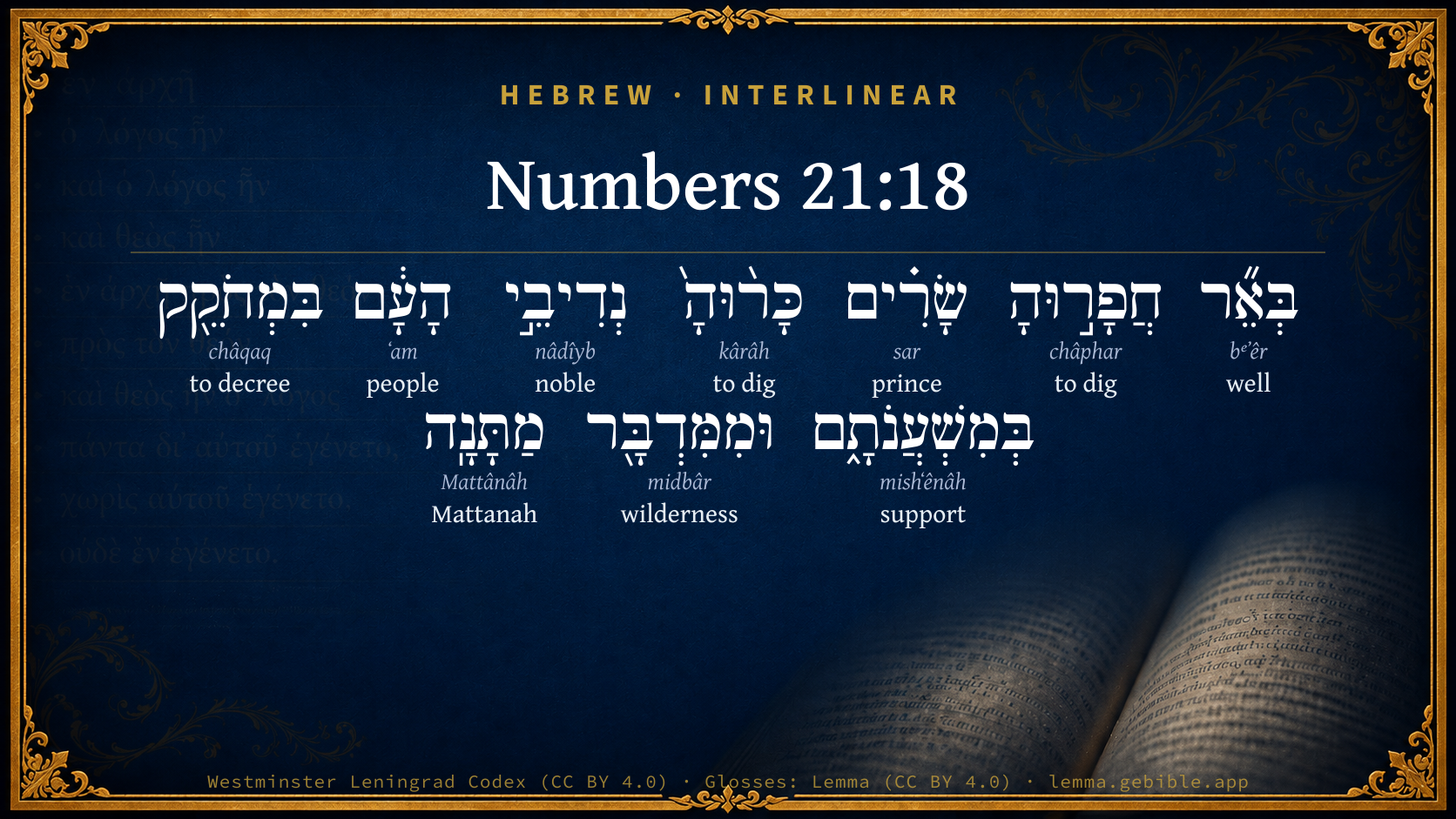
מַתָּנָֽה
Mattânâh
H4980
“Mattanah”
Noun, Proper
Part of Speech
Noun
Type
Proper
Full BDB Definition

Origin: the same as H4979

TWOT: None

Mattanah = "gift of Jehovah" - a station of the Israelites in the latter part of their wanderings located east of the Jordan and probably to the southeast of the Dead Sea
  1. בְּאֵ֞ר bᵉʼêr H875 “well” Noun, Common, Feminine, Singular, Absolute
  2. חֲפָר֣וּהָ châphar H2658 “to dig · her” Verb, Qal, Perfect, 3rd Person, Common, Plural + Suffix, Personal, 3rd Person, Feminine, Singular
  3. שָׂרִ֗ים sar H8269 “princes” Noun, Common, Masculine, Plural, Absolute
  4. כָּר֨וּהָ֙ kârâh H3738 “to dig · her” Verb, Qal, Perfect, 3rd Person, Common, Plural + Suffix, Personal, 3rd Person, Feminine, Singular
  5. נְדִיבֵ֣י nâdîyb H5081 “noble of” Adjective, Adjective, Masculine, Plural, Construct
  6. הָעָ֔ם ʻam H5971 “the · people” Particle, Definite Article + Noun, Common, Masculine, Singular, Absolute
  7. בִּמְחֹקֵ֖ק châqaq H2710 “in/at · decreeing” Preposition + Verb, Poel, Participle Active, Masculine, Singular, Absolute
  8. בְּמִשְׁעֲנֹתָ֑ם mishʻênâh H4938 “in/at · supports · their” Preposition + Noun, Common, Feminine, Plural, Construct + Suffix, Personal, 3rd Person, Masculine, Plural
  9. וּמִמִּדְבָּ֖ר midbâr H4057 “and · from · wilderness” Conjunction + Preposition + Noun, Common, Masculine, Singular, Absolute

About this verse

These counts appear in no published source. They are computed here, from the morphology-tagged text and Lemma’s own curated glosses. What Lemma adds →

10
words
10
distinct lemmas
Pentateuch
section

Notable vocabulary

The rarest word here is מַתָּנָֽה Mattanah H4980 — appearing just 2 times in the whole Hebrew Bible.

First appearance in Scripture

This word makes its first canonical appearance in the Hebrew Bible here:

  • מַתָּנָֽה Mattanah H4980

Shared distinctive vocabulary

מַתָּנָֽה Mattanah H4980 occurs in 2 verses of the Hebrew Bible. Also found in:

Grammatical profile

  • 3 verbs
  • 6 nouns
  • 1 adjective

Verb forms

  • חֲפָר֣וּהָ Qal · Perfect
  • כָּר֨וּהָ֙ Qal · Perfect
  • בִּמְחֹקֵ֖ק Poel · Participle Active

Hebrew & Septuagint length

In English translation the verse runs 27 words from the Hebrew and 28 from the Septuagint (LXX English) — closely comparable.

A rough comparison of the two English renderings, which tokenize alike — not a word-level alignment.

Word counts can differ between the Hebrew and the Greek without any difference in meaning — e.g. the Hebrew direct-object marker אֵת has no separate Greek word, and Greek often adds the article ὁ.

Cross-references

10

Topical passages linked to Numbers 21:18 in the Treasury of Scripture Knowledge — connected by theme and wording, ordered by reader-vote popularity; previews shown in the World English Bible.

  • Isaiah 33:22 For Yahweh is our judge, Yahweh is our lawgiver, Yahweh is our king; he will save us.
  • Deuteronomy 5:31 But as for you, stand you here by me, and I will speak to you all the commandment, and the statutes, and the ordinances, which you shall teach them, that they may do them in the land which I give them to possess it.
  • Deuteronomy 33:4 Moses commanded us a law, An inheritance for the assembly of Jacob.
  • 2 Chronicles 17:7–9 Also in the third year of his reign he sent his princes, even Ben Hail, and Obadiah, and Zechariah, and Nethanel, and Micaiah, to teach in the cities of Judah;
  • John 1:17 For the law was given through Moses. Grace and truth came through Jesus Christ.
  • 1 Timothy 6:17–18 Charge those who are rich in this present world that they not be haughty, nor have their hope set on the uncertainty of riches, but on the living God, who richly provides us with everything to enjoy;
  • James 4:12 Only one is the lawgiver, who is able to save and to destroy. But who are you to judge another?
  • Numbers 33:45–47 They traveled from Iyim, and encamped in Dibon-gad.
  • Nehemiah 3:1 Then Eliashib the high priest rose up with his brothers the priests, and they built the sheep gate; they sanctified it, and set up the doors of it; even to the tower of Hammeah they sanctified it, to the tower of Hananel.
  • Nehemiah 3:5 Next to them the Tekoites repaired; but their nobles didn't put their necks to the work of their lord.

Cross-references courtesy of OpenBible.info (CC BY 4.0).

Hebrew and Greek witnesses Masoretic Hebrew ↔ Greek Septuagint

The same verse in the two great witnesses to the Old Testament, shown verse-for-verse.

These are two independent witnesses, not word-aligned to each other, and the Septuagint is shown in lemma (dictionary) form.

Hebrew Numbers 21:18 Masoretic · Westminster Leningrad Codex

בְּאֵ֞ר חֲפָר֣וּהָ שָׂרִ֗ים כָּר֨וּהָ֙ נְדִיבֵ֣י הָעָ֔ם בִּמְחֹקֵ֖ק בְּמִשְׁעֲנֹתָ֑ם וּמִמִּדְבָּ֖ר מַתָּנָֽה

The well, which the princes dug, Which the nobles of the people dug, With the scepter, [and] with their poles. From the wilderness [they traveled] to Mattanah;

World English Bible · Public Domain

Greek LXX Numbers 21:18 Septuagint · lemma form

φρέαρ ὀρύσσω αὐτός ἄρχων ἐκλατομέω αὐτός βασιλεύς ἔθνος ἐν ὁ βασιλεία αὐτός ἐν ὁ κυριεύω αὐτός καί ἀπό φρέαρ εἰς μανθαναιν

the princes digged it, the kings of the nations in their kingdom, in their lordship sank it in the rock: and they went from the well to Manthanain,

LXX2012 (modern English Septuagint) · Public Domain

On this verse, The Cambridge Bible for Schools and Colleges discusses the Septuagint’s reading. Read the note in Commentary ↓

Hebrew: Westminster Leningrad Codex (CC BY 4.0). Greek: Septuagint (public domain); English from LXX2012 (modern English Septuagint) (Public Domain). How the Septuagint differs from the Hebrew →

Targum (Aramaic paraphrase)

2

The Targum is the ancient Jewish Aramaic paraphrase of the Hebrew Scriptures — an interpretive translation, not the Hebrew text itself. Onkelos (literal) and Pseudo-Jonathan (expansive) render the Torah, and Jonathan the Prophets. Coverage is partial: where no permissively-licensed English translation exists for a verse, only the Aramaic is shown. This is verse-level text, not a word-by-word alignment to the Hebrew.

  1. Targum Onkelos Torah (Genesis–Deuteronomy)
    בֵּירָא דְחָפְרוּהָ רַבְרְבַיָא כְּרוּהָ רֵישֵׁי עַמָא סַפְרַיָא בְּחוּטְרֵיהוֹן וּמִמַדְבְּרָא אִתְיְהִיבַת לְהוֹן

    (no public-domain English translation for this verse)

    Targum Onkelos — Aramaic: “Onkelos Genesis” (public domain); “Onkelos Exodus” (public domain); “Onkelos Leviticus” (public domain); “Onkelos Numbers” (public domain); “Onkelos Deuteronomy” (public domain). English: “Sefaria Community Translation” (CC0 1.0 (public-domain dedication)); “J.W. Etheridge. The Targums of Onkelos and Jonathan Ben Uzziel on the Pentateuch. London: Longmans, Green, 1862” (public domain). Text via Sefaria.

  2. Targum Pseudo-Jonathan Torah (Genesis–Deuteronomy)
    בֵּירָא דְחָפָרוּ יָתָהּ אַבְהַת עַלְמָא אַבְרָהָם יִצְחָק וְיַעֲקב רַבְרְבָנַיָא דְמִלְקַדְמִין חָפְרוּ יָתָהּ רֵישֵׁי עַמָא משֶׁה וְאַהֲרן סַפְרֵיהוֹן דְיִשְרָאֵל מַשְׁכוּ יָתָהּ בְּחוּטְרֵיהוֹן וּמִמַדְבְּרָא אִתְיְהִיבַת לְהוֹן לְמַתָּנָא

    the well which the fathers of the world, Abraham Izhak, and Jakob digged: the princes who were of old digged it, the chiefs of the people: Mosheh and Aharon, the scribes of Israel, found it with their rods; and from the desert it was given to them for a gift.

    Targum Pseudo-Jonathan — Aramaic: “Targum Jonathan on Genesis” (public domain); “Targum Jonathan on Exodus” (public domain); “Targum Jonathan on Leviticus” (public domain); “Targum Jonathan on Numbers” (public domain); “Targum Jonathan on Deuteronomy” (public domain). English: “The Targum of Jonathan ben Uzziel, trans. J. W. Etheridge, London, 1862” (public domain). Text via Sefaria.

Commentary

Notes on Numbers 21:18 from classic Christian and Jewish commentators (each source and its license shown beneath its notes). The classic Christian expositions comment on the surrounding passage and are grouped to its opening verse, so a note may address several verses; the Jewish commentaries on the Tanakh (Rashi and others) are per-verse, so they appear only where the commentator wrote on this verse.

Lemma curates 59 commentaries, every one of them public domain or Creative Commons licensed, each selected and text-cleaned for this edition rather than reprinted as found. About our sources →

Trapp's Complete Commentary

John Trapp

Num 21:18 The princes digged the well, the nobles of the people digged it, by [the direction of] the lawgiver, with their staves. And from the wilderness [they went] to Mattanah:

Ver. 18. The princes digged the well.] Called therehence Beerelim, i.e., the well of the mighty ones. {Isa 15:8} Nunquam vilior erat annona Romae, quam cum terram colerent iidem qui remp. regerent: quasi gauderet terra laureato vomere scilicet, et aratore triumphali. {a}

With their staves.] Those ensigns of their honour they made to be instruments of the common good. See the Epist. Dedicat. set before my notes upon John.

{a} Plin.

John Trapp, A Commentary or Exposition upon All the Books of the Old and New Testament (1647–1656) — public domain. Text from a community e-Sword module.

Tyndale Open Study Notes

Tyndale Open Resources

21:18b-20 After moving north of the Arnon, the Hebrews left the wilderness on the eastern side of Moab and the recently conquered Amorite territory (see study note on 21:21-35). They turned westward toward the ridgeline that rises up from the Jordan Rift Valley, then traveled north to Pisgah Peak (see also 23:14; Deut 3:17, 27; 34:1, 5).

Tyndale Open Study Notes — © Tyndale Open Resources, licensed CC BY-SA 4.0. Text via the HelloAO Bible API.

Geneva Bible (1599)

Geneva Bible translators

Moses and Aaron heads of the people only smote the rock with the rod or staff, which gave water as a well that were deep digged.

Geneva Bible (1599) marginal notes — public domain. Text via Bolls.life.

Adam Clarke's Commentary

Verse 18. The princes digged the well - with their staves.] This is not easily understood. Who can suppose that the princes dug this well with their staves? And is there any other idea conveyed by our translation? The word חפרו chapharu, which is translated they digged, should be rendered they searched out, which is a frequent meaning of the root; and במשענתם bemishanotham, which we render with their staves, should be translated on their borders or confines, from the root שען shaan, to lie along. With these corrections the whole song may be read thus: -

Spring up, O well! Answer ye to it.

i.e. Repeat the other part of the song.

The well, the princes searched it out.

This is the answer.

The nobles of the people have digged it.

By a decree, upon their own borders.

This was the chorus.

This is the whole of the quotation from what is called the book of the wars of the Lord. But see Dr. Kennicott's remarks at the end of this chapter.

Adam Clarke's Commentary on the Bible (1810–1826) — public domain. Text from a community e-Sword/MySword module.

Ellicott's Commentary for English Readers

(18) By the direction of the lawgiver.—Better, with the ruler’s staff. The same word occurs in Gen_49:10, where it stands in parallelism to “the sceptre.” (See Note in loc.)

And from the wilderness they went to Mat-tanah.—The Targums interpret this and Num_21:19-20 of the well, And from the wilderness it was given to them for a gift, and from thence it was given to them in Mattanah, &c. The Targum of Onkelos is as follows: “And from the time that it was given to them, it descended with them to the rivers, &c.” The Targum of Palestine is—“And from the wilderness, &c.” (as above).

A Bible Commentary for English Readers, edited by Charles John Ellicott (1878–1897) — public domain. Text from a community e-Sword module.

The Cambridge Bible for Schools and Colleges

gen. ed. J. J. S. Perowne

18. with the ruler’s wand, with their staves] These do not seem to be implements suitable for digging a well. But it is suggested by Budde that there is ‘an allusion to a custom by which when a well had been discovered it was lightly covered over, and then, on a subsequent occasion, solemnly opened with a symbolic action of the sceptre-like staves of the Sheikhs’; see Gray, Numb. p. 289, where parallels are cited for the practice of singing to a well. R.V. marg. ‘by order of the lawgiver’ retains the improbable interpretation of the A.V. [Note: .V. The Authorised Version.]

The historical setting in which the song has been placed obscures its real nature. Popular snatches of song were sung during the intervals of labour in the field, or in honour of the vine at the vintage, or in honour of a well or spring at the time of drawing water. The present stanza appears to be of the latter class. Wells were highly prized; and the songs would, as it were, persuade them to yield up their precious contents.

And from the wilderness [they journeyed to] Mattanah] The clause is doubtful, for (1) they had already left the wilderness (of Num_21:13) when they moved to Beer, and (2) the Lucianic recension of the LXX. omits ‘and from Mattanah’ in Num_21:19. Mattanah, if it was the name of a place, is unknown; but the word means ‘a gift,’ and Budde ingeniously suggests that the clause forms the last line of the song—‘from the wilderness a gift,’ omitting the initial ‘and’ (ו). The LXX. translators appear to have felt the difficulty of ‘from the wilderness’ and to have removed it by reading ‘And from Beer to Mattanah.’

The Targ. of Onkelos on this verse contains a legend according to which the well followed the Israelites on their journeys over hill and dale. In 1Co_10:4 S. Paul refers to the legend but combines with it a reference to the rock which produced water (Num_20:11).

The Cambridge Bible for Schools and Colleges (gen. ed. J. J. S. Perowne; Cambridge University Press, 1878–1918) — public domain. Text from a community e-Sword module.

John Gill's Exposition

And from Mattanah to Nahaliel, and from Nahaliel to Bamoth. All the Targums interpret this, and the following verse, not of the journeying of the children of Israel, but of the motion of the well, that that, from the place from whence it was given them, descended with them into the valleys, and from thence to the high places, as these words signify: and indeed those places are not mentioned in the journeys of the children of Israel, Num 33:1 and were not stations where they pitched, but places they passed through before they came to Abarim, and the wilderness of Kedemoth.

and were not stations where they pitched, but places they passed through before they came to Abarim, and the wilderness of Kedemoth.

Numbers 21:20

num 21:20

num 21:20

num 21:20And from Bamoth, in the valley,.... Or rather "to the valley", as the Targum of Onkelos, since Bamoth signifies high places; though, according to the Jerusalem Talmud (o), Bamoth, Baal, which seems to be the same place, was in a plain:

that is in the country of Moab; the valley belonged to Moab, into which Israel came:

to the top of Pisgah; not that the valley reached to the top, nor did the children of Israel go to the top of it, only Moses, but rather to the bottom, which indeed is meant; for it intends the beginning of it, where Pisgah, which was an high mountain near the plains of Moab, began, and which was properly the foot of it:

which looketh towards Jeshimon; that is, Pisgah, as Jarchi rightly interprets it, which looked over a place called Jeshimon; and which signifies a wilderness, and is no other indeed than the wilderness of Kedemoth, Deu 2:26 for from thence the following messengers were sent.

(o) Sheviith, fol. 38. 4.

John Gill's Exposition of the Whole Bible (1746–1763) — public domain (CC PDM 1.0). Text via the HelloAO Bible API.

Haydock's Catholic Bible Commentary

Mathana. Perhaps they did not stop here, though all the encampments are not specified, chap. xxxiii. Nahaliel, "God my torrent," and Bamoth, "the heights," are also situated upon the Arnon.

George Leo Haydock (1774–1849), Haydock's Catholic Family Bible and Commentary, 1859 edition — public domain. Excludes Psalms (Douay-Rheims chapter numbering differs from Protestant) and Deuterocanonical books (Catholic canon only).

Matthew Poole's English Annotations

The princes digged; either by themselves, or by others whom they commanded to do it. By the direction of the lawgiver, or, with the lawgiver, i.e. Moses; they together with Moses, or they by Moses’s direction and appointment, which is signified Num 21:16.

Their staves are here mentioned, either,

1. As the ensigns of their authority, Jdg 5:14, by which they gave this command of digging.

2. As the instruments of their work; not that they, did formally and effectually dig the well or receptacle for the water, for which spades were more proper than staves, but that as Moses smote the rock with his rod, so they struck the earth with their staves, making only some small impression for form sake, or as a sign that God would cause the water to flow forth out of the earth where they smote it, as he did before out of the rock.

Matthew Poole's English Annotations on the Holy Bible (1683–1685) — public domain. Text from a community e-Sword/MySword module.

Whedon's Commentary on the Bible

Daniel D. Whedon

18. Mattanah cannot be identified. Le Clerc suggests that it may be the same as the mysterious Vaheb, (Num_21:14, note,) since its meaning in Arabic is the same as that of Mattanah in Hebrew. Neither this nor the other names occurring in this context are found in the catalogue of stations in chap. 33. This discrepancy may arise from the fact that the same station had several names, or from two contiguous stations being occupied at the same time. Kurtz thinks that the object of the writer in the thirty-third chapter is statistical, that is, to set forth, not all the halting places but the regular camps where the tabernacle was erected, while in earlier passages the object is historical. Hence more places are enumerated, as in Num_21:11 and Num_22:1, seven places are mentioned between Ije-abarim and the plains of Moab; in Num_33:44-48, only three places.

Daniel D. Whedon (gen. ed.), Commentary on the Old and New Testaments (1874–1909) — public domain. Text from a community e-Sword module.

The Pulpit Commentary

By the direction of the lawgiver, qqejomBi. Literally, "by the lawgiver," or, as some prefer, "with the scepter." The meaning of michokek is disputed, (see on Gen_49:10) but in either ease the meaning must be practically as in the A.V It speaks of the alacrity with which the leaders of Israel, Moses himself amongst them, began the work even with the insignia of their office. And from the wilderness... to Mattanah. Beer was still in the desert country eastward of the cultivated belt: from thence they crossed, still on the north of Arnon, and probably leaving it somewhat to the south, into a more settled country.

The Pulpit Commentary (1880–1919), ed. H.D.M. Spence-Jones & Joseph S. Exell — public domain. Text from a community e-Sword module.

John Wesley's Explanatory Notes

With their staves - Probably as Moses smote the rock with his rod, so they struck the earth with their staves, as a sign that God would cause the water to flow out of the earth where they smote it, as he did before out of the rock. Perhaps they made holes with their staves in the sandy ground, and God caused the water immediately to spring up.

John Wesley, Explanatory Notes Upon the Whole Bible (1754–1765) — public domain. Text via the GEBible commentary corpus.

Rashi

Rabbi Shlomo Yitzchaki (Rashi)

באר חפרוה THE WELL, [PRINCES] DIGGED IT means: This is the well which the princes, Moses and Aaron, digged (cf. Targum Jonathan on).

במשענתם means WITH THE STAFF.

וממדבר מתנה AND FROM THE WILDERNESS was it given them [as a מתנה, a gift].

Rashi on the Tanakh — English translations: “The Judaica Press complete Tanach with Rashi, translated by A. J. Rosenberg” (CC BY 4.0); “Pentateuch with Rashi's commentary by M. Rosenbaum and A.M. Silbermann, 1929-1934” (public domain); “The Metsudah Tanach series, Lakewood, N.J” (CC BY 4.0); and “The Book of Joshua, Metsudah Publications, 1997” (CC BY 4.0). Text via Sefaria.

Ramban (Nachmanides)

Rabbi Moshe ben Nachman (Ramban / Nachmanides)

UMIMIDBAR MATANAH.’ The meaning of this is as Onkelos rendered it [“and from the wilderness it was given to them”], this being an elliptical expression that is common in songs. Thus it is saying that “from the wilderness, which is a land of drought and thirst, was this gift [the well] given to us; and from this gift [of the well which descended] unto the brooks, and from these brooks [ascended] to the heights until Pisgah, which looks down upon the land which is a complete howling wilderness — there was no other brook, nor any other spring of water except for this one.” This was the Well of Miriam in the opinion of our Rabbis, or a well which came out by word of Moses at the command of the Almighty, which Israel had not asked for. For when G-d told Moses, Gather the people together, and I will give them water, streams overflowed from it [the well], and continued unto distant places.

Ramban (Nachmanides) on the Tanakh — English translation: “Commentary on the Torah by Ramban (Nachmanides). Translated and annotated by Charles B. Chavel. New York, Shilo Pub. House, 1971-1976” (CC BY 4.0). Text via Sefaria.

Lesson kit

Teaching starters — assembled from the data on this page, not authored interpretation. Every prompt links to the verse data it draws on. Edit before teaching.

Numbers, in the Pentateuch, opens this verse with 10 words (10 distinct Hebrew lemmas). Its most distinctive word is Mattânâh (“Mattanah”). A historical commentator’s framing appears above. Read the whole chapter for the surrounding context.

Discussion questions

  1. How does “Mattanah” (Mattânâh) shape what this verse is saying?
  2. The word “Mattanah” first appears here in Scripture. What is being introduced at this debut?
  3. Numbers 21:19 shares the word «Mattanah» with this verse. How do the two illuminate each other?
  4. These translations render this verse differently. What is at stake in choosing one wording over another?
  5. The verb «חֲפָר֣וּהָ» is Qal Perfect. How does its form color the action?
  6. Reading how Trapp's Complete Commentary and Tyndale Open Study Notes read this verse, where do the two commentators agree and where do they part?

Things to notice

Reading settings

Reading text

Shown beneath each verse's original-language words.

Old Testament
Old Testament edition

Read the OT as the Masoretic Hebrew (MT) or the Greek Septuagint (LXX).

English shown for the Greek Septuagint (in the Hebrew ↔ Greek comparison).

Comparing translations? Open the Compare panel on any verse page to stack up to four side by side.