
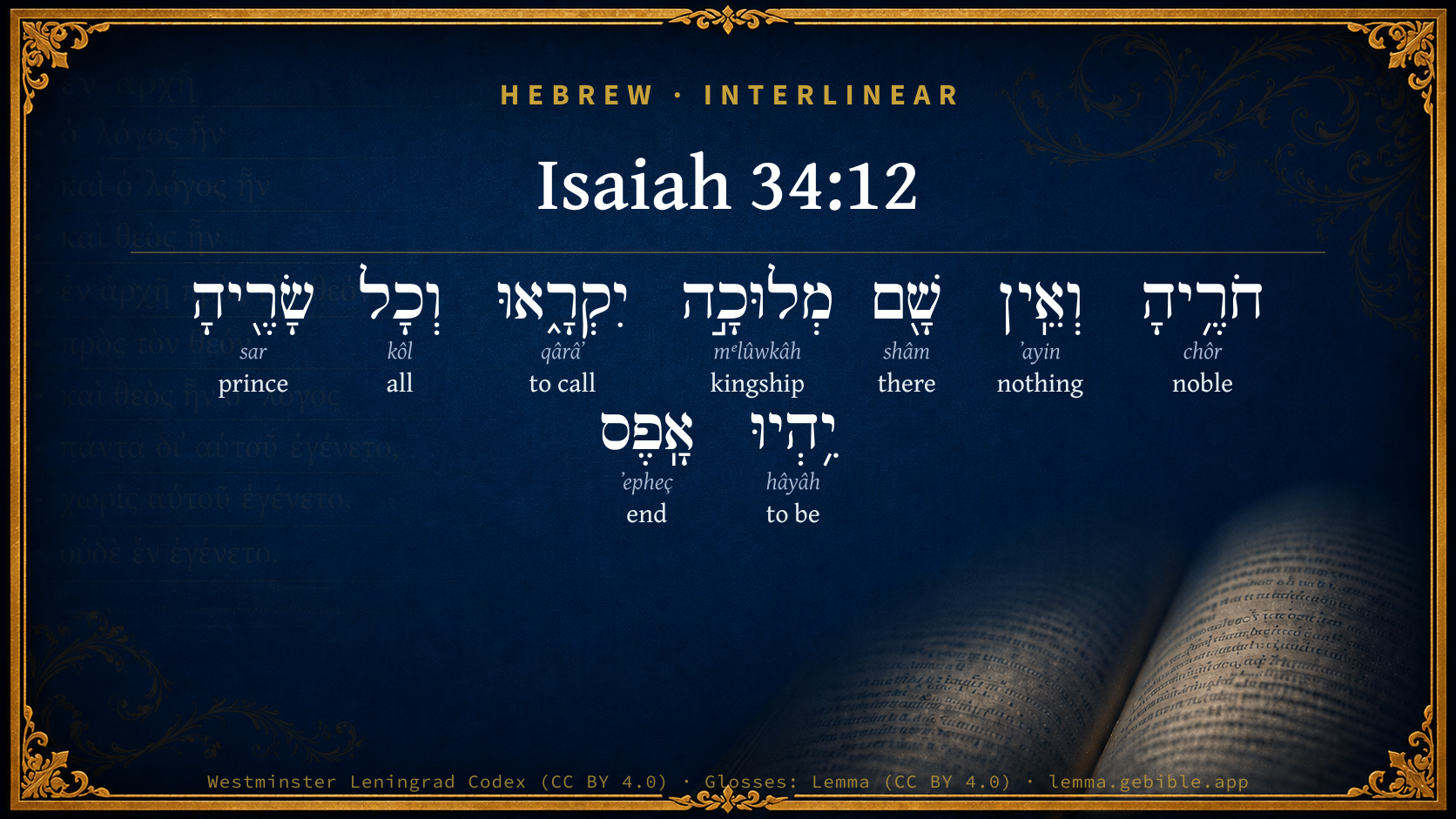
Isaiah 34:12

Hebrew (Westminster Leningrad Codex) Isaiah 34:12 appears in the Hebrew Old Testament. The text above is from the Westminster Leningrad Codex. Each word links to its Strong’s number, a concise gloss, and parsing drawn from the Open Scriptures Hebrew Bible morphology. Click any word for its full Brown-Driver-Briggs (BDB) entry.
Download image
Cite this verse

Isaiah 34:12 (World English Bible). Public Domain. Lemma interlinear Bible study tool, https://lemma.gebible.app/v/isaiah/34/12.

Show BibTeX & RIS
BibTeX
RIS
English Translation
They shall call the nobles of it to the kingdom, but none shall be there; and all its princes shall be nothing.
World English Bible · Public Domain
Download a study sheet

One document with this verse’s original text, its word-by-word gloss line, the meaning frame, cross-references with their text, attributed commentary, and full source and license credits — printable, and it pastes into notes with its structure intact.

This verse Autodidact and up

Study sheet (.html) Plain text (.txt)

A passage Seminary Student

Up to 50 verses in one chapter. A passage sheet keeps up to 6 commentary sources and 12 cross-references per verse, in the order this page ranks them, and says so on the sheet whenever that leaves anything out. Ask for a single verse and you get the Autodidact verse sheet above.

Everything on this page stays free to read, with no account — the sheet is a download of what is already on screen, not access to it.

Want to remove ads? Support Godless Engineer
Compare translations 3

The same verse in 3 English versions, stacked beneath the original-language interlinear above. Click any original word for its lexicon entry.

Each is an independent rendering of the whole verse — the interlinear is not word-aligned to these translations.

Highlighted words mark where these versions differ — a whole-verse word diff, not a word-by-word alignment.

  • World English Bible Public Domain
    They shall call the nobles of it to the kingdom, but none shall be there; and all its princes shall be nothing.
  • King James Version Public Domain
    They shall call the nobles thereof to the kingdom, but none shall be there, and all her princes shall be nothing.
  • unfoldingWord Literal Text CC BY-SA 4.0
    Its nobles—but there is not there they call a kingdom, and all of its princes are nothing.

unfoldingWord Literal Text — © unfoldingWord, licensed CC BY-SA 4.0. Word-aligned USFM3 via Door43 (git.door43.org/unfoldingWord/en_ult).

Versions to compare (up to 4)

3 of 4 selected

Show all 18 translations

Every available English version of this verse, each an independent rendering of the whole verse.

  • World English Bible Public Domain
    They shall call the nobles of it to the kingdom, but none shall be there; and all its princes shall be nothing.
  • Berean Standard Bible Public Domain
    No nobles will be left to proclaim a king, and all her princes will come to nothing.
  • Majority Standard Bible Public Domain
    No nobles will be left to proclaim a king, and all her princes will come to nothing.
  • King James Version Public Domain
    They shall call the nobles thereof to the kingdom, but none shall be there, and all her princes shall be nothing.
  • American Standard Version (1901) Public Domain
    They shall call the nobles thereof to the kingdom, but none shall be there; and all its princes shall be nothing.
  • Revised Version (1885) Public Domain
    They shall call the nobles thereof to the kingdom, but none shall be there; and all her princes shall be nothing.
  • Geneva Bible (1599) Public Domain
    The nobles thereof shall call to the kingdome, and there shalbe none, and all the princes thereof shalbe as nothing.
  • Douay-Rheims (1899) Public Domain
    The nobles thereof shall not be there: they shall call rather upon the king, and all the princes thereof shall be nothing.
  • Young's Literal Translation Public Domain
    `To' the kingdom her freemen they call, But there are none there, And all her princes are at an end.
  • Literal Standard Version CC BY-SA 4.0
    They call her nobles [to] the kingdom, || But there are none there, || And all her princes are at an end.
  • Unlocked Literal Bible CC BY-SA 4.0
    Her nobles will have nothing left to call a kingdom, and all her princes will be nothing.
  • unfoldingWord Literal Text CC BY-SA 4.0
    Its nobles—but there is not there they call a kingdom, and all of its princes are nothing.
  • Darby Bible Public Domain
    Of her nobles who should proclaim the kingdom, none are there; and all her princes shall be nought.
  • World Messianic Bible Public Domain
    They shall call its nobles to the kingdom, but none shall be there; and all its princes shall be nothing.
  • Webster's Bible Public Domain
    They shall call her nobles to the kingdom, but none shall be there, and all her princes shall be nothing.
  • Free Bible Version CC BY-SA 4.0
    Its nobles won't have anything to call a kingdom; all its princes will be gone.
  • Bible in Basic English Public Domain
    The jackals will be there, and her great ones will be gone; they will say, There is no longer a kingdom there, and all her chiefs will have come to an end.
  • JPS Tanakh (1917) Public Domain
    As for her nobles, none shall be there to be called to the kingdom; and all her princes shall be nothing.

Literal Standard Version (2020), Covenant Press — licensed CC BY-SA 4.0. Text via the HelloAO Bible API (eBible.org). Unlocked Literal Bible (unfoldingWord) — licensed CC BY-SA 4.0. Text via the HelloAO Bible API (eBible.org). unfoldingWord Literal Text — © unfoldingWord, licensed CC BY-SA 4.0. Word-aligned USFM3 via Door43 (git.door43.org/unfoldingWord/en_ult). Free Bible Version, Dr. Jonathan Gallagher — licensed CC BY-SA 4.0. Text via the HelloAO Bible API (eBible.org).

Word by word

More ways to search: Search by grammar → Find every occurrence → Compare this word →

Practice this passage: Drill this verse → Learn its vocabulary →

About this verse

These counts appear in no published source. They are computed here, from the morphology-tagged text and Lemma’s own curated glosses. What Lemma adds →

9
words
9
distinct lemmas
Prophets
section

Notable vocabulary

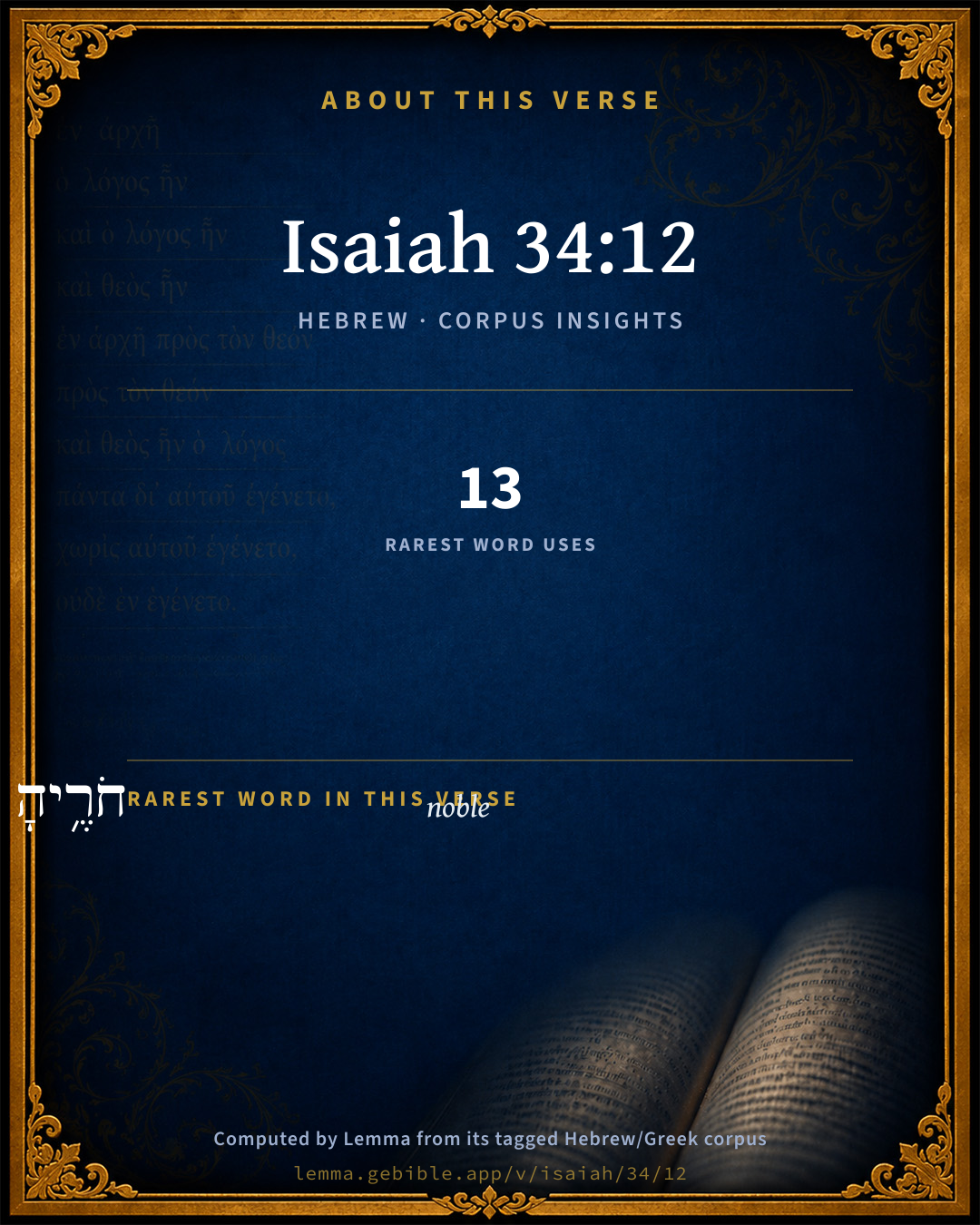
The rarest word here is חֹרֶ֥יהָ noble H2715 — appearing just 13 times in the whole Hebrew Bible.

Shared distinctive vocabulary

חֹרֶ֥יהָ noble H2715 occurs in 13 verses of the Hebrew Bible. Also found in:

Grammatical profile

  • 2 verbs
  • 5 nouns
  • 1 adverb
  • 1 particle

Verb forms

  • יִקְרָ֑אוּ Qal · Imperfect
  • יִ֥הְיוּ Qal · Imperfect

Hebrew & Septuagint length

In English translation the verse runs 22 words from the Hebrew and 16 from the Septuagint (LXX English) — closely comparable.

A rough comparison of the two English renderings, which tokenize alike — not a word-level alignment.

Word counts can differ between the Hebrew and the Greek without any difference in meaning — e.g. the Hebrew direct-object marker אֵת has no separate Greek word, and Greek often adds the article ὁ.

Cross-references

9

Topical passages linked to Isaiah 34:12 in the Treasury of Scripture Knowledge — connected by theme and wording, ordered by reader-vote popularity; previews shown in the World English Bible.

  • Isaiah 3:6–8 Indeed a man shall take hold of his brother in the house of his father, saying, "You have clothing, you be our ruler, And let this ruin be under your hand."
  • Ecclesiastes 10:16–17 Woe to you, land, when your king is a child, And your princes eat in the morning!
  • Isaiah 41:11–12 Behold, all those who are incensed against you shall be disappointed and confounded: those who strive with you shall be as nothing, and shall perish.
  • Isaiah 41:24 Behold, you are of nothing, and your work is of nothing; an abomination is he who chooses you.
  • Jeremiah 27:20 which Nebuchadnezzar king of Babylon didn't take, when he carried away captive Jeconiah the son of Jehoiakim, king of Judah, from Jerusalem to Babylon, and all the nobles of Judah and Jerusalem;
  • Jeremiah 39:6 Then the king of Babylon killed the sons of Zedekiah in Riblah before his eyes: also the king of Babylon killed all the nobles of Judah.
  • 1 Corinthians 8:4 Therefore concerning the eating of things sacrificed to idols, we know that no idol is anything in the world, and that there is no other God but one.
  • 1 Corinthians 13:2 If I have the gift of prophecy, and know all mysteries and all knowledge; and if I have all faith, so as to remove mountains, but don't have love, I am nothing.
  • 2 Corinthians 12:11 I have become foolish in boasting. You compelled me, for I ought to have been commended by you, for in nothing was I inferior to the very best apostles, though I am nothing.

Cross-references courtesy of OpenBible.info (CC BY 4.0).

Hebrew and Greek witnesses Masoretic Hebrew ↔ Greek Septuagint

The same verse in the two great witnesses to the Old Testament, shown verse-for-verse.

These are two independent witnesses, not word-aligned to each other, and the Septuagint is shown in lemma (dictionary) form.

Hebrew Isaiah 34:12 Masoretic · Westminster Leningrad Codex

חֹרֶ֥יהָ וְאֵֽין שָׁ֖ם מְלוּכָ֣ה יִקְרָ֑אוּ וְכָל שָׂרֶ֖יהָ יִ֥הְיוּ אָֽפֶס

They shall call the nobles of it to the kingdom, but none shall be there; and all its princes shall be nothing.

World English Bible · Public Domain

Greek LXX Isaiah 34:12 Septuagint · lemma form

ὁ ἄρχων αὐτός οὐ εἰμί ὁ γάρ βασιλεύς αὐτός καί ὁ ἄρχων αὐτός καί ὁ μεγιστάν αὐτός εἰμί εἰς ἀπώλεια

Her princes shall be no more; for her kings and her great men shall be destroyed.

LXX2012 (modern English Septuagint) · Public Domain

Hebrew: Westminster Leningrad Codex (CC BY 4.0). Greek: Septuagint (public domain); English from LXX2012 (modern English Septuagint) (Public Domain). How the Septuagint differs from the Hebrew →

Targum (Aramaic paraphrase)

1

The Targum is the ancient Jewish Aramaic paraphrase of the Hebrew Scriptures — an interpretive translation, not the Hebrew text itself. Onkelos (literal) and Pseudo-Jonathan (expansive) render the Torah, and Jonathan the Prophets. Coverage is partial: where no permissively-licensed English translation exists for a verse, only the Aramaic is shown. This is verse-level text, not a word-by-word alignment to the Hebrew.

  1. Targum Jonathan Prophets (Joshua–Malachi)
    דַהֲווֹ אָמְרִין בְּנֵי חֵירִין אֲנַחְנָא וְלָא צְבָן לְקַבָּלָא אֲנַחְנָא וְלָא צְבָן לְקַבָּלָא עֲלֵיהוֹן מַלְכוּ וְכָל רַבְרָבָהָא יְהוֹן לִלְמָא:

    They said, we are the sons of free men, and they were not willing to accept over them a kingly government; and all her princes shall come to nothing

    Targum Jonathan — Aramaic: “Mikraot Gedolot” (public domain). English: “Sefaria Community Translation” (CC0 1.0 (public-domain dedication)); “London "Chaldee Paraphrase," 1871” (public domain). Text via Sefaria.

Commentary

Notes on Isaiah 34:12 from classic Christian and Jewish commentators (each source and its license shown beneath its notes). The classic Christian expositions comment on the surrounding passage and are grouped to its opening verse, so a note may address several verses; the Jewish commentaries on the Tanakh (Rashi and others) are per-verse, so they appear only where the commentator wrote on this verse.

Lemma curates 59 commentaries, every one of them public domain or Creative Commons licensed, each selected and text-cleaned for this edition rather than reprinted as found. About our sources →

Trapp's Complete Commentary

John Trapp

Isa 34:12 They shall call the nobles thereof to the kingdom, but none [shall be] there, and all her princes shall be nothing.

Ver. 12. They shall call the nobles thereof to the kingdom.] The Venetians have magistrates called pregadi; because at first men were prayed to take the office, and to help to govern the State: but here were none left for such a purpose.

John Trapp, A Commentary or Exposition upon All the Books of the Old and New Testament (1647–1656) — public domain. Text from a community e-Sword module.

Geneva Bible (1599)

Geneva Bible translators

Meaning, here shall be neither order nor policy, nor state of commonweal.

Geneva Bible (1599) marginal notes — public domain. Text via Bolls.life.

Jamieson, Fausset & Brown

Robert Jamieson, A. R. Fausset & David Brown

Rather, "As to her nobles, there shall be none there who shall declare a kingdom," that is, a king [MAURER]; or else, "There shall be no one there whom they shall call to the kingdom" [ROSENMULLER] (Isa 3:6, &c.). Idumea was at first governed by dukes (Gen 36:15); out of them the king wan chosen when the constitution became a monarchy.

Jamieson, Fausset & Brown — Commentary Critical and Explanatory on the Whole Bible (1871) — public domain (CC PDM 1.0). Text via the HelloAO Bible API.

Ellicott's Commentary for English Readers

(12) They shall call the nobles thereof . . .—The monarchy of Edom seems to have been elective, its rulers being known, not as kings, but by the title which the English version renders by “dukes” (Gen_36:15-43). It will be noticed that no chief in the list of dukes is the son of his predecessor. Isaiah fore tells as part of the utter collapse of Edom that there shall be neither electors nor any to elect.

A Bible Commentary for English Readers, edited by Charles John Ellicott (1878–1897) — public domain. Text from a community e-Sword module.

The Cambridge Bible for Schools and Colleges

gen. ed. J. J. S. Perowne

12. They shall call the nobles … there] A very obscure sentence, probably through a defect in the text. The rendering of E.V. might be maintained if with Prof. Weir we suppose a transposition of words in the original; the inference being that the monarchy in Edom was elective (cf. Gen_36:31 ff.). More likely, however, “her nobles” is the subject of a sentence the rest of which is now lost; and the following words are to be translated “and there is no kingdom there which they may proclaim.”

The Cambridge Bible for Schools and Colleges (gen. ed. J. J. S. Perowne; Cambridge University Press, 1878–1918) — public domain. Text from a community e-Sword module.

John Gill's Exposition

They shall call the nobles thereof to the kingdom, but none shall be there,.... They shall call them to take upon them the kingdom and government, and there shall be none to do it, or that will care to do it; or rather there will be no kingdom to take unto them. The words may be rendered either, "as for the nobles thereof, not there a kingdom shall they be called" (p); or, "the nobles shall call"; or, "they shall call the nobles", and "there shall be no kingdom" (q); the kingdom of the beast, as it is called, Rev 16:10 shall be no more; and though the cardinals, who are like to nobles, may call for it, and expect it, or be called to it, yet to no purpose; this kingdom will not only be full of darkness, but utterly destroyed:

and all her princes shall be nothing; shall come to nothing; the above mentioned cardinals, who are clothed and live like princes, these shall be no more; the same with the merchants of the earth, which like the merchants of Tyre are princes, Rev 18:3.

(p) "nobiles ejus, et non ibi regnum vocabuntur", Forerius. (q) "Ingenuos ejus vocabunt, et non erit ibi regnum", Tigurine version.

John Gill's Exposition of the Whole Bible (1746–1763) — public domain (CC PDM 1.0). Text via the HelloAO Bible API.

Albert Barnes' Notes on the Bible

They shall call the nobles thereof to the kingdom - A more correct rendering of this would be, ‘As to the nobles, they shall call them, but there shall be there no kingdom.’ The idea is, that the kingdom would be desolate; there would be no people to rule. Or, there will be no nobles there who shall survive the destruction, and who can undertake the government of the state. The idea is taken from a government or constitution where the monarch is chosen from the ranks of the nobility. Idumea was formerly governed, as we have seen (see the Introduction to the chapter), by dukes or princes; and it is probable that when it became a monarchy it was a part of the constitution that the sovereign should be chosen from their ranks. The idea here is, that none would be left who could be called to the throne; or if any were left, they would be unwilling to undertake the government of a country where all was disorder and confusion.

And all her princes shall be nothing - Long since Idumea has ceased to be a kingdom, and there are neither nobles nor princes there, nor are there any remains of an organized and independent government.

Albert Barnes' Notes on the Bible (1834–1885) — public domain. Text from a community e-Sword/MySword module.

Matthew Poole's English Annotations

They shall call the nobles thereof to the kingdom, but none shall be there; they shall endeavour to heal their breaches, but in vain; the remnant of the people shall seek for any fit person, and offer the kingdom to him; but they shall not find any such who shall be willing to undertake the government.

Shall be nothing; either shall be lost and cut off, or shall have no courage or strength left in them.

Matthew Poole's English Annotations on the Holy Bible (1683–1685) — public domain. Text from a community e-Sword/MySword module.

The Pulpit Commentary

They shall call the nobles, etc.; rather, as for her nobles, there shall be none there for them to call to the kingdom. The nobles are termed horim, probably because the right of succession to the kingdom was vested in the descendants of the Horites, from whom the Edomites took their territory. (Gen_36:20, Gen_36:29, Gen_36:30) These having died out, there would be no one to appoint as king.

The Pulpit Commentary (1880–1919), ed. H.D.M. Spence-Jones & Joseph S. Exell — public domain. Text from a community e-Sword module.

John Wesley's Explanatory Notes

None - They shall not find any willing to undertake the government. Nothing - Shall have no courage or strength left in them.

John Wesley, Explanatory Notes Upon the Whole Bible (1754–1765) — public domain. Text via the GEBible commentary corpus.

J. A. Alexander on Isaiah

Joseph Addison Alexander

“Her caves and there is no one there (i.e., her uninhabited or empty caves) they will (still) call a kingdom, and all her chiefs will be cessation” (i.e., cease to be). The great variety of explanations which have been given of this verse, and the harshness of construction with which most of them are chargeable, may serve as an excuse for the suggestion of a new one, not as certainly correct, but as possibly entitled to consideration. All interpreters coincide in giving to the first noun, the sense of nobles, which it certainly has in several places. (See 1Ki 21:8; 1Ki 21:11; Neh 2:16; Neh 4:14). But in several others, it no less certainly means holes or caves. (See 1Sa 14:11; Job 30:6; Nah 2:12). Now it is matter of history, not only that Edom was full of caverns, but that these were inhabited, and that the aboriginal inhabitants, expelled by Esau, were expressly called Horites, as being troglodytes or inhabitants of caverns (Gen 14:6; Gen 36:20; Deu 2:12; Deu 2:22). This being the case, the entire depopulation of the country, and especially the destruction of its princes, might be naturally and poetically expressed by saying that the kingdom of Edom should be thenceforth a kingdom of deserted caverns. How appropriate such a description would be to the actual condition of the country, and particularly to its ancient capital, may be seen from Robinson’s account of Petra (Palestine, II pp. 514-537).

Joseph Addison Alexander, The Prophecies of Isaiah (1846–1847; New York: Scribner, 1870–1878) — public domain. Text from a community e-Sword module.

Rashi

Rabbi Shlomo Yitzchaki (Rashi)

As for its nobles, there are none who proclaim the kingdom Its princes stand, and none of them calls upon himself the name of ruling and kingdom.

nothing Destruction.

Rashi on the Tanakh — English translations: “The Judaica Press complete Tanach with Rashi, translated by A. J. Rosenberg” (CC BY 4.0); “Pentateuch with Rashi's commentary by M. Rosenbaum and A.M. Silbermann, 1929-1934” (public domain); “The Metsudah Tanach series, Lakewood, N.J” (CC BY 4.0); and “The Book of Joshua, Metsudah Publications, 1997” (CC BY 4.0). Text via Sefaria.

Ibn Ezra

Rabbi Abraham ibn Ezra

חוריה The nobles thereof. They are compared with the white colour; the people of the lower class are called the black (Prov. 22:29).

יקראו They shall be called. Lit., They—the people—will call them. למלוכה ═ מלוכה to the kingdom.

אפס Nothing.

Ibn Ezra on the Tanakh — English translations: “Sefaria Community Translation” (CC0 1.0 (public-domain dedication)); “Yalkut, Sifsei Chachomim Chumash, Metsudah Publications, 2009” (CC BY 4.0); and “Commentary of Ibn Ezra on Isaiah - trans. by M. Friedlander, 1873” (public domain). Text via Sefaria.

Lesson kit

Teaching starters — assembled from the data on this page, not authored interpretation. Every prompt links to the verse data it draws on. Edit before teaching.

Isaiah, in the Prophets, opens this verse with 9 words (9 distinct Hebrew lemmas). Its most distinctive word is chôr (“noble”). A historical commentator’s framing appears above. Read the whole chapter for the surrounding context.

Discussion questions

  1. How does “noble” (chôr) shape what this verse is saying?
  2. How does 1 Kings 21:8, which shares the word «noble», read alongside this verse?
  3. These translations render this verse differently. What is at stake in choosing one wording over another?
  4. «יִקְרָ֑אוּ» is a Qal Imperfect verb. How does that grammatical form shape the action described?
  5. Compare how Trapp's Complete Commentary and Geneva Bible (1599) read this verse. Where do they agree or differ?

Things to notice

Reading settings

Reading text

Shown beneath each verse's original-language words.

Old Testament
Old Testament edition

Read the OT as the Masoretic Hebrew (MT) or the Greek Septuagint (LXX).

English shown for the Greek Septuagint (in the Hebrew ↔ Greek comparison).

Comparing translations? Open the Compare panel on any verse page to stack up to four side by side.