
Esther 1:14

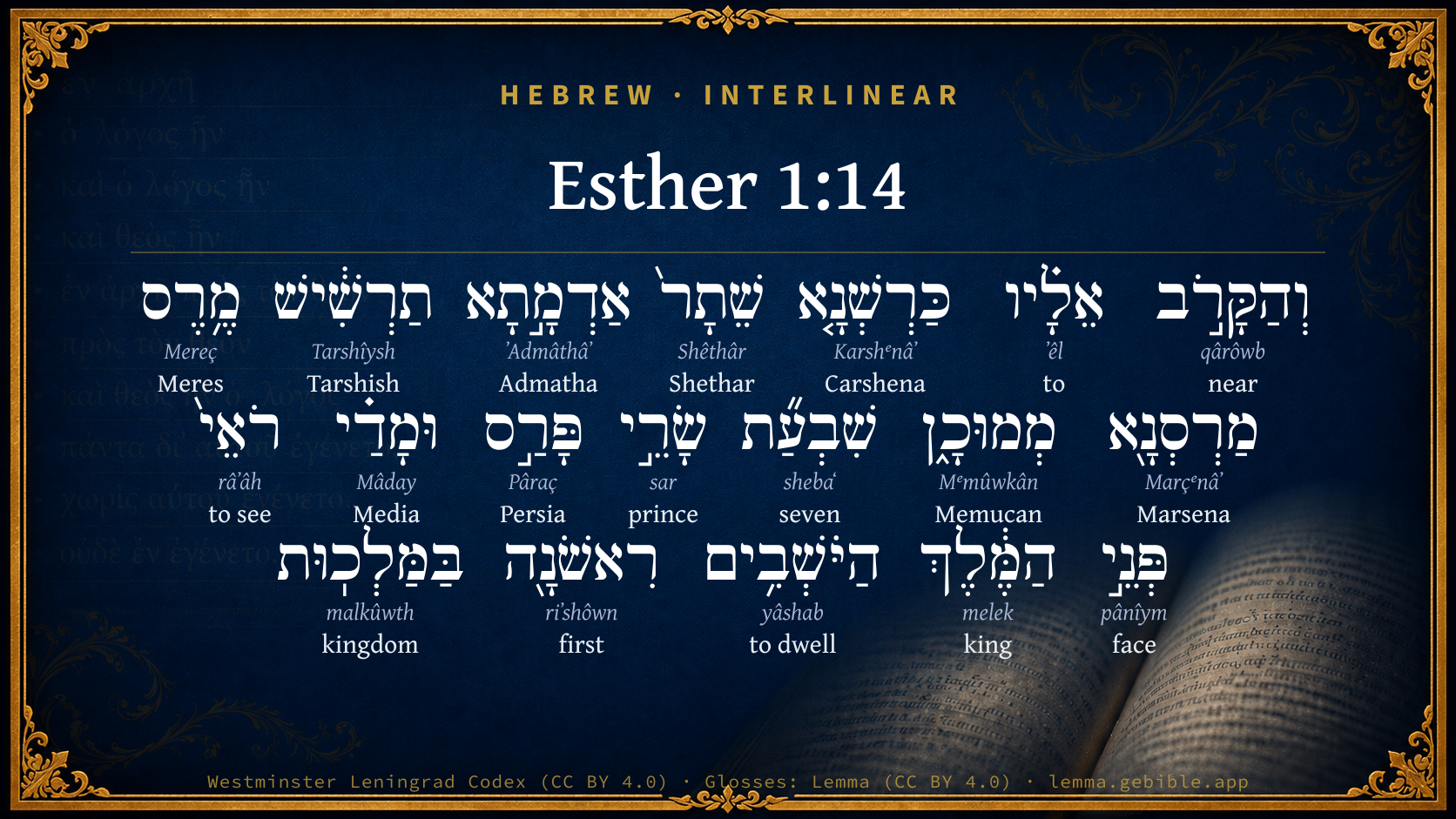
Hebrew (Westminster Leningrad Codex) Esther 1:14 appears in the Hebrew Old Testament. The text above is from the Westminster Leningrad Codex. Each word links to its Strong’s number, a concise gloss, and parsing drawn from the Open Scriptures Hebrew Bible morphology. Click any word for its full Brown-Driver-Briggs (BDB) entry.
Download image
Cite this verse

Esther 1:14 (World English Bible). Public Domain. Lemma interlinear Bible study tool, https://lemma.gebible.app/v/esther/1/14.

Show BibTeX & RIS
BibTeX
RIS
English Translation
and the next to him were Carshena, Shethar, Admatha, Tarshish, Meres, Marsena, and Memucan, the seven princes of Persia and Media, who saw the king's face, and sat first in the kingdom),
World English Bible · Public Domain
Highlights
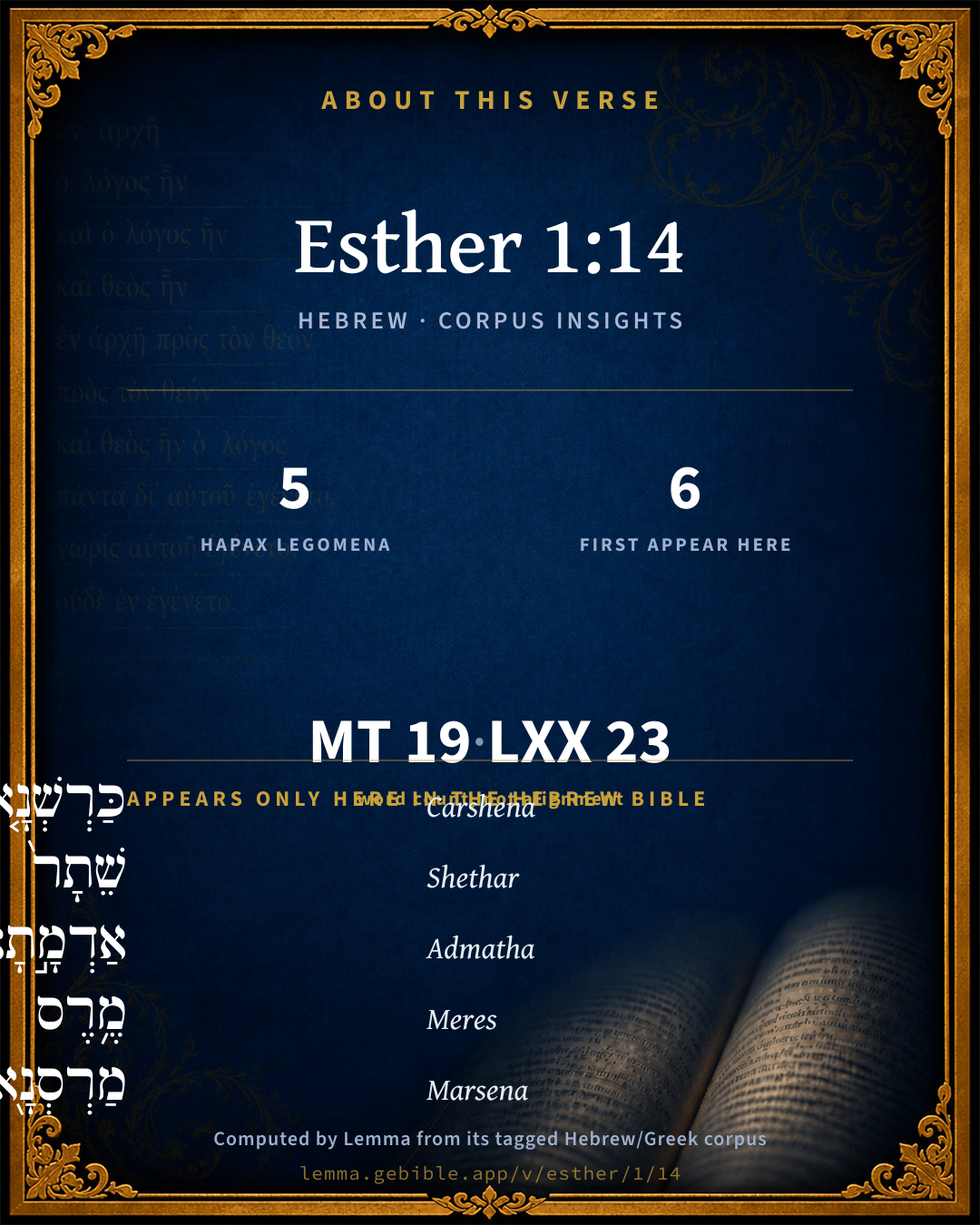
  • 5 hapax legomena — only here in the Hebrew Bible
  • 6 first appearances in the Hebrew Bible
Full analysis ↓
Download a study sheet

One document with this verse’s original text, its word-by-word gloss line, the meaning frame, cross-references with their text, attributed commentary, and full source and license credits — printable, and it pastes into notes with its structure intact.

This verse Autodidact and up

Study sheet (.html) Plain text (.txt)

A passage Seminary Student

Up to 50 verses in one chapter. A passage sheet keeps up to 6 commentary sources and 12 cross-references per verse, in the order this page ranks them, and says so on the sheet whenever that leaves anything out. Ask for a single verse and you get the Autodidact verse sheet above.

Everything on this page stays free to read, with no account — the sheet is a download of what is already on screen, not access to it.

Want to remove ads? Support Godless Engineer
Compare translations 3

The same verse in 3 English versions, stacked beneath the original-language interlinear above. Click any original word for its lexicon entry.

Each is an independent rendering of the whole verse — the interlinear is not word-aligned to these translations.

Highlighted words mark where these versions differ — a whole-verse word diff, not a word-by-word alignment.

  • World English Bible Public Domain
    and the next to him were Carshena, Shethar, Admatha, Tarshish, Meres, Marsena, and Memucan, the seven princes of Persia and Media, who saw the king's face, and sat first in the kingdom),
  • King James Version Public Domain
    And the next unto him was Carshena, Shethar, Admatha, Tarshish, Meres, Marsena, and Memucan, the seven princes of Persia and Media, which saw the king's face, and which sat the first in the kingdom;)
  • unfoldingWord Literal Text CC BY-SA 4.0
    and the ones near to him were Karshena, Shethar, Admatha, Tarshish, Meres, Mersena, Memukan, seven officials of Persia and Media who were seers of the face of the king, the ones who sat first in the kingdom):

unfoldingWord Literal Text — © unfoldingWord, licensed CC BY-SA 4.0. Word-aligned USFM3 via Door43 (git.door43.org/unfoldingWord/en_ult).

Versions to compare (up to 4)

3 of 4 selected

Show all 18 translations

Every available English version of this verse, each an independent rendering of the whole verse.

  • World English Bible Public Domain
    and the next to him were Carshena, Shethar, Admatha, Tarshish, Meres, Marsena, and Memucan, the seven princes of Persia and Media, who saw the king's face, and sat first in the kingdom),
  • Berean Standard Bible Public Domain
    His closest advisors were Carshena, Shethar, Admatha, Tarshish, Meres, Marsena, and Memucan, the seven princes of Persia and Media who had personal access to the king and ranked highest in the kingdom.
  • Majority Standard Bible Public Domain
    His closest advisors were Carshena, Shethar, Admatha, Tarshish, Meres, Marsena, and Memucan, the seven princes of Persia and Media who had personal access to the king and ranked highest in the kingdom.
  • King James Version Public Domain
    And the next unto him was Carshena, Shethar, Admatha, Tarshish, Meres, Marsena, and Memucan, the seven princes of Persia and Media, which saw the king's face, and which sat the first in the kingdom;)
  • American Standard Version (1901) Public Domain
    and the next unto him were Carshena, Shethar, Admatha, Tarshish, Meres, Marsena, and Memucan, the seven princes of Persia and Media, who saw the king's face, and sat first in the kingdom),
  • Revised Version (1885) Public Domain
    and the next unto him was Carshena, Shethar, Admatha, Tarshish, Meres, Marsena, and Memucan, the seven princes of Persia and Media, which saw the king’s face, and sat first in the kingdom:)
  • Geneva Bible (1599) Public Domain
    And the next vnto him was Carshena, Shethar, Admatha, Tarshish, Meres, Marsena, and Memucan the seuen princes of Persia and Media, which sawe the Kings face, and sate the first in the kingdome)
  • Douay-Rheims (1899) Public Domain
    (Now the chief and nearest him were, Charsena, and Sethar, and Admatha, and Tharsis, and Mares, and Marsana, and Mamuchan, seven princes of the Persians, and of the Medes, who saw the face of the king, and were used to sit first after him:)
  • Young's Literal Translation Public Domain
    and he who is near unto him `is' Carshena, Shethar, Admatha, Tarshish, Meres, Marsena, Memucan, seven heads of Persia and Media seeing the face of the king, who are sitting first in the kingdom --
  • Literal Standard Version CC BY-SA 4.0
    and he who is near to him [is] Carshena, Shethar, Admatha, Tarshish, Meres, Marsena, Memucan, seven heads of Persia and Media seeing the face of the king, who are sitting first in the kingdom—
  • Unlocked Literal Bible CC BY-SA 4.0
    Now the ones close to him were Karshena, Shethar, Admatha, Tarshish, Meres, Marsena, and Memukan, seven princes of Persia and Media. They had access to the king, and they held the highest offices within the kingdom.
  • unfoldingWord Literal Text CC BY-SA 4.0
    and the ones near to him were Karshena, Shethar, Admatha, Tarshish, Meres, Mersena, Memukan, seven officials of Persia and Media who were seers of the face of the king, the ones who sat first in the kingdom):
  • Darby Bible Public Domain
    and the next to him were Carshena, Shethar, Admatha, Tarshish, Meres, Marsena, [and] Memucan, the seven princes of Persia and Media, who saw the king's face, and who sat first in the kingdom),
  • World Messianic Bible Public Domain
    and next to him were Carshena, Shethar, Admatha, Tarshish, Meres, Marsena, and Memucan, the seven princes of Persia and Media, who saw the king’s face, and sat first in the kingdom),
  • Webster's Bible Public Domain
    And the next to him was Carshena, Shethar, Admatha, Tarshish, Meres, Marsena, and Memucan, the seven princes of Persia and Media, who saw the king's face, and who sat the first in the kingdom;)
  • Free Bible Version CC BY-SA 4.0
    Those closest to him were Carshena, Shethar, Admatha, Tarshish, Meres, Marsena, and Memucan. They were the seven nobles of Persia and Media who had frequent meetings with the king and had the highest positions in the kingdom.
  • Bible in Basic English Public Domain
    And second only to him were Carshena, Shethar, Admatha, Tarshish, Meres, Marsena, and Memucan, the seven rulers of Persia and Media, who were friends of the king, and had the first places in the kingdom:)
  • JPS Tanakh (1917) Public Domain
    and the next unto him was Carshena, Shethar, Admatha, Tarshish, Meres, Marsena, and Memucan, the seven princes of Persia and Media, who saw the king's face, and sat the first in the kingdom:

Literal Standard Version (2020), Covenant Press — licensed CC BY-SA 4.0. Text via the HelloAO Bible API (eBible.org). Unlocked Literal Bible (unfoldingWord) — licensed CC BY-SA 4.0. Text via the HelloAO Bible API (eBible.org). unfoldingWord Literal Text — © unfoldingWord, licensed CC BY-SA 4.0. Word-aligned USFM3 via Door43 (git.door43.org/unfoldingWord/en_ult). Free Bible Version, Dr. Jonathan Gallagher — licensed CC BY-SA 4.0. Text via the HelloAO Bible API (eBible.org).

Word by word

More ways to search: Search by grammar → Find every occurrence → Compare this word →

Practice this passage: Drill this verse → Learn its vocabulary →

כַּרְשְׁנָ֤א
Karshᵉnâʼ
H3771
“Carshena”
Noun, Proper
Part of Speech
Noun
Type
Proper
Full BDB Definition

Origin: of foreign origin

TWOT: None

Carshena = "illustrious" - one of the 7 princes of Persia and Media under king Ahasuerus
  1. וְהַקָּרֹ֣ב qârôwb H7138 “and · the · near” Conjunction + Particle, Definite Article + Adjective, Adjective, Masculine, Singular, Absolute
  2. אֵלָ֗יו ʼêl H413 “to · him” Preposition + Suffix, Personal, 3rd Person, Masculine, Singular
  3. שֵׁתָר֙ Shêthâr H8369 “Shethar” Noun, Proper
  4. אַדְמָ֣תָא ʼAdmâthâʼ H133 “Admatha” Noun, Proper
  5. תַרְשִׁ֔ישׁ Tarshîysh H8659 “Tarshish” Noun, Proper
  6. מֶ֥רֶס Mereç H4825 “Meres” Noun, Proper
  7. מַרְסְנָ֖א Marçᵉnâʼ H4826 “Marsena” Noun, Proper
  8. מְמוּכָ֑ן Mᵉmûwkân H4462 “Memucan” Noun, Proper
  9. שִׁבְעַ֞ת shebaʻ H7651 “seven” Adjective, Cardinal number, Masculine, Singular, Construct
  10. שָׂרֵ֣י sar H8269 “princes of” Noun, Common, Masculine, Plural, Construct
  11. פָּרַ֣ס Pâraç H6539 “Persia” Noun, Proper
  12. וּמָדַ֗י Mâday H4074 “and · Media” Conjunction + Noun, Proper
  13. רֹאֵי֙ râʼâh H7200 “seeing” Verb, Qal, Participle Active, Masculine, Plural, Construct
  14. פְּנֵ֣י pânîym H6440 “face(s) of” Noun, Common, Both, Plural, Construct
  15. הַמֶּ֔לֶךְ melek H4428 “the · king” Particle, Definite Article + Noun, Common, Masculine, Singular, Absolute
  16. הַיֹּשְׁבִ֥ים yâshab H3427 “the · dwelling” Particle, Definite Article + Verb, Qal, Participle Active, Masculine, Plural, Absolute
  17. רִאשֹׁנָ֖ה riʼshôwn H7223 “first” Adjective, Adjective, Feminine, Singular, Absolute
  18. בַּמַּלְכֽוּת malkûwth H4438 “in/at the · kingdom” Preposition, Determined + Noun, Common, Feminine, Singular, Absolute

About this verse

These counts appear in no published source. They are computed here, from the morphology-tagged text and Lemma’s own curated glosses. What Lemma adds →

19
words
19
distinct lemmas
Historical
section

Notable vocabulary

5 hapax legomena — words that appear only here in the entire Hebrew Bible:

  • כַּרְשְׁנָ֤א Carshena H3771
  • שֵׁתָר֙ Shethar H8369
  • אַדְמָ֣תָא Admatha H133
  • מֶ֥רֶס Meres H4825
  • מַרְסְנָ֖א Marsena H4826

First appearance in Scripture

These words make their first canonical appearance in the Hebrew Bible here:

  • כַּרְשְׁנָ֤א Carshena H3771
  • שֵׁתָר֙ Shethar H8369
  • אַדְמָ֣תָא Admatha H133
  • מֶ֥רֶס Meres H4825
  • מַרְסְנָ֖א Marsena H4826
  • מְמוּכָ֑ן Memucan H4462

Shared distinctive vocabulary

מְמוּכָ֑ן Memucan H4462 occurs in 3 verses of the Hebrew Bible. Also found in:

Grammatical profile

  • 2 verbs
  • 13 nouns
  • 3 adjectives
  • 1 preposition

Verb forms

  • רֹאֵי֙ Qal · Participle Active
  • הַיֹּשְׁבִ֥ים Qal · Participle Active

Hebrew & Septuagint length

In English translation the verse runs 32 words from the Hebrew and 30 from the Septuagint (LXX English) — closely comparable.

A rough comparison of the two English renderings, which tokenize alike — not a word-level alignment.

Word counts can differ between the Hebrew and the Greek without any difference in meaning — e.g. the Hebrew direct-object marker אֵת has no separate Greek word, and Greek often adds the article ὁ.

In the original languages it is 19 Hebrew tokens and 23 Greek tokens — but the two are counted differently (Hebrew bundles its prefixes and suffixes into one token; the Greek is in lemma form), so that isn’t a like-for-like length.

Cross-references

4

Topical passages linked to Esther 1:14 in the Treasury of Scripture Knowledge — connected by theme and wording, ordered by reader-vote popularity; previews shown in the World English Bible.

  • 2 Kings 25:19 and out of the city he took an officer who was set over the men of war; and five men of those who saw the king's face, who were found in the city; and the scribe, the captain of the host, who mustered the people of the land; and sixty men of the people of the land, who were found in the city.
  • Ezra 7:14 Because you are sent of the king and his seven counselors, to inquire concerning Judah and Jerusalem, according to the law of your God which is in your hand,
  • Matthew 18:10 See that you don't despise one of these little ones, for I tell you that in heaven their angels always see the face of my Father who is in heaven.
  • Revelation 22:4 They will see his face, and his name will be on their foreheads.

Cross-references courtesy of OpenBible.info (CC BY 4.0).

Hebrew and Greek witnesses Masoretic Hebrew ↔ Greek Septuagint

The same verse in the two great witnesses to the Old Testament, shown verse-for-verse.

These are two independent witnesses, not word-aligned to each other, and the Septuagint is shown in lemma (dictionary) form.

Hebrew Esther 1:14 Masoretic · Westminster Leningrad Codex

וְהַקָּרֹ֣ב אֵלָ֗יו כַּרְשְׁנָ֤א שֵׁתָר֙ אַדְמָ֣תָא תַרְשִׁ֔ישׁ מֶ֥רֶס מַרְסְנָ֖א מְמוּכָ֑ן שִׁבְעַ֞ת שָׂרֵ֣י פָּרַ֣ס וּמָדַ֗י רֹאֵי֙ פְּנֵ֣י הַמֶּ֔לֶךְ הַיֹּשְׁבִ֥ים רִאשֹׁנָ֖ה בַּמַּלְכֽוּת

and the next to him were Carshena, Shethar, Admatha, Tarshish, Meres, Marsena, and Memucan, the seven princes of Persia and Media, who saw the king's face, and sat first in the kingdom),

World English Bible · Public Domain

Greek LXX Esther 1:14 Septuagint · lemma form

καί προςἔρχομαι αὐτός αρκεσαιος καί σαρσαθαιος καί μαλησεαρ ὁ ἄρχων πέρσης καί μῆδοι ὁ ἐγγύς ὁ βασιλεύς ὁ πρῶτος παρα καταἧμαι ὁ βασιλεύς

So Arkesaeus, and Sarsathaeus, and Malisear, the princes of the Persians and Medes, who were near the king, who sat chief in rank by the king, drew near to him,

LXX2012 (modern English Septuagint) · Public Domain

On this verse, The Cambridge Bible for Schools and Colleges discusses the Septuagint’s reading. Read the note in Commentary ↓

Hebrew: Westminster Leningrad Codex (CC BY 4.0). Greek: Septuagint (public domain); English from LXX2012 (modern English Septuagint) (Public Domain). How the Septuagint differs from the Hebrew →

Commentary

Notes on Esther 1:14 from classic Christian and Jewish commentators (each source and its license shown beneath its notes). The classic Christian expositions comment on the surrounding passage and are grouped to its opening verse, so a note may address several verses; the Jewish commentaries on the Tanakh (Rashi and others) are per-verse, so they appear only where the commentator wrote on this verse.

Lemma curates 59 commentaries, every one of them public domain or Creative Commons licensed, each selected and text-cleaned for this edition rather than reprinted as found. About our sources →

Trapp's Complete Commentary

John Trapp

Est 1:14 And the next unto him [was] Carshena, Shethar, Admatha, Tarshish, Meres, Marsena, [and] Memucan, the seven princes of Persia and Media, which saw the king’s face, [and] which sat the first in the kingdom;)

Ver. 14. And the next unto him was Carshena, &c.] These were his trusty and well-beloved cousins, and counsellors, primi et proximi, first in the kingdom, and next unto the king, without whom he was to have done no business of importance. But it is recorded in story that they had no freedom nor liberty of council: for every one of them had a plate or tile of gold to stand upon in the council house; and if he gave counsel that the king thought well or; the plate of gold was given him for a reward; but if he delivered anything contrary to the king’s mind, flagris caedebatur, he was beaten with stripes. Lo, this was the manner of the Persian monarchs.

The seven princes] See Ezr 7:14.

Which saw the king’s face] That came at pleasure into the presence, as they call it. It was a piece of the silly glory of these kings of Persia to secrete themselves from their subjects. No man might see the king uncalled for on pain of death, cum eius persona sub specie maiestatis occuleretur, saith Justin. Only these seven might ordinarily take the boldness to see his face; which lest Haman should do, they covered his face.

And which sat the first in the kingdom] Xenophon tells us that Cyrus, the first Persian monarch, ordained that the nobles should sit before the king every man according to his degree and dignity. Aben Ezra upon this text saith the same.

John Trapp, A Commentary or Exposition upon All the Books of the Old and New Testament (1647–1656) — public domain. Text from a community e-Sword module.

Joseph Benson's Commentary

Est 1:14. Which saw the king’s face — Who had constant freedom of access to the king, and opportunities of familiar converse with him; which is thus expressed, because the Persian kings were very seldom seen by their subjects. Who sat the first in the kingdom — Who were his chief counsellors and officers.

Joseph Benson's Commentary on the Old and New Testaments (1811–1818) — public domain. Text from a community e-Sword module.

Geneva Bible (1599)

Geneva Bible translators

Which were his chief counselors, that might have always access to him.

Geneva Bible (1599) marginal notes — public domain. Text via Bolls.life.

Adam Clarke's Commentary

Verse 14. And the next unto him - the seven princes] Probably, the privy counsellors of the king. Which saw the king's face - were at all times admitted to the royal presence.

Adam Clarke's Commentary on the Bible (1810–1826) — public domain. Text from a community e-Sword/MySword module.

Ellicott's Commentary for English Readers

(14) Marsena.—It has been suggested that we may possibly recognise here Mardonius, the commander at Marathon; and in Admatha, Artabanus, the uncle of Xerxes.

The seven princes.—There were seven leading families in Persia, the heads of which were the king’s chief advisers, the “seven counsellors” of Ezr_7:14. Herodotus (iii. 84) speaks of the seven nobles who rose against the Pseudo-Smerdis as chief in the nation.

A Bible Commentary for English Readers, edited by Charles John Ellicott (1878–1897) — public domain. Text from a community e-Sword module.

The Cambridge Bible for Schools and Colleges

gen. ed. J. J. S. Perowne

14. The names of the seven princes have evidently suffered much in transmission. According to Herodotus (vii. 5–17) Mardonius (Xerxes’ cousin) and Artabanus (his uncle) were the king’s chief advisers in the early part of his reign. These names may be represented in the text by ‘Marsena’ and ‘Admatha.’ The LXX. gives but three names. This may be owing to a scribe (or the original translators) having a partially illegible manuscript to work upon.

the seven princes of Persia and Media] who took rank as members of the king’s council above the other great men of the kingdom. So in Ezra (Ezr_7:14) we find that Artaxerxes had seven special advisers. There were, according to Herodotus (iii. 84), seven great families in Persia, the heads of which had peculiar rights. One of these rights was that of access to the king at all times, unless when he was in the women’s apartments.

which saw the king’s face] i.e. who had the right of access to his presence. Some connect this privilege with the story of the assassination of the Pseudo-Smerdis (b.c. 522) by Darius and six other conspirators. The latter, we are told, made a bargain with their colleague, whose claims to the throne they were championing, to the effect that they should at all times have the right of approach just mentioned (Herod. iii. 84).

The Cambridge Bible for Schools and Colleges (gen. ed. J. J. S. Perowne; Cambridge University Press, 1878–1918) — public domain. Text from a community e-Sword module.

John Gill's Exposition

And the next unto him,.... That sat next to the king, and was the chief in dignity and authority under him:

was Carshena; and so everyone in their rank and order, as next mentioned:

Shethar, Admatha, Tarshish, Meres, Marsena, and Memucan; who, according to the latter Targum, were of different countries; the first of Africa, the second of India, the third of Idumea, the fourth of Egypt, the fifth of Resen, Gen 10:12 which is framed out of Marsena, who is dropped, and the last of Jerusalem, said to be Daniel; though the former Targum makes him to be Haman:

the seven powers of Persia and Media; which custom of having seven counsellors with the kings of Persia arose from the seven princes that slew Smerdis the pretender, and made Darius Hystaspis king, the father of Xerxes:

which saw the king's face; were intimate and familiar with him, often in his presence; yea, might go into it when they pleased, without the ceremony of being introduced; which privilege the above persons reserved to themselves, when they placed Darius on the throne, as Herodotus relates (u):

and which sat the first in the kingdom; next to the king, and were assisting to him in the administration of government, see Ezr 7:14.

(u) lb. (Thalia, sive, l. 3.) c. 84, 118.

John Gill's Exposition of the Whole Bible (1746–1763) — public domain (CC PDM 1.0). Text via the HelloAO Bible API.

Albert Barnes' Notes on the Bible

In Marsena we may perhaps recognize the famous Mardonius, and in Admatha, Xerxes’ uncle, Artabanus.

The seven princes - There were seven families of the first rank in Persia, from which alone the king could take his wives. Their chiefs were entitled to have free access to the monarch’s person. See the margin reference note.

Albert Barnes' Notes on the Bible (1834–1885) — public domain. Text from a community e-Sword/MySword module.

Matthew Poole's English Annotations

Which saw the king’s face; which had constant freedom of access to the king, and familiar converse with him; which is thus expressed, because the Persian kings were very seldom seen by their subjects.

Which sat the first in the kingdom; which were his chief counsellors and officers, and had the precedency from all others.

Matthew Poole's English Annotations on the Holy Bible (1683–1685) — public domain. Text from a community e-Sword/MySword module.

Whedon's Commentary on the Bible

Daniel D. Whedon

14. The seven princes — These seven, whose names are here given, are among the wise men whom he consulted. They were his most intimate counsellors, and the very highest nobles of the empire. See the note on Ezr_7:14. In the name Admatha we may, perhaps, recognise Artabanus, the uncle of Xerxes, (Herod., Est_7:10,) and in Marsena, his famous general Mardonius.

Daniel D. Whedon (gen. ed.), Commentary on the Old and New Testaments (1874–1909) — public domain. Text from a community e-Sword module.

The Pulpit Commentary

And the next unto him was Carshena, Shethar, etc. The chief native advisers of Xerxes in the early part of his reign appear to have been Mardonius (Pera Marduniya) and Artabanus (Pers, Artapana), who was his uncle (Herod., 7:5-17). It is possible that Mardonius may be here represented by Marsena, and Artabanus by Admatha; but the names could only have taken these shapes by a large amount of corruption. The other form have a general Persian air, but do not admit of even conjectural identification. The seven princes of Persia and Media. Ezra assigns to the Persian monarch seven special counsellors, (Est_7:1-4) and Herodotus says that there were seven leading families in Persia whose heads were specially privileged (3:84). The title, however, "princes of Persia and Media," is not found anywhere but here. Which saw the king"s face. Among the privileges said by Herodotus to have been reserved to the heads of the great families, one of the most valued was that of free access to the monarch at all times, unless he were in the seraglio.

Privileged persons.

princes of Persia and Media, which saw the king"s face, and sat first in the kingdom." It has always been the custom of kings to surround themselves with those who should be able to help or advise, or be the media of transmitting their desires or decrees to the people. These officers of state have been called "wise men," viziers, councillors, ministers. They form the executive. In Persia there was no electoral representation, the government was absolute. Hence the seven men whose names are mentioned were appointed by the king, and his whim could remove them.

So long as they were in favour they were accounted privileged persons. Two things are told of them:

I They had a PRIVILEGED SIGHT.

II They had a PROMINENT POSITION.

I It was the custom of the kings of Persia to seclude themselves as much as possible from their subjects. Only those who were appointed to come near might see his face. This reserve was assumed in order to foster reverence and awe of the great king among the people. When one who had been permitted to approach, and had gained the king"s favour, lost it, the attendants immediately covered his face that he might not look on the king. "As the word went out of the king"s mouth, they covered Haman"s face". (Est_7:8) The seven wise men here mentioned were permitted to see the king"s face at any time. The rulers of Persia assumed the title of "king of kings." That which was assumed by them belongs only to God. Who can see his face? He dwells in light "unapproachable." When Jacob wrestled with the angel of the Lord, he carried a reminder thereof in the limp or lameness, the result of the touch of that supernatural Being. When Moses desired to see the Divine glory he was bidden in a cleft rock; when he communed with God his face glistened so that be had to hide it beneath a veil. When Manoah offered a sacrifice, and the angel whose name was "secret" did wondrously, he feared he would be slain because of the visit from another world. "No man hath seen God at any time." Man could not see the unutterable glory and live. But there is One, "the only begotten Son," who not only saw his face, but rested "in the bosom" of the Divine Father, and "hath declared him." He gives to us this privileged sight also. God was in Christ. The meaning- of the incarnation was this, that men looking at Christ looked on "God manifest in the flesh." Philip wanted a further view of the Father, and Christ told him, "He that hath seen me hath seen the Father." Intercourse was possible under the old dispensation; sight was made possible under the new. Faith in Christ sees God. "The pure in heart see God" not only hereafter, but here. This is a high privilege. The Queen of Sheba said to Solomon, "Happy are thy men, and happy are these thy servants which stand continually before thee and hear thy wisdom." The happiness of the true Christian is to stand ever in the presence of God. This privilege is the gift of God"s grace. None could admit to the sight of his mercy and glory unless he had graciously permitted it. The sight is not for a few, but for all who will come unto him through Christ.

II The PROMINENT POSITION occupied by the "wise men" of Persia may suggest the advance which comes through spiritual character. "To sit first" in the kingdom is not to be the one aim, but it will be given to those for whom it is prepared those who are prepared for it. High spiritual qualities give pre-eminence. This pre-eminence is not to be sought for itself. There must be no ambition, or we are those unfitted for it. Spiritual character must be sought as its own reward, and because it pleases God. James and John made a great mistake when they asked, through their mother, Christ for a promise of prominent position. "The last will be first, and first last." Heaven is no place of pomp, but of discrimination of character. Mere questions of precedence, whether in court, ecclesiastical, or municipal affairs, are generally petty, because based on mere accident and opinion. In heaven character will decide precedence. Those nearest the throne will probably be those who felt themselves the most unworthy; men like Paul, who felt himself "less than the least of all saints." The great thing for us is not to seek pre-eminence, but inner spiritual power; by simple faith, humility, zeal, unselfishness, devoutness, living as in the presence of God, and having every thought and action in harmony with God"s will. As the current of a river sets to the ocean, so the whole "set" of a life may be God-ward. The seven men who "sat first in the kingdom" were in their position that they might advise the king. When we are brought into God"s kingdom it will be to drink in of his wisdom. These men also could be easily removed. Their position depended on the whim of the monarch, and therefore was insecure. When we are once brought into God"s kingdom above we shall be safe for ever. No enemy shall dislodge, no storm trouble, no sin assail, but we shall be safe for ever. We read of Haman being "advanced," and of the king setting "his seat above all the princes that were with him". (Est_3:1) This must have been gall and wormwood to the rest of the princes. No such jealousy will enter the hearts of those who are permitted to behold in heaven the King"s face, and to sit in his kingdom. H.

The Pulpit Commentary (1880–1919), ed. H.D.M. Spence-Jones & Joseph S. Exell — public domain. Text from a community e-Sword module.

John Wesley's Explanatory Notes

Saw - Who had constant freedom of access to the king, and familiar converse with him: which is thus expressed, because the Persian kings were very seldom seen by their subjects. Sat - Who were his chief counsellors and officers.

John Wesley, Explanatory Notes Upon the Whole Bible (1754–1765) — public domain. Text via the GEBible commentary corpus.

Rashi

Rabbi Shlomo Yitzchaki (Rashi)

And the nearest to him to present his words before them were the following: Carshena, Shethar, etc.

Rashi on the Tanakh — English translations: “The Judaica Press complete Tanach with Rashi, translated by A. J. Rosenberg” (CC BY 4.0); “Pentateuch with Rashi's commentary by M. Rosenbaum and A.M. Silbermann, 1929-1934” (public domain); “The Metsudah Tanach series, Lakewood, N.J” (CC BY 4.0); and “The Book of Joshua, Metsudah Publications, 1997” (CC BY 4.0). Text via Sefaria.

Lesson kit

Teaching starters — assembled from the data on this page, not authored interpretation. Every prompt links to the verse data it draws on. Edit before teaching.

Esther, in the Historical, opens this verse with 19 words (19 distinct Hebrew lemmas). Its most distinctive word is Karshᵉnâʼ (“Carshena”). A historical commentator’s framing appears above. Read the whole chapter for the surrounding context.

Discussion questions

  1. What does “Carshena” (Karshᵉnâʼ) contribute to the verse as a whole?
  2. 5 words here appear nowhere else in the Hebrew Bible. Why might the author reach for such rare wording?
  3. 6 words make their first appearance in Scripture here. What does this debut establish?
  4. How does Esther 1:16, which shares the word «Memucan», read alongside this verse?
  5. These translations render this verse differently; the difference is in the English rendering, not the original. What questions does that raise?
  6. «רֹאֵי֙» is a Qal Participle Active verb. How does that grammatical form shape the action described?
  7. Compare how Trapp's Complete Commentary and Joseph Benson's Commentary read this verse. Where do they agree or differ?

Things to notice

Reading settings

Reading text

Shown beneath each verse's original-language words.

Old Testament
Old Testament edition

Read the OT as the Masoretic Hebrew (MT) or the Greek Septuagint (LXX).

English shown for the Greek Septuagint (in the Hebrew ↔ Greek comparison).

Comparing translations? Open the Compare panel on any verse page to stack up to four side by side.