
Hosea 7:5

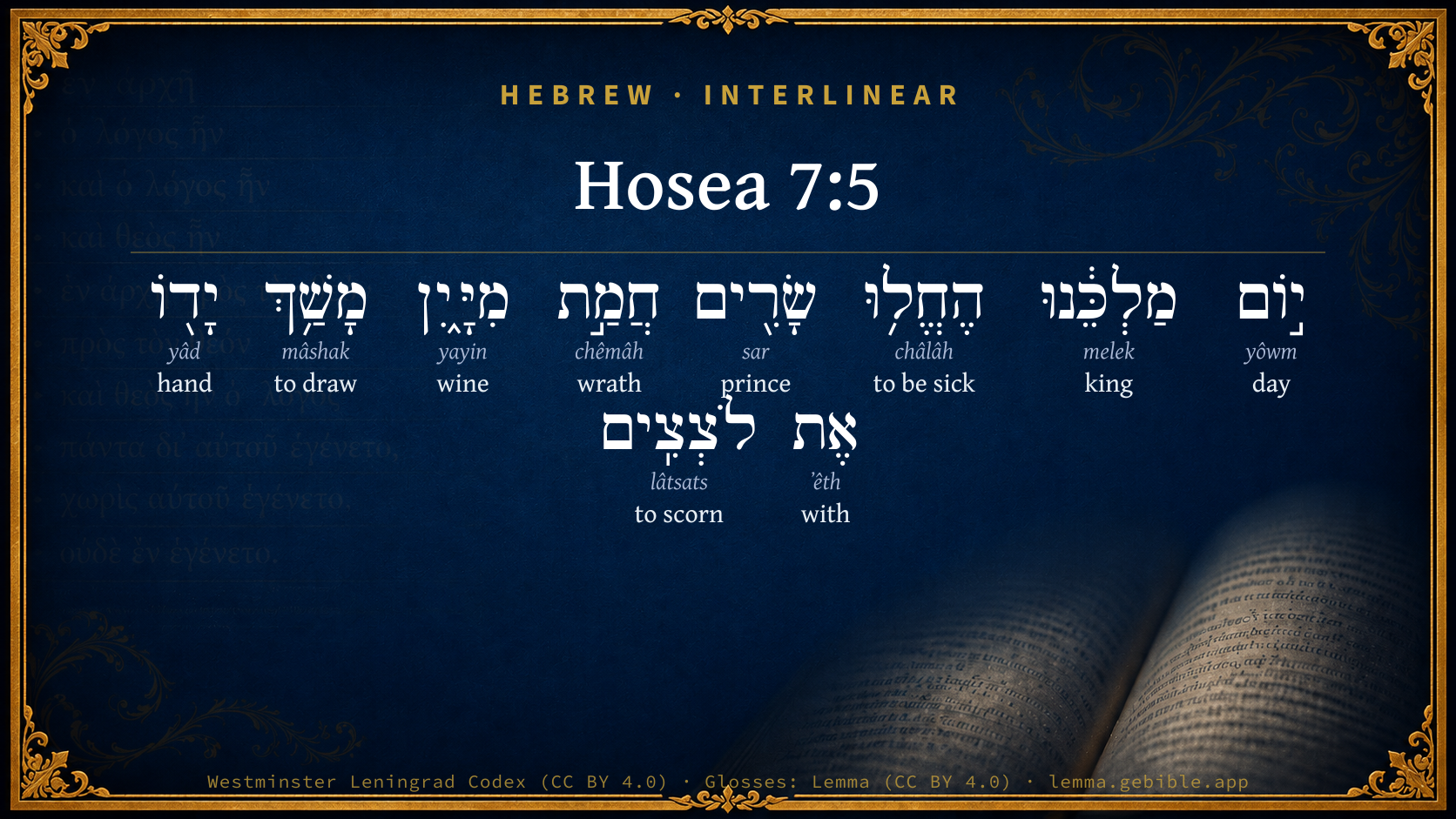
Hebrew (Westminster Leningrad Codex) Hosea 7:5 appears in the Hebrew Old Testament. The text above is from the Westminster Leningrad Codex. Each word links to its Strong’s number, a concise gloss, and parsing drawn from the Open Scriptures Hebrew Bible morphology. Click any word for its full Brown-Driver-Briggs (BDB) entry.
Download image
Cite this verse

Hosea 7:5 (World English Bible). Public Domain. Lemma interlinear Bible study tool, https://lemma.gebible.app/v/hosea/7/5.

Show BibTeX & RIS
BibTeX
RIS
English Translation
On the day of our king, the princes made themselves sick with the heat of wine. He joined his hand with mockers.
World English Bible · Public Domain
Highlights
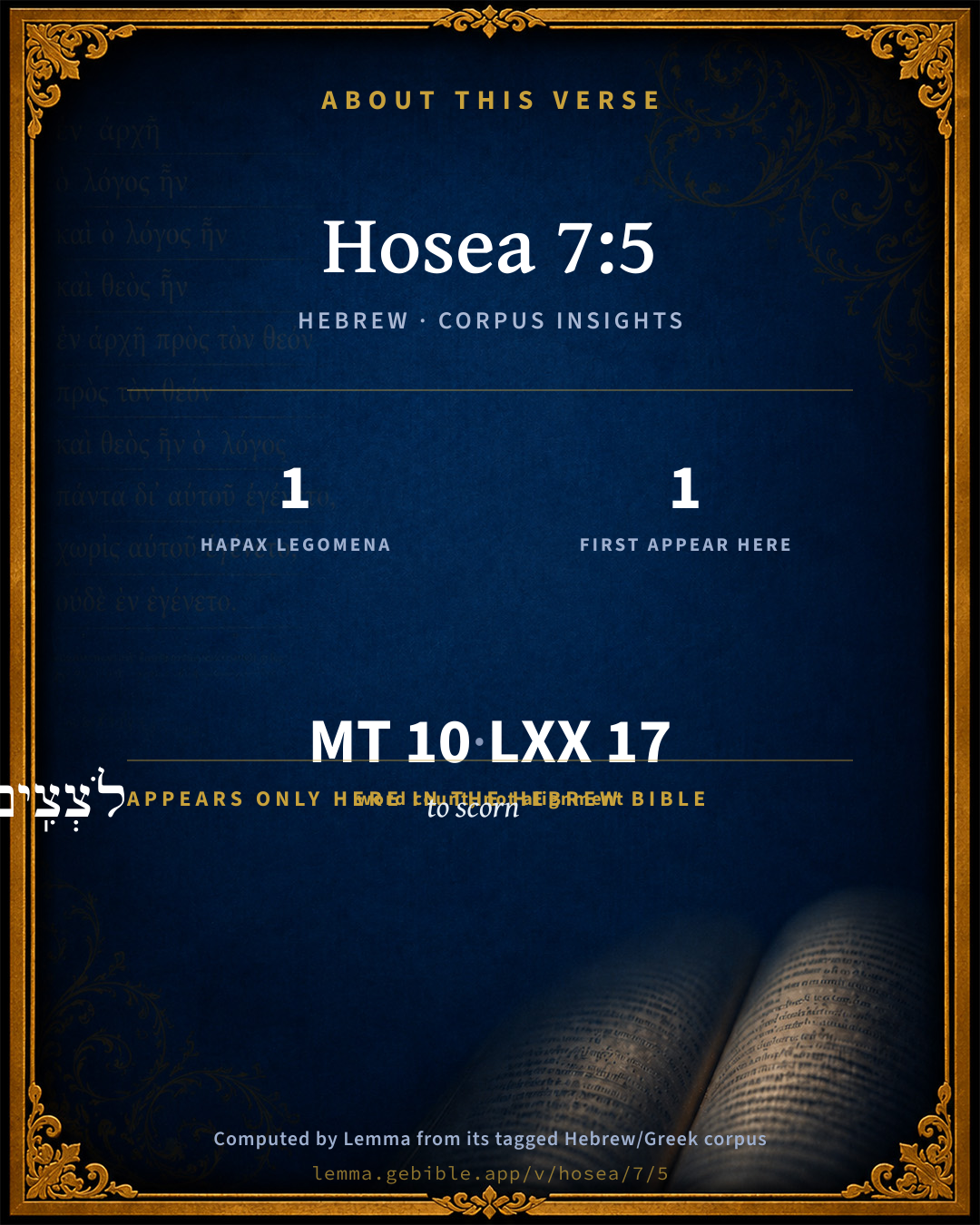
  • 1 hapax legomenon — only here in the Hebrew Bible
  • 1 first appearance in the Hebrew Bible
Full analysis ↓
Download a study sheet

One document with this verse’s original text, its word-by-word gloss line, the meaning frame, cross-references with their text, attributed commentary, and full source and license credits — printable, and it pastes into notes with its structure intact.

This verse Autodidact and up

Study sheet (.html) Plain text (.txt)

A passage Seminary Student

Up to 50 verses in one chapter. A passage sheet keeps up to 6 commentary sources and 12 cross-references per verse, in the order this page ranks them, and says so on the sheet whenever that leaves anything out. Ask for a single verse and you get the Autodidact verse sheet above.

Everything on this page stays free to read, with no account — the sheet is a download of what is already on screen, not access to it.

Want to remove ads? Support Godless Engineer
Compare translations 3

The same verse in 3 English versions, stacked beneath the original-language interlinear above. Click any original word for its lexicon entry.

Each is an independent rendering of the whole verse — the interlinear is not word-aligned to these translations.

Highlighted words mark where these versions differ — a whole-verse word diff, not a word-by-word alignment.

  • World English Bible Public Domain
    On the day of our king, the princes made themselves sick with the heat of wine. He joined his hand with mockers.
  • King James Version Public Domain
    In the day of our king the princes have made him sick with bottles of wine; he stretched out his hand with scorners.
  • unfoldingWord Literal Text CC BY-SA 4.0
    the day of our king, the princes made sick heat from wine. He extended his hand with the mockers.

unfoldingWord Literal Text — © unfoldingWord, licensed CC BY-SA 4.0. Word-aligned USFM3 via Door43 (git.door43.org/unfoldingWord/en_ult).

Versions to compare (up to 4)

3 of 4 selected

Show all 18 translations

Every available English version of this verse, each an independent rendering of the whole verse.

  • World English Bible Public Domain
    On the day of our king, the princes made themselves sick with the heat of wine. He joined his hand with mockers.
  • Berean Standard Bible Public Domain
    The princes are inflamed with wine on the day of our king; so he joins hands with those who mock him.
  • Majority Standard Bible Public Domain
    The princes are inflamed with wine on the day of our king; so he joins hands with those who mock him.
  • King James Version Public Domain
    In the day of our king the princes have made him sick with bottles of wine; he stretched out his hand with scorners.
  • American Standard Version (1901) Public Domain
    On the day of our king the princes made themselves sick with the heat of wine; he stretched out his hand with scoffers.
  • Revised Version (1885) Public Domain
    On the day of our king the princes made themselves sick with the heat of wine; he stretched out his hand with scorners.
  • Geneva Bible (1599) Public Domain
    This is the day of our King: the princes haue made him sicke with flagons of wine: he stretcheth out his hand to scorners.
  • Douay-Rheims (1899) Public Domain
    The day of our king, the princes began to be mad with wine: he stretched out his hand with scorners.
  • Young's Literal Translation Public Domain
    A day of our king! Princes have polluted themselves `with' the poison of wine, He hath drawn out his hand with scorners.
  • Literal Standard Version CC BY-SA 4.0
    A day of our king! Princes have defiled themselves [with] the poison of wine, || He has drawn out his hand with scorners.
  • Unlocked Literal Bible CC BY-SA 4.0
    On the day of our king the officials made themselves sick with the heat of wine. He reached out with his hand to those who were mocking.
  • unfoldingWord Literal Text CC BY-SA 4.0
    the day of our king, the princes made sick heat from wine. He extended his hand with the mockers.
  • Darby Bible Public Domain
    In the day of our king, the princes made themselves sick with the heat of wine: he stretched out his hand to scorners.
  • World Messianic Bible Public Domain
    On the day of our king, the princes made themselves sick with the heat of wine. He joined his hand with mockers.
  • Webster's Bible Public Domain
    In the day of our king the princes have made him sick with bottles of wine; he stretched out his hand with scorners.
  • Free Bible Version CC BY-SA 4.0
    On the king's birthday the princes drink so much they are sick, while he joins in with those who mock.
  • Bible in Basic English Public Domain
    On the day of our king, the rulers made him ill with the heat of wine; his hand was stretched out with the men of pride.
  • JPS Tanakh (1917) Public Domain
    On the day of our king the princes make him sick with the heat of wine, he stretcheth out his hand with scorners.

Literal Standard Version (2020), Covenant Press — licensed CC BY-SA 4.0. Text via the HelloAO Bible API (eBible.org). Unlocked Literal Bible (unfoldingWord) — licensed CC BY-SA 4.0. Text via the HelloAO Bible API (eBible.org). unfoldingWord Literal Text — © unfoldingWord, licensed CC BY-SA 4.0. Word-aligned USFM3 via Door43 (git.door43.org/unfoldingWord/en_ult). Free Bible Version, Dr. Jonathan Gallagher — licensed CC BY-SA 4.0. Text via the HelloAO Bible API (eBible.org).

Word by word

More ways to search: Search by grammar → Find every occurrence → Compare this word →

Practice this passage: Drill this verse → Learn its vocabulary →

לֹצְצִֽים
lâtsats
H3945
“scorning”
Verb, Polel, Participle Active, Masculine, Plural, Absolute
Part of Speech
Verb
Stem
Polel
Form
Participle Active
Gender
Masculine
Number
Plural
State
Absolute
Full BDB Definition

Origin: a primitive root

TWOT: 1113

(Qal) to scorn, make mouths at, talk arrogantly
  1. י֣וֹם yôwm H3117 “day of” Noun, Common, Masculine, Singular, Construct
  2. מַלְכֵּ֔נוּ melek H4428 “king · our” Noun, Common, Masculine, Singular, Construct + Suffix, Personal, 1st Person, Common, Plural
  3. הֶחֱל֥וּ châlâh H2470 “to be sick” Verb, Hiphil, Perfect, 3rd Person, Common, Plural
  4. שָׂרִ֖ים sar H8269 “princes” Noun, Common, Masculine, Plural, Absolute
  5. חֲמַ֣ת chêmâh H2534 “wrath of” Noun, Common, Feminine, Singular, Construct
  6. מִיָּ֑יִן yayin H3196 “from · wine” Preposition + Noun, Common, Masculine, Singular, Absolute
  7. מָשַׁ֥ךְ mâshak H4900 “to draw” Verb, Qal, Perfect, 3rd Person, Masculine, Singular
  8. יָד֖וֹ yâd H3027 “hand · his” Noun, Common, Both, Singular, Construct + Suffix, Personal, 3rd Person, Masculine, Singular
  9. אֶת ʼêth H854 “with” Preposition

About this verse

These counts appear in no published source. They are computed here, from the morphology-tagged text and Lemma’s own curated glosses. What Lemma adds →

10
words
10
distinct lemmas
Prophets
section

Notable vocabulary

1 hapax legomenon — a word that appears only here in the entire Hebrew Bible:

  • לֹצְצִֽים to scorn H3945

First appearance in Scripture

This word makes its first canonical appearance in the Hebrew Bible here:

  • לֹצְצִֽים to scorn H3945

Shared distinctive vocabulary

מָשַׁ֥ךְ to draw H4900 occurs in 36 verses of the Hebrew Bible. Also found in:

Grammatical profile

  • 3 verbs
  • 6 nouns
  • 1 preposition

Verb forms

  • הֶחֱל֥וּ Hiphil · Perfect
  • מָשַׁ֥ךְ Qal · Perfect
  • לֹצְצִֽים Polel · Participle Active

Hebrew & Septuagint length

In English translation the verse runs 22 words from the Hebrew and 22 from the Septuagint (LXX English) — the same length.

A rough comparison of the two English renderings, which tokenize alike — not a word-level alignment.

Word counts can differ between the Hebrew and the Greek without any difference in meaning — e.g. the Hebrew direct-object marker אֵת has no separate Greek word, and Greek often adds the article ὁ.

In the original languages it is 10 Hebrew tokens and 17 Greek tokens — but the two are counted differently (Hebrew bundles its prefixes and suffixes into one token; the Greek is in lemma form), so that isn’t a like-for-like length.

Cross-references

18

Topical passages linked to Hosea 7:5 in the Treasury of Scripture Knowledge — connected by theme and wording, ordered by reader-vote popularity; previews shown in the World English Bible.

  • Genesis 40:20 It happened the third day, which was Pharaoh's birthday, that he made a feast for all his servants, and he lifted up the head of the chief cupbearer and the head of the chief baker among his servants.
  • Psalms 1:1 Blessed is the man who doesn't walk in the counsel of the wicked, Nor stand in the way of sinners, Nor sit in the seat of scoffers;
  • Psalms 69:12 Those who sit in the gate talk about me. I am the song of the drunkards.
  • Isaiah 28:1 Woe to the crown of pride of the drunkards of Ephraim, and to the fading flower of his glorious beauty, which is on the head of the fat valley of those who are overcome with wine!
  • Daniel 5:23 but have lifted up yourself against the Lord of heaven; and they have brought the vessels of his house before you, and you and your lords, your wives and your concubines, have drunk wine from them; and you have praised the gods of silver and gold, of brass, iron, wood, and stone, which don't see, nor hear, nor know; and the God in whose hand your breath is, and whose are all your ways, you have not glorified.
  • Ephesians 5:18 Don't be drunken with wine, in which is dissipation, but be filled with the Spirit,
  • 1 Peter 4:3–4 For we have spent enough of our past time doing the desire of the Gentiles, and having walked in lewdness, lusts, drunken binges, orgies, carousings, and abominable idolatries.
  • 1 Kings 13:4 It happened, when the king heard the saying of the man of God, which he cried against the altar in Bethel, that Jeroboam put forth his hand from the altar, saying, Lay hold on him. His hand, which he put forth against him, dried up, so that he could not draw it back again to him.
  • Proverbs 13:20 One who walks with wise men grows wise, But a companion of fools suffers harm.
  • Proverbs 20:1 Wine is a mocker, and beer is a brawler; Whoever is led astray by them is not wise.
  • Proverbs 23:29–35 Who has woe? Who has sorrow? Who has strife? Who has complaints? Who has needless bruises? Who has bloodshot eyes?
  • Isaiah 5:11–12 Woe to those who rise up early in the morning, that they may follow strong drink; Who stay late into the night, until wine inflames them!
  • Isaiah 5:22–23 Woe to those who are mighty to drink wine, And champions at mixing strong drink;
  • Isaiah 28:7–8 Even these reel with wine, and stagger with strong drink; the priest and the prophet reel with strong drink, they are swallowed up of wine, they stagger with strong drink; they err in vision, they stumble in judgment.
  • Daniel 5:1–4 Belshazzar the king made a great feast to a thousand of his lords, and drank wine before the thousand.
  • Habakkuk 2:15–16 "Woe to him who gives his neighbor drink, pouring your inflaming wine until they are drunk, so that you may gaze at their naked bodies!
  • Matthew 14:6 But when Herod's birthday came, the daughter of Herodias danced among them and pleased Herod.
  • Mark 6:21 Then a convenient day came, that Herod on his birthday made a supper for his nobles, the high officers, and the chief men of Galilee.

Cross-references courtesy of OpenBible.info (CC BY 4.0).

Hebrew and Greek witnesses Masoretic Hebrew ↔ Greek Septuagint

The same verse in the two great witnesses to the Old Testament, shown verse-for-verse.

These are two independent witnesses, not word-aligned to each other, and the Septuagint is shown in lemma (dictionary) form.

Hebrew Hosea 7:5 Masoretic · Westminster Leningrad Codex

י֣וֹם מַלְכֵּ֔נוּ הֶחֱל֥וּ שָׂרִ֖ים חֲמַ֣ת מִיָּ֑יִן מָשַׁ֥ךְ יָד֖וֹ אֶת לֹצְצִֽים

On the day of our king, the princes made themselves sick with the heat of wine. He joined his hand with mockers.

World English Bible · Public Domain

Greek LXX Hosea 7:5 Septuagint · lemma form

ὁ ἡμέρα ὁ βασιλεύς σύ ἄρχω ὁ ἄρχων θυμόω ἐκ οἶνος ἐκτείνω ὁ χείρ αὐτός μετά λοιμός

In the days of our kings, the princes began to be inflamed with wine: he stretched out his hand with pestilent fellows.

LXX2012 (modern English Septuagint) · Public Domain

On this verse, Trapp's Complete Commentary discusses the Septuagint’s reading. Read the note in Commentary ↓

Hebrew: Westminster Leningrad Codex (CC BY 4.0). Greek: Septuagint (public domain); English from LXX2012 (modern English Septuagint) (Public Domain). How the Septuagint differs from the Hebrew →

Targum (Aramaic paraphrase)

1

The Targum is the ancient Jewish Aramaic paraphrase of the Hebrew Scriptures — an interpretive translation, not the Hebrew text itself. Onkelos (literal) and Pseudo-Jonathan (expansive) render the Torah, and Jonathan the Prophets. Coverage is partial: where no permissively-licensed English translation exists for a verse, only the Aramaic is shown. This is verse-level text, not a word-by-word alignment to the Hebrew.

  1. Targum Jonathan Prophets (Joshua–Malachi)
    יוֹמָא דְמַנִיאוּ עֲלֵיהוֹן מַלְכְּהוֹן שְׁרִיאוּ רַבְרְבַיָא לְמִשְׁתֵּיהּ עִמֵיהּ חֲמַר נְגַד לִידֵי סִיעַת שַׁכְּרִין:

    (no public-domain English translation for this verse)

    Targum Jonathan — Aramaic: “Mikraot Gedolot” (public domain). English: “Sefaria Community Translation” (CC0 1.0 (public-domain dedication)); “London "Chaldee Paraphrase," 1871” (public domain). Text via Sefaria.

Commentary

Notes on Hosea 7:5 from classic Christian and Jewish commentators (each source and its license shown beneath its notes). The classic Christian expositions comment on the surrounding passage and are grouped to its opening verse, so a note may address several verses; the Jewish commentaries on the Tanakh (Rashi and others) are per-verse, so they appear only where the commentator wrote on this verse.

Lemma curates 59 commentaries, every one of them public domain or Creative Commons licensed, each selected and text-cleaned for this edition rather than reprinted as found. About our sources →

Trapp's Complete Commentary

John Trapp

Hos 7:5 In the day of our king the princes have made [him] sick with bottles of wine; he stretched out his hand with scorners.

Ver. 5. In the day of our king] Our good king, on whom they so much doted, that they forgot God and his sincerer service. Quaecunque a regibus dicuntur aut fiunt, Gallis mirifice solet placere. It is reported of the French by their own chronicles, that they are wonderfully well pleased with whatsoever is said or done by their king (Epit. Hist. Gallor. 134); so that they affect to speak like him, to be arrayed like him, and to imitate him in everything. Their song is, Mihi placet quicquid Regi placet. But is not this to idolize the creature? and have not many (otherwise well minded men) among us been by this means miscarried to their cost in our late combustions? This day of their king was either his birthday (so Pagnine rendereth it here, die natalis eius), or his coronation day (so the Chaldee paraphrast carrieth it), which also is the birthday of a king as he is king, 1Sa 13:1, unless haply he have the happiness to be crowned (not in his cradle only, as Europus, king of Macedon, and the late King James were, but) in his mother’s womb, as Misdaetus, king of Persia, was, the crown being set upon his mother’s great belly before he was born. Now in this solemn day of the king (when they should have been better busied), the princes have made him sick, or the princes were sick, they drank themselves sick, drowning their bodies and souls (as Richard III did his brother Clarence) in a butt of Malmsey. How many importunate and impudent drinkers are there, that by drinking other men’s health destroy their own! See Master Prinne’s Health’s-sickness, and accord him that said,

“ Una salus sanis, nullam potare salutem,

Non est in pota vera salute salus. ”

But what beastly bedlams, or rather incarnate devils, were those three drunkards mentioned by Jo. Manlius in his Common Places, who drank so long till one of them fell down stark dead; and yet the other two, nothing terrified with such a dreadful example of divine vengeance, went on to drink, and poured the dead man’s part into him as he lay by them? Oh horrible! Drunkenness is a detestable vice in any, but especially in men of place and power, Pro 31:4. Woe be to those drunken vice-gods (as I may in the worst sense best call them), woe to the very crown of their pride, in drinking down many, Isa 28:1, as Mark Antony wrote, or rather spued out, a book concerning his own abilities to bear strong drink! Darius also boasted of the same faculty in his very epitaph: a poor praise. Drunkenness in a king is a capital sin, and makes the land reel; witness Belshazzar carousing in the bowels of the sanctuary to the honour of Shar, his drunken god; Alexander the Great drinking himself to death, and killing forty-one more with excessive drinking, to get that crown of one hundred and eighty pounds weight, which he had provided for him that drank most (hence those feast days were called σακεαι ημεραι, they were like the Roman Saturnalia); Bonosus the emperor, that beastly drunkard, called therefore a tankard, ( Hic pendet Amphora); and Tiberius, surnamed Biberius, for his tippling; like as Erasmus, called Eccius Ieccius, for the same cause: and well he might; for as he lived a shameful drunkard, so being nonplust at Ratisbon by Melancthon in a public disputation, and drinking more tban was fit that night at the Bishop of Mundina’s lodgings (who had among the best Italian wines), he fell into a fever, whereof he died. Drunkenness is a flattering evil, a sweet poison, a cunning Circe, that besots the soul, destroys the body, dolores gignit in capite, in stomacho, in tote corpore acerrimos, grievous diseases and dolours in the head, stomach, whole man. At the last "it biteth like a serpent, and stingeth like an adder," Pro 23:32. The drunkard saith, as the vine in Jotham’s parable, Non possum relinquere vinum meum, Take away my liquor, you take away my life. But it proves to him in the issue like that wine mentioned by Moses, Deu 32:33 : their wine is the poison of dragons, and cruel venom of asps, which makes the spirits warm, and the body sick to death.

With bottles of wine] Or, with heat through wine, as Isa 5:11, and so Jarchi expoundeth it. The same word signifieth the poison of a serpent, Psa 58:4, which inflameth and killeth: confer Pro 23:32, and think of that cup of fire and brimstone, Psa 11:6, to be one day turned down the wide gullets of intemperate drinkers; which will be much worse to them than was that ladle full of boiling lead, which the Turkish bashaw caused to be poured down the throat of a drunken wretch, without giving him any respite for the recovery of his lost wits.

He stretched out his hand with scorners] He, that is, the king, forgetting his kingly dignity, authority, and gravity (for there is a decorum, το πρεπον, to be observed in every calling, but by great ones especially), stretched out his hand, as a companion and comrade, as a hail-fellow-well-met (as they say), prostituting his regal authority to every scoundrel that would pledge him; or at least, giving them his hand to kiss, which Job saith God will not do, Job 8:20.

With scorners] Those worst of men, Psa 1:1, those pests, ακολαστοι λοιμοι, as the Septuagint here render it, those incorrigible persons, as they translate the word, Pro 20:1, where also it is fitly said, that wine is a mocker, because it maketh men mockers. Hence that of David, "with hypocritical mockers at feasts they gnashed upon me with their teeth," Psa 35:16. And that holy jealousy of Job for his children, lest (while they were feasting and merry-making) they should curse God, or mock at men. Tales enim evadunt qui strenue helluantur (Tarnov.). It is ordinary with such as are full-gorged with good cheer, and throughly heated with wine, to set their mouths against heaven, and to license their tongues to walk through the earth, Psa 73:9; they have a flout to fling, and a fool’s bolt to shoot at their betters by many degrees; yea, though they be kings that do it (as here), they stretch out their hands with scorners, and jeer at the power and profession of godliness; they are no better than base fellows, as great Antiochus is called, Dan 11:21, and as Kimchi upon this text noteth from his Father, that those that at the beginning of the feast or compotation were here called princes, are afterwards, when they fell to quafflngand flouting, called (in contempt) scoffers and scorners. Polanus and others, by stretching out the hand, understand, ad aequales haustus potare, &c., a drinking share and share alike with every base companion, till drunk; they became despicable. Nempe ubi, neque mens, neque pes suum facit officium. The Greeks, when they meet at feasts or banquets, drink small draughts at first, which by degrees they increase, till they come to the height of intemperance. Hence Graecari, and as merry as a Greek. How much better those Spartans, of whom the poet,

“ Quinetiam Spartae mos est laudabilis ille,

Ut bibat arbitrio pocula quisque suo? ”

How much better the Persians in Esther’s time, Est 1:8, "the drinking was according to the law, none did compel," &c. And what a drunken beast was Domitius, the father of Nero, who slew Liberius, an honest Roman, because he refused to take up his cups, as he commanded him! (Sueton.). The Carthaginians made a law, that none of their magistrates during their office should drink any wine. Romulus being invited to a feast, would not drink much, quia postridie negotium haberet, because he had public business to despatch on the morrow. Ahasuerus, drinking more freely on the first day of the feast, became so frolic, that in his mirth he forgot what was convenient; and guided by his passions, sent for Vashti, Est 1:5; Est 1:10.

John Trapp, A Commentary or Exposition upon All the Books of the Old and New Testament (1647–1656) — public domain. Text from a community e-Sword module.

Joseph Benson's Commentary

Hos 7:5-7. In the day of our king — Probably the anniversary of his birth, or coronation; the princes have made him sick with bottles of wine — Or, when the princes began to be hot with wine, (so Newcome,) he stretched out his hand with scorners — Deriders of God and man. Some recent and notorious act of contempt to God, or to his prophets, or to public justice, is here alluded to. “Those,” says Bishop Horsley, “who in their cups made a jest of the true religion, and derided the denunciations of God’s prophets, the king distinguished with the most familiar marks of his royal favour; in this way carrying on the plot of delusion.” They — Those luxurious and drunken princes; have made ready their heart like an oven — Hot with concupiscence, ambition, revenge, and covetousness. While they lie in wait — Against the life or estate of some of their subjects. Their baker sleepeth, &c. — As a baker, having kindled a fire in his oven, goes to bed and sleeps all night, and in the morning finds his oven well heated, and ready for his purpose; so these, when they have laid some wicked plot, though they may seem to sleep for a while, yet the fire is glowing within, and flames out as soon as ever there is opportunity for it. They are all hot as an oven — The whole people are inflamed with bad passions, and have followed the ill example of their princes and great men. Or, the flame of civil discord is spread among the people in general; and, as fire devours, so has this destroyed their judges and rulers by conspiracies and assassinations. All their kings are fallen — An anarchy continued for eleven years after the death of Jeroboam II., and the six following kings, the last who reigned in Israel, fell by conspirators, namely, Zechariah, Shallum, Menahem, Pekahiah, Pekah, and Hoshea. There is none among them that calleth unto me — And yet these plain signs of my indignation have not brought either kings or people to a due humiliation and sorrow for their sins.

Joseph Benson's Commentary on the Old and New Testaments (1811–1818) — public domain. Text from a community e-Sword module.

Geneva Bible (1599)

Geneva Bible translators

They used all riot and excess in their feasts, and solemnities whereby their king was overcome with surfeit, and brought into diseases, and delighted in flatteries.

Geneva Bible (1599) marginal notes — public domain. Text via Bolls.life.

Jamieson, Fausset & Brown

Robert Jamieson, A. R. Fausset & David Brown

the day of our king--his birthday or day of inauguration.

have made him sick--namely, the king. MAURER translates, "make themselves sick."

with bottles of wine--drinking not merely glasses, but bottles. MAURER translates, "Owing to the heat of wine."

he stretched out his hand with scorners--the gesture of revellers in holding out the cup and in drinking to one another's health. Scoffers were the king's boon companions.

Jamieson, Fausset & Brown — Commentary Critical and Explanatory on the Whole Bible (1871) — public domain (CC PDM 1.0). Text via the HelloAO Bible API.

John Calvin's Commentaries

The Prophet here reproves especially the king and his courtiers. He had spoken of the whole people, and showed that the filth of evils was every where diffused: but he now relates how strangely the king and his courtiers ruled. Hence he says, The day of our king! the princes have made him sick; that is, so great has been the intemperance of excess, that the king himself became sick through too much drinking, and extended his hand to mockers. In short, the Prophet means, that the members of government in the kingdom of Israel had become so corrupt, that in the hall or palace of the king there was no regard for decency, and no shame.

By “the day of the king,” some understand his birth-day; and we know that it has been a very old custom even for the common people to celebrate their birth-day. Others refer it to the day of coronation, which is more probable. Some take it for the very beginning of his reign, which seems strained. The day of our king! that is “Our king is now seated on his throne, he has now undertaken the government of the kingdom; let us then feast plentifully, and glut ourselves with eating and drinking.” This sense suits well; but I do not know whether it can bear the name of day; he calls it the day of the king. I would then rather adopt their opinion, who explain it as the annual day of coronation: The day then of our king. There are yet interpreters, who render the sentence thus, “In the day the princes have made the king sick;” but I make this separation in it, The day of the king! the princes have made him sick.

It was not indeed sinful or blamable to celebrate yearly the memory of the coronation; but then the king ought to have stirred up himself and others to give thanks to God; the goodness of the Lord, in preserving the kingdom safe, ought to have been acknowledged at the end of the year; the king ought also to have asked of God the spirit of wisdom and strength for the future, that he might discharge rightly his office. But the Prophet shows here that there was nothing then in a sound state; for they had turned into gross abuse what was in itself, as I have said, useful. The day then of our king — how is it spent? Does the king humbly supplicate pardon before God, if he has done any thing unworthy of his station, if in any thing he has offended? Does he give thanks that God has hitherto sustained him by his support? Does he prepare himself for the future discharge of his duty? No such thing; but the princes indulge excess, and stimulate their king; yea, they so overcome him with immoderate drinking, that they make him sick. This then, he says, is their way of proceeding; nothing royal now appears in the king’s palace, or even worthy of men; for they abandon themselves like beasts to drunkenness, and so great intemperance prevails among them, that they ruin the king himself with a bottle of wine.

Some render this, “a flagon;” חמת, chemet, means properly a bottle; and we know that wine was then preserved in bottles, as the Orientals do to this day. Then with a bottle of wine, with immoderate drinking, they made the king sick.

He then says, that the king stretched forth his hand to scorners; that is, forgetting himself, he retained no gravity, but became like a buffoon, and indecently mixed with worthless men. For the Prophet, I doubt not, calls those scorners, who, having cast away all shame, indulge in buffoonery and wantonness. He therefore says, that the king held forth his hand to scorners, as a proof of friendship. As he was then the companion of buffoons and worthless men, he had cast away from him everything royal which he ought to have had. This is the meaning. The Prophet, therefore, deplores this corruption, that there was no longer any dignity or decency in the king and his princes, being wholly given, as they were, to excess and drunkenness; yea, they turned sacred days into this abuse, when the king ought to have conducted himself in a manner worthy of the rank of the highest honor: he prostituted himself to every kind of wantonness, and his princes were his leaders and encouragers. This so great a depravity the Prophet now deplores. It follows —

John Calvin's Commentaries (1540-1563) — public domain. Text from the Calvin Translation Society English edition (1840s-50s) via the Christian Classics Ethereal Library (ccel.org). Calvin's coverage is partial (roughly two-thirds of the Bible); uncommented books and verses are honest gaps, never fabricated. The 19th-century editor's footnotes and remarks are omitted so the notes are faithfully Calvin's own voice.

Ellicott's Commentary for English Readers

(5) Following the hint of the LXX. and other versions, the rendering of which is based on a slightly different punctuation of the Hebrew, we prefer to translate, the day of our king the princes have begun with the glowing (or fever) of wine—i.e., the carousal of the princely retinue in celebration of the sovereign’s coronation-day (or birthday) commences at an early hour, significant of monstrous excess. (Comp. Act_2:15.) There is bitterness in the use of the pronoun “our” before “king.” Otherwise we must render, have made themselves ill with the fever of wine (the Authorised version is here inaccurate). The last clause is obscure; probably it means “he (i.e., our king) hath made common cause with scorners,” and is boon-companion of the dissolute and depraved. (Comp. Exo_23:1.)

A Bible Commentary for English Readers, edited by Charles John Ellicott (1878–1897) — public domain. Text from a community e-Sword module.

The Cambridge Bible for Schools and Colleges

gen. ed. J. J. S. Perowne

5. Here the figurative description is interrupted by one from real life.

In the day of our king] Either the coronation-day (so the Targum), or (comp. Mat_14:6) the royal birthday is meant. The prophet quotes the words of the princes. He was himself too loyal to the house of David to adopt the phrase seriously.

have made him sick with bottles of wine] Rather, are become sick with the fever of wine. The Auth. Version probably means to imply that the princes meant to assassinate the king when he was drunk; but there is no evidence of this (see on Hos_7:7).

he stretched out his hand with scorners] i.e. he (the king) entered into close relations with proud, lawless men (comp. Pro_21:24). So Isaiah too calls the politicians of Judah ‘men of scorn’ (Isa_28:14). Hosea may perhaps refer to some lawless project decided upon in the intoxication of the revel.

The Cambridge Bible for Schools and Colleges (gen. ed. J. J. S. Perowne; Cambridge University Press, 1878–1918) — public domain. Text from a community e-Sword module.

John Gill's Exposition

In the day of our king,.... Either his birthday, or his coronation day, when he was inaugurated into his kingly office, as the Targum, Jarchi, and Kimchi; or the day on which Jeroboam set up the calves, which might be kept as an anniversary: or, "it is the day of our king" (o); and may be the words of the priests and false prophets, exciting the people to adultery; and may show by what means they drew them into it, saying this is the king's birthday, or coronation day, or a holy day of his appointing, let us meet together, and drink his health; and so by indulging to intemperance, through the heat of wine, led them on to adultery, corporeal or spiritual, or both:

the princes have made him sick with bottles of wine: that is, the courtiers who attended at court on such a day to compliment the king upon the occasion, and to drink his health, drank to him in large cups, perhaps a bottle of wine at once; which he pledging them in the same manner, made him sick or drunk: to make any man drunk is criminal, and especially a king; as it was also a weakness and sin in him to drink to excess, which is not for kings, of all men, to do: or it may be rendered, "the princes became sick through the heat of wine" (p), so Jarchi; they were made sick by others, or they made themselves so by drinking too much wine, which inflamed their bodies, gorged their stomachs, made their heads dizzy, and them so "weak", as the word (q) also signifies, that they could not stand upon their legs; which are commonly the effects of excessive drinking, especially in those who are not used to it, as the king and the princes might not be, only on such occasions:

he stretched out his hand with scorners; meaning the king, who, in his cups, forgetting his royal dignity, used too much familiarity with persons of low life, and of an ill behaviour, irreligious ones; who, especially when drunk, made a jest of all religion; scoffed at good men, and everything that was serious; and even set their mouths against the heavens; denied there was a God, or spoke very indecently and irreverently of him; these the king made his drinking companions, took the cup, and drank to them in turn, and shook them by the hand; or admitted them to kiss his hand, and were all together, hail fellows well met. Joseph Kimchi thinks these are the same with the princes, called so before they were drunk, but afterwards "scorners".

(o) "dies regis nostri", V. L. Calvin, Tigurine version, Tarnovius, Cocceius, Schmidt. (p) "argotarunt principes a calore vini", Liveleus; "morbo afficiunt se calore ex vino", Tarnovius. (q) "Quem infirmant principes aestu a vino", Cocceius; "infirmum facerunt", Munster; "infirmant", Schmidt.

John Gill's Exposition of the Whole Bible (1746–1763) — public domain (CC PDM 1.0). Text via the HelloAO Bible API.

Albert Barnes' Notes on the Bible

In the day of our king, the princes have made him sick with bottles of wine - (Or, “with heat from wine.”) Their holydays, like those of so many Englishmen now, were days of excess. “The day of their king” was probably some civil festival; his birthday, or his coronation-day. The prophet owns the king, in that he calls him “our king;” he does not blame them for keeping the day, but for the way in which they kept it. Their festival they turned into an irreligious and anti-religious carousal; making themselves like “the brutes which perish,” and tempting their king first to forget his royal dignity, and then to blaspheme the majesty of God.

He stretched out his hand with scorners - as it is said, “Wine is a mocker” (or “scoffer”). Drunkenness, by taking off all power of self restraint, brings out the evil which is in the man. The “scorner” or “scoffer” is one who “neither fears God nor regards man” Luk 18:4, but makes a jest of all things, true and good, human or divine. Such were these corrupt princes of the king of Israel; with these “he stretched out the hand,” in token of his good fellowship with them, and that he was one with them. He withdrew his hand or his society from good and sober people, and “stretched” it “out,” not to punish these, but to join with them, as people in drink reach out their hands to any whom they meet, in token of their sottish would-be friendliness. With these the king drank, jested, played the buffoon, praised his idols, scoffed at God. The flattery of the bad is a man’s worst foe.

Albert Barnes' Notes on the Bible (1834–1885) — public domain. Text from a community e-Sword/MySword module.

Haydock's Catholic Bible Commentary

Princes. The chief men joined in the schism and idolatry. (Worthington) --- Mad, with drinking at the king’s coronation, or at his coming to the crown. (Calmet) --- Bacchus presents three cups to the wise; the fourth is the cup of petulance, the fifth of shouts, the sixth of debauchery, &c. (Atheneus Dipsc. ii. 1.) (Ecclesiasticus xxxi. 38.) --- Scorners. Septuagint, "pestilent people," who turn religion and piety to ridicule. Instead of repressing them, the king admits them to favour.

George Leo Haydock (1774–1849), Haydock's Catholic Family Bible and Commentary, 1859 edition — public domain. Excludes Psalms (Douay-Rheims chapter numbering differs from Protestant) and Deuterocanonical books (Catholic canon only).

Matthew Poole's English Annotations

In the day of our king: whether this day were any occasional day that the king of Israel took to feast his nobles, as Ahasuerus did his; or whether the anniversary of his birth or coronation, both which were usually celebrated among most nations, the birthday especially; so Pharaoh, Gen 40:20, and Herod, Mat 14:6; whether of these we inquire not curiously.

The princes, who attended on the king to witness their joy in the remembrance of that day which made the public glad so great a blessing was bestowed upon them, and to wish many such days unto their king and the kingdom.

Have made him sick with bottles of wine; in their excess of drinking healths, no doubt; instead of a pious arid thankful remembrance of God’s mercies, they run into monstrous impieties of luxury and drunkenness, and with bottles of wine, drank off probably at one draught, inflame themselves and their king, and drink him almost to death while they drink and wish his life.

He stretched out his hand: in these drunken feasts it seems the king of Israel forgat himself, became too familiar a companion, and used the formalities of these drinking matches, stretched out his hand with scorners, who deride religion, and wish confusion to the professors of it.

Matthew Poole's English Annotations on the Holy Bible (1683–1685) — public domain. Text from a community e-Sword/MySword module.

The Pulpit Commentary

In the day of our king. This may mean the anniversary of his birth his birthday celebration, or the anniversary of his accession or coronation; or it may have been used in an ambiguous sense, and to include the day of his destruction, like the tragic irony or contrast between the knowledge of the spectator and the supposed ignorance of the actor. The expression "our" is either a real acknowledgment of the kings of Israel, or rather the lip-loyalty of the traitorous princes who were compassing his ruin. The princes have made him sick with bottles of wine. The literal rendering is, have made sick the heat of him; i.e. made him sick with heat from wine. The construction resembles Mic_6:13, "I will make sick thy smiting;" i.e. I will make thee sick through smiting thee. The heat from wine repeats in some sort the preceding figure of a heated oven. The object of these wretches was twofold to inflame their passion, and nerve their hands for the bloody work on which they were set; and to leave the king powerless, a helpless victim in their hands. He stretched out his hand with scorners. Whatever the real origin of this phrase may be, the meaning is plain he joined in fellowship with those wicked princes, and took part on terms of equality with them in their brutish debauch and profane carousal. He stretched out his hand and hailed them as boon-companions.

A like diversity of exposition is found in connection with ver. 5, at least it, first clause.

1. There is

(1) the rendering already given; but

(2) Wunsche, taking wljh from llj, to begin, as is done by the LXX, Syriac, Chaldee, and Jerome, translates:" The princes begin i.e. open the day of our king in the heat of wine." Consequently, yom is

(a) the object of this verb; while,

(b) according to the usual rendering, it is the accusative of time, equivalent to others again

(c) take the word as a nominative absolute, or translate the clause as an independent one; thus Simson: "It is the day of our king.

2. Again, jmj st. construct of hmje, from the root or (for the construct state is used, not only for the genitive-relation, but also before prepositions, the relative pronoun, relative clauses, even ray copulative, etc.), is

(1) the accusative of the clause, equivalent to "in the heat (proceeding) from wine;" or

(2) be may be understood; or

(3) the preposition rain may be regarded as transposed, Rashi explains it: "From the heat of the wine that burneth in them;" or

(4) yleB may be supplied, as Wunsche suggests, equivalent to "possessors (bearers) of heat from wine.

3. xle is a scoffer and worse than lysik, a fool, or yjip, a simpleton; the last acts through inexperience, the second from unwisdom, the first, though possessing in some measure both wisdom and experience, acts in disregard of both. The meaning is given by Kimchi in the following comment: "The sense of ym yj is that the one came with his bottle full of wine, and the other with his bottle; and they made the king sick;" and to this there is an exact parallel in Hab_2:15, "Woe unto him that giveth his neighbour drink, that puttest thy bottle to him, and makest him drunken also." In the second clause the expression, "drawing out the hand," is borrowed from drunken carousals, in which the hand is stretched out in asking, receiving, and handing the goblets; or, more simply, according to Pussy, who says, "Men in drink reach out their hands to any whom they meet, in token of their sottish would be friendliness."

The Pulpit Commentary (1880–1919), ed. H.D.M. Spence-Jones & Joseph S. Exell — public domain. Text from a community e-Sword module.

John Wesley's Explanatory Notes

In the day of our king - Probably the anniversary of his birth or coronation. Stretched out his hand - In these drunken feasts it seems the king forgat himself, and stretched out his hand, with those who deride religion, and with confusion to the professors of it.

John Wesley, Explanatory Notes Upon the Whole Bible (1754–1765) — public domain. Text via the GEBible commentary corpus.

Rashi

Rabbi Shlomo Yitzchaki (Rashi)

The day of our king The day we crown our king.

the princes became ill Our princes became ill.

from the heat of the wine From the heat of the wine which burns within them, and the king withdraws his hand from the good and proper people to join the scorners.

Rashi on the Tanakh — English translations: “The Judaica Press complete Tanach with Rashi, translated by A. J. Rosenberg” (CC BY 4.0); “Pentateuch with Rashi's commentary by M. Rosenbaum and A.M. Silbermann, 1929-1934” (public domain); “The Metsudah Tanach series, Lakewood, N.J” (CC BY 4.0); and “The Book of Joshua, Metsudah Publications, 1997” (CC BY 4.0). Text via Sefaria.

Lesson kit

Teaching starters — assembled from the data on this page, not authored interpretation. Every prompt links to the verse data it draws on. Edit before teaching.

Hosea, in the Prophets, opens this verse with 10 words (10 distinct Hebrew lemmas). Its most distinctive word is lâtsats (“to scorn”). A historical commentator’s framing appears above. Read the whole chapter for the surrounding context.

Discussion questions

  1. How does “to scorn” (lâtsats) shape what this verse is saying?
  2. This verse holds 1 word here found nowhere else in the Hebrew Bible. What might the rare word draw attention to?
  3. The word “to scorn” first appears here in Scripture. What is being introduced at this debut?
  4. Genesis 37:28 shares the word «to draw» with this verse. How do the two illuminate each other?
  5. These translations render this verse differently. What is at stake in choosing one wording over another?
  6. The verb «הֶחֱל֥וּ» is Hiphil Perfect. How does its form color the action?
  7. Reading how Trapp's Complete Commentary and Joseph Benson's Commentary read this verse, where do the two commentators agree and where do they part?

Things to notice

Reading settings

Reading text

Shown beneath each verse's original-language words.

Old Testament
Old Testament edition

Read the OT as the Masoretic Hebrew (MT) or the Greek Septuagint (LXX).

English shown for the Greek Septuagint (in the Hebrew ↔ Greek comparison).

Comparing translations? Open the Compare panel on any verse page to stack up to four side by side.