Genesis 37:36

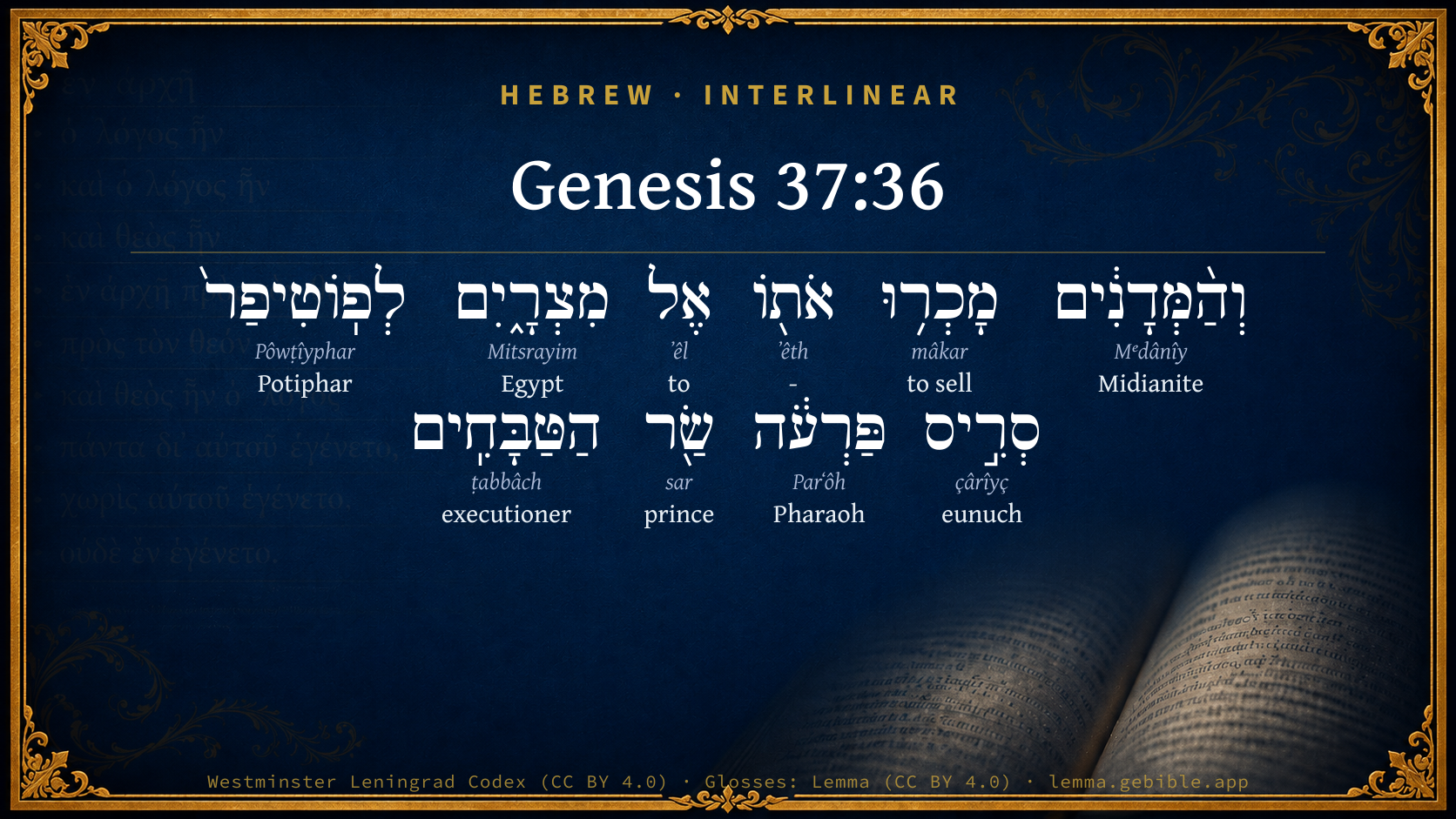
Hebrew (Westminster Leningrad Codex) Genesis 37:36 appears in the Hebrew Old Testament. The text above is from the Westminster Leningrad Codex. Each word links to its Strong’s number, a concise gloss, and parsing drawn from the Open Scriptures Hebrew Bible morphology. Click any word for its full Brown-Driver-Briggs (BDB) entry.
Download image
Cite this verse

Genesis 37:36 (World English Bible). Public Domain. Lemma interlinear Bible study tool, https://lemma.gebible.app/v/genesis/37/36.

Show BibTeX & RIS
BibTeX
RIS
English Translation
The Midianites sold him into Egypt to Potiphar, an officer of Pharaoh's, the captain of the guard.
World English Bible · Public Domain
Highlights
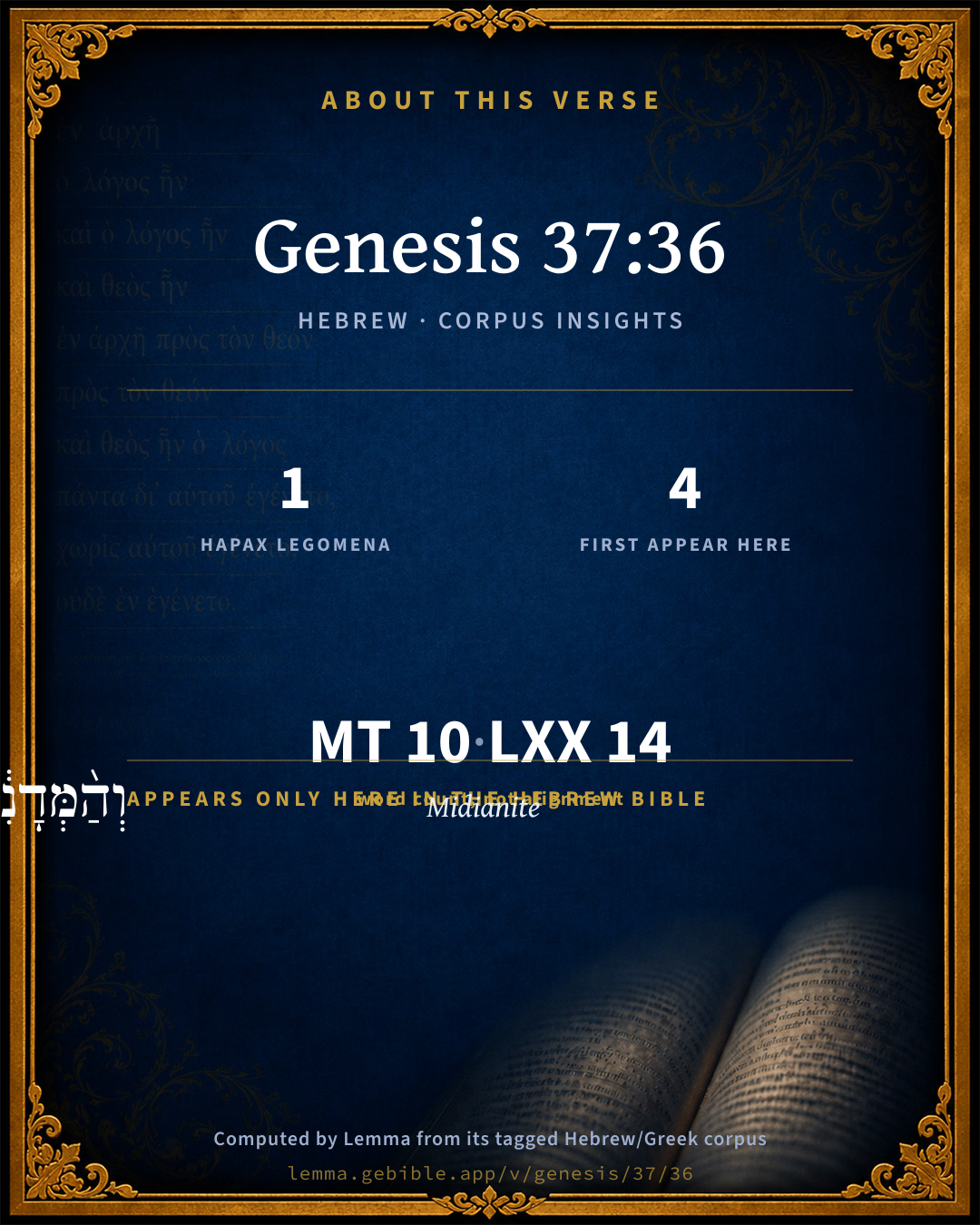
  • 1 hapax legomenon — only here in the Hebrew Bible
  • 4 first appearances in the Hebrew Bible
Full analysis ↓
Download a study sheet

One document with this verse’s original text, its word-by-word gloss line, the meaning frame, cross-references with their text, attributed commentary, and full source and license credits — printable, and it pastes into notes with its structure intact.

This verse Autodidact and up

Study sheet (.html) Plain text (.txt)

A passage Seminary Student

Up to 50 verses in one chapter. A passage sheet keeps up to 6 commentary sources and 12 cross-references per verse, in the order this page ranks them, and says so on the sheet whenever that leaves anything out. Ask for a single verse and you get the Autodidact verse sheet above.

Everything on this page stays free to read, with no account — the sheet is a download of what is already on screen, not access to it.

Want to remove ads? Support Godless Engineer
Compare translations 3

The same verse in 3 English versions, stacked beneath the original-language interlinear above. Click any original word for its lexicon entry.

Each is an independent rendering of the whole verse — the interlinear is not word-aligned to these translations.

Highlighted words mark where these versions differ — a whole-verse word diff, not a word-by-word alignment.

  • World English Bible Public Domain
    The Midianites sold him into Egypt to Potiphar, an officer of Pharaoh's, the captain of the guard.
  • King James Version Public Domain
    And the Midianites sold him into Egypt unto Potiphar, an officer of Pharaoh's, and captain of the guard.
  • unfoldingWord Literal Text CC BY-SA 4.0
    And the Midianites sold him in Egypt to Potiphar, an official of Pharaoh, the chief of the guards.

unfoldingWord Literal Text — © unfoldingWord, licensed CC BY-SA 4.0. Word-aligned USFM3 via Door43 (git.door43.org/unfoldingWord/en_ult).

Versions to compare (up to 4)

3 of 4 selected

Show all 18 translations

Every available English version of this verse, each an independent rendering of the whole verse.

  • World English Bible Public Domain
    The Midianites sold him into Egypt to Potiphar, an officer of Pharaoh's, the captain of the guard.
  • Berean Standard Bible Public Domain
    Meanwhile, the Midianites sold Joseph in Egypt to Potiphar, an officer of Pharaoh and captain of the guard.
  • Majority Standard Bible Public Domain
    Meanwhile, the Midianites sold Joseph in Egypt to Potiphar, an officer of Pharaoh and captain of the guard.
  • King James Version Public Domain
    And the Midianites sold him into Egypt unto Potiphar, an officer of Pharaoh's, and captain of the guard.
  • American Standard Version (1901) Public Domain
    And the Midianites sold him into Egypt unto Potiphar, an officer of Pharaoh's, the captain of the guard.
  • Revised Version (1885) Public Domain
    And the Midianites sold him into Egypt unto Potiphar, an officer of Pharaoh’s, the captain of the guard.
  • Geneva Bible (1599) Public Domain
    And the Midianites solde him into Egypt vnto Potiphar an Eunuche of Pharaohs, and his chiefe stewarde.
  • Douay-Rheims (1899) Public Domain
    The Madianites sold Joseph in Egypt to Putiphar, an eunuch of Pharao, captain of the soldiers.
  • Young's Literal Translation Public Domain
    And the Medanites have sold him unto Egypt, to Potiphar, a eunuch of Pharaoh, head of the executioners.
  • Literal Standard Version CC BY-SA 4.0
    And the Midianites have sold him to Egypt, to Potiphar, a eunuch of Pharaoh, head of the executioners.
  • Unlocked Literal Bible CC BY-SA 4.0
    The Midianites sold him in Egypt to Potiphar, an officer of Pharaoh, the captain of the bodyguard.
  • unfoldingWord Literal Text CC BY-SA 4.0
    And the Midianites sold him in Egypt to Potiphar, an official of Pharaoh, the chief of the guards.
  • Darby Bible Public Domain
    And the Midianites sold him into Egypt, to Potiphar, a chamberlain of Pharaoh, the captain of the life-guard.
  • World Messianic Bible Public Domain
    The Midianites sold him into Egypt to Potiphar, an officer of Pharaoh’s, the captain of the guard.
  • Webster's Bible Public Domain
    And the Midianites sold him into Egypt to Potiphar, an officer of Pharaoh's, and captain of the guard.
  • Free Bible Version CC BY-SA 4.0
    In the meantime the Ishmaelites had arrived in Egypt and had sold Joseph to Potiphar. Potiphar was one of Pharaoh's officers, the captain of the guard.
  • Bible in Basic English Public Domain
    And in Egypt the men of Midian gave him for a price to Potiphar, a captain of high position in Pharaoh's house.
  • JPS Tanakh (1917) Public Domain
    And the Midianites sold him into Egypt unto Potiphar, an officer of Pharaoh's, the captain of the guard.

Literal Standard Version (2020), Covenant Press — licensed CC BY-SA 4.0. Text via the HelloAO Bible API (eBible.org). Unlocked Literal Bible (unfoldingWord) — licensed CC BY-SA 4.0. Text via the HelloAO Bible API (eBible.org). unfoldingWord Literal Text — © unfoldingWord, licensed CC BY-SA 4.0. Word-aligned USFM3 via Door43 (git.door43.org/unfoldingWord/en_ult). Free Bible Version, Dr. Jonathan Gallagher — licensed CC BY-SA 4.0. Text via the HelloAO Bible API (eBible.org).

Word by word

More ways to search: Search by grammar → Find every occurrence → Compare this word →

Practice this passage: Drill this verse → Learn its vocabulary →

וְהַ֨מְּדָנִ֔ים
Mᵉdânîy
H4092
“and · the · Midianites”
Conjunction + Particle, Definite Article + Noun, Gentilic, Masculine, Plural, Absolute
Part of Speech
Conjunction + Particle + Noun
Type
Gentilic
Gender
Masculine
Number
Plural
State
Absolute
Full BDB Definition

Origin: a variation of H4084

TWOT: None

Midianite = see Midian " strife" - a member of the tribe of Midian - an inhabitant of the land of Midian
  1. מָכְר֥וּ mâkar H4376 “to sell” Verb, Qal, Perfect, 3rd Person, Common, Plural
  2. אֹת֖וֹ ʼêth H853 “- · him” Particle, Direct Object + Suffix, Personal, 3rd Person, Masculine, Singular
  3. אֶל ʼêl H413 “to” Preposition
  4. מִצְרָ֑יִם Mitsrayim H4714 “Egypt” Noun, Proper
  5. לְפֽוֹטִיפַר֙ Pôwṭîyphar H6318 “to/for · Potiphar” Preposition + Noun, Proper
  6. סְרִ֣יס çârîyç H5631 “eunuch of” Noun, Common, Masculine, Singular, Construct
  7. פַּרְעֹ֔ה Parʻôh H6547 “Pharaoh” Noun, Proper
  8. שַׂ֖ר sar H8269 “prince of” Noun, Common, Masculine, Singular, Construct
  9. הַטַּבָּחִֽים ṭabbâch H2876 “the · executioners” Particle, Definite Article + Noun, Common, Masculine, Plural, Absolute

About this verse

These counts appear in no published source. They are computed here, from the morphology-tagged text and Lemma’s own curated glosses. What Lemma adds →

10
words
10
distinct lemmas
Pentateuch
section

Notable vocabulary

1 hapax legomenon — a word that appears only here in the entire Hebrew Bible:

  • וְהַ֨מְּדָנִ֔ים Midianite H4092

First appearance in Scripture

These words make their first canonical appearance in the Hebrew Bible here:

  • וְהַ֨מְּדָנִ֔ים Midianite H4092
  • לְפֽוֹטִיפַר֙ Potiphar H6318
  • סְרִ֣יס eunuch H5631
  • הַטַּבָּחִֽים executioner H2876

Shared distinctive vocabulary

לְפֽוֹטִיפַר֙ Potiphar H6318 occurs in 2 verses of the Hebrew Bible. Also found in:

Grammatical profile

  • 1 verb
  • 7 nouns
  • 1 preposition
  • 1 particle

Verb forms

  • מָכְר֥וּ Qal · Perfect

Hebrew & Septuagint length

In the original languages it is 10 Hebrew tokens and 14 Greek tokens — but the two are counted differently (Hebrew bundles its prefixes and suffixes into one token; the Greek is in lemma form), so that isn’t a like-for-like length.

Cross-references

7

Topical passages linked to Genesis 37:36 in the Treasury of Scripture Knowledge — connected by theme and wording, ordered by reader-vote popularity; previews shown in the World English Bible.

  • Genesis 37:28 Midianites who were merchants passed by, and they drew and lifted up Joseph out of the pit, and sold Joseph to the Ishmaelites for twenty pieces of silver. They brought Joseph into Egypt.
  • Genesis 40:4 The captain of the guard assigned them to Joseph, and he took care of them. They stayed in prison many days.
  • Genesis 25:1–2 Abraham took another wife, and her name was Keturah.
  • Genesis 39:1–23 Joseph was brought down to Egypt. Potiphar, an officer of Pharaoh's, the captain of the guard, an Egyptian, bought him from the hand of the Ishmaelites that had brought him down there.
  • 2 Kings 25:8 Now in the fifth month, on the seventh day of the month, which was the nineteenth year of king Nebuchadnezzar, king of Babylon, came Nebuzaradan the captain of the guard, a servant of the king of Babylon, to Jerusalem.
  • Isaiah 56:3 Neither let the foreigner, who has joined himself to Yahweh, speak, saying, Yahweh will surely separate me from his people; neither let the eunuch say, Behold, I am a dry tree.
  • Esther 1:10 On the seventh day, when the heart of the king was merry with wine, he commanded Mehuman, Biztha, Harbona, Bigtha, and Abagtha, Zethar, and Carcass, the seven chamberlains who ministered in the presence of Ahasuerus the king,

Cross-references courtesy of OpenBible.info (CC BY 4.0).

Hebrew and Greek witnesses Masoretic Hebrew ↔ Greek Septuagint

The same verse in the two great witnesses to the Old Testament, shown verse-for-verse.

These are two independent witnesses, not word-aligned to each other, and the Septuagint is shown in lemma (dictionary) form.

Hebrew Genesis 37:36 Masoretic · Westminster Leningrad Codex

וְהַ֨מְּדָנִ֔ים מָכְר֥וּ אֹת֖וֹ אֶל מִצְרָ֑יִם לְפֽוֹטִיפַר֙ סְרִ֣יס פַּרְעֹ֔ה שַׂ֖ר הַטַּבָּחִֽים

The Midianites sold him into Egypt to Potiphar, an officer of Pharaoh's, the captain of the guard.

World English Bible · Public Domain

Greek LXX Genesis 37:36 Septuagint · lemma form

ὁ δέ μαδιηναῖος ἀποδίδωμι ὁ ιωσηφ εἰς αἴγυπτος ὁ πετεφρης ὁ σπάδων φαραώ ἀρχιμάγειρος

No English rendering of this Greek verse — the small residue in the structurally divergent books.

On this verse, Ellicott's Commentary for English Readers discusses the Septuagint’s reading. Read the note in Commentary ↓

Hebrew: Westminster Leningrad Codex (CC BY 4.0). Greek: Septuagint (public domain); English from a public-domain English Septuagint. How the Septuagint differs from the Hebrew →

Targum (Aramaic paraphrase)

2

The Targum is the ancient Jewish Aramaic paraphrase of the Hebrew Scriptures — an interpretive translation, not the Hebrew text itself. Onkelos (literal) and Pseudo-Jonathan (expansive) render the Torah, and Jonathan the Prophets. Coverage is partial: where no permissively-licensed English translation exists for a verse, only the Aramaic is shown. This is verse-level text, not a word-by-word alignment to the Hebrew.

  1. Targum Onkelos Torah (Genesis–Deuteronomy)
    וּמִדְיָנָאֵי זַבִּינוּ יָתֵהּ לְמִצְרָיִם לְפוֹטִיפַר רַבָּא דְפַרְעֹה רַב קָטוֹלַיָּא

    (no public-domain English translation for this verse)

    Targum Onkelos — Aramaic: “Onkelos Genesis” (public domain); “Onkelos Exodus” (public domain); “Onkelos Leviticus” (public domain); “Onkelos Numbers” (public domain); “Onkelos Deuteronomy” (public domain). English: “Sefaria Community Translation” (CC0 1.0 (public-domain dedication)); “J.W. Etheridge. The Targums of Onkelos and Jonathan Ben Uzziel on the Pentateuch. London: Longmans, Green, 1862” (public domain). Text via Sefaria.

  2. Targum Pseudo-Jonathan Torah (Genesis–Deuteronomy)
    וּמִדְיָנָאֵי זַבִּינוּ יָתֵיהּ לְמִצְרַיִם לְפוֹטִיפַר רַבָּא דְפַרְעה רַב סַפּוֹקְלַטוֹרְיָא

    But the Midianites sold him in Mizraim to Potiphar a captain of Pharoh, a captain of the guards.

    Targum Pseudo-Jonathan — Aramaic: “Targum Jonathan on Genesis” (public domain); “Targum Jonathan on Exodus” (public domain); “Targum Jonathan on Leviticus” (public domain); “Targum Jonathan on Numbers” (public domain); “Targum Jonathan on Deuteronomy” (public domain). English: “The Targum of Jonathan ben Uzziel, trans. J. W. Etheridge, London, 1862” (public domain). Text via Sefaria.

Commentary

Notes on Genesis 37:36 from classic Christian and Jewish commentators (each source and its license shown beneath its notes). The classic Christian expositions comment on the surrounding passage and are grouped to its opening verse, so a note may address several verses; the Jewish commentaries on the Tanakh (Rashi and others) are per-verse, so they appear only where the commentator wrote on this verse.

Lemma curates 59 commentaries, every one of them public domain or Creative Commons licensed, each selected and text-cleaned for this edition rather than reprinted as found. About our sources →

Trapp's Complete Commentary

John Trapp

Gen 37:36 And the Midianites sold him into Egypt unto Potiphar, an officer of Pharaoh’s, [and] captain of the guard.

Ver. 36. And the Midianites.] Little knew Joseph what God was in doing. Have patience, till he have brought both ends together.

John Trapp, A Commentary or Exposition upon All the Books of the Old and New Testament (1647–1656) — public domain. Text from a community e-Sword module.

Tyndale Open Study Notes

Tyndale Open Resources

37:36 sold Joseph to Potiphar: Joseph found himself in a place of service that seemed congruent with his rise to authority, yet he still faced more testing.

Tyndale Open Study Notes — © Tyndale Open Resources, licensed CC BY-SA 4.0. Text via the HelloAO Bible API.

Geneva Bible (1599)

Geneva Bible translators

Or, captain of the guard.

Which word doth not always signify him that is gelded, but also him that is in some high dignity.

Geneva Bible (1599) marginal notes — public domain. Text via Bolls.life.

Adam Clarke's Commentary

Verse 36. Potiphar, an officer of Pharaoh's] The word סריס saris, translated officer, signifies a eunuch; and lest any person should imagine that because this Potiphar had a wife, therefore it is absurd to suppose him to have been a eunuch, let such persons know that it is not uncommon in the east for eunuchs to have wives, nay, some of them have even a harem or seraglio where they keep many women, though it does not appear that they have any progeny; and probably discontent on this ground might have contributed as much to the unfaithfulness of Potiphar's wife, as that less principled motive through which it is commonly believed she acted.

Captain of the guard.] שר הטבחים sar kattabbachim, chief of the butchers; a most appropriate name for the guards of an eastern despot. If a person offend one of the despotic eastern princes, the order to one of the life-guards is, Go and bring me his head; and this command is instantly obeyed, without judge, jury, or any form of law. Potiphar, we may therefore suppose, was captain of those guards whose business it was to take care of the royal person, and execute his sovereign will on all the objects of his displeasure. Reader, if thou hast the happiness to live under the British constitution, be thankful to God. Here, the will, the power, and utmost influence of the king, were he even so disposed, cannot deprive the meanest subject of his property, his liberty, or his life. All the solemn legal forms of justice must be consulted; the culprit, however accused, be heard by himself and his counsel; and in the end twelve honest, impartial men, chosen from among his fellows, shall decide on the validity of the evidence produced by the accuser. For the trial by jury, as well as for innumerable political blessings, may God make the inhabitants of Great Britain thankful!

1. WITH this chapter the history of Joseph commences, and sets before our eyes such a scene of wonders wrought by Divine Providence in such a variety of surprising instances, as cannot fail to confirm our faith in God, show the propriety of resignation to his will, and confidence in his dispensations, and prove that all things work together for good to them that love him. Joseph has often been considered as a type of Christ, and this subject in the hands of different persons has assumed a great variety of colouring. The following parallels appear the most probable; but I shall not pledge myself for the propriety of any of them: "Jesus Christ, prefigured by Joseph, the beloved of his father, and by him sent to visit his brethren, is the innocent person whom his brethren sold for a few pieces of silver, the bargain proposed by his brother Judah, (Greek Judas,) the very namesake of that disciple and brother (for so Christ vouchsafes to call him) who sold his Lord and Master; and who by this means became their Lord and Saviour; nay, the Saviour of strangers, and of the whole world; which had not happened but for this plot of destroying him, the act of rejecting, and exposing him to sale. In both examples we find the same fortune and the same innocence: Joseph in the prison between two criminals; Jesus on the cross between two thieves. Joseph foretells deliverance to one of his companions and death to the other, from the same omens: of the two thieves, one reviles Christ, and perishes in his crimes; the other believes, and is assured of a speedy entrance into paradise. Joseph requests the person that should be delivered to be mindful of him in his glory; the person saved by Jesus Christ entreats his deliverer to remember him when he came into his kingdom." - See Pascal's Thoughts. Parallels and coincidences of this kind should always be received cautiously, for where the Spirit of God has not marked a direct resemblance, and obviously referred to it as such in some other part of his word, it is bold, if not dangerous, to say "such and such things and persons are types of Christ." We have instances sufficiently numerous, legitimately attested, without having recourse to those which are of dubious import and precarious application. See the observation on Clarke "Ge 40:23".

2. Envy has been defined, "pain felt, and malignity conceived, at the sight of excellence or happiness in another." Under this detestable passion did the brethren of Joseph labour; and had not God particularly interposed, it would have destroyed both its subjects and its object, Perhaps there is no vice which so directly filiates itself on Satan, as this does. In opposition to the assertion that we cannot envy that by which we profit, it may be safely replied that we may envy our neighbour's wisdom, though he gives us good counsel; his riches, though he supplies our wants; and his greatness, though he employs it for our protection.

3. How ruinous are family distractions! A house divided against itself cannot stand. Parents should take good heed that their own conduct be not the first and most powerful cause of such dissensions, by exciting envy in some of their children through undue partiality to others; but it is in vain to speak to most parents on the subject; they will give way to foolish predilections, till, in the prevailing distractions of their families, they meet with the punishment of their imprudence, when regrets are vain, and the evil past remedy.

Adam Clarke's Commentary on the Bible (1810–1826) — public domain. Text from a community e-Sword/MySword module.

John Calvin's Commentaries

36. And the Midianites sold him into Egypt It was a sad spectacle, that Joseph should be thus driven from one hand to another. For it added no small indignity to his former suffering, that he is set to sale as a slave. The Lord, however, ceased not to care for him. He even suffered him to be transferred from hand to hand, in order that, at length, it might indeed appear, that he had come, by celestial guidance, to that very dominion which had been promised him in his dreams. Potiphar is called a eunuch, not because he was one really; but because, among the Orientals, it was usual to denote the satraps and princes of the court by that name. The Hebrews are not agreed respecting the dignity which Moses ascribes to him; for some explain it as the “chief of the slaughterers,” whom the Greek interpreters follow. But I rather agree with others, who say that he was “the prefect of the soldiers;” not that he had the command of the whole army, but because he had the royal troops under his hand and authority: such are now the captains of the guard, if you join with it another office which the prefects of the prison exercise. For this may be gathered from Genesis 39:1

John Calvin's Commentaries (1540-1563) — public domain. Text from the Calvin Translation Society English edition (1840s-50s) via the Christian Classics Ethereal Library (ccel.org). Calvin's coverage is partial (roughly two-thirds of the Bible); uncommented books and verses are honest gaps, never fabricated. The 19th-century editor's footnotes and remarks are omitted so the notes are faithfully Calvin's own voice.

Ellicott's Commentary for English Readers

(36) Midianites.—Heb., Medanites. (See Note on Gen_37:25.)

Potiphar.—Three chief interpretations are given of this name The first explains it by two Coptic words, according to which it would signify “father of the king.” This would make it an official name equivalent to prime minister or vizier. Gesenius considers it to be the same name as Potipherah (Gen_41:50), and explains it as meaning “consecrated to Ra,” that is, the sun-god. Thirdly, Canon Cook, in the “Excursus on Egyptian Words,” at the end of Vol. I. of The Speaker’s Commentary, argues with much cogency, that it means “father of the palace.” This again would be an official name.

An officer.—Though this word literally in Hebrew signifies an eunuch, yet either, as seems probable from other places, it had come to mean any officer of the palace, or Potiphar was chief of the eunuchs, and therefore is himself numbered among them.

Captain of the guard.—Heb., chief of the slaughterers, by which the LXX. understand the slaughterers of animals for food, and translate “chief cook.” The other versions understand by it the commander of the king’s body-guard, whose business it would be to execute condemned criminals. A comparison with 2Ki_25:8, where the same title is given to Nebuzar-adan, proves that this interpretation is correct.

A Bible Commentary for English Readers, edited by Charles John Ellicott (1878–1897) — public domain. Text from a community e-Sword module.

The Cambridge Bible for Schools and Colleges

gen. ed. J. J. S. Perowne

36. Midianites] Heb. Medanites. This verse, from E, resumes the narrative from Gen_37:29-30.

Potiphar] An Egyptian name, denoting “the gift of Ra,” the sun-god. It appears as “Potiphera,” Gen_41:45, Gen_46:20. LXX Πετεφρῆς, Lat. Putiphar, reproducing the Egyptian Pedephrç = “he whom the sun-god gives.”

officer] Lit. “eunuch.” Probably a word used to denote an official about the court. Heb. saris, LXX σπάδων, Lat. eunuchus. Some Assyriologists prefer the derivation from ša rêši = “he who is the head.” But there seems to be no sufficient reason to call in question the meaning which the word has in Hebrew, Aramaic, and Arabic. The class to which the saris belonged has always infested Oriental courts, and the name was therefore likely to acquire a general significance as “a court official.” Cf. 2Ki_18:17 (Rab-saris); Jer_39:3; Jer_39:13; Dan_1:3.

Pharaoh] i.e. the king of Egypt. The title, but not the personal name, of the sovereign: see note on Gen_12:15.

captain of the guard] Heb. chief of the executioners, and, as such, having charge of the prisoners (Gen_40:3-4, Gen_41:12). Cf. “captain of the guard,” 2Ki_25:8; Jer_39:9; Jer_41:10; Jer_43:6; Jer_52:12; Dan_2:14. Another very possible rendering is “chief of the butchers” (cf. Gen_40:2, “chief of the bakers”), the officer over the men who killed the animals for the food of the king’s house, and one of the principal officials in an ancient court. The Heb. word in the sing. is “cook” in 1Sa_9:23-24, i.e. the man who killed the animal for food and cooked it.

If so, the rendering of the LXX ἀρχιμάγειρος, “head cook,” “head of the kitchen department,” is nearer the truth than that of the Lat. magister militum.

The Cambridge Bible for Schools and Colleges (gen. ed. J. J. S. Perowne; Cambridge University Press, 1878–1918) — public domain. Text from a community e-Sword module.

Haydock's Catholic Bible Commentary

An eunuch. This word sometimes signifies a chamberlain, courtier, or officer of the king: and so it is taken in this place. (Challoner) --- Soldiers, cooks, or butchers. Hebrew tabachim, executioners, mactantium. He might also be chief sacrificer, governor of the prisons, &c., all these employments were anciently very honourable, Daniel ii. 14. The providence of God never shines more brightly in any part of the Scripture, than in this history of Joseph, except in that of Jesus Christ, of whom Joseph was a beautiful figure. He was born when his father was grown old, as Jesus was in the last age of the world; he was a son increasing, as Jesus waxed in age and grace before God and men; both were beloved by their father, both comely, &c. (Calmet)

George Leo Haydock (1774–1849), Haydock's Catholic Family Bible and Commentary, 1859 edition — public domain. Excludes Psalms (Douay-Rheims chapter numbering differs from Protestant) and Deuterocanonical books (Catholic canon only).

Matthew Poole's English Annotations

Whose office it was to apprehend and punish criminal persons. See Gen 40:3; Jer 39:9; Mar 6:27.

Matthew Poole's English Annotations on the Holy Bible (1683–1685) — public domain. Text from a community e-Sword/MySword module.

Whedon's Commentary on the Bible

Daniel D. Whedon

36. Potiphar — “A eunuch of Pharaoh: this is the primary meaning, although the word came afterwards to mean officer in general, since the officers about the royal person were usually eunuchs.

Captain of the guard — Rendered literally in the margin, ‘chief of the executioners, chief marshall,’ an appropriate title for the officer who executed the arbitrary and summary sentences of the Pharaohs.” — Newhall.

Daniel D. Whedon (gen. ed.), Commentary on the Old and New Testaments (1874–1909) — public domain. Text from a community e-Sword module.

The Pulpit Commentary

And the Midianites or Medanites, descendants of Medan, a brother of Midian, both of whom were sons of Abraham by Keturah. (Gen_25:2) That the Arabian merchants are called Ishmaelites (ver. 27), Midianites (ver. 28), and Medanites (ver. 36), is explained as an evidence of varying legends (Tuch, Bleek, Davidson, Colenso), but is better accounted for as indicating that the traders were composed of men of various nations (Clericus); that the Midianites, Ishmaelites, and Medanites were often confounded from their common parentage and closely similar habits (Keil); that the narrator did not intend to lay stress upon the nationality, but upon the occupation, of the travelers (Havernick); that the proprietors of the caravan were Ishmaelites, and the company attending it Midianites or Medanites (Lange); that the Ishmaelites were the genus, and the Midianites and Medanites the species, of the same nation (Rosenm Quarry); that the Midianites or Medanites were the actual purchasers of Joseph, while the caravan took its name from the Ishmaelites, who formed the larger portion of it (Murphy)sold him into Egypt (i.e. having brought him into Egypt, perhaps, as Luther conjectures, passing through Hebron on the way, sold him) unto Potiphar, the name is abbreviated from Poti-Phera, (Gen_41:50) i.e. he who belongs to the sun (Gesenius, sub voce). The LXX render Petefrhv or Petefrhan officer syris; from srs; an unused root signifying to pull up by the roots, originally means a eunuch, (Isa_56:3, Isa_56:4) such as Orientalmonarchs were accustomed to set over their harems, (Est_2:3, Est_2:14, 15 4:5) but is here employed to denote an officer or courtier generally, without any reference to the primary signification, since Potiphar was marriedof Pharaoh"s, (vide Gen_12:15) and captain of the guard literally, captain of the slaughterers, i.e. chief officer of the executioners, the nature of whoso duties may be understood from the fact that he was keeper of the State prison, "where the king"s prisoners were bound". (Gen_39:20)

The Pulpit Commentary (1880–1919), ed. H.D.M. Spence-Jones & Joseph S. Exell — public domain. Text from a community e-Sword module.

Keil & Delitzsch

C. F. Keil & F. Delitzsch

But Joseph, while his father was mourning, was sold by the Midianites to Potiphar, the chief of Pharaoh's trabantes, to be first of all brought low, according to the wonderful counsel of God, and then to be exalted as ruler in Egypt, before whom his brethren would bow down, and as the saviour of the house of Israel. The name Potiphar is a contraction of Poti Pherah (Gen 41:50); the lxx render both Πετεφρής or Πετεφρῆ (vid., Gen 41:50). סריס (eunuch) is used here, as in Sa1 8:15 and in most of the passages of the Old Testament, for courtier or chamberlain, without regard to the primary meaning, as Potiphar was married. "Captain of the guard" (lit., captain of the slaughterers, i.e., the executioners), commanding officer of the royal body-guard, who executed the capital sentences ordered by the king, as was also the case with the Chaldeans (Kg2 25:8; Jer 39:9; Jer 52:12. See my Commentary on the Books of Kings, vol. i. pp. 35, 36, Eng. Tr.).

Keil & Delitzsch — Biblical Commentary on the Old Testament (1861–1891) — public domain (CC PDM 1.0). Text via the HelloAO Bible API. (Old Testament only.)

Rashi

Rabbi Shlomo Yitzchaki (Rashi)

הטבחים— means the slaughterers of the kings animals.

Rashi on the Tanakh — English translations: “The Judaica Press complete Tanach with Rashi, translated by A. J. Rosenberg” (CC BY 4.0); “Pentateuch with Rashi's commentary by M. Rosenbaum and A.M. Silbermann, 1929-1934” (public domain); “The Metsudah Tanach series, Lakewood, N.J” (CC BY 4.0); and “The Book of Joshua, Metsudah Publications, 1997” (CC BY 4.0). Text via Sefaria.

Ramban (Nachmanides)

Rabbi Moshe ben Nachman (Ramban / Nachmanides)

OFFICER OF ‘HATABACHIM.’ This means the slaughterers of the king’s animals. This is the language of Rashi. Similarly, it says, And the ‘tabach’ (cook) took up the thigh; For perfumers and for cooks (‘tabachoth’)., 8:13.Closer to the meaning of the word hatabachim is the opinion of Onkelos who says that since the prison house was under his charge, [he was called the officer of the tabachim, since] we find the word t’vichah in connection with the killing of people. Prepare ye the slaughter (‘matbiach’) for his children; Thou hast slaughtered (‘tavachta’) unsparingly. The verse in the book of Daniel is proof of the validity of Onkelos’ interpretation: To Arioch the captain of ‘tabachaya’ of the king, who was gone forth to slay the wise men of Babylon. or tabachim is thus clearly associated with the slaying of people. See my Hebrew commentary, Note 77, pp. 211-212.

Ramban (Nachmanides) on the Tanakh — English translation: “Commentary on the Torah by Ramban (Nachmanides). Translated and annotated by Charles B. Chavel. New York, Shilo Pub. House, 1971-1976” (CC BY 4.0). Text via Sefaria.

Radak

Rabbi David Kimhi (Radak)

והמדנים, we already explained who they were and what they did on verse 28.

שר הטבחים, as per Onkelos, Pharaoh’s chief executioner.

Radak on the Tanakh — English translations: “Sefaria Community Translation” (CC0 1.0 (public-domain dedication)); “Eliyahu Munk, HaChut Hameshulash” (CC BY 4.0); “Rabbi Mike Feuer, Jerusalem Anthology” (CC BY 4.0); and “R. David Kimhi on the first book of Psalms, Translated by R.G. Finch, London, 1919” (public domain). Text via Sefaria.

Lesson kit

Teaching starters — assembled from the data on this page, not authored interpretation. Every prompt links to the verse data it draws on. Edit before teaching.

Genesis, in the Pentateuch, opens this verse with 10 words (10 distinct Hebrew lemmas). Its most distinctive word is Mᵉdânîy (“Midianite”). A historical commentator’s framing appears above. Read the whole chapter for the surrounding context.

Discussion questions

  1. What does “Midianite” (Mᵉdânîy) contribute to the verse as a whole?
  2. 1 word here appears nowhere else in the Hebrew Bible. Why might the author reach for such rare wording?
  3. 4 words make their first appearance in Scripture here. What does this debut establish?
  4. How does Genesis 39:1, which shares the word «Potiphar», read alongside this verse?
  5. These translations render this verse differently. What is at stake in choosing one wording over another?
  6. «מָכְר֥וּ» is a Qal Perfect verb. How does that grammatical form shape the action described?
  7. Compare how Trapp's Complete Commentary and Tyndale Open Study Notes read this verse. Where do they agree or differ?

Things to notice

Reading settings

Reading text

Shown beneath each verse's original-language words.

Old Testament
Old Testament edition

Read the OT as the Masoretic Hebrew (MT) or the Greek Septuagint (LXX).

English shown for the Greek Septuagint (in the Hebrew ↔ Greek comparison).

Comparing translations? Open the Compare panel on any verse page to stack up to four side by side.