
2 Chronicles 28:21

Hebrew (Westminster Leningrad Codex) 2 Chronicles 28:21 appears in the Hebrew Old Testament. The text above is from the Westminster Leningrad Codex. Each word links to its Strong’s number, a concise gloss, and parsing drawn from the Open Scriptures Hebrew Bible morphology. Click any word for its full Brown-Driver-Briggs (BDB) entry.
Download image
Cite this verse

2 Chronicles 28:21 (World English Bible). Public Domain. Lemma interlinear Bible study tool, https://lemma.gebible.app/v/2-chronicles/28/21.

Show BibTeX & RIS
BibTeX
RIS
English Translation
For Ahaz took away a portion out of the house of Yahweh, and out of the house of the king and of the princes, and gave it to the king of Assyria: but it didn't help him.
World English Bible · Public Domain
Download a study sheet

One document with this verse’s original text, its word-by-word gloss line, the meaning frame, cross-references with their text, attributed commentary, and full source and license credits — printable, and it pastes into notes with its structure intact.

This verse Autodidact and up

Study sheet (.html) Plain text (.txt)

A passage Seminary Student

Up to 50 verses in one chapter. A passage sheet keeps up to 6 commentary sources and 12 cross-references per verse, in the order this page ranks them, and says so on the sheet whenever that leaves anything out. Ask for a single verse and you get the Autodidact verse sheet above.

Everything on this page stays free to read, with no account — the sheet is a download of what is already on screen, not access to it.

Want to remove ads? Support Godless Engineer
Compare translations 3

The same verse in 3 English versions, stacked beneath the original-language interlinear above. Click any original word for its lexicon entry.

Each is an independent rendering of the whole verse — the interlinear is not word-aligned to these translations.

Highlighted words mark where these versions differ — a whole-verse word diff, not a word-by-word alignment.

  • World English Bible Public Domain
    For Ahaz took away a portion out of the house of Yahweh, and out of the house of the king and of the princes, and gave it to the king of Assyria: but it didn't help him.
  • King James Version Public Domain
    For Ahaz took away a portion out of the house of the LORD, and out of the house of the king, and of the princes, and gave it unto the king of Assyria: but he helped him not.
  • unfoldingWord Literal Text CC BY-SA 4.0
    For Ahaz divided up the house of Yahweh and the house of the king and the chiefs. And he gave to the king of Assyria, but it was not a help to him.

unfoldingWord Literal Text — © unfoldingWord, licensed CC BY-SA 4.0. Word-aligned USFM3 via Door43 (git.door43.org/unfoldingWord/en_ult).

Versions to compare (up to 4)

3 of 4 selected

Show all 18 translations

Every available English version of this verse, each an independent rendering of the whole verse.

  • World English Bible Public Domain
    For Ahaz took away a portion out of the house of Yahweh, and out of the house of the king and of the princes, and gave it to the king of Assyria: but it didn't help him.
  • Berean Standard Bible Public Domain
    Although Ahaz had taken a portion from the house of the LORD, from the royal palace, and from the princes and had presented it to the king of Assyria, it did not help him.
  • Majority Standard Bible Public Domain
    Although Ahaz had taken a portion from the house of the LORD, from the royal palace, and from the princes and had presented it to the king of Assyria, it did not help him.
  • King James Version Public Domain
    For Ahaz took away a portion out of the house of the LORD, and out of the house of the king, and of the princes, and gave it unto the king of Assyria: but he helped him not.
  • American Standard Version (1901) Public Domain
    For Ahaz took away a portion out of the house of Jehovah, and out of the house of the king and of the princes, and gave it unto the king of Assyria: but it helped him not.
  • Revised Version (1885) Public Domain
    For Ahaz took away a portion out of the house of the LORD, and out of the house of the king and of the princes, and gave it unto the king of Assyria: but it helped him not.
  • Geneva Bible (1599) Public Domain
    For Ahaz tooke a portion out of the house of the Lord and out of the Kings house and of the Princes, and gaue vnto the king of Asshur: yet it helped him not.
  • Douay-Rheims (1899) Public Domain
    And Achaz stripped the house of the Lord, and the house of the kings, and of the princes, and gave gifts to the king of the Assyrians, and yet it availed him nothing.
  • Young's Literal Translation Public Domain
    though Ahaz hath taken a portion `out' of the house of Jehovah, and `out' of the house of the king, and of the princes, and giveth to the king of Asshur, yet it is no help to him.
  • Literal Standard Version CC BY-SA 4.0
    though Ahaz has taken a portion [out] of the house of YHWH, and [out] of the house of the king, and of the princes, and gives to the king of Asshur, yet it is no help to him.
  • Unlocked Literal Bible CC BY-SA 4.0
    For Ahaz plundered the house of Yahweh and the houses of the king and the leaders, to give the valuable things to the kings of Assyria. But doing this did not benefit him.
  • unfoldingWord Literal Text CC BY-SA 4.0
    For Ahaz divided up the house of Yahweh and the house of the king and the chiefs. And he gave to the king of Assyria, but it was not a help to him.
  • Darby Bible Public Domain
    For Ahaz stripped the house of Jehovah, and the house of the king and of the princes, and gave to the king of Assyria; but he was of no help to him.
  • World Messianic Bible Public Domain
    For Ahaz took away a portion out of the LORD’s house, and out of the house of the king and of the princes, and gave it to the king of Assyria; but it didn’t help him.
  • Webster's Bible Public Domain
    For Ahaz took away a portion from the house of the LORD, and from the house of the king, and of the princes, and gave it to the king of Assyria: but he helped him not.
  • Free Bible Version CC BY-SA 4.0
    Ahaz took what was valuable from the Lord's Temple, the king's palace, and from his officials and gave them to the king of Assyria as tribute. But it didn't help him.
  • Bible in Basic English Public Domain
    For Ahaz took a part of the wealth from the house of the Lord, and from the house of the king and of the great men, and gave it to the king of Assyria; but it was no help to him.
  • JPS Tanakh (1917) Public Domain
    For Ahaz stripped the house of the LORD, and the house of the king and the princes, and gave thereof unto the king of Assyria; but it helped him not.

Literal Standard Version (2020), Covenant Press — licensed CC BY-SA 4.0. Text via the HelloAO Bible API (eBible.org). Unlocked Literal Bible (unfoldingWord) — licensed CC BY-SA 4.0. Text via the HelloAO Bible API (eBible.org). unfoldingWord Literal Text — © unfoldingWord, licensed CC BY-SA 4.0. Word-aligned USFM3 via Door43 (git.door43.org/unfoldingWord/en_ult). Free Bible Version, Dr. Jonathan Gallagher — licensed CC BY-SA 4.0. Text via the HelloAO Bible API (eBible.org).

Word by word

More ways to search: Search by grammar → Find every occurrence → Compare this word →

Practice this passage: Drill this verse → Learn its vocabulary →

לְעֶזְרָ֖ה
ʻezrâh
H5833
“to/for · help”
Preposition + Noun, Common, Feminine, Singular, Absolute
Part of Speech
Preposition + Noun
Type
Common
Gender
Feminine
Number
Singular
State
Absolute
Full BDB Definition

Origin: from H5828

TWOT: 1598b

help, succour, assistance - help, succour - one who helps
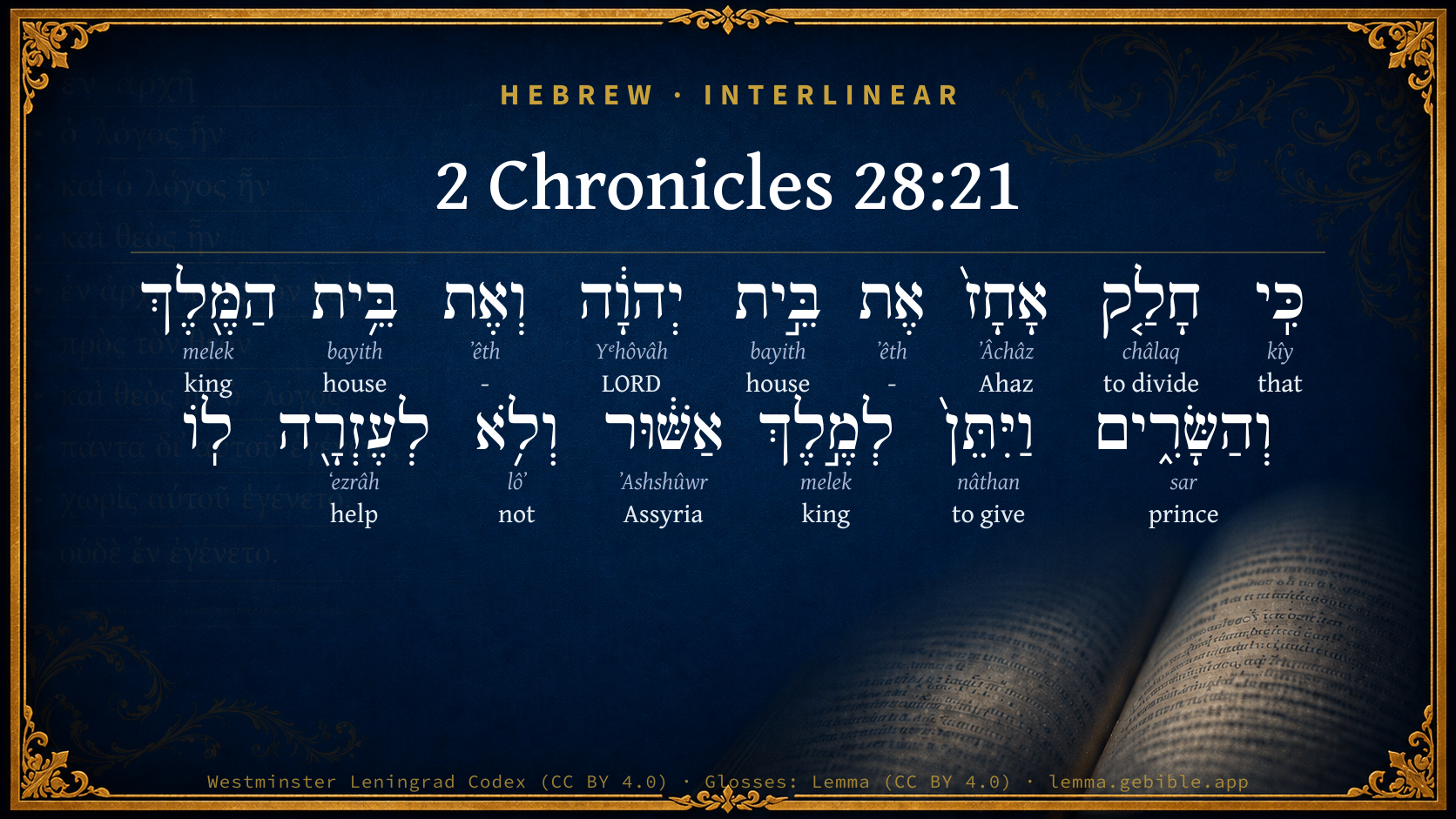
  1. כִּֽי kîy H3588 “that” Conjunction
  2. חָלַ֤ק châlaq H2505 “to divide” Verb, Qal, Perfect, 3rd Person, Masculine, Singular
  3. אָחָז֙ ʼÂchâz H271 “Ahaz” Noun, Proper
  4. אֶת ʼêth H853 “-” Particle, Direct Object
  5. בֵּ֣ית bayith H1004 “house of” Noun, Common, Masculine, Singular, Construct
  6. יְהוָ֔ה Yᵉhôvâh H3068 “LORD” Noun, Proper
  7. וְאֶת ʼêth H853 “and · -” Conjunction + Particle, Direct Object
  8. בֵּ֥ית bayith H1004 “house of” Noun, Common, Masculine, Singular, Construct
  9. הַמֶּ֖לֶךְ melek H4428 “the · king” Particle, Definite Article + Noun, Common, Masculine, Singular, Absolute
  10. וְהַשָּׂרִ֑ים sar H8269 “and · the · princes” Conjunction + Particle, Definite Article + Noun, Common, Masculine, Plural, Absolute
  11. וַיִּתֵּן֙ nâthan H5414 “and · to give” Conjunction + Verb, Qal, Sequential Imperfect, 3rd Person, Masculine, Singular
  12. לְמֶ֣לֶךְ melek H4428 “to/for · king of” Preposition + Noun, Common, Masculine, Singular, Construct
  13. אַשּׁ֔וּר ʼAshshûwr H804 “Assyria” Noun, Proper
  14. וְלֹ֥א lôʼ H3808 “and · not” Conjunction + Particle, Negative

About this verse

These counts appear in no published source. They are computed here, from the morphology-tagged text and Lemma’s own curated glosses. What Lemma adds →

16
words
12
distinct lemmas
Historical
section

Shared distinctive vocabulary

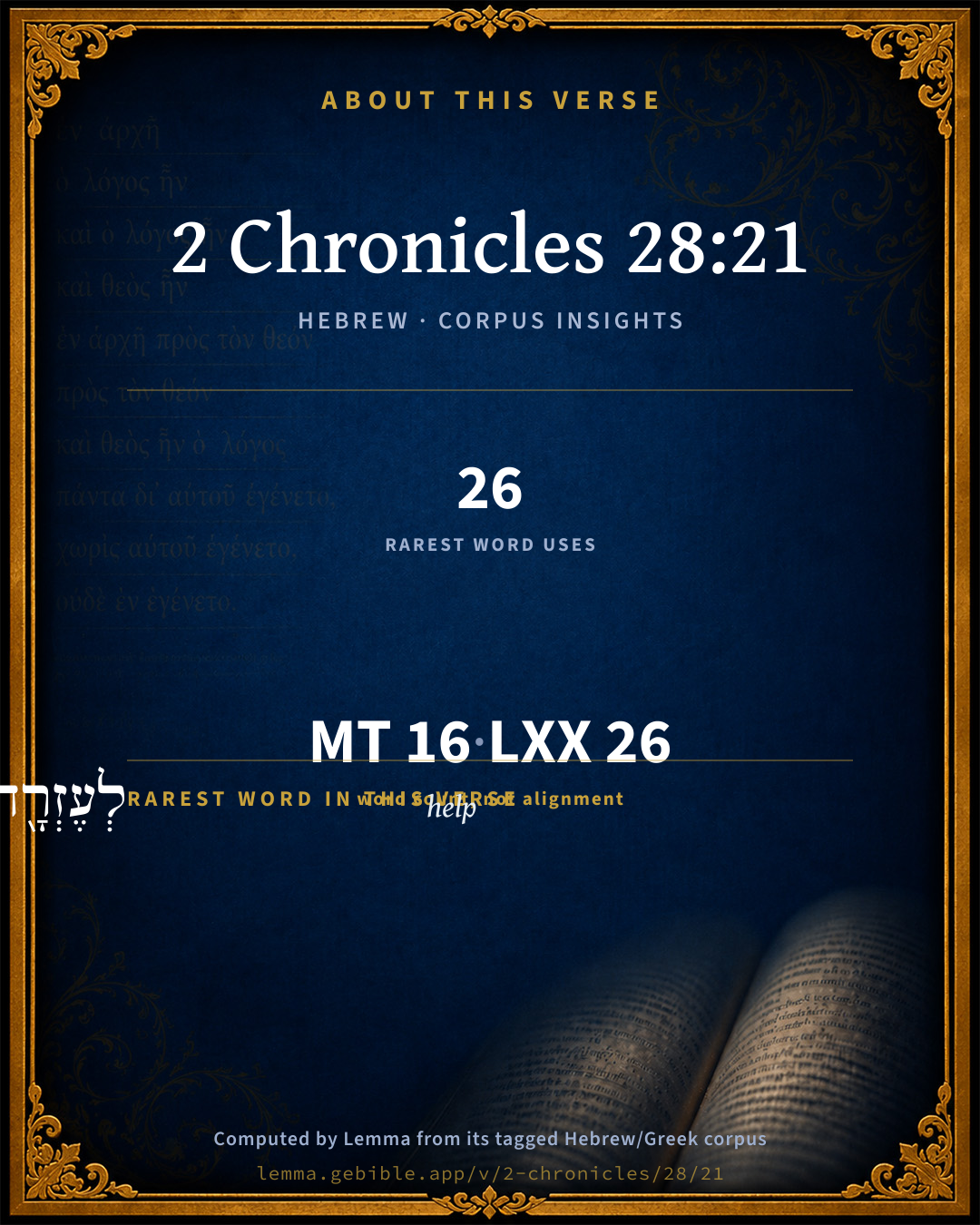
לְעֶזְרָ֖ה help H5833 occurs in 25 verses of the Hebrew Bible. Also found in:

Grammatical profile

  • 2 verbs
  • 9 nouns
  • 1 preposition
  • 1 conjunction
  • 3 particles

Verb forms

  • חָלַ֤ק Qal · Perfect
  • וַיִּתֵּן֙ Qal · Sequential Imperfect

Repetition

Words recur within this verse — often emphatic in Hebrew:

  • בֵּ֣ית house H1004 ×2
  • הַמֶּ֖לֶךְ king H4428 ×2

Hebrew & Septuagint length

In English translation the verse runs 37 words from the Hebrew and 41 from the Septuagint (LXX English) — closely comparable.

A rough comparison of the two English renderings, which tokenize alike — not a word-level alignment.

Word counts can differ between the Hebrew and the Greek without any difference in meaning — e.g. the Hebrew direct-object marker אֵת has no separate Greek word, and Greek often adds the article ὁ.

In the original languages it is 16 Hebrew tokens and 26 Greek tokens — but the two are counted differently (Hebrew bundles its prefixes and suffixes into one token; the Greek is in lemma form), so that isn’t a like-for-like length.

Cross-references

4

Topical passages linked to 2 Chronicles 28:21 in the Treasury of Scripture Knowledge — connected by theme and wording, ordered by reader-vote popularity; previews shown in the World English Bible.

  • 2 Kings 16:8–9 Ahaz took the silver and gold that was found in the house of Yahweh, and in the treasures of the king's house, and sent it for a present to the king of Assyria.
  • 2 Kings 18:15–16 Hezekiah gave [him] all the silver that was found in the house of Yahweh, and in the treasures of the king's house.
  • 2 Chronicles 12:9 So Shishak king of Egypt came up against Jerusalem, and took away the treasures of the house of Yahweh, and the treasures of the king's house: he took all away: he took away also the shields of gold which Solomon had made.
  • Proverbs 20:25 It is a snare to a man to make a rash dedication, Then later to consider his vows.

Cross-references courtesy of OpenBible.info (CC BY 4.0).

Hebrew and Greek witnesses Masoretic Hebrew ↔ Greek Septuagint

The same verse in the two great witnesses to the Old Testament, shown verse-for-verse.

These are two independent witnesses, not word-aligned to each other, and the Septuagint is shown in lemma (dictionary) form.

Hebrew 2 Chronicles 28:21 Masoretic · Westminster Leningrad Codex

כִּֽי חָלַ֤ק אָחָז֙ אֶת בֵּ֣ית יְהוָ֔ה וְאֶת בֵּ֥ית הַמֶּ֖לֶךְ וְהַשָּׂרִ֑ים וַיִּתֵּן֙ לְמֶ֣לֶךְ אַשּׁ֔וּר וְלֹ֥א לְעֶזְרָ֖ה לֽוֹ

For Ahaz took away a portion out of the house of Yahweh, and out of the house of the king and of the princes, and gave it to the king of Assyria: but it didn't help him.

World English Bible · Public Domain

Greek LXX 2 Chronicles 28:21 Septuagint · lemma form

καί λαμβάνω αχαζ ὁ ἐν οἶκος κύριος καί ὁ ἐν οἶκος ὁ βασιλεύς καί ὁ ἄρχων καί δίδωμι ὁ βασιλεύς ασσουρ καί οὐ εἰς βοήθεια αὐτός

And Achaz took the things that were in the house of the Lord, and the things in the house of the king, and of the princes, and gave them to the king of Assyria: but he was no help to him,

LXX2012 (modern English Septuagint) · Public Domain

Hebrew: Westminster Leningrad Codex (CC BY 4.0). Greek: Septuagint (public domain); English from LXX2012 (modern English Septuagint) (Public Domain). How the Septuagint differs from the Hebrew →

Commentary

Notes on 2 Chronicles 28:21 from classic Christian and Jewish commentators (each source and its license shown beneath its notes). The classic Christian expositions comment on the surrounding passage and are grouped to its opening verse, so a note may address several verses; the Jewish commentaries on the Tanakh (Rashi and others) are per-verse, so they appear only where the commentator wrote on this verse.

Lemma curates 59 commentaries, every one of them public domain or Creative Commons licensed, each selected and text-cleaned for this edition rather than reprinted as found. About our sources →

Trapp's Complete Commentary

John Trapp

2Ch 28:21 For Ahaz took away a portion [out] of the house of the LORD, and [out] of the house of the king, and of the princes, and gave [it] unto the king of Assyria: but he helped him not.

Ver. 21. And Ahaz took away a portion.] He hoped hereby to ingratiate with the Assyrian; but the hope of the wicked shall perish, saith Solomon. See on 2Ki 16:8.

John Trapp, A Commentary or Exposition upon All the Books of the Old and New Testament (1647–1656) — public domain. Text from a community e-Sword module.

Geneva Bible (1599)

Geneva Bible translators

Hebrew, divided.

Geneva Bible (1599) marginal notes — public domain. Text via Bolls.life.

Adam Clarke's Commentary

Verse 21. But he helped him not.] He did him no ultimate service. 2Kg 16:9.

After ver. 15, the 23d, 24th, and 25th verses are introduced before the 16th, in the Syriac and Arabic, and the 22d verse is wholly wanting in both, though some of the expressions may be found in the twenty-first verse.

Adam Clarke's Commentary on the Bible (1810–1826) — public domain. Text from a community e-Sword/MySword module.

Ellicott's Commentary for English Readers

(21) Took away a portion . . . gave it.—Rather, For Ahaz had despoiled the house of the Lord, and the house of the king and the princes, and had given it. (Comp. 2Ki_16:8.)

The princes—i.e., the great courtiers living in the palace, whose valuables as well as those of Ahaz were ransacked to make up the costly bribe. (Syriac and Arabic, “the vessels which were in the house of the Lord, and in the house of the former kings, and in the rich houses.”)

But he helped him not.—And it was not for help (i.e., it resulted not in help) to him. His submission to Tiglath brought him no real advantage, but rather hastened the downfall of his kingdom.

“The Assyrians had no regard to the welfare of their vassals. The principle of the monarchy was plunder; and Ahaz, whose treasures had been exhausted by his first tribute, was soon driven, by the repeated demands of his masters, to strip the Temple even of its ancient bronze-work and other fixed ornaments (2Ki_16:17, seq.). The time was not far off when the rapacity of the Assyrian could no longer be satisfied, and his plundering hordes would be let loose upon the land” (Robertson Smith).

A Bible Commentary for English Readers, edited by Charles John Ellicott (1878–1897) — public domain. Text from a community e-Sword module.

The Cambridge Bible for Schools and Colleges

gen. ed. J. J. S. Perowne

21. took away a portion out of the house of the Lord, and out of the house] Render, plundered the house of the LORD and the house, etc.

but he helped] R.V. but it helped.

The Cambridge Bible for Schools and Colleges (gen. ed. J. J. S. Perowne; Cambridge University Press, 1878–1918) — public domain. Text from a community e-Sword module.

John Gill's Exposition

For he sacrificed unto the gods of Damascus, which smote him,.... As he foolishly imagined, that they might do him no more hurt; as it is said of the Indians, that they worship the devil, that he may not hurt them; but that a king of Judah should do this is monstrous stupidity; rather therefore the meaning may be, that he worshipped the gods of those that smote him, those of the men or soldiers of Damascus (m) see Ch2 28:5 for the Spirit of God would never ascribe the smiting of him to idols, though he himself might:

and he said, because the gods of the kings of Syria help them; which looks as if this was before Damascus was taken by the king of Assyria, and when Rezin king of Syria prevailed over Ahaz:

therefore will I sacrifice to them, that they may help me; against the Edomites and Philistines; wherefore rather to this, his idolatry, respect is had in Ch2 28:22,

but they were the ruin of him, and of all Israel; the worship of them was the cause of all the calamities that came upon that part of Israel of which he was king.

(m) So Junius & Tremellius, Piscator.

John Gill's Exposition of the Whole Bible (1746–1763) — public domain (CC PDM 1.0). Text via the HelloAO Bible API.

Haydock's Catholic Bible Commentary

Gifts. Tribute. C. --- Heb. "and gave it to, &c.: but he did not help him." H.

George Leo Haydock (1774–1849), Haydock's Catholic Family Bible and Commentary, 1859 edition — public domain. Excludes Psalms (Douay-Rheims chapter numbering differs from Protestant) and Deuterocanonical books (Catholic canon only).

Matthew Poole's English Annotations

Distressed him, or, straitened him, by robbing him of his treasures. But he helped him not, but strengthened him not; a most emphatical expression: for though he weakened his present enemy the Syrian, as is related, 2Ki 16:9, yet really, and all things considered, he did not strengthen Ahaz and his kingdom, but rather weaken them; for by the removing the Syrian, who, though a troublesome neighbour, was a kind of bulwark to him, as to many other enemies, he smoothed the way for himself, a far more dangerous and mischievous enemy, as appears by his invasion of Judah in the very next king’s reign.

Matthew Poole's English Annotations on the Holy Bible (1683–1685) — public domain. Text from a community e-Sword/MySword module.

The Pulpit Commentary

Add to references of last verse 2Ch_16:2; 2Ki_12:18 2Ki_18:15. But he helped him not. See the parallel in its ver. 9, (2Ki 16) and note on our foregoing verse.

Vers. 21-27.

Sin in its issues.

To what will sin lead us? What, when it nears its end and when it is finished, will it bring forth? We have the answer in this portion of Ahaz"s life.

I INFATUATION. He robbed the palace and even plundered the temple in order to bribe the King of Assyria to help him, instead of going to the house of the Lord as a servant and suppliant of Jehovah, to seek and find his help. That is to say, he committed robbery and sacrilege in order to secure the succour of a man who afterwards deceived and defrauded him (ver. 21), when, by simple piety and integrity, he might have secured the aid of Omnipotence, the help of One that never fails his people. His course was one of utter infatuation. He neglected the one way that was quite open to him, and that would certainly have succeeded; he adopted a measure that was full of iniquity, and that was likely to end, as it did, in failure. He put the finishing stroke to his fatuity when he worshipped "the gods which smote him" (ver. 23). Sin does lead down to infatuation, it leads men to seek their joy and their heritage in the poorest and most unsatisfying springs, to pursue wisdom and wealth in directions where emptiness and poverty are alone to be obtained; it leads men to neglect the Fountain of living waters, the Source of all truth and wisdom, of all excellency and joy. It strews the path of the guilty with melancholy failures.

II DEFIANCE. Ahaz could hardly go further in defying the Lord God of his fathers, the Divine One whom he was taught and trained to worship, than he did by his conduct as here described (vers. 24, 25). It was an act of unholy hardihood, of almost desperate defiance, that could only be the outcome of a guilty obduracy of spirit. He must have resented the action of Jehovah and determined to go all possible lengths in defying his authority. Well might the spirit of Isaiah be aroused as he witnessed this profanation, this open and daring rebellion against the living God. When men have long given way to their folly and to their sinful inclinations they do sometimes go to this awful length. They defy the God that made them, in whose power they stand. They may deny his existence; they may mock at his judgments, and at his final condemnation of their course; they may speak arrogantly and impiously of his power and of his rule: "How doth God know? and is there knowledge in the Most High?". (Psa_73:11)

III DEATH. Ahaz went down to an early and a dishonoured death (ver. 27). We do not wonder that he died before he reached the age of forty. The disasters he brought upon his country, and the mental strain which he must have undergone to proceed to such lengths of impiety, are enough to account for a premature decline and death. And all the better instincts of that instructed people led them to refuse the funereal honour they usually paid to their kings. "Sin, when it is finished, bringeth forth death." The issue of all sin is death physical, spiritual, eternal. This is its wages. Let those who are moving down its sad decline take note of the end to which they move. But let us realize that to all who will turn from its enticements and break from its evil power, to all who will accept the supreme gift of God in Jesus Christ, "eternal life" is open. C. (Rom_6:23)

The Pulpit Commentary (1880–1919), ed. H.D.M. Spence-Jones & Joseph S. Exell — public domain. Text from a community e-Sword module.

Rashi

Rabbi Shlomo Yitzchaki (Rashi)

but he was of no help to him Even though we find in II Kings (ibid. verse 9): “and the king of Assyria went up to Damascus and seized it and exiled it[s inhabitants] to Kir, and slew Rezin,” he was not much of an aid to him to strengthen him and to restore the cities that the Philistines had taken from him.

Rashi on the Tanakh — English translations: “The Judaica Press complete Tanach with Rashi, translated by A. J. Rosenberg” (CC BY 4.0); “Pentateuch with Rashi's commentary by M. Rosenbaum and A.M. Silbermann, 1929-1934” (public domain); “The Metsudah Tanach series, Lakewood, N.J” (CC BY 4.0); and “The Book of Joshua, Metsudah Publications, 1997” (CC BY 4.0). Text via Sefaria.

Lesson kit

Teaching starters — assembled from the data on this page, not authored interpretation. Every prompt links to the verse data it draws on. Edit before teaching.

2 Chronicles, in the Historical, opens this verse with 16 words (12 distinct Hebrew lemmas). Its most distinctive word is ʻezrâh (“help”). A historical commentator’s framing appears above. Read the whole chapter for the surrounding context.

Discussion questions

  1. What does “help” (ʻezrâh) contribute to the verse as a whole?
  2. How does Judges 5:23, which shares the word «help», read alongside this verse?
  3. What does the repetition of “house” (2× in this one verse) do in this verse?
  4. These translations render this verse differently; the difference is in the English rendering, not the original. What questions does that raise?
  5. «חָלַ֤ק» is a Qal Perfect verb. How does that grammatical form shape the action described?
  6. Compare how Trapp's Complete Commentary and Geneva Bible (1599) read this verse. Where do they agree or differ?

Things to notice

Reading settings

Reading text

Shown beneath each verse's original-language words.

Old Testament
Old Testament edition

Read the OT as the Masoretic Hebrew (MT) or the Greek Septuagint (LXX).

English shown for the Greek Septuagint (in the Hebrew ↔ Greek comparison).

Comparing translations? Open the Compare panel on any verse page to stack up to four side by side.