Jeremiah 2:26

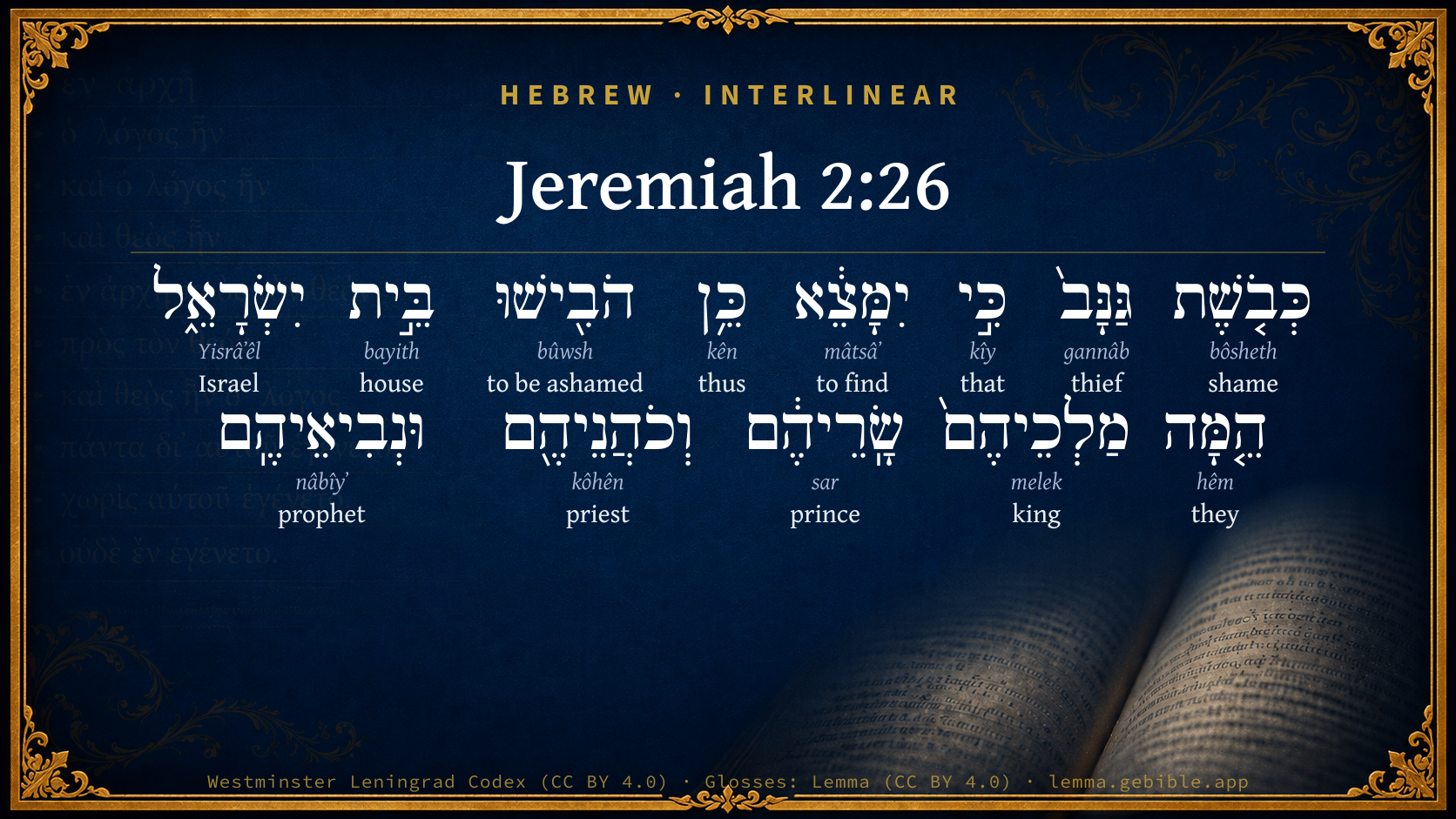
Hebrew (Westminster Leningrad Codex) Jeremiah 2:26 appears in the Hebrew Old Testament. The text above is from the Westminster Leningrad Codex. Each word links to its Strong’s number, a concise gloss, and parsing drawn from the Open Scriptures Hebrew Bible morphology. Click any word for its full Brown-Driver-Briggs (BDB) entry.
Download image
Cite this verse

Jeremiah 2:26 (World English Bible). Public Domain. Lemma interlinear Bible study tool, https://lemma.gebible.app/v/jeremiah/2/26.

Show BibTeX & RIS
BibTeX
RIS
English Translation
As the thief is ashamed when he is found, so is the house of Israel ashamed; they, their kings, their princes, and their priests, and their prophets;
World English Bible · Public Domain
Download a study sheet

One document with this verse’s original text, its word-by-word gloss line, the meaning frame, cross-references with their text, attributed commentary, and full source and license credits — printable, and it pastes into notes with its structure intact.

This verse Autodidact and up

Study sheet (.html) Plain text (.txt)

A passage Seminary Student

Up to 50 verses in one chapter. A passage sheet keeps up to 6 commentary sources and 12 cross-references per verse, in the order this page ranks them, and says so on the sheet whenever that leaves anything out. Ask for a single verse and you get the Autodidact verse sheet above.

Everything on this page stays free to read, with no account — the sheet is a download of what is already on screen, not access to it.

Want to remove ads? Support Godless Engineer
Compare translations 3

The same verse in 3 English versions, stacked beneath the original-language interlinear above. Click any original word for its lexicon entry.

Each is an independent rendering of the whole verse — the interlinear is not word-aligned to these translations.

Highlighted words mark where these versions differ — a whole-verse word diff, not a word-by-word alignment.

  • World English Bible Public Domain
    As the thief is ashamed when he is found, so is the house of Israel ashamed; they, their kings, their princes, and their priests, and their prophets;
  • King James Version Public Domain
    As the thief is ashamed when he is found, so is the house of Israel ashamed; they, their kings, their princes, and their priests, and their prophets.
  • unfoldingWord Literal Text CC BY-SA 4.0
    Like the shame of a thief when he is found, so the house of Israel has been put to shame— they, their kings, their princes, and their priests and prophets,

unfoldingWord Literal Text — © unfoldingWord, licensed CC BY-SA 4.0. Word-aligned USFM3 via Door43 (git.door43.org/unfoldingWord/en_ult).

Versions to compare (up to 4)

3 of 4 selected

Show all 18 translations

Every available English version of this verse, each an independent rendering of the whole verse.

  • World English Bible Public Domain
    As the thief is ashamed when he is found, so is the house of Israel ashamed; they, their kings, their princes, and their priests, and their prophets;
  • Berean Standard Bible Public Domain
    As the thief is ashamed when he is caught, so the house of Israel is disgraced. They, their kings, their officials, their priests, and their prophets
  • Majority Standard Bible Public Domain
    As the thief is ashamed when he is caught, so the house of Israel is disgraced. They, their kings, their officials, their priests, and their prophets
  • King James Version Public Domain
    As the thief is ashamed when he is found, so is the house of Israel ashamed; they, their kings, their princes, and their priests, and their prophets.
  • American Standard Version (1901) Public Domain
    As the thief is ashamed when he is found, so is the house of Israel ashamed; they, their kings, their princes, and their priests, and their prophets;
  • Revised Version (1885) Public Domain
    As the thief is ashamed when he is found, so is the house of Israel ashamed; they, their kings, their princes, and their priests, and their prophets;
  • Geneva Bible (1599) Public Domain
    As the theefe is ashamed, when he is foud, so is the house of Israel ashamed, they, their kings, their princes and their Priests, and their Prophets,
  • Douay-Rheims (1899) Public Domain
    As the thief is confounded when he is taken, so is the house of Israel confounded, they and their kings, their princes and their priests, and their prophets.
  • Young's Literal Translation Public Domain
    As the shame of a thief when he is found, So put to shame have been the house of Israel, They, their kings, their heads, And their priests, and their prophets,
  • Literal Standard Version CC BY-SA 4.0
    As the shame of a thief when he is found, || So has the house of Israel been put to shame, || They, their kings, their heads, || And their priests, and their prophets,
  • Unlocked Literal Bible CC BY-SA 4.0
    Like the shame of a thief when he is found, so the house of Israel will be ashamed— they, their kings, their princes, and their priests and prophets!
  • unfoldingWord Literal Text CC BY-SA 4.0
    Like the shame of a thief when he is found, so the house of Israel has been put to shame— they, their kings, their princes, and their priests and prophets,
  • Darby Bible Public Domain
    As a thief is ashamed when he is found, so shall the house of Israel be ashamed -- they, their kings, their princes, and their priests, and their prophets --
  • World Messianic Bible Public Domain
    As the thief is ashamed when he is found, so the house of Israel is ashamed— they, their kings, their princes, their priests, and their prophets,
  • Webster's Bible Public Domain
    As the thief is ashamed when he is found, so is the house of Israel ashamed: they, their kings, their princes, and their priests, and their prophets,
  • Free Bible Version CC BY-SA 4.0
    In the same way that a thief feels guilty when caught, so the people of Israel have been shamed. All of them—their kings, their officials, their priests, and their prophets.
  • Bible in Basic English Public Domain
    As the thief is shamed when he is taken, so is Israel shamed; they, their kings and their rulers, their priests and their prophets;
  • JPS Tanakh (1917) Public Domain
    As the thief is ashamed when he is found, so is the house of Israel ashamed; they, their kings, their princes, and their priests, and their prophets;

Literal Standard Version (2020), Covenant Press — licensed CC BY-SA 4.0. Text via the HelloAO Bible API (eBible.org). Unlocked Literal Bible (unfoldingWord) — licensed CC BY-SA 4.0. Text via the HelloAO Bible API (eBible.org). unfoldingWord Literal Text — © unfoldingWord, licensed CC BY-SA 4.0. Word-aligned USFM3 via Door43 (git.door43.org/unfoldingWord/en_ult). Free Bible Version, Dr. Jonathan Gallagher — licensed CC BY-SA 4.0. Text via the HelloAO Bible API (eBible.org).

Word by word

More ways to search: Search by grammar → Find every occurrence → Compare this word →

Practice this passage: Drill this verse → Learn its vocabulary →

גַּנָּב֙
gannâb
H1590
“thief”
Noun, Common, Masculine, Singular, Absolute
Part of Speech
Noun
Type
Common
Gender
Masculine
Number
Singular
State
Absolute
Full BDB Definition

Origin: from H1589

TWOT: 364b

thief
  1. כְּבֹ֤שֶׁת bôsheth H1322 “like/as · shame of” Preposition + Noun, Common, Feminine, Singular, Construct
  2. כִּ֣י kîy H3588 “that” Conjunction
  3. יִמָּצֵ֔א mâtsâʼ H4672 “to find” Verb, Niphal, Imperfect, 3rd Person, Masculine, Singular
  4. כֵּ֥ן kên H3651 “thus” Particle, Demonstrative
  5. הֹבִ֖ישׁוּ bûwsh H954 “to be ashamed” Verb, Hiphil, Perfect, 3rd Person, Common, Plural
  6. בֵּ֣ית bayith H1004 “house of” Noun, Common, Masculine, Singular, Construct
  7. יִשְׂרָאֵ֑ל Yisrâʼêl H3478 “Israel” Noun, Proper
  8. הֵ֤מָּה hêm H1992 “they” Pronoun, Personal, 3rd Person, Masculine, Plural
  9. מַלְכֵיהֶם֙ melek H4428 “kings · their” Noun, Common, Masculine, Plural, Construct + Suffix, Personal, 3rd Person, Masculine, Plural
  10. שָֽׂרֵיהֶ֔ם sar H8269 “princes · their” Noun, Common, Masculine, Plural, Construct + Suffix, Personal, 3rd Person, Masculine, Plural
  11. וְכֹהֲנֵיהֶ֖ם kôhên H3548 “and · priests · their” Conjunction + Noun, Common, Masculine, Plural, Construct + Suffix, Personal, 3rd Person, Masculine, Plural
  12. וּנְבִיאֵיהֶֽם nâbîyʼ H5030 “and · prophets · their” Conjunction + Noun, Common, Masculine, Plural, Construct + Suffix, Personal, 3rd Person, Masculine, Plural

About this verse

These counts appear in no published source. They are computed here, from the morphology-tagged text and Lemma’s own curated glosses. What Lemma adds →

13
words
13
distinct lemmas
Prophets
section

Notable vocabulary

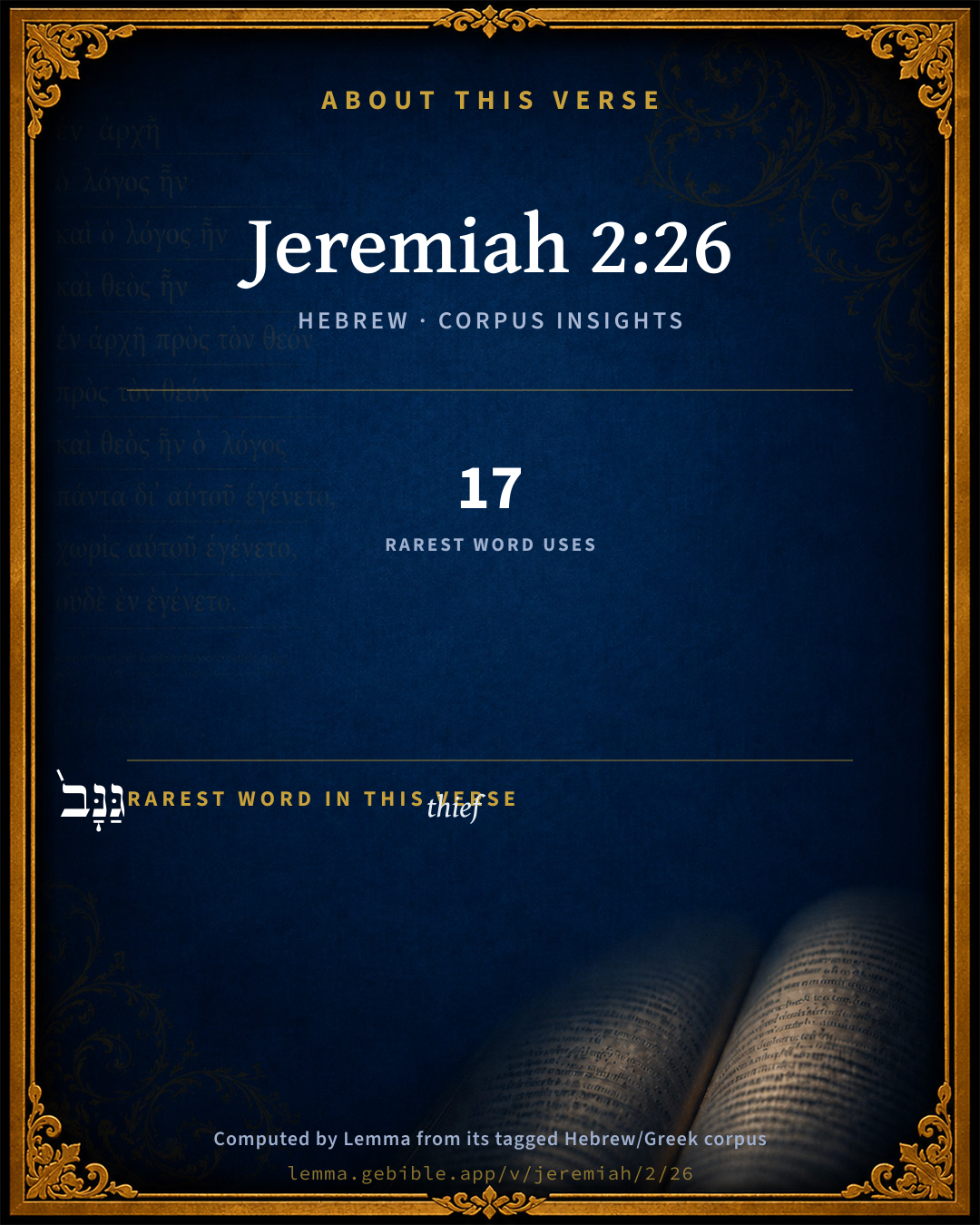
The rarest word here is גַּנָּב֙ thief H1590 — appearing just 17 times in the whole Hebrew Bible.

Shared distinctive vocabulary

גַּנָּב֙ thief H1590 occurs in 17 verses of the Hebrew Bible. Also found in:

Grammatical profile

  • 2 verbs
  • 8 nouns
  • 1 pronoun
  • 1 conjunction
  • 1 particle

Verb forms

  • יִמָּצֵ֔א Niphal · Imperfect
  • הֹבִ֖ישׁוּ Hiphil · Perfect

Cross-references

10

Topical passages linked to Jeremiah 2:26 in the Treasury of Scripture Knowledge — connected by theme and wording, ordered by reader-vote popularity; previews shown in the World English Bible.

  • Ezra 9:7 Since the days of our fathers we have been exceeding guilty to this day; and for our iniquities have we, our kings, and our priests, been delivered into the hand of the kings of the lands, to the sword, to captivity, and to plunder, and to confusion of face, as it is this day.
  • Nehemiah 9:32–34 Now therefore, our God, the great, the mighty, and the awesome God, who keep covenant and loving kindness, don't let all the travail seem little before you, that has come on us, on our kings, on our princes, and on our priests, and on our prophets, and on our fathers, and on all your people, since the time of the kings of Assyria to this day.
  • Jeremiah 32:32 because of all the evil of the children of Israel and of the children of Judah, which they have done to provoke me to anger, they, their kings, their princes, their priests, and their prophets, and the men of Judah, and the inhabitants of Jerusalem.
  • Proverbs 6:30–31 Men don't despise a thief, If he steals to satisfy himself when he is hungry:
  • Isaiah 1:29 For they shall be ashamed of the oaks which you have desired, And you shall be confounded for the gardens that you have chosen.
  • Jeremiah 2:36 Why go you about so much to change your way? you shall be ashamed of Egypt also, as you were ashamed of Assyria.
  • Jeremiah 3:24–25 But the shameful thing has devoured the labor of our fathers from our youth, their flocks and their herds, their sons and their daughters.
  • Jeremiah 48:27 For wasn't Israel a derision to you? was he found among thieves? for as often as you speak of him, you wag the head.
  • Daniel 9:6–8 neither have we listened to your servants the prophets, who spoke in your name to our kings, our princes, and our fathers, and to all the people of the land.
  • Romans 6:21 What fruit then did you have at that time in the things of which you are now ashamed? For the end of those things is death.

Cross-references courtesy of OpenBible.info (CC BY 4.0).

Hebrew and Greek witnesses Masoretic Hebrew ↔ Greek Septuagint

The same verse in the two great witnesses to the Old Testament, shown verse-for-verse.

These are two independent witnesses, not word-aligned to each other, and the Septuagint is shown in lemma (dictionary) form.

Hebrew Jeremiah 2:26 Masoretic · Westminster Leningrad Codex

כְּבֹ֤שֶׁת גַּנָּב֙ כִּ֣י יִמָּצֵ֔א כֵּ֥ן הֹבִ֖ישׁוּ בֵּ֣ית יִשְׂרָאֵ֑ל הֵ֤מָּה מַלְכֵיהֶם֙ שָֽׂרֵיהֶ֔ם וְכֹהֲנֵיהֶ֖ם וּנְבִיאֵיהֶֽם

As the thief is ashamed when he is found, so is the house of Israel ashamed; they, their kings, their princes, and their priests, and their prophets;

World English Bible · Public Domain

Greek LXX Structure differs

In the Septuagint, Jeremiah is about an eighth shorter than the Hebrew and arranges its material differently — the Oracles Against the Nations (Hebrew chapters 46–51) appear in the middle of the Greek book, after 25:13. Because the chapter and verse boundaries do not line up, a verse-for-verse comparison with the Hebrew is not shown.

A verse-for-verse comparison isn’t shown here because the chapters and verses don’t line up. Switch to the LXX edition with the MT / LXX toggle above to read the Greek directly.

Hebrew: Westminster Leningrad Codex (CC BY 4.0). Greek: Septuagint (public domain); English from a public-domain English Septuagint. How the Septuagint differs from the Hebrew →

Targum (Aramaic paraphrase)

1

The Targum is the ancient Jewish Aramaic paraphrase of the Hebrew Scriptures — an interpretive translation, not the Hebrew text itself. Onkelos (literal) and Pseudo-Jonathan (expansive) render the Torah, and Jonathan the Prophets. Coverage is partial: where no permissively-licensed English translation exists for a verse, only the Aramaic is shown. This is verse-level text, not a word-by-word alignment to the Hebrew.

  1. Targum Jonathan Prophets (Joshua–Malachi)
    כְּבַהֲתַת גְבַר דְמִתְחַשֵׁיב מְהֵימָן וּמִשְׁתְּכַח גְנִיב כֵּן בְּהִיתוּ בֵּית יִשְׂרָאֵל אִינוּן מַלְכֵּיהוֹן רַבְרְבֵהוּן וְכַהֲנֵיהוֹן וּנְבִיֵהוֹן דְשִׁקְרָא:

    (no public-domain English translation for this verse)

    Targum Jonathan — Aramaic: “Mikraot Gedolot” (public domain). English: “Sefaria Community Translation” (CC0 1.0 (public-domain dedication)); “London "Chaldee Paraphrase," 1871” (public domain). Text via Sefaria.

Commentary

Notes on Jeremiah 2:26 from classic Christian and Jewish commentators (each source and its license shown beneath its notes). The classic Christian expositions comment on the surrounding passage and are grouped to its opening verse, so a note may address several verses; the Jewish commentaries on the Tanakh (Rashi and others) are per-verse, so they appear only where the commentator wrote on this verse.

Lemma curates 59 commentaries, every one of them public domain or Creative Commons licensed, each selected and text-cleaned for this edition rather than reprinted as found. About our sources →

Trapp's Complete Commentary

John Trapp

Jer 2:26 As the thief is ashamed when he is found, so is the house of Israel ashamed; they, their kings, their princes, and their priests, and their prophets,

Ver. 26. As the thief is ashamed when he is found.] As usually he is at length, notwithstanding all his sleights and wiles. That was a cunning thief indeed of whom Dio writeth in the life of Severus. Bulas he calleth him, an Italian, who having gotten together six hundred such as himself, robbed many in Italy under the emperor’s nose for two years together; and although he was diligently sought for by the emperor and his armies, yet he could not be caught. Visis enim non videbatur, non inveniebatur inventus, deprehensus non capiebatur, saith the historian; he was too hard for them all.

So is the house of Israel ashamed.] They are, or ought to be so; but

“ Nihil est audacius illis

Deprensis: vires animosque a crimine sumunt. ”

John Trapp, A Commentary or Exposition upon All the Books of the Old and New Testament (1647–1656) — public domain. Text from a community e-Sword module.

Joseph Benson's Commentary

Jer 2:26-28. As the thief is ashamed — As the thief has nothing to say for himself, but is perfectly confounded when he is taken in the very act, so the house of Israel hath no manner of plea wherewith to defend or excuse their idolatry. They, their kings, their princes — Whose duty it was to have restrained them from such practices by their authority; their priests, and their prophets — Who ought to have set them a better example, and have given them better instruction. Saying to a stock, Thou art my father — Giving the title of father, which belongs to God, as the sovereign Creator and Preserver of all things, (see Jer 3:19,) to senseless images, made of wood and stone. They did not, indeed, think themselves to be created or made by these images, but thus they addressed the gods whom they thought to be present in the consecrated images. But as there was in fact no such deity residing in the image, but it was a mere nothing, a fiction of the idolaters, their worship in reality centred in, or went no higher than, the image itself. For they have turned their back unto me — A token of contempt and aversion; and not their face — Which they turn wholly toward their idols. But in the time of their trouble — A time which is approaching; they will say, Arise, and save us — As they did formerly; see the margin. When they prove, by experience, the vanity of their idols, and their own folly in relying on things that cannot help or save them, and in rejecting me, then they will apply to me for relief and aid. But where are thy gods? — Thy idols, the gods of thy own making? Let them arise — From the places where they are fixed; if they can save thee in the time of thy trouble — In thy great distress, when thou art in such need of help. For according to the number of thy cities are thy gods — For thou hast a sufficient number of them, every country and city having its peculiar deity, imitating the heathen, who, according to Varro, had above thirty thousand gods. Make trial, if any, or all of them together, can help thee.

Joseph Benson's Commentary on the Old and New Testaments (1811–1818) — public domain. Text from a community e-Sword module.

Keil & Delitzsch

C. F. Keil & F. Delitzsch

And yet idolatry brings to the people only disgrace, giving no help in the time of need. Jer 2:26. "As a thief is shamed when he is taken, so is the house of Israel put to shame; they, their kings, their princes, their priests, and their prophets. Jer 2:27. Because they say to the wood, Thou art my father; and to the stone, Thou hast borne me: for they have turned to me the back and not the face; but in the time of their trouble they say, Arise, and help us. Jer 2:28. Where then are thy gods that thou hast made thee? let them arise, if they can help thee in the time of thy trouble; for as many as are thy cities, so many are thy gods, Judah." The thought in Jer 2:26 and Jer 2:27 is this, Israel reaps from its idolatry but shame, as the thief from stealing when he is caught in the act. The comparison in Jer 2:26 contains a universal truth of force at all times. The perf. הובישׁוּ is the timeless expression of certainty (Hitz.), and refers to the past as well as to the future. Just as already in past time, so also in the future, idolatry brings but shame and confusion by the frustration of the hopes placed in the false gods. The "house of Israel" is all Israel collectively, and not merely the kingdom of the ten tribes. To give the greater emphasis to the reproaches, the leading ranks are mentioned one by one. אמרים, not: who say, but because (since) they say to the wood, etc., i.e., because they hold images of wood and stone for the gods to whom they owe life and being; whereas Jahveh alone is their Creator or Father and Genitor, Deu 32:6, Deu 32:18; Isa 64:7; Mal 2:10. אבן is fem., and thus is put for mother. The Keri ילדתּנוּ is suggested solely by the preceding אמרים, while the Chet. is correct, and is to be read ילדתּני, inasmuch as each one severally speaks thus. - With "for they have turned" follows the reason of the statement that Israel will reap only shame from its idolatry. To the living God who has power to help them they turn their back; but when distress comes upon them they cry to Him for help (קוּמה והושׁיענוּ as in Psa 3:8). But then God will send the people to their gods (idols); then will it discover they will not help, for all so great as their number is. The last clause of Jer 2:28 runs literally: the number of thy cities are thy gods become, i.e., so great is the number of thy gods; cf. Jer 11:13. Judah is here directly addressed, so that the people of Judah may not take for granted that what has been said is of force for the ten tribes only. On the contrary, Judah will experience the same as Israel of the ten tribes did when disaster broke over it.

Keil & Delitzsch — Biblical Commentary on the Old Testament (1861–1891) — public domain (CC PDM 1.0). Text via the HelloAO Bible API. (Old Testament only.)

Tyndale Open Study Notes

Tyndale Open Resources

2:26 Israel’s leaders felt no shame for the evil they did; any contrition they expressed in the face of God’s punishment stemmed from selfishness, not repentance (Ps 78:34-37).

Tyndale Open Study Notes — © Tyndale Open Resources, licensed CC BY-SA 4.0. Text via the HelloAO Bible API.

Geneva Bible (1599)

Geneva Bible translators

As a thief will not acknowledge his fault, till he be taken with the deed, and ready to be punished, so they will not confess their idolatry, till the plagues due to the same light upon them.

Geneva Bible (1599) marginal notes — public domain. Text via Bolls.life.

Jamieson, Fausset & Brown

Robert Jamieson, A. R. Fausset & David Brown

is ashamed--is put to shame.

thief-- (Joh 10:1).

Israel--that is, Judah (Jer 2:28).

Jamieson, Fausset & Brown — Commentary Critical and Explanatory on the Whole Bible (1871) — public domain (CC PDM 1.0). Text via the HelloAO Bible API.

Adam Clarke's Commentary

Verse 26. As the thief is ashamed] As the pilferer is confounded when he is caught in the fact; so shalt thou, thy kings, princes, priests, and prophets, be confounded, when God shall arrest thee in thy idolatries, and deliver thee into the hands of thine enemies.

Adam Clarke's Commentary on the Bible (1810–1826) — public domain. Text from a community e-Sword/MySword module.

John Calvin's Commentaries

Some render the words in the future tense, “So ashamed shall be the house of Israel,” etc.; and they think that the Prophet is speaking here of the punishment which was impending over the people: but I explain the words as they are, — that the impiety of the people was so gross, that there was no need formally to prove it, as it was so very palpable. Hence the Prophet compares the Jews to open thieves, as though he had said, that hypocrites among that people gained nothing by their evasions and subterfuges, for their impiety was quite public: they were like a thief when caught, who cannot deny nor hide his crime. Hence he says that they were caught, as they say, in the very act; that is, their flagitious deeds were so conspicuous, that whatever objections they might raise, they could not clear themselves, but their baseness was known to all. We now then perceive what the Prophet means. We have before seen that the people had recourse to many excuses, but Jeremiah shews here, that they attained nothing by their evasions, except that they more fully discovered their own effrontery, for their dishonesty was evident to all; it was so manifest that they could not cover it by any cloaks and pretences.

Nor does he speak only of the common people; but he condemns kings, princes, priests, and prophets, as though he had said, that they were become so corrupt from the least to the greatest, that having cast off all shame, they openly shewed a manifest and gross contempt for God by following their own inventions and superstitions. And yet the Jews no doubt attempted by many excuses to defend themselves; but God here shakes off all those fallacious pretexts, by which they thought to cover their flagitious deeds, and says that they were notwithstanding manifestly thieves.

The Prophet had said before, that the Jews made a different declaration; and now he condemns their effrontery: but there is no inconsistency as to the meaning. The Jews denied that they were apostates and guilty of perfidy, or that they had forsaken the worship of God; they denied this in words; but the Prophet, in now proclaiming their shamelessness, does not refer to words; for they had ready at hand their false pretensions, as it has been already stated: but the Prophet now takes the fact itself as granted, and says that they wickedly and perversely resisted God, so that their wickedness and obstinacy were past all remedy. It now follows —

John Calvin's Commentaries (1540-1563) — public domain. Text from the Calvin Translation Society English edition (1840s-50s) via the Christian Classics Ethereal Library (ccel.org). Calvin's coverage is partial (roughly two-thirds of the Bible); uncommented books and verses are honest gaps, never fabricated. The 19th-century editor's footnotes and remarks are omitted so the notes are faithfully Calvin's own voice.

Ellicott's Commentary for English Readers

(26) As the thief . . .—The words point to the sense of shame as already felt, and as therefore bringing with it the possibility of repentance. Once they gloried in their false worship; now they feel as if detected in a crime. Conscience had once again been roused into activity.

A Bible Commentary for English Readers, edited by Charles John Ellicott (1878–1897) — public domain. Text from a community e-Sword module.

The Cambridge Bible for Schools and Colleges

gen. ed. J. J. S. Perowne

26. Israel, though insensible now to their disgrace, will realise it presently and all classes will be filled with confusion (as a detected thief) when the penalty arrives. Cp. Isa_1:29 ff.

ashamed] disconcerted by the failure of plans, a frequent sense of the word: cp. Jer_2:36, Jer_17:18, Jer_48:13; Job_6:20; Joe_1:11.

The Cambridge Bible for Schools and Colleges (gen. ed. J. J. S. Perowne; Cambridge University Press, 1878–1918) — public domain. Text from a community e-Sword module.

John Gill's Exposition

Saying to a stock,.... "To a tree" (f); to a piece of wood; that is, to an image made of it; so the Targum,

"they say to an image of wood;''

what follows:

thou art my father; ascribing that to the idol which belongs to God, who was their Father that made them, and upheld them, was the author of their beings, and the God of their mercies:

and to a stone; an image of stone:

thou hast brought me forth: into being; affirming it to be his former and maker; so the Targum,

"to that which is made of stone, thou hast created me:''

for they have turned their back unto me, and not their face; they turned their faces to images of wood and stone, and worshipped them; and they turned their backs upon the Lord, his worship and ordinances, and apostatized from him; which the Targum thus expresses,

"for they turned their backs on my worship, and did not put my fear before their faces:''

but in the time of their trouble; when any calamity befalls them, as famine, pestilence, sword, captivity, and the like:

they will say, arise, and save us; not that they will say so to their idols, but they will say so to the true God; for notwithstanding they worshipped idols in time of prosperity, forgetting God their Saviour; yet in adversity they are brought to their senses, and find that none but God can save them, and therefore apply to him; to which agrees the Targum,

"and in the time that evil comes upon them, they deny their idols, and confess before me, and say, have mercy on us, and save us.''

(f) "ligno", V. L. Pagnanius, Montanus, Schmidt.

John Gill's Exposition of the Whole Bible (1746–1763) — public domain (CC PDM 1.0). Text via the HelloAO Bible API.

Haydock's Catholic Bible Commentary

Taken. Juda affected still to be very pious, ver. 23.

George Leo Haydock (1774–1849), Haydock's Catholic Family Bible and Commentary, 1859 edition — public domain. Excludes Psalms (Douay-Rheims chapter numbering differs from Protestant) and Deuterocanonical books (Catholic canon only).

Matthew Poole's English Annotations

Ashamed when he is found; not ashamed of his sin of theft, but that he is found, that his shifts and blinds would serve him no longer, especially if he have had the reputation of an honest man.

The house of Israel; or families, the twelve tribes; a metonymy of the subject.

Ashamed; or, confounded, in the passive voice; viz. when they shall be taken by Nebuchadnezzar, then their idols, which they went a whoring after, shall be discovered, and so put them to shame: in the active voice, their inability to help them, Jer 2:28; Isa 1:29; Hos 4:19; and their shame will be the more, because they had the repute of being my people.

Their kings, their princes, and their priests, and their prophets; rulers and teachers, such as should have given better examples, and better instruction.

Matthew Poole's English Annotations on the Holy Bible (1683–1685) — public domain. Text from a community e-Sword/MySword module.

The Pulpit Commentary

Is... ashamed. It is the per-feet of prophetic certitude.

A shame to be ashamed of.

There is, as Paul tells us, (2Co 7) a godly sorrow and a sorrow of the world; a godly sorrow working out a repentance never to be regretted, and a sorrow of the world which works out death. So there is a shame and humiliation which is profitable in the right way and to the highest degree, when a man comes into all the horrors of self-discovery, and is ready to declare himself, feeling it no exaggeration, as the chief of sinners. Such a shame is indeed the highest of blessings, since it gives something like a complete understanding of what human nature owes to the cleansing blood of Christ, and to the renewing power of the Spirit. But there is also shame and humiliation such as the jailer at Philippi felt when he suspected his prisoners were gone, and degradation was impending over him at the hand of his masters. It is to such a shame that our attention is directed here. The shame of a thief, not for the wrong he has done, but because he is detected in the doing of it. Israel, we see, is being dealt with in very plain language. Already the nation which God had so favored, and from which he had expected so much, has been spoken of as lower than an idolater. And now it is likened to the thief in the moment when his knavery is discovered. Consider, then, as here suggested

I WHY THE SINNER SHOULD BE ASHAMED. The thief, of course, ought to be ashamed, and ashamed whether he is caught or not. He ought to come into such a state of mind as to acknowledge his offence and make restitution, even when otherwise his offence might remain undiscovered. He should be ashamed because he has done wrong; because he has broken a commandment of God; because he lives on what has been won by the industry and toil of his neighbors; because, in addition, he is robbing his neighbors of what benefit should have come to them from his own industry and toil. Some have enough to make them bow their heads in despair of ever being able to make restitution; and it is just when we thus begin to estimate the sense of shame that should fill the thoughts of the thief that we also come to have a clear idea of what a universal feeling amongst mankind shame should be. "The thief should be thoroughly ashamed of himself, you say, in all possible ways. True, he ought. But now take to mind the home-pressing words of the apostle, "Wherein thou judgest another, thou condemnest thyself; for thou that judgest doest the same things". (Rom_2:1) Nay, there may be more to be said for the thief than for thee. Only too often he has a bad start, and no real chance of getting out of bad associations. He may get so hemmed in with temptations as to find it very difficult to resist. And in any case, the thief has no more cause to Be ashamed of his theft than any other sinner for his own particular mode of self-indulgence. God does not draw the distinctions which we are compelled to do, between wrongs that are crimes and wrongs that are not crimes. His distinctions are made on altogether different principles principles which abide. If the thief has wronged his neighbor in one way, be sure of this, that you have wronged him in another. If the thief has sinned against God in one way, you have sinned against him in another. You may go through the world without the slightest fear of anything leaping to the light such as will bring the detective"s tap upon your shoulder, and nevertheless you have yet to be bowed in unspeakable bitterness of shame because you have been defrauding God and missing the great end of life. What is wanted is that all of us should come to ourselves being guided by that unerring Spirit which guides into all truth, and self being revealed by the light of the cross and of eternity.

II WHY THE SINNER ACTUALLY IS ASHAMED. Discovery is what he dreads; discovery puts him in utter confusion. Discovery is disgrace and ruin, so far as his future relation to men is concerned. Henceforth he passes into a suspected and avoided class; he has test the mark of respectability and confidence. The sad thing is that, in the eyes of a large part of mankind, discovery seems to make all the difference. One may do a great deal of wrong with social impunity, if only there is cleverness enough to keep on the hither boundary of what is reckoned criminal. Those who are most serenely indifferent to the Law of God will fall into all sorts of sins, real and far-reaching evils, rather than transgress a certain social code. It is not so long ago since the duel ceased to be a part of the social code of England; and what a curious standard of honor was involved in such a practice! There are countries still where a man is disgraced if he refuses to fight; if he fights and kills his man it is reckoned no shame at all. The most immoral and debauched of men are yet curiously sensitive to what they choose to consider points of honor. People will plunge over head and ears into debt, and run into the wildest extravagance, that they may flourish a little longer in the social splendor which they know they have not the honest means to maintain. They feel it is a greater disgrace to sink in the world than to he unable to pay their debts. How needful it is for the Christian to take up all positions which he feels to be right right according to the Divine will, no matter how much he may be exposed to the reproach of folly, Quixotism, and fanaticism I Let us pray that we may ever have a godly shame when the light of heaven is thrown on us, and we are contrasted with God in his holiness and Jesus in his perfect manhood. Let us equally pray that we may never Be ashamed of Jesus. It is a harder thing than many seem to think, even though they are constantly acknowledging in hymn and prayer what they owe to Jesus in the way of gratitude and service. Y.

The Pulpit Commentary (1880–1919), ed. H.D.M. Spence-Jones & Joseph S. Exell — public domain. Text from a community e-Sword module.

John Wesley's Explanatory Notes

Found - Not ashamed of his sin of theft, but that he is at last found.

John Wesley, Explanatory Notes Upon the Whole Bible (1754–1765) — public domain. Text via the GEBible commentary corpus.

unfoldingWord translationNotes

Door43 World Missions Community

the house of Israel

The word "house" is a metonym for the family that lives in the house. In this case it refers to Israel's descendants. See how you translated this in Jeremiah 2:4. AT: "the Israelites" or "the Israelite people group" (See: Metonymy)

when he is found

This idiom means that someone discovers that the person's actions. This can be stated in active form. AT: "when someone finds him" or "when people know that he has stolen things" (See: Idiom and Active or Passive)

they, their kings, their princes, and their priests and prophets

This list shows that everyone belonging to Israel will be ashamed.

These are the ones who say to the tree, 'You are my father,' and to the stone, 'You gave birth to me.'

Here "tree" and "stone" represent idols carved from wood and stone. These words emphasize that the idol was made of ordinary things and is not worthy of worship. AT: "These people are the ones who say to a carved piece of wood, 'You are my father,' and to a carved stone, 'You gave birth to me.'" (See: Metonymy)

their back faces me and not their faces

"their backs are toward me; their faces are not toward me." This represents them rejecting God. AT: "they have turned away from me" or "they have turned their backs toward me and not their faces" or "they have completely rejected me" (See: Metaphor)

Arise and save us

It can be made clear that they say this to Yahweh. "Yahweh, come and save us" (See: Assumed Knowledge and Implicit Information)

Yet where are the gods that you made for yourselves?

With this question God implies that people should ask the gods they worship to help them. He uses this irony to show that he is angry that they worship other gods. AT: "You should ask the gods you made to help you." or "You do not ask the gods you made to help you." (See: Rhetorical Question and Irony)

Let them arise if they wish to save you in your time of troubles

God implies that false gods should help the people who worship them. He knows that false gods cannot help people. When he said this he was using irony to show that he was angry that his people worshiped false gods. AT: "You do not ask them because know you that they cannot save you in your time of troubles" (See: Irony)

translationWords

shame

thief

house

king

prince

priest

prophet

ancestor

stone

face

trouble

raise

save

false god

kingdom of Judah

unfoldingWord translationNotes — © Distant Shores Media and the Door43 World Missions Community, licensed CC BY-SA 4.0. Source: git.door43.org/Door43/en_tn.

Rashi

Rabbi Shlomo Yitzchaki (Rashi)

when he is found out At the beginning, when he is found to be a thief, and he was presumed to be faithful. In this manner, Jonathan rendered it.

Rashi on the Tanakh — English translations: “The Judaica Press complete Tanach with Rashi, translated by A. J. Rosenberg” (CC BY 4.0); “Pentateuch with Rashi's commentary by M. Rosenbaum and A.M. Silbermann, 1929-1934” (public domain); “The Metsudah Tanach series, Lakewood, N.J” (CC BY 4.0); and “The Book of Joshua, Metsudah Publications, 1997” (CC BY 4.0). Text via Sefaria.

Lesson kit

Teaching starters — assembled from the data on this page, not authored interpretation. Every prompt links to the verse data it draws on. Edit before teaching.

Jeremiah, in the Prophets, opens this verse with 13 words (13 distinct Hebrew lemmas). Its most distinctive word is gannâb (“thief”). A historical commentator’s framing appears above. Read the whole chapter for the surrounding context.

Discussion questions

  1. The word gannâb carries the sense “thief.” How does it shape the verse?
  2. How does Exodus 22:2, which shares the word «thief», read alongside this verse?
  3. The translations on this page render this verse differently — a whole-verse word diff, not a word-by-word alignment. What might account for the different wordings?
  4. «יִמָּצֵ֔א» is a Niphal Imperfect verb. How does that grammatical form shape the action described?
  5. Compare how Trapp's Complete Commentary and Joseph Benson's Commentary read this verse. Where do they agree or differ?

Things to notice

Reading settings

Reading text

Shown beneath each verse's original-language words.

Old Testament
Old Testament edition

Read the OT as the Masoretic Hebrew (MT) or the Greek Septuagint (LXX).

English shown for the Greek Septuagint (in the Hebrew ↔ Greek comparison).

Comparing translations? Open the Compare panel on any verse page to stack up to four side by side.