Ezra 10:5

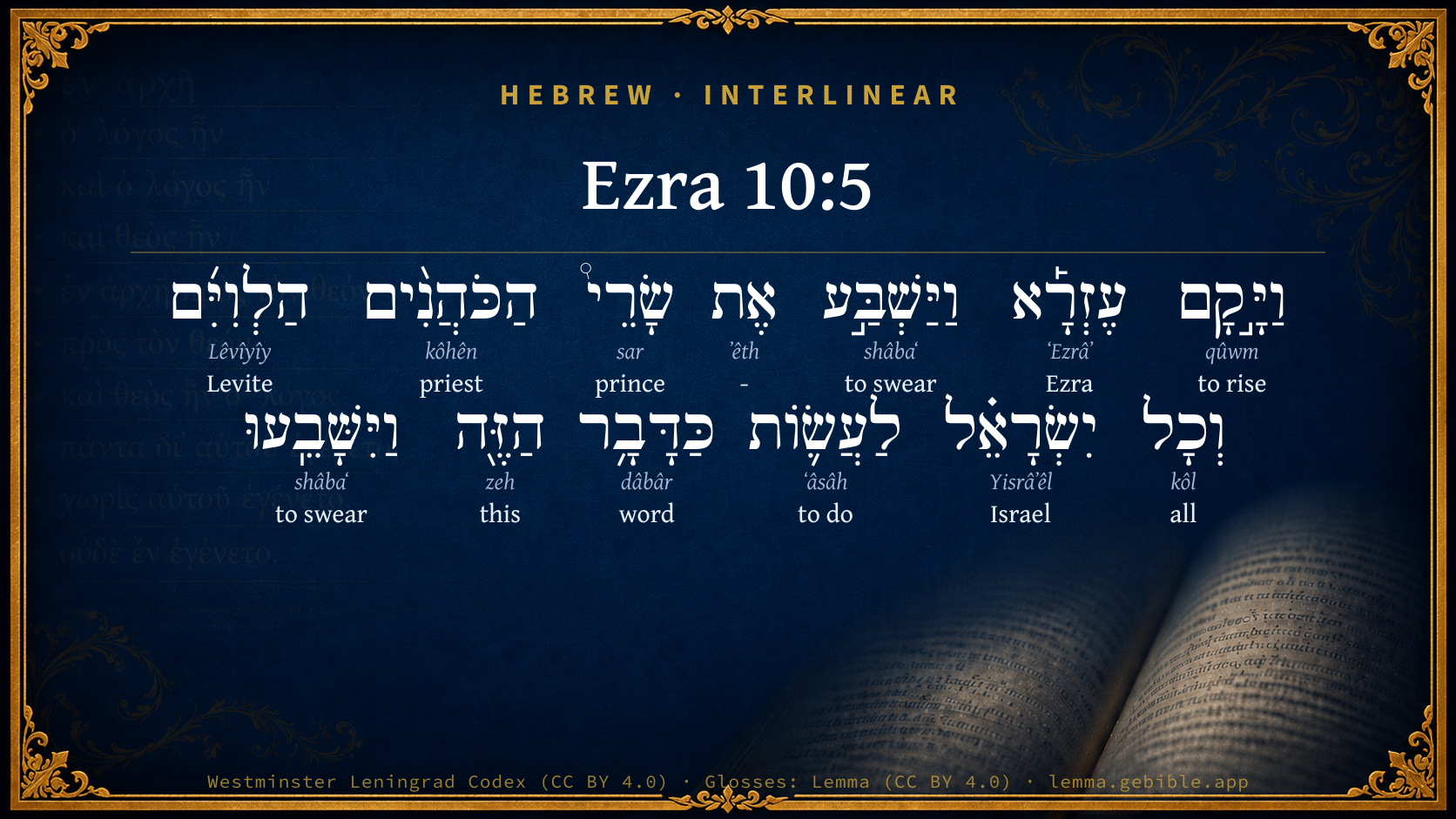
Hebrew (Westminster Leningrad Codex) Ezra 10:5 appears in the Hebrew Old Testament. The text above is from the Westminster Leningrad Codex. Each word links to its Strong’s number, a concise gloss, and parsing drawn from the Open Scriptures Hebrew Bible morphology. Click any word for its full Brown-Driver-Briggs (BDB) entry.
Download image
Cite this verse

Ezra 10:5 (World English Bible). Public Domain. Lemma interlinear Bible study tool, https://lemma.gebible.app/v/ezra/10/5.

Show BibTeX & RIS
BibTeX
RIS
English Translation
Then arose Ezra, and made the chiefs of the priests, the Levites, and all Israel, to swear that they would do according to this word. So they swore.
World English Bible · Public Domain
Download a study sheet

One document with this verse’s original text, its word-by-word gloss line, the meaning frame, cross-references with their text, attributed commentary, and full source and license credits — printable, and it pastes into notes with its structure intact.

This verse Autodidact and up

Study sheet (.html) Plain text (.txt)

A passage Seminary Student

Up to 50 verses in one chapter. A passage sheet keeps up to 6 commentary sources and 12 cross-references per verse, in the order this page ranks them, and says so on the sheet whenever that leaves anything out. Ask for a single verse and you get the Autodidact verse sheet above.

Everything on this page stays free to read, with no account — the sheet is a download of what is already on screen, not access to it.

Want to remove ads? Support Godless Engineer
Compare translations 3

The same verse in 3 English versions, stacked beneath the original-language interlinear above. Click any original word for its lexicon entry.

Each is an independent rendering of the whole verse — the interlinear is not word-aligned to these translations.

Highlighted words mark where these versions differ — a whole-verse word diff, not a word-by-word alignment.

  • World English Bible Public Domain
    Then arose Ezra, and made the chiefs of the priests, the Levites, and all Israel, to swear that they would do according to this word. So they swore.
  • King James Version Public Domain
    Then arose Ezra, and made the chief priests, the Levites, and all Israel, to swear that they should do according to this word. And they sware.
  • unfoldingWord Literal Text CC BY-SA 4.0
    And Ezra arose and caused the leaders of the priests, the Levites, and all Israel to swear an oath to do according to this word. So they swore an oath.

unfoldingWord Literal Text — © unfoldingWord, licensed CC BY-SA 4.0. Word-aligned USFM3 via Door43 (git.door43.org/unfoldingWord/en_ult).

Versions to compare (up to 4)

3 of 4 selected

Show all 18 translations

Every available English version of this verse, each an independent rendering of the whole verse.

  • World English Bible Public Domain
    Then arose Ezra, and made the chiefs of the priests, the Levites, and all Israel, to swear that they would do according to this word. So they swore.
  • Berean Standard Bible Public Domain
    So Ezra got up and made the leading priests, Levites, and all Israel take an oath to do what had been said. And they took the oath.
  • Majority Standard Bible Public Domain
    So Ezra got up and made the leading priests, Levites, and all Israel take an oath to do what had been said. And they took the oath.
  • King James Version Public Domain
    Then arose Ezra, and made the chief priests, the Levites, and all Israel, to swear that they should do according to this word. And they sware.
  • American Standard Version (1901) Public Domain
    Then arose Ezra, and made the chiefs of the priests, the Levites, and all Israel, to swear that they would do according to this word. So they sware.
  • Revised Version (1885) Public Domain
    Then arose Ezra, and made the chiefs of the priests, the Levites, and all Israel, to swear that they would do according to this word. So they sware.
  • Geneva Bible (1599) Public Domain
    Then arose Ezra, and caused the chiefe Priestes, the Leuites, and all Israel, to sweare that they would doe according to this worde. So they sware.
  • Douay-Rheims (1899) Public Domain
    So Esdras arose, and made the chiefs of the priests and of the Levites, and all Israel, to swear that they would do according to this word, and they swore.
  • Young's Literal Translation Public Domain
    And Ezra riseth, and causeth the heads of the priests, the Levites, and all Israel, to swear to do according to this word -- and they swear.
  • Literal Standard Version CC BY-SA 4.0
    And Ezra rises, and causes the heads of the priests, the Levites, and all Israel, to swear to do according to this word—and they swear.
  • Unlocked Literal Bible CC BY-SA 4.0
    So Ezra rose and made the priestly officials, the Levites, and all of Israel promise to act in this way. So they all took a solemn oath.
  • unfoldingWord Literal Text CC BY-SA 4.0
    And Ezra arose and caused the leaders of the priests, the Levites, and all Israel to swear an oath to do according to this word. So they swore an oath.
  • Darby Bible Public Domain
    Then Ezra arose, and made the chiefs of the priests, of the Levites, and of all Israel, to swear that they would do according to this word. And they swore.
  • World Messianic Bible Public Domain
    Then Ezra arose, and made the chiefs of the priests, the Levites, and all Israel to swear that they would do according to this word. So they swore.
  • Webster's Bible Public Domain
    Then arose Ezra, and made the chief priests, the Levites, and all Israel, to swear that they would do according to this word. And they swore.
  • Free Bible Version CC BY-SA 4.0
    So Ezra stood up and made the leading priests, Levites, and all the Israelites present take an oath to act on what had just been said. They all took the oath.
  • Bible in Basic English Public Domain
    Then Ezra got up, and made the chiefs of the priests and the Levites and all Israel take an oath that they would do this. So they took an oath.
  • JPS Tanakh (1917) Public Domain
    Then arose Ezra, and made the chiefs of the priests, the Levites, and all Israel, to swear that they would do according to this word. So they swore.

Literal Standard Version (2020), Covenant Press — licensed CC BY-SA 4.0. Text via the HelloAO Bible API (eBible.org). Unlocked Literal Bible (unfoldingWord) — licensed CC BY-SA 4.0. Text via the HelloAO Bible API (eBible.org). unfoldingWord Literal Text — © unfoldingWord, licensed CC BY-SA 4.0. Word-aligned USFM3 via Door43 (git.door43.org/unfoldingWord/en_ult). Free Bible Version, Dr. Jonathan Gallagher — licensed CC BY-SA 4.0. Text via the HelloAO Bible API (eBible.org).

Word by word

More ways to search: Search by grammar → Find every occurrence → Compare this word →

Practice this passage: Drill this verse → Learn its vocabulary →

עֶזְרָ֡א
ʻEzrâʼ
H5830
“Ezra”
Noun, Proper
Part of Speech
Noun
Type
Proper
Full BDB Definition

Origin: a variation of H5833

TWOT: None

Ezra = "help" - the priest and scribe who led the reforms of the returned exiles in Jerusalem; co-worker with Nehemiah - a priest with Zerubbabel - another post-exilic Jew
  1. וַיָּ֣קָם qûwm H6965 “and · to rise” Conjunction + Verb, Qal, Sequential Imperfect, 3rd Person, Masculine, Singular
  2. וַיַּשְׁבַּ֣ע shâbaʻ H7650 “and · to swear” Conjunction + Verb, Hiphil, Sequential Imperfect, 3rd Person, Masculine, Singular
  3. אֶת ʼêth H853 “-” Particle, Direct Object
  4. שָׂרֵי֩ sar H8269 “princes of” Noun, Common, Masculine, Plural, Construct
  5. הַכֹּהֲנִ֨ים kôhên H3548 “the · priests” Particle, Definite Article + Noun, Common, Masculine, Plural, Absolute
  6. הַלְוִיִּ֜ם Lêvîyîy H3881 “the · Levites” Particle, Definite Article + Noun, Gentilic, Masculine, Plural, Absolute
  7. וְכָל kôl H3605 “and · all of” Conjunction + Noun, Common, Masculine, Singular, Construct
  8. יִשְׂרָאֵ֗ל Yisrâʼêl H3478 “Israel” Noun, Proper
  9. לַעֲשׂ֛וֹת ʻâsâh H6213 “to do” Preposition + Verb, Qal, Infinitive Construct
  10. כַּדָּבָ֥ר dâbâr H1697 “like/as the · word” Preposition, Determined + Noun, Common, Masculine, Singular, Absolute
  11. הַזֶּ֖ה zeh H2088 “the · this” Particle, Definite Article + Pronoun, Demonstrative, Masculine, Singular
  12. וַיִּשָּׁבֵֽעוּ shâbaʻ H7650 “and · to swear” Conjunction + Verb, Niphal, Sequential Imperfect, 3rd Person, Masculine, Plural

About this verse

These counts appear in no published source. They are computed here, from the morphology-tagged text and Lemma’s own curated glosses. What Lemma adds →

13
words
12
distinct lemmas
Historical
section

Notable vocabulary

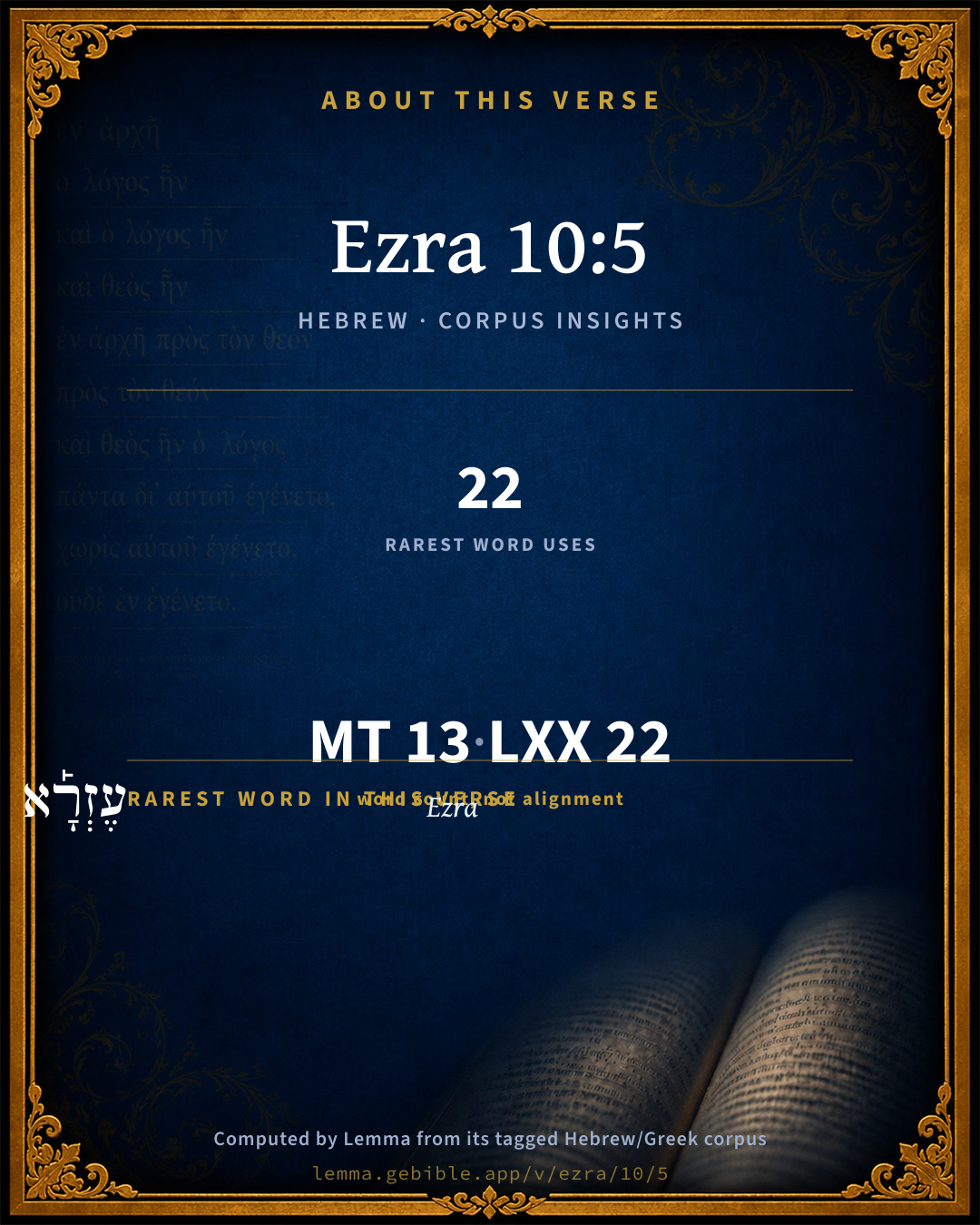
The rarest word here is עֶזְרָ֡א Ezra H5830 — appearing just 22 times in the whole Hebrew Bible.

Shared distinctive vocabulary

עֶזְרָ֡א Ezra H5830 occurs in 22 verses of the Hebrew Bible. Also found in:

Grammatical profile

  • 4 verbs
  • 7 nouns
  • 1 pronoun
  • 1 particle

Verb forms

  • וַיָּ֣קָם Qal · Sequential Imperfect
  • וַיַּשְׁבַּ֣ע Hiphil · Sequential Imperfect
  • לַעֲשׂ֛וֹת Qal · Infinitive Construct
  • וַיִּשָּׁבֵֽעוּ Niphal · Sequential Imperfect

Repetition

A word recurs within this verse — often emphatic in Hebrew:

  • וַיַּשְׁבַּ֣ע to swear H7650 ×2

Hebrew & Septuagint length

In English translation the verse runs 28 words from the Hebrew and 27 from the Septuagint (LXX English) — closely comparable.

A rough comparison of the two English renderings, which tokenize alike — not a word-level alignment.

Word counts can differ between the Hebrew and the Greek without any difference in meaning — e.g. the Hebrew direct-object marker אֵת has no separate Greek word, and Greek often adds the article ὁ.

In the original languages it is 13 Hebrew tokens and 22 Greek tokens — but the two are counted differently (Hebrew bundles its prefixes and suffixes into one token; the Greek is in lemma form), so that isn’t a like-for-like length.

Cross-references

10

Topical passages linked to Ezra 10:5 in the Treasury of Scripture Knowledge — connected by theme and wording, ordered by reader-vote popularity; previews shown in the World English Bible.

  • Nehemiah 13:25 I contended with them, and cursed them, and struck certain of them, and plucked off their hair, and made them swear by God, [saying], You shall not give your daughters to their sons, nor take their daughters for your sons, or for yourselves.
  • Nehemiah 5:12 Then said they, We will restore them, and will require nothing of them; so will we do, even as you say. Then I called the priests, and took an oath of them, that they would do according to this promise.
  • Ezra 10:3 Now therefore let us make a covenant with our God to put away all the wives, and such as are born of them, according to the counsel of my lord, and of those who tremble at the commandment of our God; and let it be done according to the law.
  • Nehemiah 10:29 They joined with their brothers, their nobles, and entered into a curse, and into an oath, to walk in God's law, which was given by Moses the servant of God, and to observe and do all the commandments of Yahweh our Lord, and his ordinances and his statutes;
  • Proverbs 1:5 That the wise man may hear, and increase in learning; That the man of understanding may attain to sound counsel:
  • Proverbs 9:9 Instruct a wise man, and he will be still wiser. Teach a righteous man, and he will increase in learning.
  • Proverbs 15:23 Joy comes to a man with the reply of his mouth. How good is a word at the right time!
  • Proverbs 25:11–12 A word fitly spoken Is like apples of gold in settings of silver.
  • Proverbs 27:9 Perfume and incense bring joy to the heart; So does earnest counsel from a man's friend.
  • Matthew 26:63 But Jesus held his peace. The high priest answered him, "I adjure you by the living God, that you tell us whether you are the Christ, the Son of God."

Cross-references courtesy of OpenBible.info (CC BY 4.0).

Hebrew and Greek witnesses Masoretic Hebrew ↔ Greek Septuagint

The same verse in the two great witnesses to the Old Testament, shown verse-for-verse.

These are two independent witnesses, not word-aligned to each other, and the Septuagint is shown in lemma (dictionary) form.

Hebrew Ezra 10:5 Masoretic · Westminster Leningrad Codex

וַיָּ֣קָם עֶזְרָ֡א וַיַּשְׁבַּ֣ע אֶת שָׂרֵי֩ הַכֹּהֲנִ֨ים הַלְוִיִּ֜ם וְכָל יִשְׂרָאֵ֗ל לַעֲשׂ֛וֹת כַּדָּבָ֥ר הַזֶּ֖ה וַיִּשָּׁבֵֽעוּ

Then arose Ezra, and made the chiefs of the priests, the Levites, and all Israel, to swear that they would do according to this word. So they swore.

World English Bible · Public Domain

Greek LXX Ezra 10:5 Septuagint · lemma form

καί ἀναἵστημι εσδρας καί ὁρκίζω ὁ ἄρχω ὁ ἱερεύς καί λευείτης καί πᾶς ἰσραήλ ὁ ποιέω κατά ὁ ῥῆμα οὗτος καί ὄμνυμι

Then Esdras arose, and caused the rulers, the priests, and Levites, and all Israel, to swear that they would do according to this word: and they swore.

LXX2012 (modern English Septuagint) · Public Domain

In the Septuagint this is one book — Esdras B (2 Esdras): Ezra is chapters 1–10, Nehemiah 11–23.

On this verse, The Cambridge Bible for Schools and Colleges discusses the Septuagint’s reading. Read the note in Commentary ↓

Hebrew: Westminster Leningrad Codex (CC BY 4.0). Greek: Septuagint (public domain); English from LXX2012 (modern English Septuagint) (Public Domain). How the Septuagint differs from the Hebrew →

Commentary

Notes on Ezra 10:5 from classic Christian and Jewish commentators (each source and its license shown beneath its notes). The classic Christian expositions comment on the surrounding passage and are grouped to its opening verse, so a note may address several verses; the Jewish commentaries on the Tanakh (Rashi and others) are per-verse, so they appear only where the commentator wrote on this verse.

Lemma curates 59 commentaries, every one of them public domain or Creative Commons licensed, each selected and text-cleaned for this edition rather than reprinted as found. About our sources →

Trapp's Complete Commentary

John Trapp

Ezr 10:5 Then arose Ezra, and made the chief priests, the Levites, and all Israel, to swear that they should do according to this word. And they sware.

Ver. 5. Then arose Ezra] According to the counsel of Shechaniah, Ezr 10:4. "How forcible are right words!" Job 6:25. One seasonable speech, falling upon a prepared heart, hath oft a strong and sweet operation; as that similitude used by Peter Martyr, reading upon the First to the Corinthians, had upon Galeacius Caracciolus, that noble Italian convert; and as some speeches of Staupicius had upon Luther, who was likewise much confirmed and cheered up by conference with an old priest at Erfurt, who largely discoursed about justification by faith, and explained the articles of the Creed to him (Life of Luther, by Mr Clark).

And made the chief priests, the Levites, and all Israel] Oρκος, ερκος. An oath is a fence; and, added to a vow or covenant, it doth notably conduce (as a holy exorcism) to conjure down our rebellious wills, and, as cords or chains, to hamper our treacherous hearts, that they backslide not, like backsliding heifers. Moist bodies, as water, must be put into close vessels; so must man’s heart be bound together by strongest helps and resolutions. Neither cast we any new snare hereby upon ourselves, 1Co 7:35, but rather a new provocation to the payment of an old debt we owe to God. Such was that of Jacob, Gen 28:20; Gen 31:13; of David Psa 119:106; of the Nazarites, Num 6:2-3 Rechabites, Jer 35:6. This shows a very earnest desire to obey; it sharpeneth also our prayers, and disheartens the devil; who, seeing us thus peremptory and resolute, will despair, and depart.

John Trapp, A Commentary or Exposition upon All the Books of the Old and New Testament (1647–1656) — public domain. Text from a community e-Sword module.

Tyndale Open Study Notes

Tyndale Open Resources

10:5 The solemn oath involved both a promise to take action and a self-imposed curse for failure to do what was promised (see Ruth 1:16-17; 1 Sam 14:24-28).

Tyndale Open Study Notes — © Tyndale Open Resources, licensed CC BY-SA 4.0. Text via the HelloAO Bible API.

Jamieson, Fausset & Brown

Robert Jamieson, A. R. Fausset & David Brown

Then Ezra . . . went into the chamber of Johanan--At a private council of the princes and elders held there, under the presidency of Ezra, it was resolved to enter into a general covenant to put away their foreign wives and children; that a proclamation should be made for all who had returned from Babylon to repair within three days to Jerusalem, under pain of excommunication and confiscation of their property.

Jamieson, Fausset & Brown — Commentary Critical and Explanatory on the Whole Bible (1871) — public domain (CC PDM 1.0). Text via the HelloAO Bible API.

Adam Clarke's Commentary

Verse 5. And they sware.] The thing was evidently contrary to the law of God; and now he bound them by an oath to rectify the abuse.

Adam Clarke's Commentary on the Bible (1810–1826) — public domain. Text from a community e-Sword/MySword module.

The Cambridge Bible for Schools and Colleges

gen. ed. J. J. S. Perowne

5. Ezra’s prompt action: an oath administered to the princes.

the chief priests, the Levites, and all Israel] R.V. the chiefs of the priests. Here as in Ezr_8:29 the A.V. by rendering ‘chief priests’ gives an erroneous meaning. ‘The chiefs’ here spoken of are the princes or leaders of the three groups into which the people divides itself at this time, priests, Levites, and Israel or laity. Cf. ‘the chiefs of the priests’ (2Ch_36:14), ‘the chiefs of the Levites’ (2Ch_35:9), ‘the princes (or chiefs) of Judah’ (Neh_12:31), ‘the princes of the people’ (Neh_11:1). The rendering of the LXX. (ὥρκισε τοὺς ἄρχοντας τοὺς ἱερεῖς κ.τ.λ.) seems to make ‘the princes’ or chiefs a separate class from the priests and the Levites.

Ezra’s policy was at once to bind to his side the leaders of the people. By administering to them the oath of cooperation in the work of reform, while public feeling was still intensely aroused, he secured from them a public assurance of support. After that, they could not well recede from their oath. If they did not second his efforts, their hands were effectually tied. In dealing with a community which was to all intents and purposes a religious oligarchy, to compromise the chiefs or princes in his favour was the first and surest step to a successful result.

according to this word] i.e. Shecaniah’s proposal that the people should put away from them the foreign women, whom they had married.

The Cambridge Bible for Schools and Colleges (gen. ed. J. J. S. Perowne; Cambridge University Press, 1878–1918) — public domain. Text from a community e-Sword module.

John Gill's Exposition

Then arose Ezra,.... From the ground where he lay:

and made the chief priests, and the Levites, and all Israel, to swear that they should do according to this word: he took an oath of all that were present to do what was proposed, namely, to put away strange wives and their children:

and they sware; by means of which they were kept to their word of promise, an oath being a solemn, sacred, thing.

John Gill's Exposition of the Whole Bible (1746–1763) — public domain (CC PDM 1.0). Text via the HelloAO Bible API.

Whedon's Commentary on the Bible

Daniel D. Whedon

5. Made… all Israel to swear — That is, all Israel that were present and represented on that occasion.

Daniel D. Whedon (gen. ed.), Commentary on the Old and New Testaments (1874–1909) — public domain. Text from a community e-Sword module.

The Pulpit Commentary

Then arose Ezra, and made the chief priests to swear. Rather, made the princes, the priests, etc. to swear" LXX). That they would do according to this word. That they would act in the matter as Shechaniah had recommended, and put away the idolatrous wives.

The Pulpit Commentary (1880–1919), ed. H.D.M. Spence-Jones & Joseph S. Exell — public domain. Text from a community e-Sword module.

Keil & Delitzsch

C. F. Keil & F. Delitzsch

Then Ezra (who during this speech had continued upon his knees) arose, and made the chiefs of the priests, of the Levites, and of all Israel swear to do according to this word; and they swore. הזּה הדּבר is Shecaniah's proposal to put away the strange wives.

Keil & Delitzsch — Biblical Commentary on the Old Testament (1861–1891) — public domain (CC PDM 1.0). Text via the HelloAO Bible API. (Old Testament only.)

unfoldingWord translationNotes

Door43 World Missions Community

Jehohanan ... Eliashib

These are the names of men. (See: How to Translate Names)

translationWords

priest

Levi

promise

mourn

faithless

captive

unfoldingWord translationNotes — © Distant Shores Media and the Door43 World Missions Community, licensed CC BY-SA 4.0. Source: git.door43.org/Door43/en_tn.

Lesson kit

Teaching starters — assembled from the data on this page, not authored interpretation. Every prompt links to the verse data it draws on. Edit before teaching.

Ezra, in the Historical, opens this verse with 13 words (12 distinct Hebrew lemmas). Its most distinctive word is ʻEzrâʼ (“Ezra”). A historical commentator’s framing appears above. Read the whole chapter for the surrounding context.

Discussion questions

  1. The word ʻEzrâʼ carries the sense “Ezra.” How does it shape the verse?
  2. Ezra 7:1 shares the word «Ezra» with this verse. How do the two illuminate each other?
  3. “to swear” occurs 2× in this one verse. What is the effect of the repetition?
  4. These translations render this verse differently. What is at stake in choosing one wording over another?
  5. The verb «וַיָּ֣קָם» is Qal Sequential Imperfect. How does its form color the action?
  6. Reading how Trapp's Complete Commentary and Tyndale Open Study Notes read this verse, where do the two commentators agree and where do they part?

Things to notice

Reading settings

Reading text

Shown beneath each verse's original-language words.

Old Testament
Old Testament edition

Read the OT as the Masoretic Hebrew (MT) or the Greek Septuagint (LXX).

English shown for the Greek Septuagint (in the Hebrew ↔ Greek comparison).

Comparing translations? Open the Compare panel on any verse page to stack up to four side by side.