
Job 3:15

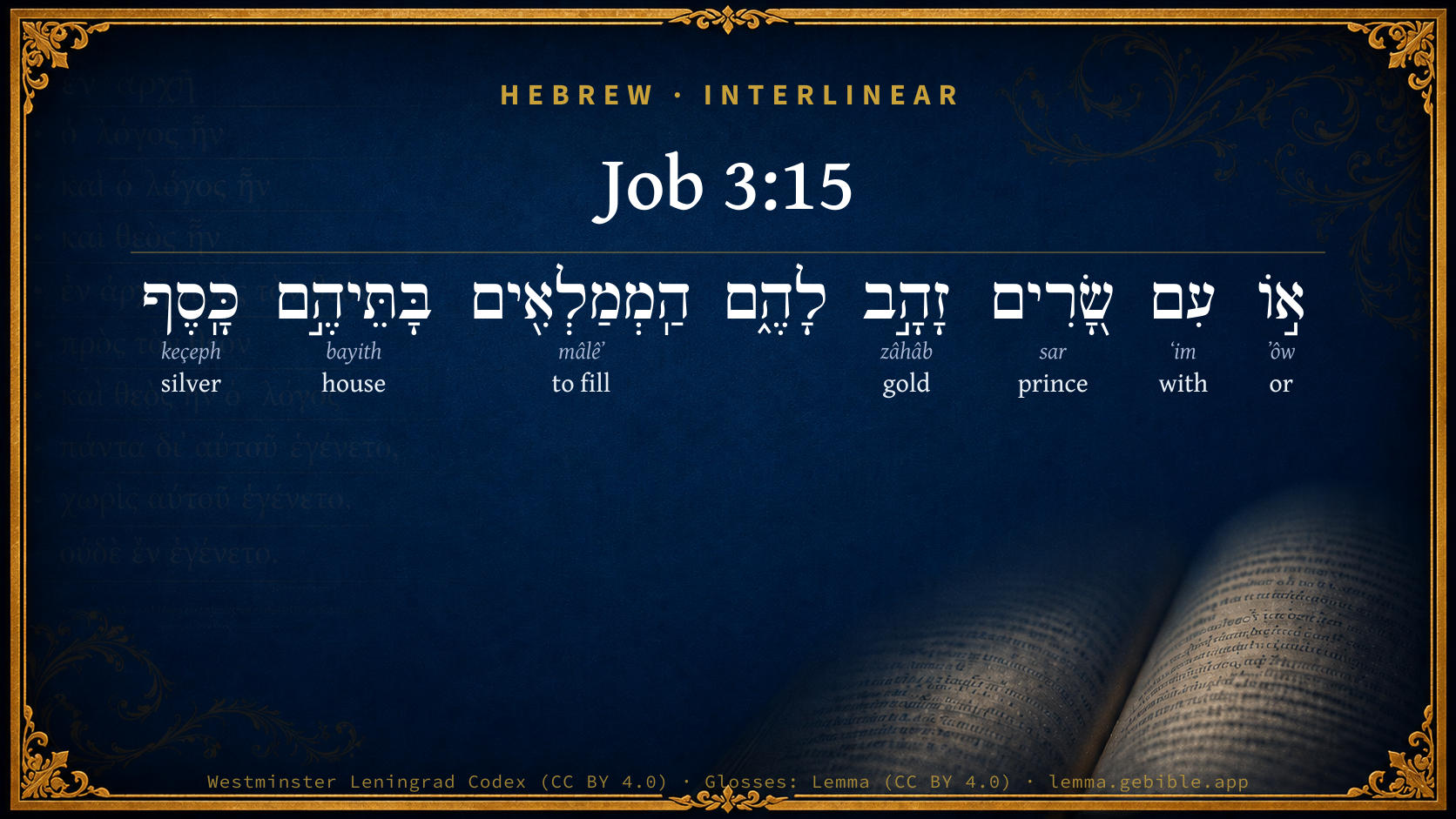
Hebrew (Westminster Leningrad Codex) Job 3:15 appears in the Hebrew Old Testament. The text above is from the Westminster Leningrad Codex. Each word links to its Strong’s number, a concise gloss, and parsing drawn from the Open Scriptures Hebrew Bible morphology. Click any word for its full Brown-Driver-Briggs (BDB) entry.
Download image
Cite this verse

Job 3:15 (World English Bible). Public Domain. Lemma interlinear Bible study tool, https://lemma.gebible.app/v/job/3/15.

Show BibTeX & RIS
BibTeX
RIS
English Translation
Or with princes who had gold, Who filled their houses with silver:
World English Bible · Public Domain
Download a study sheet

One document with this verse’s original text, its word-by-word gloss line, the meaning frame, cross-references with their text, attributed commentary, and full source and license credits — printable, and it pastes into notes with its structure intact.

This verse Autodidact and up

Study sheet (.html) Plain text (.txt)

A passage Seminary Student

Up to 50 verses in one chapter. A passage sheet keeps up to 6 commentary sources and 12 cross-references per verse, in the order this page ranks them, and says so on the sheet whenever that leaves anything out. Ask for a single verse and you get the Autodidact verse sheet above.

Everything on this page stays free to read, with no account — the sheet is a download of what is already on screen, not access to it.

Want to remove ads? Support Godless Engineer
Compare translations 3

The same verse in 3 English versions, stacked beneath the original-language interlinear above. Click any original word for its lexicon entry.

Each is an independent rendering of the whole verse — the interlinear is not word-aligned to these translations.

Highlighted words mark where these versions differ — a whole-verse word diff, not a word-by-word alignment.

  • World English Bible Public Domain
    Or with princes who had gold, Who filled their houses with silver:
  • King James Version Public Domain
    Or with princes that had gold, who filled their houses with silver:
  • unfoldingWord Literal Text CC BY-SA 4.0
    or with princes, gold to them, the ones having filled their houses with silver.

unfoldingWord Literal Text — © unfoldingWord, licensed CC BY-SA 4.0. Word-aligned USFM3 via Door43 (git.door43.org/unfoldingWord/en_ult).

Versions to compare (up to 4)

3 of 4 selected

Show all 18 translations

Every available English version of this verse, each an independent rendering of the whole verse.

  • World English Bible Public Domain
    Or with princes who had gold, Who filled their houses with silver:
  • Berean Standard Bible Public Domain
    or with princes who had gold, who filled their houses with silver.
  • Majority Standard Bible Public Domain
    or with princes who had gold, who filled their houses with silver.
  • King James Version Public Domain
    Or with princes that had gold, who filled their houses with silver:
  • American Standard Version (1901) Public Domain
    Or with princes that had gold, Who filled their houses with silver:
  • Revised Version (1885) Public Domain
    Or with princes that had gold, who filled their houses with silver:
  • Geneva Bible (1599) Public Domain
    Or with the princes that had golde, and haue filled their houses with siluer.
  • Douay-Rheims (1899) Public Domain
    Or with princes, that possess gold, and All their houses with silver:
  • Young's Literal Translation Public Domain
    Or with princes -- they have gold, They are filling their houses `with' silver.
  • Literal Standard Version CC BY-SA 4.0
    Or with princes—they have gold, || They are filling their houses [with] silver.
  • Unlocked Literal Bible CC BY-SA 4.0
    Or I would have been lying with princes who once had gold, who had filled their houses with silver.
  • unfoldingWord Literal Text CC BY-SA 4.0
    or with princes, gold to them, the ones having filled their houses with silver.
  • Darby Bible Public Domain
    Or with princes who had gold, who filled their houses with silver;
  • World Messianic Bible Public Domain
    or with princes who had gold, who filled their houses with silver;
  • Webster's Bible Public Domain
    Or with princes that had gold, who filled their houses with silver:
  • Free Bible Version CC BY-SA 4.0
    or with noblemen who collected gold and filled their houses with silver.
  • Bible in Basic English Public Domain
    Or with rulers who had gold, and whose houses were full of silver;
  • JPS Tanakh (1917) Public Domain
    Or with princes that had gold, who filled their houses with silver;

Literal Standard Version (2020), Covenant Press — licensed CC BY-SA 4.0. Text via the HelloAO Bible API (eBible.org). Unlocked Literal Bible (unfoldingWord) — licensed CC BY-SA 4.0. Text via the HelloAO Bible API (eBible.org). unfoldingWord Literal Text — © unfoldingWord, licensed CC BY-SA 4.0. Word-aligned USFM3 via Door43 (git.door43.org/unfoldingWord/en_ult). Free Bible Version, Dr. Jonathan Gallagher — licensed CC BY-SA 4.0. Text via the HelloAO Bible API (eBible.org).

Word by word

More ways to search: Search by grammar → Find every occurrence → Compare this word →

Practice this passage: Drill this verse → Learn its vocabulary →

הַֽמְמַלְאִ֖ים
mâlêʼ
H4390
“the · filling”
Particle, Definite Article + Verb, Piel, Participle Active, Masculine, Plural, Absolute
Part of Speech
Particle + Verb
Stem
Piel
Form
Participle Active
Gender
Masculine
Number
Plural
State
Absolute
Full BDB Definition

Origin: a primitive root

TWOT: 1195

to fill, be full - (Qal) - to be full - fulness, abundance (participle) - to be full, be accomplished, be ended - to consecrate, fill the hand - (Niphal) - to be filled, be armed, be satisfied - to be accomplished, be ended - (Piel) - to fill - to satisfy - to fulfil, accomplish, complete - to confirm - (Pual) to be filled - (Hithpael) to mass themselves against
  1. א֣וֹ ʼôw H176 “or” Conjunction
  2. עִם ʻim H5973 “with” Preposition
  3. שָׂ֭רִים sar H8269 “princes” Noun, Common, Masculine, Plural, Absolute
  4. זָהָ֣ב zâhâb H2091 “gold” Noun, Common, Masculine, Singular, Absolute
  5. בָּתֵּיהֶ֣ם bayith H1004 “houses · their” Noun, Common, Masculine, Plural, Construct + Suffix, Personal, 3rd Person, Masculine, Plural
  6. כָּֽסֶף keçeph H3701 “silver” Noun, Common, Masculine, Singular, Absolute

About this verse

These counts appear in no published source. They are computed here, from the morphology-tagged text and Lemma’s own curated glosses. What Lemma adds →

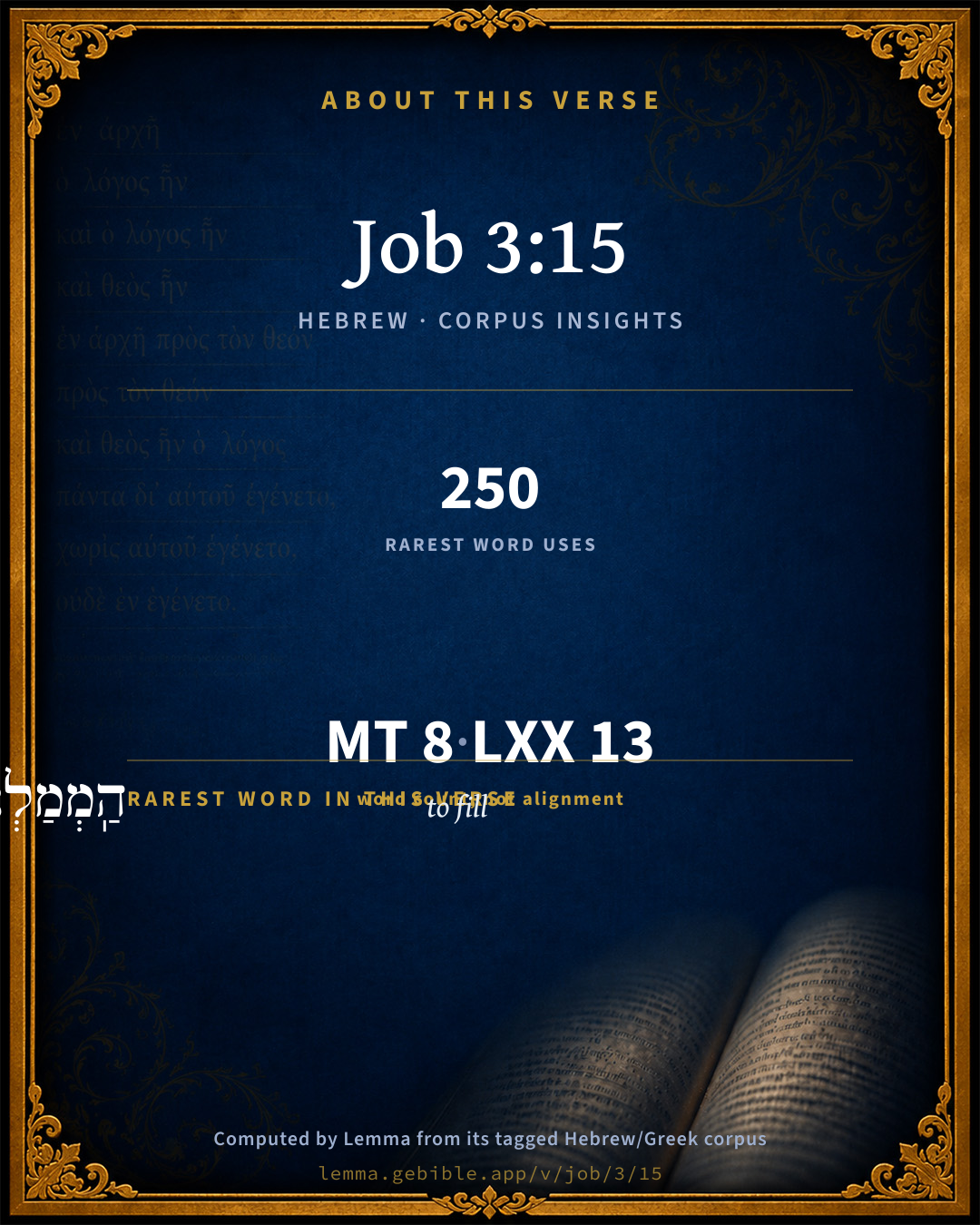
8
words
7
distinct lemmas
Wisdom
section

Grammatical profile

  • 1 verb
  • 4 nouns
  • 2 prepositions
  • 1 conjunction

Verb forms

  • הַֽמְמַלְאִ֖ים Piel · Participle Active

Hebrew & Septuagint length

In English translation the verse runs 12 words from the Hebrew and 13 from the Septuagint (LXX English) — closely comparable.

A rough comparison of the two English renderings, which tokenize alike — not a word-level alignment.

Word counts can differ between the Hebrew and the Greek without any difference in meaning — e.g. the Hebrew direct-object marker אֵת has no separate Greek word, and Greek often adds the article ὁ.

In the original languages it is 8 Hebrew tokens and 13 Greek tokens — but the two are counted differently (Hebrew bundles its prefixes and suffixes into one token; the Greek is in lemma form), so that isn’t a like-for-like length.

Cross-references

8

Topical passages linked to Job 3:15 in the Treasury of Scripture Knowledge — connected by theme and wording, ordered by reader-vote popularity; previews shown in the World English Bible.

  • 1 Kings 10:27 The king made silver to be in Jerusalem as stones, and cedars made he to be as the sycamore trees that are in the lowland, for abundance.
  • Job 22:25 The Almighty will be your treasure, Precious silver to you.
  • Zephaniah 1:18 Neither their silver nor their gold will be able to deliver them in the day of Yahweh's wrath, but the whole land will be devoured by the fire of his jealousy; for he will make an end, yes, a terrible end, of all those who dwell in the land.
  • Numbers 22:18 Balaam answered the servants of Balak, If Balak would give me his house full of silver and gold, I can't go beyond the word of Yahweh my God, to do less or more.
  • Job 12:21 He pours contempt on princes, And loosens the belt of the strong.
  • Job 27:16–17 Though he heap up silver as the dust, And prepare clothing as the clay;
  • Isaiah 2:7 Their land is full of silver and gold, Neither is there any end of their treasures. Their land also is full of horses, Neither is there any end of their chariots.
  • Zechariah 9:3 Tyre built herself a stronghold, And heaped up silver like the dust, And fine gold like the mire of the streets.

Cross-references courtesy of OpenBible.info (CC BY 4.0).

Hebrew and Greek witnesses Masoretic Hebrew ↔ Greek Septuagint

The same verse in the two great witnesses to the Old Testament, shown verse-for-verse.

These are two independent witnesses, not word-aligned to each other, and the Septuagint is shown in lemma (dictionary) form.

Hebrew Job 3:15 Masoretic · Westminster Leningrad Codex

א֣וֹ עִם שָׂ֭רִים זָהָ֣ב לָהֶ֑ם הַֽמְמַלְאִ֖ים בָּתֵּיהֶ֣ם כָּֽסֶף

Or with princes who had gold, Who filled their houses with silver:

World English Bible · Public Domain

Greek LXX Job 3:15 Septuagint · lemma form

ἤ μετά ἄρχων ὅς πολύς ὁ χρυσός ὅς πίμπλημι ὁ οἶκος αὐτός ἀργύριον

or with rulers, whose gold was abundant, who filled their houses with silver:

LXX2012 (modern English Septuagint) · Public Domain

Hebrew: Westminster Leningrad Codex (CC BY 4.0). Greek: Septuagint (public domain); English from LXX2012 (modern English Septuagint) (Public Domain). How the Septuagint differs from the Hebrew →

Commentary

Notes on Job 3:15 from classic Christian and Jewish commentators (each source and its license shown beneath its notes). The classic Christian expositions comment on the surrounding passage and are grouped to its opening verse, so a note may address several verses; the Jewish commentaries on the Tanakh (Rashi and others) are per-verse, so they appear only where the commentator wrote on this verse.

Lemma curates 59 commentaries, every one of them public domain or Creative Commons licensed, each selected and text-cleaned for this edition rather than reprinted as found. About our sources →

Trapp's Complete Commentary

John Trapp

Job 3:15 Or with princes that had gold, who filled their houses with silver:

Ver. 15. Or with princes that had gold] Great store of it. Petrarch reporteth of Pope John XXII, that his heirs found in his coffers no less than 250 tons of gold. Boniface VIII, taken prisoner and plundered by the command of Philip the Fair, king of France, had as much gold carried away out of his palace as all the kings of Europe received for one year’s revenue from their subjects, together with their crown land. What a mass of treasure had Cardinal Wolsey gotten here! and before him Cardinal Beaufort, who when he saw that he must needs die, and that his riches could not reprieve him till a further time, asked, Why should I die, being so rich? fie, will not death be hired? will money do nothing? The Cardinal Sylberperger took so great a pleasure in money, that when he was grievously tormented with the gout, his only remedy to ease the pain was to have a bason full of gold set before him, into which he would put his lame hands, turning the gold upside down. Of Nugas, the Scythian monarch, it is said, that when Michael Paleologus, the Greek emperor, sent him many rich ornaments for a present, he asked whether they could drive away calamities, diseases, and death? this because they could not do, he slighted them. These princes that had gold, and filled their houses with silver, what would not they have given to have bought off death? but riches avail not in the day of wrath; it is righteousness only that delivereth from death, Pro 11:4. Thrice happy, then, are they who are rich to God, as our Saviour phraseth it, who have the Almighty to be their gold; and who have silver of strength, as Eliphaz speaketh, Job 22:25.

Who filled their houses with silver] That is, their graves, say some; called the dead men’s houses, Job 17:13. The Jews call the burying place Bethchajin, the house of the living; and they used not only to adorn their sepulchres richly; but also to put their wealth into the grave with them. Josephus saith that Hircanus found in David’s sepulchre three thousand talents and, Jer 8:1, God threateneth that the Chaldeans shall bring out the bones of the kings of Judah, and of his princes, out of their graves, as searching there for hid treasure; so some conceive. Sure it is, that in the siege of Jerusalem, under Vespasian, there was gold found in the entrails of a Jew that was slain, which caused over twenty thousand of them to be ripped up.

John Trapp, A Commentary or Exposition upon All the Books of the Old and New Testament (1647–1656) — public domain. Text from a community e-Sword module.

Joseph Benson's Commentary

Job 3:15-16. Or with princes that had gold, &c. — My repose and security from worldly anxieties would have been the same with that of those princes who were once celebrated for their wealth, and whose birth entitled them to large treasures of gold and silver. Or as a hidden — That is, undiscerned and unregarded; untimely birth — Born before the due time, and therefore extinct. I had not been — To wit, in the land of the living, of which he here speaks; as infants which never saw light — As those fœtuses that were never quickened, and come to nothing, or those infants which are stifled and dead before their birth.

Joseph Benson's Commentary on the Old and New Testaments (1811–1818) — public domain. Text from a community e-Sword module.

Whedon's Commentary on the Bible

Daniel D. Whedon

15. Their houses — Meaning, their tombs; thus Rosenmuller, Hirtel, and Hitzig. In like manner Isaiah (Isa_14:18) and Diodorus Siculus, (i, 51,) according to whom the Egyptians called their graves houses, οικοι. The ancients buried treasures with their dead. Josephus tells us that immense wealth was interred with David, and that about nine centuries afterward Hyrcanus opened one room of the sepulchre, and took out three thousand talents, part of which he gave to Antiochus, that the siege of the city might be raised. (Antiq., vii, chap. 15.) Canon Cook cites a papyrus from the times of Rameses III., (contemporary with the early Judges,) which contains an account of the trial and execution of robbers who broke into several Egyptian tombs, and despoiled the mummies of large quantities of gold. Job specifies three classes of the fortunate dead:

1. Those whose display is greatest in death, Job_3:14.

2. Those most successful in life, Job_3:15.

3. Those who altogether failed of conscious existence in this life, Job_3:16. They are all one in the grave, and could he only have died as soon as he was born he would have been equally at rest. The splendid successes of life take upon them a different hue when contemplated from the brink of the grave. That the repose of death should be more to be desired than gold, and silver, and brilliancy of mortal estate, bears witness, not to emotions of envious regret on the part of Job over his own lost grandeur, as some have intimated — nor is it “irony,” as Umbreit would have it, “which often blazes forth from the black cloud of melancholy” — it is rather the view of an enlightened soul, that sees in the rest of the grave the shadow of the eternal “rest that remaineth for the people of God.” Even the heathen philosopher Aristotle, (cited by RAWLINSON, Christianity, etc., page 238,) looked upon man’s final happiness as an “energy of rest;” one single, pure, unchanging, and perpetual energy of thought; the silent contemplation of God and Godlike things.

Daniel D. Whedon (gen. ed.), Commentary on the Old and New Testaments (1874–1909) — public domain. Text from a community e-Sword module.

Tyndale Open Study Notes

Tyndale Open Resources

3:15 rich in gold, whose palaces were filled with silver: This might refer to treasure-filled tombs, but it more likely refers to the futile hoarding of wealth that ends in death (as in 3:14).

Tyndale Open Study Notes — © Tyndale Open Resources, licensed CC BY-SA 4.0. Text via the HelloAO Bible API.

Jamieson, Fausset & Brown

Robert Jamieson, A. R. Fausset & David Brown

filled their houses with silver--Some take this to refer to the treasures which the ancients used to bury with their dead. But see Job 3:26.

Jamieson, Fausset & Brown — Commentary Critical and Explanatory on the Whole Bible (1871) — public domain (CC PDM 1.0). Text via the HelloAO Bible API.

Adam Clarke's Commentary

Verse 15. Or with princes that had gold] Chief or mighty men, lords of the soil, or fortunate adventurers in merchandise, who got gold in abundance, filled their houses with silver, left all behind, and had nothing reserved for themselves but the empty places which they had made for their last dwelling, and where their dust now sleeps, devoid of care, painful journeys, and anxious expectations. He alludes here to the case of the covetous, whom nothing can satisfy, as an Asiatic writer has observed, but the dust that fills his mouth when laid in the grave. - SAADY.

Adam Clarke's Commentary on the Bible (1810–1826) — public domain. Text from a community e-Sword/MySword module.

The Cambridge Bible for Schools and Colleges

gen. ed. J. J. S. Perowne

15. their houses with silver] There is no reason for supposing that “houses” means mausoleums or tombs. The reference is not to the practice of burying treasures along with the dead, nor to the idea that the pomp of riches could thus be perpetuated in death. It is those who were famous in this life with whom Job, had he died, would have been in company in death.

The Cambridge Bible for Schools and Colleges (gen. ed. J. J. S. Perowne; Cambridge University Press, 1878–1918) — public domain. Text from a community e-Sword module.

John Gill's Exposition

Or with princes that had gold,.... A large abundance of it while they lived, but now, being dead, were no longer in the possession of it, but on a level with those that had none; nor could their gold, while they had it, preserve them from death, and now, being dead, it was no longer theirs, nor of any use unto them; these princes, by this description of them, seem to be such who had not the dominion over any particular place or country, but their riches lay in gold and silver, as follows:

who filled their houses with silver; had an abundance of it, either in their coffers, which they hoarded up, or in the furniture of their houses, which were much of it of silver; they had large quantities of silver plate, as well as of money; but these were of no profit in the hour of death, nor could they carry them with them; but in the grave, where they were, those were equal to them, of whom it might have been said, silver and gold they had none.

John Gill's Exposition of the Whole Bible (1746–1763) — public domain (CC PDM 1.0). Text via the HelloAO Bible API.

Albert Barnes' Notes on the Bible

Or with princes that had gold - That is, he would have been united with the rich and the great. Is there not here too also a slight evidence of the fondness for wealth, which might have been one of the errors of this good man? Would it not seem that such was his estimate of the importance of being esteemed rich, that he would count it an honor to be united with the affluent in death, rather than be subjected to a condition of poverty and want among the living?

Who filled their houses with silver - Rosenmuller supposes that there is reference here to the custom among the ancients of burying treasures with the dead, and that the word “houses” refers to the tombs or mausoleums which they erected. That such a custom prevailed, there can be no doubt. Josephus informs us that large quantities of treasure were buried in the tomb with David, which afterward was taken out for the supply of an army; and Schultens (“in loc.”) says that the custom prevailed extensively among the Arabs. The custom of burying valuable objects with the dead was practiced also among the aborigines of N. America, and is to this day practiced in Africa. If this be the sense here, then the idea of Job was, that he would have been in his grave united with those who even there were accompanied with wealth, rather than suffering the loss of all his property as he was among the living.

Albert Barnes' Notes on the Bible (1834–1885) — public domain. Text from a community e-Sword/MySword module.

Haydock's Catholic Bible Commentary

Houses, while alive; (Calmet) or their tombs were thus enriched with silver, (Menochius) as this practice was not uncommon, ver. 22. (Josephus, [Antiquities?] xiii. 15.) --- Marcian forbade it. St. Chrysostom complains it subsisted in his time. (Orat. Annæ.) (Calmet)

George Leo Haydock (1774–1849), Haydock's Catholic Family Bible and Commentary, 1859 edition — public domain. Excludes Psalms (Douay-Rheims chapter numbering differs from Protestant) and Deuterocanonical books (Catholic canon only).

The Pulpit Commentary

Or with princes that had gold, who filled their houses with silver. This may either mean simply," princes who were rich in silver and gold during their lifetime," or "princes who have gold and silver buried with them in their tombs." It was the custom in Egypt, in Phoenicia, and elsewhere throughout the East, to bury large quantities of treasure, especially gold and silver vessels, and jewellery, in the sepulchres of kings and other great men. A tomb of a Scythian king in the Crimea, opened about fifty years ago, contained a golden shield, a golden diadem, two silver vases, a vase in electrum, and a number of ornaments, partly in electrum and partly in gold (see the author"s "Herodotus," vol. 3. p. 59, 3rd edit.). Another Scythian tomb near the Caspian, opened by the Russian authorities, contained ornaments set with rubies and emeralds, together with four sheets of gold, weighing forty pounds. A third, near Asterabad, contained a golden goblet, weighing seventy ounces; a pot, eleven ounces, and two small trumpets. The tombs of the kings and queens in Egypt were so richly supplied with treasure that, in the time of the twentieth dynasty, a thieves" society was formed for plundering them, especially of their golden ornaments (Brugsch, "History of Egypt," vol. 1. p. 247, 1st edit.). The tomb of Cyrus the Great contained, we are told (Arrian, "Exp. Alex.," 6:29), a golden couch, a golden table set out with drinking-cups, a golden bowl, and much elegant clothing adorned with gems. Phoenician tombs, in Cyprus especially, have recently yielded enormous treasures (Di Cesnola, "Cyprus," pp. 310-316). If the "gold" and "silver" of the present passage refer to treasures buried with princes and kings, we must understand by the "houses" of the second clause their tombs. The Egyptians called their tombs their "eternal abodes" (Diod. Sic., 1:51).

The Pulpit Commentary (1880–1919), ed. H.D.M. Spence-Jones & Joseph S. Exell — public domain. Text from a community e-Sword module.

unfoldingWord translationNotes

Door43 World Missions Community

General Information:

Job continues his thoughts about dying before he was born.

Or I would have been lying ... that never see the light

This describes something that might have happened but did not happen. (See: Hypothetical Situations)

I would have been lying with princes

"I would be resting with princes." In this phrase, the words "lying" and "resting" are a polite way of saying "no longer alive." (See: Euphemism)

who once had gold, who had filled their houses with silver

Job uses parallelism to emphasize what he is saying. (See: Parallelism)

Or perhaps I would have been stillborn, like infants that never see the light

Job uses parallelism to emphasize what he is saying. (See: Parallelism)

I would have been stillborn

"I would have died in my mother's womb"

like infants that never see the light

"like babies who had never been born"

infants

"babies" or "very small children"

translationWords

prince

gold

house

silver

unfoldingWord translationNotes — © Distant Shores Media and the Door43 World Missions Community, licensed CC BY-SA 4.0. Source: git.door43.org/Door43/en_tn.

Lesson kit

Teaching starters — assembled from the data on this page, not authored interpretation. Every prompt links to the verse data it draws on. Edit before teaching.

Job, in the Wisdom, opens this verse with 8 words (7 distinct Hebrew lemmas). Its most distinctive word is mâlêʼ (“to fill”). A historical commentator’s framing appears above. Read the whole chapter for the surrounding context.

Discussion questions

  1. The word mâlêʼ carries the sense “to fill.” How does it shape the verse?
  2. 1 Kings 10:27 shares this passage’s theme. How do the two illuminate each other?
  3. These translations render this verse differently; the difference is in the English rendering, not the original. What questions does that raise?
  4. The verb «הַֽמְמַלְאִ֖ים» is Piel Participle Active. How does its form color the action?
  5. Reading how Trapp's Complete Commentary and Joseph Benson's Commentary read this verse, where do the two commentators agree and where do they part?

Things to notice

Reading settings

Reading text

Shown beneath each verse's original-language words.

Old Testament
Old Testament edition

Read the OT as the Masoretic Hebrew (MT) or the Greek Septuagint (LXX).

English shown for the Greek Septuagint (in the Hebrew ↔ Greek comparison).

Comparing translations? Open the Compare panel on any verse page to stack up to four side by side.