2 Chronicles 8:10

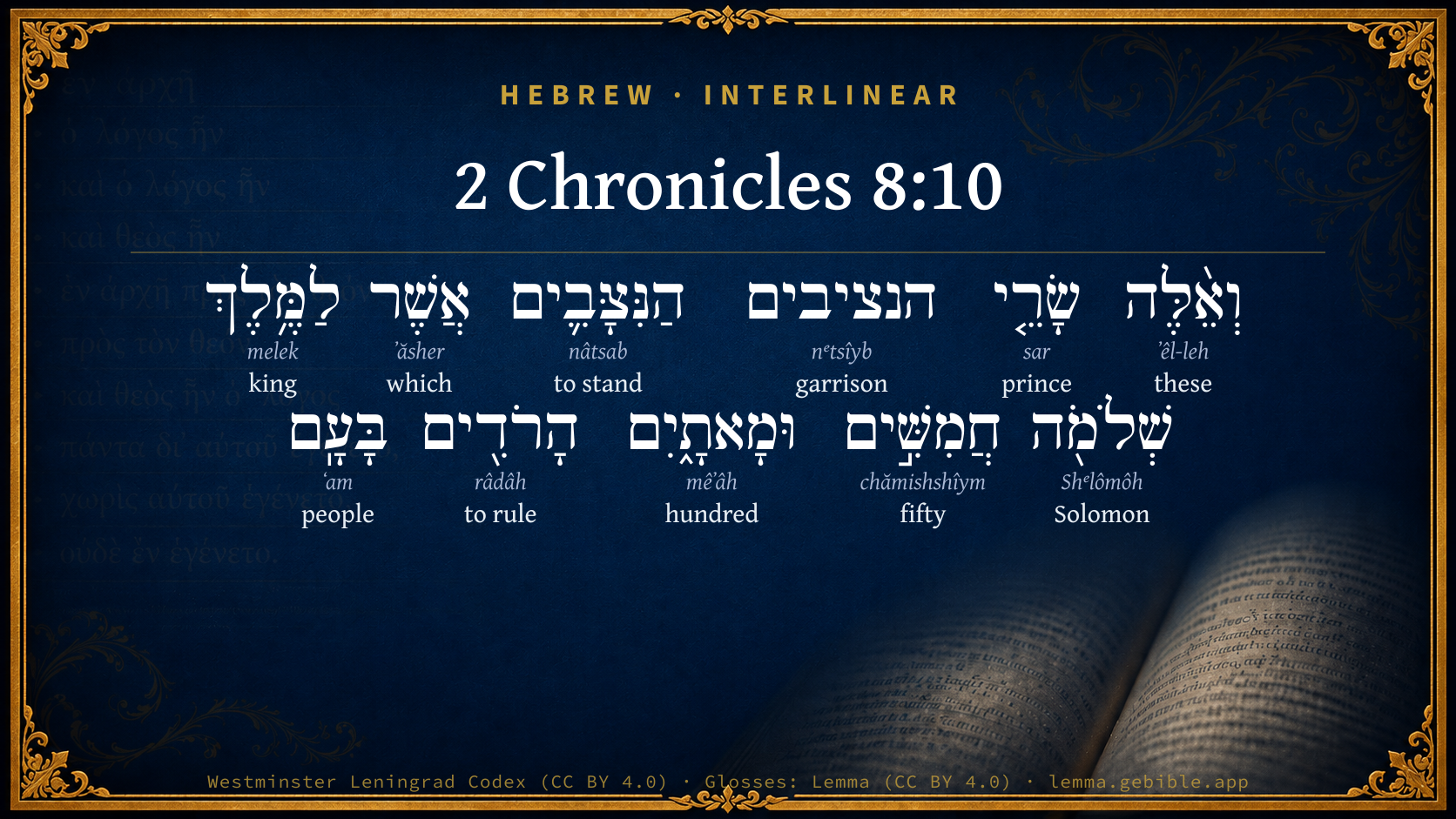
Hebrew (Westminster Leningrad Codex) 2 Chronicles 8:10 appears in the Hebrew Old Testament. The text above is from the Westminster Leningrad Codex. Each word links to its Strong’s number, a concise gloss, and parsing drawn from the Open Scriptures Hebrew Bible morphology. Click any word for its full Brown-Driver-Briggs (BDB) entry.
Download image
Cite this verse

2 Chronicles 8:10 (World English Bible). Public Domain. Lemma interlinear Bible study tool, https://lemma.gebible.app/v/2-chronicles/8/10.

Show BibTeX & RIS
BibTeX
RIS
English Translation
These were the chief officers of king Solomon, even two hundred fifty, who ruled over the people.
World English Bible · Public Domain
Download a study sheet

One document with this verse’s original text, its word-by-word gloss line, the meaning frame, cross-references with their text, attributed commentary, and full source and license credits — printable, and it pastes into notes with its structure intact.

This verse Autodidact and up

Study sheet (.html) Plain text (.txt)

A passage Seminary Student

Up to 50 verses in one chapter. A passage sheet keeps up to 6 commentary sources and 12 cross-references per verse, in the order this page ranks them, and says so on the sheet whenever that leaves anything out. Ask for a single verse and you get the Autodidact verse sheet above.

Everything on this page stays free to read, with no account — the sheet is a download of what is already on screen, not access to it.

Want to remove ads? Support Godless Engineer
Compare translations 3

The same verse in 3 English versions, stacked beneath the original-language interlinear above. Click any original word for its lexicon entry.

Each is an independent rendering of the whole verse — the interlinear is not word-aligned to these translations.

Highlighted words mark where these versions differ — a whole-verse word diff, not a word-by-word alignment.

  • World English Bible Public Domain
    These were the chief officers of king Solomon, even two hundred fifty, who ruled over the people.
  • King James Version Public Domain
    And these were the chief of king Solomon's officers, even two hundred and fifty, that bare rule over the people.
  • unfoldingWord Literal Text CC BY-SA 4.0
    And these, the chiefs of supervisors who were to King Solomon, 250 ruling over the people.

unfoldingWord Literal Text — © unfoldingWord, licensed CC BY-SA 4.0. Word-aligned USFM3 via Door43 (git.door43.org/unfoldingWord/en_ult).

Versions to compare (up to 4)

3 of 4 selected

Show all 18 translations

Every available English version of this verse, each an independent rendering of the whole verse.

  • World English Bible Public Domain
    These were the chief officers of king Solomon, even two hundred fifty, who ruled over the people.
  • Berean Standard Bible Public Domain
    They were also the chief officers for King Solomon: 250 supervisors.
  • Majority Standard Bible Public Domain
    They were also the chief officers for King Solomon: 250 supervisors.
  • King James Version Public Domain
    And these were the chief of king Solomon's officers, even two hundred and fifty, that bare rule over the people.
  • American Standard Version (1901) Public Domain
    And these were the chief officers of king Solomon, even two hundred and fifty, that bare rule over the people.
  • Revised Version (1885) Public Domain
    And these were the chief officers of king Solomon, even two hundred and fifty, that bare rule over the people,
  • Geneva Bible (1599) Public Domain
    So these were the chiefe of the officers which Salomon had, euen two hundreth and fiftie that bare rule ouer the people.
  • Douay-Rheims (1899) Public Domain
    And all the chief captains of king Solomon's army were two hundred and fifty, who taught the people.
  • Young's Literal Translation Public Domain
    and these `are' heads of the officers whom king Solomon hath, two hundred and fifty who are rulers among the people.
  • Literal Standard Version CC BY-SA 4.0
    and these [are] heads of the officers whom King Solomon has, two hundred and fifty who are rulers among the people.
  • Unlocked Literal Bible CC BY-SA 4.0
    These were also the chief officers managing the supervisors who belonged to King Solomon, 250 of them, who supervised the people who did the work.
  • unfoldingWord Literal Text CC BY-SA 4.0
    And these, the chiefs of supervisors who were to King Solomon, 250 ruling over the people.
  • Darby Bible Public Domain
    And these were the chief of king Solomon's superintendents, two hundred and fifty, that ruled over the people.
  • World Messianic Bible Public Domain
    These were the chief officers of King Solomon, even two-hundred fifty, who ruled over the people.
  • Webster's Bible Public Domain
    And these were the chief of king Solomon's officers, even two hundred and fifty, that bore rule over the people.
  • Free Bible Version CC BY-SA 4.0
    They were also King Solomon's chief officers, 250 men who supervised the people.
  • Bible in Basic English Public Domain
    Now these were the chief men in authority whom King Solomon had: two hundred and fifty of them, in authority over the people.
  • JPS Tanakh (1917) Public Domain
    And these were the chief officers of king Solomon, even two hundred and fifty, that bore rule over the people.

Literal Standard Version (2020), Covenant Press — licensed CC BY-SA 4.0. Text via the HelloAO Bible API (eBible.org). Unlocked Literal Bible (unfoldingWord) — licensed CC BY-SA 4.0. Text via the HelloAO Bible API (eBible.org). unfoldingWord Literal Text — © unfoldingWord, licensed CC BY-SA 4.0. Word-aligned USFM3 via Door43 (git.door43.org/unfoldingWord/en_ult). Free Bible Version, Dr. Jonathan Gallagher — licensed CC BY-SA 4.0. Text via the HelloAO Bible API (eBible.org).

Word by word

More ways to search: Search by grammar → Find every occurrence → Compare this word →

Practice this passage: Drill this verse → Learn its vocabulary →

הנציבים
nᵉtsîyb
H5333
“the · garrisons”
Particle, Definite Article + Noun, Common, Masculine, Plural, Absolute
Part of Speech
Particle + Noun
Type
Common
Gender
Masculine
Number
Plural
State
Absolute
Full BDB Definition

Origin: from H5324

TWOT: 1398b

set over, something placed, pillar, prefect, garrison, post - pillar - prefect, deputy
  1. וְאֵ֨לֶּה ʼêl-leh H428 “and · these” Conjunction + Pronoun, Demonstrative, Common, Plural
  2. שָׂרֵ֤י sar H8269 “princes of” Noun, Common, Masculine, Plural, Construct
  3. הַנִּצָּבִ֛ים nâtsab H5324 “the · standing” Particle, Definite Article + Verb, Niphal, Participle Active, Masculine, Plural, Absolute
  4. אֲשֶׁר ʼăsher H834 “which” Particle, Relative
  5. לַמֶּ֥לֶךְ melek H4428 “to/for the · king” Preposition, Determined + Noun, Common, Masculine, Singular, Absolute
  6. שְׁלֹמֹ֖ה Shᵉlômôh H8010 “Solomon” Noun, Proper
  7. חֲמִשִּׁ֣ים chămishshîym H2572 “fifty” Adjective, Cardinal number, Both, Plural, Absolute
  8. וּמָאתָ֑יִם mêʼâh H3967 “and · hundred” Conjunction + Adjective, Cardinal number, Both, Dual, Absolute
  9. הָרֹדִ֖ים râdâh H7287 “the · ruling” Particle, Definite Article + Verb, Qal, Participle Active, Masculine, Plural, Absolute
  10. בָּעָֽם ʻam H5971 “in/at the · people” Preposition, Determined + Noun, Common, Masculine, Singular, Absolute

About this verse

These counts appear in no published source. They are computed here, from the morphology-tagged text and Lemma’s own curated glosses. What Lemma adds →

11
words
11
distinct lemmas
Historical
section

Notable vocabulary

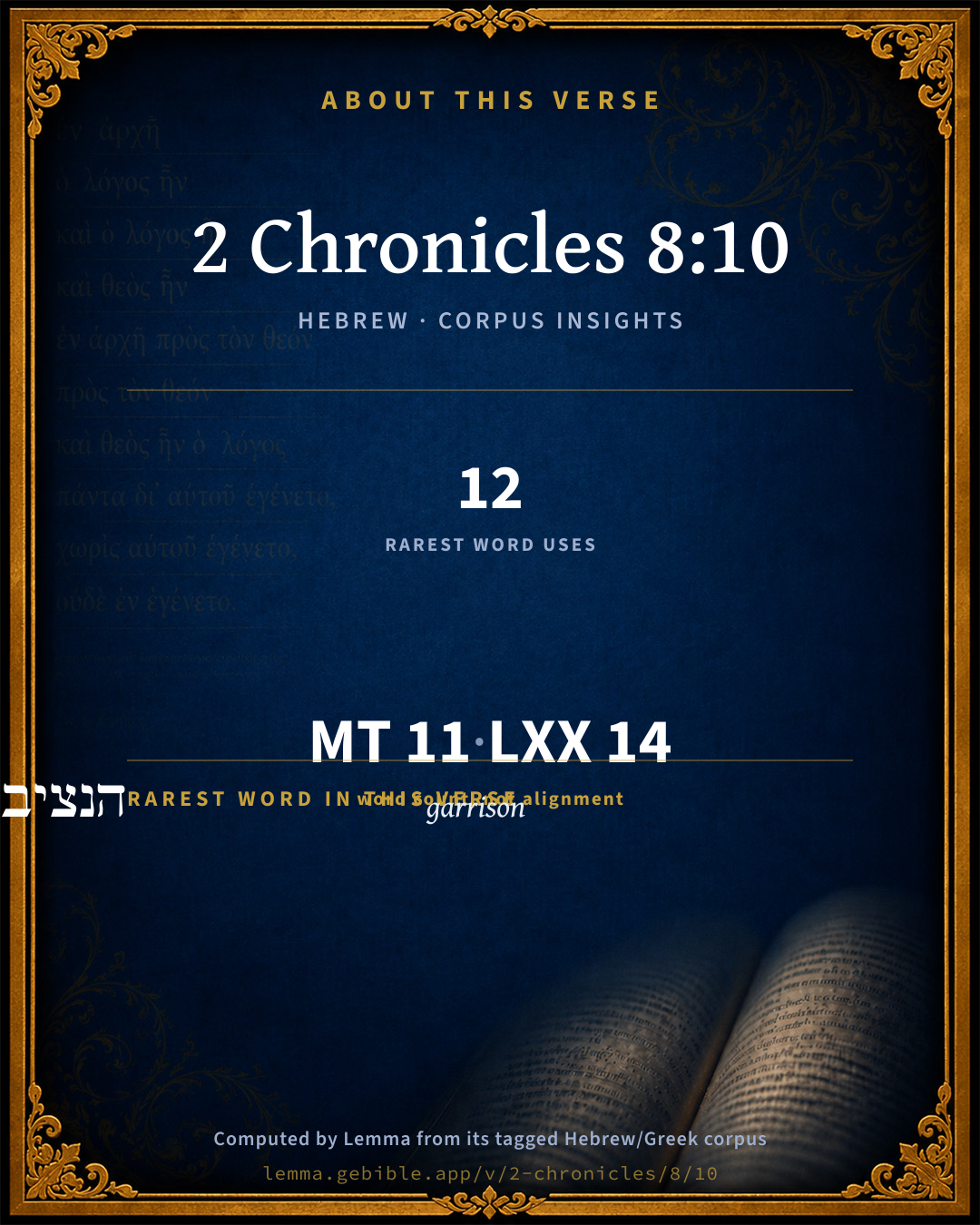
The rarest word here is הנציבים garrison H5333 — appearing just 12 times in the whole Hebrew Bible.

Shared distinctive vocabulary

הנציבים garrison H5333 occurs in 11 verses of the Hebrew Bible. Also found in:

Grammatical profile

  • 2 verbs
  • 5 nouns
  • 2 adjectives
  • 1 pronoun
  • 1 particle

Verb forms

  • הַנִּצָּבִ֛ים Niphal · Participle Active
  • הָרֹדִ֖ים Qal · Participle Active

Hebrew & Septuagint length

In English translation the verse runs 17 words from the Hebrew and 21 from the Septuagint (LXX English) — closely comparable.

A rough comparison of the two English renderings, which tokenize alike — not a word-level alignment.

Word counts can differ between the Hebrew and the Greek without any difference in meaning — e.g. the Hebrew direct-object marker אֵת has no separate Greek word, and Greek often adds the article ὁ.

In the original languages it is 11 Hebrew tokens and 14 Greek tokens — but the two are counted differently (Hebrew bundles its prefixes and suffixes into one token; the Greek is in lemma form), so that isn’t a like-for-like length.

Cross-references

3

Topical passages linked to 2 Chronicles 8:10 in the Treasury of Scripture Knowledge — connected by theme and wording, ordered by reader-vote popularity; previews shown in the World English Bible.

  • 1 Kings 5:16 besides Solomon's chief officers who were over the work, three thousand and three hundred, who bore rule over the people who labored in the work.
  • 1 Kings 9:23 These were the chief officers who were over Solomon's work, five hundred fifty, who bore rule over the people who labored in the work.
  • 2 Chronicles 2:18 He set seventy thousand of them to bear burdens, and eighty thousand who were stone cutters in the mountains, and three thousand six hundred overseers to set the people at work.

Cross-references courtesy of OpenBible.info (CC BY 4.0).

Hebrew and Greek witnesses Masoretic Hebrew ↔ Greek Septuagint

The same verse in the two great witnesses to the Old Testament, shown verse-for-verse.

These are two independent witnesses, not word-aligned to each other, and the Septuagint is shown in lemma (dictionary) form.

Hebrew 2 Chronicles 8:10 Masoretic · Westminster Leningrad Codex

וְאֵ֨לֶּה שָׂרֵ֤י הנציבים הַנִּצָּבִ֛ים אֲשֶׁר לַמֶּ֥לֶךְ שְׁלֹמֹ֖ה חֲמִשִּׁ֣ים וּמָאתָ֑יִם הָרֹדִ֖ים בָּעָֽם

These were the chief officers of king Solomon, even two hundred fifty, who ruled over the people.

World English Bible · Public Domain

Greek LXX 2 Chronicles 8:10 Septuagint · lemma form

καί οὗτος ἄρχων ὁ προστάτης βασιλεύς σαλωμών πεντήκοντα καί διακόσιοι ἐργοδιωκτέω ἐν ὁ λαός

And these are the chiefs of the officers of king Solomon, two hundred and fifty overseeing the work among the people.

LXX2012 (modern English Septuagint) · Public Domain

Hebrew: Westminster Leningrad Codex (CC BY 4.0). Greek: Septuagint (public domain); English from LXX2012 (modern English Septuagint) (Public Domain). How the Septuagint differs from the Hebrew →

Commentary

Notes on 2 Chronicles 8:10 from classic Christian and Jewish commentators (each source and its license shown beneath its notes). The classic Christian expositions comment on the surrounding passage and are grouped to its opening verse, so a note may address several verses; the Jewish commentaries on the Tanakh (Rashi and others) are per-verse, so they appear only where the commentator wrote on this verse.

Lemma curates 59 commentaries, every one of them public domain or Creative Commons licensed, each selected and text-cleaned for this edition rather than reprinted as found. About our sources →

Trapp's Complete Commentary

John Trapp

2Ch 8:10 And these [were] the chief of king Solomon’s officers, [even] two hundred and fifty, that bare rule over the people.

Ver. 10. See on 1Ki 9:23.

John Trapp, A Commentary or Exposition upon All the Books of the Old and New Testament (1647–1656) — public domain. Text from a community e-Sword module.

Geneva Bible (1599)

Geneva Bible translators

For in all there were 3300 but here he meaneth of them that had the principal charge, read 1 Kings 9:23.

Geneva Bible (1599) marginal notes — public domain. Text via Bolls.life.

Jamieson, Fausset & Brown

Robert Jamieson, A. R. Fausset & David Brown

two hundred and fifty that bare rule--(Compare Kg1 9:23). It is generally agreed that the text of one of these passages is corrupt.

Jamieson, Fausset & Brown — Commentary Critical and Explanatory on the Whole Bible (1871) — public domain (CC PDM 1.0). Text via the HelloAO Bible API.

The Cambridge Bible for Schools and Colleges

gen. ed. J. J. S. Perowne

10. And these were the chief] After this preface (cp. 1Ki_9:23) we expect both here and in 1 Kin. a list of these persons; cp. 1Ch_11:10 ff; 1Ch_12:1 ff. Possibly the text of 1 Kin. suffered at an early date, and the list was missing when the Chronicler wrote.

two hundred and fifty] According to 1Ki_9:23, five hundred and fifty. On the other hand the under-overseers are reckoned at three thousand six hundred in 2Ch_2:18 as against three thousand three hundred in 1Ki_5:16. The total number therefore of overseers of all kinds is given both in 1 Kin. and 2 Chr. as 3850.

The Cambridge Bible for Schools and Colleges (gen. ed. J. J. S. Perowne; Cambridge University Press, 1878–1918) — public domain. Text from a community e-Sword module.

Albert Barnes' Notes on the Bible

On the number compare 1Ki 5:16 note.

Albert Barnes' Notes on the Bible (1834–1885) — public domain. Text from a community e-Sword/MySword module.

Haydock's Catholic Bible Commentary

Fifty. These were different from the 550 overseers, 3 Kings ix. 23.

George Leo Haydock (1774–1849), Haydock's Catholic Family Bible and Commentary, 1859 edition — public domain. Excludes Psalms (Douay-Rheims chapter numbering differs from Protestant) and Deuterocanonical books (Catholic canon only).

Rashi

Rabbi Shlomo Yitzchaki (Rashi)

two hundred fifty And in I Kings (9:23): “five hundred fifty,” but [in fact], these two are identical, for there Scripture deducts three hundred and then repeats and counts them again, for there it is written (5:30): “Besides Solomon’s chief officers, etc....three thousand and three hundred, who bore rule,” and here it is written above (2:1): “three thousand six hundred.” We find that what is missing in one verse is added in the other verse. Scripture separates them because the three hundred extra were proselytes, and they were appointed over those three thousand three hundred who ruled over the seventy thousand who bore burdens and the eighty thousand hewers in the mountains (I Kings 5:29), and these two hundred fifty were Israelites, appointed over those three hundred proselytes.

Rashi on the Tanakh — English translations: “The Judaica Press complete Tanach with Rashi, translated by A. J. Rosenberg” (CC BY 4.0); “Pentateuch with Rashi's commentary by M. Rosenbaum and A.M. Silbermann, 1929-1934” (public domain); “The Metsudah Tanach series, Lakewood, N.J” (CC BY 4.0); and “The Book of Joshua, Metsudah Publications, 1997” (CC BY 4.0). Text via Sefaria.

Lesson kit

Teaching starters — assembled from the data on this page, not authored interpretation. Every prompt links to the verse data it draws on. Edit before teaching.

2 Chronicles, in the Historical, opens this verse with 11 words (11 distinct Hebrew lemmas). Its most distinctive word is nᵉtsîyb (“garrison”). A historical commentator’s framing appears above. Read the whole chapter for the surrounding context.

Discussion questions

  1. The word nᵉtsîyb carries the sense “garrison.” How does it shape the verse?
  2. How does Genesis 19:26, which shares the word «garrison», read alongside this verse?
  3. These translations render this verse differently. What is at stake in choosing one wording over another?
  4. «הַנִּצָּבִ֛ים» is a Niphal Participle Active verb. How does that grammatical form shape the action described?
  5. Compare how Trapp's Complete Commentary and Geneva Bible (1599) read this verse. Where do they agree or differ?

Things to notice

Reading settings

Reading text

Shown beneath each verse's original-language words.

Old Testament
Old Testament edition

Read the OT as the Masoretic Hebrew (MT) or the Greek Septuagint (LXX).

English shown for the Greek Septuagint (in the Hebrew ↔ Greek comparison).

Comparing translations? Open the Compare panel on any verse page to stack up to four side by side.