
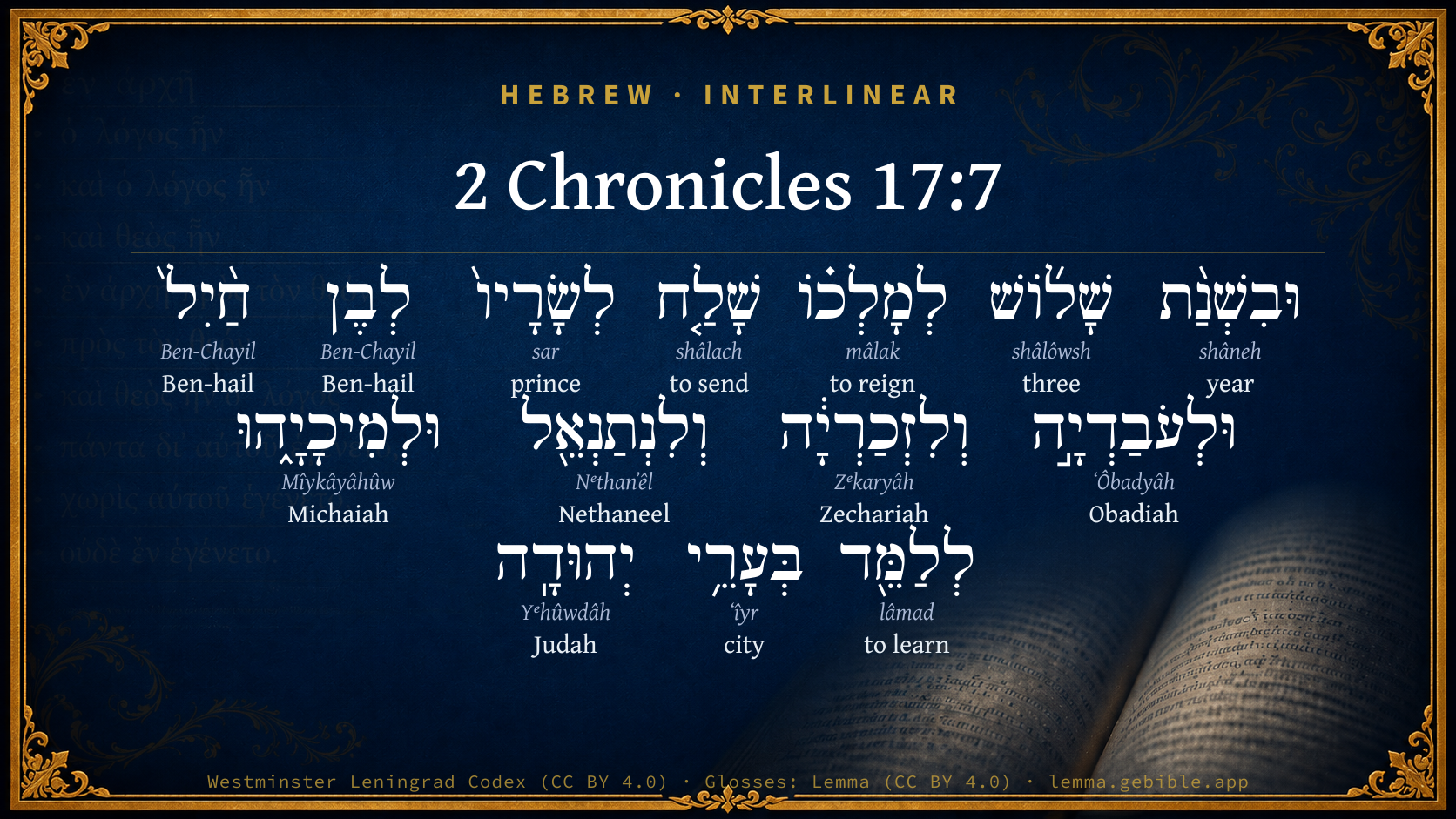
2 Chronicles 17:7

Hebrew (Westminster Leningrad Codex) 2 Chronicles 17:7 appears in the Hebrew Old Testament. The text above is from the Westminster Leningrad Codex. Each word links to its Strong’s number, a concise gloss, and parsing drawn from the Open Scriptures Hebrew Bible morphology. Click any word for its full Brown-Driver-Briggs (BDB) entry.
Download image
Cite this verse

2 Chronicles 17:7 (World English Bible). Public Domain. Lemma interlinear Bible study tool, https://lemma.gebible.app/v/2-chronicles/17/7.

Show BibTeX & RIS
BibTeX
RIS
English Translation
Also in the third year of his reign he sent his princes, even Ben Hail, and Obadiah, and Zechariah, and Nethanel, and Micaiah, to teach in the cities of Judah;
World English Bible · Public Domain
Highlights
  • 1 first appearance in the Hebrew Bible
Full analysis ↓
Download a study sheet

One document with this verse’s original text, its word-by-word gloss line, the meaning frame, cross-references with their text, attributed commentary, and full source and license credits — printable, and it pastes into notes with its structure intact.

This verse Autodidact and up

Study sheet (.html) Plain text (.txt)

A passage Seminary Student

Up to 50 verses in one chapter. A passage sheet keeps up to 6 commentary sources and 12 cross-references per verse, in the order this page ranks them, and says so on the sheet whenever that leaves anything out. Ask for a single verse and you get the Autodidact verse sheet above.

Everything on this page stays free to read, with no account — the sheet is a download of what is already on screen, not access to it.

Want to remove ads? Support Godless Engineer
Compare translations 3

The same verse in 3 English versions, stacked beneath the original-language interlinear above. Click any original word for its lexicon entry.

Each is an independent rendering of the whole verse — the interlinear is not word-aligned to these translations.

Highlighted words mark where these versions differ — a whole-verse word diff, not a word-by-word alignment.

  • World English Bible Public Domain
    Also in the third year of his reign he sent his princes, even Ben Hail, and Obadiah, and Zechariah, and Nethanel, and Micaiah, to teach in the cities of Judah;
  • King James Version Public Domain
    Also in the third year of his reign he sent to his princes, even to Benhail, and to Obadiah, and to Zechariah, and to Nethaneel, and to Michaiah, to teach in the cities of Judah.
  • unfoldingWord Literal Text CC BY-SA 4.0
    And in the third year of his reign he sent his chiefs, Ben-Hail, and Obadiah, and Zechariah, and Nethanel, and Micaiah, to teach in the cities of Judah.

unfoldingWord Literal Text — © unfoldingWord, licensed CC BY-SA 4.0. Word-aligned USFM3 via Door43 (git.door43.org/unfoldingWord/en_ult).

Versions to compare (up to 4)

3 of 4 selected

Show all 18 translations

Every available English version of this verse, each an independent rendering of the whole verse.

  • World English Bible Public Domain
    Also in the third year of his reign he sent his princes, even Ben Hail, and Obadiah, and Zechariah, and Nethanel, and Micaiah, to teach in the cities of Judah;
  • Berean Standard Bible Public Domain
    In the third year of his reign, Jehoshaphat sent his officials Ben-hail, Obadiah, Zechariah, Nethanel, and Micaiah to teach in the cities of Judah,
  • Majority Standard Bible Public Domain
    In the third year of his reign, Jehoshaphat sent his officials Ben-hail, Obadiah, Zechariah, Nethanel, and Micaiah to teach in the cities of Judah,
  • King James Version Public Domain
    Also in the third year of his reign he sent to his princes, even to Benhail, and to Obadiah, and to Zechariah, and to Nethaneel, and to Michaiah, to teach in the cities of Judah.
  • American Standard Version (1901) Public Domain
    Also in the third year of his reign he sent his princes, even Ben-hail, and Obadiah, and Zechariah, and Nethanel, and Micaiah, to teach in the cities of Judah;
  • Revised Version (1885) Public Domain
    Also in the third year of his reign he sent his princes, even Ben-hail, and Obadiah, and Zechariah, and Nethanel, and Micaiah, to teach in the cities of Judah;
  • Geneva Bible (1599) Public Domain
    And in the thirde yere of his reigne he sent his princes, Ben-hail, and Obadiah, and Zechariah, and Nethaneel, and Michaiah, that they should teach in the cities of Iudah,
  • Douay-Rheims (1899) Public Domain
    And in the third year of his reign, he sent of his princes Benhail, and Abdias, and Zacharias, and Nathanael, and Micheas, to teach in the cities of Juda:
  • Young's Literal Translation Public Domain
    And in the third year of his reign he hath sent for his heads, for Ben-Hail, and for Obadiah, and for Zechariah, and for Nethaneel, and for Michaiah, to teach in cities of Judah,
  • Literal Standard Version CC BY-SA 4.0
    And in the third year of his reign he has sent for his heads, for Ben-Hail, and for Obadiah, and for Zechariah, and for Nethaneel, and for Michaiah, to teach in cities of Judah;
  • Unlocked Literal Bible CC BY-SA 4.0
    In the third year of his reign he sent his officials Ben-Hail, Obadiah, Zechariah, Nethanel, and Micaiah, to teach in the cities of Judah.
  • unfoldingWord Literal Text CC BY-SA 4.0
    And in the third year of his reign he sent his chiefs, Ben-Hail, and Obadiah, and Zechariah, and Nethanel, and Micaiah, to teach in the cities of Judah.
  • Darby Bible Public Domain
    And in the third year of his reign he sent his princes, Ben-hail, and Obadiah, and Zechariah, and Nethaneel, and Micah, to teach in the cities of Judah;
  • World Messianic Bible Public Domain
    Also in the third year of his reign he sent his princes, even Ben Hail, Obadiah, Zechariah, Nethanel, and Micaiah, to teach in the cities of Judah;
  • Webster's Bible Public Domain
    Also in the third year of his reign he sent to his princes, even to Ben-hail, and to Obadiah, and to Zechariah, and to Nethaneel, and to Michaiah, to teach in the cities of Judah.
  • Free Bible Version CC BY-SA 4.0
    In the third year of his reign, Jehoshaphat sent his officials Ben-hail, Obadiah, Zechariah, Nethanel, and Micaiah to teach in the towns of Judah.
  • Bible in Basic English Public Domain
    In the third year of his rule he sent Benhail and Obadiah and Zechariah and Nethanel and Micaiah, his captains, as teachers into the towns of Judah;
  • JPS Tanakh (1917) Public Domain
    Also in the third year of his reign he sent his princes, even Ben-hail, and Obadiah, and Zechariah, and Nethanel, and Micaiah, to teach in the cities of Judah;

Literal Standard Version (2020), Covenant Press — licensed CC BY-SA 4.0. Text via the HelloAO Bible API (eBible.org). Unlocked Literal Bible (unfoldingWord) — licensed CC BY-SA 4.0. Text via the HelloAO Bible API (eBible.org). unfoldingWord Literal Text — © unfoldingWord, licensed CC BY-SA 4.0. Word-aligned USFM3 via Door43 (git.door43.org/unfoldingWord/en_ult). Free Bible Version, Dr. Jonathan Gallagher — licensed CC BY-SA 4.0. Text via the HelloAO Bible API (eBible.org).

Word by word

More ways to search: Search by grammar → Find every occurrence → Compare this word →

Practice this passage: Drill this verse → Learn its vocabulary →

לְבֶן
Ben-Chayil
H1134
“to/for · Ben-hail”
Preposition + Noun, Proper
Part of Speech
Preposition + Noun
Type
Proper
Full BDB Definition

Origin: from H1121 and H2428

TWOT: None

Ben-hail = "son of strength" or " son (man) of might" - a ruler (prince) under Jehoshaphat
  1. וּבִשְׁנַ֨ת shâneh H8141 “and · in/at · year of” Conjunction + Preposition + Noun, Common, Feminine, Singular, Construct
  2. שָׁל֜וֹשׁ shâlôwsh H7969 “three” Adjective, Cardinal number, Feminine, Singular, Absolute
  3. לְמָלְכ֗וֹ mâlak H4427 “to reign · him” Preposition + Verb, Qal, Infinitive Construct + Suffix, Personal, 3rd Person, Masculine, Singular
  4. שָׁלַ֤ח shâlach H7971 “to send” Verb, Qal, Perfect, 3rd Person, Masculine, Singular
  5. לְשָׂרָיו֙ sar H8269 “to/for · princes · his” Preposition + Noun, Common, Masculine, Plural, Construct + Suffix, Personal, 3rd Person, Masculine, Singular
  6. חַ֨יִל֙ Ben-Chayil H1134 “Ben-hail” Noun, Proper
  7. וּלְעֹבַדְיָ֣ה ʻÔbadyâh H5662 “and · to/for · Obadiah” Conjunction + Preposition + Noun, Proper
  8. וְלִזְכַרְיָ֔ה Zᵉkaryâh H2148 “and · to/for · Zechariah” Conjunction + Preposition + Noun, Proper
  9. וְלִנְתַנְאֵ֖ל Nᵉthanʼêl H5417 “and · to/for · Nethaneel” Conjunction + Preposition + Noun, Proper
  10. וּלְמִיכָיָ֑הוּ Mîykâyâhûw H4322 “and · to/for · Michaiah” Conjunction + Preposition + Noun, Proper
  11. לְלַמֵּ֖ד lâmad H3925 “to learn” Preposition + Verb, Piel, Infinitive Construct
  12. בְּעָרֵ֥י ʻîyr H5892 “in/at · cities of” Preposition + Noun, Common, Feminine, Plural, Construct
  13. יְהוּדָֽה Yᵉhûwdâh H3063 “Judah” Noun, Proper

About this verse

These counts appear in no published source. They are computed here, from the morphology-tagged text and Lemma’s own curated glosses. What Lemma adds →

14
words
13
distinct lemmas
Historical
section

Notable vocabulary

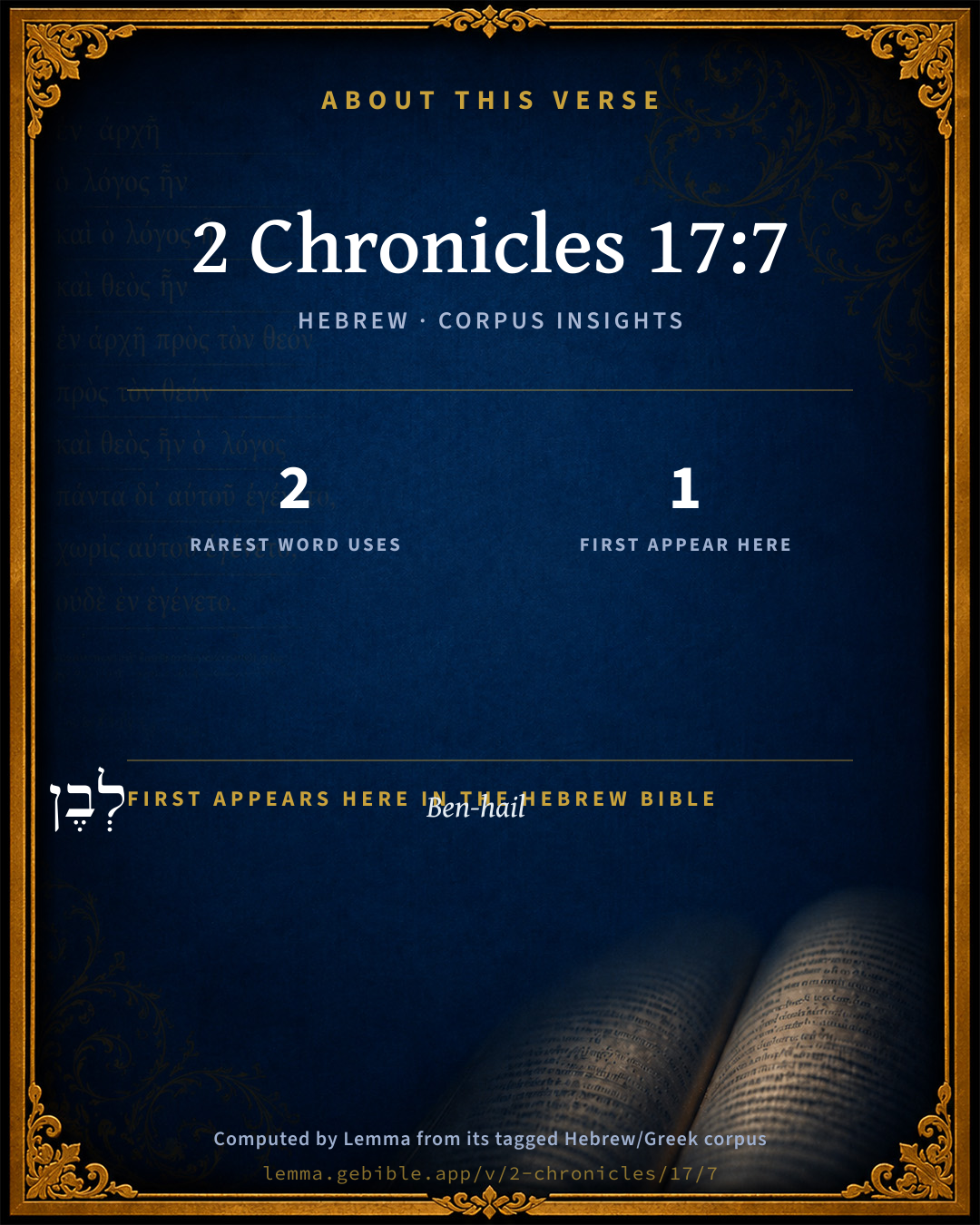
The rarest word here is לְבֶן Ben-hail H1134 — appearing just 2 times in the whole Hebrew Bible.

First appearance in Scripture

This word makes its first canonical appearance in the Hebrew Bible here:

  • לְבֶן Ben-hail H1134

Grammatical profile

  • 3 verbs
  • 10 nouns
  • 1 adjective

Verb forms

  • לְמָלְכ֗וֹ Qal · Infinitive Construct
  • שָׁלַ֤ח Qal · Perfect
  • לְלַמֵּ֖ד Piel · Infinitive Construct

Repetition

A word recurs within this verse — often emphatic in Hebrew:

  • לְבֶן Ben-hail H1134 ×2

Hebrew & Septuagint length

In English translation the verse runs 30 words from the Hebrew and 31 from the Septuagint (LXX English) — closely comparable.

A rough comparison of the two English renderings, which tokenize alike — not a word-level alignment.

Word counts can differ between the Hebrew and the Greek without any difference in meaning — e.g. the Hebrew direct-object marker אֵת has no separate Greek word, and Greek often adds the article ὁ.

Cross-references

17

Topical passages linked to 2 Chronicles 17:7 in the Treasury of Scripture Knowledge — connected by theme and wording, ordered by reader-vote popularity; previews shown in the World English Bible.

  • 2 Chronicles 35:3 He said to the Levites who taught all Israel, who were holy to Yahweh, Put the holy ark in the house which Solomon the son of David king of Israel did build; there shall no more be a burden on your shoulders: now serve Yahweh your God, and his people Israel.
  • Ecclesiastes 12:9–10 Further, because the Preacher was wise, he still taught the people knowledge. Yes, he pondered, sought out, and set in order many proverbs.
  • 2 Chronicles 15:3 Now for a long season Israel was without the true God, and without a teaching priest, and without law:
  • Nehemiah 8:7–8 Also Jeshua, and Bani, and Sherebiah, Jamin, Akkub, Shabbethai, Hodiah, Maaseiah, Kelita, Azariah, Jozabad, Hanan, Pelaiah, and the Levites, caused the people to understand the law: and the people [stood] in their place.
  • 2 Chronicles 30:22 Hezekiah spoke comfortably to all the Levites who had good understanding [in the service] of Yahweh. So they ate throughout the feast for the seven days, offering sacrifices of peace-offerings, and making confession to Yahweh, the God of their fathers.
  • Nehemiah 8:13–14 On the second day were gathered together the heads of fathers' [houses] of all the people, the priests, and the Levites, to Ezra the scribe, even to give attention to the words of the law.
  • Nehemiah 9:3 They stood up in their place, and read in the book of the law of Yahweh their God a fourth part of the day; and [another] fourth part they confessed, and worshiped Yahweh their God.
  • Psalms 51:13 Then I will teach transgressors your ways. Sinners shall be converted to you.
  • Ecclesiastes 1:12 I, the Preacher, was king over Israel in Jerusalem.
  • Luke 4:43–44 But he said to them, "I must preach the good news of the Kingdom of God to the other cities also. For this reason I have been sent."
  • Acts 1:1 The first book I wrote, Theophilus, concerned all that Jesus began both to do and to teach,
  • Deuteronomy 4:5 Behold, I have taught you statutes and ordinances, even as Yahweh my God commanded me, that you should do so in the midst of the land where you go in to possess it.
  • Deuteronomy 33:10 They shall teach Jacob your ordinances, Israel your law: They shall put incense before you, Whole burnt offering on your altar.
  • Psalms 34:11 Come, you children, listen to me. I will teach you the fear of Yahweh.
  • Isaiah 49:23 Kings shall be your nursing fathers, and their queens your nursing mothers: they shall bow down to you with their faces to the earth, and lick the dust of your feet; and you shall know that I am Yahweh; and those who wait for me shall not be disappointed.
  • Matthew 4:23 Jesus went about in all Galilee, teaching in their synagogues, preaching the Gospel of the Kingdom, and healing every disease and every sickness among the people.
  • Mark 4:2 He taught them many things in parables, and told them in his teaching,

Cross-references courtesy of OpenBible.info (CC BY 4.0).

Hebrew and Greek witnesses Masoretic Hebrew ↔ Greek Septuagint

The same verse in the two great witnesses to the Old Testament, shown verse-for-verse.

These are two independent witnesses, not word-aligned to each other, and the Septuagint is shown in lemma (dictionary) form.

Hebrew 2 Chronicles 17:7 Masoretic · Westminster Leningrad Codex

וּבִשְׁנַ֨ת שָׁל֜וֹשׁ לְמָלְכ֗וֹ שָׁלַ֤ח לְשָׂרָיו֙ לְבֶן חַ֨יִל֙ וּלְעֹבַדְיָ֣ה וְלִזְכַרְיָ֔ה וְלִנְתַנְאֵ֖ל וּלְמִיכָיָ֑הוּ לְלַמֵּ֖ד בְּעָרֵ֥י יְהוּדָֽה

Also in the third year of his reign he sent his princes, even Ben Hail, and Obadiah, and Zechariah, and Nethanel, and Micaiah, to teach in the cities of Judah;

World English Bible · Public Domain

Greek LXX 2 Chronicles 17:7 Septuagint · lemma form

καί ἐν ὁ τρίτος ἔτος ὁ βασιλεία αὐτός ἀποστέλλω ὁ ἡγέομαι αὐτός καί ὁ υἱός ὁ δυνατός ὁ αβδια καί ζαχαριας καί ναθαναηλ καί μιχαιας διδάσκω ἐν πόλις ἰουδά

And in the third year of his reign, he sent his chief men, and his mighty men, Abdias and Zacharias, and Nathanael, and Michaias, to teach in the cities of Juda.

LXX2012 (modern English Septuagint) · Public Domain

On this verse, Ellicott's Commentary for English Readers discusses the Septuagint’s reading. Read the note in Commentary ↓

Hebrew: Westminster Leningrad Codex (CC BY 4.0). Greek: Septuagint (public domain); English from LXX2012 (modern English Septuagint) (Public Domain). How the Septuagint differs from the Hebrew →

Commentary

Notes on 2 Chronicles 17:7 from classic Christian and Jewish commentators (each source and its license shown beneath its notes). The classic Christian expositions comment on the surrounding passage and are grouped to its opening verse, so a note may address several verses; the Jewish commentaries on the Tanakh (Rashi and others) are per-verse, so they appear only where the commentator wrote on this verse.

Lemma curates 59 commentaries, every one of them public domain or Creative Commons licensed, each selected and text-cleaned for this edition rather than reprinted as found. About our sources →

Jamieson, Fausset & Brown

Robert Jamieson, A. R. Fausset & David Brown

HE SENDS LEVITES TO TEACH IN JUDAH. (Ch2 17:7-11)

Also in the third year of his reign he sent to his princes, . . . to teach in the cities of Judah--The ordinary work of teaching devolved on the priests. But extraordinary commissioners were appointed, probably to ascertain whether the work had been done or neglected. This deputation of five princes, assisted by two priests and nine Levites, was to make a circuit of the towns in Judah. It is the first practical measure we read of as being adopted by any of the kings for the religious instruction of the people. Time and unbroken opportunities were afforded for carrying out fully this excellent plan of home education, for the kingdom enjoyed internal tranquillity as well as freedom for foreign wars. It is conformable to the pious style of the sacred historian to trace this profound peace to the "fear of the Lord having fallen on all kingdoms of the lands that were round about Judah."

Jamieson, Fausset & Brown — Commentary Critical and Explanatory on the Whole Bible (1871) — public domain (CC PDM 1.0). Text via the HelloAO Bible API.

Trapp's Complete Commentary

John Trapp

2Ch 17:7 Also in the third year of his reign he sent to his princes, [even] to Benhail, and to Obadiah, and to Zechariah, and to Nethaneel, and to Michaiah, to teach in the cities of Judah.

Ver. 7. He sent to his princes to teach in the cities of Judah.] Teaching princes there are not many, such as were David, Solomon, George, prince of Anhalt, &c., but these were sent with the teaching Levites to countenance and bear them out in this visitation general, and perhaps to punish the opposite and obstinate, if any such. Junius readeth the text thus, He sent with his princes, these Levites for the teaching. Or, the princes taught the people the law of the land; the priests and Levites the law of God: both did mutually help one another. So a Danish king of this land made a law, that at the general court of every shire the bishop of the diocese should accompany the sheriff, that the one might countenance God’s law, the other man’s. {a} Queen Elizabeth once in her progress through Suffolk, observing that the justices of that county who came to meet her had every man his minister next to his body, said she wondered not that that county was so well governed, where she saw that the word and sword went so lovingly together. {b}

{a} In Scotland, in their General Assembly, the king had his commissioner or substitute, to see that nothing was concluded to his prejudice.

{b} Speed.

John Trapp, A Commentary or Exposition upon All the Books of the Old and New Testament (1647–1656) — public domain. Text from a community e-Sword module.

Joseph Benson's Commentary

2Ch 17:7. He sent to his princes — to teach in the cities of Judah — To inform the people of their duty, and of the king’s pleasure. As judges teach or instruct the people in the laws of the land, when they deliver their charges upon the bench; so did these princes, in the king’s name, admonish and require the people to observe and obey the laws of God, which were the municipal laws of that land: the particular explication and enforcement whereof they left to the Levites and priests here following, who were sent for this end, and accordingly taught the people, 2Ch 17:9.

Joseph Benson's Commentary on the Old and New Testaments (1811–1818) — public domain. Text from a community e-Sword module.

Tyndale Open Study Notes

Tyndale Open Resources

17:7-9 Jehoshaphat carried out the Lord’s requirement to know the law (Deut 5:1; 17:18-20), commissioning five royal officers, nine Levites, and two priests to instruct the people in the book of the covenant. Levites frequently functioned as teachers during the Second Temple period as well (Neh 8:7). • Some versions omit Tob-adonijah; it appears to be a scribal error of repetition.

Tyndale Open Study Notes — © Tyndale Open Resources, licensed CC BY-SA 4.0. Text via the HelloAO Bible API.

Geneva Bible (1599)

Geneva Bible translators

He knew it was in vain to profess religion, except such were appointed which could instruct the people in the same, and had authority to put away all idolatry.

Geneva Bible (1599) marginal notes — public domain. Text via Bolls.life.

Adam Clarke's Commentary

Verse 7. - 9. To teach in the cities of Judah.] "To teach the fear of the Lord in the cities of Judah."-Targum.

In these verses we find a remarkable account of an itinerant ministry established by Jehoshaphat; and in this work he employed three classes of men:

1. The princes.

2. The Levites.

3. The priests.

We may presume that the princes instructed the people in the nature of the civil law and constitution of the kingdom; the Levites instructed them in every thing that appertained to the temple service, and ritual law; and the priests instructed them in the nature and design of the religion they professed. Thus the nation became thoroughly instructed in their duty to God, to the king, and to each other. They became, therefore, as one man; and against a people thus united, on such principles, no enemy could be successful.

Adam Clarke's Commentary on the Bible (1810–1826) — public domain. Text from a community e-Sword/MySword module.

Ellicott's Commentary for English Readers

THE COMMISSIONERS OF PUBLIC INSTRUCTION IN THE LAW.

(7) He sent to his princes, even to Ben-hail . . . to Michaiah.—Rather, He sent his princes, Ben- hail and Obadiah . . . and Michaiah. (The le “to,” in the chronicler’s idiom, marking the object of the verb.) If, however, Authorised Version were correct, the construction would not be unique, as the Speaker’s Com mentary asserts. (Comp. 2Ki_5:7, “this man sendeth to me to recover a man,” &c.)

Princes.—None of the personages mentioned in this and the following verse are otherwise known. The “five princes” were laymen of rank, and were accompanied by nine (eight) Levites and two priests.

Ben-hail.—Son of valour. A compound proper name, only occurring here, but analogous to Ben-hur. Ben-deker, and Ben-hesed in 1Ki_4:8-10. (The LXX. renders “the sons of the mighty.” Syriac, “the chiefs of the forces;” apparently reading bnê chail.)

Nethaneel.—Syriac, Mattanael; Arabic, Mattaniah, Michaiah. Syriac and Arabic, Malachiah.

A Bible Commentary for English Readers, edited by Charles John Ellicott (1878–1897) — public domain. Text from a community e-Sword module.

The Cambridge Bible for Schools and Colleges

gen. ed. J. J. S. Perowne

7–9 (no parallel in 1 Kin.). Jehoshaphat’s Provision for Teaching the Law

7. he sent to his princes … to teach] R.V. he sent his princes, even Ben-hail, and Obadiah, and Zechariah, and Nethanel, and Micaiah, to teach.

The Cambridge Bible for Schools and Colleges (gen. ed. J. J. S. Perowne; Cambridge University Press, 1878–1918) — public domain. Text from a community e-Sword module.

John Gill's Exposition

Also in the third year of his reign he sent to his princes,.... That dwelt in the several parts of the kingdom; or he sent them, being with him, some of the principal men of his court; for may be a sign of the accusative case, as it sometimes is:

even to Benhail, and to Obadiah, and to Zechariah, and to Nethaneel, and to Michaiah, to teach in the cities of Judah; to see that they were taught, and oblige them to attend to the instructions that should be given them, and not mutiny and rebel against their teachers; and to let them know what was the king's pleasure on this head, and to back with their authority the priests and Levites, whose proper work it was to instruct, and who therefore were sent with them, as follows.

John Gill's Exposition of the Whole Bible (1746–1763) — public domain (CC PDM 1.0). Text via the HelloAO Bible API.

Albert Barnes' Notes on the Bible

The princes were not sent as teachers themselves, but had the duty committed to them of seeing that the people were taught. The actual teachers were the priests and Levites of 2Ch 17:8.

Albert Barnes' Notes on the Bible (1834–1885) — public domain. Text from a community e-Sword/MySword module.

Haydock's Catholic Bible Commentary

Princes. Political, (T.) to see that all paid attention to the proper teachers; (Malachias ii. 7.; C.) and thus to partake in that good work. M. --- The princes might also give instruction by word (C.) and example. H.

George Leo Haydock (1774–1849), Haydock's Catholic Family Bible and Commentary, 1859 edition — public domain. Excludes Psalms (Douay-Rheims chapter numbering differs from Protestant) and Deuterocanonical books (Catholic canon only).

Matthew Poole's English Annotations

To teach in the cities of Judah; to inform the people of their duty, and of the king’s pleasure. As judges or justices of peace teach or instruct the people in the laws of the land, when they deliver their charges upon the bench; so did these princes in the king’s name admonish and require the people to observe and obey the laws of God, which were the prinicipal laws of that land; the particular explication and enforcement whereof they left to the Levites and priests here following, who were sent for this end, and accordingly taught the people, 2Ch 17:9.

Matthew Poole's English Annotations on the Holy Bible (1683–1685) — public domain. Text from a community e-Sword/MySword module.

Whedon's Commentary on the Bible

Daniel D. Whedon

7. He sent to his princes… to teach — He committed the matter of teaching to their oversight and care, and the teaching was done by the Levites and priests, as stated in the next verse. He did well to put down idolatry, but he was wise enough to know that unless the people were instructed, they would soon apostatize again.

Daniel D. Whedon (gen. ed.), Commentary on the Old and New Testaments (1874–1909) — public domain. Text from a community e-Sword module.

The Pulpit Commentary

Vers. 7-9. He sent; Hebrew, jlv; The Hebrew text distinctly says, he sent to his princes, not, "he sent his princes." The meaning is he sent orders to his princes to see to it that Judah was taught (ver. 9) the book of the Law of the Lord (Lev_10:11; Deu_4:9 Deu_17:18) not, indeed, without their own personal aid in whatever way able to be given, but systematically and with authority by the Levites and priests. (Deu_33:10) This deeper fathoming of the needs of the time, and of what constituted its real safety, was greatly to the spiritual credit of Jehoshaphat. The references (2Ch_15:3 2Ch_35:2-4, 2Ch_35:10-12) are full of point. None of these princes, or Levites and priests, are elsewhere mentioned by name.

Vers. 7-9.

A strong because instructed people.

Jehoshaphat had not been long on the throne before he took a step admirably adapted to benefit and, indeed, to bless the nation. Better than "strengthening himself against Israel" by increasing his garrisons (vers. 1, 2) was the enlightenment of "all the cities of Judah," the teaching of "the people" (ver. 9) from "the book of the Law of the Lord.

I STRENGTH IN INSTRUCTION. It is well for a land to have its strong, unassailable fortresses, its well-garrisoned towns, its frontier of steep mountain or of precipitous rock. But the strength of a nation does not reside in such defences as these; it lies in the intelligence, the vigour, the courage, the patriotism, of its people. All material munitions will fail to keep out the enemy when "the people" are corrupt and enfeebled. Without any remarkable fortifications constructed by human art and labour, a free, brave, godly nation will be respected and preserved. And such a nation will be only found where there is knowledge and consequent intelligence. You cannot build anything durable on ignorance. Ignorance means folly, indulgence in the lower pleasures, feebleness, decline. "Knowledge is power" in more ways than one.

II INSTRUCTION IN SACRED TRUTH. Power needs to be rightly guided; misguided, it is the source of greatest evil. Everything depends on the way in which intelligence is directed. Genius, working towards an evil end, is a force that is simply terrible. The world can suffer no sadder infliction than a man or a community possessed of the power of highly cultivated intelligence, but unregulated by righteous principles, abandoning itself to unworthy impulses. Therefore was it of the first importance that those who went "throughout all the cities of Judah" should "teach the people" from "the book of the Law of the Lord." Thence they would gain those directing truths, those commanding principles which would lead in the ways of holiness and heavenly wisdom. Therefore is it of the first importance, here and everywhere, that throughout all our cities and all our towns and villages we should not only have "the schoolmaster abroad," but have the Christian teacher also, busily, earnestly, faithfully making known the will of God, the truth and grace of Jesus Christ, basing all character on sound morality, and basing all morals on their only sound foundation, Christian truth.

III SACRED TRUTH SUPPLIED IN EVERY OPEN WAY. Jehoshaphat did not think it enough to leave things to be done by existing institutions. Like a wise and an earnest man, he east about for additional methods, he looked in all directions for competent men to effect his pious purpose. And he called out:

1. The man who brought the weight of his social position the prince( ver. 7).

2. The man who carried the influence of his sacred office the priest (ver.8).

3. The man who contributed the strength of special training the Levite (ver. 8). Thus wisely and effectively are we to work. In our country there is:

(1) Scope for much Christian instruction throughout the land. There are the young coming up to be taught; there are the neglected and spiritually ignorant multitudes crowded in our great cities; there are uninstructed numbers needing to be taught the way of life, scattered through the rural districts of the land. There is ample room yet for the work of the teacher.

(2) Ample teaching material from which to draw. Those who can contribute social rank, or intellectual power, or special religious training, or exceptional spiritual fervour, or even the ordinary knowledge and common zeal of the members of our Christian Churches. There is available on every hand a very large measure of capacity for religious instruction; and this the Christian Church should, like the King of Judah, enlist on behalf of the country. Then may we look for

(3) the most excellent results; for a country covered with Christian teachers, and saturated with heavenly truth, will be a nation walking in the fear of God and resting under his smile. C.

Vers. 7-9.

An old Education Act.

I ITS PROMULGATION.

1. By whom? Jehoshaphat, the son of Asa and King of Judah. Kings and parliaments should care for the education of the people. No better means of promoting social order.

2. When? In the third year of his reign. Jehoshaphat postponed not a work so excellent, but assigned it a precedence, answering to its importance. Of greater consequence was it for the prosperity of his dominions and the peace of his reign that his subjects should be instructed, than that his armies should be drilled or his garrisons strengthened.

3. For what end? The religious improvement of the people. Under the Old Testament economy that formed part of the duty of the Hebrew state, because state and Church were then one. Under the New Testament economy, when state and Church are not coextensive, the obligation to provide religious education for both old and young rests exclusively upon the Church; the furtherance of secular instruction being the department that properly belongs to the state. If, however, the state is not required to directly furnish teaching in religion, it is not at liberty to hinder the Church, but is bound to afford her free scope for discharging the special work committed to her care.

II ITS CONSTITUTION.

1. Three orders of teachers.

(1) Laymen of high rank princes, of whom the names were Ben-hail, Obadiah, Zechariah, Nethaneel, and Michaiah, but of whom nothing more is known. If they were "princes" in the sense of being related to the royal family, then to none could the work be more fittingly assigned; if heads of families or fathers" houses, the propriety of appointing them was still more evident; if governors of districts, it was not dimmed.

(2) Levites, nine in number Shemaiah, Nethaniah, Zebadiah, Asahel, Shemiramoth, Jehonathan, Adonijah, Tobijah, and Tob-adonijah, all now equally unknown.

(3) Priests, two in number Elishama and Jehoram.

2. Three kinds of instruction. This at least probable from the appointing of three classes of teachers.

(1) Civil law, and the constitution of the kingdom, were pro-sumably taught by the laymen.

(2) Ritual law, and what pertained to the worship of the temple, by the Levites.

(3) Moral law, with the nature and obligation of religion, by the priests. "Thus the nation became thoroughly instructed in their duty to God, to the king, and to each other" (Adam Clarke).

III ITS OPERATION. It was put in force:

1. Immediately. Good resolutions cannot be too soon carried out, or good schemes too quickly set on foot. Quite as many noble projects are ruined by procrastination as by undue haste.

2. Universally. The teaching deputies went through the land, visited the cities and villages, and left no part unblessed by their labours.

3. Earnestly. They taught the people; not simply opened schools, and read dry and uninteresting lectures on civil, ecclesiastical, and religious history, but saw that the people understood and practised what was taught.

Learn:

1. The true glory of a king to care for the welfare of his subjects.

2. The value of secular, but especially of religious, instruction.

3. The best spring of prosperity for a people-knowledge of the Law of theLord.

4. The true function of a teacher to cause the people to understand.

5. The ultimate end of education obedience. W.

The Pulpit Commentary (1880–1919), ed. H.D.M. Spence-Jones & Joseph S. Exell — public domain. Text from a community e-Sword module.

John Wesley's Explanatory Notes

To teach - To inform the people of their duty, and of the king's pleasure, as Judges teach or instruct the people in the laws of the land, when they deliver their charges upon the bench; so did these princes in the king's name admonish and require the people to observe and obey the laws of God, which were the municipal laws of that land: the particular explication and enforcement whereof, they left to the Levites and priests here following, who were sent for this end, and accordingly taught the people, ver. 9.

John Wesley, Explanatory Notes Upon the Whole Bible (1754–1765) — public domain. Text via the GEBible commentary corpus.

unfoldingWord translationNotes

Door43 World Missions Community

the third

"year 3" (See: Ordinal Numbers)

Ben-Hail, Obadiah, Zechariah, Nethanel, and Micaiah ... Shemaiah, Nethaniah, Zebadiah, Asahel, Shemiramoth, Jehonathan, Adonijah, Tobijah, and Tob-Adonijah ... Elishama and Jehoram

These are names of men. (See: How to Translate Names)

translationWords

year

reign

send

Levi

priest

law

people group

unfoldingWord translationNotes — © Distant Shores Media and the Door43 World Missions Community, licensed CC BY-SA 4.0. Source: git.door43.org/Door43/en_tn.

Rashi

Rabbi Shlomo Yitzchaki (Rashi)

Ben Hail That was his name. Others explain: he sent to his officers, every officer a valiant man. But I have difficulty with this interpretation because, if so, it should have only said, “Obadiah.” The fact that it says, “to Obadiah” proves that Ben Hail was a person’s name.

to teach in the cities of Judah [i.e., to teach] the Torah and to instruct the Children of Israel.

Rashi on the Tanakh — English translations: “The Judaica Press complete Tanach with Rashi, translated by A. J. Rosenberg” (CC BY 4.0); “Pentateuch with Rashi's commentary by M. Rosenbaum and A.M. Silbermann, 1929-1934” (public domain); “The Metsudah Tanach series, Lakewood, N.J” (CC BY 4.0); and “The Book of Joshua, Metsudah Publications, 1997” (CC BY 4.0). Text via Sefaria.

Lesson kit

Teaching starters — assembled from the data on this page, not authored interpretation. Every prompt links to the verse data it draws on. Edit before teaching.

2 Chronicles, in the Historical, opens this verse with 14 words (13 distinct Hebrew lemmas). Its most distinctive word is Ben-Chayil (“Ben-hail”). A historical commentator’s framing appears above. Read the whole chapter for the surrounding context.

Discussion questions

  1. The word Ben-Chayil carries the sense “Ben-hail.” How does it shape the verse?
  2. This is the first place “Ben-hail” appears in Scripture (first appears here). What does its debut here establish?
  3. How does 2 Chronicles 35:3, which shares this passage’s theme, read alongside this verse?
  4. What does the repetition of “Ben-hail” (2× in this one verse) do in this verse?
  5. The translations on this page render this verse differently — a whole-verse word diff, not a word-by-word alignment. What might account for the different wordings?
  6. «לְמָלְכ֗וֹ» is a Qal Infinitive Construct verb. How does that grammatical form shape the action described?
  7. Compare how Jamieson, Fausset & Brown and Trapp's Complete Commentary read this verse. Where do they agree or differ?

Things to notice

  • 1 word makes its first canonical appearance in Scripture here.
  • These translations choose different wording for 12 words in this verse.
  • “Ben-hail” occurs 2× in this single verse.
  • 13 distinct Hebrew lemmas span 14 words in this verse.

Reading settings

Reading text

Shown beneath each verse's original-language words.

Old Testament
Old Testament edition

Read the OT as the Masoretic Hebrew (MT) or the Greek Septuagint (LXX).

English shown for the Greek Septuagint (in the Hebrew ↔ Greek comparison).

Comparing translations? Open the Compare panel on any verse page to stack up to four side by side.