
2 Chronicles 12:6

Hebrew (Westminster Leningrad Codex) 2 Chronicles 12:6 appears in the Hebrew Old Testament. The text above is from the Westminster Leningrad Codex. Each word links to its Strong’s number, a concise gloss, and parsing drawn from the Open Scriptures Hebrew Bible morphology. Click any word for its full Brown-Driver-Briggs (BDB) entry.
Download image
Cite this verse

2 Chronicles 12:6 (World English Bible). Public Domain. Lemma interlinear Bible study tool, https://lemma.gebible.app/v/2-chronicles/12/6.

Show BibTeX & RIS
BibTeX
RIS
English Translation
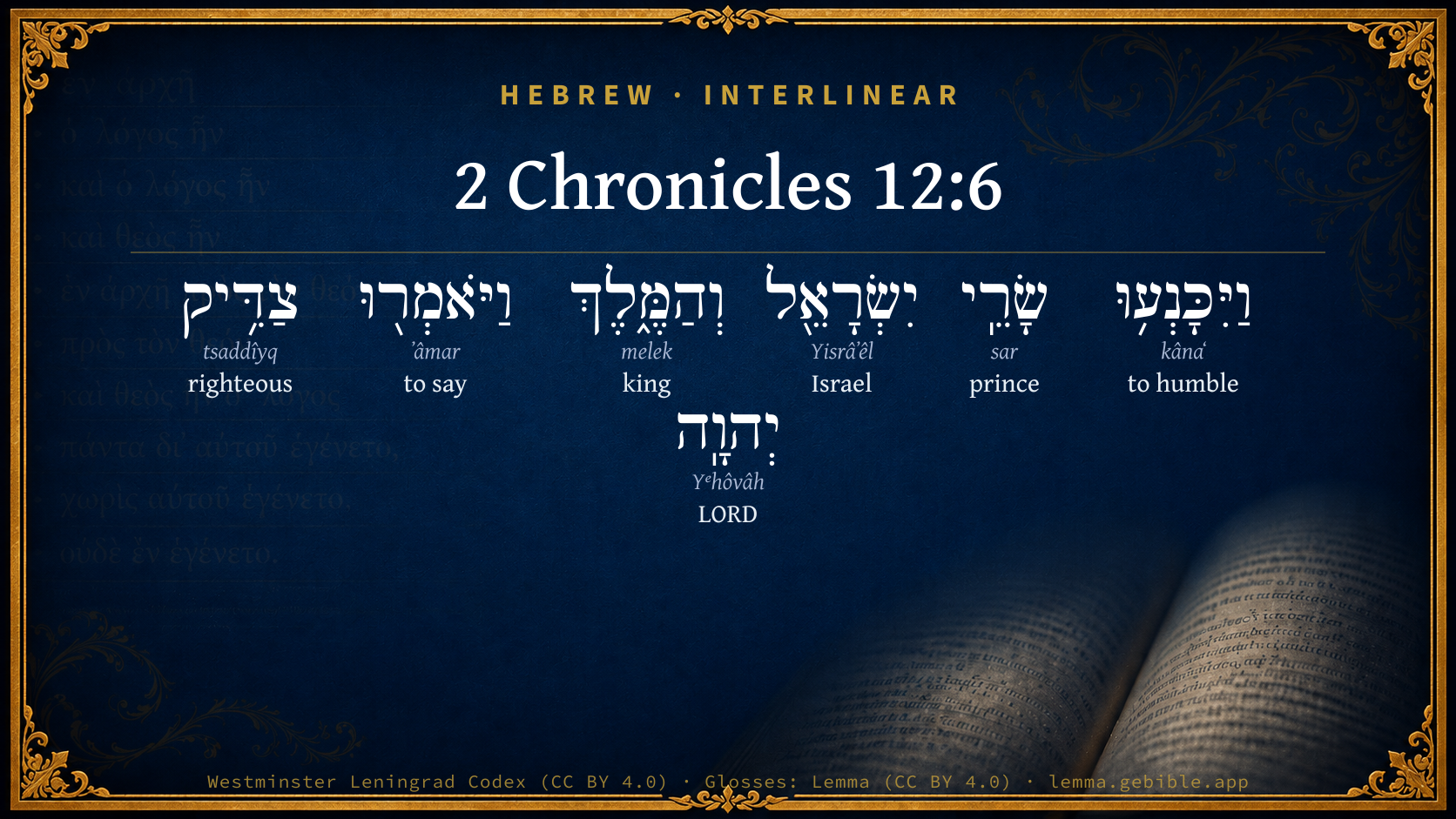
Then the princes of Israel and the king humbled themselves; and they said, Yahweh is righteous.
World English Bible · Public Domain
Download a study sheet

One document with this verse’s original text, its word-by-word gloss line, the meaning frame, cross-references with their text, attributed commentary, and full source and license credits — printable, and it pastes into notes with its structure intact.

This verse Autodidact and up

Study sheet (.html) Plain text (.txt)

A passage Seminary Student

Up to 50 verses in one chapter. A passage sheet keeps up to 6 commentary sources and 12 cross-references per verse, in the order this page ranks them, and says so on the sheet whenever that leaves anything out. Ask for a single verse and you get the Autodidact verse sheet above.

Everything on this page stays free to read, with no account — the sheet is a download of what is already on screen, not access to it.

Want to remove ads? Support Godless Engineer
Compare translations 3

The same verse in 3 English versions, stacked beneath the original-language interlinear above. Click any original word for its lexicon entry.

Each is an independent rendering of the whole verse — the interlinear is not word-aligned to these translations.

Highlighted words mark where these versions differ — a whole-verse word diff, not a word-by-word alignment.

  • World English Bible Public Domain
    Then the princes of Israel and the king humbled themselves; and they said, Yahweh is righteous.
  • King James Version Public Domain
    Whereupon the princes of Israel and the king humbled themselves; and they said, The LORD is righteous.
  • unfoldingWord Literal Text CC BY-SA 4.0
    And the chiefs of Israel and the king humbled themselves. And they said, “Righteous is Yahweh.”

unfoldingWord Literal Text — © unfoldingWord, licensed CC BY-SA 4.0. Word-aligned USFM3 via Door43 (git.door43.org/unfoldingWord/en_ult).

Versions to compare (up to 4)

3 of 4 selected

Show all 18 translations

Every available English version of this verse, each an independent rendering of the whole verse.

  • World English Bible Public Domain
    Then the princes of Israel and the king humbled themselves; and they said, Yahweh is righteous.
  • Berean Standard Bible Public Domain
    So the leaders of Israel and the king humbled themselves and said, “The LORD is righteous.”
  • Majority Standard Bible Public Domain
    So the leaders of Israel and the king humbled themselves and said, “The LORD is righteous.”
  • King James Version Public Domain
    Whereupon the princes of Israel and the king humbled themselves; and they said, The LORD is righteous.
  • American Standard Version (1901) Public Domain
    Then the princes of Israel and the king humbled themselves; and they said, Jehovah is righteous.
  • Revised Version (1885) Public Domain
    Then the princes of Israel and the king humbled themselves; and they said, The LORD is righteous.
  • Geneva Bible (1599) Public Domain
    Then the princes of Israel, and the King humbled themselues, and sayde, The Lord is iust.
  • Douay-Rheims (1899) Public Domain
    And the princes of Israel, and the king, being in a consternation, said: The Lord is just.
  • Young's Literal Translation Public Domain
    and the heads of Israel are humbled, and the king, and they say, `Righteous `is' Jehovah.'
  • Literal Standard Version CC BY-SA 4.0
    and the heads of Israel are humbled—and the king—and they say, “YHWH [is] righteous.”
  • Unlocked Literal Bible CC BY-SA 4.0
    Then the princes of Israel and the king humbled themselves and said, “Yahweh is righteous.”
  • unfoldingWord Literal Text CC BY-SA 4.0
    And the chiefs of Israel and the king humbled themselves. And they said, “Righteous is Yahweh.”
  • Darby Bible Public Domain
    And the princes of Israel and the king humbled themselves; and they said, Jehovah is righteous.
  • World Messianic Bible Public Domain
    Then the princes of Israel and the king humbled themselves; and they said, “The LORD is righteous.”
  • Webster's Bible Public Domain
    Upon which the princes of Israel, and the king humbled themselves; and they said, The LORD is righteous.
  • Free Bible Version CC BY-SA 4.0
    The leaders of Israel and the king admitted they were wrong and said, “The Lord is right.”
  • Bible in Basic English Public Domain
    Then the chiefs of Israel and the king made themselves low and said, The Lord is upright.
  • JPS Tanakh (1917) Public Domain
    Then the princes of Israel and the king humbled themselves; and they said: 'The LORD is righteous.'

Literal Standard Version (2020), Covenant Press — licensed CC BY-SA 4.0. Text via the HelloAO Bible API (eBible.org). Unlocked Literal Bible (unfoldingWord) — licensed CC BY-SA 4.0. Text via the HelloAO Bible API (eBible.org). unfoldingWord Literal Text — © unfoldingWord, licensed CC BY-SA 4.0. Word-aligned USFM3 via Door43 (git.door43.org/unfoldingWord/en_ult). Free Bible Version, Dr. Jonathan Gallagher — licensed CC BY-SA 4.0. Text via the HelloAO Bible API (eBible.org).

Word by word

More ways to search: Search by grammar → Find every occurrence → Compare this word →

Practice this passage: Drill this verse → Learn its vocabulary →

וַיִּכָּנְע֥וּ
kânaʻ
H3665
“and · to humble”
Conjunction + Verb, Niphal, Sequential Imperfect, 3rd Person, Masculine, Plural
Part of Speech
Conjunction + Verb
Stem
Niphal
Form
Sequential Imperfect
Person
3rd Person
Gender
Masculine
Number
Plural
Full BDB Definition

Origin: a primitive root

TWOT: 1001

to be humble, be humbled, be subdued, be brought down, be low, be under, be brought into subjection - (Niphal) - to humble oneself - to be humbled, be subdued - (Hiphil) - to humble - to subdue
  1. שָׂרֵֽי sar H8269 “princes of” Noun, Common, Masculine, Plural, Construct
  2. יִשְׂרָאֵ֖ל Yisrâʼêl H3478 “Israel” Noun, Proper
  3. וְהַמֶּ֑לֶךְ melek H4428 “and · the · king” Conjunction + Particle, Definite Article + Noun, Common, Masculine, Singular, Absolute
  4. וַיֹּאמְר֖וּ ʼâmar H559 “and · to say” Conjunction + Verb, Qal, Sequential Imperfect, 3rd Person, Masculine, Plural
  5. צַדִּ֥יק tsaddîyq H6662 “righteous” Adjective, Adjective, Masculine, Singular, Absolute
  6. יְהוָֽה Yᵉhôvâh H3068 “LORD” Noun, Proper

About this verse

These counts appear in no published source. They are computed here, from the morphology-tagged text and Lemma’s own curated glosses. What Lemma adds →

7
words
7
distinct lemmas
Historical
section

Shared distinctive vocabulary

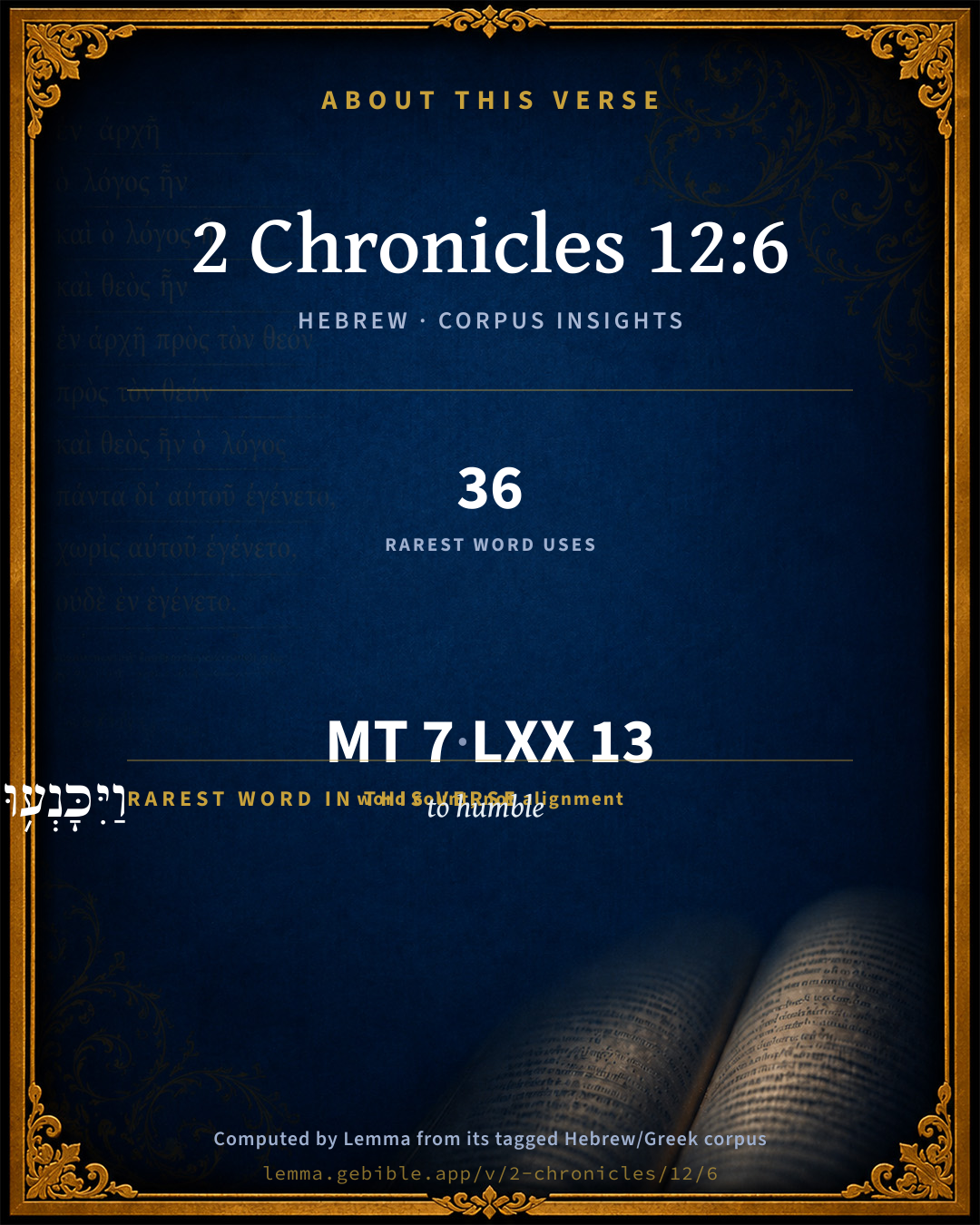
וַיִּכָּנְע֥וּ to humble H3665 occurs in 32 verses of the Hebrew Bible. Also found in:

Grammatical profile

  • 2 verbs
  • 4 nouns
  • 1 adjective

Verb forms

  • וַיִּכָּנְע֥וּ Niphal · Sequential Imperfect
  • וַיֹּאמְר֖וּ Qal · Sequential Imperfect

Hebrew & Septuagint length

In English translation the verse runs 16 words from the Hebrew and 16 from the Septuagint (LXX English) — the same length.

A rough comparison of the two English renderings, which tokenize alike — not a word-level alignment.

Word counts can differ between the Hebrew and the Greek without any difference in meaning — e.g. the Hebrew direct-object marker אֵת has no separate Greek word, and Greek often adds the article ὁ.

In the original languages it is 7 Hebrew tokens and 13 Greek tokens — but the two are counted differently (Hebrew bundles its prefixes and suffixes into one token; the Greek is in lemma form), so that isn’t a like-for-like length.

Cross-references

23

Topical passages linked to 2 Chronicles 12:6 in the Treasury of Scripture Knowledge — connected by theme and wording, ordered by reader-vote popularity; previews shown in the World English Bible.

  • Exodus 9:27 Pharaoh sent, and called for Moses and Aaron, and said to them, "I have sinned this time. Yahweh is righteous, and I and my people are wicked.
  • Daniel 9:14 Therefore has Yahweh watched over the evil, and brought it on us; for Yahweh our God is righteous in all his works which he does, and we have not obeyed his voice.
  • Exodus 10:3 Moses and Aaron went in to Pharaoh, and said to him, "This is what Yahweh, the God of the Hebrews, says: 'How long will you refuse to humble yourself before me? Let my people go, that they may serve me.
  • Judges 1:7 Adoni-bezek said, "Seventy kings, having their thumbs and their great toes cut off, gathered [their food] under my table: as I have done, so God has requited me." They brought him to Jerusalem, and he died there.
  • 1 Kings 8:37–39 If there be in the land famine, if there be pestilence, if there be blasting [or] mildew, locust [or] caterpillar; if their enemy besiege them in the land of their cities; whatever plague, whatever sickness there be;
  • 2 Chronicles 32:26 Notwithstanding Hezekiah humbled himself for the pride of his heart, both he and the inhabitants of Jerusalem, so that the wrath of Yahweh didn't come on them in the days of Hezekiah.
  • 2 Chronicles 33:12 When he was in distress, he begged Yahweh his God, and humbled himself greatly before the God of his fathers.
  • 2 Chronicles 33:19 His prayer also, and how [God] was entreated of him, and all his sin and his trespass, and the places in which he built high places, and set up the Asherim and the engraved images, before he humbled himself: behold, they are written in the history of Hozai.
  • 2 Chronicles 33:23 He didn't humble himself before Yahweh, as Manasseh his father had humbled himself; but this same Amon trespassed more and more.
  • Job 33:27 He sings before men, and says, 'I have sinned, and perverted that which was right, And it didn't profit me.
  • Psalms 78:34–35 When he killed them, then they inquired after him. They returned and sought God earnestly.
  • Psalms 129:4 Yahweh is righteous. He has cut apart the cords of the wicked.
  • Jeremiah 13:15 Hear you, and give ear; don't be proud; for Yahweh has spoken.
  • Jeremiah 13:18 Say you to the king and to the queen-mother, Humble yourselves, sit down; for your headdresses are come down, even the crown of your glory.
  • Jeremiah 44:10 They are not humbled even to this day, neither have they feared, nor walked in my law, nor in my statutes, that I set before you and before your fathers.
  • Lamentations 1:18 Yahweh is righteous; for I have rebelled against his commandment: Please hear all you peoples, and see my sorrow: My virgins and my young men are gone into captivity.
  • Daniel 5:22 You his son, Belshazzar, have not humbled your heart, though you knew all this,
  • Hosea 5:15 I will go and return to my place, until they acknowledge their offense, And seek my face. In their affliction they will seek me earnestly."
  • Luke 18:14 I tell you, this man went down to his house justified rather than the other; for everyone who exalts himself will be humbled, but he who humbles himself will be exalted."
  • Romans 10:3 For being ignorant of God's righteousness, and seeking to establish their own righteousness, they didn't subject themselves to the righteousness of God.
  • James 4:6 But he gives more grace. Therefore it says, "God resists the proud, but gives grace to the humble."
  • James 4:10 Humble yourselves in the sight of the Lord, and he will exalt you.
  • Leviticus 26:40–41 "'If they confess their iniquity, and the iniquity of their fathers, in their trespass which they trespassed against me, and also that, because they walked contrary to me,

Cross-references courtesy of OpenBible.info (CC BY 4.0).

Hebrew and Greek witnesses Masoretic Hebrew ↔ Greek Septuagint

The same verse in the two great witnesses to the Old Testament, shown verse-for-verse.

These are two independent witnesses, not word-aligned to each other, and the Septuagint is shown in lemma (dictionary) form.

Hebrew 2 Chronicles 12:6 Masoretic · Westminster Leningrad Codex

וַיִּכָּנְע֥וּ שָׂרֵֽי יִשְׂרָאֵ֖ל וְהַמֶּ֑לֶךְ וַיֹּאמְר֖וּ צַדִּ֥יק יְהוָֽה

Then the princes of Israel and the king humbled themselves; and they said, Yahweh is righteous.

World English Bible · Public Domain

Greek LXX 2 Chronicles 12:6 Septuagint · lemma form

καί αἰσχύνω ὁ ἄρχων ἰσραήλ καί ὁ βασιλεύς καί εἶπον δίκαιος ὁ κύριος

And the elders of Israel and the king were ashamed, and said, The Lord is righteous.

LXX2012 (modern English Septuagint) · Public Domain

Hebrew: Westminster Leningrad Codex (CC BY 4.0). Greek: Septuagint (public domain); English from LXX2012 (modern English Septuagint) (Public Domain). How the Septuagint differs from the Hebrew →

Commentary

Notes on 2 Chronicles 12:6 from classic Christian and Jewish commentators (each source and its license shown beneath its notes). The classic Christian expositions comment on the surrounding passage and are grouped to its opening verse, so a note may address several verses; the Jewish commentaries on the Tanakh (Rashi and others) are per-verse, so they appear only where the commentator wrote on this verse.

Lemma curates 59 commentaries, every one of them public domain or Creative Commons licensed, each selected and text-cleaned for this edition rather than reprinted as found. About our sources →

Trapp's Complete Commentary

John Trapp

2Ch 12:6 Whereupon the princes of Israel and the king humbled themselves; and they said, The LORD [is] righteous.

Ver. 6. Whereupon the princes of Israel.] That is, Of Judah, as 2Ch 12:1.

And the king humbled themselves.] But feignedly and forcedly, {see 2Ch 12:14} as was that of Pharaoh and Ahab.

John Trapp, A Commentary or Exposition upon All the Books of the Old and New Testament (1647–1656) — public domain. Text from a community e-Sword module.

Joseph Benson's Commentary

2Ch 12:6. Whereupon the princes and the king humbled themselves — They penitentially acknowledged their sin, and patiently accepted the punishment of it, saying, The Lord is righteous — We have none to blame but ourselves: let God be clear when he is judged. Thus it becomes us, when we are under the rebukes of divine providence, to justify God, and judge ourselves. “Even princes and kings,” says Henry, “must either bend or break; either be humbled or ruined.”

Joseph Benson's Commentary on the Old and New Testaments (1811–1818) — public domain. Text from a community e-Sword module.

Tyndale Open Study Notes

Tyndale Open Resources

12:6-7 Shemaiah’s speech expresses the elements required in Solomon’s prayer at the dedication of the Temple (7:14). The leaders of Israel . . . humbled themselves, and the wrath of judgment was removed from Jerusalem.

Tyndale Open Study Notes — © Tyndale Open Resources, licensed CC BY-SA 4.0. Text via the HelloAO Bible API.

Geneva Bible (1599)

Geneva Bible translators

And therefore doth justly punish you for your sins.

Geneva Bible (1599) marginal notes — public domain. Text via Bolls.life.

Jamieson, Fausset & Brown

Robert Jamieson, A. R. Fausset & David Brown

the princes of Israel--(compare Ch2 12:5, "the princes of Judah").

Jamieson, Fausset & Brown — Commentary Critical and Explanatory on the Whole Bible (1871) — public domain (CC PDM 1.0). Text via the HelloAO Bible API.

Adam Clarke's Commentary

Verse 6. Whereupon the princes of Israel and the king humbled themselves] This is not mentioned in the parallel place, 1Kg 14:25-29: this was the sole reason why Jerusalem was not at this time totally destroyed, and the house of David entirely cut off; for they were totally incapable of defending themselves against this innumerable host.

Adam Clarke's Commentary on the Bible (1810–1826) — public domain. Text from a community e-Sword/MySword module.

Ellicott's Commentary for English Readers

(6) Whereupon.—And.

The princes of Israel.—See Note on 2Ch_12:1. “princes of Judah “. (2Ch_12:5) is the meaning.

Humbled themselves.—Literally, bowed (2Ch_7:14). (Comp. Jon_3:5-6.)

The Lord is righteous.—Comp. Exo_9:27 (the exclamation of Pharaoh); and Ezr_9:15.

A Bible Commentary for English Readers, edited by Charles John Ellicott (1878–1897) — public domain. Text from a community e-Sword module.

The Cambridge Bible for Schools and Colleges

gen. ed. J. J. S. Perowne

6. Whereupon] R.V. Then.

princes of Israel] Called “princes of Judah” in 2Ch_12:5; cp. note on 2Ch_11:3.

humbled themselves] i.e. they fasted and put on sackcloth; cp. 1Ki_21:27; 1Ki_21:29.

The Lord is righteous] Cp. Pharaoh’s confession (Exo_9:27), and the Psalmist’s address to God, “That thou mayest be justified (lit. “mayest be righteous”) when thou speakest, and be clear when thou judgest” (Psa_51:4). The “righteousness” of God is made known to man in His judgment whether the judgment be of condemnation (as here) or of acquittal (as 1Jn_1:9, R.V.).

The Cambridge Bible for Schools and Colleges (gen. ed. J. J. S. Perowne; Cambridge University Press, 1878–1918) — public domain. Text from a community e-Sword module.

John Gill's Exposition

Whereupon the princes of Israel and the king humbled themselves,.... Both by words acknowledging their sins, and the justice of God, and by deeds, perhaps putting on sackcloth, as was usual on such occasions, and betaking themselves to fasting and prayer:

and they said, the Lord is righteous; in giving them up into the hand of their enemies, seeing they had forsaken him, and sinned against him.

John Gill's Exposition of the Whole Bible (1746–1763) — public domain (CC PDM 1.0). Text via the HelloAO Bible API.

Albert Barnes' Notes on the Bible

They said, The Lord is righteous - i. e., they acknowledged the justice of the sentence which had gone forth against them 2Ch 12:5.

Albert Barnes' Notes on the Bible (1834–1885) — public domain. Text from a community e-Sword/MySword module.

The Pulpit Commentary

Note, as very apt parallel passages, (Jer_13:15, Jer_13:18; Exo_9:27.

The Pulpit Commentary (1880–1919), ed. H.D.M. Spence-Jones & Joseph S. Exell — public domain. Text from a community e-Sword module.

Lesson kit

Teaching starters — assembled from the data on this page, not authored interpretation. Every prompt links to the verse data it draws on. Edit before teaching.

2 Chronicles, in the Historical, opens this verse with 7 words (7 distinct Hebrew lemmas). Its most distinctive word is kânaʻ (“to humble”). A historical commentator’s framing appears above. Read the whole chapter for the surrounding context.

Discussion questions

  1. The word kânaʻ carries the sense “to humble.” How does it shape the verse?
  2. How does Leviticus 26:41, which shares the word «to humble», read alongside this verse?
  3. These translations render this verse differently; the difference is in the English rendering, not the original. What questions does that raise?
  4. «וַיִּכָּנְע֥וּ» is a Niphal Sequential Imperfect verb. How does that grammatical form shape the action described?
  5. Compare how Trapp's Complete Commentary and Joseph Benson's Commentary read this verse. Where do they agree or differ?

Things to notice

Reading settings

Reading text

Shown beneath each verse's original-language words.

Old Testament
Old Testament edition

Read the OT as the Masoretic Hebrew (MT) or the Greek Septuagint (LXX).

English shown for the Greek Septuagint (in the Hebrew ↔ Greek comparison).

Comparing translations? Open the Compare panel on any verse page to stack up to four side by side.