Isaiah 23:8

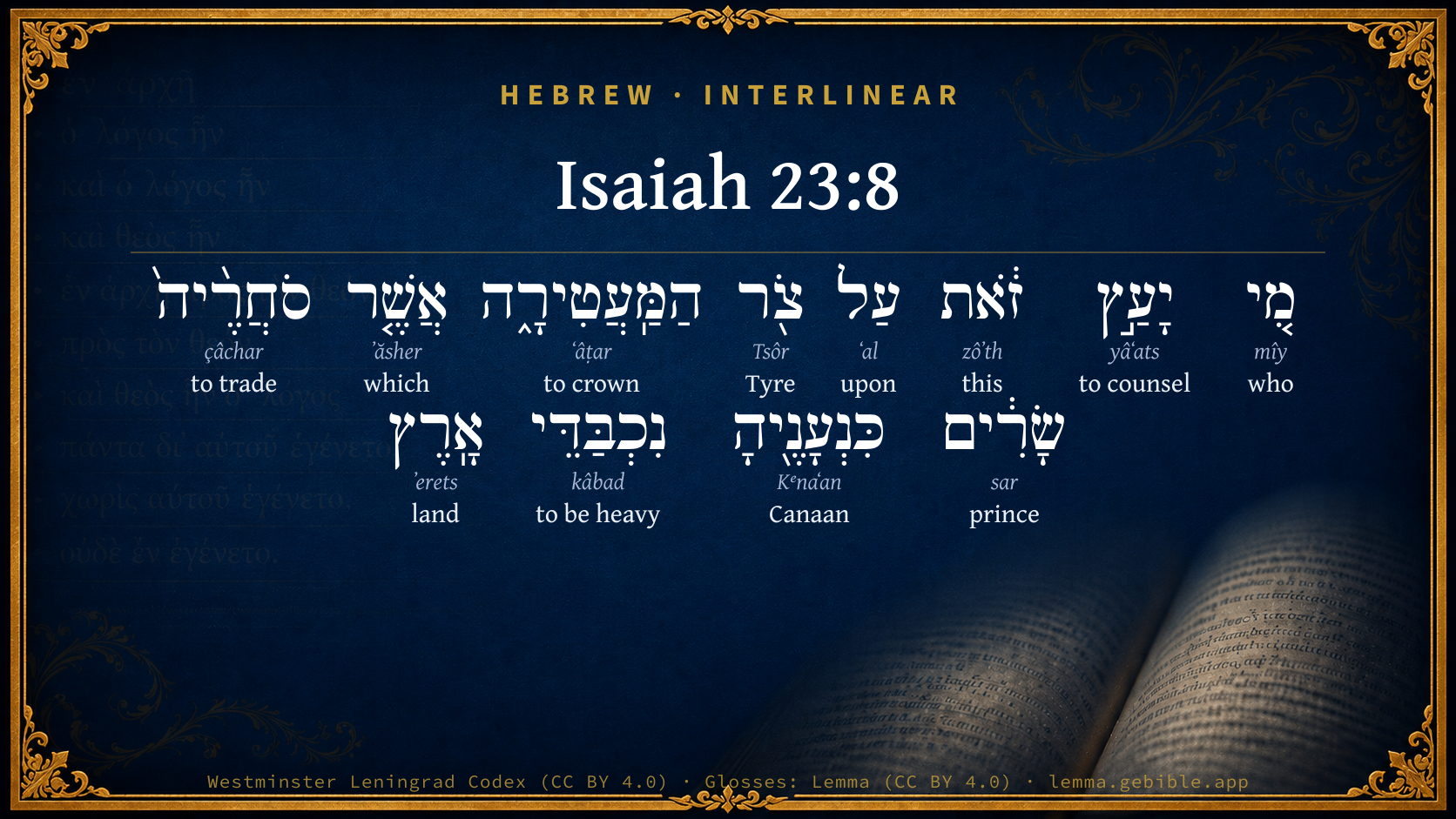
Hebrew (Westminster Leningrad Codex) Isaiah 23:8 appears in the Hebrew Old Testament. The text above is from the Westminster Leningrad Codex. Each word links to its Strong’s number, a concise gloss, and parsing drawn from the Open Scriptures Hebrew Bible morphology. Click any word for its full Brown-Driver-Briggs (BDB) entry.
Download image
Cite this verse

Isaiah 23:8 (World English Bible). Public Domain. Lemma interlinear Bible study tool, https://lemma.gebible.app/v/isaiah/23/8.

Show BibTeX & RIS
BibTeX
RIS
English Translation
Who has purposed this against Tyre, the giver of crowns, whose merchants are princes, whose traffickers are the honorable of the earth?
World English Bible · Public Domain
Download a study sheet

One document with this verse’s original text, its word-by-word gloss line, the meaning frame, cross-references with their text, attributed commentary, and full source and license credits — printable, and it pastes into notes with its structure intact.

This verse Autodidact and up

Study sheet (.html) Plain text (.txt)

A passage Seminary Student

Up to 50 verses in one chapter. A passage sheet keeps up to 6 commentary sources and 12 cross-references per verse, in the order this page ranks them, and says so on the sheet whenever that leaves anything out. Ask for a single verse and you get the Autodidact verse sheet above.

Everything on this page stays free to read, with no account — the sheet is a download of what is already on screen, not access to it.

Want to remove ads? Support Godless Engineer
Compare translations 3

The same verse in 3 English versions, stacked beneath the original-language interlinear above. Click any original word for its lexicon entry.

Each is an independent rendering of the whole verse — the interlinear is not word-aligned to these translations.

Highlighted words mark where these versions differ — a whole-verse word diff, not a word-by-word alignment.

  • World English Bible Public Domain
    Who has purposed this against Tyre, the giver of crowns, whose merchants are princes, whose traffickers are the honorable of the earth?
  • King James Version Public Domain
    Who hath taken this counsel against Tyre, the crowning city, whose merchants are princes, whose traffickers are the honourable of the earth?
  • unfoldingWord Literal Text CC BY-SA 4.0
    Who determined this against Tyre, the one crowning, whose merchants princes, whose traders honored ones of the earth?

unfoldingWord Literal Text — © unfoldingWord, licensed CC BY-SA 4.0. Word-aligned USFM3 via Door43 (git.door43.org/unfoldingWord/en_ult).

Versions to compare (up to 4)

3 of 4 selected

Show all 18 translations

Every available English version of this verse, each an independent rendering of the whole verse.

  • World English Bible Public Domain
    Who has purposed this against Tyre, the giver of crowns, whose merchants are princes, whose traffickers are the honorable of the earth?
  • Berean Standard Bible Public Domain
    Who planned this against Tyre, the bestower of crowns, whose traders are princes, whose merchants are renowned on the earth?
  • Majority Standard Bible Public Domain
    Who planned this against Tyre, the bestower of crowns, whose traders are princes, whose merchants are renowned on the earth?
  • King James Version Public Domain
    Who hath taken this counsel against Tyre, the crowning city, whose merchants are princes, whose traffickers are the honourable of the earth?
  • American Standard Version (1901) Public Domain
    Who hath purposed this against Tyre, the bestower of crowns, whose merchants are princes, whose traffickers are the honorable of the earth?
  • Revised Version (1885) Public Domain
    Who hath purposed this against Tyre, the crowning city, whose merchants are princes, whose traffickers are the honourable of the earth?
  • Geneva Bible (1599) Public Domain
    Who hath decreed this against Tyrus (that crowneth men) whose marchantes are princes? whose chapmen are the nobles of the worlde?
  • Douay-Rheims (1899) Public Domain
    Who hath taken this counsel against Tyre, that was formerly crowned, whose merchants were princes, and her traders the nobles of the earth?
  • Young's Literal Translation Public Domain
    Who hath counselled this against Tyre, The crowning one, whose traders `are' princes, Her merchants the honoured of earth?'
  • Literal Standard Version CC BY-SA 4.0
    Who has counseled this against Tyre, || The crowning one, whose traders [are] princes, || Her merchants—the honored of earth?
  • Unlocked Literal Bible CC BY-SA 4.0
    Who has planned this against Tyre, the giver of crowns, whose merchants are princes, whose traders are the honored ones of the earth?
  • unfoldingWord Literal Text CC BY-SA 4.0
    Who determined this against Tyre, the one crowning, whose merchants princes, whose traders honored ones of the earth?
  • Darby Bible Public Domain
    Who hath purposed this against Tyre, the distributor of crowns, whose merchants were princes, whose dealers were the honourable of the earth?
  • World Messianic Bible Public Domain
    Who has planned this against Tyre, the giver of crowns, whose merchants are princes, whose traders are the honorable of the earth?
  • Webster's Bible Public Domain
    Who hath taken this counsel against Tyre, the crowning city, whose merchants are princes, whose traders are the honorable of the earth?
  • Free Bible Version CC BY-SA 4.0
    Who planned this attack on Tyre? Tyre, who created kingdoms, whose merchants were princes, whose traders were honored around the world!
  • Bible in Basic English Public Domain
    By whom was this purposed against Tyre, the crowning town, whose traders are chiefs, whose business men are honoured in the land?
  • JPS Tanakh (1917) Public Domain
    Who hath devised this against Tyre, the crowning city, whose merchants are princes, whose traffickers are the honourable of the earth?

Literal Standard Version (2020), Covenant Press — licensed CC BY-SA 4.0. Text via the HelloAO Bible API (eBible.org). Unlocked Literal Bible (unfoldingWord) — licensed CC BY-SA 4.0. Text via the HelloAO Bible API (eBible.org). unfoldingWord Literal Text — © unfoldingWord, licensed CC BY-SA 4.0. Word-aligned USFM3 via Door43 (git.door43.org/unfoldingWord/en_ult). Free Bible Version, Dr. Jonathan Gallagher — licensed CC BY-SA 4.0. Text via the HelloAO Bible API (eBible.org).

Word by word

More ways to search: Search by grammar → Find every occurrence → Compare this word →

Practice this passage: Drill this verse → Learn its vocabulary →

הַמַּֽעֲטִירָ֑ה
ʻâṭar
H5849
“the · crowning”
Particle, Definite Article + Verb, Hiphil, Participle Active, Feminine, Singular, Absolute
Part of Speech
Particle + Verb
Stem
Hiphil
Form
Participle Active
Gender
Feminine
Number
Singular
State
Absolute
Full BDB Definition

Origin: a primitive root

TWOT: 1608 , 1608b

to surround - (Qal) to surround - to crown, give a crown - (Piel) to crown - (Hiphil) crown-bestower (participle)
  1. מִ֚י mîy H4310 “who” Particle, Interrogative
  2. יָעַ֣ץ yâʻats H3289 “to counsel” Verb, Qal, Perfect, 3rd Person, Masculine, Singular
  3. זֹ֔את zôʼth H2063 “this” Pronoun, Demonstrative, Feminine, Singular
  4. עַל ʻal H5921 “upon” Preposition
  5. צֹ֖ר Tsôr H6865 “Tyre” Noun, Proper
  6. אֲשֶׁ֤ר ʼăsher H834 “which” Particle, Relative
  7. סֹחֲרֶ֨יה֙ çâchar H5503 “trading · her” Verb, Qal, Participle Active, Masculine, Plural, Construct + Suffix, Personal, 3rd Person, Feminine, Singular
  8. שָׂרִ֔ים sar H8269 “princes” Noun, Common, Masculine, Plural, Absolute
  9. כִּנְעָנֶ֖יהָ Kᵉnaʻan H3667 “merchants · her” Noun, Common, Masculine, Plural, Construct + Suffix, Personal, 3rd Person, Feminine, Singular
  10. נִכְבַּדֵּי kâbad H3513 “being heavy” Verb, Niphal, Participle Active, Masculine, Plural, Construct
  11. אָֽרֶץ ʼerets H776 “land” Noun, Common, Both, Singular, Absolute

About this verse

These counts appear in no published source. They are computed here, from the morphology-tagged text and Lemma’s own curated glosses. What Lemma adds →

12
words
12
distinct lemmas
Prophets
section

Notable vocabulary

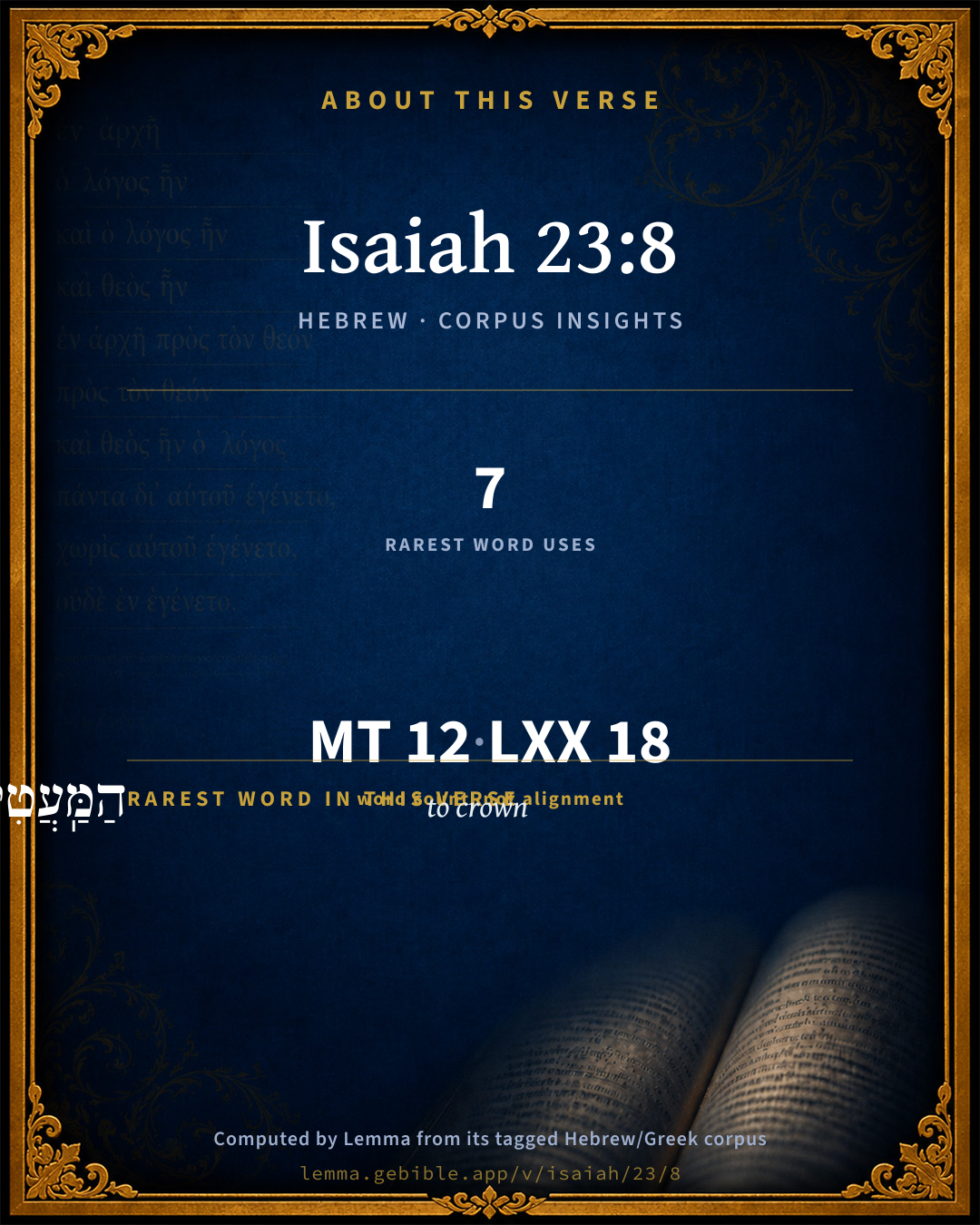
The rarest word here is הַמַּֽעֲטִירָ֑ה to crown H5849 — appearing just 7 times in the whole Hebrew Bible.

Shared distinctive vocabulary

הַמַּֽעֲטִירָ֑ה to crown H5849 occurs in 7 verses of the Hebrew Bible. Also found in:

Grammatical profile

  • 4 verbs
  • 4 nouns
  • 1 pronoun
  • 1 preposition
  • 2 particles

Verb forms

  • יָעַ֣ץ Qal · Perfect
  • הַמַּֽעֲטִירָ֑ה Hiphil · Participle Active
  • סֹחֲרֶ֨יה֙ Qal · Participle Active
  • נִכְבַּדֵּי Niphal · Participle Active

Hebrew & Septuagint length

In English translation the verse runs 22 words from the Hebrew and 24 from the Septuagint (LXX English) — closely comparable.

A rough comparison of the two English renderings, which tokenize alike — not a word-level alignment.

Word counts can differ between the Hebrew and the Greek without any difference in meaning — e.g. the Hebrew direct-object marker אֵת has no separate Greek word, and Greek often adds the article ὁ.

In the original languages it is 12 Hebrew tokens and 18 Greek tokens — but the two are counted differently (Hebrew bundles its prefixes and suffixes into one token; the Greek is in lemma form), so that isn’t a like-for-like length.

Cross-references

7

Topical passages linked to Isaiah 23:8 in the Treasury of Scripture Knowledge — connected by theme and wording, ordered by reader-vote popularity; previews shown in the World English Bible.

  • Deuteronomy 29:24–28 even all the nations shall say, Why has Yahweh done thus to this land? what means the heat of this great anger?
  • Isaiah 10:8 For he says, Aren't my princes all of them kings?
  • Isaiah 36:9 How then can you turn away the face of one captain of the least of my master's servants, and put your trust on Egypt for chariots and for horsemen?
  • Jeremiah 50:44–45 Behold, [the enemy] shall come up like a lion from the pride of the Jordan against the strong habitation: for I will suddenly make them run away from it; and whoever is chosen, him will I appoint over it: for who is like me? and who will appoint me a time? and who is the shepherd who can stand before me?
  • Ezekiel 28:2–6 Son of man, tell the prince of Tyre, Thus says the Lord Yahweh: Because your heart is lifted up, and you have said, I am a god, I sit in the seat of God, in the midst of the seas; yet you are man, and not God, though you did set your heart as the heart of God;-
  • Ezekiel 28:12–18 Son of man, take up a lamentation over the king of Tyre, and tell him, Thus says the Lord Yahweh: You seal up the sum, full of wisdom, and perfect in beauty.
  • Revelation 18:8 Therefore in one day her plagues will come: death, mourning, and famine; and she will be utterly burned with fire; for the Lord God who has judged her is strong.

Cross-references courtesy of OpenBible.info (CC BY 4.0).

Hebrew and Greek witnesses Masoretic Hebrew ↔ Greek Septuagint

The same verse in the two great witnesses to the Old Testament, shown verse-for-verse.

These are two independent witnesses, not word-aligned to each other, and the Septuagint is shown in lemma (dictionary) form.

Hebrew Isaiah 23:8 Masoretic · Westminster Leningrad Codex

מִ֚י יָעַ֣ץ זֹ֔את עַל צֹ֖ר הַמַּֽעֲטִירָ֑ה אֲשֶׁ֤ר סֹחֲרֶ֨יה֙ שָׂרִ֔ים כִּנְעָנֶ֖יהָ נִכְבַּדֵּי אָֽרֶץ

Who has purposed this against Tyre, the giver of crowns, whose merchants are princes, whose traffickers are the honorable of the earth?

World English Bible · Public Domain

Greek LXX Isaiah 23:8 Septuagint · lemma form

τίς οὗτος βουλεύω ἐπί τύρος μή ἥσσων εἰμί ἤ οὐ ἰσχύω ὁ ἔμπορος αὐτός ἔνδοξος ἄρχων ὁ γῆ

Who has devised this counsel against Tyre? Is she inferior? or has she no strength? her merchants were the glorious princes of the earth.

LXX2012 (modern English Septuagint) · Public Domain

Hebrew: Westminster Leningrad Codex (CC BY 4.0). Greek: Septuagint (public domain); English from LXX2012 (modern English Septuagint) (Public Domain). How the Septuagint differs from the Hebrew →

Targum (Aramaic paraphrase)

1

The Targum is the ancient Jewish Aramaic paraphrase of the Hebrew Scriptures — an interpretive translation, not the Hebrew text itself. Onkelos (literal) and Pseudo-Jonathan (expansive) render the Torah, and Jonathan the Prophets. Coverage is partial: where no permissively-licensed English translation exists for a verse, only the Aramaic is shown. This is verse-level text, not a word-by-word alignment to the Hebrew.

  1. Targum Jonathan Prophets (Joshua–Malachi)
    מַן מְלִיךְ דָא עַל צוֹר דַהֲיַת מְמַלְכָּא מַלְכִין דִי תַגָרָהָא רַבְרְבִין שִׁלְטוֹנָאָה יְקִירֵי אַרְעָא:

    Who hath taken this counsel against Tyre, against her that was giving advice? whose merchants are princes, and whose rulers the nobles of the land.

    Targum Jonathan — Aramaic: “Mikraot Gedolot” (public domain). English: “Sefaria Community Translation” (CC0 1.0 (public-domain dedication)); “London "Chaldee Paraphrase," 1871” (public domain). Text via Sefaria.

Commentary

Notes on Isaiah 23:8 from classic Christian and Jewish commentators (each source and its license shown beneath its notes). The classic Christian expositions comment on the surrounding passage and are grouped to its opening verse, so a note may address several verses; the Jewish commentaries on the Tanakh (Rashi and others) are per-verse, so they appear only where the commentator wrote on this verse.

Lemma curates 59 commentaries, every one of them public domain or Creative Commons licensed, each selected and text-cleaned for this edition rather than reprinted as found. About our sources →

Trapp's Complete Commentary

John Trapp

Isa 23:8 Who hath taken this counsel against Tyre, the crowning [city], whose merchants [are] princes, whose traffickers [are] the honourable of the earth?

Ver. 8. The crowning city.] Heb., The crowning or crowned: a city of kings, {a} as Cyneas once said of Rome, This is a style better befitting heaven and the crowned saints there.

Whose merchants are princes.] Little kings, as we say. So they are at Venice; so the Hogens Moghens of the Netherlands.

{a} Vidi civitatem regum. See the state of kings.

John Trapp, A Commentary or Exposition upon All the Books of the Old and New Testament (1647–1656) — public domain. Text from a community e-Sword module.

The Biblical Illustrator

Joseph S. Exell

Isa_23:8

Tyre, the crowning city, whose merchants are princes

Tyre, the crowning city

The speaker cannot drop his satire: he has got accustomed to it now; he is in his best vein of mockery.

The crowning city was Tyre because she distributed crowns to the Phoenician colonies,--so to say, she kept a whole cupboard full of crowns, and took one outafter another, and gave to the little colonies that they might play at being kingdoms (Eze_27:23-25). (J. Parker, D. D.)

The ancient estimate of trade

This passage reveals to us the estimation in which merchants were held in ancient time. Tyre was celebrated for her commerce. Her traders were renowned because of their wealth. The treasure they amassed gave them rank and position. They were influential and honoured. Trade was not regarded in old time as a menial, but a noble pursuit. The ambitious entered into it as a means to gratify their ambition. It furnished them with a field in which to exercise their faculties and develop their powers. Subsequently the sword gave rank and power,--valour, and not ability, lifted men to thrones: but before the feudal age, in the ancient time, and among the older civilisations, merchants were princes, and traffickers were the honourable of the earth. (W. H. Murray.)

The origin of commerce

It is not difficult to ascertain the origin of commerce. It was born of mens necessities, and was characterised by the spirit of accommodation. Its birth dates back to the first family that existed on the earth. One had what another needed, and for it he had something to give in exchange. From this mutual need sprang trade. It was a family institution, a method by which the several members of the household could benefit themselves and each other. As families increased and population multiplied, trade enlarged the circle of its operations, became more complex and multiform in its action and agents, and at length grew to be a vast system of exchange; the means of universal accommodation by which every person in the community received and bestowed benefits, and acquired the facilities of a larger and happier life. But it still kept its original significance and family spirit. Such was the origin of trade. There was nothing selfish about it; it was not mercenary, it was benevolent and humane. Centuries later, when it had become a profession, and its agents a class among other classes, there was nothing in its parentage of which it need be ashamed, no reason why those who were engaged in it should not be called the honourable of the earth. (W. H. Murray.)

Trade gave birth to our modern cities

If we would realise more fully the noble part that merchants have played in the history of the world, and the close relation that commerce has always sustained to human progress, we hare only to investigate the origin of cities and consider the forces that pushed them upward in their growth. It was trade that gave birth to our modern cities; a knot of traders beneath the wails of a castle, feeding the castle and protected by it, adding booth to booth and house to house,--so cities arose, so have they been builded. The same is true today. Commercial facilities and necessities are the forces that build our cities. They represent the material forces and results of civilisation. Each city is a hive, and ships and railways are the bees that bring honey to the hive, bringing it from all the world. They fly everywhere,--these bees with sails and wheels for wings,--their flight girdles the earth, and the rush and roar of their going and returning fill the whole air. Now, cities represent progress. In them you see the results of human invention and skill. Here the artist brings his canvas and the sculptor his marble. Hero the loom is represented by the finest fabrics, and architecture lifts the pillars of her power. In cities oratory finds her school, and eloquence her platform; music her applause, and the poet his wreath. Every city is a record, a testimony, an advertisement. In its congregated forces and results you behold the people who built it. (W. H. Murray.)

Commerce and discovery

Nor would it be well to overlook the use that God has made of commerce in relation to discoveries. The pioneers of civilisation have been ships and traders. The race has, as it were, sailed to its triumphs. (W. H. Murray.)

God in commerce

I. GODS PLAN IS TO GIVE EVERY MAN WHAT HE NEEDS PHYSICALLY, MENTALLY, AND SPIRITUALLY.

II. TO REESTABLISH THE FAMILY RELATION AMONG MEN. (W. H. Murray.)

Gods design in commerce

It is not that individuals may be enriched,--that is only an accidental result, one of the minor consequences; the realobject on the part of God, the great result to be achieved, is and will be this: that every man on the face of the whole earth may be supplied with what he needs, in body, mind, and spirit, to the end that he may stand at last clothed in the original beauty and excellence, the likeness of which has for so many ages been lost from the earth. (W. H. Murray.)

Merchants

I. MANY MERCHANTS ARE MUCH TRIED WITH LIMITED CAPITAL.

II. MANY MERCHANTS ARE TEMPTED TO OVERCARE AND ANXIETY.

III. MERCHANTS ARE TEMPTED SOMETIMES TO NEGLECT THEIR HOME DUTIES.

IV. MANY MERCHANTS ARE TEMPTED TO MAKE FINANCIAL GAIN OF MORE IMPORTANCE THAN THE SOUL. (T. De Witt Talmage, D. D.)

The folly of reckless speculation

If ever tempted into reckless speculation, preach to your soul a sermon from the text: As a partridge sitteth on eggs and hatcheth them not, so riches got by fraud; a man shall leave them in the midst of his days, and at the end he shall be a fool. (T. DeWitt Talmage, D. D.)

Rivalry in business

Go where you will, in town or country, you will find half a dozen shops struggling for a custom that would only keep up one. And so they are forced to undersell one another; and, when they have got down the prices all they can by fair means, they are forced to get them lower by foul, and to sand the sugar, and sloeleaf the tea, and put, Satan--that prompts them on--knows what, into the bread; and then they dont thrive--they cant thrive. Gods curse must be on them. They began by trying to oust each other and eat each other up, and, while they are eating up their neighbours, their neighbours eat them up, and so they all come to ruin together. (C. Kingsley, M. A.)

The Biblical Illustrator, edited by Joseph S. Exell (c. 1880s–1900s) — public domain. Text from a community e-Sword module.

Joseph Benson's Commentary

Isa 23:8-9. Who hath taken this counsel against Tyre? — Words of admiration. Who, and where, is he that could imagine, or durst attempt such a thing as this? This is the work of God, and not of man. The crowning city — Which was a royal city, and carried away the crown from all other cities: whose merchants are princes — Equal to princes for wealth, and power, and reputation. The Lord of hosts hath purposed it — This is the Lord’s own doing; to stain the pride of all glory — God’s design is, by this example, to abase the pride of all the potentates of the earth, that they may see how weak they are when he sets himself against them.

Joseph Benson's Commentary on the Old and New Testaments (1811–1818) — public domain. Text from a community e-Sword module.

Tyndale Open Study Notes

Tyndale Open Resources

23:8 The Lord had brought this disaster on Tyre (23:9). • Through commercial links, Tyre had created wealth for itself and its trading partners; in this sense, Tyre was a great creator of kingdoms.

Tyndale Open Study Notes — © Tyndale Open Resources, licensed CC BY-SA 4.0. Text via the HelloAO Bible API.

Geneva Bible (1599)

Geneva Bible translators

Who maketh her merchants like princes.

Geneva Bible (1599) marginal notes — public domain. Text via Bolls.life.

Jamieson, Fausset & Brown

Robert Jamieson, A. R. Fausset & David Brown

Who--answered in Isa 23:9, "The Lord of hosts."

crowning--crown-giving; that is, the city from which dependent kingdoms had arisen, as Tartessus in Spain, Citium in Cyprus, and Carthage in Africa (Eze 27:33).

traffickers--literally, "Canaanites," who were famed for commerce (compare Hos 12:7, Margin).

Jamieson, Fausset & Brown — Commentary Critical and Explanatory on the Whole Bible (1871) — public domain (CC PDM 1.0). Text via the HelloAO Bible API.

Ellicott's Commentary for English Readers

(8) The crowning city.—The participle is strictly transitive in its force. Tyre was the distributor of crowns to the Phœnician colonies. The Vulg., however, gives “crowned.”

Whose merchants are princes.—It is a fact worth noting in the history of language that the word for “merchants” here, and in Hos_12:7; Pro_31:24, is the same as that for Canaanite. The traffickers of the earth were pre-eminently of that race.

A Bible Commentary for English Readers, edited by Charles John Ellicott (1878–1897) — public domain. Text from a community e-Sword module.

The Cambridge Bible for Schools and Colleges

gen. ed. J. J. S. Perowne

8, 9. This is the execution of Jehovah’s purpose, and therefore irreversible.

the crowning city] Or, the crown-giver. Tyre is rightly so-called, inasmuch as some of her colonies (Kition, Tarshish and Carthage) were ruled by kings, subject to the mother-city.

whose traffickers] The word is probably the gentilic noun “Canaanite” which is used with the sense of “trader” in Job_41:6 [Heb. 40:30]; Pro_31:24; Zec_14:21, as the collective name “Canaan” is in older passages (Hos_12:7; Zep_1:11). It was of course from the commercial proclivities of the Phœnicians themselves that the word acquired this secondary significance amongst the Hebrews. The petty trade of Palestine seems to have been largely in the hands of Tyrian dealers (Neh_13:16 ff.) and hence a Canaanite came to mean a merchant, just as a Chaldæan came to mean an astrologer and a Scotchman in some parts of England meant a pedlar.

The Cambridge Bible for Schools and Colleges (gen. ed. J. J. S. Perowne; Cambridge University Press, 1878–1918) — public domain. Text from a community e-Sword module.

John Gill's Exposition

Who hath taken this counsel against Tyre, the crowning city,.... Which had a king over it, to whom it gave a crown; and which crowned its inhabitants with riches and plenty, and even enriched the kings of the earth, Eze 27:33 this is said as wondering who could lay a scheme to destroy such a city, or ever think of succeeding in it; who could take it into his head, or how could it enter into his heart, or who could have a heart to go about it, and still less power to effect the ruin of such a city, which was the queen of cities, and gave laws and crowns, riches and wealth, to others; surely no mere mortal could be concerned in this; see Rev 13:3,

whose merchants are princes; either really such, for even princes and kings of the earth traded with her, Eze 27:21 or they were as rich as princes in other countries were:

whose traffickers are the honourable of the earth; made rich by trafficking with her, and so attained great honour and glory in the world; see Rev 18:3.

John Gill's Exposition of the Whole Bible (1746–1763) — public domain (CC PDM 1.0). Text via the HelloAO Bible API.

Albert Barnes' Notes on the Bible

Who hath taken this counsel? - To whom is this to be traced? Is this the work of man, or is it the plan of God? - questions which would naturally arise at the contemplation of the ruin of a city so ancient and so magnificent. The object of this question is to trace it all to God; and this perhaps indicates the scope of the prophecy - to show that God reigns, and does all his pleasure ever cities and kingdoms.

The crowning city - The distributer of crowns; or the city from which dependent towns, provinces, and kingdoms had arisen. Many colonies and cities had been founded by Tyre. Tartessus in Spain, Citium in Cyprus, Carthage in Africa, and probably many other places were Phenician colonies, and derived their origin from Tyre, and were still its tributaries and dependants (compare Eze 27:33).

Whose merchants are princes - Princes trade with thee; and thus acknowledge their dependence on thee. Or, thy merchants are splendid, gorgeous, and magnificent like princes. The former, however, is probably the meaning.

Whose traffickers - (כנעניה kı̂ne‛âneyhâ, Canaanites). As the ancient inhabitants of Canaan were “traffickers or merchants,” the word came to denote merchants in general (see Job 41:6; Eze 17:4; Hos 12:7; Zep 1:1 l). So the word Chaldean came to mean astrologers, because they were celebrated for astrology.

Albert Barnes' Notes on the Bible (1834–1885) — public domain. Text from a community e-Sword/MySword module.

Haydock's Catholic Bible Commentary

Earth. The merchants were as rich as kings, or the latter sent their merchandise to Tyre, Ezechiel xxvii. 33.

George Leo Haydock (1774–1849), Haydock's Catholic Family Bible and Commentary, 1859 edition — public domain. Excludes Psalms (Douay-Rheims chapter numbering differs from Protestant) and Deuterocanonical books (Catholic canon only).

Matthew Poole's English Annotations

Who hath taken this counsel against Tyre? words of admiration: who and where is he that could imagine or durst attempt such a thing as this? This is the work of God, as is expressed, Isa 23:9, and not of man.

The crowning city; which was a royal city, Jer 25:22, and called a kingdom, Eze 28:2,12, and carried away the crown from all other cities, and crowned herself and her, citizens with glory and delights.

Whose merchants are princes; equal to princes for wealth, and power, and reputation.

Matthew Poole's English Annotations on the Holy Bible (1683–1685) — public domain. Text from a community e-Sword/MySword module.

Whedon's Commentary on the Bible

Daniel D. Whedon

8, 9. Who hath taken… counsel — Of whose purpose come results such as these upon great Tyre? Is it possible any one can bring such things about? The irony is withering, yet solemn and stately. Jehovah, to stain the glory of man — not at Tyre alone — hath done it. So always.

The honourable — Solid men and families, as society calls them, sooner or later come down.

Daniel D. Whedon (gen. ed.), Commentary on the Old and New Testaments (1874–1909) — public domain. Text from a community e-Sword module.

The Pulpit Commentary

Who hath taken this counsel? Who can have conceived the thought of destroying a city at once so powerful and so conducive to the advantage of other states? The answer is given in the next verse. The crowning city; i.e. "the dispenser of crowns." Either to the governors of her colonies, or perhaps to the other cities of Phoenicia Proper. It is not quite clear whether the kings of those cities needed the sanction of Tyro to confirm them on their thrones, or not. The Hebrew word used must certainly be rendered "crowning," and not "crowned." Whose merchants are princes. Not actually sovereigns, but the chief men in the state under the king. Traffickers; literally, Canaanites . But the ethnic name seems to have early acquired the secondary meaning of "traders". (see Job_41:6)

The Pulpit Commentary (1880–1919), ed. H.D.M. Spence-Jones & Joseph S. Exell — public domain. Text from a community e-Sword module.

John Wesley's Explanatory Notes

Who - This is the word of God, and not of man. The crowning city - Which was a royal city, and carried away the crown from all other cities. Princes - Equal to princes for wealth, and power, and reputation.

John Wesley, Explanatory Notes Upon the Whole Bible (1754–1765) — public domain. Text via the GEBible commentary corpus.

J. A. Alexander on Isaiah

Joseph Addison Alexander

“Who hath purposed this against Tyre the crowning (city), whose merchants (are) princes, her traffickers the honored of the earth?” Most writers seem to be agreed that the word here translated crowning denotes the crowner or crown-giver, in allusion to the fact that crowned heads were among the tributaries of Phoenicia, according to the testimony of the Greek historians. The question in this verse implies that no ordinary power could have done it.

Joseph Addison Alexander, The Prophecies of Isaiah (1846–1847; New York: Scribner, 1870–1878) — public domain. Text from a community e-Sword module.

unfoldingWord translationNotes

Door43 World Missions Community

Who has planned this against Tyre ... of the earth?

Isaiah uses a question to mock Tyre. The word "this" refers to God's plans to destroy Tyre which Isaiah described in Isa 23:1-7. Also, "Tyre" refers to the people who live in Tyre. This rhetorical question can be translated as a statement. AT: "It was Yahweh who has planned to destroy the people of Tyre ... of the earth." (See: Rhetorical Question and Metonymy)

the giver of crowns

Here "crown" refers to the power a person has as a ruler over people. AT: "who gives people power to rule over others" (See: Metonymy)

whose merchants are princes

The merchants are compared to princes to emphasize how much power they had when they went to different lands. AT: "whose merchants are like princes" (See: Metaphor)

whose traders are the honored ones of the earth

This can be stated in active form. AT: "whose traders the people of the earth give the highest honors" (See: Active or Passive)

to dishonor her pride and all her glory

"to dishonor them because they were proud of their own glory"

her pride ... her glory ... her honored ones

Here "her" refers to the city of Tyre which represents the people who live there. AT: "their pride ... their glory ... their honored one" (See: Metonymy)

translationWords

Tyre

crown

prince

honor

Yahweh of hosts

dishonor

proud

glory

shame

unfoldingWord translationNotes — © Distant Shores Media and the Door43 World Missions Community, licensed CC BY-SA 4.0. Source: git.door43.org/Door43/en_tn.

Rashi

Rabbi Shlomo Yitzchaki (Rashi)

whose traffickers (כִּנְעָנֶיהָ) traffickers. Comp. (Hosea 12:8) “As for the trafficker (כְּנַעַן) in his hand are the balances of deceit”; (Zech. 14:21) “And there shall no longer be a trafficker (כְּנַעֲנִי).”

Rashi on the Tanakh — English translations: “The Judaica Press complete Tanach with Rashi, translated by A. J. Rosenberg” (CC BY 4.0); “Pentateuch with Rashi's commentary by M. Rosenbaum and A.M. Silbermann, 1929-1934” (public domain); “The Metsudah Tanach series, Lakewood, N.J” (CC BY 4.0); and “The Book of Joshua, Metsudah Publications, 1997” (CC BY 4.0). Text via Sefaria.

Ibn Ezra

Rabbi Abraham ibn Ezra

המעטירה The crowning city. That was a glory to the islands.

כנעניה Her merchants. Comp. כנען a merchant (Hos. 12:8)

Ibn Ezra on the Tanakh — English translations: “Sefaria Community Translation” (CC0 1.0 (public-domain dedication)); “Yalkut, Sifsei Chachomim Chumash, Metsudah Publications, 2009” (CC BY 4.0); and “Commentary of Ibn Ezra on Isaiah - trans. by M. Friedlander, 1873” (public domain). Text via Sefaria.

Lesson kit

Teaching starters — assembled from the data on this page, not authored interpretation. Every prompt links to the verse data it draws on. Edit before teaching.

Isaiah, in the Prophets, opens this verse with 12 words (12 distinct Hebrew lemmas). Its most distinctive word is ʻâṭar (“to crown”). A historical commentator’s framing appears above. Read the whole chapter for the surrounding context.

Discussion questions

  1. What does “to crown” (ʻâṭar) contribute to the verse as a whole?
  2. 1 Samuel 23:26 shares the word «to crown» with this verse. How do the two illuminate each other?
  3. The translations on this page render this verse differently — a whole-verse word diff, not a word-by-word alignment. What might account for the different wordings?
  4. The verb «יָעַ֣ץ» is Qal Perfect. How does its form color the action?
  5. Reading how Trapp's Complete Commentary and The Biblical Illustrator read this verse, where do the two commentators agree and where do they part?

Things to notice

Reading settings

Reading text

Shown beneath each verse's original-language words.

Old Testament
Old Testament edition

Read the OT as the Masoretic Hebrew (MT) or the Greek Septuagint (LXX).

English shown for the Greek Septuagint (in the Hebrew ↔ Greek comparison).

Comparing translations? Open the Compare panel on any verse page to stack up to four side by side.