
Jeremiah 25:18

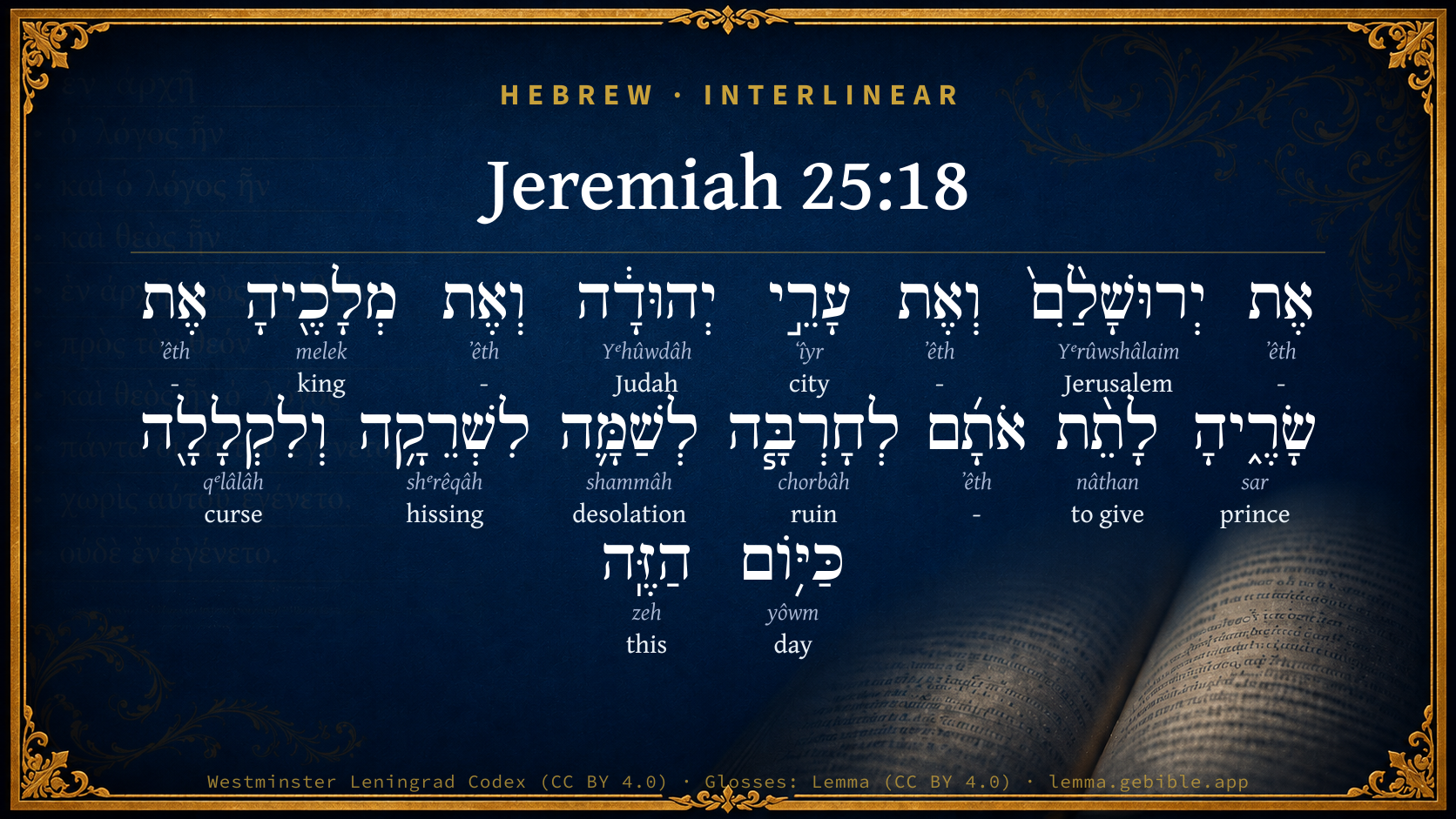
Hebrew (Westminster Leningrad Codex) Jeremiah 25:18 appears in the Hebrew Old Testament. The text above is from the Westminster Leningrad Codex. Each word links to its Strong’s number, a concise gloss, and parsing drawn from the Open Scriptures Hebrew Bible morphology. Click any word for its full Brown-Driver-Briggs (BDB) entry.
Download image
Cite this verse

Jeremiah 25:18 (World English Bible). Public Domain. Lemma interlinear Bible study tool, https://lemma.gebible.app/v/jeremiah/25/18.

Show BibTeX & RIS
BibTeX
RIS
English Translation
[to wit], Jerusalem, and the cities of Judah, and the kings of it, and the princes of it, to make them a desolation, an astonishment, a hissing, and a curse, as it is this day;
World English Bible · Public Domain
Download a study sheet

One document with this verse’s original text, its word-by-word gloss line, the meaning frame, cross-references with their text, attributed commentary, and full source and license credits — printable, and it pastes into notes with its structure intact.

This verse Autodidact and up

Study sheet (.html) Plain text (.txt)

A passage Seminary Student

Up to 50 verses in one chapter. A passage sheet keeps up to 6 commentary sources and 12 cross-references per verse, in the order this page ranks them, and says so on the sheet whenever that leaves anything out. Ask for a single verse and you get the Autodidact verse sheet above.

Everything on this page stays free to read, with no account — the sheet is a download of what is already on screen, not access to it.

Want to remove ads? Support Godless Engineer
Compare translations 3

The same verse in 3 English versions, stacked beneath the original-language interlinear above. Click any original word for its lexicon entry.

Each is an independent rendering of the whole verse — the interlinear is not word-aligned to these translations.

Highlighted words mark where these versions differ — a whole-verse word diff, not a word-by-word alignment.

  • World English Bible Public Domain
    [to wit], Jerusalem, and the cities of Judah, and the kings of it, and the princes of it, to make them a desolation, an astonishment, a hissing, and a curse, as it is this day;
  • King James Version Public Domain
    To wit, Jerusalem, and the cities of Judah, and the kings thereof, and the princes thereof, to make them a desolation, an astonishment, an hissing, and a curse; as it is this day;
  • unfoldingWord Literal Text CC BY-SA 4.0
    Jerusalem and the cities of Judah and its kings its officials, to make them a ruin, a desolation, a hissing, and a curse, as this day;

unfoldingWord Literal Text — © unfoldingWord, licensed CC BY-SA 4.0. Word-aligned USFM3 via Door43 (git.door43.org/unfoldingWord/en_ult).

Versions to compare (up to 4)

3 of 4 selected

Show all 18 translations

Every available English version of this verse, each an independent rendering of the whole verse.

  • World English Bible Public Domain
    [to wit], Jerusalem, and the cities of Judah, and the kings of it, and the princes of it, to make them a desolation, an astonishment, a hissing, and a curse, as it is this day;
  • Berean Standard Bible Public Domain
    to make them a ruin, an object of horror and contempt and cursing, as they are to this day—Jerusalem and the cities of Judah, its kings and officials;
  • Majority Standard Bible Public Domain
    to make them a ruin, an object of horror and contempt and cursing, as they are to this day—Jerusalem and the cities of Judah, its kings and officials;
  • King James Version Public Domain
    To wit, Jerusalem, and the cities of Judah, and the kings thereof, and the princes thereof, to make them a desolation, an astonishment, an hissing, and a curse; as it is this day;
  • American Standard Version (1901) Public Domain
    `to wit', Jerusalem, and the cities of Judah, and the kings thereof, and the princes thereof, to make them a desolation, an astonishment, a hissing, and a curse, as it is this day;
  • Revised Version (1885) Public Domain
    to wit, Jerusalem, and the cities of Judah, and the kings thereof, and the princes thereof, to make them a desolation, an astonishment, an hissing, and a curse; as it is this day;
  • Geneva Bible (1599) Public Domain
    Euen Ierusalem, and the cities of Iudah, and the Kings thereof, and the princes thereof, to make them desolate, an astonishment, an hissing, and a curse, as appeareth this day:
  • Douay-Rheims (1899) Public Domain
    To wit, Jerusalem, and the cities of Juda, and the kings thereof, and the princes thereof: to make them a desolation, and an astonishment, and a hissing, and a curse, as it is at this day.
  • Young's Literal Translation Public Domain
    Jerusalem, and the cities of Judah, And its kings, its heads, To give them to waste, to astonishment, To hissing, and to reviling, as `at' this day.
  • Literal Standard Version CC BY-SA 4.0
    Jerusalem, and the cities of Judah, || And its kings, its heads, || To give them to ruin, to astonishment, || To hissing, and to reviling, as [at] this day;
  • Unlocked Literal Bible CC BY-SA 4.0
    Jerusalem, the cities of Judah and her kings and officials—to turn them into ruins and something terrifying, and into an object for hissing and cursing, as they are at this present day.
  • unfoldingWord Literal Text CC BY-SA 4.0
    Jerusalem and the cities of Judah and its kings its officials, to make them a ruin, a desolation, a hissing, and a curse, as this day;
  • Darby Bible Public Domain
    Jerusalem, and the cities of Judah, and the kings thereof, and the princes thereof, to make them a waste, an astonishment, a hissing, and a curse, as it is this day;
  • World Messianic Bible Public Domain
    Jerusalem, and the cities of Judah, with its kings and its princes, to make them a desolation, an astonishment, a hissing, and a curse, as it is today;
  • Webster's Bible Public Domain
    To wit, Jerusalem, and the cities of Judah, and her kings, and her princes, to make them a desolation, an astonishment, a hissing, and a curse; as it is this day;
  • Free Bible Version CC BY-SA 4.0
    to Jerusalem and the towns of Judah, its kings and officials, destroying them so that people were horrified at what happened to them and mocked them and cursed them (and they are still like this today);
  • Bible in Basic English Public Domain
    Jerusalem and the towns of Judah and their kings and their princes, to make them a waste place, a cause of fear and surprise and a curse, as it is this day;
  • JPS Tanakh (1917) Public Domain
    Jerusalem, and the cities of Judah, and the kings thereof, and the princes thereof, to make them an appalment, an astonishment, a hissing, and a curse; as it is this day;

Literal Standard Version (2020), Covenant Press — licensed CC BY-SA 4.0. Text via the HelloAO Bible API (eBible.org). Unlocked Literal Bible (unfoldingWord) — licensed CC BY-SA 4.0. Text via the HelloAO Bible API (eBible.org). unfoldingWord Literal Text — © unfoldingWord, licensed CC BY-SA 4.0. Word-aligned USFM3 via Door43 (git.door43.org/unfoldingWord/en_ult). Free Bible Version, Dr. Jonathan Gallagher — licensed CC BY-SA 4.0. Text via the HelloAO Bible API (eBible.org).

Word by word

More ways to search: Search by grammar → Find every occurrence → Compare this word →

Practice this passage: Drill this verse → Learn its vocabulary →

לִשְׁרֵקָ֥ה
shᵉrêqâh
H8322
“to/for · hissing”
Preposition + Noun, Common, Feminine, Singular, Absolute
Part of Speech
Preposition + Noun
Type
Common
Gender
Feminine
Number
Singular
State
Absolute
Full BDB Definition

Origin: from H8319

TWOT: 2468a

hissing, whistling
  1. אֶת ʼêth H853 “-” Particle, Direct Object
  2. יְרוּשָׁלִַ֨ם֙ Yᵉrûwshâlaim H3389 “Jerusalem” Noun, Proper
  3. וְאֶת ʼêth H853 “and · -” Conjunction + Particle, Direct Object
  4. עָרֵ֣י ʻîyr H5892 “cities of” Noun, Common, Feminine, Plural, Construct
  5. יְהוּדָ֔ה Yᵉhûwdâh H3063 “Judah” Noun, Proper
  6. וְאֶת ʼêth H853 “and · -” Conjunction + Particle, Direct Object
  7. מְלָכֶ֖יהָ melek H4428 “kings · her” Noun, Common, Masculine, Plural, Construct + Suffix, Personal, 3rd Person, Feminine, Singular
  8. אֶת ʼêth H853 “-” Particle, Direct Object
  9. שָׂרֶ֑יהָ sar H8269 “princes · her” Noun, Common, Masculine, Plural, Construct + Suffix, Personal, 3rd Person, Feminine, Singular
  10. לָתֵ֨ת nâthan H5414 “to give” Preposition + Verb, Qal, Infinitive Construct
  11. אֹתָ֜ם ʼêth H853 “- · them” Particle, Direct Object + Suffix, Personal, 3rd Person, Masculine, Plural
  12. לְחָרְבָּ֧ה chorbâh H2723 “to/for · ruin” Preposition + Noun, Common, Feminine, Singular, Absolute
  13. לְשַׁמָּ֛ה shammâh H8047 “to/for · desolation” Preposition + Noun, Common, Feminine, Singular, Absolute
  14. וְלִקְלָלָ֖ה qᵉlâlâh H7045 “and · to/for · curse” Conjunction + Preposition + Noun, Common, Feminine, Singular, Absolute
  15. כַּיּ֥וֹם yôwm H3117 “like/as the · day” Preposition, Determined + Noun, Common, Masculine, Singular, Absolute
  16. הַזֶּֽה zeh H2088 “the · this” Particle, Definite Article + Pronoun, Demonstrative, Masculine, Singular

About this verse

These counts appear in no published source. They are computed here, from the morphology-tagged text and Lemma’s own curated glosses. What Lemma adds →

17
words
13
distinct lemmas
Prophets
section

Notable vocabulary

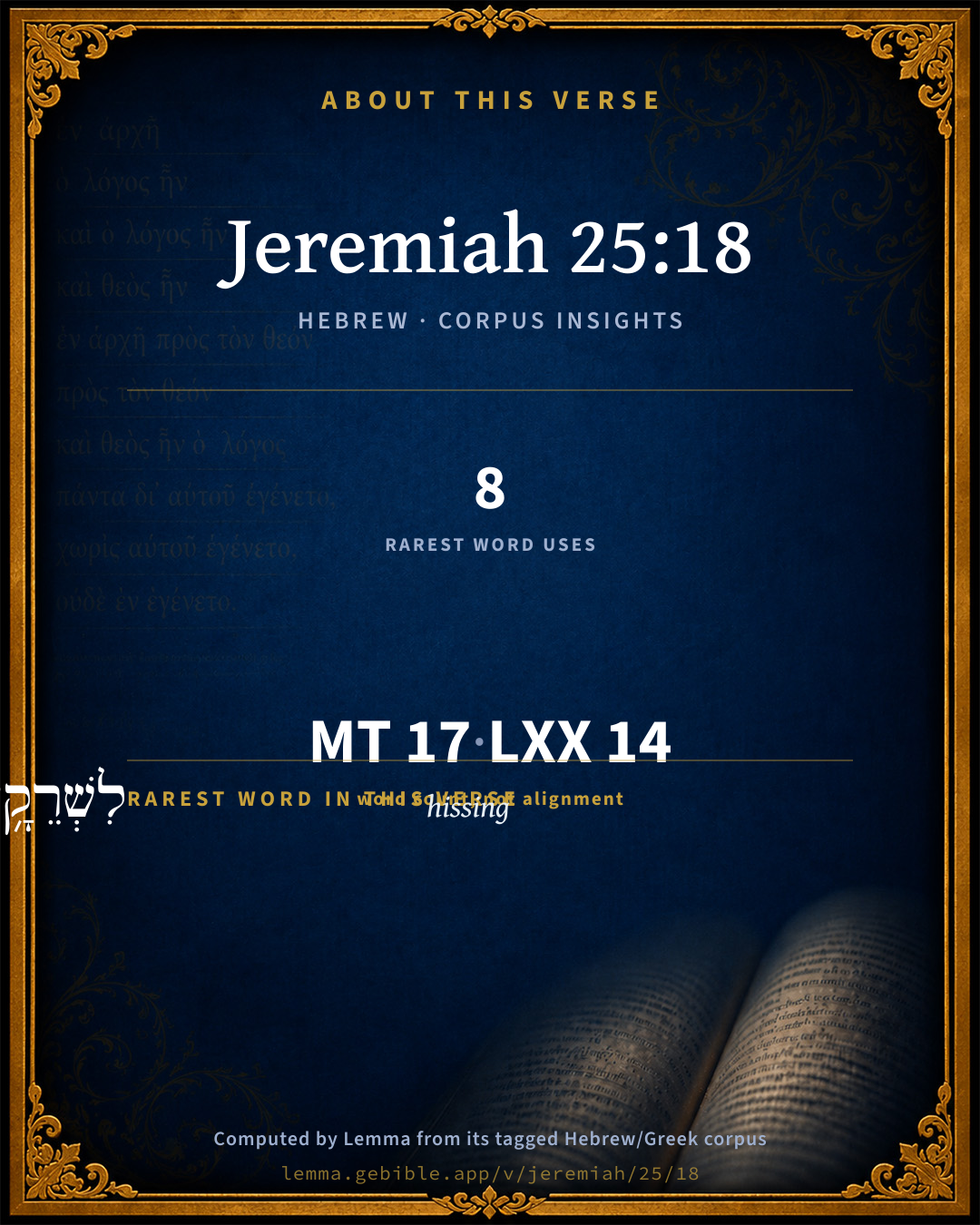
The rarest word here is לִשְׁרֵקָ֥ה hissing H8322 — appearing just 8 times in the whole Hebrew Bible.

Shared distinctive vocabulary

לִשְׁרֵקָ֥ה hissing H8322 occurs in 8 verses of the Hebrew Bible. Also found in:

Grammatical profile

  • 1 verb
  • 10 nouns
  • 1 pronoun
  • 5 particles

Verb forms

  • לָתֵ֨ת Qal · Infinitive Construct

Hebrew & Septuagint length

In the original languages it is 17 Hebrew tokens and 14 Greek tokens — but the two are counted differently (Hebrew bundles its prefixes and suffixes into one token; the Greek is in lemma form), so that isn’t a like-for-like length.

Cross-references

19

Topical passages linked to Jeremiah 25:18 in the Treasury of Scripture Knowledge — connected by theme and wording, ordered by reader-vote popularity; previews shown in the World English Bible.

  • Psalms 60:3 You have shown your people hard things. You have made us drink the wine that makes us stagger.
  • Jeremiah 24:9 I will even give them up to be tossed back and forth among all the kingdoms of the earth for evil; to be a reproach and a proverb, a taunt and a curse, in all places where I shall drive them.
  • Jeremiah 44:22 so that Yahweh could no longer bear, because of the evil of your doings, and because of the abominations which you have committed; therefore is your land become a desolation, and an astonishment, and a curse, without inhabitant, as it is this day.
  • Joshua 6:18 But as for you, only keep yourselves from the devoted thing, lest when you have devoted it, you take of the devoted thing; so would you make the camp of Israel accursed, and trouble it.
  • 1 Kings 8:24 who have kept with your servant David my father that which you did promise him: yes, you spoke with your mouth, and have fulfilled it with your hand, as it is this day.
  • 2 Kings 22:19 because your heart was tender, and you did humble yourself before Yahweh, when you heard what I spoke against this place, and against the inhabitants of it, that they should become a desolation and a curse, and have torn your clothes, and wept before me; I also have heard you, says Yahweh.
  • Ezra 9:7 Since the days of our fathers we have been exceeding guilty to this day; and for our iniquities have we, our kings, and our priests, been delivered into the hand of the kings of the lands, to the sword, to captivity, and to plunder, and to confusion of face, as it is this day.
  • Nehemiah 9:36 Behold, we are servants this day, and as for the land that you gave to our fathers to eat the fruit of it and the good of it, behold, we are servants in it.
  • Isaiah 51:17–22 Awake, awake, stand up, Jerusalem, that have drunk at the hand of Yahweh the cup of his wrath; you have drunken the bowl of the cup of staggering, and drained it.
  • Jeremiah 1:10 behold, I have this day set you over the nations and over the kingdoms, to pluck up and to break down and to destroy and to overthrow, to build and to plant.
  • Jeremiah 19:3–9 and say, Hear you the word of Yahweh, kings of Judah, and inhabitants of Jerusalem: thus says Yahweh of Hosts, the God of Israel, Behold, I will bring evil on this place, which whoever hears, his ears shall tingle.
  • Jeremiah 21:6–10 I will strike the inhabitants of this city, both man and animal: they shall die of a great pestilence.
  • Jeremiah 25:9 behold, I will send and take all the families of the north, says Yahweh, and [I will send] to Nebuchadrezzar the king of Babylon, my servant, and will bring them against this land, and against the inhabitants of it, and against all these nations round about; and I will utterly destroy them, and make them an astonishment, and a hissing, and perpetual desolations.
  • Jeremiah 25:11 This whole land shall be a desolation, and an astonishment; and these nations shall serve the king of Babylon seventy years.
  • Ezekiel 9:5–8 To the others he said in my hearing, Go you through the city after him, and strike: don't let your eye spare, neither have you pity;
  • Daniel 9:12 He has confirmed his words, which he spoke against us, and against our judges who judged us, by bringing on us a great evil; for under the whole sky has not been done as has been done on Jerusalem.
  • Amos 2:5 But I will send a fire on Judah, And it will devour the palaces of Jerusalem."
  • Amos 3:2 "You only have I chosen of all the families of the earth. Therefore I will punish you for all of your sins."
  • 1 Peter 4:17 For the time has come for judgment to begin at the house of God. If it begins first with us, what will happen to those who don't obey the Gospel of God?

Cross-references courtesy of OpenBible.info (CC BY 4.0).

Hebrew and Greek witnesses Masoretic Hebrew ↔ Greek Septuagint

The same verse in the two great witnesses to the Old Testament, shown verse-for-verse.

These are two independent witnesses, not word-aligned to each other, and the Septuagint is shown in lemma (dictionary) form.

Hebrew Jeremiah 25:18 Masoretic · Westminster Leningrad Codex

אֶת יְרוּשָׁלִַ֨ם֙ וְאֶת עָרֵ֣י יְהוּדָ֔ה וְאֶת מְלָכֶ֖יהָ אֶת שָׂרֶ֑יהָ לָתֵ֨ת אֹתָ֜ם לְחָרְבָּ֧ה לְשַׁמָּ֛ה לִשְׁרֵקָ֥ה וְלִקְלָלָ֖ה כַּיּ֥וֹם הַזֶּֽה

[to wit], Jerusalem, and the cities of Judah, and the kings of it, and the princes of it, to make them a desolation, an astonishment, a hissing, and a curse, as it is this day;

World English Bible · Public Domain

Greek LXX Structure differs

In the Septuagint, Jeremiah is about an eighth shorter than the Hebrew and arranges its material differently — the Oracles Against the Nations (Hebrew chapters 46–51) appear in the middle of the Greek book, after 25:13. Because the chapter and verse boundaries do not line up, a verse-for-verse comparison with the Hebrew is not shown.

A verse-for-verse comparison isn’t shown here because the chapters and verses don’t line up. Switch to the LXX edition with the MT / LXX toggle above to read the Greek directly.

On this verse, The Cambridge Bible for Schools and Colleges discusses the Septuagint’s reading. Read the note in Commentary ↓

Hebrew: Westminster Leningrad Codex (CC BY 4.0). Greek: Septuagint (public domain); English from a public-domain English Septuagint. How the Septuagint differs from the Hebrew →

Targum (Aramaic paraphrase)

1

The Targum is the ancient Jewish Aramaic paraphrase of the Hebrew Scriptures — an interpretive translation, not the Hebrew text itself. Onkelos (literal) and Pseudo-Jonathan (expansive) render the Torah, and Jonathan the Prophets. Coverage is partial: where no permissively-licensed English translation exists for a verse, only the Aramaic is shown. This is verse-level text, not a word-by-word alignment to the Hebrew.

  1. Targum Jonathan Prophets (Joshua–Malachi)
    יַת יְרוּשְׁלֵם וְיַת קִרְוַיָא דְבֵית יְהוּדָה וְיַת מַלְכָהָא וְיַת רַבְרְבָהָא לְמִתַּן יַתְהוֹן לְחַרְבָּא לְצָדוּ לְאִשְׁתְּמָמוּ וּלְלוּטָא כְּיוֹמָא הָדֵין:

    (no public-domain English translation for this verse)

    Targum Jonathan — Aramaic: “Mikraot Gedolot” (public domain). English: “Sefaria Community Translation” (CC0 1.0 (public-domain dedication)); “London "Chaldee Paraphrase," 1871” (public domain). Text via Sefaria.

Commentary

Notes on Jeremiah 25:18 from classic Christian and Jewish commentators (each source and its license shown beneath its notes). The classic Christian expositions comment on the surrounding passage and are grouped to its opening verse, so a note may address several verses; the Jewish commentaries on the Tanakh (Rashi and others) are per-verse, so they appear only where the commentator wrote on this verse.

Lemma curates 59 commentaries, every one of them public domain or Creative Commons licensed, each selected and text-cleaned for this edition rather than reprinted as found. About our sources →

The Cambridge Bible for Schools and Colleges

gen. ed. J. J. S. Perowne

18. The list which follows is one which has evidently been expanded. The LXX omit “all the kings of the land of Uz” (Jer_25:20), “all the kings of Arabia” [or (see note there) “all the kings of the mingled people”] (Jer_25:24), and “all the kings of Zimri” (Jer_25:25). Gi. and Co. accordingly consider that this phrase marks additions throughout. It will also be observed that in Jer_25:20 Philistia is virtually enumerated (“Ashkelon, etc.”) twice. In Jer_25:18 Co. would omit all after “Judah,” and put Pharaoh at the head of the list to be displaced afterwards by a scribe jealous for the precedence of his country even in a list of this character!

We may perceive a certain system (south to north) in the enumeration. After Jerusalem and Judah the prophet takes in order the furthest south (Egypt), south-east (Uz), south-west (Philistines), east (Edom, etc.), west (Tyre, etc.), east and northwards (Dedan, etc. to the Medes), and finally the north far and near (Jer_25:26).

kings] For the suspicious character of the use of the pl. see end of introd. note on Jer_19:3-9.

and a curse] not in LXX, and probably introduced here from Jer_24:9.

as it is this day] absent from LXX, and evidently added after b.c. 586 in the time of the exile.

The Cambridge Bible for Schools and Colleges (gen. ed. J. J. S. Perowne; Cambridge University Press, 1878–1918) — public domain. Text from a community e-Sword module.

Trapp's Complete Commentary

John Trapp

Jer 25:18 [To wit], Jerusalem, and the cities of Judah, and the kings thereof, and the princes thereof, to make them a desolation, an astonishment, an hissing, and a curse; as [it is] this day;

Ver. 18. To wit, in Jerusalem.] Judgment beginneth at God’s house {1Pe 4:17} {See Trapp on "1Pe 4:17"} {See Trapp on "Mat 25:41"} Sed si in Hierosolymis maneat scrutinium, quid fiet in Babylone? saith an ancient.

John Trapp, A Commentary or Exposition upon All the Books of the Old and New Testament (1647–1656) — public domain. Text from a community e-Sword module.

Joseph Benson's Commentary

Jer 25:18-21. To wit, Jerusalem and the cities thereof — The Jews are mentioned first, because Jeremiah, as well as the rest of the prophets, was in the first place sent to them, and they were to have the greatest share in the judgments denounced. As it is this day — This clause speaks of the desolation of Judah and Jerusalem; when all that Jeremiah had foretold against them was fulfilled; and therefore must have been added either by Baruch, his amanuensis, or else by Ezra: or whoever it was that collected Jeremiah’s prophecies into one volume, who, it is likely, added the fifty- second chapter. Pharaoh king of Egypt — Whose army Nebuchadnezzar overcame before he took Jerusalem. And all the mingled people — Or, intermingled, as Blaney translates הערב, joining the expression with the preceding verse, and understanding thereby all the foreigners resident in Egypt, who had, by intermarriages, formed connections with the Egyptians. St. Jerome takes the word in the same sense. Our translators, however, seem to have understood by it a mixture of several nations, dwelling either upon the coasts of the Mediterranean, or of the Red sea. And all the kings of the land of Uz — This was the country of Job; but concerning its situation different opinions are entertained. It was most probably on the confines of Idumea, if not a part of it. The daughter of Edom is said to dwell in the land of Uz, Lam 4:21 : see note on Job 1:1. Those who were leaders, or governors of different tribes or families, seem to have had the name of kings: they are now called emirs. And all the kings of the Philistines — The princes of the different districts, or cities, into which Philistia was divided, namely, Ashkelon and Azzah, &c. And the remnant of Ashdod — Or Azotus, which had been very much ruined by two sieges in which it was taken, the one by Tartan, the Assyrian general, mentioned Isa 20:1; the other by Psammitichus, king of Egypt, who retook it after the longest siege that had even been known in those times: Herodot. lib. 2. c. 157. The prophecy respecting the Philistines is contained in chap. 47. Edom — Or rather, And Edom — As the LXX., Syr., and Vul. read, with seven MSS. For the prophecies concerning Edom, Moab, and the Ammonites, see chap. 48. and Jer 49:1-22.

Joseph Benson's Commentary on the Old and New Testaments (1811–1818) — public domain. Text from a community e-Sword module.

Tyndale Open Study Notes

Tyndale Open Resources

25:18 Everyone drank from the cup, meaning that the leaders heard the words of judgment. • From that day until this: Jeremiah probably delivered the Lord’s messages at the time of the siege and fall of Jerusalem (588–586 BC).

Tyndale Open Study Notes — © Tyndale Open Resources, licensed CC BY-SA 4.0. Text via the HelloAO Bible API.

Geneva Bible (1599)

Geneva Bible translators

For now it beginneth and shall so continue till it be accomplished.

Geneva Bible (1599) marginal notes — public domain. Text via Bolls.life.

Jamieson, Fausset & Brown

Robert Jamieson, A. R. Fausset & David Brown

Jerusalem--put first: for "judgment begins at the house of God"; they being most guilty whose religious privileges are greatest (Pe1 4:17).

kings--Jehoiakim, Jeconiah, and Zedekiah.

as it is this day--The accomplishment of the curse had already begun under Jehoiakim. This clause, however, may have been inserted by Jeremiah at his final revision of his prophecies in Egypt.

Jamieson, Fausset & Brown — Commentary Critical and Explanatory on the Whole Bible (1871) — public domain (CC PDM 1.0). Text via the HelloAO Bible API.

John Calvin's Commentaries

He begins with Jerusalem, as it is said elsewhere that judgment would begin at God’s house. (1 Peter 4:17.) And there is nothing opposed to this in the context of the passage; for though he had promised to the children of God a happy end to the evils which they were shortly to endure, he nevertheless enumerates here all the nations on whom God had bidden him to denounce judgments. In this catalogue the Church obtains the first place; for though God be the judge of the whole world, he yet justly begins with his own Church, and that especially for two reasons — for as the father of a family watches over his children and servants, and if there be anything wrong, his solicitude is particularly manifested; so God, as he dwells in his Church, cannot do otherwise than chastise it for its faults; — and then, we know that they are less excusable, who, having been taught the will of God, do yet go on indulging their own lusts, (Luke 12:47;) for they cannot plead ignorance. Hence is fulfilled what Christ declares, that those servants shall be more grievously beaten, who, knowing their masters will, yet obstinately disregard it. There is, then, a twofold fault in the members of the Church; and no comparison can be made between them and the unbelieving who are in thick darkness. Since God shines in his Church and shews the way, as Moses says,

“Behold I set before you the way of life and of death; I therefore call heaven and earth to witness that there is no excuse for you. (Deuteronomy 30:15, 19.)

This, then, is the second reason why God first visits the sins of the faithful, or of those who are counted faithful.

There is also what appertains to an example: God chastises his own children lest he should seem by his indulgence to favor or countenance what is wicked and sinful. But this third reason is in a manner accidental; and therefore I wished to state it apart from the two other reasons. When, therefore, God so severely treats his own Church, the unbelieving ought to draw this conclusion, that if this be done in the green tree, what shall be done in the dry? (Luke 23:31.)

But the two things which I have before mentioned ought to be deemed by us as sufficient reasons why God, while suspending his vengeance as to the reprobate, punishes the elect as well as all those who profess themselves to be members of his Church. We now understand why Jeremiah mentions first the holy city, and then all the cities of Judah, the kings also and the princes; for God had with open bosom invited them to himself, but they had, as it were, from determined wickedness, provoked his wrath by despising both his Law and his Prophets.

He afterwards adds, to make them a waste, or a solitude. This was a grievous denunciation, no doubt, and we shall hereafter see that most became enraged against the holy man, and in their fury endeavored to destroy him; yet he with all intrepid mind fully declared what God had commanded him. He adds, an astonishment, and in the third place, an hissing, even that they would become detestable to all; for hissing intimates contempt, reproach, and detestation. In the fourth place he mentions a curse. We have already said what the Prophet meant by this word, even that the Jews would become in this respect a proverb, so that when one cursed another, he would use this form, “May God destroy thee as he destroyed the Jews.”

It is then added, as at this day The Prophet refers, no doubt, to the time of the city’s destruction. God had indeed even then begun to consume the people; but we shall hereafter see that the minds of the greater part were still very haughty: so that they often raised their crests and looked for a new state of things, and depended on aid from the Egyptians. But the Prophet here mentions what was not yet completed, and as it were by the finger, points out the day as having already come in which the city was to be destroyed and the temple burnt up. This, then, refers to the certainty of what he predicted. Some think that it was written after Jeremiah had been led into exile; but this conjecture has nothing to support it. It seems to me enough to suppose that his object was to rouse the Jews from their security, and to shew that in a short time all that he predicted would be accomplished, and that they were no more to doubt of this than if the calamity was now before their eyes. It follows, —

John Calvin's Commentaries (1540-1563) — public domain. Text from the Calvin Translation Society English edition (1840s-50s) via the Christian Classics Ethereal Library (ccel.org). Calvin's coverage is partial (roughly two-thirds of the Bible); uncommented books and verses are honest gaps, never fabricated. The 19th-century editor's footnotes and remarks are omitted so the notes are faithfully Calvin's own voice.

Ellicott's Commentary for English Readers

(18) As it is this day.—The words are not in the LXX., and may probably have been added after the prediction had received its fulfilment in the final capture of Jerusalem and the desolation of the country. Here, as before in Jer_25:13, we trace the hand of a transcriber. It will be noted that the prophet begins with the judgment about to fall on his own people, and then passes on from “the house of God” (1Pe_4:17) to those that are without.

A Bible Commentary for English Readers, edited by Charles John Ellicott (1878–1897) — public domain. Text from a community e-Sword module.

John Gill's Exposition

To wit, Jerusalem, and the cities of Judah,.... Which are mentioned first, because God's judgments began with them, as they usually do with the house of God, Pe1 4:17; and even now began; for this very year, in which this prophecy was delivered, Nebuchadnezzar came up and besieged Jerusalem, and carried away some captives, Dan 1:1; this was the beginning of what afterwards were more fully executed:

and the kings thereof, and the princes thereof: the Kings Jehoiakim, Jeconiah, and Zedekiah, with those of their families, the princes of the blood, and their nobles:

to make them a desolation, an astonishment, an hissing, and a curse; to strip them of their crowns and kingdom, of their wealth, and riches, and honour, and bring them into slavery and bondage; so that they became an astonishment to some, to see the change that was made in them; and were hissed stand cursed by others:

(as it is this day); which is added, either because of the certainty of it, or because it began to take, place this very year; though more fully in Jeconiah's time, and still more in Zedekiah's; or rather this clause might be added by Jeremiah after the captivity; or by Baruch, or by Ezra, or whoever collected his prophecies, and put them into one volume, as Jer 52:1 seems to be added by another hand.

John Gill's Exposition of the Whole Bible (1746–1763) — public domain (CC PDM 1.0). Text via the HelloAO Bible API.

Albert Barnes' Notes on the Bible

As it is this day - Words omitted by the Septuagint, and probably added by Jeremiah after the murder of Gedaliah had completed the ruin of the land.

Albert Barnes' Notes on the Bible (1834–1885) — public domain. Text from a community e-Sword/MySword module.

Haydock's Catholic Bible Commentary

As, &c. He probably inserted this (Haydock) after the event, (Vatable) or the country was much distressed even under Sedecias.

George Leo Haydock (1774–1849), Haydock's Catholic Family Bible and Commentary, 1859 edition — public domain. Excludes Psalms (Douay-Rheims chapter numbering differs from Protestant) and Deuterocanonical books (Catholic canon only).

Matthew Poole's English Annotations

Judgment usually beginneth at the house of God, 1Pe 4:17. God hath more known them and done them more good than other people, therefore their sins are higher provocations, and they are less excusable. By the kings here mentioned are to be understood Jehoiakim, Jehoiachin, and Zedekiah; these princes with their people God threatens to punish to astonishment, and so as men should mock at them, and curse them; which expressions we have before met with in the same cause. But here ariseth a doubt how the prophet saith,

as it is this day, whereas this prophecy, Jer 25:1, was in the fourth year of Jehoiakim, but Jerusalem was not made such a desolation till the eleventh year of Zedekiah, which was eighteen years after. Some think that though the thing were yet to come, yet the prophet speaketh of it as past, because of the certainty of it, which is but what is ordinary in the prophetical writings. Others think that these words were added after the captivity of Jeremiah, writing over his former prophecies. Others from these words judge that this part of the chapter was a prophecy at some other time following what was in the beginning of this chapter. Others think that he adds these words because the carrying into captivity was at this time begun, though not completed until the eleventh year of Zedekiah.

Matthew Poole's English Annotations on the Holy Bible (1683–1685) — public domain. Text from a community e-Sword/MySword module.

Whedon's Commentary on the Bible

Daniel D. Whedon

18. Jerusalem — Mentioned first, as being most important, and perhaps, too, most guilty.

Daniel D. Whedon (gen. ed.), Commentary on the Old and New Testaments (1874–1909) — public domain. Text from a community e-Sword module.

The Pulpit Commentary

The kings thereof. (see on Jer_19:3) As it is this day. As to the meaning of this phrase, see on Jer_11:5. The words evidently presuppose that the prediction has already been fulfilled; (Jer_44:6, Jer_44:23) consequently, they cannot have stood herein the original draft of the prophecy. An early editor, or even Jeremiah himself, must have inserted them. They are omitted in the Septuagint.

The Pulpit Commentary (1880–1919), ed. H.D.M. Spence-Jones & Joseph S. Exell — public domain. Text from a community e-Sword module.

Rashi

Rabbi Shlomo Yitzchaki (Rashi)

as of this day As they are today. Jeremiah wrote his Book after the destruction.

Rashi on the Tanakh — English translations: “The Judaica Press complete Tanach with Rashi, translated by A. J. Rosenberg” (CC BY 4.0); “Pentateuch with Rashi's commentary by M. Rosenbaum and A.M. Silbermann, 1929-1934” (public domain); “The Metsudah Tanach series, Lakewood, N.J” (CC BY 4.0); and “The Book of Joshua, Metsudah Publications, 1997” (CC BY 4.0). Text via Sefaria.

Lesson kit

Teaching starters — assembled from the data on this page, not authored interpretation. Every prompt links to the verse data it draws on. Edit before teaching.

Jeremiah, in the Prophets, opens this verse with 17 words (13 distinct Hebrew lemmas). Its most distinctive word is shᵉrêqâh (“hissing”). A historical commentator’s framing appears above. Read the whole chapter for the surrounding context.

Discussion questions

  1. How does “hissing” (shᵉrêqâh) shape what this verse is saying?
  2. How does 2 Chronicles 29:8, which shares the word «hissing», read alongside this verse?
  3. The translations on this page render this verse differently — a whole-verse word diff, not a word-by-word alignment. What might account for the different wordings?
  4. «לָתֵ֨ת» is a Qal Infinitive Construct verb. How does that grammatical form shape the action described?
  5. Compare how The Cambridge Bible for Schools and Colleges and Trapp's Complete Commentary read this verse. Where do they agree or differ?

Things to notice

Reading settings

Reading text

Shown beneath each verse's original-language words.

Old Testament
Old Testament edition

Read the OT as the Masoretic Hebrew (MT) or the Greek Septuagint (LXX).

English shown for the Greek Septuagint (in the Hebrew ↔ Greek comparison).

Comparing translations? Open the Compare panel on any verse page to stack up to four side by side.