Genesis 44:7

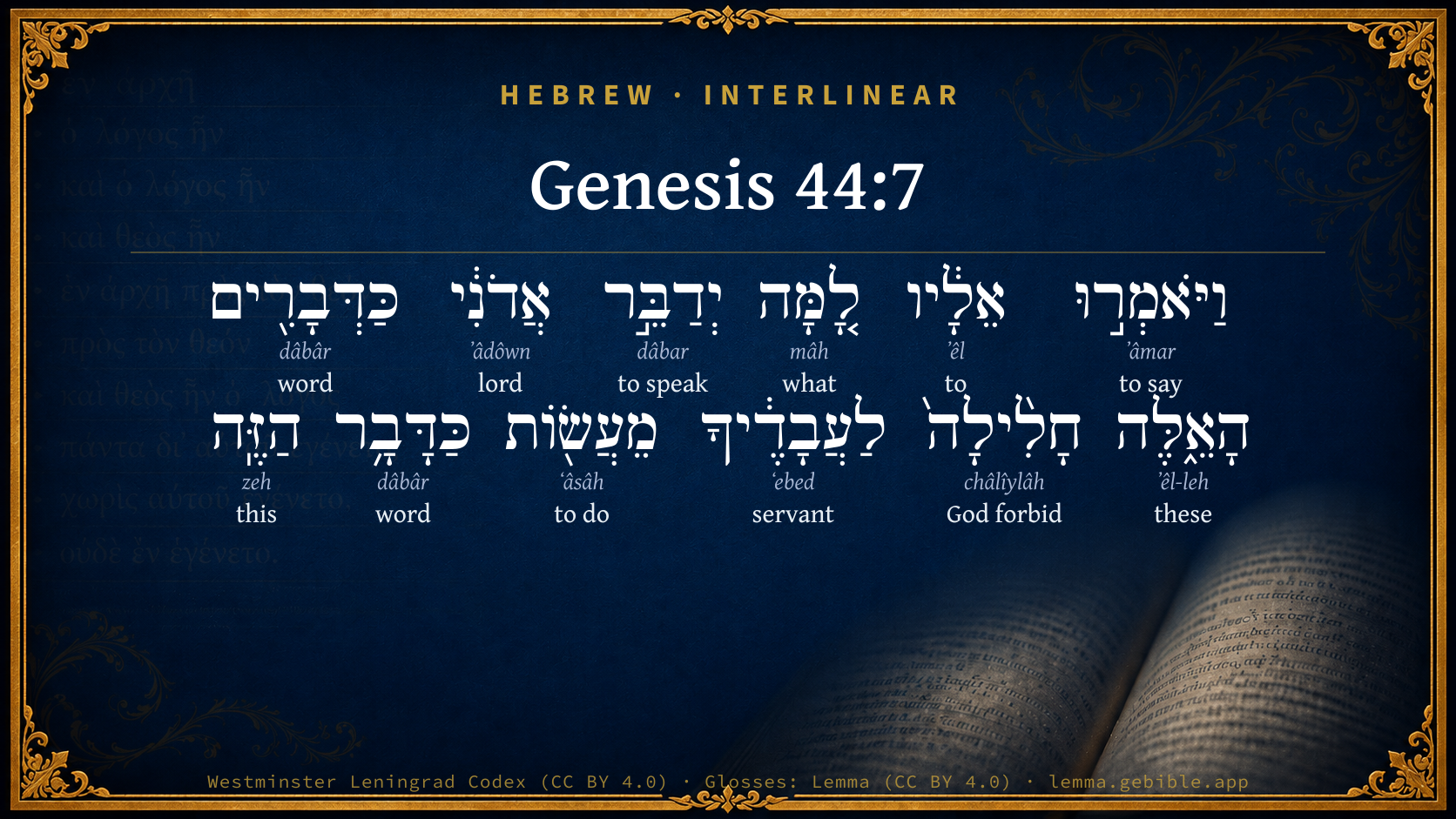
Hebrew (Westminster Leningrad Codex) Genesis 44:7 appears in the Hebrew Old Testament. The text above is from the Westminster Leningrad Codex. Each word links to its Strong’s number, a concise gloss, and parsing drawn from the Open Scriptures Hebrew Bible morphology. Click any word for its full Brown-Driver-Briggs (BDB) entry.
Download image
Cite this verse

Genesis 44:7 (World English Bible). Public Domain. Lemma interlinear Bible study tool, https://lemma.gebible.app/v/genesis/44/7.

Show BibTeX & RIS
BibTeX
RIS
English Translation
They said to him, "Why does my lord speak such words as these? Far be it from your servants that they should do such a thing!
World English Bible · Public Domain
Download a study sheet

One document with this verse’s original text, its word-by-word gloss line, the meaning frame, cross-references with their text, attributed commentary, and full source and license credits — printable, and it pastes into notes with its structure intact.

This verse Autodidact and up

Study sheet (.html) Plain text (.txt)

A passage Seminary Student

Up to 50 verses in one chapter. A passage sheet keeps up to 6 commentary sources and 12 cross-references per verse, in the order this page ranks them, and says so on the sheet whenever that leaves anything out. Ask for a single verse and you get the Autodidact verse sheet above.

Everything on this page stays free to read, with no account — the sheet is a download of what is already on screen, not access to it.

Want to remove ads? Support Godless Engineer
Compare translations 3

The same verse in 3 English versions, stacked beneath the original-language interlinear above. Click any original word for its lexicon entry.

Each is an independent rendering of the whole verse — the interlinear is not word-aligned to these translations.

Highlighted words mark where these versions differ — a whole-verse word diff, not a word-by-word alignment.

  • World English Bible Public Domain
    They said to him, "Why does my lord speak such words as these? Far be it from your servants that they should do such a thing!
  • King James Version Public Domain
    And they said unto him, Wherefore saith my lord these words? God forbid that thy servants should do according to this thing:
  • unfoldingWord Literal Text CC BY-SA 4.0
    But they said to him, “Why does my lord speak words like those? Far be it from your servants to do something like that!

unfoldingWord Literal Text — © unfoldingWord, licensed CC BY-SA 4.0. Word-aligned USFM3 via Door43 (git.door43.org/unfoldingWord/en_ult).

Versions to compare (up to 4)

3 of 4 selected

Show all 18 translations

Every available English version of this verse, each an independent rendering of the whole verse.

  • World English Bible Public Domain
    They said to him, "Why does my lord speak such words as these? Far be it from your servants that they should do such a thing!
  • Berean Standard Bible Public Domain
    “Why does my lord say these things?” they asked. “Your servants could not possibly do such a thing.
  • Majority Standard Bible Public Domain
    “Why does my lord say these things?” they asked. “Your servants could not possibly do such a thing.
  • King James Version Public Domain
    And they said unto him, Wherefore saith my lord these words? God forbid that thy servants should do according to this thing:
  • American Standard Version (1901) Public Domain
    And they said unto him, Wherefore speaketh my lord such words as these? Far be it from thy servants that they should do such a thing.
  • Revised Version (1885) Public Domain
    And they said unto him, Wherefore speaketh my lord such words as these? God forbid that thy servants should do such a thing.
  • Geneva Bible (1599) Public Domain
    And they answered him, Wherefore sayeth my lorde such wordes? God forbid that thy seruants should do such a thing.
  • Douay-Rheims (1899) Public Domain
    And they answered: Why doth our lord speak so, as though thy servants had committed so heinous a fact?
  • Young's Literal Translation Public Domain
    and they say unto him, `Why doth my lord speak according to these words? far be it from thy servants to do according to this word;
  • Literal Standard Version CC BY-SA 4.0
    and they say to him, “Why does my lord speak according to these words? Far be it from your servants to do according to this word;
  • Unlocked Literal Bible CC BY-SA 4.0
    They said to him, “Why does my master speak such words as these? Far be it from your servants that they would do such a thing.
  • unfoldingWord Literal Text CC BY-SA 4.0
    But they said to him, “Why does my lord speak words like those? Far be it from your servants to do something like that!
  • Darby Bible Public Domain
    And they said to him, Why does my lord speak such words as these? Far be it from thy servants to do such a thing!
  • World Messianic Bible Public Domain
    They said to him, “Why does my lord speak such words as these? Far be it from your servants that they should do such a thing!
  • Webster's Bible Public Domain
    And they said to him, Why saith my lord these words? Far be it from us that thy servants should do according to this thing:
  • Free Bible Version CC BY-SA 4.0
    “My lord, what are you saying?” they replied. “We your servants wouldn't do anything like that!
  • Bible in Basic English Public Domain
    And they said to him, Why does my lord say such words as these? far be it from your servants to do such a thing:
  • JPS Tanakh (1917) Public Domain
    And they said unto him: 'Wherefore speaketh my lord such words as these? Far be it from thy servants that they should do such a thing.

Literal Standard Version (2020), Covenant Press — licensed CC BY-SA 4.0. Text via the HelloAO Bible API (eBible.org). Unlocked Literal Bible (unfoldingWord) — licensed CC BY-SA 4.0. Text via the HelloAO Bible API (eBible.org). unfoldingWord Literal Text — © unfoldingWord, licensed CC BY-SA 4.0. Word-aligned USFM3 via Door43 (git.door43.org/unfoldingWord/en_ult). Free Bible Version, Dr. Jonathan Gallagher — licensed CC BY-SA 4.0. Text via the HelloAO Bible API (eBible.org).

Word by word

More ways to search: Search by grammar → Find every occurrence → Compare this word →

Practice this passage: Drill this verse → Learn its vocabulary →

חָלִ֨ילָה֙
châlîylâh
H2486
“God forbid”
Particle, Interjection + Suffix, h
Part of Speech
Particle
Type
Interjection
Full BDB Definition

Origin: a directive from H2490

TWOT: 661c

far be it (from me), God forbid that, let it not be
  1. וַיֹּאמְר֣וּ ʼâmar H559 “and · to say” Conjunction + Verb, Qal, Sequential Imperfect, 3rd Person, Masculine, Plural
  2. אֵלָ֔יו ʼêl H413 “to · him” Preposition + Suffix, Personal, 3rd Person, Masculine, Singular
  3. לָ֚מָּה mâh H4100 “to/for · what” Preposition + Particle, Interrogative
  4. יְדַבֵּ֣ר dâbar H1696 “to speak” Verb, Piel, Imperfect, 3rd Person, Masculine, Singular
  5. אֲדֹנִ֔י ʼâdôwn H113 “lord · my” Noun, Common, Masculine, Singular, Construct + Suffix, Personal, 1st Person, Common, Singular
  6. כַּדְּבָרִ֖ים dâbâr H1697 “like/as the · words” Preposition, Determined + Noun, Common, Masculine, Plural, Absolute
  7. הָאֵ֑לֶּה ʼêl-leh H428 “the · these” Particle, Definite Article + Pronoun, Demonstrative, Common, Plural
  8. לַעֲבָדֶ֔יךָ ʻebed H5650 “to/for · servants · your” Preposition + Noun, Common, Masculine, Plural, Construct + Suffix, Personal, 2nd Person, Masculine, Singular
  9. מֵעֲשׂ֖וֹת ʻâsâh H6213 “from · to do” Preposition + Verb, Qal, Infinitive Construct
  10. כַּדָּבָ֥ר dâbâr H1697 “like/as the · word” Preposition, Determined + Noun, Common, Masculine, Singular, Absolute
  11. הַזֶּֽה zeh H2088 “the · this” Particle, Definite Article + Pronoun, Demonstrative, Masculine, Singular

About this verse

These counts appear in no published source. They are computed here, from the morphology-tagged text and Lemma’s own curated glosses. What Lemma adds →

12
words
11
distinct lemmas
Pentateuch
section

Notable vocabulary

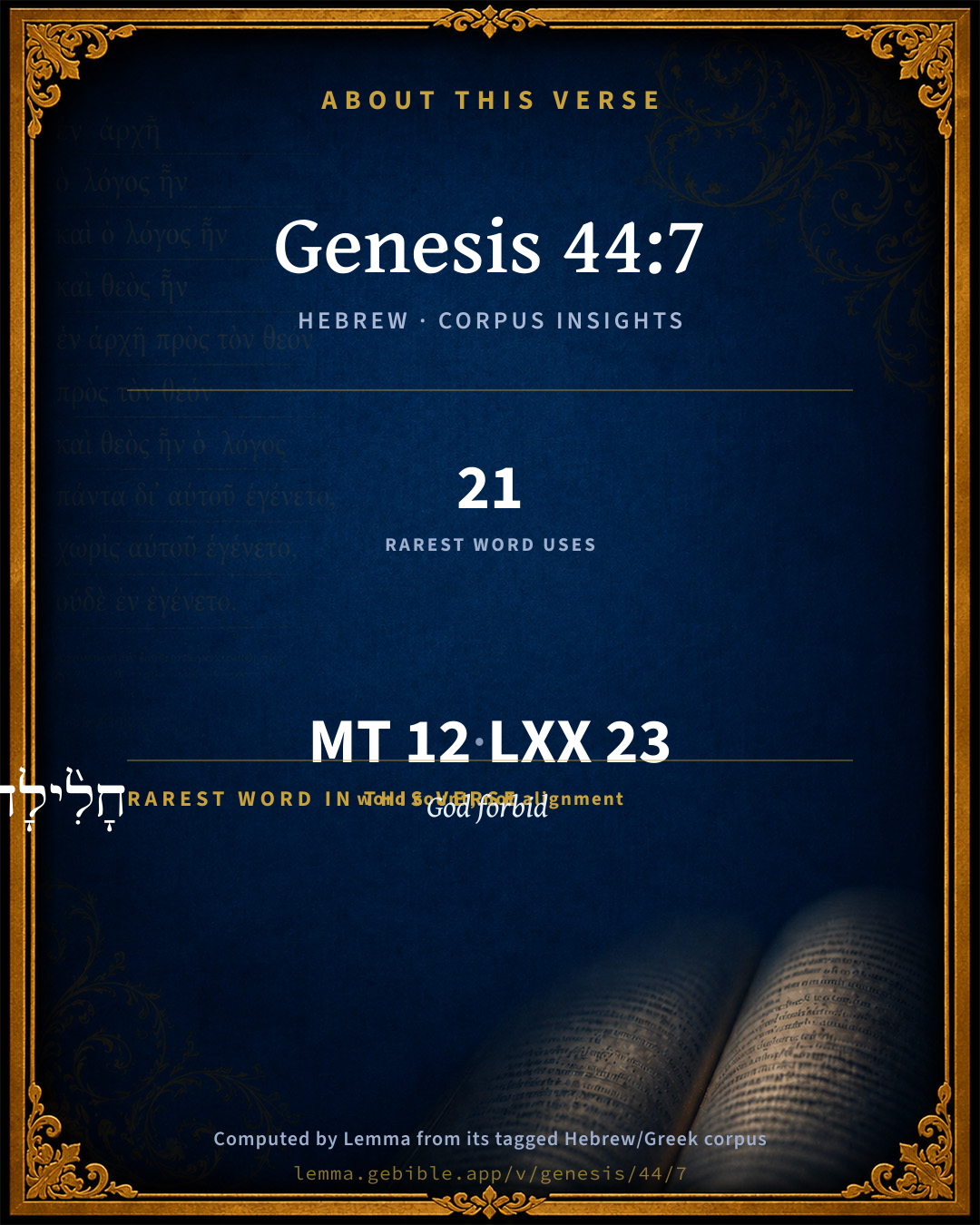
The rarest word here is חָלִ֨ילָה֙ God forbid H2486 — appearing just 21 times in the whole Hebrew Bible.

Shared distinctive vocabulary

חָלִ֨ילָה֙ God forbid H2486 occurs in 19 verses of the Hebrew Bible. Also found in:

Grammatical profile

  • 3 verbs
  • 4 nouns
  • 2 pronouns
  • 1 preposition
  • 2 particles

Verb forms

  • וַיֹּאמְר֣וּ Qal · Sequential Imperfect
  • יְדַבֵּ֣ר Piel · Imperfect
  • מֵעֲשׂ֖וֹת Qal · Infinitive Construct

Repetition

A word recurs within this verse — often emphatic in Hebrew:

  • כַּדְּבָרִ֖ים word H1697 ×2

Hebrew & Septuagint length

In English translation the verse runs 26 words from the Hebrew and 26 from the Septuagint (LXX English) — the same length.

A rough comparison of the two English renderings, which tokenize alike — not a word-level alignment.

Word counts can differ between the Hebrew and the Greek without any difference in meaning — e.g. the Hebrew direct-object marker אֵת has no separate Greek word, and Greek often adds the article ὁ.

In the original languages it is 12 Hebrew tokens and 23 Greek tokens — but the two are counted differently (Hebrew bundles its prefixes and suffixes into one token; the Greek is in lemma form), so that isn’t a like-for-like length.

Cross-references

10

Topical passages linked to Genesis 44:7 in the Treasury of Scripture Knowledge — connected by theme and wording, ordered by reader-vote popularity; previews shown in the World English Bible.

  • Genesis 38:16–18 He turned to her by the way, and said, "Please come, let me come in to you:" for he didn't know that she was his daughter-in-law. She said, "What will you give me, that you may come in to me?"
  • Genesis 34:25–31 It happened on the third day, when they were sore, that two of Jacob's sons, Simeon and Levi, Dinah's brothers, each took his sword, came upon the unsuspecting city, and killed all the males.
  • Genesis 35:22 It happened, while Israel lived in that land, that Reuben went and lay with Bilhah, his father's concubine, and Israel heard of it. Now the sons of Jacob were twelve.
  • Genesis 37:18–32 They saw him afar off, and before he came near to them, they conspired against him to kill him.
  • Joshua 22:22–29 The Mighty One, God, Yahweh, the Mighty One, God, Yahweh, he knows; and Israel he shall know: if it be in rebellion, or if in trespass against Yahweh (don't save us this day),
  • 2 Samuel 20:20 Joab answered, Far be it, far be it from me, that I should swallow up or destroy.
  • 2 Kings 8:13 Hazael said, But what is your servant, who is but a dog, that he should do this great thing? Elisha answered, Yahweh has shown me that you shall be king over Syria.
  • Proverbs 22:1 A good name is more desirable than great riches, And loving favor is better than silver and gold.
  • Ecclesiastes 7:1 A good name is better than fine perfume; and the day of death better than the day of one's birth.
  • Hebrews 13:18 Pray for us, for we are persuaded that we have a good conscience, desiring to live honorably in all things.

Cross-references courtesy of OpenBible.info (CC BY 4.0).

Hebrew and Greek witnesses Masoretic Hebrew ↔ Greek Septuagint

The same verse in the two great witnesses to the Old Testament, shown verse-for-verse.

These are two independent witnesses, not word-aligned to each other, and the Septuagint is shown in lemma (dictionary) form.

Hebrew Genesis 44:7 Masoretic · Westminster Leningrad Codex

וַיֹּאמְר֣וּ אֵלָ֔יו לָ֚מָּה יְדַבֵּ֣ר אֲדֹנִ֔י כַּדְּבָרִ֖ים הָאֵ֑לֶּה חָלִ֨ילָה֙ לַעֲבָדֶ֔יךָ מֵעֲשׂ֖וֹת כַּדָּבָ֥ר הַזֶּֽה

They said to him, "Why does my lord speak such words as these? Far be it from your servants that they should do such a thing!

World English Bible · Public Domain

Greek LXX Genesis 44:7 Septuagint · lemma form

ὁ δέ εἶπον αὐτός ἵνα τίς λαλέω ὁ κύριος κατά ὁ ῥῆμα οὗτος μή γίγνομαι ὁ παῖς σύ ποιέω κατά ὁ ῥῆμα οὗτος

And they said to him, Why does our lord speak according to these words? far be it from your servants to do according to this word.

LXX2012 (modern English Septuagint) · Public Domain

On this verse, The Pulpit Commentary discusses the Septuagint’s reading. Read the note in Commentary ↓

Hebrew: Westminster Leningrad Codex (CC BY 4.0). Greek: Septuagint (public domain); English from LXX2012 (modern English Septuagint) (Public Domain). How the Septuagint differs from the Hebrew →

Targum (Aramaic paraphrase)

2

The Targum is the ancient Jewish Aramaic paraphrase of the Hebrew Scriptures — an interpretive translation, not the Hebrew text itself. Onkelos (literal) and Pseudo-Jonathan (expansive) render the Torah, and Jonathan the Prophets. Coverage is partial: where no permissively-licensed English translation exists for a verse, only the Aramaic is shown. This is verse-level text, not a word-by-word alignment to the Hebrew.

  1. Targum Onkelos Torah (Genesis–Deuteronomy)
    וַאֲמָרוּ לֵהּ לְמָה יְמַלֵּל רִבּוֹנִי כְּפִתְגָּמַיָּא הָאִלֵּין חַס לְעַבְדָּיךְ מִלְּמֶעְבַּד כְּפִתְגָּמָא הָדֵין

    (no public-domain English translation for this verse)

    Targum Onkelos — Aramaic: “Onkelos Genesis” (public domain); “Onkelos Exodus” (public domain); “Onkelos Leviticus” (public domain); “Onkelos Numbers” (public domain); “Onkelos Deuteronomy” (public domain). English: “Sefaria Community Translation” (CC0 1.0 (public-domain dedication)); “J.W. Etheridge. The Targums of Onkelos and Jonathan Ben Uzziel on the Pentateuch. London: Longmans, Green, 1862” (public domain). Text via Sefaria.

  2. Targum Pseudo-Jonathan Torah (Genesis–Deuteronomy)
    וַאֲמָרוּ לֵיהּ לְמָא יְמַלֵיל רִבּוֹנִי כְּפִתְגָמַיָא הָאִילֵין חַס לְעַבְדָךְ מִלְמֶעֱבַד כְּפִתְגָמַיָא הָדֵין

    They said to him, Why does my lord speak words like these? Far be it from thy servants to do such a thing.

    Targum Pseudo-Jonathan — Aramaic: “Targum Jonathan on Genesis” (public domain); “Targum Jonathan on Exodus” (public domain); “Targum Jonathan on Leviticus” (public domain); “Targum Jonathan on Numbers” (public domain); “Targum Jonathan on Deuteronomy” (public domain). English: “The Targum of Jonathan ben Uzziel, trans. J. W. Etheridge, London, 1862” (public domain). Text via Sefaria.

Commentary

Notes on Genesis 44:7 from classic Christian and Jewish commentators (each source and its license shown beneath its notes). The classic Christian expositions comment on the surrounding passage and are grouped to its opening verse, so a note may address several verses; the Jewish commentaries on the Tanakh (Rashi and others) are per-verse, so they appear only where the commentator wrote on this verse.

Lemma curates 59 commentaries, every one of them public domain or Creative Commons licensed, each selected and text-cleaned for this edition rather than reprinted as found. About our sources →

Trapp's Complete Commentary

John Trapp

Gen 44:7 And they said unto him, Wherefore saith my lord these words? God forbid that thy servants should do according to this thing:

Ver. 7. God forbid that thy servants should do.] Rapine and robbery was ever condemned amongst very heathens, and severely punished. Tamerlane, in his expedition against Bajazet, took such order with his soldiers that none were injured; insomuch, that if a soldier had but taken an apple, or other thing of like value from any man, he died for it. One of his soldiers having taken a little milk from a country woman, and she thereof complaining, he ripped up his stomach; where when he found the milk, he contented the woman and sent her away, who had otherwise died for her false accusation. {a}

{a} Turk. Hist., fol. 213.

John Trapp, A Commentary or Exposition upon All the Books of the Old and New Testament (1647–1656) — public domain. Text from a community e-Sword module.

John Calvin's Commentaries

7. And they said unto him. The sons of Jacob boldly excuse themselves, because a good conscience gives them confidence. They also argue from the greater to the less: for they contend, that their having voluntarily brought back the money, which they might with impunity have applied to their own use, was such a proof of their honesty, as to make it incredible that they should have been so blinded by a little gain, as to bring upon themselves the greatest disgrace, together with immediate danger of their lives. They, therefore, declared themselves ready to submit to any punishment, if they were found guilty of the theft. When the cup was discovered in Benjamin’s sack, Moses does not relate any of their complaints; but only declares, that they testified the most bitter grief by rending their garments. I do not doubt that they were struck dumb by the unexpected result; for they were confounded, not only by the magnitude of their grief, but by perceiving themselves to be obnoxious to punishment, for that of which their conscience did not accuse them. Therefore, when they come into the presence of Joseph, they confess the injury, not because they acknowledge that the crime has been committed by them, but because excuse would be of no avail; as if they would say, “It is of no use to deny a thing which is manifest in itself.” In this sense, they say that their iniquity has been found out by God; because, although they had some secret suspicion of fraud, thinking that this had been a contrivance for the purpose of bringing an unjust charge against them, they choose rather to trace the cause of their punishment to the secret judgment of God. Some interpreters believe that they here confessed their crime committed against Joseph; but that opinion is easily refuted, because they constantly affirm that he had been torn by a wild beast, or had perished by some accident. Therefore, the more simple meaning is that which I have adduced; that although the truth of the fact is not apparent, yet they are punished by God as guilty persons. They do not, however, speak hypocritically; but being troubled and astonished in their perplexed affairs, there is nothing left for them but the consciousness that this punishment is inflicted by the secret judgment of God. And I wish that they who, when smitten by the rod of God, do not immediately perceive the cause, would adopt the same course; and when they find that men are unjustly incensed against them, would recall to mind the secret judgments of God, by which it becomes us to be humbled. Moreover, whereas Judah speaks in the name of them all, we may hence infer, that he had already obtained precedence among his brethren. And Moses exhibits him as their head and chief, when he expressly states that he and the rest came. For though the dignity of primogeniture had not yet been conferred upon him, by the solemn judgment of his father, yet it was intended for him. Certainly, in taking the post of speaker for the rest, his authority appears in his language. Again, it is necessary to recall to memory, in reference to the language of Joseph, what I have before said, that although at first he had endeavored to ascribe the glory to God, he now sins in pretending that he is a soothsayer or diviner. Some, to extenuate the fault, say that the allusion is, not to the art of augury, but to his skill in judging; there is, however, no need to resort to forced expositions for the sake of excusing the man; for he speaks according to the common understanding of the multitude, and thus foolishly countenances the received opinion.

John Calvin's Commentaries (1540-1563) — public domain. Text from the Calvin Translation Society English edition (1840s-50s) via the Christian Classics Ethereal Library (ccel.org). Calvin's coverage is partial (roughly two-thirds of the Bible); uncommented books and verses are honest gaps, never fabricated. The 19th-century editor's footnotes and remarks are omitted so the notes are faithfully Calvin's own voice.

The Cambridge Bible for Schools and Colleges

gen. ed. J. J. S. Perowne

7. God forbid] Lit. “far be it” = μὴ γένοιτο. The Heb. has no appeal to the Deity; cf. Jos_22:29.

They are convinced of their innocence, and indignantly repel the insinuation that they have rewarded the “lord’s” hospitality so basely,

The Cambridge Bible for Schools and Colleges (gen. ed. J. J. S. Perowne; Cambridge University Press, 1878–1918) — public domain. Text from a community e-Sword module.

John Gill's Exposition

And they said unto him, wherefore saith my lord these words?.... One of them, in the name of the rest, perhaps Judah, made answer, as astonished at the charge laid against them, suggesting that there was not the least foundation for it, and were quite surprised to hear anything of this kind alleged against them:

God forbid that thy servants should do according to this thing; expressing the utmost detestation of such a fact, as being what they could never be guilty of.

John Gill's Exposition of the Whole Bible (1746–1763) — public domain (CC PDM 1.0). Text via the HelloAO Bible API.

The Pulpit Commentary

Vers. 7-10. And they said unto him, Wherefore saith my lord these words? God forbid that thy servants should do (literally, for be thy seesaws from doing) according to s thing: behold, the money (literally, the silver), which we found in our sacks" mouths, we brought again unto thee out of the land of Canaan (this was an irrefragable proof of their honesty): how then should we steal out of my lord"s house silver or gold? They were even so confident of their innocence that they ventured on a rash proposition. With whomsoever of thy servants it be found, both let him die, and we also will be my lord"s bondmen literally, for servants to my lord. And he (the steward) said, Now also let it be according to your words. So LXX, Vulgate, and commentators generally; but Kalisch reads it as an interrogation, Is it right according to your words?" meaning that strict justice demanded only the punishment of the thief, as he explained. He with whom it is found shall be my servant; and ye (i.e. the others of you) shall be blameless.

The Pulpit Commentary (1880–1919), ed. H.D.M. Spence-Jones & Joseph S. Exell — public domain. Text from a community e-Sword module.

Keil & Delitzsch

C. F. Keil & F. Delitzsch

In the consciousness of their innocence the brethren repelled this charge with indignation, and appealed to the fact that they brought back the gold which was found in their sacks, and therefore could not possibly have stolen gold or silver; and declared that whoever should be found in possession of the goblet, should be put to death, and the rest become slaves.

Keil & Delitzsch — Biblical Commentary on the Old Testament (1861–1891) — public domain (CC PDM 1.0). Text via the HelloAO Bible API. (Old Testament only.)

Rashi

Rabbi Shlomo Yitzchaki (Rashi)

חלילה לעבדיך FAR BE IT FROM TIIY SERVANTS — It is a degradation (חולין a profane thing) — this is an expression denoting a shameful act. The Targum חס לעבדיך “a sparing to thy servants!” signifies “May there be a sparing from God upon us that we should not do this thing” The expression חס ושלום occurs often in the Talmud in this sense — Forbearance and peace!

Rashi on the Tanakh — English translations: “The Judaica Press complete Tanach with Rashi, translated by A. J. Rosenberg” (CC BY 4.0); “Pentateuch with Rashi's commentary by M. Rosenbaum and A.M. Silbermann, 1929-1934” (public domain); “The Metsudah Tanach series, Lakewood, N.J” (CC BY 4.0); and “The Book of Joshua, Metsudah Publications, 1997” (CC BY 4.0). Text via Sefaria.

Lesson kit

Teaching starters — assembled from the data on this page, not authored interpretation. Every prompt links to the verse data it draws on. Edit before teaching.

Genesis, in the Pentateuch, opens this verse with 12 words (11 distinct Hebrew lemmas). Its most distinctive word is châlîylâh (“God forbid”). A historical commentator’s framing appears above. Read the whole chapter for the surrounding context.

Discussion questions

  1. The word châlîylâh carries the sense “God forbid.” How does it shape the verse?
  2. How does Genesis 18:25, which shares the word «God forbid», read alongside this verse?
  3. What does the repetition of “word” (2× in this one verse) do in this verse?
  4. The translations on this page render this verse differently — a whole-verse word diff, not a word-by-word alignment. What might account for the different wordings?
  5. «וַיֹּאמְר֣וּ» is a Qal Sequential Imperfect verb. How does that grammatical form shape the action described?
  6. Compare how Trapp's Complete Commentary and John Calvin's Commentaries read this verse. Where do they agree or differ?

Things to notice

Reading settings

Reading text

Shown beneath each verse's original-language words.

Old Testament
Old Testament edition

Read the OT as the Masoretic Hebrew (MT) or the Greek Septuagint (LXX).

English shown for the Greek Septuagint (in the Hebrew ↔ Greek comparison).

Comparing translations? Open the Compare panel on any verse page to stack up to four side by side.