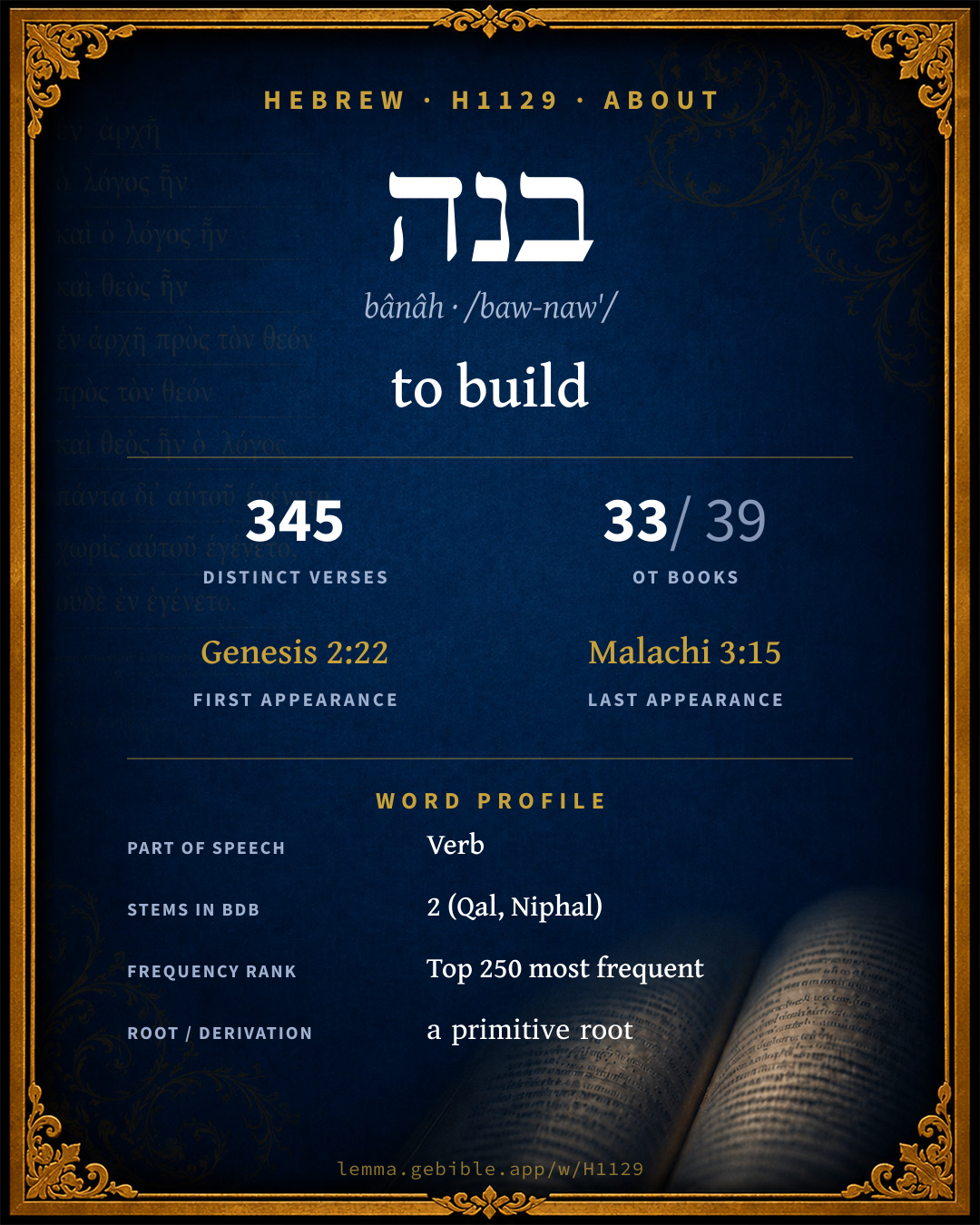
בָּנָה
to build
also: rebuild, establish, cause to continue fuller range ↓
Full lexicon entry — Brown-Driver-Briggs (BDB)
From Brown-Driver-Briggs (BDB)
Where this word appears
Grammar key — what these labels mean
Part of speech
- Verb
- An action or state-of-being word.
Stem
- Qal
- The basic, simple active stem — the plain form of the verb (“he wrote”). Here: ‘sq.’
- Niphal
- Usually the simple passive or reflexive of the Qal (“he was written”). Here: ‘be built’
Form
- Sequential Imperfect
- An imperfect with prefixed waw — the standard past-narrative form (waw-consecutive imperfect).
- Infinitive Construct
- A bound verbal noun, frequently with prepositions (“to write / in writing”).
- Perfect
- A completed action or state — Hebrew marks aspect (completeness) more than strict tense (“he wrote”).
- Imperfect
- An incomplete, ongoing, or future action (“he will / would write”).
- Participle Active
- A verbal adjective expressing ongoing or characteristic action (“writing / one who writes”).
- Sequential Perfect
- A perfect with prefixed waw continuing a preceding imperfect or command (waw-consecutive perfect).
- Imperative
- A direct command (“write!”).
- Cohortative
- A first-person volitional form expressing wish or resolve (“let me / let us write”).
- Jussive
- A third- or second-person volitional form expressing wish or command (“let him write”).
- Participle Passive
- A verbal adjective expressing action received (“written”).
- Infinitive Absolute
- An unbound verbal noun, often intensifying or standing in for a finite verb.
State
- Absolute
- The independent form of a noun, not bound to a following word.
- Construct
- A noun bound to a following noun in a possessive / “of” relationship (the construct chain).
Person
- 3rd Person
- The one spoken about (“he / she / it / they”).
- 1st Person
- The speaker (“I / we”).
- 2nd Person
- The one addressed (“you”).
Gender
- Masculine
- Grammatically masculine.
- Common
- Either gender — not distinguished for this form.
- Feminine
- Grammatically feminine.
Number
- Singular
- One.
- Plural
- More than one (in Hebrew, generally three or more).
Every verse where H1129 appears in the Book of 2 Chronicles — 54 distinct verses. Click any verse to open its interlinear word-by-word view. Verse text shown in the World English Bible for context — . Each verse’s Hebrew form is shown with its reference; the English is not keyword-highlighted, since the data carries no word-level English alignment. Use “Compare translations” on any verse to read it across multiple English versions. This concordance covers the Hebrew Bible; Septuagint (Greek Old Testament) occurrences are not indexed here.
2 Chronicles
- 2 Chronicles 2:1 לִ/בְנ֥וֹת prep + Qal inf.cs Now Solomon purposed to build a house for the name of Yahweh, and a house for his kingdom.
- 2 Chronicles 2:3 לִ/בְנֽוֹת prep + Qal inf.cs Solomon sent to Huram the king of Tyre, saying, As you dealt with David my father, and sent him cedars to build him a house in which to dwell, [even so deal with me].
- 2 Chronicles 2:4 בֽוֹנֶה Qal ptcp.act ms Behold, I am about to build a house for the name of Yahweh my God, to dedicate it to him, and to burn before him incense of sweet spices, and for the continual show bread, and for the burnt offerings morning and evening, on the Sabbaths, and on the new moons, and on the set feasts of Yahweh our God. This is [an ordinance] forever to Israel.
- 2 Chronicles 2:5 בוֹנֶ֖ה Qal ptcp.act ms The house which I build is great; for great is our God above all gods.
- 2 Chronicles 2:6 לִ/בְנֽוֹת אֶבְנֶה prep + Qal inf.cs Qal impf 1cs But who is able to build him a house, seeing heaven and the heaven of heavens can't contain him? who am I then, that I should build him a house, save only to burn incense before him?
- 2 Chronicles 2:9 בוֹנֶ֖ה Qal ptcp.act ms even to prepare me timber in abundance; for the house which I am about to build shall be great and wonderful.
- 2 Chronicles 2:12 יִבְנֶה Qal impf 3ms Huram said moreover, Blessed be Yahweh, the God of Israel, that made heaven and earth, who has given to David the king a wise son, endowed with discretion and understanding, that should build a house for Yahweh, and a house for his kingdom.
- 2 Chronicles 3:1 לִ/בְנ֤וֹת prep + Qal inf.cs Then Solomon began to build the house of Yahweh at Jerusalem on Mount Moriah, where [Yahweh] appeared to David his father, which he made ready in the place that David had appointed, in the threshing floor of Ornan the Jebusite.
- 2 Chronicles 3:2 לִ/בְנ֞וֹת prep + Qal inf.cs He began to build in the second [day] of the second month, in the fourth year of his reign.
- 2 Chronicles 3:3 לִ/בְנ֖וֹת prep + Qal inf.cs Now these are the foundations which Solomon laid for the building of the house of God. The length by cubits after the first measure was sixty cubits, and the breadth twenty cubits.
- 2 Chronicles 6:2 בָּנִ֥יתִי Qal pf 1cs But I have built you a house of habitation, and a place for you to dwell in forever.
- 2 Chronicles 6:5 לִ/בְנ֣וֹת prep + Qal inf.cs Since the day that I brought forth my people out of the land of Egypt, I chose no city out of all the tribes of Israel to build a house in, that my name might be there; neither chose I any man to be prince over my people Israel:
- 2 Chronicles 6:7 לִ/בְנ֣וֹת prep + Qal inf.cs Now it was in the heart of David my father to build a house for the name of Yahweh, the God of Israel.
- 2 Chronicles 6:8 לִ/בְנ֥וֹת prep + Qal inf.cs But Yahweh said to David my father, Whereas it was in your heart to build a house for my name, you did well that it was in your heart:
- 2 Chronicles 6:9 תִבְנֶ֖ה יִבְנֶ֥ה Qal impf 2ms Qal impf 3ms nevertheless you shall not build the house; but your son who shall come forth out of your loins, he shall build the house for my name.
- 2 Chronicles 6:10 וָ/אֶבְנֶ֣ה conj + Qal wimpf 1cs Yahweh has performed his word that he spoke; for I am risen up in the room of David my father, and sit on the throne of Israel, as Yahweh promised, and have built the house for the name of Yahweh, the God of Israel.
- 2 Chronicles 6:18 בָּנִֽיתִי Qal pf 1cs But will God in very deed dwell with men on the earth? behold, heaven and the heaven of heavens can't contain you; how much less this house which I have built!
- 2 Chronicles 6:33 בָּנִֽיתִי Qal pf 1cs then hear from heaven, even from your dwelling-place, and do according to all that the foreigner calls to you for; that all the peoples of the earth may know your name, and fear you, as does your people Israel, and that they may know that this house which I have built is called by your name.
- 2 Chronicles 6:34 בָּנִ֥יתִי Qal pf 1cs If your people go out to battle against their enemies, by whatever way you shall send them, and they pray to you toward this city which you have chosen, and the house which I have built for your name;
- 2 Chronicles 6:38 בָּנִ֥יתִי Qal pf 1cs if they return to you with all their heart and with all their soul in the land of their captivity, where they have carried them captive, and pray toward their land, which you gave to their fathers, and the city which you have chosen, and toward the house which I have built for your name:
- 2 Chronicles 8:1 בָּנָ֧ה Qal pf 3ms It happened at the end of twenty years, in which Solomon had built the house of Yahweh, and his own house,
- 2 Chronicles 8:2 בָּנָ֥ה Qal pf 3ms that the cities which Huram had given to Solomon, Solomon built them, and caused the children of Israel to dwell there.
- 2 Chronicles 8:4 וַ/יִּ֥בֶן בָּנָ֖ה conj + Qal wimpf 3ms Qal pf 3ms He built Tadmor in the wilderness, and all the store-cities, which he built in Hamath.
- 2 Chronicles 8:5 וַ/יִּ֜בֶן conj + Qal wimpf 3ms Also he built Beth Horon the upper, and Beth Horon the lower, fortified cities, with walls, gates, and bars;
- 2 Chronicles 8:6 לִ/בְנ֤וֹת prep + Qal inf.cs and Baalath, and all the store-cities that Solomon had, and all the cities for his chariots, and the cities for his horsemen, and all that Solomon desired to build for his pleasure in Jerusalem, and in Lebanon, and in all the land of his dominion.
- 2 Chronicles 8:11 בָּֽנָה Qal pf 3ms Solomon brought up the daughter of Pharaoh out of the city of David to the house that he had built for her; for he said, My wife shall not dwell in the house of David king of Israel, because the places are holy, whereunto the ark of Yahweh has come.
- 2 Chronicles 8:12 בָּנָ֖ה Qal pf 3ms Then Solomon offered burnt-offerings to Yahweh on the altar of Yahweh, which he had built before the porch,
- 2 Chronicles 9:3 בָּנָֽה Qal pf 3ms When the queen of Sheba had seen the wisdom of Solomon, and the house that he had built,
- 2 Chronicles 11:5 וַ/יִּ֧בֶן conj + Qal wimpf 3ms Rehoboam lived in Jerusalem, and built cities for defense in Judah.
- 2 Chronicles 11:6 וַ/יִּ֧בֶן conj + Qal wimpf 3ms He built Bethlehem, and Etam, and Tekoa,
- 2 Chronicles 14:6 וַ/יִּ֛בֶן conj + Qal wimpf 3ms He built fortified cities in Judah; for the land was quiet, and he had no war in those years, because Yahweh had given him rest.
- 2 Chronicles 14:7 נִבְנֶ֣ה וַ/יִּבְנ֖וּ Qal impf 1cp conj + Qal wimpf 3mp For he said to Judah, Let us build these cities, and make about them walls, and towers, gates, and bars; the land is yet before us, because we have sought Yahweh our God; we have sought him, and he has given us rest on every side. So they built and prospered.
- 2 Chronicles 16:1 וַ/יִּ֖בֶן conj + Qal wimpf 3ms In the six and thirtieth year of the reign of Asa, Baasha king of Israel went up against Judah, and built Ramah, that he might not allow anyone to go out or come in to Asa king of Judah.
- 2 Chronicles 16:5 מִ/בְּנ֖וֹת prep + Qal inf.cs It happened, when Baasha heard of it, that he left off building Ramah, and let his work cease.
- 2 Chronicles 16:6 בָּנָ֖ה וַ/יִּ֣בֶן Qal pf 3ms conj + Qal wimpf 3ms Then Asa the king took all Judah; and they carried away the stones of Ramah, and the timber of it, with which Baasha had built; and he built therewith Geba and Mizpah.
- 2 Chronicles 17:12 וַ/יִּ֧בֶן conj + Qal wimpf 3ms Jehoshaphat grew great exceedingly; and he built in Judah castles and cities of store.
- 2 Chronicles 20:8 וַ/יִּבְנ֨וּ conj + Qal wimpf 3mp They lived therein, and have built you a sanctuary therein for your name, saying,
- 2 Chronicles 26:2 בָּנָ֣ה Qal pf 3ms He built Eloth, and restored it to Judah, after that the king slept with his fathers.
- 2 Chronicles 26:6 וַ/יִּבְנֶ֣ה conj + Qal wimpf 3ms He went forth and warred against the Philistines, and broke down the wall of Gath, and the wall of Jabneh, and the wall of Ashdod; and he built cities in [the country of] Ashdod, and among the Philistines.
- 2 Chronicles 26:9 וַ/יִּ֨בֶן conj + Qal wimpf 3ms Moreover Uzziah built towers in Jerusalem at the corner gate, and at the valley gate, and at the turning [of the wall], and fortified them.
- 2 Chronicles 26:10 וַ/יִּ֨בֶן conj + Qal wimpf 3ms He built towers in the wilderness, and hewed out many cisterns, for he had much cattle; in the lowland also, and in the plain: [and he had] farmers and vineyard keepers in the mountains and in the fruitful fields; for he loved farming.
- 2 Chronicles 27:3 בָּנָ֛ה בָּנָ֖ה Qal pf 3ms Qal pf 3ms He built the upper gate of the house of Yahweh, and on the wall of Ophel he built much.
- 2 Chronicles 27:4 בָּנָ֖ה בָּנָ֔ה Qal pf 3ms Qal pf 3ms Moreover he built cities in the hill-country of Judah, and in the forests he built castles and towers.
- 2 Chronicles 32:5 וַ/יִּבֶן֩ conj + Qal wimpf 3ms He took courage, and built up all the wall that was broken down, and raised [it] up to the towers, and the other wall outside, and strengthened Millo [in] the city of David, and made weapons and shields in abundance.
- 2 Chronicles 33:3 וַ/יִּ֨בֶן֙ conj + Qal wimpf 3ms For he built again the high places which Hezekiah his father had broken down; and he reared up altars for the Baals, and made Asheroth, and worshiped all the host of the sky, and served them.
- 2 Chronicles 33:4 וּ/בָנָ֥ה conj + Qal pf 3ms He built altars in the house of Yahweh, of which Yahweh said, In Jerusalem shall my name be forever.
- 2 Chronicles 33:5 וַ/יִּ֥בֶן conj + Qal wimpf 3ms He built altars for all the host of the sky in the two courts of the house of Yahweh.
- 2 Chronicles 33:14 בָּנָ֣ה Qal pf 3ms Now after this he built an outer wall to the city of David, on the west side of Gihon, in the valley, even to the entrance at the fish gate; and he compassed Ophel about [with it], and raised it up to a very great height: and he put valiant captains in all the fortified cities of Judah.
- 2 Chronicles 33:15 בָּנָ֛ה Qal pf 3ms He took away the foreign gods, and the idol out of the house of Yahweh, and all the altars that he had built in the mountain of the house of Yahweh, and in Jerusalem, and cast them out of the city.
- 2 Chronicles 33:16 וַ/יִּ֨בֶן֙ conj + Qal wimpf 3ms He built up the altar of Yahweh, and offered thereon sacrifices of peace-offerings and of thanksgiving, and commanded Judah to serve Yahweh, the God of Israel.
- 2 Chronicles 33:19 בָּנָ֨ה Qal pf 3ms His prayer also, and how [God] was entreated of him, and all his sin and his trespass, and the places in which he built high places, and set up the Asherim and the engraved images, before he humbled himself: behold, they are written in the history of Hozai.
- 2 Chronicles 34:11 וְ/לַ/בֹּנִ֔ים conj + prep det + Qal ptcp.act mp even to the carpenters and to the builders gave they it, to buy hewn stone, and timber for couplings, and to make beams for the houses which the kings of Judah had destroyed.
- 2 Chronicles 35:3 בָּנָ֜ה Qal pf 3ms He said to the Levites who taught all Israel, who were holy to Yahweh, Put the holy ark in the house which Solomon the son of David king of Israel did build; there shall no more be a burden on your shoulders: now serve Yahweh your God, and his people Israel.
- 2 Chronicles 36:23 לִ/בְנֽוֹת prep + Qal inf.cs Thus says Cyrus king of Persia, All the kingdoms of the earth has Yahweh, the God of heaven, given me; and he has charged me to build him a house in Jerusalem, which is in Judah. Whoever there is among you of all his people, Yahweh his God be with him, and let him go up.
About this entry
At a glance — auto-summarized from this page’s data, not written by a person. Every figure links to its source below. This summary describes the numbers; it doesn’t interpret them.
At its core, בנה (bânâh) means “to build.” Scripture first uses it in Genesis 2:22. It appears 345 verses across 33 books of the Hebrew Bible, among its common vocabulary. As a verb its force shifts by stem, across 2 stems (Qal, Niphal, and more). It clusters with אבן, בית and בן under a shared root. Dig into 345-verse concordance and the renderings breakdown below.
Gloss history
Strong's 1890 vs modern scholarship
About this word
Strong's H1129 catalogs a Hebrew word from the Hebrew Old Testament.
These counts are not copied from any lexicon or concordance. They are computed here, from the morphology-tagged Hebrew Old Testament. What Lemma adds →
- 345
- distinct verses
- The word appears in 345 distinct verses.
- 33 / 39
- OT books
- The word appears in 33 of 39 Old Testament books.
- #133
- by frequency
- Top 250 most frequent Hebrew words (rank 133 of 8,640 Hebrew words by occurrence).
View all 345 occurrences in the concordance →
Most concentrated in
- 2 Chronicles 54 verses 16%
- 1 Kings 53 verses 15%
- 1 Chronicles 27 verses 8%
By section of the Old Testament
By traditional corpus
Conventional, traditional groupings — biblical authorship is debated, so this is a traditional corpus grouping, not an authorship claim. Each share is this word’s portion of its verses in that division of the Hebrew canon. Each figure is a share of the word’s 345 distinct verses.
- Prophets (Nevi'im) 164 verses · 48%
- Writings (Ketuvim) 140 verses · 41%
- Torah (Pentateuch) 41 verses · 12%
How translations render this word
Counts come from each version’s own published word-to-Strong’s tagging or interlinear alignment — an approximate guide to how each version renders this word, not a word-level alignment the data otherwise carries. Because each total is that version’s own tagged count, the per-version totals vary from one another and need not match the appearance or distinct-verse counts above. These counts may also differ from a printed concordance because Lemma counts each distinctly tagged rendering and does not collapse phrase taggings into a single head-word total. This is a fixed set of word-tagged versions (KJV, ASV, BSB, ULT) and does not change with the reading translation you choose elsewhere. Each version’s license is shown beside its name below (and on Sources).
- King James Version: Build 58×, He built 41×, Built 39×
- American Standard Version: Build 51×, He built 45×, Built 35×
- Berean Standard Bible: Build 54×, Built 46×, He built 23×
- unfoldingWord Literal Text: Build 69×, He built 62×, Built 48×
King James Version Public Domain
Renders H1129 across 376 tagged occurrences — most commonly:
Plus other, less common renderings. Plus 91 renderings that appear only once — usually multi-word phrases or single function words the recovered tagging swept in, not distinct renderings.
American Standard Version Public Domain
Renders H1129 across 376 tagged occurrences — most commonly:
Plus other, less common renderings. Plus 99 renderings that appear only once — usually multi-word phrases or single function words the recovered tagging swept in, not distinct renderings.
Berean Standard Bible Public Domain
Renders H1129 across 366 tagged occurrences — most commonly:
Plus other, less common renderings. Plus 77 renderings that appear only once — usually multi-word phrases or single function words the recovered tagging swept in, not distinct renderings. Not rendered by a distinct English word in 9 further occurrences.
unfoldingWord Literal Text CC BY-SA 4.0
Renders H1129 across 414 tagged occurrences — most commonly:
Plus other, less common renderings. Plus 57 renderings that appear only once — usually multi-word phrases or single function words the recovered tagging swept in, not distinct renderings.
19 senses and sub-senses in the full BDB
Hebrew verbs can shift meaning by stem (binyan): Qal is the basic action, Niphal is often passive or reflexive, Piel often intensifies or makes it factitive, and Hiphil is typically causative. The senses below are grouped under the stem BDB assigns to each.
What do BDB’s symbols mean?
BDB uses these scholarly abbreviations:
| Symbol | Meaning |
|---|---|
| 𝔊 | the Septuagint (the ancient Greek translation, LXX) |
| 𝔙 | the Vulgate (the Latin translation) |
| 𝔖 | the Syriac version (the Peshitta) |
| 𝔗 | the Targum (the Aramaic translation) |
| ψ | the Psalms |
| √ | root (the underlying root or stem) |
| ‖ | parallel passage (a synonymous or contrasted parallel) |
| † | the dagger: every passage where the word occurs is cited |
The 19 senses and sub-senses the full Brown-Driver-Briggs lexicon distinguishes for this word, in lexicon order (not ranked by frequency), with BDB’s own verbatim wording and sub-sense lettering. Shown in Hebrew script with BDB’s own scholarly abbreviations. The condensed entry is in the Lexicon Entry tab. See also the Forms in the corpus table below.
Qal
- Pf. ב׳ Dt 20:5 +, בָּֽנְתָה Pr 9:1; 14:1, בָּנִיתָ Dt 6:10, בָּנִתָה 1 K 9:3; וּבָנִ֫יתָ consec. Dt 20:20 +; בָּנִיתְ Ez 16:25; בָּנִיתִי 1 K 8:13 +; pl. בָּנוּ Gn 11:5 +, etc.; Impf. יִבְנֶה Dt 25:9 +; juss. וְיִבֶן Ezr 1:3 וַיִּבְנֶה Jos 19:50 + 2 times וַיִּ֫בֶן Gn 2:22 +; sf. יִבְנֵ֫הוּ Jb 20:19; 3 fs. וַתִּ֫בֶן 1 Ch 7:24 Zc 9:3; אֶבְנֶה 2 S 7:27 +; pl. יִבְנוּ Is 65:22 +, etc.; Imv. בְּנֵה Nu 23:1 +; pl. בְּנוּ Nu 32:24 +; Inf. abs. בָּנֹה 1 K 8:13; cstr. בְּנוֹת 1 Ch 6:17 +, etc.; Pt. act. בֹּנֶה (בּוֹנֶה) Gn 4:17 +; cstr. בֹּנֵה ψ 147:2; pl. בּוֹנִים (בֹּנִים) Ezr 4:1 +; cstr. בֹּנֵי 1 K 5:32(×2), etc.; pass. בָּנוּי Ct 4:4 Ju 6:28; f. בְּנוּיָה ψ 122:3; pl. בְּנוּיִם Ne 7:4;—build, e.g. Deuteronomy 20:5
- a. c. acc. (α) of city (Hex only JE) Gn 4:17; 10:11; 11:4, 5 (+ tower) v 8 (all J & his sources); Ex 1:11 Nu 32:24 Jos 24:13 (all E) Ju 1:26; 18:28 + 22 times K Ch + Je 32:31 ψ 122:3 (pt. pass.) cf. Hb 2:12; of village (חָצֵר) Ne 12:29; v. also sub rebuild, i. infr.; (β) house Gn 33:17 (J), elsewhere in Hex only Dt 6:10; 8:12; 20:20; 28:30; also 2 S 5:11 1 K 22:39 1 Ch 14:1 2 Ch 2:2 Pr 24:27 Am 5:11 Zp 1:13 Is 65:21 Je 35:7, 9 cf. Zc 5:11; as sign of security Ez 28:26 cf. 11:3; of luxury Ec 2:4 cf. Je 22:14; of permanent residence 1 K 2:36 Je 29:5, 28; especially of temple 1 K 3:1; 5:32; 6:2 + often S K Chr; fig. of wisdom’s house Pr 9:1; especially build temple ליהוה etc. 2 S 7:5, 7 1 K 6:1 (= began to build) + 13 times Chr + Is 66:1; לְשֵׁם י׳ etc. 2 S 7:13 1 K 5:17 + 8 times K, 13 times Ch; לְךָ לְשִׁמְךָ 2 Ch 20:8; לִהְיוֹת שְׁמִי שָׁם 1 K 8:16 2 Ch 6:5; לָשׂוּם שְׁמִי שָׁם 1 K 9:3; obj. chambers, or stories 1 K 6:5, 10, court 6:36 Ho 8:14 perhaps of idolt-temples; cf. 1 K 16:32; ψ 78:69 of Yahweh’s building his sanctuary, 147:2 Jerusalem, ψ 127:1 a house; also Am 9:6 his chambers in the heavens; of Sol.’s palace 1 K 7:1, 2; 9:1, 10 +; (γ) of a fortress 2 Ch 17:12 27:4 cf. of Tyre Zc 9:3 (מָצוֹר); (δ) of wall 1 K 3:1 Is 60:10 Ez 13:10 2 Ch 33:14 (cf. 27:3) Ne 4:4; 6:1 +; (ε) gate 2 K 15:35 = 2 Ch 27:3; (ζ) tower Is 5:2 2 Ch 26:9, 10; 27:4 cf. fig. Ct 8:9 & pt. pass. Ct 4:4 (in sim.); † (η) siege-works against (עַל־) a city Dt 20:20 (מָצוֹר), Ec 9:14 (מְצוֹרִים), 2 K 25:1 = Je 52:4 Ez 4:2 (all דָּיֵק), & so (without עַל־) Ez 17:17; 21:27; cf. בנה עָלַי, abs. La 3:5 (in fig.); (θ) altar Gn 22:9; 35:7 Ex 17:15; 20:25; 24:4 Nu 23:1, 14, 29 (all E), Gn 26:25 Ex 32:5 (both J), Jos 22:11 + 6 times Jos 22 (all P) Ju 6:28 (pt. pass.) 21:4 + 6 times K Ch; often sq. ליהוה etc. Gn 8:20; 12:7, 8; 13:18 (all J), Dt 27:5, 6 Jos 8:30 (E) Ju 6:24, 26 + 8 times S K Ch; †(ι) high places (בָּמָה) 1 K 11:7; 14:23 2 K 17:9; 21:3; 23:13 2 Ch 33:3, 19 Je 7:31; 19:5; 32:35; cf. גַּב Ez 16:24, 31 (both ‖ רָמָה) & רָמָה v 25; †(κ) צִיּוּן Ez 39:15; also †(λ) גִּדְרֹת צֹאן Nu 32:16 (E); †(μ) מיּ֯סַךְ הַשַּׁבָּת 2 K 16:18. e.g. Genesis 4:17
- b. c. acc. of material Ex 20:25 (E) 1 K 6:36; 18:32; 15:22 = 2 Ch 16:6 Ez 27:5; c. בְּ of material 1 K 6:15, 16; 15:17 2 Ch 16:6; cf. e.g. Exodus 20:22
- c. וַיִּבֶן אֶת־הַצֵּלָע לְאִשָּׁה Gn 2:22 and he (Yahweh) fashioned the rib into a woman. e.g. Genesis 2:22
- d. abs. 2 S 5:9 1 K 6:16 Is 9:9 Je 1:10; 18:9; 22:13; 31:28 Is 65:22 + 12 times Chr + Mal 1:4 Ec 3:3 (opp. פרץ); also e.g. 2 Samuel 5:9
- e. Pt. act. = builder 1 K 5:32(×2) + 6 times Chr + Ez 27:4 ψ 118:22; 127:1. e.g. 1 Kings 5:32
- f. cf. indef. obj. 1 K 9:19 = 2 Ch 8:6. e.g. 1 Kings 9:19
- g. וַיִּבֶן אֶת־הָהָר = and he built on the hill 1 K 16:24. e.g. 1 Kings 16:24
- h. sq. בְּ build at Zc 6:15 Ne 4:11 (cf. בְּ i 2 b, p. 88). e.g. Zechariah 6:15
- i. = rebuild Jos 6:26 1 K 16:34 Am 9:14 Is 45:13 ψ 69:36 Ne 2:5 Dn 9:25 all of city; cf. phrase בנה חָרְבוֹת עוֹלָם Is 58:12; 61:4 & Ez 36:36 Mal 1:4 Jb 3:14; of walls Mi 7:11 2 Ch 32:5 Ne 2:17; 3:33, 35, 38; 6:6 ψ 51:20 (act. of י׳); of gate Ne 3:1, 13, 14, 15; temple Zc 6:12, 13 Ezr 1:3; alter 2 Ch 33:16 (Qr וַיִּבֶן so Bö ויכן, from כון, so Öt), Ezr 3:2; high places 2 K 21:3 = 2 Ch 33:3; in some of these apparently an idea of merely repairing; so, sometimes with added notion of enlarging etc., city Nu 32:34, 37, 38 (E) Jos 19:50 (P) Ju 21:23 2 K 14:22 = 2 Ch 26:2, 1 Ch 11:8 2 Ch 8:2; 11:6 cf. Mi 3:10; Millo 1 K 9:24; 11:27; cf. house Jb 20:19. e.g. Joshua 6:26
- 2. fig.
- a. build a house (בית) = perpetuate and establish a family; subj. Leah & Rachel Ru 4:11; subj. a brother Dt 25:9; subj. י׳ (promise to David) 1 S 2:35 2 S 7:27 1 K 11:38 1 Ch 17:10 and 17:25; (to Solomon) 1 K 11:38; cf. further סֻכַּת דָּוִד Am 9:11 (rebuild, restore); = cause a household to flourish Pr 14:1 cf. opp. 27:18; also of establishing David’s throne ψ 89:5. e.g. Ruth 4:11
- b. build up Israel (after exile) subj. י׳ Je 24:6; 31:4; 33:7; 42:10 cf. 45:4 & ψ 28:5; obj. Zion ψ 102:17. e.g. Jeremiah 24:6
Niphal
- Pf. נִבְנָה 1 K 3:2; 6:7, נִבְנְתָה Nu 13:22 Ne 7:1, וְנִבְנְתָה consec. Je 30:18 + 2 times; 2 fs. וְנִבְנֵית consec. Je 31:4; 3 pl. נִבְנוּ Mal 3:15; וְנִבְנוּ consec. Je 12:16 Ez 36:33; Impf. יִבָּנֶה Jb 12:14 + 4 times; 3 fs. תִּבָּנֶה Nu 21:27 + 3 times; 2 ms. תִּבָּנֶה Jb 22:23, אִבָּנֶה Gn 16:2, וְאִבָּנֶה Gn 30:3; 3 fpl. תִּבָּנֶינָה Ez 36:10; 2 fpl. תִּבָּנֶינָה Is 44:26; Inf. לְהִבָּנוֹת Hg 1:2 Zc 8:9, בְּהִבָּנֹתוֹ 1 K 6:7(×2); Pt. נִבְנֶה 1 Ch 22:19;— e.g. 1 Kings 3:2
- 1.
- a. be built, (lit.) of city Nu 13:22; of temple 1 K 3:2 (לְשֵׁם י׳) 1 K 6:7(×3) (c. acc. mater.); Pt. = to be built (gerundive) 1 Ch 22:19. e.g. Numbers 13:22
- b. be rebuilt: of city of Sihon Nu 21:27 cf. Is 25:2; 44:26, of wall of Jerusalem Ne 7:1, of Jerusalem Je 30:18; 31:4, 38 Is 44:28 cf. Dn 9:25 תָּשׁוּב וְנִבְנְתָה, & Ez 26:14 (c. עוֹד), of ruinous places (הֶחֳרָבוֹת) Ez 36:10, 33, of a devoted city Dt 13:17 (c. עוֹד), of temple Hg 1:2 Zc 1:16; 8:9, indef. subj. Jb 12:14. e.g. Numbers 21:27
- 2.
- a. (fig.) of restored exiles, = established Je 12:16, of prosperous wicked Mal 3:15, of repentant offender Jb 22:23. e.g. Jeremiah 12:16
- b. established, made permanent, subj. חֶסֶד ψ 89:3 (c. עוֹלָם), subj. בַּיִת Pr 24:3 (by wisdom). e.g. Psalms 89:3
- c. of childless wife, by means of concubine אִבָּנֶה מִמֶּנָּה Gn 16:2; 30:3 I shall be built up, i.e. become the mother of a family, from or through her; cf. >Qal 2 a. e.g. Genesis 16:2
Senses from the full Brown-Driver-Briggs lexicon (Brown, Driver, Briggs; Oxford 1906 — public domain), digitized via Sefaria, supplemented by the OpenScriptures HebrewLexicon (CC BY 4.0). Full attribution on Sources.
Word origin
vb. build (MI, Nab. Eut No. 1 בנה, Ph. בן, Arabic بَنَا Assyrian banû COTGloss. cf. BaZMG 1887, 640, Sab. בני CIS iv. 1, No. 56, Aramaic בְּנָא, ܒܢܳܐ Palm. בנא VogNo. 31)—
— Brown-Driver-Briggs (Oxford 1906, public domain), digitized via Sefaria, supplemented by the OpenScriptures HebrewLexicon (CC BY 4.0). See Sources.
Origin: a primitive root
Jastrow Dictionary
A second Hebrew/Aramaic lexicon for comparison, covering Aramaic and post-biblical (Talmudic, Targumic, Midrashic) usage that the biblical-Hebrew BDB does not. Matched by lemma rather than by Strong’s number, so a lemma may carry more than one Jastrow headword (shown separately below), and the entries cover usage well beyond the Bible.
בני
- [to combine,] to build. Sabb. XII, 1 הַבּוֹנֶה he who builds (on the Sabbath). Ib.] 102ᵇ משום בונה (isguilty) because it is one of the labors classified under ‘building’; a. fr.—Metaph. to educate, train. Ber. 64ᵃ (ref. to Is. LIV, 93) א"ת בָּנַיִךְ אלא בוֹנַיִּךְ read not banayikh (thy children), but bonayikh (thy builders, trainers); v. בַּנָּאִים.—Ex. R. s. 23 (play on b’noth, Cant. I, 5) בּוֹנוֹת וכ׳ the authorities directing the building of Jerusalem; v. Pi.—Ḥull. 78ᵇ זה בנה אב, v. אָב, a. בִּנְיָן. [Tosef. Par. VII (VI), 4 בְּנָאוֹ ed. Zuck., v. כָּנַן.] e.g. Isaiah 54:93
- 1. to be built up. Y. B. Bath. III, 14ᵇ, a. fr. לְהִיבָּנוֹת, לִיבָּנוֹת.
- 2. (denom. of בֵּן) to get children. Gen. R. s. 71.
- (denom. of בֵּן) to be adopted, naturalized. Pesik. R. s. 43 נִתְבַּנּוּ בישראל they became full Israelitish citizens.
- to lay out, plan a city, determine its limits. Ex. R. l. c. the Great Sanedrin held sessions ומְבַנָּים אותה (not אותם) and determined the limits of Jerusalem; v. Snh. I, 5.—Part. Pu. מְבוּנֶּה cultivated; built (of human stature), well-proportioned. Keth. 112ᵃ; Sot. 34ᵇ היתה מְבוּנָּה על וכ׳ it (Hebron, in spite of the rocky nature of its soil) was seven times better cultivated than Zoan (one measure of its land yielding as much as did seven measures of the soil of Zoan). Ib. 42ᵇ (play on benayim, I Sam. XVII, 4) מב׳ מכל מום his build was without blemish. e.g. 1 Samuel 17:4
A Dictionary of the Targumim, the Talmud Babli and Yerushalmi, and the Midrashic Literature (Marcus Jastrow; London, Luzac, 1903) — Public Domain. Digitized via Sefaria. Digitized via Sefaria. Full attribution on Sources.
Forms in the corpus
The 204 distinct written forms H1129 takes in the Hebrew Bible, most frequent first — each parse links to that stem’s occurrences in the concordance. Hebrew forms include their vowel points and cantillation, so a single lemma takes many written forms.
The 60 most common forms are shown; 144 rarer forms follow in the full concordance.
Same root — word family
Other BDB entries built from the same root as H1129, grouped by Strong’s listed origin. These share a root / origin per the lexicon — not necessarily a shared meaning. Each links to that word’s own entry.
Derived from this word
- אבן ʼeben H68 stone
- בית bayith H1004 house
- בן bên H1121 son
- בנא bᵉnâʼ H1124 to build
- בניה binyâh H1140 building
- בנין binyân H1146 building
- בת bath H1323 daughter
- מבנה mibneh H4011 building
- תבן teben H8401 stubble
- תבנית tabnîyth H8403 pattern
Proper names from this root
People and places named from this root — a name, not an additional meaning of the word.
- בנוי Binnûwy H1131 Binnui
- בני Bânîy H1137 Bani
- בני Bunnîy H1138 Bunni
- בניה Bᵉnâyâh H1141 Benaiah
- יבנאל Yabnᵉʼêl H2995 Jabneel
- יבנה Yabneh H2996 Jabneh
- יבניה Yibnᵉyâh H2997 Ibneiah
- יבניה Yibnîyâh H2998 Ibnijah
- מבני Mᵉbunnay H4012 Mebunnai
Compare all same-root words → Showing 4 of 20 — not the complete family. 9 of the same-root words are proper names (people or places). They share a root, not necessarily a meaning.
Septuagint verse parallels
This word appears in 306 verses that also exist in the Greek Old Testament (Septuagint), out of the 345 Hebrew verses it occurs in. You can read those verses in Greek by switching the Old Testament edition to the Septuagint.
Read these verses in the Septuagint
- Genesis 2:22
- Exodus 1:11
- Numbers 13:22
- Deuteronomy 6:10
- Joshua 6:26
- Judges 1:26
- Ruth 4:11
- 1 Samuel 2:35
- 2 Samuel 5:9
- 1 Kings 2:36
- 2 Kings 12:11
- 1 Chronicles 6:10
This is a verse-level parallel only — the same verses exist in both the Hebrew and Greek Old Testaments. No word-level Hebrew↔Greek correspondence is claimed: the data carries no such alignment, so no Greek word is shown as this Hebrew word’s translation. Coverage is not total — the Septuagint omits the deuterocanon and renumbers the Psalms, so some Hebrew verses have no direct Greek parallel.